

Diverse Colletotrichum species cause anthracnose of tea plants (Camellia sinensis (L.) O. Kuntze) in China
Open accessThe DOI matches its Crossref record; 46 of the 48 references it cites were found in a registry or an index.
Abstract
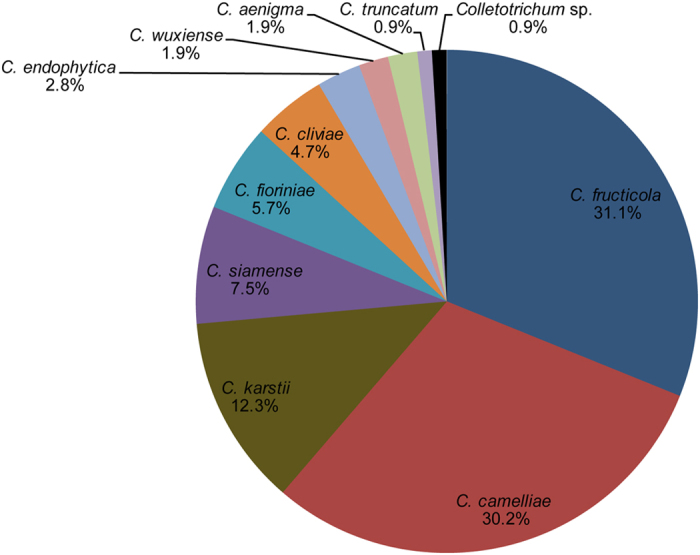
Anthracnose caused by Colletotrichum is one of the most severe diseases that can afflict Camellia sinensis. However, research on the diversity and geographical distribution of Colletotrichum in China remain limited. In this study, 106 Colletotrichum isolates were collected from diseased leaves of Ca. sinensis cultivated in the 15 main tea production provinces in China. Multi-locus phylogenetic analysis coupled with morphological identification showed that the collected isolates belonged to 11 species, including 6 known species (C. camelliae, C. cliviae, C. fioriniae, C. fructicola, C. karstii, and C. siamense), 3 new record species (C. aenigma, C. endophytica, and C. truncatum), 1 novel species (C. wuxiense), and 1 indistinguishable strain, herein described as Colletotrichum sp. Of these species, C. camelliae and C. fructicola were the dominant species causing anthracnose in Ca. sinensis. In addition, our study provided further evidence that phylogenetic analysis using a combination of ApMat and GS sequences can be used to effectively resolve the taxonomic relationships within the C. gloeosporioides species complex. Finally, pathogenicity tests suggested that C. camelliae, C. aenigma, and C. endophytica are more invasive than other species after the inoculation of the leaves of Ca. sinensis.
Overview
The claims and statistics of this paper haven’t been checked yet.
Free: it reads the open-access text and checks the first 5 claims that cite a source we can check. Create a free account to check every claim.
Integrity signals
Registry
Cites
Statistics
Figures
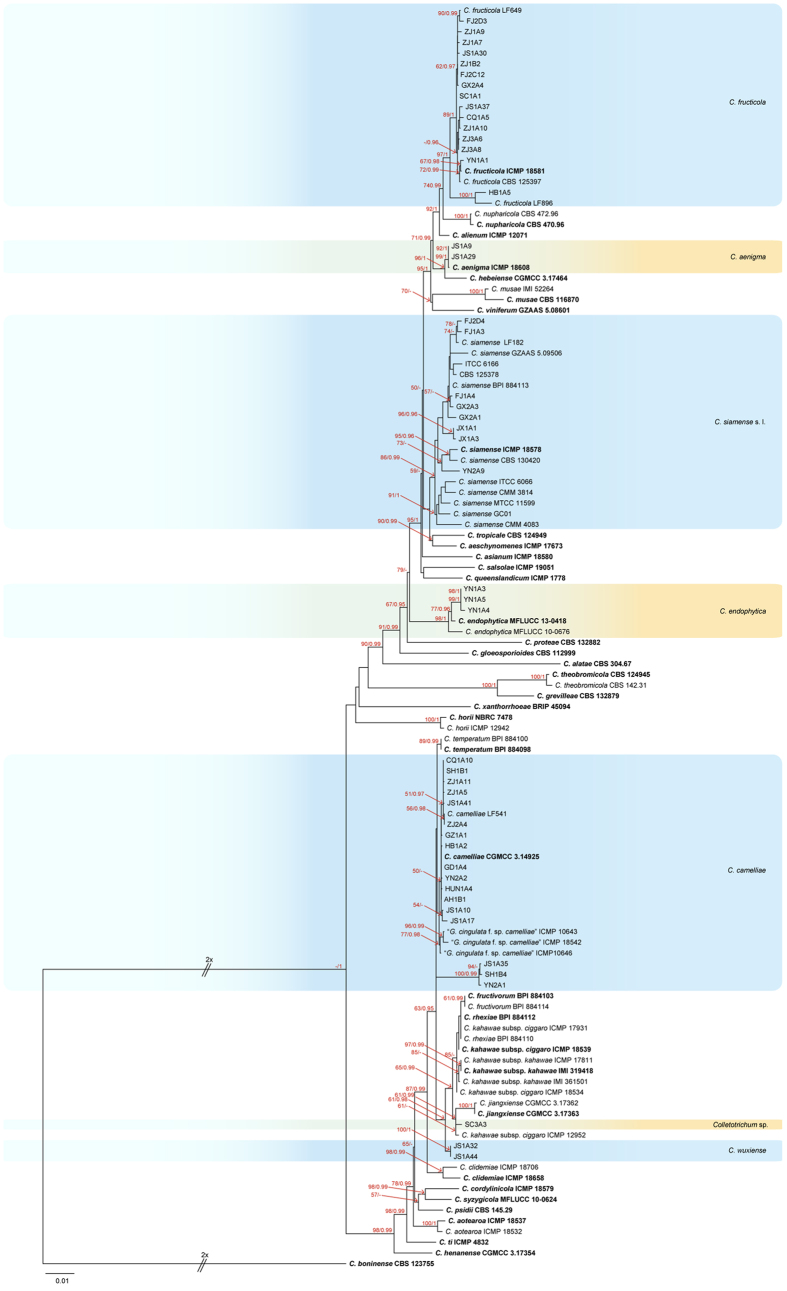
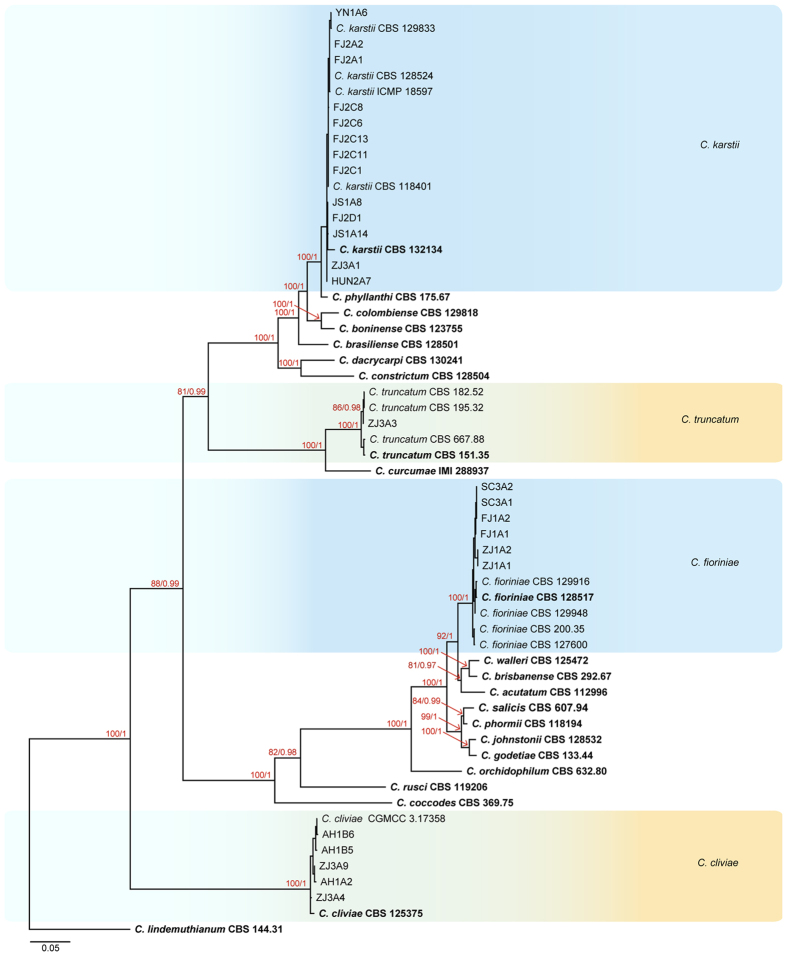
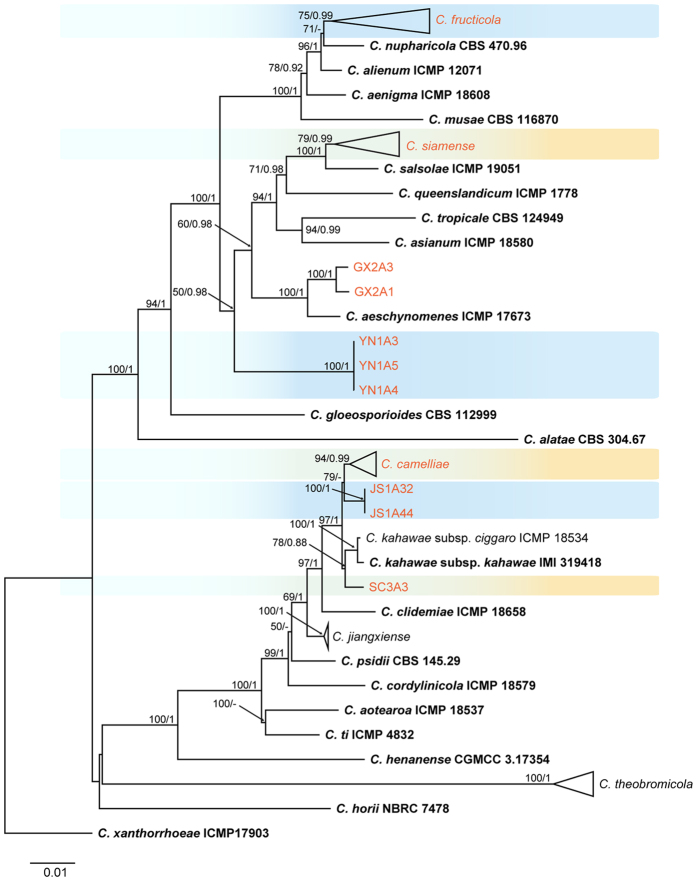
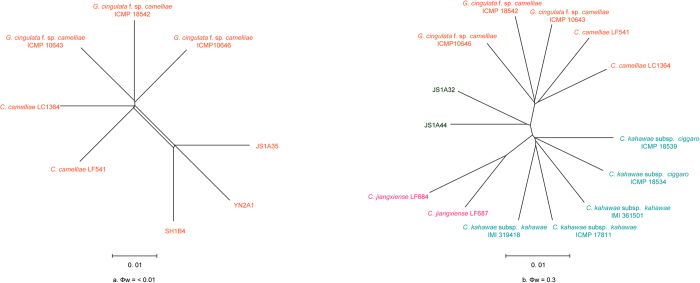
Verification
Claims the paper makes
The claims and statistics of this paper haven’t been checked yet.
Free: it reads the open-access text and checks the first 5 claims that cite a source we can check. Create a free account to check every claim.
Claims other papers make about this one
Each is checked against this paper’s own text: does it say what the citing paper says it does?
The source backs part of the claim, not all of it — or backs it for a different population, condition or comparison.
In the citing paper
“Colletotrichum endophytica was found on Pennisetum purpureum in Thailand and tea plant in China34.”
From Colletotrichum species associated with mango in southern China (2019) · cites this paper as [34]
Experimental — accuracy not yet measuredThe cited source says what the claim attributes to it.
In the citing paper
“Pathogenicity data are available for this species.”
From Colletotrichum: lifestyles, biology, morpho-species, species complexes and accepted species (2021) · cites this paper as Wang et al. 2016
The cited source says what the claim attributes to it.
In the citing paper
“This species can be separated from other species in the gloeosporioides complex by concatenated apmat and gs sequence data (Wang et al. 2016).”
From Colletotrichum: lifestyles, biology, morpho-species, species complexes and accepted species (2021) · cites this paper as Wang et al. 2016
The cited source says what the claim attributes to it.
In the citing paper
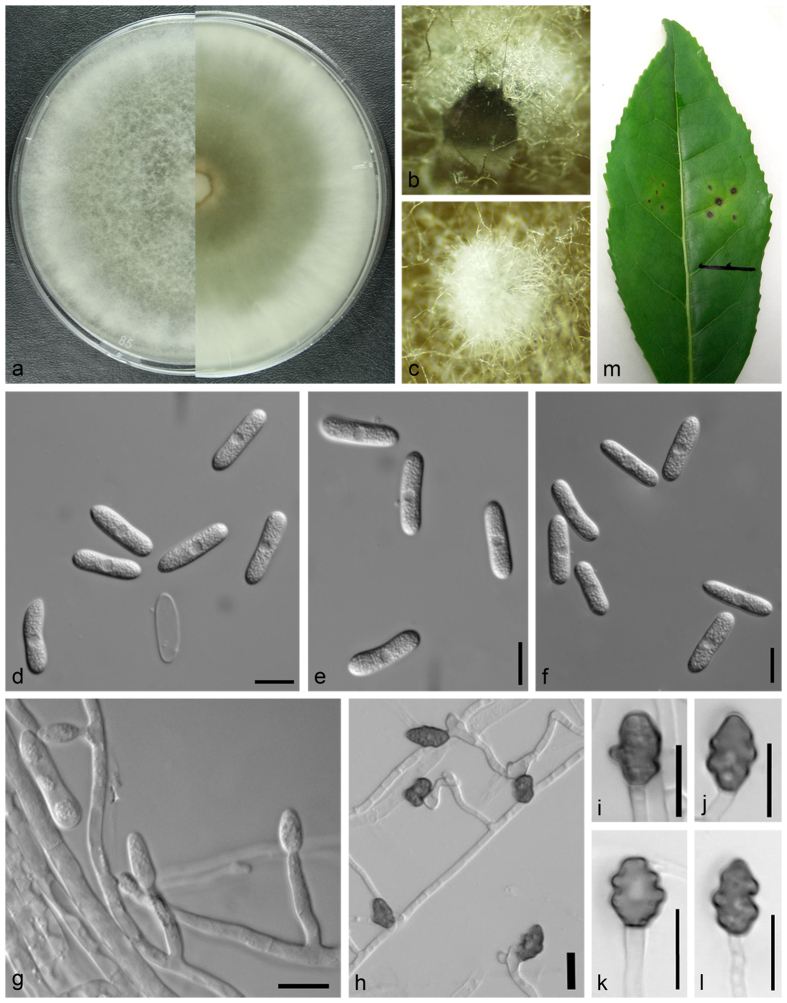
“Type -China, Jiangsu Province, Wuxi City, from diseased leaves of Camellia sinensis, 20 Aug. 2014, Y.C. Wang, holotype HMAS 246948, culture ex-type CGMCC 3.17894.”
From Colletotrichum: lifestyles, biology, morpho-species, species complexes and accepted species (2021) · cites this paper as Wang et al. 2016
Self-check
Percentages, sums and reported differences re-computed from the paper’s own numbers.
The self-check needs the paper’s full text.
Citations
Cites
Tamura, K., Peterson, D., Peterson, N., Stecher, G., Nei, M., & Kumar, S. (2011) · Molecular Biology and Evolution · doi:10.1093/molbev/msr121 · Cited by 39,969
MrBayes 3: Bayesian phylogenetic inference under mixed models
Ronquist, F., & Huelsenbeck, J. P. (2003) · Bioinformatics · doi:10.1093/bioinformatics/btg180 · Cited by 29,077
RAxML-VI-HPC: maximum likelihood-based phylogenetic analyses with thousands of taxa and mixed models
Stamatakis, A. (2006) · Bioinformatics · doi:10.1093/bioinformatics/btl446 · Cited by 15,582
Application of Phylogenetic Networks in Evolutionary Studies
Huson, D. H., & Bryant, D. (2006) · Molecular Biology and Evolution · doi:10.1093/molbev/msj030 · Cited by 8,830
Recent developments in the MAFFT multiple sequence alignment program
Katoh, K., & Toh, H. (2008) · Briefings in Bioinformatics · doi:10.1093/bib/bbn013 · Cited by 3,586
Nylander, J. A. A., Wilgenbusch, J. C., Warren, D. L., & Swofford, D. L. (2008) · Bioinformatics · doi:10.1093/bioinformatics/btm388 · Cited by 1,747
The Colletotrichum gloeosporioides species complex
Weir, B. S., Johnston, P. R., & Damm, U. (2012) · Studies in Mycology · doi:10.3114/sim0011 · Cited by 1,646
SplitsTree: analyzing and visualizing evolutionary data.
Huson, D. H. (1998) · Bioinformatics · doi:10.1093/bioinformatics/14.1.68 · Cited by 1,642
Colletotrichum – current status and future directions
Cannon, P. F., Damm, U., Johnston, P. R., & Weir, B. S. (2012) · Studies in Mycology · doi:10.3114/sim0014 · Cited by 1,105
O'Connell, R. J., Thon, M. R., Hacquard, S., Amyotte, S. G., Kleemann, J., Torres, M. F., Damm, U., Buiate, E. A., Epstein, L., Alkan, N., et al. (2012) · Nature Genetics · doi:10.1038/ng.2372 · Cited by 1,047
The Colletotrichum acutatum species complex
Damm, U., Cannon, P. F., Woudenberg, J. H. C., & Crous, P. W. (2012) · Studies in Mycology · doi:10.3114/sim0010 · Cited by 979 · cited 1×
“Description and illustrations: see Yang et al.37 and Damm et al.12.”
MethodA polyphasic approach for studying Colletotrichum
Cai, L., Hyde, K. D., Taylor, P. W. J., Weir, B. S., Waller, J. M., Abang, M. M., Zhang, J. Z., Yang, Y., Phoulivong, S., Liu, Z. Y., et al. (2009) · Queensland Department of Agriculture and Fisheries archive of scientific and research publications (Queensland Department of Agriculture and Fisheries) · Cited by 674
Self-citationThe Colletotrichum boninense species complex
Damm, U., Cannon, P. F., Woudenberg, J. H. C., Johnston, P. R., Weir, B. S., Tan, Y. P., Shivas, R. G., & Crous, P. W. (2012) · Studies in Mycology · doi:10.3114/sim0002 · Cited by 485
Colletotrichum - names in current use
Hyde, K. D., Cai, L., Cannon, P. F., Crouch, J. A., Crous, P. W., Damm, U., Goodwin, P. H., Chen, H., Johnston, P. R., Jones, E. B. G., et al. (2009) · Fungal Diversity · Cited by 420
Self-citation(2009) · KNAW research portal (Royal Academy of Art and Sciences (KNAW)) · Cited by 383
Introducing the Consolidated Species Concept to resolve species in the Teratosphaeriaceae
Quaedvlieg, W., Binder, M., Groenewald, J. Z., Summerell, B. A., Carnegie, A. J., Burgess, T. I., & Crous, P. W. (2014) · Persoonia - Molecular Phylogeny and Evolution of Fungi · doi:10.3767/003158514x681981 · Cited by 347
Pathogenesis, parasitism and mutualism in the trophic space of microbe–plant interactions
Newton, A. C., Fitt, B. D. L., Atkins, S. D., Walters, D. R., & Daniell, T. J. (2010) · Trends in Microbiology · doi:10.1016/j.tim.2010.06.002 · Cited by 332
Durable Resistance of Crops to Disease: A Darwinian Perspective
Brown, J. K. M. (2015) · Annual Review of Phytopathology · doi:10.1146/annurev-phyto-102313-045914 · Cited by 318
Liu, F., Weir, B. S., Damm, U., Crous, P. W., Wang, Y., Liu, B., Wang, M., Zhang, M., & Cai, L. (2015) · Persoonia - Molecular Phylogeny and Evolution of Fungi · doi:10.3767/003158515x687597 · Cited by 239
Self-citationThe Colletotrichum destructivum species complex - hemibiotrophic pathogens of forage and field crops
Damm, U., O'Connell, R. J., Groenewald, J. Z., & Crous, P. W. (2014) · Studies in Mycology · doi:10.1016/j.simyco.2014.09.003 · Cited by 227
Five Colletotrichum species are responsible for mango anthracnose in northeastern Brazil
Lima, N. B., de A. Batista, M. V., De Morais, M. A., Barbosa, M. A. G., Michereff, S. J., Hyde, K. D., & Câmara, M. P. S. (2013) · Fungal Diversity · doi:10.1007/s13225-013-0237-6 · Cited by 224
Silva, D. N., Talhinhas, P., Várzea, V., Cai, L., Paulo, O. S., & Batista, D. (2012) · Mycologia · doi:10.3852/11-145 · Cited by 201
Colletotrichum species associated with cultivated citrus in China
Huang, F., Chen, G. Q., Hou, X., Fu, Y. S., Cai, L., Hyde, K. D., & Li, H. Y. (2013) · Fungal Diversity · doi:10.1007/s13225-013-0232-y · Cited by 171
The Colletotrichum orbiculare species complex: Important pathogens of field crops and weeds
Damm, U., Cannon, P. F., Liu, F., Barreto, R. W., Guatimosim, E., & Crous, P. W. (2013) · Fungal Diversity · doi:10.1007/s13225-013-0255-4 · Cited by 150
What are the common anthracnose pathogens of tropical fruits?
Udayanga, D., Manamgoda, D. S., Liu, X., Chukeatirote, E., & Hyde, K. D. (2013) · Fungal Diversity · doi:10.1007/s13225-013-0257-2 · Cited by 147
Endophytic species of Colletotrichum associated with mango in northeastern Brazil
Vieira, W. A. S., Michereff, S. J., de Morais, M. A., Hyde, K. D., & Câmara, M. P. S. (2014) · Fungal Diversity · doi:10.1007/s13225-014-0293-6 · Cited by 143
The ApMat marker can resolve Colletotrichum species: a case study with Mangifera indica
Sharma, G., Kumar, N., Weir, B. S., Hyde, K. D., & Shenoy, B. D. (2013) · Fungal Diversity · doi:10.1007/s13225-013-0247-4 · Cited by 131
Crouch, J. A., Clarke, B. B., & Hillman, B. I. (2009) · Mycologia · doi:10.3852/08-231 · Cited by 124
Resolving the Colletotrichum siamense species complex using ApMat marker
Sharma, G., Pinnaka, A. K., & Shenoy, B. D. (2015) · Fungal Diversity · doi:10.1007/s13225-014-0312-7 · Cited by 120
Colletotrichum Species on Orchidaceae in Southwest China
Youlian, Y., Cai, L., Yu, Z., Liu, Z., & Hyde, K. D. (2011) · Cryptogamie, Mycologie · doi:10.7872/crym.v32.iss3.2011.229 · Cited by 119
Colletotrichum species from Jasmine (Jasminum sambac)
Wikee, S., Cai, L., Pairin, N., McKenzie, E. H. C., Su, Y.-Y., Chukeatirote, E., Thi, H. N., Bahkali, A. H., Moslem, M. A., Abdelsalam, K., et al. (2011) · Fungal Diversity · doi:10.1007/s13225-010-0049-x · Cited by 117
Osono, T. (2008) · Mycologia · doi:10.3852/07-110r1 · Cited by 116
The Colletotrichum gigasporum species complex
Liu, F., Cai, L., Crous, P. W., & Damm, U. (2014) · Persoonia - Molecular Phylogeny and Evolution of Fungi · doi:10.3767/003158514x684447 · Cited by 116
Schena, L., Mosca, S., Cacciola, S. O., Faedda, R., Sanzani, S. M., Agosteo, G. E., Sergeeva, V., & Magnano di San Lio, G. (2014) · Plant Pathology · doi:10.1111/ppa.12110 · Cited by 114
Diverse species of Colletotrichum associated with grapevine anthracnose in China
Yan, J.-Y., Jayawardena, M. M. R. S., Goonasekara, I. D., Wang, Y., Zhang, W., Liu, M., Huang, J.-B., Wang, Z.-Y., Shang, J.-J., Peng, Y.-L., et al. (2015) · Fungal Diversity · doi:10.1007/s13225-014-0310-9 · Cited by 100
Self-citationTao, G., Liu, Z.-Y., Liu, F., Gao, Y.-H., & Cai, L. (2013) · Fungal Diversity · doi:10.1007/s13225-013-0254-5 · Cited by 98
Endophytic Colletotrichum from tropical grasses with a new species C. endophytica
Manamgoda, D. S., Udayanga, D., Cai, L., Chukeatirote, E., & Hyde, K. D. (2013) · Fungal Diversity · doi:10.1007/s13225-013-0256-3 · Cited by 90
Liu, F., Damm, U., Cai, L., & Crous, P. W. (2013) · Fungal Diversity · doi:10.1007/s13225-013-0249-2 · Cited by 87
Seasonal and Habitat Dependent Variations in Culturable Endophytes of Camellia sinensis
Fang, W. (2013) · Journal of Plant Pathology & Microbiology · doi:10.4172/2157-7471.1000169 · Cited by 52
Guo, M., Pan, Y. M., Dai, Y. L., & Gao, Z. M. (2014) · Plant Disease · doi:10.1094/pdis-08-13-0896-pdn · Cited by 51
Meetum, P., Leksomboon, C., & Kanjanamaneesathian, M. (2015) · Journal of Plant Pathology · doi:10.4454/jpp.v97i2.048 · Cited by 38
Guidarelli, M., Zoli, L., Orlandini, A., Bertolini, P., & Baraldi, E. (2014) · Molecular Plant Pathology · doi:10.1111/mpp.12143 · Cited by 30
Characterization of the causal agent of poplar anthracnose occurring in the Beijing region
Zheng, L., Liang, Y., & Tian, C. (2012) · Mycotaxon · doi:10.5248/120.277 · Cited by 28
First Report of Brown Blight Disease on Camellia sinensis Caused by Colletotrichum acutatum in China
Chen, Y., Tong, H., Wei, X., & Yuan, L. (2015) · Plant Disease · doi:10.1094/pdis-07-15-0762-pdn · Cited by 22
Colletotrichum truncatum (Schw.), n. comb., on garden and Lima beans
Andrus, C. F., & Moore, W. D. (1935) · Phytopathology · Cited by 21
The Species and Distribution of Endophytic Fungi in Tea Trees
Ye, J. (2007) · He'nan nongye kexue · Cited by 7
Research works printed but not linked: 6
- Chen Z. M. & Yang Y. J. The classic of tea in china. 390 (Shanghai culture press, 2011).
- Hyde K. D.. Colletotrichum: a catalogue of confusion. Fungal Divers. 39, 1– 17 (2009).
- Prihastuti H., Cai L., Chen H., McKenzie E. & Hyde K. Characterization of Colletotrichum species associated with coffee berries in northern Thailand. Fungal Divers. 39, 89 (2009).
- Dai Q., Xu Y., Lin Q., Wang G. & Yang M. Distribution and establishment of Colletotrichum sp. as an endophyte in tea plants (Camellia sinensis). Sci. Silv. Sin. 44, 84– 89 (2008).
- Liu W. Anthracnose pathogens identification and the genetic diversity of tea plant. PhD thesis, Fujian Agriculture and Forestry University, China (2013).
- Yang Y.. Colletotrichum anthracnose of Amaryllidaceae. Fungal Divers. 39, 123– 146 (2009).
Cited by
Genera of phytopathogenic fungi: GOPHY 1
Marin-Felix, Y., Groenewald, J. Z., Cai, L., Chen, Q., Marincowitz, S., Barnes, I., Bensch, K., Braun, U., Camporesi, E., Damm, U., et al. (2017) · Studies in Mycology · doi:10.1016/j.simyco.2017.04.002 · Cited by 436
“…al. (2014) Col. walleri CBS 125472T JQ948275 JQ948605 JQ948936 JQ949266 JQ949596 JQ949926 – – – – Damm et al. (2012b) Col. wuxiense CGMCC 3.17894T KU251591 KU252045 KU251939 – KU251672 KU252200 KU251833 KU252101 – KU251722 Wang et al. (2016) Col. xanthorrhoeae ICMP 17903T JX010261 JX009927…”
Notes on currently accepted species of Colletotrichum
Jayawardena, R. (2016) · Mycosphere · doi:10.5943/mycosphere/si/2c/9 · Cited by 363
“Inf., Kew: 91 (1899) This taxon is responsible for causing twig blight and brown blight of Camellia sp. in China, Sri Lanka, the UK and the USA (Liu et al. 2015a, Wang et al. 2016).”
InfluentialColletotrichum species and complexes: geographic distribution, host range and conservation status
Talhinhas, P., & Baroncelli, R. (2021) · Fungal Diversity · doi:10.1007/s13225-021-00491-9 · Cited by 280
The Colletotrichum dracaenophilum , C. magnum and C. orchidearum species complexes
Damm, U., Sato, T., Alizadeh, A., Groenewald, J. Z., & Crous, P. W. (2019) · Studies in Mycology · doi:10.1016/j.simyco.2018.04.001 · Cited by 274
Colletotrichum: lifestyles, biology, morpho-species, species complexes and accepted species
Jayawardena, R. (2021) · Mycosphere · doi:10.5943/mycosphere/12/1/7 · Cited by 208
Metadata
- Authors
- Wang, Y.-C., Hao, X.-Y., Wang, L., Xiao, B., Wang, X.-C., & Yang, Y.-J.
- Affiliations
- Chinese Academy of Agricultural Sciences (CN)
- Northwest A&F University (CN)
- ORCID
- Wang, Lu
- Venue
- Scientific Reports
- Published
- 2016-10-26
- Volume
- 6
- Issue
- 1
- Pages
- 35287-35287
- ISSN
- 2045-2322 (ISSN-L)
- PMC
- PMC5080629
- OpenAlex
- W2541947998
- Semantic Scholar
- 668df15908b0a255f96b330350f8e7cd9ddfeab6
- Cited by
- 177
- References
- 48
- Citations by year
- 2026: 11 · 2025: 26 · 2024: 21 · 2023: 32 · 2022: 17 · 2021: 21 · 2020: 23 · 2019: 10 · 2018: 10 · 2017: 4 · 2016: 2
- FWCI
- 5.97
- Type
- journal article
- Language
- en
- Open access
- gold
- doi.org
- Licence
- cc-by
- creativecommons.org/licenses/by/4.0 (tdm)
- creativecommons.org/licenses/by/4.0 (vor)
- Locations
- Scientific Reports (publishedVersion, cc-by)
- Europe PMC (PubMed Central) (publishedVersion, cc-by)
- PubMed Central (publishedVersion, cc-by)
- PubMed (publishedVersion)
- Funders
- Chinese Academy of Agricultural Sciences (CAAS ASTIP-2014-TRICAAS)
- Earmarked Fund for China Agriculture Research System (CARS 23, CAAS-ASTIP-2014-TRICAAS)
- Agricultural Science and Technology Innovation Program (CAAS-ASTIP-2014-TRICAAS, 2014-TRICAAS)
- Topics
- Life Sciences › Agricultural and Biological Sciences › Plant Science › Plant Pathogens and Fungal Diseases
- Life Sciences › Immunology and Microbiology › Microbiology › Yeasts and Rust Fungi Studies
- Life Sciences › Agricultural and Biological Sciences › Plant Science › Fungal Plant Pathogen Control
- Keywords
- Colletotrichum, anthracnose, Camellia sinensis, tea plant disease, fungal diversity, new records, Colletotrichum camelliae, Colletotrichum aenigma, Colletotrichum gloeosporioides species complex, multilocus phylogeny, pathogenicity
- MeSH terms
- China, DNA, Fungal, Phylogeny, Plant Diseases, Mycological Typing Techniques, Plant Leaves, Colletotrichum, Camellia sinensis, Biodiversity, Multilocus Sequence Typing
About these checks
Registry, retraction, Cites and statistics results are computed, not judged, with one exception: a printed reference that no index lists is read once by a model before it counts as a citation error. Claims are extracted by a model and kept only when their quote appears verbatim in the text; each cited source is then checked, with a model’s help, for whether it says what the claim relies on. Those verdicts can be wrong — read the claim’s quote and the cited source before relying on one.
Statistics and arithmetic are recomputed, not judged.
Confidence bands are shown only for fields calibrated on our annotated test set. None is calibrated yet, so no band is shown.
What counts as a claim ›How we measure confidence ›How we check this ›
Are you an author, or do you see a problem with this page? Request a review
Data sources
Bibliographic data: Semantic Scholar, OpenAlex, Crossref.
Contains information from the Semantic Scholar Academic Graph Datasets, made available under the ODC Attribution License (ODC-BY 1.0).
Semantic Scholar’s data is described in: Kinney, R., et al. (2023). The Semantic Scholar Open Data Platform. arXiv:2301.10140.
