

Unravelling Colletotrichum species associated with Camellia : employing ApMat and GS loci to resolve species in the C. gloeosporioides complex
Open accessThe DOI matches its Crossref record; 62 of the 64 references it cites were found in a registry or an index.
Abstract
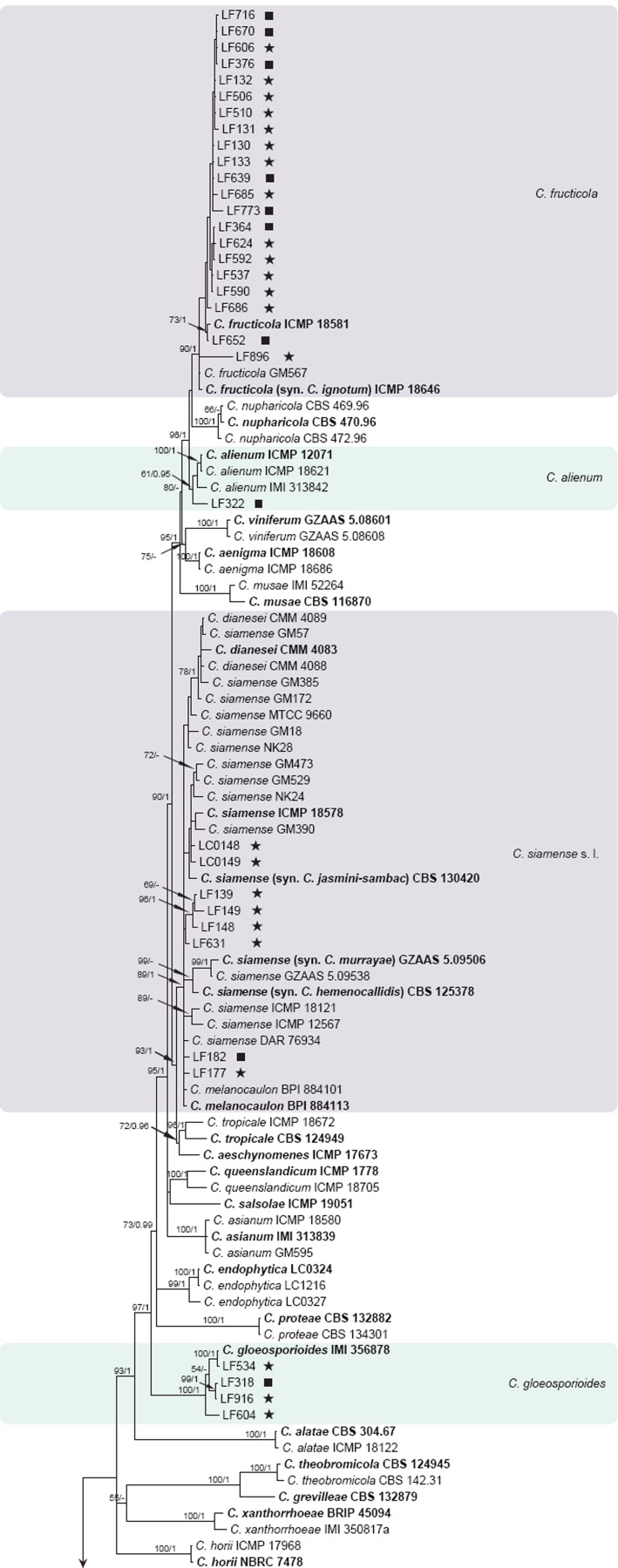
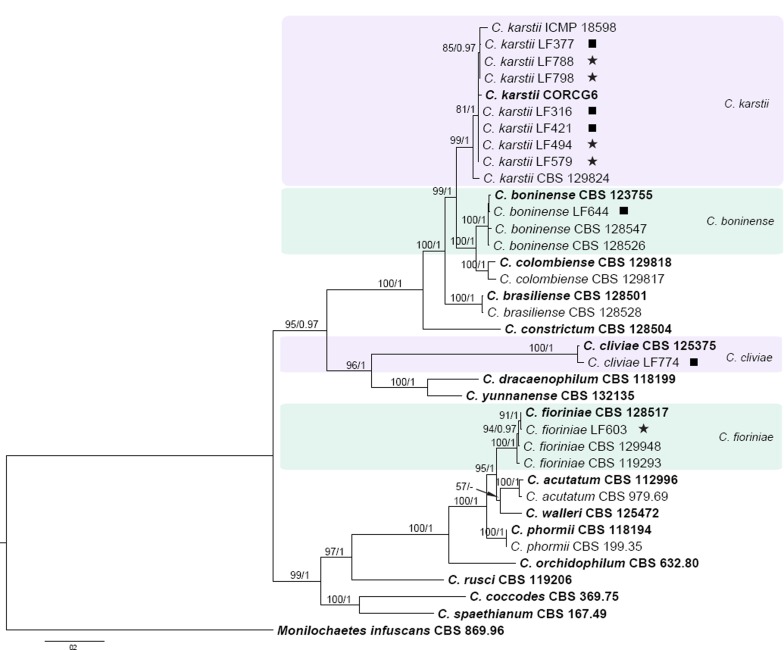
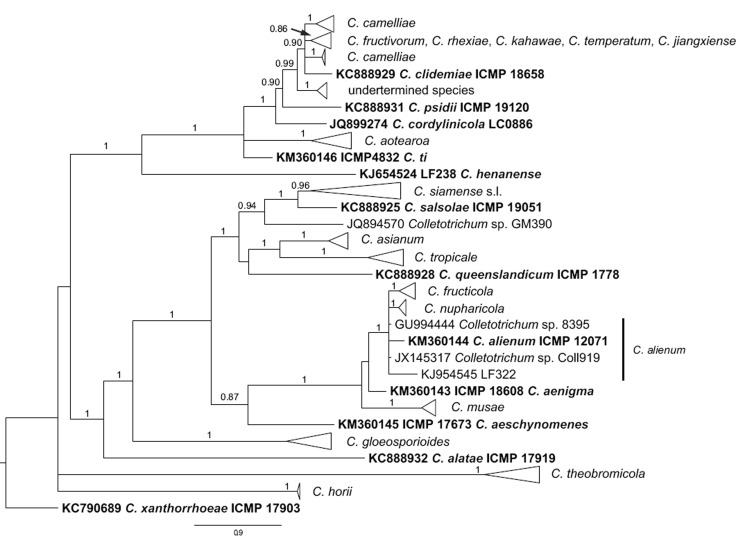
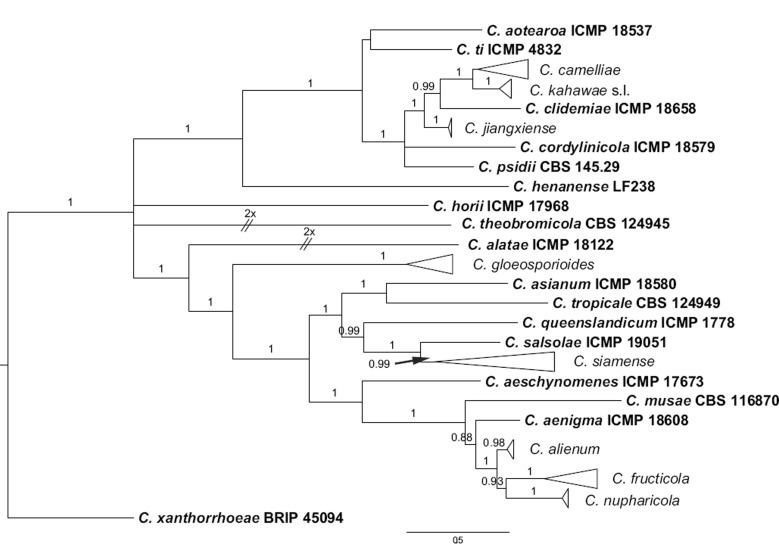
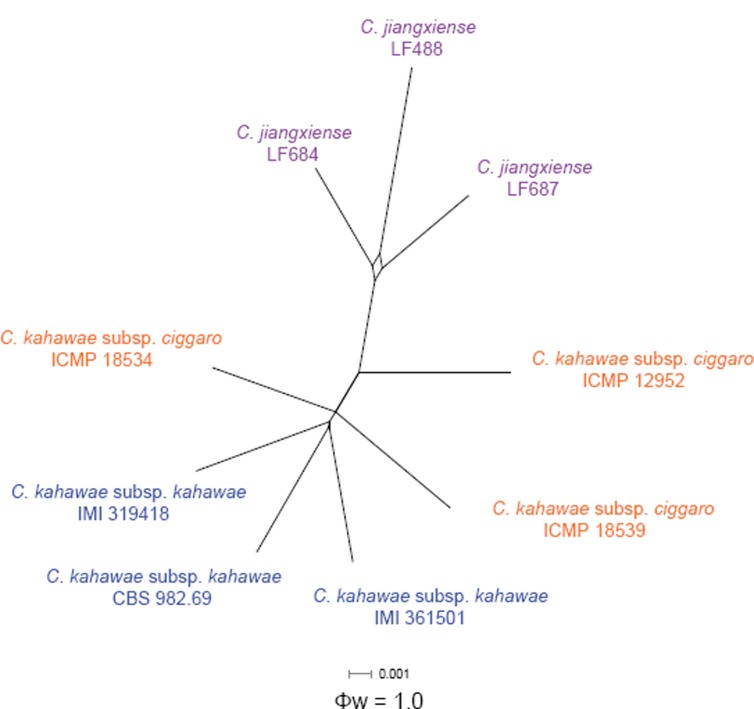
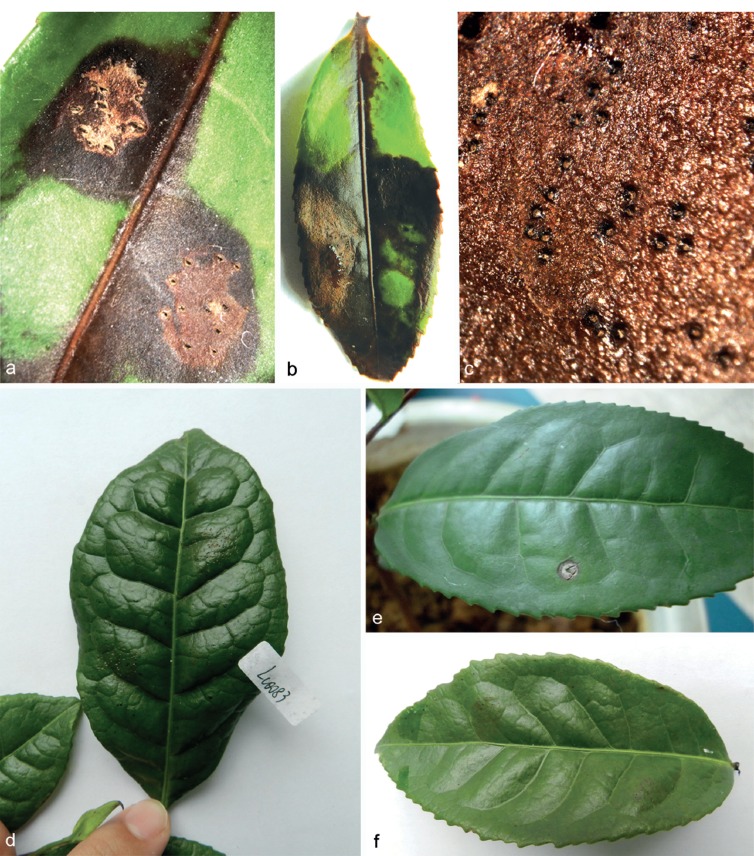
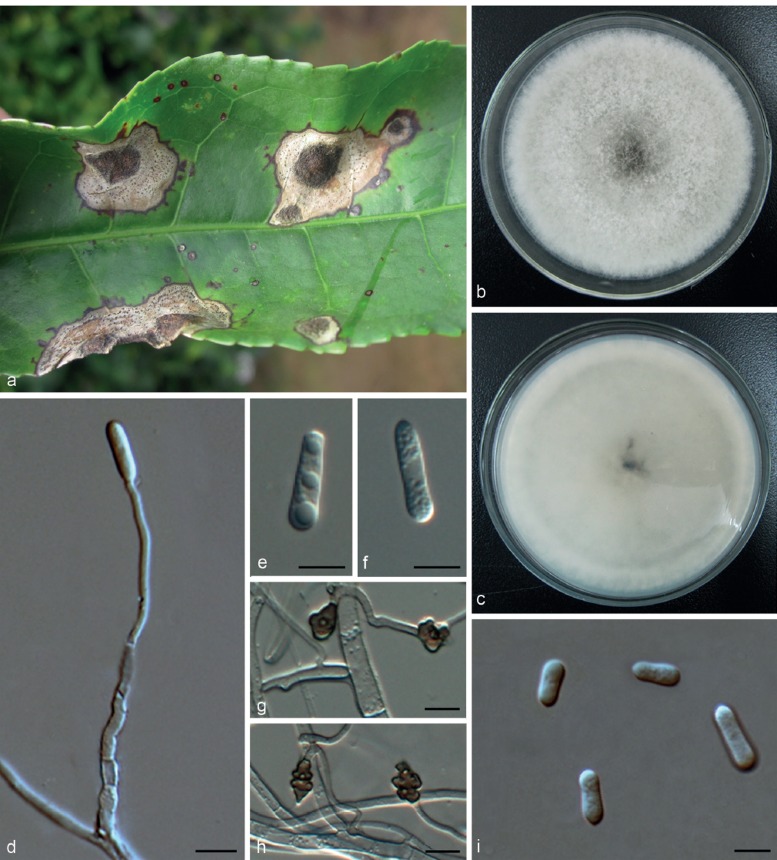
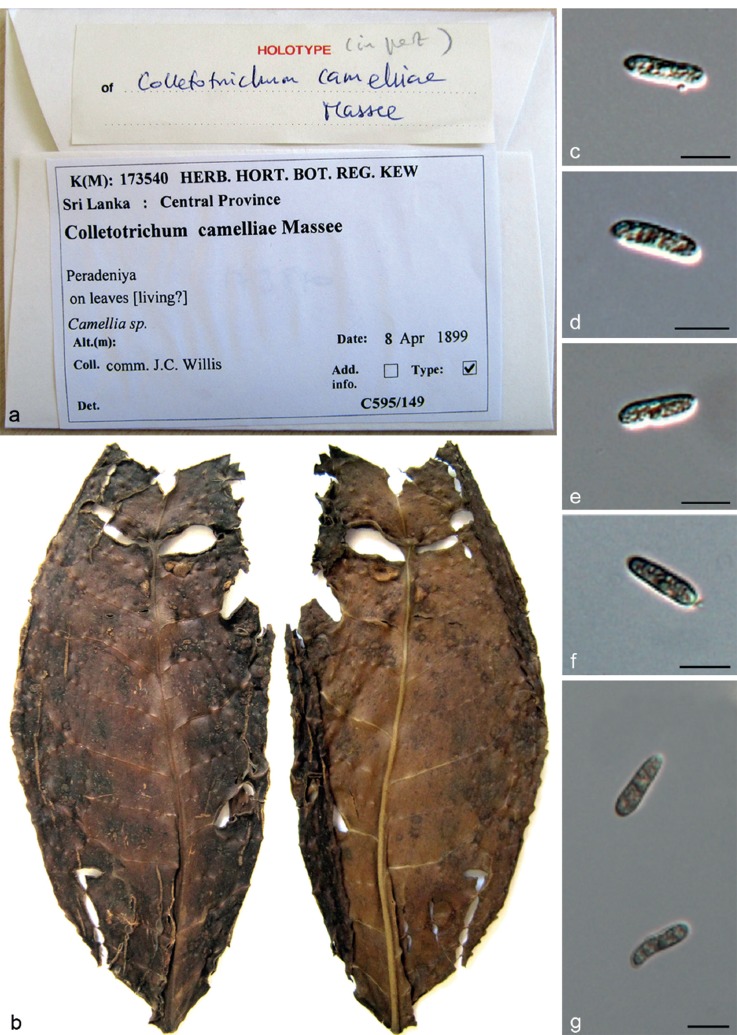
We investigated the phylogenetic diversity of 144 Colletotrichum isolates associated with symptomatic and asymptomatic tissues of Camellia sinensis and other Camellia spp. from seven provinces in China (Fujian, Guizhou, Henan, Jiangxi, Sichuan, Yunnan, Zhejiang), and seven isolates obtained from other countries, including Indonesia, UK, and the USA. Based on multi-locus (ACT, ApMat, CAL, GAPDH, GS, ITS, TUB2) phylogenetic analyses and phenotypic characters, 11 species were distinguished, including nine well-characterised species ( C. alienum , C. boninense , C. camelliae , C. cliviae , C. fioriniae , C. fructicola , C. gloeosporioides , C. karstii , C. siamense ), and two novel species ( C. henanense and C. jiangxiense ). Of these, C. camelliae proved to be the most dominant and probably host specific taxon occurring on Camellia . An epitype is also designated for the latter species in this study. Colletotrichum jiangxiense is shown to be phylogenetically closely related to the coffee berry pathogen C. kahawae subsp. kahawae . Pathogenicity tests and the pairwise homoplasy index test suggest that C. jiangxiense and C. kahawae subsp. kahawae are two independent species. This study represents the first report of C. alienum and C. cliviae occurring on Camellia sinensis . In addition, our study demonstrated that the combined use of the loci ApMat and GS in a phylogenetic analysis is able to resolve all currently accepted species in the C. gloeosporioides species complex.
Overview
The claims and statistics of this paper haven’t been checked yet.
Free: it reads the open-access text and checks the first 5 claims that cite a source we can check. Create a free account to check every claim.
Integrity signals
Registry
Cites
Statistics
Figures
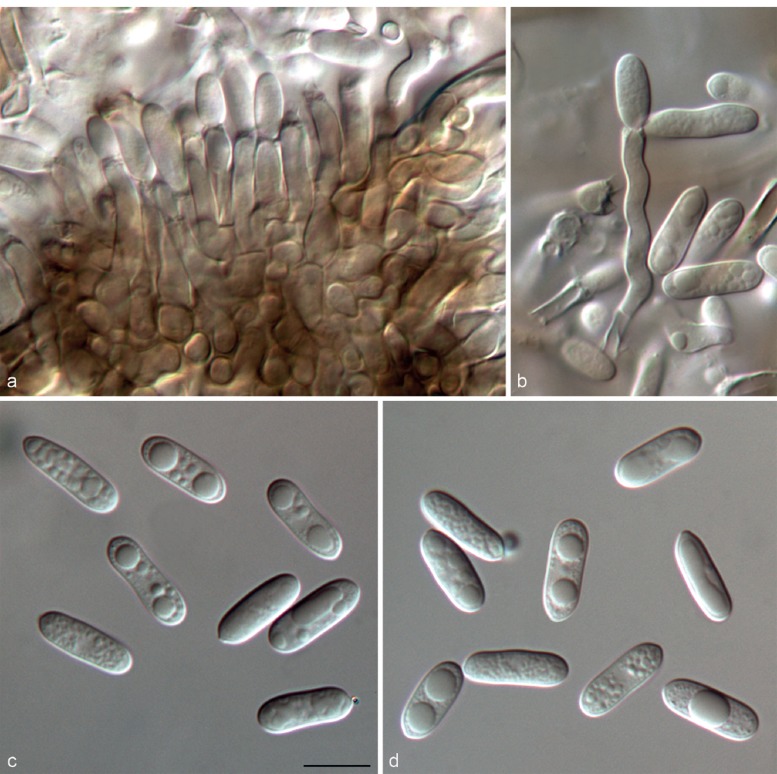
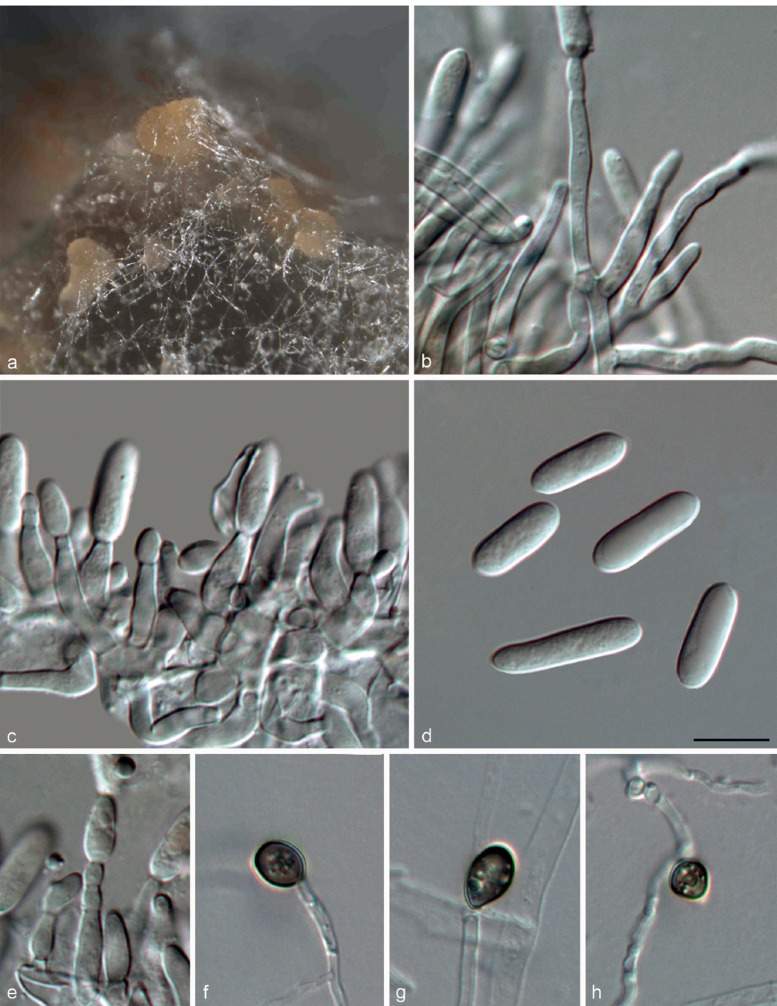
Verification
Claims the paper makes
The claims and statistics of this paper haven’t been checked yet.
Free: it reads the open-access text and checks the first 5 claims that cite a source we can check. Create a free account to check every claim.
Claims other papers make about this one
Each is checked against this paper’s own text: does it say what the citing paper says it does?
The source backs part of the claim, not all of it — or backs it for a different population, condition or comparison.
In the citing paper
“Colletotrichum camelliae belongs to the kahawae clade within the gloeosporioides complex and can be distinguished with the use of gs and apmat sequence data (Liu et al. 2015).”
From Colletotrichum: lifestyles, biology, morpho-species, species complexes and accepted species (2021) · cites this paper as Liu et al. 2015
Experimental — accuracy not yet measured
Self-check
Percentages, sums and reported differences re-computed from the paper’s own numbers.
The self-check needs the paper’s full text.
Citations
Cites
MAFFT Multiple Sequence Alignment Software Version 7: Improvements in Performance and Usability
Katoh, K., & Standley, D. M. (2013) · Molecular Biology and Evolution · doi:10.1093/molbev/mst010 · Cited by 46,209
Tamura, K., Peterson, D., Peterson, N., Stecher, G., Nei, M., & Kumar, S. (2011) · Molecular Biology and Evolution · doi:10.1093/molbev/msr121 · Cited by 39,969
Amplification and direct sequencing of fungal ribosomal RNA genes for phylogenetics
White, T. J., Bruns, T., Lee, S., & Taylor, J. (1990) · PCR Protocols · doi:10.1016/b978-0-12-372180-8.50042-1 · Cited by 36,648
MrBayes 3.2: Efficient Bayesian Phylogenetic Inference and Model Choice Across a Large Model Space
Ronquist, F., Teslenko, M., van der Mark, P., Ayres, D. L., Darling, A., Höhna, S., Larget, B., Liu, L., Suchard, M. A., & Huelsenbeck, J. P. (2012) · Systematic Biology · doi:10.1093/sysbio/sys029 · Cited by 27,843
Application of Phylogenetic Networks in Evolutionary Studies
Huson, D. H., & Bryant, D. (2006) · Molecular Biology and Evolution · doi:10.1093/molbev/msj030 · Cited by 8,830
Glass, N. L., & Donaldson, G. C. (1995) · Applied and Environmental Microbiology · doi:10.1128/aem.61.4.1323-1330.1995 · Cited by 4,755
A method for designing primer sets for speciation studies in filamentous ascomycetes
Carbone, I., & Kohn, L. M. (1999) · Mycologia · doi:10.1080/00275514.1999.12061051 · Cited by 4,217
O'Donnell, K., & Cigelnik, E. (1997) · Molecular Phylogenetics and Evolution · doi:10.1006/mpev.1996.0376 · Cited by 2,397
Rayner, R. W. (1970) · Medical Entomology and Zoology · Cited by 1,693
The Colletotrichum gloeosporioides species complex
Weir, B. S., Johnston, P. R., & Damm, U. (2012) · Studies in Mycology · doi:10.3114/sim0011 · Cited by 1,646
Self-citation
Research works printed but not linked: 26
- Damm U Cannon PF Woudenberg JHC, et al. 2012a The Colletotrichum acutatum species complex. Studies in Mycology 73: 37– 113. 23136458 PMC3458416
- Damm U Cannon PF Woudenberg JHC, et al. 2012b The Colletotrichum boninense species complex. Studies in Mycology 73: 1– 36. 23136457 PMC3458415
- Damm U O’Connell R Groenewald J, et al. 2014 The Colletotrichum destructivum species complex-hemibiotrophic pathogens of forage and field crops. Studies in Mycology 79: 49– 84. 25492986 PMC4255528
- Dai QL Xu YP Lin QQ, et al. 2008 Distribution and establishment of Colletotrichum sp. as an endophyte in tea plants (Camellia sinensis). Scientia Silvae Sinicae 44: 84– 89.
- StudiesinMycology, 50, 19
- ANZEIGER FUR SCHADLINGSKUNDE PFLANZEN UND UMWELTSCHUTZ VEREINIGT MIT SCHADLINGSBEKAMPFUNG, 5, 17
- Copes WE Thomson JL 2008 Survival analysis to determine the length of the incubation period of Camellia twig blight caused by Colletotrichum gloeosporioides. Plant Disease 92: 1177– 1182. 30769490
- FungalDiversity, 39, 183
- Arx JA von 1957 Die Arten der Gattung Colletotrichum Cda. Phytopathologische Zeitschrift 29: 413– 468.
- Cannon PF Damm U Johnston PR, et al. 2012 Colletotrichum – current status and future directions. Studies in Mycology 73: 181– 213. 23136460 PMC3458418
- Willis JC 1899 DCLII – Tea and coffee diseases. Bulletin of Miscellaneous Information Royal Botanical Gardens Kew 1899: 89– 94.
- Yang YL Liu ZY Cai L, et al. 2009 Colletotrichum anthracnose of Amaryllidaceae. Fungal Diversity 39: 123– 146.
- CANADIAN PLANT DISEASE SURVEY, 34, 186
- Weir BS Johnston PR Damm U 2012 The Colletotrichum gloeosporioides species complex. Studies in Mycology 73: 115– 180. 23136459 PMC3458417
- Stephenson SA Green JR Manners JM, et al. 1997 Cloning and characterisation of glutamine synthetase from Colletotrichum gloeosporioides and demonstration of elevated expression during pathogenesis on Stylosanthes guianensis. Current Genetics 31: 447– 454. 9162117
- Shivas RG 1989 Fungal and bacterial diseases of plants in Western Australia. Journal of the Royal Society of Western Australia 72: 1– 62.
- Silva DN Talhinhas P Cai L, et al. 2012a Host-jump drives rapid and recent ecological speciation of the emergent fungal pathogen Colletotrichum kahawae. Molecular Ecology 21: 2655– 2670. 22519519
- Ronquist F Teslenko M Mark P van der, et al. 2012 MrBayes 3.2: efficient Bayesian phylogenetic inference and model choice across a large model space. Systematic Biology 61: 539– 542. 22357727 PMC3329765
- FungalDi- versity, 39, 89
- MYCOLOGICAL PAPERS- INTERNATIONAL MYCOLOGICAL INSTITUTE, 105, 1508
- Nirenberg H 1976 Untersuchungen über die morphologische und biologische Differenzierung in der Fusarium-Sektion Liseola. Mitteilungen aus der Biologischen Bundesanstalt für Land- und Forstwirtschaft Berlin-Dahlem 169: 1– 117.
- FARM MANAGEMENT- FARM MANAGEMENT ASSOCIATION THEN CENTRE OF MANAGEMENT IN AGRICULTURE, 10, 54
- Liu W 2013 Anthracnose pathogens identification and the genetic diversity of tea plant. PhD thesis, Fujian Agriculture and Forestry University, China.
- MolecularBiologyandEvolution, 23, 254
- Katoh K Standley DM 2013 MAFFT multiple sequence alignment software version 7: improvements in performance and usability. Molecular Biology and Evolution 30: 772– 780. 23329690 PMC3603318
- PlantDisease, 98, 284
Cited by
Genera of phytopathogenic fungi: GOPHY 1
Marin-Felix, Y., Groenewald, J. Z., Cai, L., Chen, Q., Marincowitz, S., Barnes, I., Bensch, K., Braun, U., Camporesi, E., Damm, U., et al. (2017) · Studies in Mycology · doi:10.1016/j.simyco.2017.04.002 · Cited by 436
Self-citationWu, B., Hussain, M., Zhang, W., Stadler, M., Liu, X., & Xiang, M. (2019) · Mycology · doi:10.1080/21501203.2019.1614106 · Cited by 368
Notes on currently accepted species of Colletotrichum
Jayawardena, R. (2016) · Mycosphere · doi:10.5943/mycosphere/si/2c/9 · Cited by 363
“Inf., Kew: 91 (1899) This taxon is responsible for causing twig blight and brown blight of Camellia sp. in China, Sri Lanka, the UK and the USA (Liu et al. 2015a, Wang et al. 2016).”
InfluentialLife styles of Colletotrichum species and implications for plant biosecurity
De Silva, D. D., Crous, P. W., Ades, P. K., Hyde, K. D., & Taylor, P. W. J. (2017) · Fungal Biology Reviews · doi:10.1016/j.fbr.2017.05.001 · Cited by 328
“In particular, many endophytes isolated fromgrasses (Poaceae) belonged to the gloeosporioides and boninense complexes (Saikkonen et al., 2000; S anchez_M arquez et al., 2010; Ghimire et al., 2011; Liu et al., 2015).”
BackgroundSelf-citationColletotrichum species and complexes: geographic distribution, host range and conservation status
Talhinhas, P., & Baroncelli, R. (2021) · Fungal Diversity · doi:10.1007/s13225-021-00491-9 · Cited by 280
Metadata
- Authors
- Liu, F., Weir, B. S., Damm, U., Crous, P. W., Wang, Y., Liu, B., Wang, M., Zhang, M., & Cai, L.
- Affiliations
- Utrecht University (NL)
- Manaaki Whenua – Landcare Research (NZ)
- Senckenberg Museum für Naturkunde Görlitz (DE)
- Guizhou University (CN)
- Chinese Academy of Sciences (CN)
- Henan Agricultural University (CN)
- Corresponding author
- Cai, L.
- Venue
- Persoonia - Molecular Phylogeny and Evolution of Fungi
- Published
- 2015-12-23
- Volume
- 35
- Issue
- 1
- Pages
- 63-86
- ISSN
- 0031-5850 (ISSN-L)
- PMC
- PMC4713112
- OpenAlex
- W2294154321
- Cited by
- 239
- References
- 64
- Citations by year
- 2026: 15 · 2025: 23 · 2024: 22 · 2023: 28 · 2022: 30 · 2021: 30 · 2020: 24 · 2019: 19 · 2018: 21 · 2017: 15 · 2016: 11 · 2015: 1
- FWCI
- 8.53
- Type
- journal article
- Language
- en
- Open access
- green
- www.ncbi.nlm.nih.gov
- Licence
- cc-by-nc-nd
- Locations
- Persoonia - Molecular Phylogeny and Evolution of Fungi (publishedVersion)
- PubMed Central (publishedVersion, cc-by-nc-nd)
- PubMed (publishedVersion)
- KNAW Research Portal (The Royal Netherlands Academy of Arts and Sciences) (publishedVersion, other-oa)
- KNAW research portal (Royal Academy of Art and Sciences (KNAW)) (publishedVersion, other-oa)
- Data Archiving and Networked Services (DANS) (submittedVersion, other-oa)
- Data Archiving and Networked Services (DANS) (submittedVersion, cc-by)
- The Digital Academic Repository of Naturalis Biodiversity Center (Naturalis Biodiversity Center) (submittedVersion, cc-by)
- The Digital Academic Repository of Naturalis Biodiversity Center (Naturalis Biodiversity Center) (submittedVersion)
- UpSpace Institutional Repository (University of Pretoria) (submittedVersion)
- Funders
- National Natural Science Foundation of China (31322001)
- Chinese Academy of Agricultural Sciences
- Topics
- Life Sciences › Agricultural and Biological Sciences › Plant Science › Plant Pathogens and Fungal Diseases
- Life Sciences › Immunology and Microbiology › Microbiology › Yeasts and Rust Fungi Studies
- Life Sciences › Agricultural and Biological Sciences › Plant Science › Fungal Plant Pathogen Control
- Keywords
- Colletotrichum, Camellia sinensis, Camellia, Colletotrichum gloeosporioides species complex, Colletotrichum camelliae, Colletotrichum kahawae, new fungal species, species delimitation, multilocus phylogeny, epitype designation, host specificity, plant pathogenic fungi
About these checks
Registry, retraction, Cites and statistics results are computed, not judged, with one exception: a printed reference that no index lists is read once by a model before it counts as a citation error. Claims are extracted by a model and kept only when their quote appears verbatim in the text; each cited source is then checked, with a model’s help, for whether it says what the claim relies on. Those verdicts can be wrong — read the claim’s quote and the cited source before relying on one.
Statistics and arithmetic are recomputed, not judged.
Confidence bands are shown only for fields calibrated on our annotated test set. None is calibrated yet, so no band is shown.
What counts as a claim ›How we measure confidence ›How we check this ›
Are you an author, or do you see a problem with this page? Request a review
How to cite
Cite CoChat for the checks on this page, and the paper for its own findings.
- This page
- CoChat. (2026). Citation check: Unravelling Colletotrichum species associated with Camellia : employing ApMat and GS loci to resolve species in the C. gloeosporioides complex. https://app.cochat.ai/papers/10.3767/003158515x687597
- The paper
- Liu, F., Weir, B. S., Damm, U., Crous, P. W., Wang, Y., Liu, B., Wang, M., Zhang, M., & Cai, L. (2015). Unravelling Colletotrichum species associated with Camellia : employing ApMat and GS loci to resolve species in the C. gloeosporioides complex. Persoonia - Molecular Phylogeny and Evolution of Fungi. https://doi.org/10.3767/003158515x687597
Data sources
Bibliographic data: Semantic Scholar, OpenAlex, Crossref.
Contains information from the Semantic Scholar Academic Graph Datasets, made available under the ODC Attribution License (ODC-BY 1.0).
Semantic Scholar’s data is described in: Kinney, R., et al. (2023). The Semantic Scholar Open Data Platform. arXiv:2301.10140.
