

Orientation toward humans predicts cognitive performance in orang-utans
Open accessThe DOI matches its Crossref record; 63 of the 64 references it cites were found in a registry or an index, and 1 are not checked yet.
Abstract
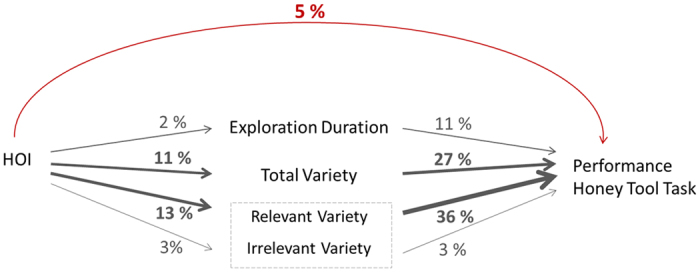
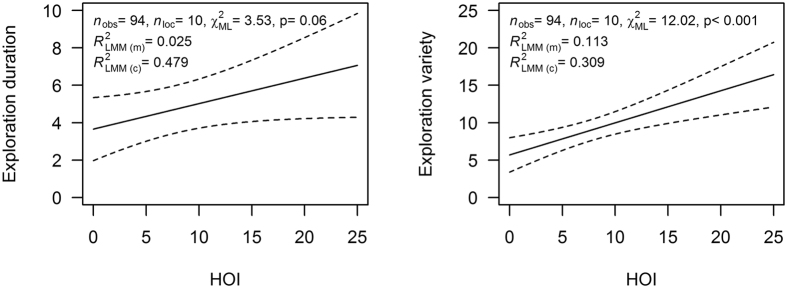
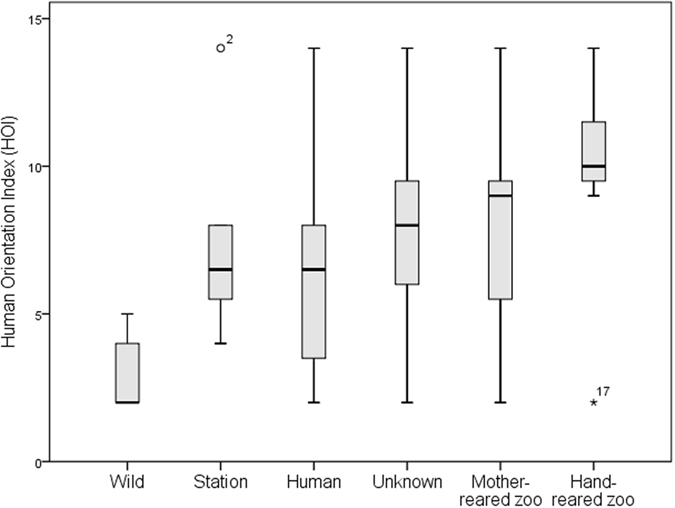
Non-human animals sometimes show marked intraspecific variation in their cognitive abilities that may reflect variation in external inputs and experience during the developmental period. We examined variation in exploration and cognitive performance on a problem-solving task in a large sample of captive orang-utans (Pongo abelii &P. pygmaeus, N = 103) that had experienced different rearing and housing conditions during ontogeny, including human exposure. In addition to measuring exploration and cognitive performance, we also conducted a set of assays of the subjects' psychological orientation, including reactions towards an unfamiliar human, summarized in the human orientation index (HOI), and towards novel food and objects. Using generalized linear mixed models we found that the HOI, rather than rearing background, best predicted both exploration and problem-solving success. Our results suggest a cascade of processes: human orientation was accompanied by a change in motivation towards problem-solving, expressed in reduced neophobia and increased exploration variety, which led to greater experience, and thus eventually to higher performance in the task. We propose that different experiences with humans caused individuals to vary in curiosity and understanding of the physical problem-solving task. We discuss the implications of these findings for comparative studies of cognitive ability.
Overview
The claims and statistics of this paper haven’t been checked yet.
Free: it reads the open-access text and checks the first 5 claims that cite a source we can check. Create a free account to check every claim.
Integrity signals
Registry
Cites
Statistics
Figures
Verification
Claims the paper makes
The claims and statistics of this paper haven’t been checked yet.
Free: it reads the open-access text and checks the first 5 claims that cite a source we can check. Create a free account to check every claim.
Claims other papers make about this one
Each is checked against this paper’s own text: does it say what the citing paper says it does?
The cited source says what the claim attributes to it.
In the citing paper
“We do not expect this to be important because we know of no studies of primate cognition that needed to control for sex [e.g., Amici et al., 2012;Hopkins et al., 2014;Damerius et al., 2017; see also Arden and Adams, 2016, for dogs].”
From A Farewell to the Encephalization Quotient: A New Brain Size Measure for Comparative Primate Cognition (2021) · cites this paper as Damerius et al., 2017
Self-check
Percentages, sums and reported differences re-computed from the paper’s own numbers.
The self-check needs the paper’s full text.
Citations
Cites
Fitting Linear Mixed-Effects Models Using lme4
Bates, D., Mächler, M., Bolker, B., & Walker, S. (2015) · Journal of Statistical Software · doi:10.18637/jss.v067.i01 · Cited by 86,835
A general and simple method for obtaining R 2 from generalized linear mixed‐effects models
Nakagawa, S., & Schielzeth, H. (2013) · Methods in Ecology and Evolution · doi:10.1111/j.2041-210x.2012.00261.x · Cited by 10,356 · cited 1×
“Further statistical analyses were performed in R version 3.2.3 59,60 using the ‘lme4’ 61 and ‘MUMIn’ 62 packages.”
MethodInfluentialIntelligence: Knowns and unknowns.
Neisser, U., Boodoo, G., Bouchard, T. J., Boykin, A. W., Brody, N., Ceci, S. J., Halpern, D. F., Loehlin, J. C., Perloff, R., Sternberg, R. J., et al. (1996) · American Psychologist · doi:10.1037/0003-066x.51.2.77 · Cited by 2,913
The formation of learning sets.
Harlow, H. F. (1949) · Psychological Review · doi:10.1037/h0062474 · Cited by 1,959
Sources of human psychological differences: the Minnesota Study of Twins Reared Apart
Bouchard, T. J., Lykken, D. T., McGue, M., Segal, N. L., & Tellegen, A. (1990) · Science · doi:10.1126/science.2218526 · Cited by 1,373
Intelligence: New findings and theoretical developments
Nisbett, R. E., Aronson, J., Blair, C., Dickens, W., Flynn, J., Halpern, D. F., & Turkheimer, E. (2012) · American Psychologist · doi:10.1037/a0026699 · Cited by 1,031
Harlow, H. F., & Zimmermann, R. R. (1959) · Science · doi:10.1126/science.130.3373.421 · Cited by 951
Learning by imitation: A hierarchical approach
Byrne, R. W., & Russon, A. E. (1998) · Behavioral and Brain Sciences · doi:10.1017/s0140525x98001745 · Cited by 884
Animal tool behavior: the use and manufacture of tools by animals
(2011) · Choice Reviews Online · doi:10.5860/choice.49-1468 · Cited by 785 · cited 2×
“Second, because the effect of captivity on cognitive performance is particularly pronounced in the context of tool use 34–39 , we assessed cognitive performance using a novel tool-use task including multi-step problem-solving with high ecological validity: the honey-tool task.”
MethodResultPotent Social Learning and Conformity Shape a Wild Primate’s Foraging Decisions
van de Waal, E., Borgeaud, C., & Whiten, A. (2013) · Science · doi:10.1126/science.1232769 · Cited by 568
Cited by
van Schaik, C. P., Triki, Z., Bshary, R., & Heldstab, S. A. (2021) · Brain, Behavior and Evolution · doi:10.1159/000517013 · Cited by 64
Bandini, E., & Harrison, R. A. (2020) · Biological reviews/Biological reviews of the Cambridge Philosophical Society · doi:10.1111/brv.12604 · Cited by 76
“…afforded by these conditions), and human contact and/or training, on the innovative abilities of chimpanzees and other animals (e.g. Haslam, 2013; Damerius et al., 2017). a Failures to innovate in captivity Despite this potential captivity effect, not all behaviours in captivity seem to be as…”
BackgroundValidity of Cognitive Tests for Non-human Animals: Pitfalls and Prospects
Schubiger, M. N., Fichtel, C., & Burkart, J. M. (2020) · Frontiers in Psychology · doi:10.3389/fpsyg.2020.01835 · Cited by 85
Self-citationExplaining the Paradox of Neophobic Explorers: The Social Information Hypothesis
Forss, S., Koski, S. E., & van Schaik, C. P. (2017) · International Journal of Primatology · doi:10.1007/s10764-017-9984-7 · Cited by 76
“2013) and orangutans (Damerius et al. 2017), which was attributed to both reduced neophobia and increased exploration tendency.”
BackgroundSelf-citationTeaching and curiosity: sequential drivers of cumulative cultural evolution in the hominin lineage
van Schaik, C. P., Pradhan, G. R., & Tennie, C. (2019) · Behavioral Ecology and Sociobiology · doi:10.1007/s00265-018-2610-7 · Cited by 60
Metadata
- Authors
- Damerius, L. A., Forss, S. I. F., Kosonen, Z. K., Willems, E. P., Burkart, J. M., Call, J., Galdikas, B. M. F., Liebal, K., Haun, D. B. M., & van Schaik, C. P.
- Affiliations
- University of Zurich (CH)
- University of St Andrews (GB)
- Freie Universität Berlin (DE)
- Leipzig University (DE)
- Corresponding author
- Damerius, Laura A.
- Forss, Sofia I. F.
- ORCID
- Venue
- Scientific Reports
- Published
- 2017-01-09
- Volume
- 7
- Issue
- 1
- Pages
- 40052-40052
- ISSN
- 2045-2322 (ISSN-L)
- PMC
- PMC5220318
- OpenAlex
- W2570048708
- Cited by
- 53
- References
- 62
- Citations by year
- 2026: 3 · 2025: 4 · 2024: 8 · 2023: 8 · 2022: 3 · 2021: 8 · 2020: 7 · 2019: 7 · 2017: 4
- FWCI
- 7.05
- Type
- journal article
- Language
- en
- Open access
- gold
- doi.org
- Licence
- cc-by
- creativecommons.org/licenses/by/4.0 (tdm)
- creativecommons.org/licenses/by/4.0 (vor)
- Locations
- Scientific Reports (publishedVersion, cc-by)
- PubMed Central (publishedVersion, cc-by)
- PubMed (publishedVersion)
- MPG.PuRe (Max Planck Society) (submittedVersion, other-oa)
- Refubium (Universitätsbibliothek der Freien Universität Berlin) (submittedVersion, cc-by)
- St Andrews Research Repository (St Andrews Research Repository) (submittedVersion, cc-by)
- Zurich Open Repository and Archive (University of Zurich) (submittedVersion, cc-by)
- Universitätsbibliothek der FU Berlin Hochschulschriftenstelle u. Dokumentenserver (cc-by)
- Topics
- Life Sciences › Agricultural and Biological Sciences › Ecology, Evolution, Behavior and Systematics › Primate Behavior and Ecology
- Life Sciences › Agricultural and Biological Sciences › Animal Science and Zoology › Animal Behavior and Welfare Studies
- Social Sciences › Psychology › Developmental and Educational Psychology › Child and Animal Learning Development
- Keywords
- orangutans, Pongo abelii, Bornean orangutan, human orientation, cognitive performance, problem solving, exploratory behavior, neophobia, curiosity, rearing conditions, housing conditions, ontogeny, individual differences in cognition, comparative cognition
- MeSH terms
- Animals, Behavior, Animal, Exploratory Behavior, Humans, Pongo pygmaeus, Problem Solving, Pongo abelii
About these checks
Registry, retraction, Cites and statistics results are computed, not judged, with one exception: a printed reference that no index lists is read once by a model before it counts as a citation error. Claims are extracted by a model and kept only when their quote appears verbatim in the text; each cited source is then checked, with a model’s help, for whether it says what the claim relies on. Those verdicts can be wrong — read the claim’s quote and the cited source before relying on one.
Statistics and arithmetic are recomputed, not judged.
Confidence bands are shown only for fields calibrated on our annotated test set. None is calibrated yet, so no band is shown.
What counts as a claim ›How we measure confidence ›How we check this ›
Are you an author, or do you see a problem with this page? Request a review
How to cite
Cite CoChat for the checks on this page, and the paper for its own findings.
- This page
- CoChat. (2026). Citation check: Orientation toward humans predicts cognitive performance in orang-utans. https://app.cochat.ai/papers/10.1038/srep40052
- The paper
- Damerius, L. A., Forss, S. I. F., Kosonen, Z. K., Willems, E. P., Burkart, J. M., Call, J., Galdikas, B. M. F., Liebal, K., Haun, D. B. M., & van Schaik, C. P. (2017). Orientation toward humans predicts cognitive performance in orang-utans. Scientific Reports. https://doi.org/10.1038/srep40052
Data sources
Bibliographic data: Semantic Scholar, OpenAlex, Crossref.
Contains information from the Semantic Scholar Academic Graph Datasets, made available under the ODC Attribution License (ODC-BY 1.0).
Semantic Scholar’s data is described in: Kinney, R., et al. (2023). The Semantic Scholar Open Data Platform. arXiv:2301.10140.
