

Target geometry and rigidity determines laser-induced cavitation bubble transport and nanoparticle productivity – a high-speed videography study
Open accessThe DOI matches its Crossref record; 29 of the 29 references it cites were found in a registry or an index.
Abstract
Productivity of laser ablation in liquids we found that the productivity is enhanced for a wire tip laser ablation due to a springboard-like effect of the flexible target releasing the cavitation bubble.
Overview
The claims and statistics of this paper haven’t been checked yet.
Free: it reads the open-access text and checks the first 5 claims that cite a source we can check. Create a free account to check every claim.
Integrity signals
Registry
Cites
Statistics
Figures




Verification
Claims the paper makes
The claims and statistics of this paper haven’t been checked yet.
Free: it reads the open-access text and checks the first 5 claims that cite a source we can check. Create a free account to check every claim.
Claims other papers make about this one
Each is checked against this paper’s own text: does it say what the citing paper says it does?
The source backs part of the claim, not all of it — or backs it for a different population, condition or comparison.
In the citing paper
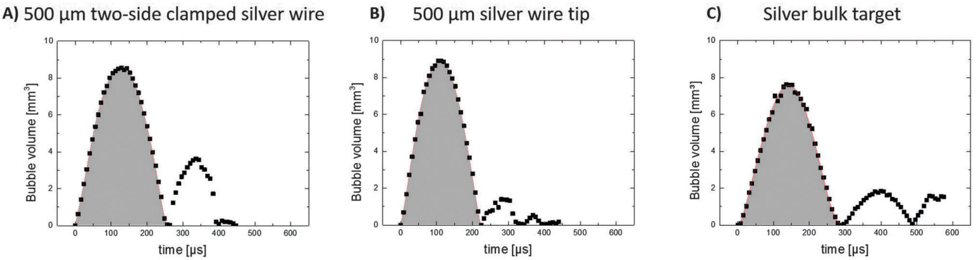
“Ablation at the tip of the wire results in a 23% shorter bubble lifetime compared to the ablation in a bulk target, due to the springboard movement, which allows a larger displacement of the bubble, as shown in Fig. 11b.”
From Green nanoparticle synthesis at scale: a perspective on overcoming the limits of pulsed laser ablation in liquids for high-throughput production (2023) · cites this paper as Kohsakowski et al. (2016)
Experimental — accuracy not yet measuredThe source backs part of the claim, not all of it — or backs it for a different population, condition or comparison.
In the citing paper
“Ablation at the tip of the wire results in a 23% shorter bubble lifetime compared to the ablation in a bulk target, due to the springboard movement, which allows a larger displacement of the bubble, as shown in Fig. 11b.”
From Green nanoparticle synthesis at scale: a perspective on overcoming the limits of pulsed laser ablation in liquids for high-throughput production (2023) · cites this paper as [100]
Experimental — accuracy not yet measuredThe cited source says what the claim attributes to it.
In the citing paper
“For the nanosecond laser which used most commonly, it is found that the cavitation bubble dynamics is one of the main stages involved in PLAL process, 10 which plays an important role in nanoparticle formation.11”
From Pulsed laser ablation of bulk target and particle products in liquid for nanomaterial fabrication (2019) · cites this paper as [11]
The cited source says what the claim attributes to it.
In the citing paper
“Nevertheless, the spring-like movement of the wire tip target does not increase the productivity compared to the clamped wire target, due to the limitation in the ablation set-up where the incident laser is shielded by the bubbles rising upward.”
From Green nanoparticle synthesis at scale: a perspective on overcoming the limits of pulsed laser ablation in liquids for high-throughput production (2023) · cites this paper as [100]
The cited source says what the claim attributes to it.
In the citing paper
“Wire-type targets (clamped wire and wire tip) showed a productivity increase of up to 2.5 times higher compared to the bulk target.”
From Green nanoparticle synthesis at scale: a perspective on overcoming the limits of pulsed laser ablation in liquids for high-throughput production (2023) · cites this paper as [100]
1 more claim about this paper
Create a free account to see every claim other papers make about this one.
Self-check
Percentages, sums and reported differences re-computed from the paper’s own numbers.
The self-check needs the paper’s full text.
Citations
Cites
CRC Handbook of Chemistry and Physics
(2014) · doi:10.1201/b17118 · Cited by 57,706
Laser ablation synthesis in solution and size manipulation of noble metal nanoparticles
Amendola, V., & Meneghetti, M. (2009) · Physical Chemistry Chemical Physics · doi:10.1039/b900654k · Cited by 1,020
Nanomaterials via Laser Ablation/Irradiation in Liquid: A Review
Zeng, H., Du, X., Singh, S. C., Kulinich, S. A., Yang, S., He, J., & Cai, W. (2012) · Advanced Functional Materials · doi:10.1002/adfm.201102295 · Cited by 966
Amendola, V., & Meneghetti, M. (2013) · Phys. Chem. Chem. Phys. · doi:10.1039/c2cp42895d · Cited by 758
Dynamics of laser-induced cavitation bubbles near an elastic boundary
BRUJAN, E.-A., NAHEN, K., SCHMIDT, P., & VOGEL, A. (2001) · Journal of Fluid Mechanics · doi:10.1017/s0022112000003347 · Cited by 417
Advanced nanoparticle generation and excitation by lasers in liquids
Barcikowski, S., & Compagnini, G. (2013) · Phys. Chem. Chem. Phys. · doi:10.1039/c2cp90132c · Cited by 287
Self-citationStreubel, R., Barcikowski, S., & Gökce, B. (2016) · Optics Letters · doi:10.1364/ol.41.001486 · Cited by 283
Self-citationMechanisms and processes of pulsed laser ablation in liquids during nanoparticle production
DellʼAglio, M., Gaudiuso, R., De Pascale, O., & De Giacomo, A. (2015) · Applied Surface Science · doi:10.1016/j.apsusc.2015.01.082 · Cited by 270
Gram Scale Synthesis of Pure Ceramic Nanoparticles by Laser Ablation in Liquid
Sajti, C. L., Sattari, R., Chichkov, B. N., & Barcikowski, S. (2010) · The Journal of Physical Chemistry C · doi:10.1021/jp906960g · Cited by 242
Self-citationDe Giacomo, A., Dell'Aglio, M., De Pascale, O., & Capitelli, M. (2007) · Spectrochimica Acta Part B: Atomic Spectroscopy · doi:10.1016/j.sab.2007.06.008 · Cited by 236
Research works printed but not linked: 1
- Sasaki, 2009, Appl. Phys. Express, 2, 0465011
Cited by
Laser Synthesis and Processing of Colloids: Fundamentals and Applications
Zhang, D., Gökce, B., & Barcikowski, S. (2017) · Chemical Reviews · doi:10.1021/acs.chemrev.6b00468 · Cited by 1,344
Self-citationXiao, J., Liu, P., Wang, C. X., & Yang, G. W. (2017) · Progress in Materials Science · doi:10.1016/j.pmatsci.2017.02.004 · Cited by 352
Pulsed Laser in Liquids Made Nanomaterials for Catalysis
Forsythe, R. C., Cox, C. P., Wilsey, M. K., & Müller, A. M. (2021) · Chemical Reviews · doi:10.1021/acs.chemrev.0c01069 · Cited by 259
Kanitz, A., Kalus, M.-R., Gurevich, E. L., Ostendorf, A., Barcikowski, S., & Amans, D. (2019) · Plasma Sources Science and Technology · doi:10.1088/1361-6595/ab3dbe · Cited by 195
Self-citationPerspective of Surfactant‐Free Colloidal Nanoparticles in Heterogeneous Catalysis
Reichenberger, S., Marzun, G., Muhler, M., & Barcikowski, S. (2019) · ChemCatChem · doi:10.1002/cctc.201900666 · Cited by 178
Self-citation
Metadata
- Authors
- Kohsakowski, S., Gökce, B., Tanabe, R., Wagener, P., Plech, A., Ito, Y., & Barcikowski, S.
- Affiliations
- University of Duisburg-Essen (DE)
- Nagaoka University of Technology (JP)
- Karlsruhe Institute of Technology (DE)
- Corresponding author
- Gökce, Bilal
- Venue
- Physical Chemistry Chemical Physics
- Publisher
- Royal Society of Chemistry (RSC)
- Published
- 2016
- Volume
- 18
- Issue
- 24
- Pages
- 16585-16593
- ISSN
- 1463-9076 (ISSN-L)
- 1463-9084
- OpenAlex
- W2407247302
- Cited by
- 48
- References
- 29
- Citations by year
- 2026: 3 · 2025: 2 · 2024: 2 · 2023: 4 · 2022: 5 · 2021: 5 · 2020: 5 · 2019: 5 · 2018: 4 · 2017: 10 · 2016: 3
- FWCI
- 3.54
- Type
- journal article
- Language
- en
- Open access
- hybrid
- doi.org
- Licence
- cc-by-nc
- Locations
- Physical Chemistry Chemical Physics (publishedVersion, cc-by-nc)
- PubMed (publishedVersion)
- Funders
- Deutsche Forschungsgemeinschaft (BA 3580/15-1, PL 325/8-1)
- Topics
- Physical Sciences › Materials Science › Materials Chemistry › Laser-Ablation Synthesis of Nanoparticles
- Physical Sciences › Physics and Astronomy › Acoustics and Ultrasonics › Ultrasound and Cavitation Phenomena
- Physical Sciences › Engineering › Industrial and Manufacturing Engineering › Laser Material Processing Techniques
- Keywords
- laser-induced cavitation, pulsed laser ablation in liquid, nanoparticle synthesis, bubble dynamics, bubble collapse, target geometry, wire targets, bubble transport, Young's modulus, bending stiffness, silver nanoparticles, copper nanoparticles, nickel nanoparticles, particle redeposition
About these checks
Registry, retraction, Cites and statistics results are computed, not judged, with one exception: a printed reference that no index lists is read once by a model before it counts as a citation error. Claims are extracted by a model and kept only when their quote appears verbatim in the text; each cited source is then checked, with a model’s help, for whether it says what the claim relies on. Those verdicts can be wrong — read the claim’s quote and the cited source before relying on one.
Statistics and arithmetic are recomputed, not judged.
Confidence bands are shown only for fields calibrated on our annotated test set. None is calibrated yet, so no band is shown.
What counts as a claim ›How we measure confidence ›How we check this ›
Are you an author, or do you see a problem with this page? Request a review
Data sources
Bibliographic data: Semantic Scholar, OpenAlex, Crossref.
Contains information from the Semantic Scholar Academic Graph Datasets, made available under the ODC Attribution License (ODC-BY 1.0).
Semantic Scholar’s data is described in: Kinney, R., et al. (2023). The Semantic Scholar Open Data Platform. arXiv:2301.10140.
