

The DOI matches its Crossref record; 71 of the 71 references it cites were found in a registry or an index.
Impact of 100 LRRK2 variants linked to Parkinson's disease on kinase activity and microtubule binding
Open accessPublished version of a preprint
Abstract
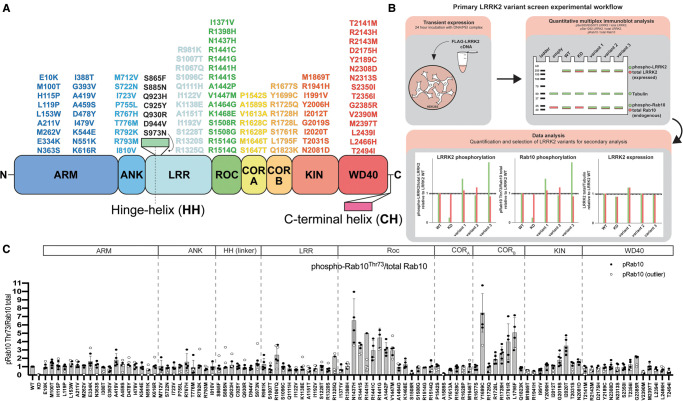
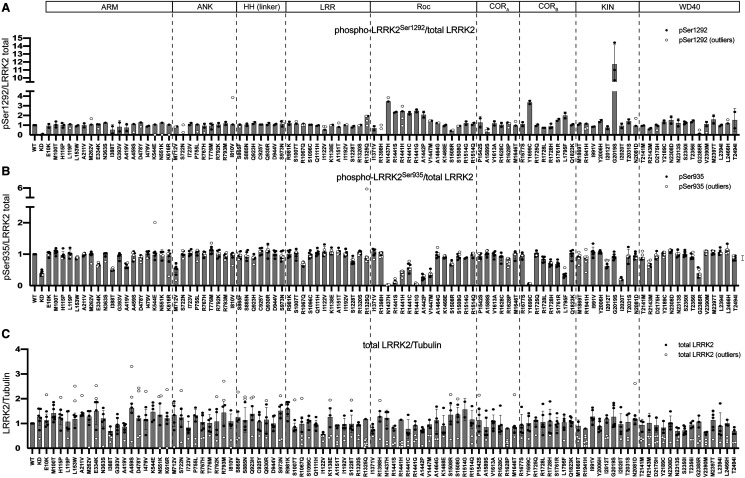
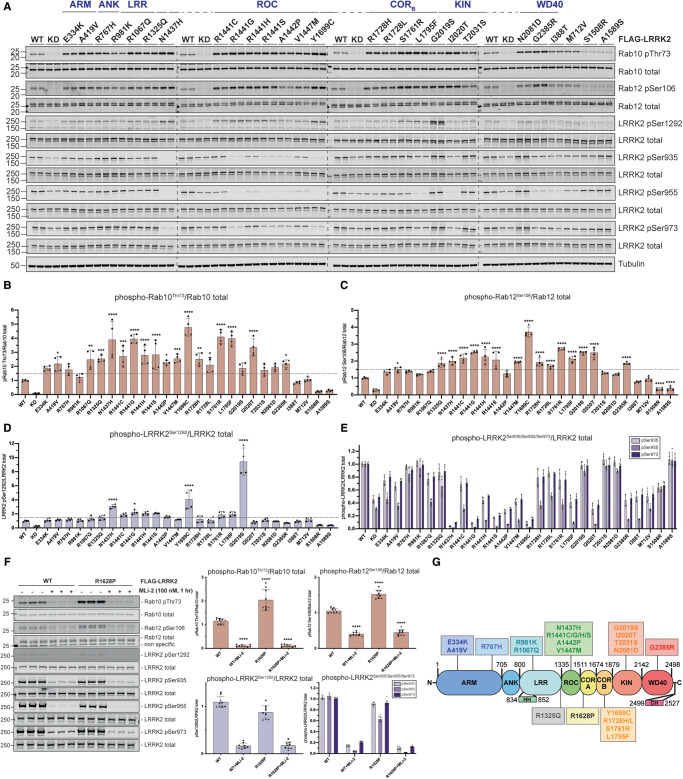
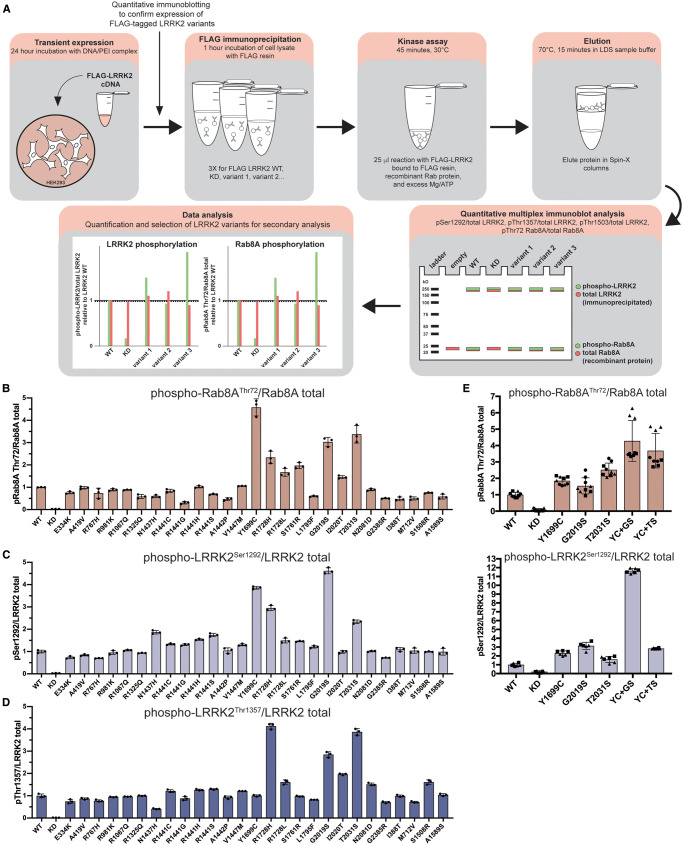
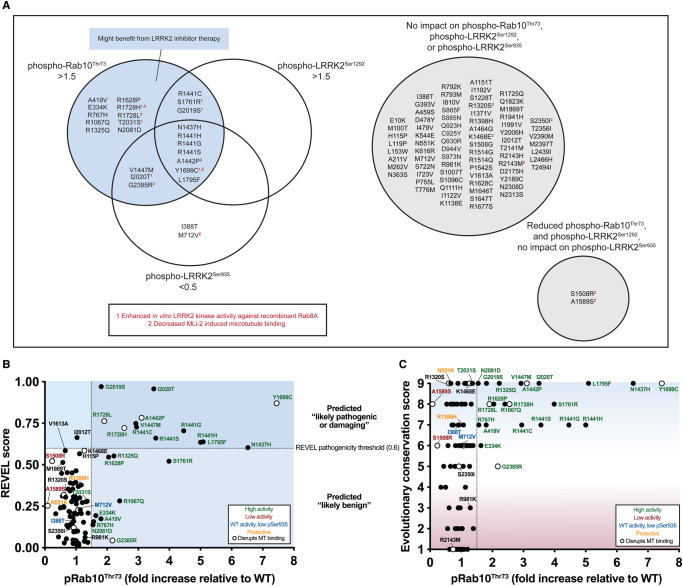
Mutations enhancing the kinase activity of leucine-rich repeat kinase-2 (LRRK2) cause Parkinson's disease (PD) and therapies that reduce LRRK2 kinase activity are being tested in clinical trials. Numerous rare variants of unknown clinical significance have been reported, but how the vast majority impact on LRRK2 function is unknown. Here, we investigate 100 LRRK2 variants linked to PD, including previously described pathogenic mutations. We identify 23 LRRK2 variants that robustly stimulate kinase activity, including variants within the N-terminal non-catalytic regions (ARM (E334K, A419V), ANK (R767H), LRR (R1067Q, R1325Q)), as well as variants predicted to destabilize the ROC:CORB interface (ROC (A1442P, V1447M), CORA (R1628P) CORB (S1761R, L1795F)) and COR:COR dimer interface (CORB (R1728H/L)). Most activating variants decrease LRRK2 biomarker site phosphorylation (pSer935/pSer955/pSer973), consistent with the notion that the active kinase conformation blocks their phosphorylation. We conclude that the impact of variants on kinase activity is best evaluated by deploying a cellular assay of LRRK2-dependent Rab10 substrate phosphorylation, compared with a biochemical kinase assay, as only a minority of activating variants (CORB (Y1699C, R1728H/L, S1761R) and kinase (G2019S, I2020T, T2031S)), enhance in vitro kinase activity of immunoprecipitated LRRK2. Twelve variants including several that activate LRRK2 and have been linked to PD, suppress microtubule association in the presence of a Type I kinase inhibitor (ARM (M712V), LRR (R1320S), ROC (A1442P, K1468E, S1508R), CORA (A1589S), CORB (Y1699C, R1728H/L) and WD40 (R2143M, S2350I, G2385R)). Our findings will stimulate work to better understand the mechanisms by which variants impact biology and provide rationale for variant carrier inclusion or exclusion in ongoing and future LRRK2 inhibitor clinical trials.
Overview
The claims and statistics of this paper haven’t been checked yet.
Run the check — free, no account needed. It reads the open-access text and checks the sources it cites.
Integrity signals
Registry
Cites
Statistics
Figures
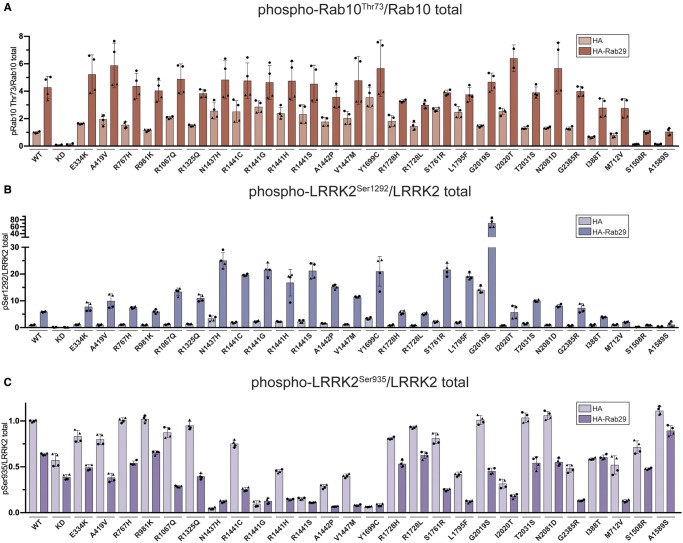
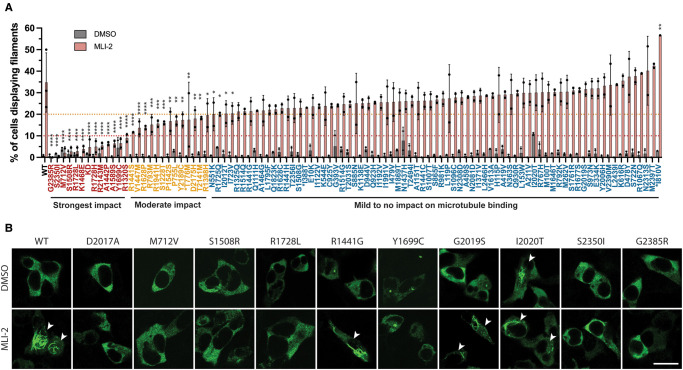
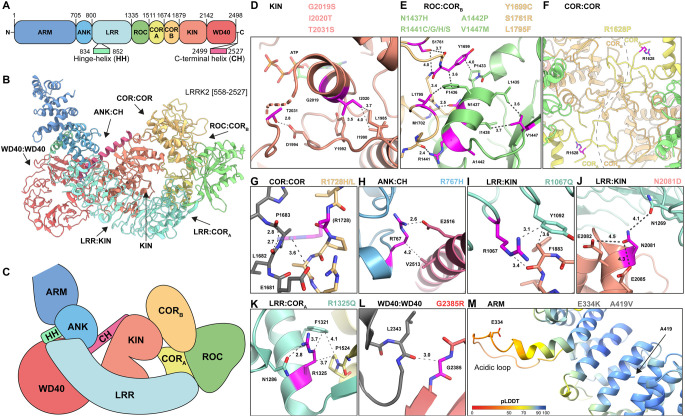
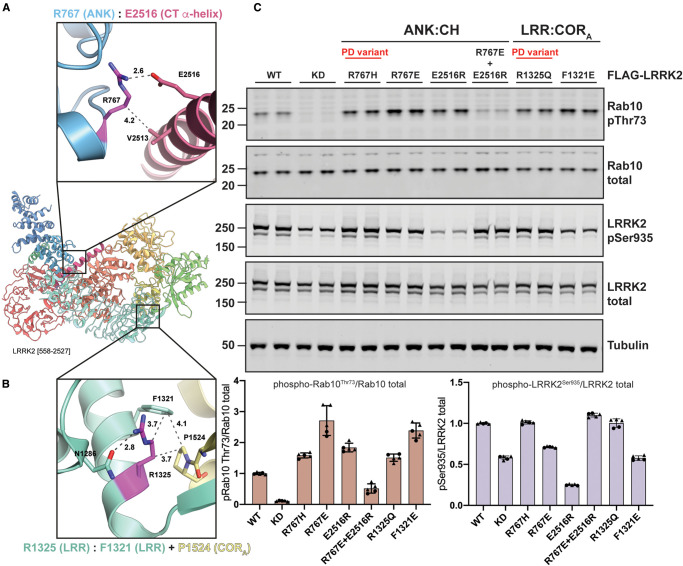
Verification
Claims the paper makes
The claims and statistics of this paper haven’t been checked yet.
Run the check — free, no account needed. It reads the open-access text and checks the sources it cites.
Self-check
Percentages, sums and reported differences re-computed from the paper’s own numbers.
The self-check needs the paper’s full text.
Citations
Cites
Highly accurate protein structure prediction with AlphaFold
Jumper, J., Evans, R., Pritzel, A., Green, T., Figurnov, M., Ronneberger, O., Tunyasuvunakool, K., Bates, R., Žídek, A., Potapenko, A., et al. (2021) · Nature · doi:10.1038/s41586-021-03819-2 · Cited by 43,764
Richards, S., Aziz, N., Bale, S., Bick, D., Das, S., Gastier-Foster, J., Grody, W. W., Hegde, M., Lyon, E., Spector, E., et al. (2015) · Genetics in Medicine · doi:10.1038/gim.2015.30 · Cited by 32,594
The mutational constraint spectrum quantified from variation in 141,456 humans
Karczewski, K. J., Francioli, L. C., Tiao, G., Cummings, B. B., Alföldi, J., Wang, Q., Collins, R. L., Laricchia, K. M., Ganna, A., Birnbaum, D. P., et al. (2020) · Nature · doi:10.1038/s41586-020-2308-7 · Cited by 9,434
Tsien, R. Y. (1998) · Annual Review of Biochemistry · doi:10.1146/annurev.biochem.67.1.509 · Cited by 6,178
Yang (2021) · doi:10.1038/s41598-020-79139-8 · Cited by 5,035
Ashkenazy, H., Abadi, S., Martz, E., Chay, O., Mayrose, I., Pupko, T., & Ben-Tal, N. (2016) · Nucleic Acids Research · doi:10.1093/nar/gkw408 · Cited by 3,163
Mutations in LRRK2 Cause Autosomal-Dominant Parkinsonism with Pleomorphic Pathology
Zimprich, A. A., Biskup, S., Leitner, P., Lichtner, P., Farrer, M. J., Lincoln, S., Kachergus, J. M., Hulihan, M., Uitti, R. J., Calne, D. B., et al. (2004) · Neuron · doi:10.1016/j.neuron.2004.11.005 · Cited by 3,087
REVEL: An Ensemble Method for Predicting the Pathogenicity of Rare Missense Variants
Ioannidis, N. M., Rothstein, J. H., Pejaver, V., Middha, S., McDonnell, S. K., Baheti, S., Musolf, A., Li, Q., Holzinger, E., Karyadi, D., et al. (2016) · The American Journal of Human Genetics · doi:10.1016/j.ajhg.2016.08.016 · Cited by 2,908
Cloning of the Gene Containing Mutations that Cause PARK8-Linked Parkinson's Disease
Paisán‐Ruiz, C., Jain, S., Evans, E. W., Gilks, W. P., Simón, J., van der Brug, M., de Munaín, A. L., Aparicio, S. F., Gil, A. M., Khan, N. L., et al. (2004) · Neuron · doi:10.1016/j.neuron.2004.10.023 · Cited by 2,453
Phosphoproteomics reveals that Parkinson's disease kinase LRRK2 regulates a subset of Rab GTPases
Steger, M., Tonelli, F., Ito, G., Davies, P., Trost, M., Vetter, M., Wachter, S., Lorentzen, E., Duddy, G., Wilson, S., et al. (2016) · eLife · doi:10.7554/elife.12813 · Cited by 1,042
Self-citation
Research works printed but not linked: 1
- 2022, Structural basis of human LRRK2 membrane recruitment and activation, bioRxiv
Cited by
Sorted by citations
Rab29-dependent asymmetrical activation of leucine-rich repeat kinase 2
(2023) · doi:10.1126/science.adi9926 · Cited by 108
Self-citationRelevance of genetic testing in the gene-targeted trial era: the Rostock Parkinson’s disease study
Westenberger, A., Skrahina, V., Usnich, T., Beetz, C., Vollstedt, E., Laabs, B., Paul, J. J., Curado, F., Skobalj, S., Gaber, H., et al. (2024) · Brain · doi:10.1093/brain/awae188 · Cited by 104
Uncovering the genetic basis of Parkinson's disease globally: from discoveries to the clinic
Lim, S., Tan, A. H., Ahmad‐Annuar, A., Okubadejo, N. U., Lohmann, K., Morris, H. R., Toh, T. S., Tay, Y. W., Lange, L. M., Bandrés‐Ciga, S., et al. (2024) · The Lancet Neurology · doi:10.1016/s1474-4422(24)00378-8 · Cited by 96
Self-citationAlessi, D. R., & Pfeffer, S. R. (2024) · Annual Review of Biochemistry · doi:10.1146/annurev-biochem-030122-051144 · Cited by 80
Self-citationParkinson’s Disease is Predominantly a Genetic Disease
Lim, S., & Klein, C. (2024) · Journal of Parkinson s Disease · doi:10.3233/jpd-230376 · Cited by 75
Metadata
- Authors
- Kalogeropulou, A. F., Purlyte, E., Tonelli, F., Lange, S. M., Wightman, M., Prescott, A. R., Padmanabhan, S., Sammler, E., & Alessi, D. R.
- Affiliations
- University of Dundee (GB)
- Michael J. Fox Foundation (US)
- Corresponding author
- Alessi, Dario R.
- ORCID
- Venue
- Biochemical Journal
- Publisher
- Portland Press Ltd.
- Published
- 2022-09-06
- Volume
- 479
- Issue
- 17
- Pages
- 1759-1783
- ISSN
- 0264-6021 (ISSN-L)
- 1470-8728
- PMC
- PMC9472821
- OpenAlex
- W4290803974
- Cited by
- 129
- References
- 71
- Citations by year
- 2026: 32 · 2025: 33 · 2024: 35 · 2023: 25 · 2022: 4
- FWCI
- 12.89
- Type
- journal article
- Language
- en
- Open access
- hybrid
- doi.org
- Licence
- Locations
- Biochemical Journal (publishedVersion, cc-by)
- bioRxiv (Cold Spring Harbor Laboratory) (acceptedVersion, cc-by)
- PubMed Central (publishedVersion, cc-by)
- PubMed (publishedVersion)
- Discovery Research Portal (University of Dundee) (acceptedVersion, cc-by)
- Funders
- Michael J. Fox Foundation for Parkinson's Research (ASAP‐000463)
- GlaxoSmithKline
- Merck KGaA
- Parkinson's UK (H-1701)
- Medical Research Council (MC_UU_00018/1)
- Topics
- Health Sciences › Medicine › Clinical Neurology › Parkinson's Disease Mechanisms and Treatments
- Life Sciences › Biochemistry, Genetics and Molecular Biology › Molecular Biology › Protein Kinase Regulation and GTPase Signaling
- Life Sciences › Biochemistry, Genetics and Molecular Biology › Molecular Biology › Nuclear Receptors and Signaling
- Keywords
- LRRK2, Parkinson's disease, kinase activity, microtubule binding, variants of uncertain significance, kinase activation, Rab10 phosphorylation, LRRK2 inhibitors, protein stability, rare variants
- MeSH terms
- Leucine-Rich Repeat Serine-Threonine Protein Kinase-2, Humans, Microtubules, Mutation, Parkinson Disease, Phosphorylation, Protein Binding
About these checks
Registry, retraction, Cites and statistics results are computed, not judged, with one exception: a printed reference that no index lists is read once by a model before it counts as a citation error. Claims are extracted by a model and kept only when their quote appears verbatim in the text; each cited source is then checked, with a model’s help, for whether it says what the claim relies on. Those verdicts can be wrong — read the claim’s quote and the cited source before relying on one.
Statistics and arithmetic are recomputed, not judged.
Confidence bands are shown only for fields calibrated on our annotated test set. None is calibrated yet, so no band is shown.
What counts as a claim ›How we measure confidence ›How we check this ›
Are you an author, or do you see a problem with this page? Request a review
