

Chemical compound-based direct reprogramming for future clinical applications.
Open accessThe DOI matches its Crossref record; 104 of the 105 references it cites were found in a registry or an index.
Abstract
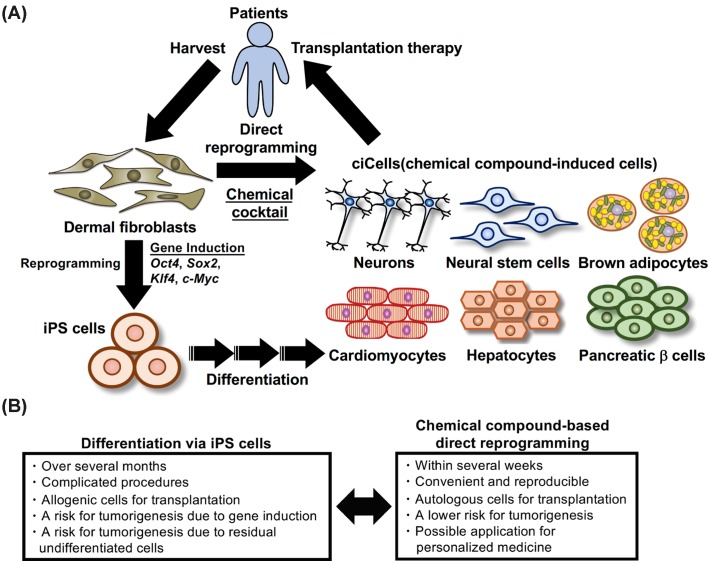
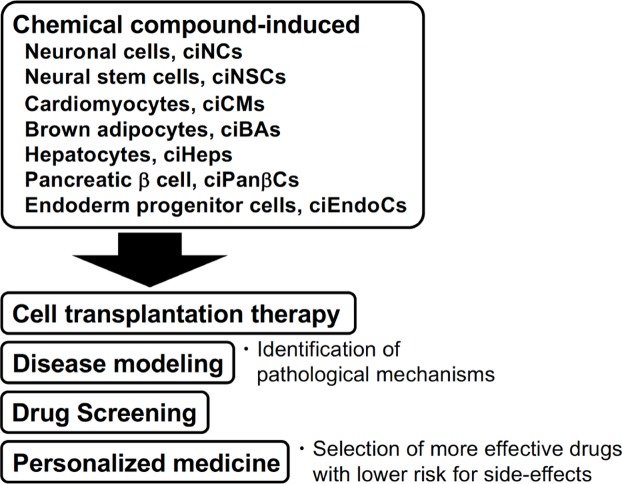
Recent studies have revealed that a combination of chemical compounds enables direct reprogramming from one somatic cell type into another without the use of transgenes by regulating cellular signaling pathways and epigenetic modifications. The generation of induced pluripotent stem (iPS) cells generally requires virus vector-mediated expression of multiple transcription factors, which might disrupt genomic integrity and proper cell functions. The direct reprogramming is a promising alternative to rapidly prepare different cell types by bypassing the pluripotent state. Because the strategy also depends on forced expression of exogenous lineage-specific transcription factors, the direct reprogramming in a chemical compound-based manner is an ideal approach to further reduce the risk for tumorigenesis. So far, a number of reported research efforts have revealed that combinations of chemical compounds and cell-type specific medium transdifferentiate somatic cells into desired cell types including neuronal cells, glial cells, neural stem cells, brown adipocytes, cardiomyocytes, somatic progenitor cells, and pluripotent stem cells. These desired cells rapidly converted from patient-derived autologous fibroblasts can be applied for their own transplantation therapy to avoid immune rejection. However, complete chemical compound-induced conversions remain challenging particularly in adult human-derived fibroblasts compared with mouse embryonic fibroblasts (MEFs). This review summarizes up-to-date progress in each specific cell type and discusses prospects for future clinical application toward cell transplantation therapy.
Overview
The claims and statistics of this paper haven’t been checked yet.
Free: it reads the open-access text and checks the first 5 claims that cite a source we can check. Create a free account to check every claim.
Integrity signals
Registry
Cites
Statistics
Figures

Verification
Claims the paper makes
The claims and statistics of this paper haven’t been checked yet.
Free: it reads the open-access text and checks the first 5 claims that cite a source we can check. Create a free account to check every claim.
Claims other papers make about this one
Each is checked against this paper’s own text: does it say what the citing paper says it does?
The source backs part of the claim, not all of it — or backs it for a different population, condition or comparison.
In the citing paper
“CHIR99021 is a GSK3α/β inhibitor, an effective inducer of CiPSCs and promoter of certain stem cell characteristics [66, 67].”
From Chemically induced reprogramming to reverse cellular aging (2023) · cites this paper as [67]
Experimental — accuracy not yet measured
Self-check
Percentages, sums and reported differences re-computed from the paper’s own numbers.
The self-check needs the paper’s full text.
Citations
Cites
Takahashi, K., & Yamanaka, S. (2006) · Cell · doi:10.1016/j.cell.2006.07.024 · Cited by 26,673
Induction of Pluripotent Stem Cells from Adult Human Fibroblasts by Defined Factors
Takahashi, K., Tanabe, K., Ohnuki, M., Narita, M., Ichisaka, T., Tomoda, K., & Yamanaka, S. (2007) · Cell · doi:10.1016/j.cell.2007.11.019 · Cited by 20,221
Beige Adipocytes Are a Distinct Type of Thermogenic Fat Cell in Mouse and Human
Wu, J., Boström, P., Sparks, L. M., Ye, L., Choi, J. H., Giang, A.-H., Khandekar, M., Virtanen, K. A., Nuutila, P., Schaart, G., et al. (2012) · Cell · doi:10.1016/j.cell.2012.05.016 · Cited by 3,319
Direct conversion of fibroblasts to functional neurons by defined factors
Vierbuchen, T., Ostermeier, A., Pang, Z. P., Kokubu, Y., Südhof, T. C., & Wernig, M. (2010) · Nature · doi:10.1038/nature08797 · Cited by 3,017
Direct reprogramming of fibroblasts into functional cardiomyocytes by defined factors
Ieda, M., Fu, J.-D., Delgado-Olguin, P., Vedantham, V., Hayashi, Y., Bruneau, B. G., & Srivastava, D. (2010) · Cell · doi:10.1016/j.cell.2010.07.002 · Cited by 2,454
PRDM16 controls a brown fat/skeletal muscle switch
Seale, P., Bjork, B., Yang, W., Kajimura, S., Chin, S., Kuang, S., Scimè, A., Devarakonda, S., Conroe, H. M., Erdjument-Bromage, H., et al. (2008) · Nature · doi:10.1038/nature07182 · Cited by 2,347
Zhang, Y., Sloan, S. A., Clarke, L. E., Caneda, C., Plaza, C. A., Blumenthal, P. D., Vogel, H., Steinberg, G. K., Edwards, M. S. B., Li, G., et al. (2016) · Neuron · doi:10.1016/j.neuron.2015.11.013 · Cited by 2,295
Generation of Functional Human Pancreatic β Cells In Vitro
Pagliuca, F. W., Millman, J. R., Gürtler, M., Segel, M., Van Dervort, A., Ryu, J. H., Peterson, Q. P., Greiner, D., & Melton, D. A. (2014) · Cell · doi:10.1016/j.cell.2014.09.040 · Cited by 2,025
In vivo reprogramming of adult pancreatic exocrine cells to β-cells
Zhou, Q., Brown, J., Kanarek, A., Rajagopal, J., & Melton, D. A. (2008) · Nature · doi:10.1038/nature07314 · Cited by 2,010
Huangfu, D., Maehr, R., Guo, W., Eijkelenboom, A., Snitow, M., Chen, A. E., & Melton, D. A. (2008) · Nature Biotechnology · doi:10.1038/nbt1418 · Cited by 1,606
Research works printed but not linked: 1
- Zhao, 2015, High-efficiency reprogramming of fibroblasts into cardiomyocytes requires suppression of pro-fibrotic signalling, Nat. Commun., 6, 8243, 10.1038/ncomms9243 · DOI · Paper page
Cited by
Chemically induced reprogramming to reverse cellular aging
Yang, J.-H., Petty, C. A., Dixon-McDougall, T., Lopez, M. V., Tyshkovskiy, A., Maybury-Lewis, S., Tian, X., Ibrahim, N., Chen, Z., Griffin, P. T., et al. (2023) · Aging · doi:10.18632/aging.204896 · Cited by 136
Cancer cell reprogramming: a promising therapy converting malignancy to benignity
Gong, L., Yan, Q., Zhang, Y., Fang, X., Liu, B., & Guan, X. (2019) · 癌症:英文版 · doi:10.1186/s40880-019-0393-5 · Cited by 90
“It is convenient to manufacture small molecules and scale their throughput to induce reprogramming with different lineages [94].”
BackgroundTumorigenicity risk of iPSCs in vivo: nip it in the bud
Zhong, C., Liu, M., Pan, X., & Zhu, H. (2022) · Precision Clinical Medicine · doi:10.1093/pcmedi/pbac004 · Cited by 82
Small Molecules that Promote Self-Renewal of Stem Cells and Somatic Cell Reprogramming
Chen, G., Guo, Y., Li, C., Li, S., & Wan, X. (2020) · Stem Cell Reviews and Reports · doi:10.1007/s12015-020-09965-w · Cited by 56
“cule compounds had been reported and reviewedmainly in the fields of nerve cells and cardiomyocytes [77].”
BackgroundChang, Y., Cho, B., Kim, S., & Kim, J. (2019) · Experimental & Molecular Medicine · doi:10.1038/s12276-019-0251-1 · Cited by 59
Metadata
- Authors
- Takeda, Y., Harada, Y., Yoshikawa, T., & Dai, P.
- Affiliations
- Kyoto Prefectural University of Medicine (JP)
- Louis Pasteur Center for Medical Research (JP)
- Corresponding author
- Dai, Ping
- Venue
- Bioscience Reports
- Publisher
- Portland Press Ltd.
- Published
- 2018-05-08
- Volume
- 38
- Issue
- 3
- ISSN
- 0144-8463 (ISSN-L)
- 1573-4935
- PMC
- PMC5938430
- OpenAlex
- W2800663083
- Cited by
- 57
- References
- 105
- Citations by year
- 2026: 3 · 2025: 9 · 2024: 6 · 2023: 10 · 2022: 9 · 2021: 4 · 2020: 11 · 2019: 4 · 2018: 1
- FWCI
- 0.49
- Type
- journal article
- Language
- en
- Open access
- gold
- doi.org
- Locations
- Bioscience Reports (publishedVersion, cc-by)
- Europe PMC (PubMed Central) (publishedVersion, cc-by)
- PubMed Central (publishedVersion, cc-by)
- PubMed (publishedVersion)
- Topics
- Life Sciences › Biochemistry, Genetics and Molecular Biology › Molecular Biology › Pluripotent Stem Cells Research
- Life Sciences › Biochemistry, Genetics and Molecular Biology › Molecular Biology › Developmental Biology and Gene Regulation
- Life Sciences › Neuroscience › Developmental Neuroscience › Neurogenesis and neuroplasticity mechanisms
- Keywords
- chemical reprogramming, induced pluripotent stem cells, epigenetic modifications, signaling pathways, autologous fibroblasts, cell transplantation therapy, neuronal differentiation, cardiomyocyte differentiation, brown adipocyte differentiation, neural stem cells, glial cells
- MeSH terms
- Animals, Cell Differentiation, Humans, Neurons, Pyridines, Pyrimidines, Gene Expression Regulation, Developmental, Epigenesis, Genetic, Regenerative Medicine, Mice, Induced Pluripotent Stem Cells, Neural Stem Cells, Cellular Reprogramming
About these checks
Registry, retraction, Cites and statistics results are computed, not judged, with one exception: a printed reference that no index lists is read once by a model before it counts as a citation error. Claims are extracted by a model and kept only when their quote appears verbatim in the text; each cited source is then checked, with a model’s help, for whether it says what the claim relies on. Those verdicts can be wrong — read the claim’s quote and the cited source before relying on one.
Statistics and arithmetic are recomputed, not judged.
Confidence bands are shown only for fields calibrated on our annotated test set. None is calibrated yet, so no band is shown.
What counts as a claim ›How we measure confidence ›How we check this ›
Are you an author, or do you see a problem with this page? Request a review
How to cite
Cite CoChat for the checks on this page, and the paper for its own findings.
- This page
- CoChat. (2026). Citation check: Chemical compound-based direct reprogramming for future clinical applications. https://app.cochat.ai/papers/10.1042/bsr20171650
- The paper
- Takeda, Y., Harada, Y., Yoshikawa, T., & Dai, P. (2018). Chemical compound-based direct reprogramming for future clinical applications. Bioscience Reports. https://doi.org/10.1042/bsr20171650
Data sources
Bibliographic data: Semantic Scholar, OpenAlex, Crossref.
Contains information from the Semantic Scholar Academic Graph Datasets, made available under the ODC Attribution License (ODC-BY 1.0).
Semantic Scholar’s data is described in: Kinney, R., et al. (2023). The Semantic Scholar Open Data Platform. arXiv:2301.10140.
