

Global database of direct solar radiation at the Moon’s surface for lunar engineering purposes
Open accessThe DOI matches its Crossref record; 10 of the 12 references it cites were found in a registry or an index.
Abstract
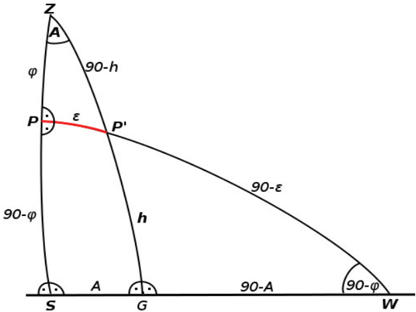
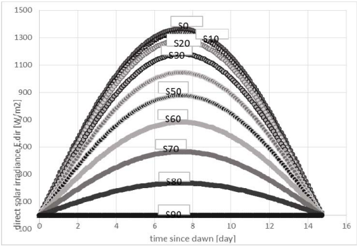
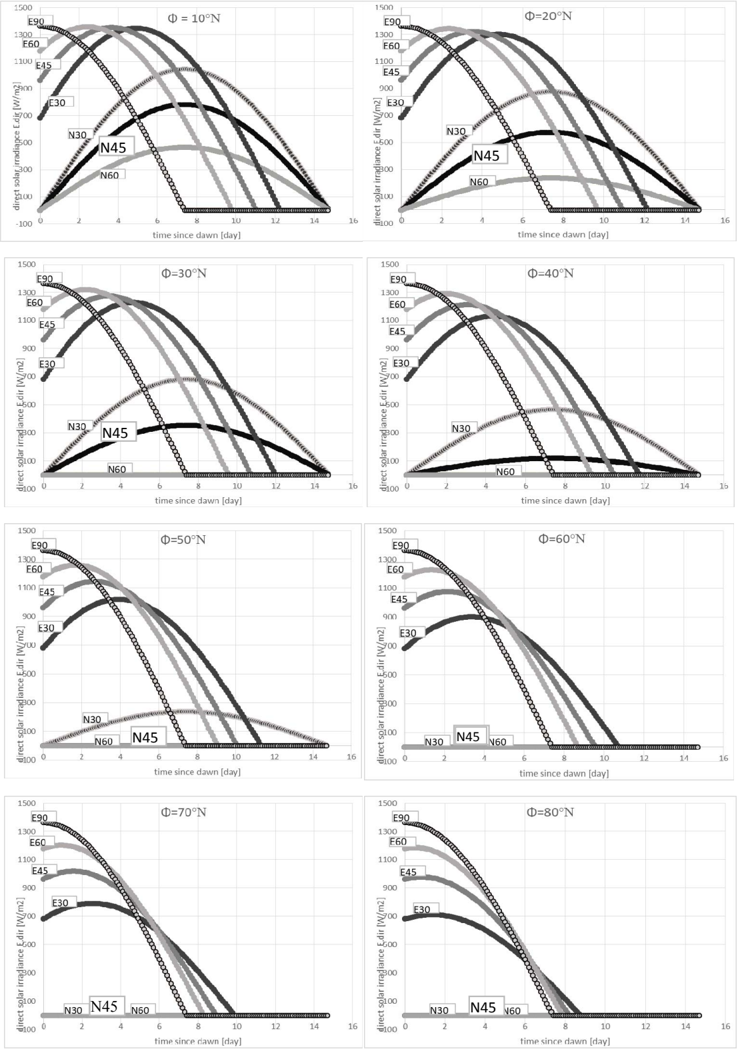
The purpose of this paper was to provide preliminary data concerning global availability of solar energy at the surface of the Moon. Lack of gaseous atmosphere and accompanying phenomena such as precipitations or cloud cover makes the Moon’s surface an extraordinarily advantageous place for solar energy harvesting. On the other hand, excessive exposure to undamped sunlight may cause problems with buildings’ interior overheating or increase decay rate of photovoltaic cells. Thus, basic information concerning solar irradiance and diurnal insolation at specified selenographic latitudes are indispensable for location selection for future lunar facilities and their design process. In order to approximate Sun’s position at lunar sky, simple analytical astrometric model of lunar rotation was developed. Basing on that model, direct diurnal irradiances and insolations were calculated for various flat surface orientations, and selenographic latitudes. Computed data were presented in charts and tables.This lunar insolation database may serve as guideline for location of future lunar settlements and research stations, and to estimate their diurnal energy demands.
Overview
The claims and statistics of this paper haven’t been checked yet.
Free: it reads the open-access text and checks the first 5 claims that cite a source we can check. Create a free account to check every claim.
Integrity signals
Registry
Cites
Statistics
Figures
Verification
Claims the paper makes
The claims and statistics of this paper haven’t been checked yet.
Free: it reads the open-access text and checks the first 5 claims that cite a source we can check. Create a free account to check every claim.
Claims other papers make about this one
Each is checked against this paper’s own text: does it say what the citing paper says it does?
The source backs part of the claim, not all of it — or backs it for a different population, condition or comparison.
In the citing paper
“In 1722 Jacques Cassini demonstrated, that the axial tilt of the Moon equals 1.54 • and is constant in time [39,59].”
From Parametric Study of a Lunar Base Power Systems (2021) · cites this paper as [39]
Experimental — accuracy not yet measuredThe cited source says what the claim attributes to it.
In the citing paper
“Owing to the relatively slow rotation of the moon, an average lunar cycle (LC) also known as the synodic month, lasts 29.531 earth days [39].”
From Parametric Study of a Lunar Base Power Systems (2021) · cites this paper as [39]
Self-check
Percentages, sums and reported differences re-computed from the paper’s own numbers.
The self-check needs the paper’s full text.
Citations
Cites
Calculation of monthly average insolation on tilted surfaces
Klein, S. A. (1977) · Solar Energy · doi:10.1016/0038-092x(77)90001-9 · Cited by 767
Johnson, F. S. (1954) · Journal of Meteorology · doi:10.1175/1520-0469(1954)011<0431:tsc>2.0.co;2 · Cited by 431 · cited 1×
“Due to slight Eccentricity of Earth’s orbit, instantaneous values of TSI above earth’s atmosphere varies annually between 1,412 W/m(2) at perihelion and 1,320 W/m(2) at aphelion [3].”
BackgroundVasavada, A. R., Bandfield, J. L., Greenhagen, B. T., Hayne, P. O., Siegler, M. A., Williams, J., & Paige, D. A. (2012) · Journal of Geophysical Research: Planets · doi:10.1029/2011je003987 · Cited by 357
Benaroya, H., & Bernold, L. E. (2007) · Acta Astronautica · doi:10.1016/j.actaastro.2007.05.001 · Cited by 129
Malla, R. B., & Brown, K. M. (2015) · Acta Astronautica · doi:10.1016/j.actaastro.2014.10.038 · Cited by 109
Microwave processing of lunar soil for supporting longer-term surface exploration on the Moon
Srivastava, V., Lim, S., & Anand, M. (2016) · Space Policy · doi:10.1016/j.spacepol.2016.07.005 · Cited by 51
Solar bricks for lunar construction
Miranda, L. V., Valdès, J. R., & Cortes, D. D. (2017) · Construction and Building Materials · doi:10.1016/j.conbuildmat.2017.02.029 · Cited by 28
Transient Thermal Model and Analysis of the Lunar Surface and Regolith for Cryogenic Fluid Storage
Christie, R. J., Plachta, D. W., & Yasan, M. M. (2013) · NASA Technical Reports Server (NASA) · Cited by 23
Yarkovsky-O'Keefe-Radzievskii-Paddack effect with anisotropic radiation
Breiter, S., & Vokrouhlický, D. (2011) · Monthly Notices of the Royal Astronomical Society · doi:10.1111/j.1365-2966.2010.17663.x · Cited by 17 · cited 2×
“This power radiates uniformly into space, so, for a surface perpendicular to the incident sunlight, radiant flux per unit area is inversely proportional to the square of the distance from the centre of the Sun, according to equation (1) [2]:”
BackgroundMaMBA - a functional Moon and Mars Base Analog
Heinicke, C., & Foing, B. H. (2017) · epsc · Cited by 3
Research works printed but not linked: 4
- 9. M.G. Langseth, S.J. Keihm, In-situ measurements of lunar heat flow, in: Proc. Sov.- Am. Conf. Geochem. Moon Planets, NASA SP-370, NASA, Washington, D.C., 283- 293 (1977)
- 12. L. D. Moondust, Materials Today, 18 (4), (2015) E3S Web of Conferences 49, 00053 (2018) https://doi.org/10.1051/e3sconf/20184900053 SOLINA 2018
- 17. Overheating Analysis of a Naturally Ventilated Office Building in a Temperate Climate H. Altan, I. Ward, J. Mohelnikova and F. Vajkay PLEA 2008-25th Conference on Passive and Low Energy Architecture, Dublin, 22nd to 24th October 2008)
- 18. Mohammed Bekhti-In Orbit Irradiation Effects Evaluation of the Alsat-1 Solar Panels International Journal of Energy Science and Engineering 1 (1), 24-30 (2015)
Cited by
Laser melting manufacturing of large elements of lunar regolith simulant for paving on the Moon
Ginés-Palomares, J.-C., Fateri, M., Kalhöfer, E., Schubert, T., Meyer, L., Kolsch, N., Lipińska, M. B., Davenport, R. J., Imhof, B., Waclavicek, R., et al. (2023) · Scientific Reports · doi:10.1038/s41598-023-42008-1 · Cited by 78
Mineral Processing and Metal Extraction on the Lunar Surface - Challenges and Opportunities
Shaw, M., Humbert, M. S., Brooks, G., Rhamdhani, M. A., Duffy, A. R., & Pownceby, M. I. (2021) · Mineral Processing and Extractive Metallurgy Review · doi:10.1080/08827508.2021.1969390 · Cited by 69
Liu, Z., Cheng, K., Yin, Z., Wang, Z., Wang, J., & Qin, J. (2022) · Energy Conversion and Management · doi:10.1016/j.enconman.2022.115445 · Cited by 52
Spark plasma sintering and optical characterization of lunar regolith simulant
Licheri, R., Orrù, R., Sani, E., Dell’Oro, A., & Cao, G. (2022) · Acta Astronautica · doi:10.1016/j.actaastro.2022.09.016 · Cited by 44
Parametric Study of a Lunar Base Power Systems
Kaczmarzyk, M., & Musiał, M. (2021) · Energies · doi:10.3390/en14041141 · Cited by 43
“Common practice for lunar PV systems is to use a fixed mount for the solar panels and to orient the array toward the equator with its tilt angle equal to the site latitude [27,28,37,39].”
InfluentialSelf-citationThermodynamic modelling of ultra-high vacuum thermal decomposition for lunar resource processing
Shaw, M., Brooks, G. A., Rhamdhani, M. A., Duffy, A. R., & Pownceby, M. I. (2021) · Planetary and Space Science · doi:10.1016/j.pss.2021.105272 · Cited by 38
Sun, Q., Zhang, H., Sun, Z., & Xia, Y. (2023) · Energy · doi:10.1016/j.energy.2023.127241 · Cited by 29
Schaible, M. J., Sjolund, K., Ryan, E. A., Shofner, M. L., Reynolds, J. R., Linsey, J., & Orlando, T. M. (2023) · Acta Astronautica · doi:10.1016/j.actaastro.2023.07.003 · Cited by 20
Characteristic of thermal energy system self-driven by exhausted heat from equipment in lunar base
Zhang, K., Sun, P., Li, S., Spataru, C., Lv, X., & Weng, Y. (2022) · Applied Thermal Engineering · doi:10.1016/j.applthermaleng.2022.118751 · Cited by 18
LunarLeaper—A mission concept to explore the lunar subsurface with a small-scale legged robot
Kolvenbach, H., Mittelholz, A. M., Stähler, S. C., Arm, P., Bickel, V., Fuhrer, A., Jodar, J. G., Margarit, R., Church, J., Krasnova, E., et al. (2025) · Acta Astronautica · doi:10.1016/j.actaastro.2025.11.039 · Cited by 17
Space Agriculture: A Comprehensive Systems-Level Review of Challenges and Opportunities
Fazayeli, H., Daigh, A. L. M., Palmer, C., Pitla, S. K., Jones, D., & Ge, Y. (2025) · Agriculture · doi:10.3390/agriculture15242541 · Cited by 14
“The Moon receives unfiltered, high-energy solar flux due to the absence of an atmosphere, exposing plants and hardware to intense ultraviolet (UV) and ionizing radiation [154,155].”
Moon Village: main aspects and open issues in lunar habitat thermoenergetics design. A Review
Rugani, R., Martelli, F., Martino, M., & Salvadori, G. (2021) · IEEE International Conference on Environment and Electrical Engineering and IEEE Industrial and Commercial Power Systems Europe (EEEIC / I&CPS Europe) · doi:10.1109/eeeic/icpseurope51590.2021.9584521 · Cited by 14
Pinello, L., Brancato, L., Giglio, M., Cadini, F., & Luca, G. F. D. (2024) · Aerospace · doi:10.3390/aerospace11010073 · Cited by 13
Towards a Semi-Autonomous Robotic Exploration of a Lunar Skylight Cavity
Sonsalla, R. U., Planthaber, S., Domínguez, R., Dettmann, A., Cordes, F., Hülsen, B., Schulz, C., Schöberl, P., Kasperski, S., Wiedemann, H., et al. (2022) · IEEE Aerospace Conference (AERO) · doi:10.1109/aero53065.2022.9843610 · Cited by 13
Chen, G., Shen, C., Liu, X., & Kalogirou, S. A. (2025) · Energy · doi:10.1016/j.energy.2025.136005 · Cited by 11
Sun, W., Zhao, B., Pei, Y., Shi, L., Hu, M.-B., Li, M., Ren, X., & Pei, G. (2024) · Science China Technological Sciences · doi:10.1007/s11431-023-2560-y · Cited by 10
“This means that in the middle and low latitudes, seasonal changes don’t impact solar energy collection [21].”
Internal Heat Gains in a Lunar Base—A Contemporary Case Study
Kaczmarzyk, M., Starakiewicz, A., & Waśniowski, A. (2020) · Energies · doi:10.3390/en13123213 · Cited by 9
Self-citationSoft deployable airless wheel for lunar lava tube intact exploration
Lee, S. W., Cho, N., Lee, G., Lee, S., Kim, J., Shim, G., Jang, J., Kim, S. K., Seo, T., Sim, C. K., et al. (2025) · Science Robotics · doi:10.1126/scirobotics.adx2549 · Cited by 9
Cao, G., Concas, A., Orrù, R., Licheri, R., Sani, E., Dell’Oro, A., Fais, G., Manis, C., Manca, A., Uras, G., et al. (2023) · Frontiers in Space Technologies · doi:10.3389/frspt.2023.1146461 · Cited by 9
“The surface of the Moon, due to its high solar irradiance, provides favorable conditions for harvesting solar energy, given an appropriate site (Kaczmarzyk et al., 2018).”
A novel method for extracting metals from asteroids using non-aqueous deep eutectic solvents
Rivera, R. M., Bird, P., Jenkin, G. R. T., & Abbott, A. P. (2023) · Scientific Reports · doi:10.1038/s41598-023-44152-0 · Cited by 8
Rastinasab, V., Hu, W., & Tahmasebi, M. K. (2021) · Aerospace · doi:10.3390/aerospace8070186 · Cited by 8
Simulation of a thermoelectric power generation system with multiple heat storage for lunar habitat
Kim, S., Lim, H., Kim, B.-J., Kim, T., Park, S.-H., & Jeong, J.-W. (2025) · Acta Astronautica · doi:10.1016/j.actaastro.2025.07.034 · Cited by 7
Hsu, A. L., Pelrine, R. E., Pinto, R. D. G., Howe, A. S., & Schaler, E. W. (2023) · IEEE Aerospace Conference (AERO) · doi:10.1109/aero55745.2023.10115827 · Cited by 6
“It also estimates solar power generation based on solar flux for each mission option’s latitude [51, 52] and system power consumption based on each mission option’s expected slope.”
BackgroundMethodA computational framework for making early design decisions in deep space habitats
Behjat, A., Liu, X., Forero, O. D., Ibrahimov, R., Dyke, S. J., Bilionis, I., Ramirez, J., & Whitaker, D. R. (2024) · Advances in Engineering Software · doi:10.1016/j.advengsoft.2024.103690 · Cited by 6
Sun, Z., Zhang, H., Sun, Q., Zhang, C., & You, E. (2025) · Energy · doi:10.1016/j.energy.2025.134929 · Cited by 5
Levchenko, L., Xu, S., Baranov, O., & Bazaka, K. (2023) · Global Challenges · doi:10.1002/gch2.202300086 · Cited by 5
Zhou, R., Dai, G., Fan, S., Xiang, P., Mao, W., Jia, L.-J., & Zheng, H. (2025) · Case Studies in Construction Materials · doi:10.1016/j.cscm.2025.e04636 · Cited by 3
LunarLeaper - A Mission Concept to Explore the Lunar Subsurface with a Small-Scale Legged Robot
Kolvenbach, H., Mittelholz, A. M., Stähler, S. C., Church, J., Arm, P., Bickel, V., Walas, K., Grott, M., Hamran, S., Karatekin, Ö., et al. (2024) · IAF Space Exploration Symposium · doi:10.52202/078357-0040 · Cited by 3
Solar energy on the Moon for fixed or tracked photovoltaic systems
Weiss, M., Dumais, F., Volatier, M., Aimez, V., Jaouad, A., & Darnon, M. (2024) · EPJ Photovoltaics · doi:10.1051/epjpv/2024021 · Cited by 2
Cho, C., Haxholdt, V., Rupani, V., Silk, E. A., Almamun, O., Heintz, S., & Person, T. (2025) · Cryogenics · doi:10.1016/j.cryogenics.2025.104229 · Cited by 1
Optimal Microgrid Sizing for Lunar Habitats in Non-Polar Regions
Hanif, M., & Bazzi, A. M. (2025) · North American Power Symposium (NAPS) · doi:10.1109/naps66256.2025.11272194 · Cited by 1
“One lunar day is approximately 29.5 Earth days, consisting of about 14.75 Earth days (354 hours) of sunlight followed by 14.75 Earth days (354 hours) of darkness [4], [5].”
InfluentialQuantification of oxygen production from solar pyrolysis of lunar regolith
Robinot, J., Rodat, S., Abanades, S., Bêche, E., Paillet, A., & Cowley, A. (2026) · Advances in Space Research · doi:10.1016/j.asr.2026.02.003 · Cited by 1
Lunar Exploration and Access to Polar Regions (LEAPR)
Ruperto, W. A., Rullán, A., García, A. Z., Morales, A. R., Cesani, A. C., Velez, A. F., Troche-Vargas, C., Santiago, C., Rosa, D. Q., Marrero, E. R., et al. (2019) · AIAA Propulsion and Energy Forum · doi:10.2514/6.2019-3882
Insolation and Temperature on the Moon
Reddy, P. K. S., Serla, J. K., & Karanam, D. P. (2022) · Springer eBooks · doi:10.1007/978-3-319-05546-6_198-1
Lunar science based on Apollo solar cell measurements
Aranya, S., Gopkumar, G., & Girish, T. E. (2023) · Elsevier eBooks · doi:10.1016/b978-0-12-823300-9.00009-1
Insolation and Temperature on the Moon
Reddy, P. K. S., Serla, J. K., & Prasad, K. D. (2023) · Springer eBooks · doi:10.1007/978-3-319-14541-9_198
Performance analysis and design of solid oxide cells system for the lunar base
Ji, Z., Cheng, L., Zainullina, A., & Wang, Z. (2025) · Energy Conversion and Management X · doi:10.1016/j.ecmx.2025.101412
Santaeufemia, S., Detrell, G., & Salman, L. (2025) · International Conference on Environmental Systems (ICES) · doi:10.32865/2346/102649
Photocatalytic Water Splitting on the Lunar Surface: Prospects for In Situ Resource Utilization
Kalyan, R., Small, T. D., Metha, G. F., Hamza, M. A., O'Dea, T. J., Shen, Y., & Shearer, C. J. (2026) · Advanced Materials Interfaces · doi:10.1002/admi.202500889
Mission-Oriented Site Selection for Future Lunar Mining Operations
Tulu, E., & Kaya, Y. A. (2026) · IEEE Aerospace Conference (AERO) · doi:10.1109/aero66936.2026.11520082
Performance analysis of a particle-based lunar solar thermal power system
Si, T., Qi, Y., Gu, L., Huang, Z., Cheng, Z., & Wang, Q. (2026) · Energy · doi:10.1016/j.energy.2026.141599
System architecture and logistics for sub-surface exploration of the Moon
Krejčiřík, M. (2026) · Brno University of Technology Digital Library (Brno University of Technology)
Long-term assessment of lunar illumination and solar irradiance for research station site selection
Chen, G., Jiao, K., Shen, C., & Kalogirou, S. A. (2026) · Acta Astronautica · doi:10.1016/j.actaastro.2026.07.053
Exploring Thermal Environmental Considerations for Designing Lunar Habitats on the Lunar South Pole
Boldini, A., Kamel, E., Bhattacharya, A., Connel, E., Lesan, M., & Gravois, A. (2026) · International Conference on Environmental Systems (ICES) · doi:10.32865/2346/109071
Metadata
- Authors
- Kaczmarzyk, M., Gawronski, M., & Piatkowski, G.
- Affiliations
- Rzeszów University of Technology (PL)
- ORCID
- Kaczmarzyk, Marcin
- Venue
- E3S Web of Conferences
- Publisher
- EDP Sciences
- Published
- 2018
- Volume
- 49
- Pages
- 00053
- ISSN
- 2267-1242 (ISSN-L)
- OpenAlex
- W2887968584
- Cited by
- 39
- References
- 12
- Citations by year
- 2026: 5 · 2025: 9 · 2024: 4 · 2023: 9 · 2022: 5 · 2021: 5 · 2020: 1 · 2019: 1
- FWCI
- 0.71
- Type
- conference paper
- Language
- en
- Open access
- diamond
- doi.org
- Licence
- Locations
- E3S Web of Conferences (publishedVersion, cc-by)
- Springer Link (Chiba Institute of Technology) (submittedVersion)
- DOAJ (DOAJ: Directory of Open Access Journals) (submittedVersion)
- Topics
- Physical Sciences › Energy › Renewable Energy, Sustainability and the Environment › Solar Radiation and Photovoltaics
- Physical Sciences › Earth and Planetary Sciences › Space and Planetary Science › Planetary Science and Exploration
- Physical Sciences › Engineering › Aerospace Engineering › Spacecraft Design and Technology
- Keywords
- direct solar radiation, lunar surface, solar irradiation, solar irradiance, lunar settlement, solar energy harvesting, site selection
About these checks
Registry, retraction, Cites and statistics results are computed, not judged, with one exception: a printed reference that no index lists is read once by a model before it counts as a citation error. Claims are extracted by a model and kept only when their quote appears verbatim in the text; each cited source is then checked, with a model’s help, for whether it says what the claim relies on. Those verdicts can be wrong — read the claim’s quote and the cited source before relying on one.
Statistics and arithmetic are recomputed, not judged.
Confidence bands are shown only for fields calibrated on our annotated test set. None is calibrated yet, so no band is shown.
What counts as a claim ›How we measure confidence ›How we check this ›
Are you an author, or do you see a problem with this page? Request a review
Data sources
Bibliographic data: Semantic Scholar, OpenAlex, Crossref.
Contains information from the Semantic Scholar Academic Graph Datasets, made available under the ODC Attribution License (ODC-BY 1.0).
Semantic Scholar’s data is described in: Kinney, R., et al. (2023). The Semantic Scholar Open Data Platform. arXiv:2301.10140.
