

Prevalence of Depression, Anxiety, and Stress during COVID-19 Pandemic
Open accessThe DOI matches its Crossref record; 42 of the 42 references it cites were found in a registry or an index.
Abstract
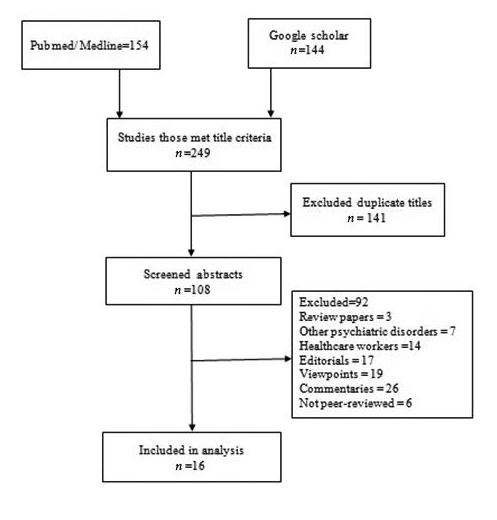
The coronavirus disease 2019 (COVID-19) crisis has greatly affected human lives across the world. Uncertainty and quarantine have been affecting people's mental health. Estimations of mental health problems are needed immediately for the better planning and management of these concerns at a global level. A rapid scoping review was conducted to get the estimation of mental health problems in the COVID-19 pandemic during the first 7 months. Peer-reviewed, data-based journal articles published in the English language were searched in the PubMed, Medline, and Google Scholar electronic databases from December 2019 to June 2020. Papers that met the inclusion criteria were analyzed and discussed in this review. A total of 16 studies were included. Eleven studies were from China, two from India, and one from Spain, Italy, and Iran. Prevalence of all forms of depression was 20%, anxiety 35%, and stress 53% in the combined study population of 113,285 individuals. The prevalence rate of all forms of depression, anxiety, stress, sleep problems, and psychological distress in general population was found to be higher during COVID-19 pandemic.
Overview
The claims and statistics of this paper haven’t been checked yet.
Free: it reads the open-access text and checks the first 5 claims that cite a source we can check. Create a free account to check every claim.
Integrity signals
Registry
Cites
Statistics
Figures
Verification
Claims the paper makes
The claims and statistics of this paper haven’t been checked yet.
Free: it reads the open-access text and checks the first 5 claims that cite a source we can check. Create a free account to check every claim.
Claims other papers make about this one
Each is checked against this paper’s own text: does it say what the citing paper says it does?
The cited source says what the claim attributes to it.
In the citing paper
“The rates of anxious-depressive symptoms found in the current study are lower than in other studies conducted in early 2020, at the beginning of the pandemic [33,34] but consistent with the other investigations conducted during the pandemic [8,17,18,35,36].”
From Anxiety and Depression during the Second Wave of the COVID-19 Pandemic: The Role of Coping Strategies (2023) · cites this paper as [35]
Self-check
Percentages, sums and reported differences re-computed from the paper’s own numbers.
The self-check needs the paper’s full text.
Citations
Cites
Wang, C., Pan, R., Wan, X., Tan, Y., Xu, L., Ho, C. S., & Ho, R. C. (2020) · International Journal of Environmental Research and Public Health · doi:10.3390/ijerph17051729 · Cited by 9,923
The psychological impact of the COVID-19 epidemic on college students in China
Cao, W., Fang, Z., Hou, G., Han, M., Xu, X., Dong, J., & Zheng, J. (2020) · Psychiatry Research · doi:10.1016/j.psychres.2020.112934 · Cited by 5,843
Holmes, E. A., O'Connor, R. C., Perry, V. H., Tracey, I., Wessely, S., Arseneault, L., Ballard, C., Christensen, H., Cohen Silver, R., Everall, I., et al. (2020) · The Lancet Psychiatry · doi:10.1016/s2215-0366(20)30168-1 · Cited by 5,715
Using social and behavioural science to support COVID-19 pandemic response
Bavel, J. J. V., Baicker, K., Boggio, P. S., Capraro, V., Cichocka, A., Cikara, M., Crockett, M. J., Crum, A. J., Douglas, K. M., Druckman, J. N., et al. (2020) · Nature Human Behaviour · doi:10.1038/s41562-020-0884-z · Cited by 4,964
Mental health and the COVID-19 pandemic
Pfefferbaum, B., & North, C. S. (2020) · New England Journal of Medicine · doi:10.1056/nejmp2008017 · Cited by 4,378
Qiu, J., Shen, B., Zhao, M., Wang, Z., Xie, B., & Xu, Y. (2020) · General Psychiatry · doi:10.1136/gpsych-2020-100213 · Cited by 4,307
Huang, Y., & Zhao, N. (2020) · Psychiatry Research · doi:10.1016/j.psychres.2020.112954 · Cited by 3,736
Pappa, S., Ntella, V., Giannakas, T., Giannakoulis, V. G., Papoutsi, E., & Katsaounou, P. (2020) · Brain Behavior and Immunity · doi:10.1016/j.bbi.2020.05.026 · Cited by 3,617
Timely mental health care for the 2019 novel coronavirus outbreak is urgently needed
Xiang, Y.-T., Yang, Y., Li, W., Zhang, L., Zhang, Q., Cheung, T., & Ng, C. H. (2020) · The Lancet Psychiatry · doi:10.1016/s2215-0366(20)30046-8 · Cited by 3,598
The outbreak of COVID-19 coronavirus and its impact on global mental health
Torales, J., O’Higgins, M., Castaldelli-Maia, J. M., & Ventriglio, A. (2020) · International Journal of Social Psychiatry · doi:10.1177/0020764020915212 · Cited by 3,013
Cited by
The relationship between fear of COVID-19 and mental health problems: A meta-analysis
Şimşir, Z., Koç, H., Seki, T., & Griffiths, M. D. (2022) · Death Studies · doi:10.1080/07481187.2021.1889097 · Cited by 219
Assessing the Psychological Impact of COVID-19 among College Students: An Evidence of 15 Countries
Batra, K., Sharma, M., Batra, R., Singh, T. P., & Schvaneveldt, N. (2021) · Healthcare · doi:10.3390/healthcare9020222 · Cited by 198
Self-citationSaddik, B. A., Hussein, A., Albanna, A., Elbarazi, I., Al-Shujairi, A., Sharif‐Askari, F. S., Temsah, M.-H. A., Stip, É., Hamid, Q. A., & Halwani, R. (2021) · BMC Psychiatry · doi:10.1186/s12888-021-03213-2 · Cited by 185
Bhat, S., & Chokroverty, S. (2021) · Sleep Medicine · doi:10.1016/j.sleep.2021.07.021 · Cited by 171
“depression are well known to have reciprocal relationships with insomnia [5,6], and it has been shown that the prevalence of all forms of psychological distress in the general population has been higher during the pandemic [7,8].”
BackgroundDistance Learning in the COVID-19 Era: Perceptions in Southern Italy
Ferraro, F., Ambra, F. I., Aruta, L., & Iavarone, M. L. (2020) · Education Sciences · doi:10.3390/educsci10120355 · Cited by 140
“The whole situation produced a significant negative impact on students, with an increase in the number of cases of mental distress [13], with spikes in depression, anxiety, and stress cases [14,15].”
Background
Metadata
- Authors
- Lakhan, R., Agrawal, A., & Sharma, M.
- Affiliations
- Department of Health and Human Performance, Seabury Center, Berea, Kentucky, United States
- All India Institute of Medical Sciences Bhopal (IN)
- University of Nevada, Las Vegas (US)
- Venue
- Journal of Neurosciences in Rural Practice
- Publisher
- Scientific Scholar
- Published
- 2020-09-11
- Volume
- 11
- Issue
- 4
- Pages
- 519-525
- ISSN
- 0976-3147 (ISSN-L)
- PMC
- PMC7595780
- OpenAlex
- W3086788763
- Cited by
- 421
- References
- 40
- Citations by year
- 2026: 20 · 2025: 62 · 2024: 87 · 2023: 112 · 2022: 98 · 2021: 41 · 2020: 1
- FWCI
- 4.93
- Type
- journal article
- Language
- en
- Open access
- gold
- doi.org
- Licence
- Locations
- Journal of Neurosciences in Rural Practice (publishedVersion, cc-by-nc-nd)
- PubMed Central (publishedVersion, cc-by-nc-nd)
- PubMed (publishedVersion)
- Digital Scholarship - UNLV (University of Nevada Reno) (acceptedVersion, cc-by-nc-nd)
- DOAJ (DOAJ: Directory of Open Access Journals) (acceptedVersion)
- Digital Scholarship - UNLV (University of Nevada Reno) (submittedVersion, cc-by)
- Topics
- Social Sciences › Psychology › Clinical Psychology › COVID-19 and Mental Health
- Health Sciences › Medicine › Public Health, Environmental and Occupational Health › Maternal Mental Health During Pregnancy and Postpartum
- Health Sciences › Medicine › Psychiatry and Mental health › Mental Health Treatment and Access
- Keywords
- COVID-19 pandemic, depression, anxiety, stress, prevalence, mental health, psychological distress, sleep disorders, quarantine, uncertainty
About these checks
Registry, retraction, Cites and statistics results are computed, not judged, with one exception: a printed reference that no index lists is read once by a model before it counts as a citation error. Claims are extracted by a model and kept only when their quote appears verbatim in the text; each cited source is then checked, with a model’s help, for whether it says what the claim relies on. Those verdicts can be wrong — read the claim’s quote and the cited source before relying on one.
Statistics and arithmetic are recomputed, not judged.
Confidence bands are shown only for fields calibrated on our annotated test set. None is calibrated yet, so no band is shown.
What counts as a claim ›How we measure confidence ›How we check this ›
Are you an author, or do you see a problem with this page? Request a review
How to cite
Cite CoChat for the checks on this page, and the paper for its own findings.
- This page
- CoChat. (2026). Citation check: Prevalence of Depression, Anxiety, and Stress during COVID-19 Pandemic. https://app.cochat.ai/papers/10.1055/s-0040-1716442
- The paper
- Lakhan, R., Agrawal, A., & Sharma, M. (2020). Prevalence of Depression, Anxiety, and Stress during COVID-19 Pandemic. Journal of Neurosciences in Rural Practice. https://doi.org/10.1055/s-0040-1716442
Data sources
Bibliographic data: Semantic Scholar, OpenAlex, Crossref.
Contains information from the Semantic Scholar Academic Graph Datasets, made available under the ODC Attribution License (ODC-BY 1.0).
Semantic Scholar’s data is described in: Kinney, R., et al. (2023). The Semantic Scholar Open Data Platform. arXiv:2301.10140.
