

The DOI matches its Crossref record; 22 of the 22 references it cites were found in a registry or an index.
Plasma Neutralization of the SARS-CoV-2 Omicron Variant
Open accessPublished version of a preprint
Abstract
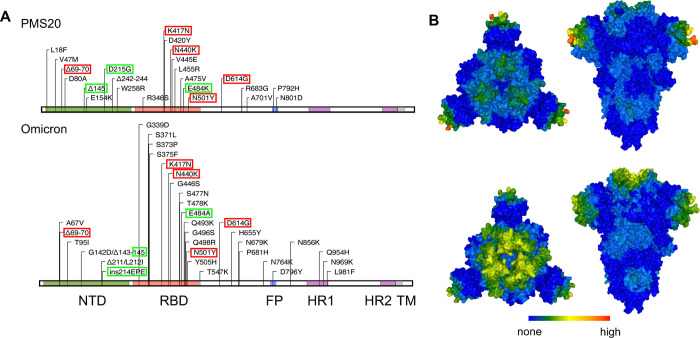
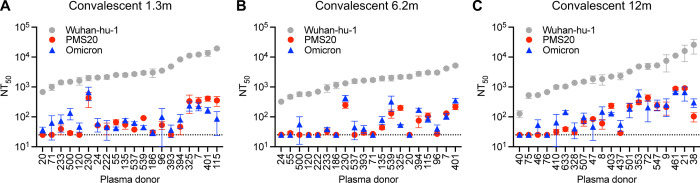
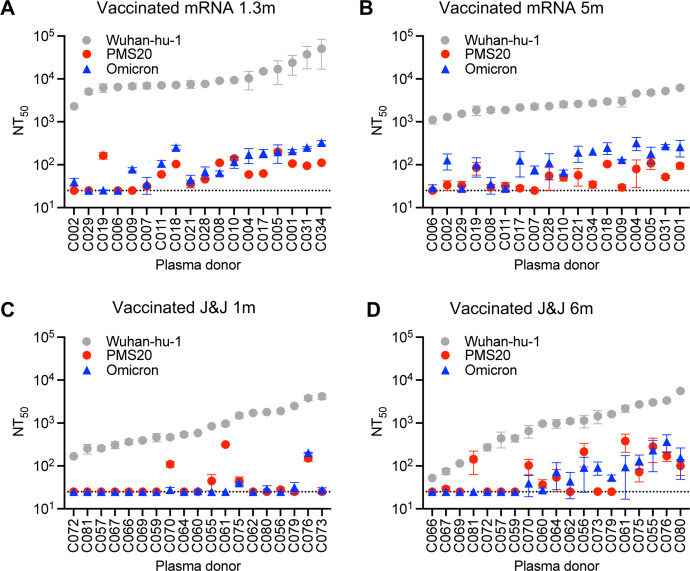
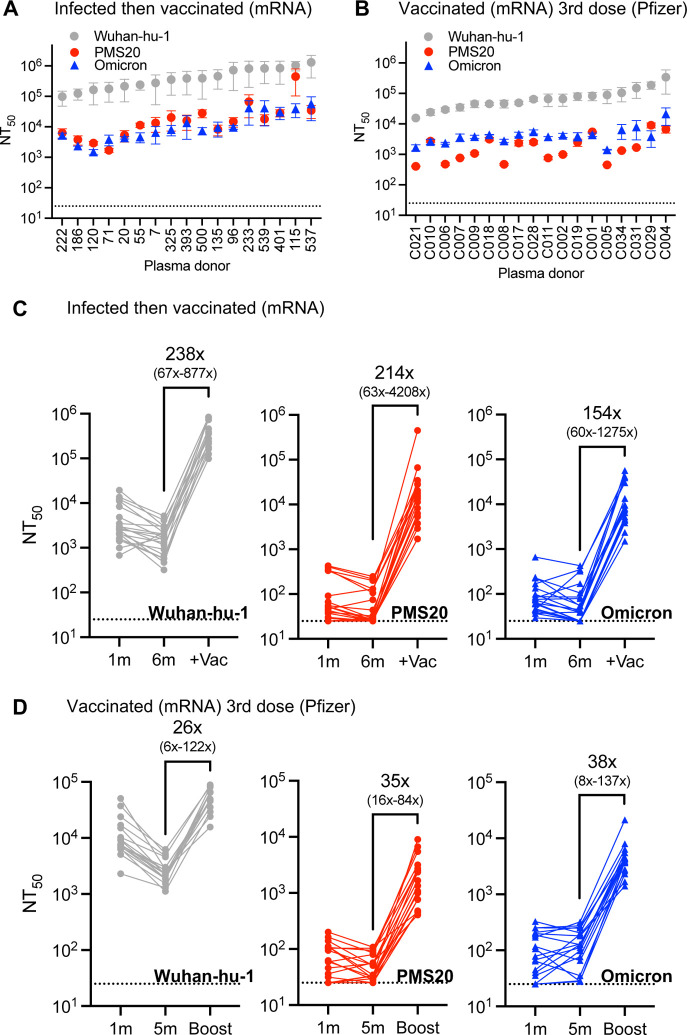
BACKGROUND: The Omicron SARS-CoV-2 variant has spread internationally and is responsible for rapidly increasing case numbers. The emergence of divergent variants in the context of a heterogeneous and evolving neutralizing antibody response in host populations might compromise protection afforded by vaccines or prior infection. METHODS: We measured neutralizing antibody titers in 169 longitudinally collected plasma samples using pseudotypes bearing the Wuhan-hu-1 or the Omicron variant or a laboratory-designed neutralization-resistant SARS-CoV-2 spike (PMS20). Plasmas were obtained from convalescents who did or did not subsequently receive an mRNA vaccine, or naive individuals who received 3-doses of mRNA or 1-dose Ad26 vaccines. Samples were collected approximately 1, 5-6 and 12 months after initial vaccination or infection. RESULTS: Like PMS20, the Omicron spike protein was substantially resistant to neutralization compared to Wuhan-hu-1. In convalescent plasma the median deficit in neutralizing activity against PMS20 or Omicron was 30- to 60-fold. Plasmas from recipients of 2 mRNA vaccine doses were 30- to 180- fold less potent against PMS20 and Omicron than Wuhan-hu-1. Notably, previously infected or two-mRNA dose vaccinated individuals who received additional mRNA vaccine dose(s) had 38 to 154-fold and 35 to 214-fold increases in neutralizing activity against Omicron and PMS20 respectively. CONCLUSIONS: Omicron exhibits similar distribution of sequence changes and neutralization resistance as does a laboratory-designed neutralization-resistant spike protein, suggesting natural evolutionary pressure to evade the human antibody response. Currently available mRNA vaccine boosters, that may promote antibody affinity maturation, significantly ameliorate SARS-CoV-2 neutralizing antibody titers.
Overview
The claims and statistics of this paper haven’t been checked yet.
Run the check — free, no account needed. It reads the open-access text and checks the sources it cites.
Integrity signals
Registry
Cites
Statistics
Figures
Verification
Claims the paper makes
The claims and statistics of this paper haven’t been checked yet.
Run the check — free, no account needed. It reads the open-access text and checks the sources it cites.
Claims other papers make about this one
Each is checked against this paper’s own text: does it say what the citing paper says it does?
The source backs part of the claim, not all of it — or backs it for a different population, condition or comparison.
In the citing paper
“However, due to escape of the Omicron variant from current approved vaccines, the efficacy of all current vaccines is reduced and a new variant-specific analysis is therefore required [13][14][15] .”
From Safety and immunogenicity of a prefusion non-stabilized spike protein mRNA COVID-19 vaccine: a phase I trial (2022) · cites this paper as [14]
Experimental — accuracy not yet measured
Self-check
Percentages, sums and reported differences re-computed from the paper’s own numbers.
The self-check needs the paper’s full text.
Citations
Cites
Convergent Antibody Responses to SARS-CoV-2 in Convalescent Individuals
Robbiani, D. F., Gaebler, C., Muecksch, F., Lorenzi, J. C. C., Wang, Z., Cho, A., Agudelo, M., Barnes, C. O., Gazumyan, A., Finkin, S., et al. (2020) · Nature · doi:10.1038/s41586-020-2456-9 · Cited by 1,853
Self-citationHoffmann, M., Kleine-Weber, H., & Pöhlmann, S. (2020) · Molecular Cell · doi:10.1016/j.molcel.2020.04.022 · Cited by 1,852
Evolution of antibody immunity to SARS-CoV-2
Gaebler, C., Wang, Z., Lorenzi, J. C. C., Muecksch, F., Finkin, S., Tokuyama, M., Cho, A., Jankovic, M., Schaefer-Babajew, D., Oliveira, T. Y., et al. (2021) · Nature · doi:10.1038/s41586-021-03207-w · Cited by 1,674
Self-citationPotent neutralizing antibodies against multiple epitopes on SARS-CoV-2 spike
Liu, L., Wang, P., Nair, M. S., Yu, J., Rapp, M., Wang, Q., Luo, Y., Chan, J. F.-W., Sahi, V., Figueroa, A., et al. (2020) · Nature · doi:10.1038/s41586-020-2571-7 · Cited by 1,349
mRNA vaccine-elicited antibodies to SARS-CoV-2 and circulating variants
Wang, Z., Schmidt, F., Weisblum, Y., Muecksch, F., Barnes, C. O., Finkin, S., Schaefer-Babajew, D., Cipolla, M., Gaebler, C., Lieberman, J. A., et al. (2021) · Nature · doi:10.1038/s41586-021-03324-6 · Cited by 1,343
Self-citationEscape from neutralizing antibodies by SARS-CoV-2 spike protein variants
Weisblum, Y., Schmidt, F., Zhang, F., DaSilva, J., Poston, D., Lorenzi, J. C., Muecksch, F., Rutkowska, M., Hoffmann, H.-H., Michailidis, E., et al. (2020) · eLife · doi:10.7554/elife.61312 · Cited by 1,308
Self-citationOmicron SARS-CoV-2 variant: a new chapter in the COVID-19 pandemic
Karim, S. S. A., & Karim, Q. A. (2021) · The Lancet · doi:10.1016/s0140-6736(21)02758-6 · Cited by 1,302
Baum, A., Fulton, B. O., Wloga, E., Copin, R., Pascal, K. E., Russo, V., Giordano, S., Lanza, K., Negron, N., Ni, M., et al. (2020) · Science · doi:10.1126/science.abd0831 · Cited by 1,253
Greaney, A. J., Loes, A. N., Crawford, K. H. D., Starr, T. N., Malone, K. D., Chu, H. Y., & Bloom, J. D. (2021) · Cell Host & Microbe · doi:10.1016/j.chom.2021.02.003 · Cited by 1,178
Naturally enhanced neutralizing breadth against SARS-CoV-2 one year after infection
Wang, Z., Muecksch, F., Schaefer-Babajew, D., Finkin, S., Viant, C., Gaebler, C., Hoffmann, H. H., Barnes, C. O., Cipolla, M., Ramos, V., et al. (2021) · Nature · doi:10.1038/s41586-021-03696-9 · Cited by 721
Self-citation
Cited by
Sorted by citations
Striking antibody evasion manifested by the Omicron variant of SARS-CoV-2
Liu, L., Iketani, S., Guo, Y., Chan, J. F.-W., Wang, M., Liu, L., Luo, Y., Chu, H., Huang, Y., Nair, M. S., et al. (2022) · Nature · doi:10.1038/s41586-021-04388-0 · Cited by 1,290
Tarke, A., Coelho, C. H., Zhang, Z., Dan, J. M., Yu, E. D., Methot, N., Bloom, N. I., Goodwin, B., Phillips, E., Mallal, S., et al. (2022) · Cell · doi:10.1016/j.cell.2022.01.015 · Cited by 858
SARS-CoV-2 Omicron variant: recent progress and future perspectives
Fan, Y., Li, X., Zhang, L., Wan, S., Zhang, L., & Zhou, F. (2022) · Signal Transduction and Targeted Therapy · doi:10.1038/s41392-022-00997-x · Cited by 599
Shrestha, L. B., Foster, C. S. P., Rawlinson, W. D., Tedla, N. T., & Bull, R. A. (2022) · Reviews in Medical Virology · doi:10.1002/rmv.2381 · Cited by 483
Divergent SARS-CoV-2 Omicron–reactive T and B cell responses in COVID-19 vaccine recipients
GeurtsvanKessel, C. H., Geers, D., Schmitz, K. S., Mykytyn, A. Z., Lamers, M. M., Bogers, S., Scherbeijn, S. M. J., Gommers, L., Sablerolles, R. S. G., Nieuwkoop, N. N., et al. (2022) · Science Immunology · doi:10.1126/sciimmunol.abo2202 · Cited by 406
Metadata
- Authors
- Schmidt, F., Muecksch, F., Weisblum, Y., Da Silva, J., Bednarski, E., Cho, A., Wang, Z., Gaebler, C., Caskey, M., Nussenzweig, M. C., Hatziioannou, T., & Bieniasz, P. D.
- Affiliations
- Rockefeller University (US)
- Rockefeller University, New York, NY
- Corresponding author
- Bieniasz, Paul D.
- Venue
- New England Journal of Medicine
- Publisher
- Massachusetts Medical Society
- Published
- 2022-02-10
- Volume
- 386
- Issue
- 6
- Pages
- 599-601
- ISSN
- 0028-4793 (ISSN-L)
- 1533-4406
- PMC
- PMC8687470
- OpenAlex
- W4205145778
- Cited by
- 432
- References
- 22
- Citations by year
- 2026: 9 · 2025: 16 · 2024: 24 · 2023: 68 · 2022: 307
- FWCI
- 32.20
- Type
- journal article
- Language
- en
- Open access
- bronze
- doi.org
- Locations
- New England Journal of Medicine (publishedVersion)
- medRxiv (acceptedVersion, cc-by-nc-nd)
- PubMed Central (publishedVersion)
- PubMed (publishedVersion)
- PubMed Central (submittedVersion, cc-by-nc-nd)
- Funders
- Howard Hughes Medical Institute
- National Institutes of Health (2U19AI111825, P01-AI138398-S1, R01AI501111, R01AI78788, R37AI64003)
- National Center for Advancing Translational Sciences (UL1 TR001866)
- Topics
- Health Sciences › Medicine › Infectious Diseases › SARS-CoV-2 and COVID-19 Research
- Health Sciences › Medicine › Infectious Diseases › COVID-19 Clinical Research Studies
- Life Sciences › Agricultural and Biological Sciences › Animal Science and Zoology › Animal Virus Infections Studies
- Keywords
- Omicron variant, neutralizing antibodies, plasma neutralization, spike protein mutations, receptor binding domain, N-terminal domain, antibody escape, Wuhan-Hu-1, COVID-19 recovery, mRNA vaccines, neutralization titers
About these checks
Registry, retraction, Cites and statistics results are computed, not judged, with one exception: a printed reference that no index lists is read once by a model before it counts as a citation error. Claims are extracted by a model and kept only when their quote appears verbatim in the text; each cited source is then checked, with a model’s help, for whether it says what the claim relies on. Those verdicts can be wrong — read the claim’s quote and the cited source before relying on one.
Statistics and arithmetic are recomputed, not judged.
Confidence bands are shown only for fields calibrated on our annotated test set. None is calibrated yet, so no band is shown.
What counts as a claim ›How we measure confidence ›How we check this ›
Are you an author, or do you see a problem with this page? Request a review
