

Everyone does it—differently: A window into emerging adults’ smartphone use
Open accessThe DOI matches its Crossref record; 74 of the 74 references it cites were found in a registry or an index.
Abstract
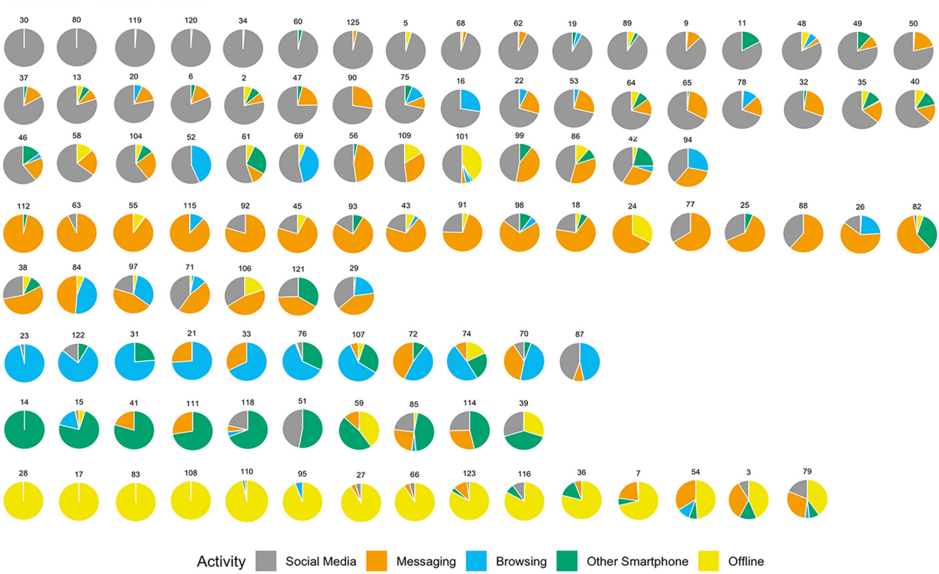
Concerns regarding smartphones’ and social media’s impact on youth remain high amidst a growing realization that current research is not designed to confirm (or refute) such concerns. This study aims to answer fundamental questions regarding youths’ use of smartphones, by implementing a novel user-centric research method. The smartphone use of 114 emerging adults was recorded, followed by in-depth interviews that incorporated the recording and in-app information to help participants recall their behaviours, motivations, and feelings. Results indicate that smartphone use is indeed ubiquitous; 88 out of 114 participants started using their smartphone as soon as they were left alone. However, the findings of this study also demonstrate great diversity in smartphone use, in e.g. social media platforms used and motivations for using different apps. These results illustrate that it no longer seems sensible to refer to “screen time” as if it represents a homogeneous phenomenon across youth. Additionally, preliminary indications have been found of relationships between individual differences in mental health indices and variations in smartphone use. The current study provides new insights into youths’ smartphone use and its relationship with wellbeing.
Overview
The claims and statistics of this paper haven’t been checked yet.
Free: it reads the open-access text and checks the first 5 claims that cite a source we can check. Create a free account to check every claim.
Integrity signals
Registry
Cites
Statistics
Figures


Verification
Claims the paper makes
The claims and statistics of this paper haven’t been checked yet.
Free: it reads the open-access text and checks the first 5 claims that cite a source we can check. Create a free account to check every claim.
Claims other papers make about this one
Each is checked against this paper’s own text: does it say what the citing paper says it does?
The source backs part of the claim, not all of it — or backs it for a different population, condition or comparison.
In the citing paper
“The emphasis on specific body measurements can lead to critical self-evaluation against often unattainable societal standards. Such comparisons can engender feelings of inadequacy, lower self-esteem, and foster dissatisfaction with one’s body image, which, in turn, can adversely affect overall mental well-being [63].”
From Body Perceptions and Psychological Well-Being: A Review of the Impact of Social Media and Physical Measurements on Self-Esteem and Mental Health with a Focus on Body Image Satisfaction and Its Relationship with Cultural and Gender Factors (2024) · cites this paper as [63]
Experimental — accuracy not yet measured
Self-check
Percentages, sums and reported differences re-computed from the paper’s own numbers.
The self-check needs the paper’s full text.
Citations
Cites
R: A Language and Environment for Statistical Computing
R Core Team (2025) · doi:10.32614/r.manuals · Cited by 352,181
(1970) · Cited by 24,983
A Simple Sequentially Rejective Multiple Test Procedure
(1979) · Scandinavian Journal of Statistics · doi:10.2307/4615733 · Cited by 21,526
(1995) · Cited by 6,909
Kirschbaum, C., Pirke, K.-M., & Hellhammer, D. H. (2008) · Neuropsychobiology · doi:10.1159/000119004 · Cited by 6,093
Self-Compassion: An Alternative Conceptualization of a Healthy Attitude Toward Oneself
NEFF, K. (2003) · Self and Identity · doi:10.1080/15298860309032 · Cited by 5,440
State-Trait Anxiety Inventory for Adults
Spielberger, C. D. (2012) · PsycTESTS Dataset · doi:10.1037/t06496-000 · Cited by 3,479
Construction and factorial validation of a short form of the Self-Compassion Scale
Raes, F., Pommier, E., Neff, K. D., & Van Gucht, D. (2011) · Clinical Psychology & Psychotherapy · doi:10.1002/cpp.702 · Cited by 2,997
Validity and reliability of the Experience-Sampling Method
CSIKSZENTMIHALYI, M., & LARSON, R. (1987) · The Journal of Nervous and Mental Disease · doi:10.1097/00005053-198709000-00004 · Cited by 2,544
Depression Anxiety Stress Scales
Lovibond, S. H., & Lovibond, P. F. (2011) · PsycTESTS Dataset · doi:10.1037/t01004-000 · Cited by 2,416
Research works printed but not linked: 2
- Krasnova H, Wenninger H, Widjaja T, Buxmann P (2013) Envy on Facebook: a hidden threat to users’ life satisfaction? Paper presented at 11th International Conference on Wirtschaftsinformatik, Leipzig, Germany, 27 February–1 March 2013
- UNCTAD (2020) Coronavirus reveals need to bridge the digital divide. In: United Nations Conference on Trade and Development. https://unctad.org/news/coronavirus-reveals-need-bridge-digital-divide. Accessed 14 Oct 2020
Cited by
Merino, M., Tornero-Aguilera, J. F., Rubio-Zarapuz, A., Villanueva-Tobaldo, C. V., Martín-Rodríguez, A., & Clemente-Suárez, V. J. (2024) · Healthcare · doi:10.3390/healthcare12141396 · Cited by 349
“Such comparisons can engender feelings of inadequacy, lower self-esteem, and foster dissatisfaction with one’s body image, which, in turn, can adversely affect overall mental well-being [63].”
BackgroundThe associations between screen time and mental health in adolescents: a systematic review
Santos, R. M. S., Mendes, C. G., Sen Bressani, G. Y., de Alcantara Ventura, S., de Almeida Nogueira, Y. J., de Miranda, D. M., & Romano-Silva, M. A. (2023) · BMC Psychology · doi:10.1186/s40359-023-01166-7 · Cited by 311
Digital well-being theory and research
Büchi, M. (2024) · New Media & Society · doi:10.1177/14614448211056851 · Cited by 277
Using SOR framework to explore the driving factors of older adults smartphone use behavior
Huang, T. (2023) · Humanities and Social Sciences Communications · doi:10.1057/s41599-023-02221-9 · Cited by 102
Zhu, W., Liu, J., Lou, H., Mu, F.-Z., & Li, B. (2024) · PLoS ONE · doi:10.1371/journal.pone.0307162 · Cited by 63
Metadata
- Authors
- Griffioen, N., Scholten, H., Lichtwarck-Aschoff, A., van Rooij, M., & Granic, I.
- Affiliations
- Radboud University Nijmegen (NL)
- University of Twente (NL)
- Corresponding author
- Griffioen, Nastasia
- Venue
- Humanities and Social Sciences Communications
- Published
- 2021-07-20
- Volume
- 8
- Issue
- 1
- ISSN
- 2055-1045 (ISSN-L)
- 2662-9992
- OpenAlex
- W3186895832
- Cited by
- 51
- References
- 73
- Citations by year
- 2026: 9 · 2025: 11 · 2024: 14 · 2023: 9 · 2022: 5 · 2021: 3
- FWCI
- 10.74
- Type
- journal article
- Language
- en
- Open access
- gold
- doi.org
- Licence
- cc-by
- creativecommons.org/licenses/by/4.0 (tdm)
- creativecommons.org/licenses/by/4.0 (vor)
- Locations
- Humanities and Social Sciences Communications (publishedVersion, cc-by)
- University of Groningen research database (University of Groningen / Centre for Information Technology) (publishedVersion, cc-by)
- University of Twente Research Information (publishedVersion, cc-by)
- RePEc: Research Papers in Economics (submittedVersion)
- DOAJ (DOAJ: Directory of Open Access Journals) (submittedVersion, cc-by-sa)
- Radboud Repository (Radboud University) (submittedVersion)
- Radboud Repository (Radboud University) (submittedVersion, other-oa)
- University of Groningen research database (University of Groningen / Centre for Information Technology) (submittedVersion, cc-by)
- University of Twente Research Information (submittedVersion, other-oa)
- Funders
- European Commission (HORIZON2020)
- H2020 European Research Council (683262)
- Topics
- Social Sciences › Sociology and Political Science › Impact of Technology on Adolescents
- Social Sciences › Education › Child Development and Digital Technology
- Social Sciences › Communication › Digital Media and Philosophy
- Keywords
- smartphone use, emerging adults, youth, social media, screen time, individual differences, mental health, well-being
About these checks
Registry, retraction, Cites and statistics results are computed, not judged, with one exception: a printed reference that no index lists is read once by a model before it counts as a citation error. Claims are extracted by a model and kept only when their quote appears verbatim in the text; each cited source is then checked, with a model’s help, for whether it says what the claim relies on. Those verdicts can be wrong — read the claim’s quote and the cited source before relying on one.
Statistics and arithmetic are recomputed, not judged.
Confidence bands are shown only for fields calibrated on our annotated test set. None is calibrated yet, so no band is shown.
What counts as a claim ›How we measure confidence ›How we check this ›
Are you an author, or do you see a problem with this page? Request a review
How to cite
Cite CoChat for the checks on this page, and the paper for its own findings.
- This page
- CoChat. (2026). Citation check: Everyone does it—differently: A window into emerging adults’ smartphone use. https://app.cochat.ai/papers/10.1057/s41599-021-00863-1
- The paper
- Griffioen, N., Scholten, H., Lichtwarck-Aschoff, A., van Rooij, M., & Granic, I. (2021). Everyone does it—differently: A window into emerging adults’ smartphone use. Humanities and Social Sciences Communications. https://doi.org/10.1057/s41599-021-00863-1
Data sources
Bibliographic data: Semantic Scholar, OpenAlex, Crossref.
Contains information from the Semantic Scholar Academic Graph Datasets, made available under the ODC Attribution License (ODC-BY 1.0).
Semantic Scholar’s data is described in: Kinney, R., et al. (2023). The Semantic Scholar Open Data Platform. arXiv:2301.10140.
