

Comparison of dielectric loss in titanium nitride and aluminum superconducting resonators
Open accessThe DOI matches its Crossref record; 27 of the 27 references it cites were found in a registry or an index.
Abstract
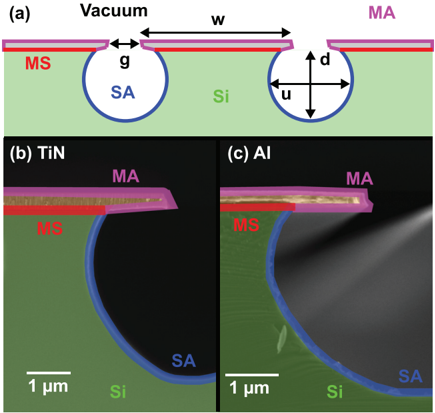
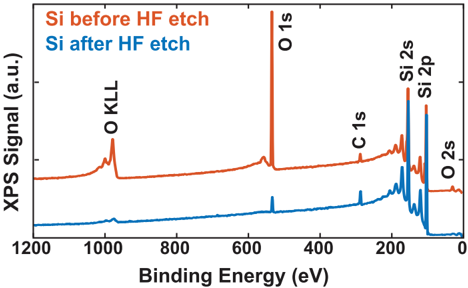
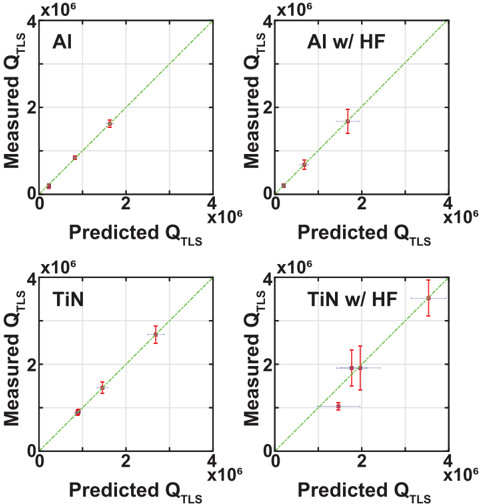
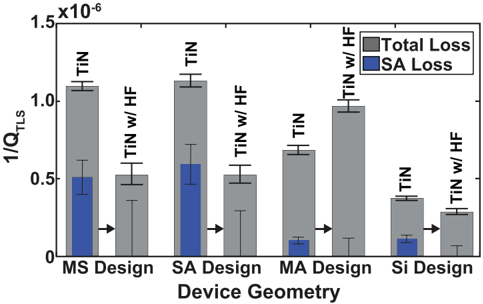
Lossy dielectrics are a significant source of decoherence in superconducting quantum circuits. In this report, we model and compare the dielectric loss in bulk and interfacial dielectrics in titanium nitride (TiN) and aluminum (Al) superconducting coplanar waveguide resonators. We fabricate isotropically trenched resonators to produce a series of device geometries that accentuate a specific dielectric region's contribution to the resonator quality factor. While each dielectric region contributes significantly to loss in TiN devices, the metal–air interface dominates the loss in the Al devices. Furthermore, we evaluate the quality factor of each TiN resonator geometry with and without a post-process hydrofluoric etch and find that it reduced losses from the substrate–air interface, thereby improving the quality factor.
Overview
The claims and statistics of this paper haven’t been checked yet.
Free: it reads the open-access text and checks the first 5 claims that cite a source we can check. Create a free account to check every claim.
Integrity signals
Registry
Cites
Statistics
Figures

Verification
Claims the paper makes
The claims and statistics of this paper haven’t been checked yet.
Free: it reads the open-access text and checks the first 5 claims that cite a source we can check. Create a free account to check every claim.
Claims other papers make about this one
Each is checked against this paper’s own text: does it say what the citing paper says it does?
The cited source says what the claim attributes to it.
In the citing paper
“Under the assumptions made for the interface thicknesses and dielectric constants, the effective interface loss tangent of our devices is , which is slightly better than the equivalently calculated values of for previously reported aluminium on silicon resonators44.”
From Advanced CMOS manufacturing of superconducting qubits on 300 mm wafers (2024) · cites this paper as [44]
Self-check
Percentages, sums and reported differences re-computed from the paper’s own numbers.
The self-check needs the paper’s full text.
Citations
Cites
Decoherence in Josephson Qubits from Dielectric Loss
Martinis, J. M., Cooper, K. B., McDermott, R., Steffen, M., Ansmann, M., Osborn, K. D., Cicak, K., Oh, S., Pappas, D. P., Simmonds, R. W., et al. (2005) · Physical Review Letters · doi:10.1103/physrevlett.95.210503 · Cited by 838
Place, A. P. M., Rodgers, L. V. H., Mundada, P., Smitham, B. M., Fitzpatrick, M., Leng, Z., Premkumar, A., Bryon, J., Vrajitoarea, A., Sussman, S., et al. (2021) · Nature Communications · doi:10.1038/s41467-021-22030-5 · Cited by 563
Towards understanding two-level-systems in amorphous solids: insights from quantum circuits
Müller, C., Cole, J. H., & Lisenfeld, J. (2019) · Reports on Progress in Physics · doi:10.1088/1361-6633/ab3a7e · Cited by 508
Planar superconducting resonators with internal quality factors above one million
Megrant, A., Neill, C., Barends, R., Chiaro, B., Chen, Y., Feigl, L., Kelly, J., Lucero, E., Mariantoni, M., O’Malley, P. J. J., et al. (2012) · Applied Physics Letters · doi:10.1063/1.3693409 · Cited by 481
Surface participation and dielectric loss in superconducting qubits
Wang, C., Axline, C., Gao, Y. Y., Brecht, T., Chu, Y., Frunzio, L., Devoret, M. H., & Schoelkopf, R. J. (2015) · Applied Physics Letters · doi:10.1063/1.4934486 · Cited by 340
Microwave dielectric loss at single photon energies and millikelvin temperatures
O’Connell, A. D., Ansmann, M., Bialczak, R. C., Hofheinz, M., Katz, N., Lucero, E., McKenney, C., Neeley, M., Wang, H., Weig, E. M., et al. (2008) · Applied Physics Letters · doi:10.1063/1.2898887 · Cited by 274
Improved superconducting qubit coherence using titanium nitride
Chang, J. B., Vissers, M. R., Córcoles, A. D., Sandberg, M., Gao, J., Abraham, D. W., Chow, J. M., Gambetta, J. M., Beth Rothwell, M., Keefe, G. A., et al. (2013) · Applied Physics Letters · doi:10.1063/1.4813269 · Cited by 247
Bruno, A., de Lange, G., Asaad, S., van der Enden, K. L., Langford, N. K., & DiCarlo, L. (2015) · Applied Physics Letters · doi:10.1063/1.4919761 · Cited by 239
Surface loss simulations of superconducting coplanar waveguide resonators
Wenner, J., Barends, R., Bialczak, R. C., Chen, Y., Kelly, J., Lucero, E., Mariantoni, M., Megrant, A., O’Malley, P. J. J., Sank, D., et al. (2011) · Applied Physics Letters · doi:10.1063/1.3637047 · Cited by 211
Study of loss in superconducting coplanar waveguide resonators
Sage, J. M., Bolkhovsky, V., Oliver, W. D., Turek, B., & Welander, P. B. (2011) · Journal of Applied Physics · doi:10.1063/1.3552890 · Cited by 210
Self-citation
Cited by
Materials challenges and opportunities for quantum computing hardware
de Leon, N. P., Itoh, K. M., Kim, D., Mehta, K. K., Northup, T. E., Paik, H., Palmer, B. S., Samarth, N., Sangtawesin, S., & Steuerman, D. W. (2021) · Science · doi:10.1126/science.abb2823 · Cited by 710
“For example, direct measurements of dielectric loss-limited resonators can be made more rapidly than full superconducting qubit measurements (60, 348).”
BackgroundSelf-citationQuantum information processing with bosonic qubits in circuit QED
Joshi, A., Noh, K., & Gao, Y. Y. (2021) · Quantum Science and Technology · doi:10.1088/2058-9565/abe989 · Cited by 152
Material matters in superconducting qubits
Murray, C. E. (2021) · Materials Science and Engineering R Reports · doi:10.1016/j.mser.2021.100646 · Cited by 173
Localization and Mitigation of Loss in Niobium Superconducting Circuits
Altoé, M. V. P., Banerjee, A., Berk, C., Hajr, A., Schwartzberg, A., Song, C., Alghadeer, M., Aloni, S., Elowson, M. J., Kreikebaum, J. M., et al. (2022) · PRX Quantum · doi:10.1103/prxquantum.3.020312 · Cited by 119
Investigation of Microwave Loss Induced by Oxide Regrowth in High- Q Niobium Resonators
Verjauw, J., Potočnik, A., Mongillo, M., Acharya, R., Mohiyaddin, F., Simion, G., Pacco, A., Ivanov, T., Wan, D., Vanleenhove, A., et al. (2021) · Physical Review Applied · doi:10.1103/physrevapplied.16.014018 · Cited by 105
“The LER receive a hydrofluoric acid (HF) etch to remove surface oxides [10], followed by a controlled oxide regrowth.”
BackgroundMethod
Metadata
- Authors
- Melville, A., Calusine, G., Woods, W., Serniak, K., Golden, E., Niedzielski, B. M., Kim, D. K., Sevi, A., Yoder, J. L., Dauler, E. A., & Oliver, W. D.
- Affiliations
- MIT Lincoln Laboratory (US)
- Corresponding author
- Melville, A.
- Venue
- Applied Physics Letters
- Publisher
- AIP Publishing
- Published
- 2020-09-21
- Volume
- 117
- Issue
- 12
- ISSN
- 0003-6951 (ISSN-L)
- 1077-3118
- OpenAlex
- W3043049963
- Cited by
- 69
- References
- 26
- Citations by year
- 2026: 7 · 2025: 8 · 2024: 17 · 2023: 18 · 2022: 12 · 2021: 7
- FWCI
- 3.63
- Type
- journal article
- Language
- en
- Open access
- hybrid
- doi.org
- Licence
- cc-by
- creativecommons.org/licenses/by/4.0/ (vor, 2 d)
- creativecommons.org/licenses/by/4.0/ (tdm, 2 d)
- Locations
- Applied Physics Letters (publishedVersion, cc-by)
- arXiv (Cornell University) (submittedVersion)
- arXiv (Cornell University)
- Funders
- U.S. Department of Defense (FA8721-05-C-0002, FA8702-15-D-0001)
- Topics
- Physical Sciences › Physics and Astronomy › Atomic and Molecular Physics, and Optics › Quantum Information and Cryptography
- Physical Sciences › Engineering › Electrical and Electronic Engineering › Superconducting and THz Device Technology
- Physical Sciences › Physics and Astronomy › Atomic and Molecular Physics, and Optics › Mechanical and Optical Resonators
- Keywords
- dielectric loss, titanium nitride, aluminum, superconducting resonators, coplanar waveguide resonators, quality factor, decoherence, metal-air interface, lossy dielectrics, superconducting quantum circuits
About these checks
Registry, retraction, Cites and statistics results are computed, not judged, with one exception: a printed reference that no index lists is read once by a model before it counts as a citation error. Claims are extracted by a model and kept only when their quote appears verbatim in the text; each cited source is then checked, with a model’s help, for whether it says what the claim relies on. Those verdicts can be wrong — read the claim’s quote and the cited source before relying on one.
Statistics and arithmetic are recomputed, not judged.
Confidence bands are shown only for fields calibrated on our annotated test set. None is calibrated yet, so no band is shown.
What counts as a claim ›How we measure confidence ›How we check this ›
Are you an author, or do you see a problem with this page? Request a review
How to cite
Cite CoChat for the checks on this page, and the paper for its own findings.
- This page
- CoChat. (2026). Citation check: Comparison of dielectric loss in titanium nitride and aluminum superconducting resonators. https://app.cochat.ai/papers/10.1063/5.0021950
- The paper
- Melville, A., Calusine, G., Woods, W., Serniak, K., Golden, E., Niedzielski, B. M., Kim, D. K., Sevi, A., Yoder, J. L., Dauler, E. A., & Oliver, W. D. (2020). Comparison of dielectric loss in titanium nitride and aluminum superconducting resonators. Applied Physics Letters. https://doi.org/10.1063/5.0021950
Data sources
Bibliographic data: Semantic Scholar, OpenAlex, Crossref.
Contains information from the Semantic Scholar Academic Graph Datasets, made available under the ODC Attribution License (ODC-BY 1.0).
Semantic Scholar’s data is described in: Kinney, R., et al. (2023). The Semantic Scholar Open Data Platform. arXiv:2301.10140.
