

Oxygen, ecology, and the Cambrian radiation of animals
Open accessThe DOI matches its Crossref record; 136 of the 137 references it cites were found in a registry or an index.
Abstract
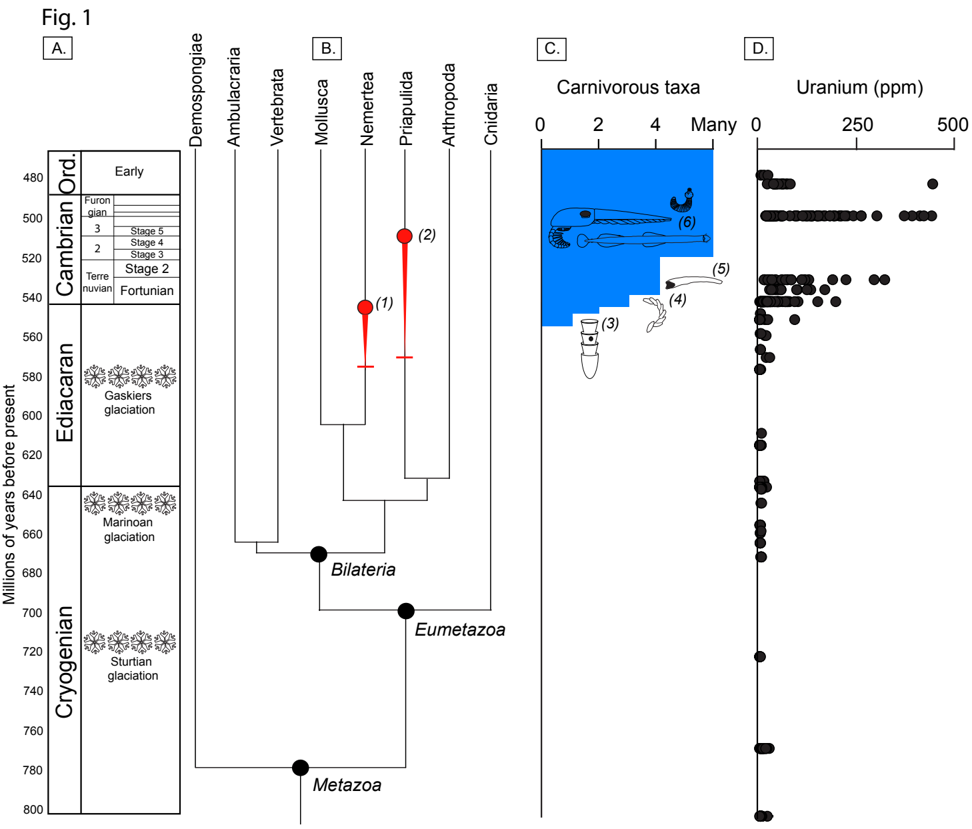
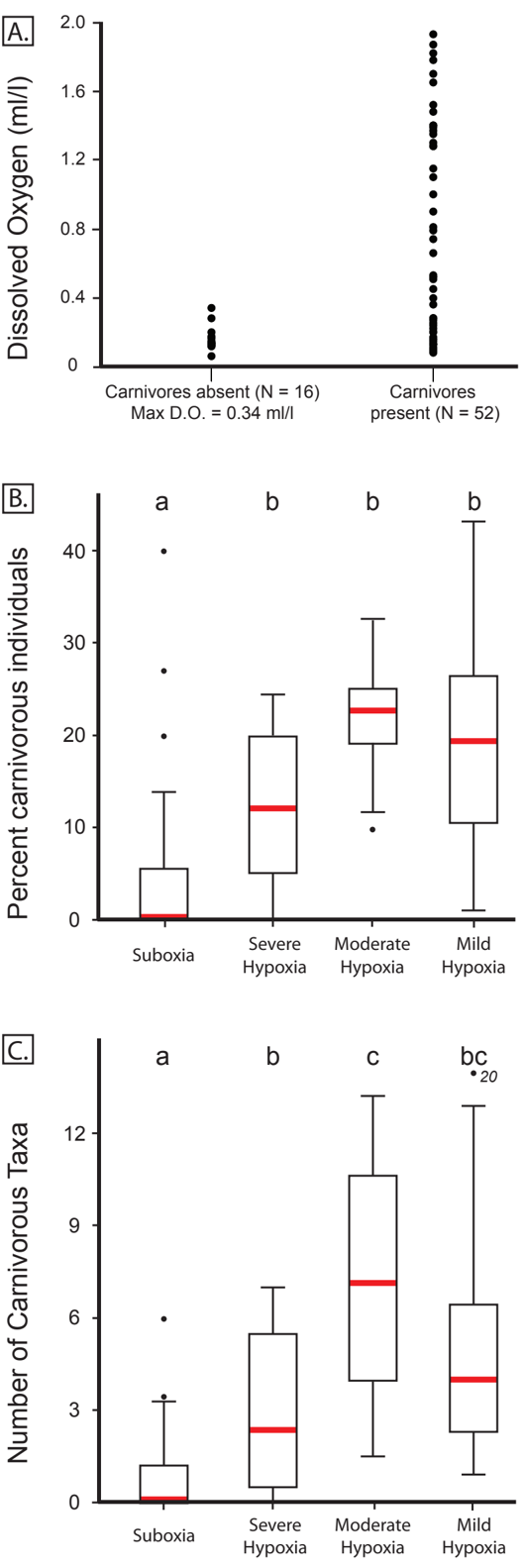
The Proterozoic-Cambrian transition records the appearance of essentially all animal body plans (phyla), yet to date no single hypothesis adequately explains both the timing of the event and the evident increase in diversity and disparity. Ecological triggers focused on escalatory predator–prey “arms races” can explain the evolutionary pattern but not its timing, whereas environmental triggers, particularly ocean/atmosphere oxygenation, do the reverse. Using modern oxygen minimum zones as an analog for Proterozoic oceans, we explore the effect of low oxygen levels on the feeding ecology of polychaetes, the dominant macrofaunal animals in deep-sea sediments. Here we show that low oxygen is clearly linked to low proportions of carnivores in a community and low diversity of carnivorous taxa, whereas higher oxygen levels support more complex food webs. The recognition of a physiological control on carnivory therefore links environmental triggers and ecological drivers, providing an integrated explanation for both the pattern and timing of Cambrian animal radiation.
Overview
The claims and statistics of this paper haven’t been checked yet.
Free: it reads the open-access text and checks the first 5 claims that cite a source we can check. Create a free account to check every claim.
Integrity signals
Registry
Cites
Statistics
Figures
Verification
Claims the paper makes
The claims and statistics of this paper haven’t been checked yet.
Free: it reads the open-access text and checks the first 5 claims that cite a source we can check. Create a free account to check every claim.
Claims other papers make about this one
Each is checked against this paper’s own text: does it say what the citing paper says it does?
The source backs part of the claim, not all of it — or backs it for a different population, condition or comparison.
In the citing paper
“Many of the new animal body plans and lifestyles that appeared during the early Cambrian were associated with considerably higher oxygen demands 9,10 .”
From Possible links between extreme oxygen perturbations and the Cambrian radiation of animals (2019) · cites this paper as [9]
Experimental — accuracy not yet measuredThe source backs part of the claim, not all of it — or backs it for a different population, condition or comparison.
In the citing paper
“In the modern and ancient oceans, well-oxygenated waters are generally associated with larger body sizes, higher diversity, advanced skeletal biomineralization, and increased motility and carnivory 9,10,54,55 .”
From Possible links between extreme oxygen perturbations and the Cambrian radiation of animals (2019) · cites this paper as [9]
Experimental — accuracy not yet measuredThe source backs part of the claim, not all of it — or backs it for a different population, condition or comparison.
In the citing paper
“This, consequently, would have increased surface ocean carbonate supersaturation, which may have reduced the physiological cost of carbonate skeleton construction and facilitated the evolutionary arms race13.”
From Rise to modern levels of ocean oxygenation coincided with the Cambrian radiation of animals (2015) · cites this paper as [13]
Experimental — accuracy not yet measuredThe source backs part of the claim, not all of it — or backs it for a different population, condition or comparison.
In the citing paper
“there is a broad consensus that dissolved oxygen provision reached a threshold, or series of thresholds, during the Neoproterozoic, allowing the diversification of metazoans and their increasing metabolic demands (23-25).”
From Integrated records of environmental change and evolution challenge the Cambrian Explosion (2019) · cites this paper as [23]
Experimental — accuracy not yet measuredThe source backs part of the claim, not all of it — or backs it for a different population, condition or comparison.
In the citing paper
“Modern lowoxygen regions are heterogeneous and dynamic habitats that support low diversity communities of opportunistic and non-skeletal metazoans, many of which are meiofaunal: large, skeletal, and motile metazoans, which form complex, biodiverse ecosystems, typically require higher oxygen levels (23).”
From Integrated records of environmental change and evolution challenge the Cambrian Explosion (2019) · cites this paper as [23]
Experimental — accuracy not yet measured
6 more claims about this paper
Create a free account to see every claim other papers make about this one.
Self-check
Percentages, sums and reported differences re-computed from the paper’s own numbers.
The self-check needs the paper’s full text.
Citations
Cites
Díaz, R. J., & Rosenberg, R. (1995) · Oceanography and Marine Biology/Oceanography and marine biology - an annual review · Cited by 2,846
The Diet of Worms: A Study of Polychaete Feeding Guilds
Fauchald, K., & Jumars, P. A. (1979) · Smithsonian Digital Repository (Smithsonian Institution) · Cited by 2,334
(2000) · CrossRef Listing of Deleted DOIs · doi:10.1016/s0967-0653(97)84825-9 · Cited by 2,011
Thresholds of hypoxia for marine biodiversity
Vaquer-Sunyer, R., & Duarte, C. M. (2008) · Proceedings of the National Academy of Sciences · doi:10.1073/pnas.0803833105 · Cited by 1,971
Biochemical Adaptation: Mechanism and Process in Physiological Evolution
Hochachka, P. W., & Somero, G. N. (2002) · doi:10.1093/oso/9780195117028.001.0001 · Cited by 1,906
Erwin, D. H., Laflamme, M., Tweedt, S. M., Sperling, E. A., Pisani, D., & Peterson, K. J. (2011) · Science · doi:10.1126/science.1206375 · Cited by 1,336 · cited 16×
“Palma M, et al. (2005) Macrobenthic animal assemblages of the continental margin off Chile (22° to 42° S).”
BackgroundInfluentialSelf-citationEarly animal evolution: emerging views from comparative biology and geology
Knoll, A. H., & Carroll, S. B. (1999) · Science · doi:10.1126/science.284.5423.2129 · Cited by 821 · cited 10×
“(Geological Society London, London), pp 405–414. 10. Peterson KJ, McPeek MA, Evans DAD (2005) Tempo and mode of early animal evo-”
BackgroundInfluentialSelf-citationGlobal distribution of naturally occurring marine hypoxia on continental margins
Helly, J. J., & Levin, L. A. (2004) · Deep Sea Research Part I: Oceanographic Research Papers · doi:10.1016/j.dsr.2004.03.009 · Cited by 767
Self-citationCoull, B. C. (1977) · Medical Entomology and Zoology · Cited by 748
OXYGEN MINIMUM ZONE BENTHOS: ADAPTATION AND COMMUNITY RESPONSE TO HYPOXIA
(2003) · Oceanography and Marine Biology, An Annual Review, Volume 41 · doi:10.1201/9780203180570-3 · Cited by 706
Self-citation
Research works printed but not linked: 2
- 9. Dzik J (2005) in The Rise and Fall of the Ediacara Biota, eds Vickers-Rich P, Komarower, P. (Geological Society London, London), pp 405-414.
- 11. Parker A (2003) In the Blink of an Eye (Perseus Publishing, Cambridge, MA).
Cited by
Items 201–300 of 392
No Furongian Biodiversity Gap: Evidence from South China
Deng, Y., Fan, J., Yang, S., Shi, Y., Lu, Z., Xu, H., Sun, Z., Zhao, F., & Hou, Z.-S. (2022) · Palaeogeography Palaeoclimatology Palaeoecology · doi:10.1016/j.palaeo.2023.111492 · Cited by 19
Mesoproterozoic paleo-redox changes during 1500–1400 Ma in the Yanshan Basin, North China
Chen, X., Li, M., Sperling, E. A., Zhang, T., Zong, K., Liu, Y., & Shen, Y. (2020) · Precambrian Research · doi:10.1016/j.precamres.2020.105835 · Cited by 21
“Although the exact oxygen levels are debated, higher oxygen levels are certainly required to support the activities of eukaryotes with large bodies and more complex food webs (Sperling et al., 2013; Cole et al., 2020).”
BackgroundSelf-citationCaxito, F. D. A., Sperling, E. A., Fazio, G., Adôrno, R. R., Denezine, M., do Carmo, D. A., Giorgioni, M., Uhlein, G. J., & Sial, A. N. (2024) · Geoscience Frontiers · doi:10.1016/j.gsf.2024.101810 · Cited by 19
“…by which oxygen influenced animal evolution are unclear, it was most probably through crossing of critical ecological thresholds at low O 2 (Sperling et al., 2013, 2022) and through stabilization of metazoan extinction rates after O 2 rose to near-modern levels during the early Phanerozoic…”
Self-citationZhang, T., Li, Y., Fan, T., Lash, G. G., Gao, Z., & Fan, Q. (2020) · Palaeogeography Palaeoclimatology Palaeoecology · doi:10.1016/j.palaeo.2020.110011 · Cited by 18
Macrobenthos relative to the oxygen minimum zone on the East Indian margin, Bay of Bengal
Raman, A. V., Damodaran, R., Levin, L. A., Thiruchitrambalam, G., Rao, Y. K. V., Nanduri, S., & Madhusoodhanan, R. (2014) · Marine Ecology · doi:10.1111/maec.12176 · Cited by 18
Self-citationWas the Cambrian explosion both an effect and an artifact of true polar wander?
Mitchell, R. N., Raub, T. D., Silva, S. C., & Kirschvink, J. L. (2015) · American Journal of Science · doi:10.2475/10.2015.02 · Cited by 18
Ocean Redox State at 2500‒500 Ma: Modern Concepts
Maslov, A. V., & Podkovyrov, V. N. (2018) · Lithology and Mineral Resources · doi:10.1134/s0024490218030057 · Cited by 19
A New Negative Carbon Isotope Interval Caused by Manganese Redox Cycling After the Shuram Excursion
Zhang, B., Cao, J., Hu, K., Liao, Z., Zhang, R., Zhang, Y., Shi, C., & Konhauser, K. O. (2024) · Journal of Geophysical Research Solid Earth · doi:10.1029/2023jb028307 · Cited by 18
“During the middle Ediacaran, the South China Block was near 24°N, and it finally approached the equator by the early Cambrian (Li et al., 2013, 2022).”
InfluentialChromium evidence for protracted oxygenation during the Paleoproterozoic
Mänd, K., Planavsky, N. J., Porter, S. M., Robbins, L. J., Wang, C., Kreitsmann, T., Paiste, K., Paiste, P., Romashkin, A. E., Deines, Y. E., et al. (2022) · Earth and Planetary Science Letters · doi:10.1016/j.epsl.2022.117501 · Cited by 17
Extremophiles in Earth's Deep Seas: A View Toward Life in Exo-Oceans
McClain, C. R., Bryant, S. R. D., Hanks, G. W., & Bowles, M. W. (2022) · Astrobiology · doi:10.1089/ast.2021.0120 · Cited by 17
“Certain ecological traits, such as carnivory, may also be tied to higher oxygen levels as active predation and digestion of large prey parcels are metabolically expensive (Sperling et al. , 2013).”
Zhang, J., Lyons, T. W., Li, C., Fang, X. M., Chen, Q., Botting, J. P., & Zhang, Y. (2022) · Global and Planetary Change · doi:10.1016/j.gloplacha.2022.103917 · Cited by 17
Ichnofossil record of selective predation by Cambrian trilobites
Selly, T., Huntley, J. W., Shelton, K. L., & Schiffbauer, J. D. (2015) · Palaeogeography Palaeoclimatology Palaeoecology · doi:10.1016/j.palaeo.2015.11.033 · Cited by 17
Freymueller, N. A., Moore, J. R., & Myers, C. (2019) · Paleobiology · doi:10.1017/pab.2019.10 · Cited by 16
“We hypothesized carnivores to decrease in diversity due to increased prey mortality resulting from anoxia and because carnivory has been shown to require higher oxygen concentrations for both prey capture and metabolism (Sperling et al. 2013).”
BackgroundIntersection of motor volumes predicts the outcome of ambush predation of larval zebrafish
Bhattacharyya, K., McLean, D. L., & MacIver, M. A. (2021) · Journal of Experimental Biology · doi:10.1242/jeb.235481 · Cited by 15
Hg isotope evidence for oceanic oxygenation during the Cambrian Explosion
Fan, H., Fu, X., Yang, R., Wen, H., Hu, C., Ward, J. F., Zhang, H., Zhang, H., & Zhang, X. (2023) · Geochimica et Cosmochimica Acta · doi:10.1016/j.gca.2023.10.020 · Cited by 15
Yuan, L., Zhou, Y., Chen, X., Zhu, M., Poulton, S. W., Tian, Z., Li, D., THIRLWALL, M. F., & Shields, G. (2023) · Precambrian Research · doi:10.1016/j.precamres.2023.107004 · Cited by 16
“Furthermore, Algeo and Lyons (2006) proposed that changes in the degree of connection with the open ocean also affects Mo abundance in basinal seawater and sediments.”
BackgroundBurrowers from the Past: Mitochondrial Signatures of Ordovician Bivalve Infaunalization
Plazzi, F., Puccio, G., & Passamonti, M. (2017) · Genome Biology and Evolution · doi:10.1093/gbe/evx051 · Cited by 14
“However, this is not the ancestral bivalve condition; Cambrian forms were surface crawlers and only during the Ordovician a fundamental infaunalization process took place, leading to bivalves as we currently know them.”
BackgroundOn the use of models in understanding the rise of complex life
Lenton, T. M. (2020) · Interface Focus · doi:10.1098/rsfs.2020.0018 · Cited by 13
“Recently, it became apparent that oxygen levels would have to have been very low to have constrained the evolution or ecological expansion of sponges (the basal animals) [9] and several other (subsequently evolved) types of animal life [2].”
BackgroundAn evolutionary solution of terrestrial isopods to cope with low atmospheric oxygen levels
Horváthová, T., Antoł, A., Czarnoleski, M., Kozłowski, J., & Bauchinger, U. (2017) · Journal of Experimental Biology · doi:10.1242/jeb.156661 · Cited by 12
The Ediacaran‐Cambrian Transition
Kaufman, A. J. (2018) · Geophysical monograph · doi:10.1002/9781119382508.ch7 · Cited by 13
Cole, D. B., Ozaki, K., & Reinhard, C. T. (2022) · Global Biogeochemical Cycles · doi:10.1029/2021gb007052 · Cited by 13
Ecological constraints on the origin of neurones
Monk, T., Paulin, M. G., & Green, P. (2015) · Journal of Mathematical Biology · doi:10.1007/s00285-015-0862-7 · Cited by 15
“…fragments, trace fossils, or functional interpretations of body parts that are consistent with the existence of macrophagy (e.g. shells and drills) (Clapham et al. 2003; Hua et al. 2003; McMenamin 1986; Narbonne 2005; Northcutt 2012; Sperling et al. 2013; Waggoner 1998; Xiao and Laflamme 2008).”
BackgroundAdaptive responses in Cambrian predator and prey highlight the arms race during the rise of animals
Bicknell, R. D. C., Campione, N. E., Brock, G. A., & Paterson, J. R. (2025) · Current Biology · doi:10.1016/j.cub.2024.12.007 · Cited by 12
Trott, T. J. (2017) · Marine and Freshwater Behaviour and Physiology · doi:10.1080/10236244.2017.1304153 · Cited by 12
“The Priapulida is a phylum of exclusively marine worms which were among the most abundant benthic metazoan carnivores during the Cambrian (Vannier & Chen 2005; Vannier et al. 2010; Sperling et al. 2013).”
BackgroundWei, G., Li, D., Lu, Z., Jiang, G., & Ling, H.-F. (2024) · Global and Planetary Change · doi:10.1016/j.gloplacha.2024.104522 · Cited by 13
Soreghan, G. S., & Cohen, A. S. (2013) · Scientific Drilling · doi:10.5194/sd-16-63-2013 · Cited by 12
Dietary inference from dental topographic analysis of feeding tools in diverse animals
Stockey, C., Adams, N. F., Harvey, T. H. P., Donoghue, P. C. J., & Purnell, M. A. (2022) · Methods in Ecology and Evolution · doi:10.1111/2041-210x.13832 · Cited by 12
Schiffbauer, J. D. (2016) · Geology · doi:10.1130/focus112016.1 · Cited by 11
Okafor, M.-M., & Azmy, K. (2023) · Palaeogeography Palaeoclimatology Palaeoecology · doi:10.1016/j.palaeo.2023.111978 · Cited by 11
Partial recovery of macrozoobenthos on the northwestern shelf of the Black Sea
Chevalier, S., Beauchard, O., Teacă, A., Soetaert, K., & Grégoire, M. (2024) · Marine Pollution Bulletin · doi:10.1016/j.marpolbul.2024.116857 · Cited by 11
Wang, H., Wang, D., Wei, G., Ling, H., Struck, U., Wei, W., Yao, S., Cheng, C., Li, J., Sun, Y., et al. (2021) · Precambrian Research · doi:10.1016/j.precamres.2021.106501 · Cited by 11
A Bayesian Analysis of Technological Intelligence in Land and Oceans
Lingam, M., Balbi, A., & Mahajan, S. M. (2023) · The Astrophysical Journal · doi:10.3847/1538-4357/acb6fa · Cited by 11
“…that the evolution of the forerunners of TIs (e.g., complex multicellular life forms that are macroscopic and motile) might necessitate high O2 concentrations; the latter could also promote higher biodiversity and complex food webs (Levin & Gage 1998; Sperling et al. 2013; Knoll & Sperling 2014).”
BackgroundRespiratory medium and circulatory anatomy constrain size evolution in marine macrofauna
Heim, N. A., Bakshi, S. H., Buu, L., Chen, S., Heh, S., Jain, A., Noll, C., Patkar, A., Rizk, N., Sundararajan, S., et al. (2020) · Paleobiology · doi:10.1017/pab.2020.16 · Cited by 11
Meinhold, G., Willbold, M., Karius, V., Jensen, S., Agić, H., Ebbestad, J. O. R., Palacios, T., Högström, A. E. S., Høyberget, M., & Taylor, W. L. (2022) · Precambrian Research · doi:10.1016/j.precamres.2022.106845 · Cited by 12
Wu, K., Zhang, T., Yang, Y., Sun, Y., & Yuan, D. (2016) · Journal of Earth Science · doi:10.1007/s12583-016-0693-5 · Cited by 11
Redox heterogeneity of the Ediacaran ocean constrained by chromium isotopes
He, X., Fang, Z., Gao, Y., Yu, X., Shen, Y., & Qin, L. (2022) · Geochimica et Cosmochimica Acta · doi:10.1016/j.gca.2022.12.024 · Cited by 10
Venugopal, A., Tripathy, G. R., Goswami, V., Ghosh, S. K., & Singh, D. (2023) · Geochemistry Geophysics Geosystems · doi:10.1029/2023gc011182 · Cited by 10
The struggle to equilibrate outer and inner milieus: Renal evolution revisited
Keogh, L., Kilroy, D. P., & Bhattacharjee, S. (2020) · Annals of Anatomy - Anatomischer Anzeiger · doi:10.1016/j.aanat.2020.151610 · Cited by 11
Cadmium isotope evidence for near-modern bio-productivity in the early Cambrian ocean
Liu, Z., Dickson, A. J., Sun, H., Wu, Y., Qiu, Z., & Tian, H. (2024) · Chemical Geology · doi:10.1016/j.chemgeo.2024.122275 · Cited by 9
Li, H., Zhuo, D., Wáng, B., Nakamine, H., Yamamoto, S., Zhang, W., Jepson, J. E., Ohl, M., Aspöck, U., Aspöck, H., et al. (2024) · Systematic Biology · doi:10.1093/sysbio/syae068 · Cited by 15
The Interdisciplinary Entanglement of Characterization and Explanation
Dresow, M. W., & Love, A. C. (2022) · The British Journal for the Philosophy of Science · doi:10.1086/720414 · Cited by 10
The evolution of complex multicellularity in animals
Kourki, A. N. (2022) · Biology & Philosophy · doi:10.1007/s10539-022-09870-1 · Cited by 9
Caxito, F. D. A., Frei, R., Sial, A. N., Uhlein, G. J., de Moura, W. A. L., Pereira, E., & Rodrigues, R. (2022) · Geology · doi:10.1130/g50344.1 · Cited by 9
Gradients and instability: Macrozoobenthic communities in the Benguela Upwelling System off Namibia
Amorim, K., & Zettler, M. L. (2023) · Estuarine Coastal and Shelf Science · doi:10.1016/j.ecss.2023.108421 · Cited by 9
Xiang, L., Cai, C., He, X., Jiang, L., Yuan, Y., Wang, T., Jia, L., & Yu, L. (2016) · Journal of Earth Science · doi:10.1007/s12583-016-0695-3 · Cited by 9
“Furthermore, the downward migration of oxycline will promote the bloom of consumer, ameliorate the predator-prey strategy, and directly extend the complexity of ecosystem (Sperling et al., 2013).”
BackgroundBreathing room for early animals
Fischer, W. W. (2016) · Proceedings of the National Academy of Sciences · doi:10.1073/pnas.1525100113 · Cited by 9
Palaeoecology of Ediacaran metazoan reefs
Wood, R. A. (2016) · Geological Society London Special Publications · doi:10.1144/sp448.1 · Cited by 9
“Experimental work has also shown that the oxygen levels necessary to support small, primitive metazoans such as sponges (Porifera) are far lower (Mills et al., 2014) than those required for large, active, and ecologically-important animals such as carnivorous predators (Sperling et al., 2013).”
BackgroundTrubovitz, S., & Stigall, A. L. (2017) · Lethaia · doi:10.1111/let.12233 · Cited by 9
How did life come to tolerate and thrive in an oxygenated world?
Fischer, W. W., & Valentine, J. S. (2019) · Free Radical Biology and Medicine · doi:10.1016/j.freeradbiomed.2019.07.021 · Cited by 9
Ferreira, P. L. F., Ader, M., Caetano-Filho, S., Sansjofre, P., de Paula-Santos, G. M., Babinski, M., Guacaneme, C., Bedoya-Rueda, C., Rojas, V., Reis, H., et al. (2021) · Frontiers in Earth Science · doi:10.3389/feart.2021.692895 · Cited by 8
Rugen, E. J., Ineson, J. R., & Frei, R. (2022) · Precambrian Research · doi:10.1016/j.precamres.2022.106781 · Cited by 8
Ai, Y., Zhu, G., Li, T., & Zhu, Z. (2023) · Applied Geochemistry · doi:10.1016/j.apgeochem.2023.105588 · Cited by 8
Animal Evolution: When Small Worms Cast Long Phylogenetic Shadows
Vinther, J. (2015) · Current Biology · doi:10.1016/j.cub.2015.07.003 · Cited by 8
Molecular dating of the blood pigment hemocyanin provides new insight into the origin of animals
Costa-Paiva, E. M., Mello, B., Bezerra, B. S., Coates, C. J., Halanych, K. M., Brown, F. D., Leme, J. D. M., & Trindade, R. I. F. (2021) · Geobiology · doi:10.1111/gbi.12481 · Cited by 8
The Evolutionary Origin of Nervous Systems and Implications for Neural Computation
Monk, T. (2014) · Otago University Research Archive (University of Otago) · Cited by 8
Climatic-oceanic destabilization facilitated the euxinic expansion in the early Cambrian oceans
Cao, G., Liu, S., Liu, P., Zhao, Y., Liu, Y., Li, D., Guo, X., Zhang, Y., Yang, L., Zhang, Z., et al. (2025) · Global and Planetary Change · doi:10.1016/j.gloplacha.2025.104925 · Cited by 8
Orbitally‐Driven Nutrient Pulses Linked to Early Cambrian Periodic Oxygenation and Animal Radiation
Zhang, Y., Mills, B. J. W., Newton, R. J., He, T., Roper, A., Yang, T., & Zhu, M. (2025) · Geophysical Research Letters · doi:10.1029/2025gl118689 · Cited by 8
“…carbon‐sulfur isotopic couplings observed in the lower Cambrian successions as well as being consistent with other key boundary conditions (e.g., seawater sulfate concentration (Brennan et al., 2004) and atmospheric O 2 levels (Sperling et al., 2013, 2015), Figure S14 in Supporting Information S1).”
InfluentialTubule system of earliest shells as a defense against increasing microbial attacks
Li, L., Topper, T. P., Betts, M. J., Altanshagai, G., Enkhbaatar, B., Li, G., Li, S., Skovsted, C. B., Cui, L., & Zhang, X. (2024) · iScience · doi:10.1016/j.isci.2024.109112 · Cited by 7
Harnik, P. G., Chao, A., Collins, K. S., & Rillo, M. C. (2024) · Continental Shelf Research · doi:10.1016/j.csr.2024.105339 · Cited by 7
Polar Meiofauna—Antipoles or Parallels?
Ingels, J., Hasemann, C., Soltwedel, T., & Vanreusel, A. (2023) · Springer eBooks · doi:10.1007/978-3-031-21622-0_9 · Cited by 7
Wang, X., Dong, L., Ma, H., Lang, X., & Wang, R. (2024) · Global and Planetary Change · doi:10.1016/j.gloplacha.2024.104546 · Cited by 7
On the mechanisms of sulfur isotope fractionation during microbial sulfate reduction
Leavitt, W. D. (2014) · Digital Access to Scholarship at Harvard (DASH) (Harvard University) · Cited by 7
Ocean redox evolution past and present
Hardisty, D. S., & Lau, K. (2024) · Elsevier eBooks · doi:10.1016/b978-0-323-99762-1.00033-4 · Cited by 6
Meng, G., Gai, H., Wu, Y., Gao, P., Lu, C., Zhou, Q., Li, T., Fan, Q., Liu, W., Zhao, Y., et al. (2025) · Global and Planetary Change · doi:10.1016/j.gloplacha.2025.105146 · Cited by 6
Chanchai, W., Nelson, L. L., Smith, E. F., Hardisty, D. S., Lonsdale, M. C., Burke, J. E., & Lau, K. (2025) · Geobiology · doi:10.1111/gbi.70039 · Cited by 7
“…body and trace fossil records indicate significant ecological developments, including the emergence of ecosystem engineering behaviors such as intensive and complex bioturbation, and ecological interactions like predation (Darroch et al. 2018, 2023; Mángano et al. 2012; Sperling et al. 2013).”
Zheng, C. Y. C., Kerans, C., Buatois, L. A., Mángano, M. G., & Ko, L. ‘. (2024) · Sedimentology · doi:10.1111/sed.13169 · Cited by 6
“Under long-standing hypoxia, the deposit-feeding strategy of vermiform animals is the preferred trophic type within the sediment or at the surface (Levin et al ., 2009; Sperling et al ., 2013).”
BackgroundHe, Y., Zhu, X., Qiu, Y., Pang, L., & Zhao, T. (2022) · Precambrian Research · doi:10.1016/j.precamres.2022.106901 · Cited by 6
Hu, D., Sun, L., Xu, Y., Zhang, X., Zhang, X., & Shen, Y. (2025) · Chemical Geology · doi:10.1016/j.chemgeo.2025.122890 · Cited by 5
Tan, Y., Meng, G., Feng, Y., Liu, W., Wang, Q., Gao, P., & Xiao, X. (2025) · Journal of Marine Science and Engineering · doi:10.3390/jmse13061175 · Cited by 5
Wei, K., Cao, H., Chen, F., Wang, Z., An, Z., Huang, H., & Chen, C. (2023) · Geological Magazine · doi:10.1017/s0016756823000833 · Cited by 5
“The remarkable increase in dissolved oxygen levels in oceans was thought to serve as a pivotal catalyst that resulted in the innovation of primitive simple animals and their diversification (e.g., Erwin et al. 2011; Sperling et al. 2013).”
BackgroundEvidence for low sulfate and anoxic deep waters in early Cambrian
Gong, Y., Li, D., Li, M., Sun, L., Zhang, X., Cui, Y., Fu, Y., Xu, Y., & Shen, Y. (2024) · Palaeogeography Palaeoclimatology Palaeoecology · doi:10.1016/j.palaeo.2024.112281 · Cited by 5
The ancestral architecture of the immune system in simplest animals
Romanova, D. Y., & Moroz, L. L. (2025) · Frontiers in Immunology · doi:10.3389/fimmu.2024.1529836 · Cited by 5
Belato, F. A., Mello, B., Coates, C. J., Halanych, K. M., Brown, F. D., Morandini, A. C., Leme, J. D. M., Trindade, R. I. F., & Costa-Paiva, E. M. (2023) · Geobiology · doi:10.1111/gbi.12577 · Cited by 5
“To meet the energetic and structural demands of larger animals, oxy - gen is necessary to maintain ATP production through the mitochon - drial respiratory chain, and to synthesize collagen (Mills & Canfield, 2014 ; Semenza, 2007 ; Sperling et al., 2013 ).”
BackgroundThe Early Earth as an Analogue for Exoplanetary Biogeochemistry
Stüeken, E. E., Olson, S. L., Moore, E. K., & Foley, B. J. (2024) · Reviews in Mineralogy and Geochemistry · doi:10.2138/rmg.2024.90.14 · Cited by 5
Liu, S., Jia, C., Zhu, X., Su, W., & Zhao, T. (2025) · Palaeogeography Palaeoclimatology Palaeoecology · doi:10.1016/j.palaeo.2025.113077 · Cited by 4
Clemente, J. N. R., Fan, H., Ostrander, C. M., Zhang, H., Wen, H., Sperling, E. A., & Nielsen, S. G. (2025) · Geobiology · doi:10.1111/gbi.70028 · Cited by 5
Self-citationGoswami, A., Mohanty, S., Sarangi, S., Das, S., Mohanty, D., & Barik, A. (2025) · International Journal of Earth Sciences · doi:10.1007/s00531-025-02538-7 · Cited by 4
“Therefore, V/Cr above 2 is considered to be a representative of anoxic environment whereas values < 1 which represent the boundary between suboxic and oxic condition (Ernst 1970; Emerson and Huested 1991; Jones and Manning 1994; Sperling et al. 2013).”
Biddle, S. K., & Gingras, M. K. (2026) · Earth-Science Reviews · doi:10.1016/j.earscirev.2026.105440 · Cited by 4
Biddle, S. K., & Gingras, M. K. (2025) · Sedimentology · doi:10.1111/sed.70063 · Cited by 4
“…( > 2% TOC; Wetzel, 1983, 1991); and transient oxygenation, since sustained deep-tier feeding behaviours require stable, well-oxygenated conditions due to higher metabolic demands compared to shallow-tier mobile deposit feeding (Buatois et al ., 2011; Sperling et al ., 2013; Desai & Biswas, 2018).”
Chen, X., Zhou, Y., Poulton, S. W., Bowyer, F. T., Mettam, C., Zhang, S., Zhu, M., Li, D. S., von Strandmann, P. A. E. P., Mills, B. J. W., et al. (2026) · Earth and Planetary Science Letters · doi:10.1016/j.epsl.2026.119848 · Cited by 4
On the evolutionary emergence of predation
Ispolatov, Y., Doebeli, C., & Doebeli, M. (2023) · Journal of Theoretical Biology · doi:10.1016/j.jtbi.2023.111578 · Cited by 4
Li, J., & Azmy, K. (2023) · Marine and Petroleum Geology · doi:10.1016/j.marpetgeo.2023.106408 · Cited by 4
Ke, W., Wei, G., Yin, Y., Yu, Z., He, T., Zhu, M., & Ling, H. (2024) · Global and Planetary Change · doi:10.1016/j.gloplacha.2024.104596 · Cited by 4
Yang, B., Chen, D., & Liu, M. (2025) · Palaeogeography Palaeoclimatology Palaeoecology · doi:10.1016/j.palaeo.2025.112881 · Cited by 4
Dolman, J. (2013) · Wildlife Society Bulletin · doi:10.1002/wsb.307 · Cited by 4
Phanerozoic co-evolution of O2-CO2 and ocean habitability
Lu, Z., Rickaby, R. E. M., Payne, J. L., & Prow‐Fleischer, A. N. (2024) · National Science Review · doi:10.1093/nsr/nwae099 · Cited by 4
Sanchez, E. A. M., & Fairchild, T. R. (2018) · Revista Geonomos · doi:10.18285/geonomos.v25i2.1076 · Cited by 4
Birch, R. (2020) · Proceedings of the Geologists Association · doi:10.1016/j.pgeola.2020.01.004 · Cited by 4
Framing causal questions about the past: The Cambrian explosion as case study
Priest, G. (2017) · Studies in History and Philosophy of Science Part C Studies in History and Philosophy of Biological and Biomedical Sciences · doi:10.1016/j.shpsc.2017.04.003 · Cited by 4
Selection for mitochondrial quality drives evolution of the germlinePreprint
Radzvilavicius, A. L., Hadjivasiliou, Z., Lane, N. J., & Pomiankowski, A. (2015) · bioRxiv (Cold Spring Harbor Laboratory) · doi:10.1101/026252 · Cited by 4
Charcoal, forests, and Earth's palaeozoic geochemical oxygen cycle
Carpenter, D. K. (2017) · ePrints Soton (University of Southampton) · Cited by 4
Intersection of motor volumes predicts the outcome of ambush predation of larval zebrafishPreprint
Bhattacharyya, K., McLean, D. L., & MacIver, M. A. (2019) · bioRxiv (Cold Spring Harbor Laboratory) · doi:10.1101/626549 · Cited by 5
“An escalating arms race in predator-prey interactions is considered a major driving force behind the evolution 25 of diverse animal morphologies [1] and consequently of the nervous systems controlling them [2].”
BackgroundDuda, J. (2014) · eDiss (Georg-August-Universität Göttingen) · doi:10.53846/goediss-4716 · Cited by 4
Mángano, M. G., & Buatois, L. A. (2020) · Elsevier eBooks · doi:10.1016/b978-0-08-102908-4.00142-9 · Cited by 4
Josephine, A. N., & Gauns, M. (2025) · Regional Studies in Marine Science · doi:10.1016/j.rsma.2025.104085 · Cited by 3
Ocean Giants Through Time: Evolution and Ecology Intertwined
Pimiento, C., Cortés, D., & Valenzuela‐Toro, A. M. (2025) · Annual Review of Ecology Evolution and Systematics · doi:10.1146/annurev-ecolsys-102723-054842 · Cited by 3
Slowing planetary rotation influences ocean nutrient cycling and oxygenation
Capirala, A., & Olson, S. L. (2026) · Science Advances · doi:10.1126/sciadv.adw3368 · Cited by 3
“Considering the effect of rotation on dissolved surface O 2 , estimates of atmospheric pO 2 near ~ 1 % PAL for the evolution of the earliest animals ( 51 , 55 , 56 ) may be too low.”
Holland, F. S. M., Stüeken, E. E., Dan, W., Zhang, W., Zhu, Y., & Mikhail, S. (2026) · Earth and Planetary Science Letters · doi:10.1016/j.epsl.2026.119890 · Cited by 3
Reviewing chronostratigraphic uncertainty of the Ediacaran–Cambrian transition
Bowyer, F. T., & Nelson, L. L. (2026) · Journal of the Geological Society · doi:10.1144/jgs2025-100 · Cited by 3
The co-evolution of life and biogeochemical cycles in our planet
Martinelli, L. A., & Augusto, F. G. (2022) · Biota Neotropica · doi:10.1590/1676-0611-bn-2022-1402 · Cited by 3
Metadata
- Authors
- Sperling, E. A., Frieder, C. A., Raman, A. V., Girguis, P. R., Levin, L. A., & Knoll, A. H.
- Affiliations
- Departments of aEarth and Planetary Sciences and
- Scripps Institution of Oceanography (US)
- Andhra University (IN)
- Harvard University (US)
- Venue
- Proceedings of the National Academy of Sciences
- Publisher
- National Academy of Sciences
- Published
- 2013-07-29
- Volume
- 110
- Issue
- 33
- Pages
- 13446-13451
- ISSN
- 0027-8424 (ISSN-L)
- 1091-6490
- PMC
- PMC3746845
- OpenAlex
- W2064523628
- Cited by
- 367
- References
- 137
- Citations by year
- 2026: 13 · 2025: 24 · 2024: 37 · 2023: 22 · 2022: 30 · 2021: 25 · 2020: 34 · 2019: 31 · 2018: 27 · 2017: 32 · 2016: 35 · 2015: 28 · 2014: 25 · 2013: 4
- FWCI
- 20.78
- Type
- journal article
- Language
- en
- Open access
- green
- www.ncbi.nlm.nih.gov
- Locations
- Proceedings of the National Academy of Sciences (publishedVersion)
- Europe PMC (PubMed Central) (publishedVersion)
- PubMed Central (publishedVersion)
- PubMed (publishedVersion)
- Digital Access to Scholarship at Harvard (DASH) (Harvard University) (submittedVersion, cc-by)
- eScholarship (California Digital Library) (submittedVersion)
- Funders
- National Aeronautics and Space Administration
- Ministry of Earth Sciences
- NASA Astrobiology Institute
- Topics
- Physical Sciences › Earth and Planetary Sciences › Paleontology › Paleontology and Stratigraphy of Fossils
- Physical Sciences › Earth and Planetary Sciences › Paleontology › Evolution and Paleontology Studies
- Physical Sciences › Earth and Planetary Sciences › Paleontology › Paleontology and Evolutionary Biology
- Keywords
- oxygen minimum zone, ocean oxygenation, predation, predator-prey arms race, Polychaeta, feeding ecology, carnivory, food web complexity, deep-sea macrofauna, animal body plans, diversification timing
- MeSH terms
- Analysis of Variance, Animals, Biological Evolution, Feeding Behavior, Fossils, Oceans and Seas, Oxygen, Paleontology, Food Chain, Biodiversity
About these checks
Registry, retraction, Cites and statistics results are computed, not judged, with one exception: a printed reference that no index lists is read once by a model before it counts as a citation error. Claims are extracted by a model and kept only when their quote appears verbatim in the text; each cited source is then checked, with a model’s help, for whether it says what the claim relies on. Those verdicts can be wrong — read the claim’s quote and the cited source before relying on one.
Statistics and arithmetic are recomputed, not judged.
Confidence bands are shown only for fields calibrated on our annotated test set. None is calibrated yet, so no band is shown.
What counts as a claim ›How we measure confidence ›How we check this ›
Are you an author, or do you see a problem with this page? Request a review
Data sources
Bibliographic data: Semantic Scholar, OpenAlex, Crossref.
Contains information from the Semantic Scholar Academic Graph Datasets, made available under the ODC Attribution License (ODC-BY 1.0).
Semantic Scholar’s data is described in: Kinney, R., et al. (2023). The Semantic Scholar Open Data Platform. arXiv:2301.10140.
