

Oxygen, ecology, and the Cambrian radiation of animals
Open accessThe DOI matches its Crossref record; 136 of the 137 references it cites were found in a registry or an index.
Abstract
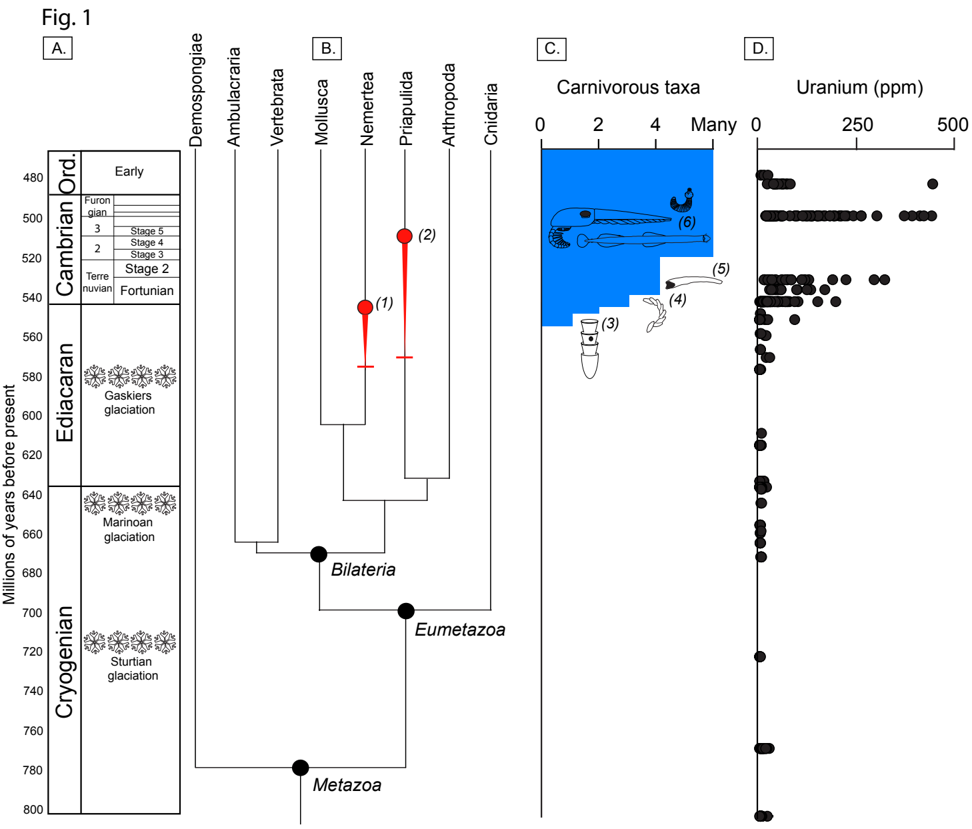
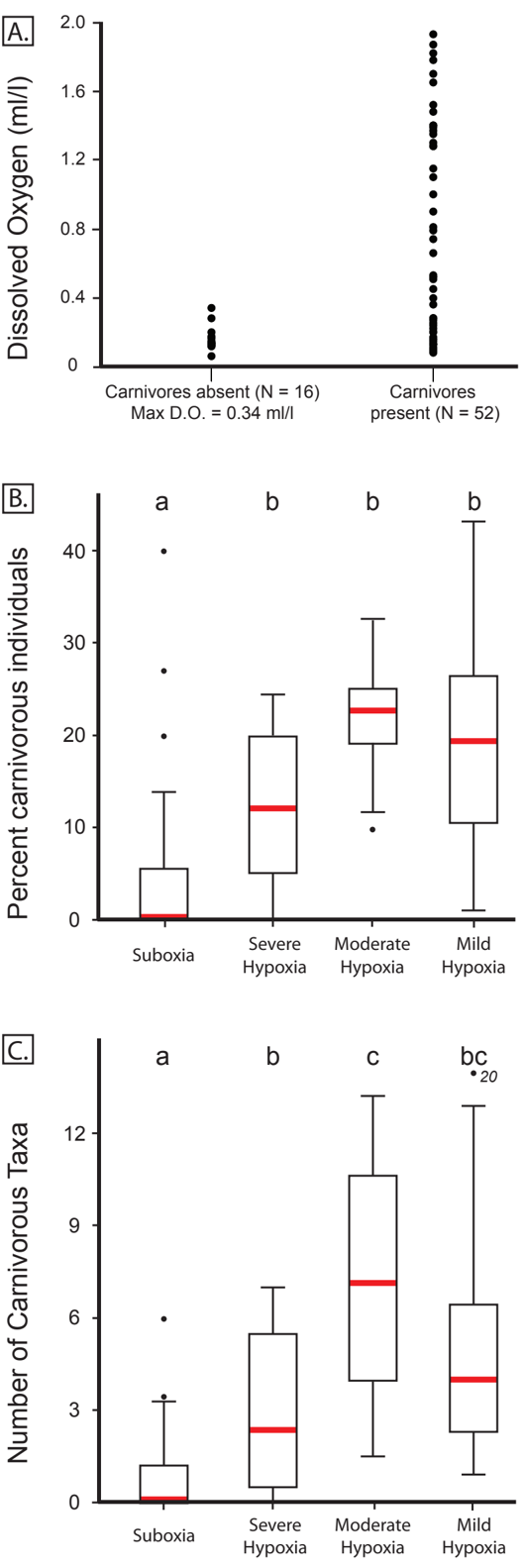
The Proterozoic-Cambrian transition records the appearance of essentially all animal body plans (phyla), yet to date no single hypothesis adequately explains both the timing of the event and the evident increase in diversity and disparity. Ecological triggers focused on escalatory predator–prey “arms races” can explain the evolutionary pattern but not its timing, whereas environmental triggers, particularly ocean/atmosphere oxygenation, do the reverse. Using modern oxygen minimum zones as an analog for Proterozoic oceans, we explore the effect of low oxygen levels on the feeding ecology of polychaetes, the dominant macrofaunal animals in deep-sea sediments. Here we show that low oxygen is clearly linked to low proportions of carnivores in a community and low diversity of carnivorous taxa, whereas higher oxygen levels support more complex food webs. The recognition of a physiological control on carnivory therefore links environmental triggers and ecological drivers, providing an integrated explanation for both the pattern and timing of Cambrian animal radiation.
Overview
The claims and statistics of this paper haven’t been checked yet.
Free: it reads the open-access text and checks the first 5 claims that cite a source we can check. Create a free account to check every claim.
Integrity signals
Registry
Cites
Statistics
Figures
Verification
Claims the paper makes
The claims and statistics of this paper haven’t been checked yet.
Free: it reads the open-access text and checks the first 5 claims that cite a source we can check. Create a free account to check every claim.
Claims other papers make about this one
Each is checked against this paper’s own text: does it say what the citing paper says it does?
The source backs part of the claim, not all of it — or backs it for a different population, condition or comparison.
In the citing paper
“Many of the new animal body plans and lifestyles that appeared during the early Cambrian were associated with considerably higher oxygen demands 9,10 .”
From Possible links between extreme oxygen perturbations and the Cambrian radiation of animals (2019) · cites this paper as [9]
Experimental — accuracy not yet measuredThe source backs part of the claim, not all of it — or backs it for a different population, condition or comparison.
In the citing paper
“In the modern and ancient oceans, well-oxygenated waters are generally associated with larger body sizes, higher diversity, advanced skeletal biomineralization, and increased motility and carnivory 9,10,54,55 .”
From Possible links between extreme oxygen perturbations and the Cambrian radiation of animals (2019) · cites this paper as [9]
Experimental — accuracy not yet measuredThe source backs part of the claim, not all of it — or backs it for a different population, condition or comparison.
In the citing paper
“This, consequently, would have increased surface ocean carbonate supersaturation, which may have reduced the physiological cost of carbonate skeleton construction and facilitated the evolutionary arms race13.”
From Rise to modern levels of ocean oxygenation coincided with the Cambrian radiation of animals (2015) · cites this paper as [13]
Experimental — accuracy not yet measuredThe source backs part of the claim, not all of it — or backs it for a different population, condition or comparison.
In the citing paper
“there is a broad consensus that dissolved oxygen provision reached a threshold, or series of thresholds, during the Neoproterozoic, allowing the diversification of metazoans and their increasing metabolic demands (23-25).”
From Integrated records of environmental change and evolution challenge the Cambrian Explosion (2019) · cites this paper as [23]
Experimental — accuracy not yet measuredThe source backs part of the claim, not all of it — or backs it for a different population, condition or comparison.
In the citing paper
“Modern lowoxygen regions are heterogeneous and dynamic habitats that support low diversity communities of opportunistic and non-skeletal metazoans, many of which are meiofaunal: large, skeletal, and motile metazoans, which form complex, biodiverse ecosystems, typically require higher oxygen levels (23).”
From Integrated records of environmental change and evolution challenge the Cambrian Explosion (2019) · cites this paper as [23]
Experimental — accuracy not yet measured
6 more claims about this paper
Create a free account to see every claim other papers make about this one.
Self-check
Percentages, sums and reported differences re-computed from the paper’s own numbers.
The self-check needs the paper’s full text.
Citations
Cites
Díaz, R. J., & Rosenberg, R. (1995) · Oceanography and Marine Biology/Oceanography and marine biology - an annual review · Cited by 2,846
The Diet of Worms: A Study of Polychaete Feeding Guilds
Fauchald, K., & Jumars, P. A. (1979) · Smithsonian Digital Repository (Smithsonian Institution) · Cited by 2,334
(2000) · CrossRef Listing of Deleted DOIs · doi:10.1016/s0967-0653(97)84825-9 · Cited by 2,011
Thresholds of hypoxia for marine biodiversity
Vaquer-Sunyer, R., & Duarte, C. M. (2008) · Proceedings of the National Academy of Sciences · doi:10.1073/pnas.0803833105 · Cited by 1,971
Biochemical Adaptation: Mechanism and Process in Physiological Evolution
Hochachka, P. W., & Somero, G. N. (2002) · doi:10.1093/oso/9780195117028.001.0001 · Cited by 1,906
Erwin, D. H., Laflamme, M., Tweedt, S. M., Sperling, E. A., Pisani, D., & Peterson, K. J. (2011) · Science · doi:10.1126/science.1206375 · Cited by 1,336 · cited 16×
“Palma M, et al. (2005) Macrobenthic animal assemblages of the continental margin off Chile (22° to 42° S).”
BackgroundInfluentialSelf-citationEarly animal evolution: emerging views from comparative biology and geology
Knoll, A. H., & Carroll, S. B. (1999) · Science · doi:10.1126/science.284.5423.2129 · Cited by 821 · cited 10×
“(Geological Society London, London), pp 405–414. 10. Peterson KJ, McPeek MA, Evans DAD (2005) Tempo and mode of early animal evo-”
BackgroundInfluentialSelf-citationGlobal distribution of naturally occurring marine hypoxia on continental margins
Helly, J. J., & Levin, L. A. (2004) · Deep Sea Research Part I: Oceanographic Research Papers · doi:10.1016/j.dsr.2004.03.009 · Cited by 767
Self-citationCoull, B. C. (1977) · Medical Entomology and Zoology · Cited by 748
OXYGEN MINIMUM ZONE BENTHOS: ADAPTATION AND COMMUNITY RESPONSE TO HYPOXIA
(2003) · Oceanography and Marine Biology, An Annual Review, Volume 41 · doi:10.1201/9780203180570-3 · Cited by 706
Self-citation
Research works printed but not linked: 2
- 9. Dzik J (2005) in The Rise and Fall of the Ediacara Biota, eds Vickers-Rich P, Komarower, P. (Geological Society London, London), pp 405-414.
- 11. Parker A (2003) In the Blink of an Eye (Perseus Publishing, Cambridge, MA).
Cited by
Items 301–392 of 392
Ai, Y., Zhu, G., Li, T., Zhang, Z., Zhang, Y., Duan, P., Liu, J., Zhao, K., & Li, X. (2023) · The Science of The Total Environment · doi:10.1016/j.scitotenv.2023.169277 · Cited by 3
Reduction in Marine Primary Productivity in the Early Cambrian Nanhua Basin, South China
Jin, C., Zhang, Z., Cheng, M., Wang, G., Chang, H., Cao, Z., & Zhang, T. (2024) · ACS Omega · doi:10.1021/acsomega.3c09161 · Cited by 3
“3 Therefore, the enhanced oxygenation of the oceanic systems has been widely invoked for metazoan evolution during the early Cambrian.”
BackgroundHehmeyer, J., Plessier, F., & Marlow, H. Q. (2024) · Annual Review of Cell and Developmental Biology · doi:10.1146/annurev-cellbio-111822-124041 · Cited by 3
International Symposium on the Ediacaran–Cambrian Transition (ISECT) 2017
Liu, A., Matthews, J. J., McIlroy, D., Narbonne, G. M., Landing, E., Menon, L. R., & Laflamme, M. (2018) · Episodes · doi:10.18814/epiiugs/2018/v41i2/008 · Cited by 3
“…and geological phenomena are widely considered to have been linked during the Ediacaran to Cambrian transition (e.g., Canfield et al., 2007; Sperling et al., 2013; Boyle et al., 2014; Herringshaw et al., 2017; Shields, 2017), and their interac- tion across this interval is an area of…”
BackgroundExperimental snowball earth viscosity drives the evolution of motile multicellularity
Halling, A., Goodson, B., Hirschmann, A., Wing, B. A., & Simpson, C. (2026) · iScience · doi:10.1016/j.isci.2026.117756 · Cited by 3
“2,47,48 We now know that the significant rise of atmospheric oxygen levels occurred after the Cambrian explosion 49–55 , nearly 200 million years too late for it to be the cause of the origin of multicellularity in animals and 800 million years too late for multicellular algae.”
Zhang, G., Chen, D., Ding, Y., & Huang, T. (2020) · Geological Journal · doi:10.1002/gj.4031 · Cited by 3
The Carbon Isotope Record and Earth Surface Oxygenation
Laakso, T. A., & Schrag, D. P. (2022) · Geophysical monograph · doi:10.1002/9781119595007.ch8 · Cited by 3
Petach, T. N. (2015) · Digital Access to Scholarship at Harvard (DASH) (Harvard University) · Cited by 3
Temperature: a key driver of Earth’s habitability over the last billion yearsPreprint
Bergmann, K., Boekelheide, N., Clarke, J. W., Cantine, M. D., Wilcots, J., Anderson, N. T., Jost, A. B., Laub, O., Drozd, J. K., Goldberg, S. L., et al. (2022) · ESS Open Archive · doi:10.1002/essoar.10511918.3 · Cited by 3
Predatory drill holes in Ostracoda: An overview of patterns in the fossil record
Cruz, C. S., Villegas‐Martín, J., Bergue, C. T., Coimbra, J. C., Klompmaker, A. A., & Ritter, M. D. N. (2025) · Earth-Science Reviews · doi:10.1016/j.earscirev.2025.105239 · Cited by 3
Xiong, M., Chen, L., Chen, X., Tan, X., Cao, J., Wu, S., Zhang, Z., Liao, C., Zhong, K., & Wang, G. (2026) · Sedimentology · doi:10.1111/sed.70129 · Cited by 2
A New Progress of the Proterozoic Chronostratigraphical Division
Ming-xiang, M., & Khaing, K. K. (2016) · Acta Geologica Sinica - English Edition · doi:10.1111/1755-6724.12764 · Cited by 2
Patterns in Palaeontology - the earliest skeletons
Penny, A. (2018) · Helda - University of Helsinki Institutional Repository · Cited by 2
Schlesinger, W. H., & Bernhardt, E. S. (2020) · Elsevier eBooks · doi:10.1016/b978-0-12-814608-8.00001-3 · Cited by 2
Origin and Early Evolution of Animals
Peterson, K. J. (2014) · Oxford University Press eBooks · doi:10.1093/obo/9780199941728-0043 · Cited by 2
Martin, E. L. O. (2016) · theses.fr (ABES) · doi:10.70675/84136300z3723z4326za610z607fb105295e · Cited by 2
Meta-omics and environmental meta-data : towards a new comprehension of the biological carbon pump
Benoiston, A. (2019) · theses.fr (ABES) · doi:10.70675/23827314z843fz4693z8122z218cefac01ba · Cited by 2
Evolution of Eukaryotes with Respect to Atmosphere Oxygen Appearance and Rise
Ivanović, Z., & Vlaski‐Lafarge, M. (2015) · Elsevier eBooks · doi:10.1016/b978-0-12-800540-8.00008-9 · Cited by 1
A Cnidarian affinity for Salterella and Volborthella: implications for the evolution of shells
Vayda, P. J., Xiao, S., Keller, N., Hagen, A., Strauss, J. V., Hagadorn, J. W., Lonsdale, M. C., Selly, T., & Schiffbauer, J. D. (2025) · Journal of Paleontology · doi:10.1017/jpa.2025.10164 · Cited by 1
“…2013), genetic repatterning to facilitate diverse body plans (Valentine et al., 1999), increased oxygen availability supporting complex food webs (Sperling et al., 2013), or oversaturated alkaline environments inducing precipitation of minerals on organic substrates (Grant, 1990; Wood et al.,…”
Chipman, A. D. (2026) · BioEssays · doi:10.1002/bies.70136 · Cited by 1
McMenamin, M. A. S. (2016) · Springer geology · doi:10.1007/978-3-319-22777-1_14 · Cited by 1
Sipunculan celomocytes increase the resistance to H2O2-induced cell death under hypoxia
Lombardo, T., Peralta, D., Kornblihtt, L. I., & Blanco, G. A. C. (2014) · Invertebrate survival journal · Cited by 1
A ragadozó táplálkozási mód megjelenése és a fény szerepe a kambriumi életrobbanás előkészítésében
Bujtor, L. (2020) · Magyar Tudomány · doi:10.1556/2065.181.2020.2.8 · Cited by 1
Towards the Big History of information. Approaching the origins of information behaviour
Karvalics, L. Z., & Bujtor, L. (2023) · Biosystems · doi:10.1016/j.biosystems.2023.104991 · Cited by 1
Ebbestad, J. O. R., Cederström, P., & Peel, J. S. (2022) · GFF · doi:10.1080/11035897.2023.2233571 · Cited by 1
Insights from Sponge Transcriptomes & Physiology about the Early Evolution of Nervous Systems
Farrar, N. R. (2014) · ERA: Education and Research Archive (University of Alberta) · doi:10.7939/r3183485q · Cited by 1
Padrões de diversificação de Bougainvilliidae no contexto evolutivo de Medusozoa (Cnidaria)
Becerril, M. D. L. A. M. (2016) · Digital Library of Theses and Dissertations (Universidade de São Paulo) · doi:10.11606/t.41.2016.tde-04112015-142910 · Cited by 2
Intermediate and Vacillating Redox in Ancient Marine Settings and Their Biological Implications
Hardisty, D. S. (2016) · eScholarship (California Digital Library) · Cited by 1
Biomarkers and the dawn of animal life
Bobrovskiy, I. (2019) · ANU Open Research (Australian National University) · doi:10.25911/5d77832381283 · Cited by 1
From skin to brain: modelling a whole-body coordination scenario of nervous system origin
de Wiljes, O. (2020) · University of Groningen research database (University of Groningen / Centre for Information Technology) · doi:10.33612/diss.123420732 · Cited by 1
Weathering of accretionary orogens as a trigger for the Cambrian ExplosionPreprint
Zhu, M., Zhang, Y., Pastor‐Galán, D., Smit, M., Mills, B. J. W., Zhang, F., Guilmette, C., Miao, L., Li, S., Ganbat, A., et al. (2023) · Research Square · doi:10.21203/rs.3.rs-3162070/v1 · Cited by 1
Cheng, M., Stüeken, E. E., Yin, Z., Algeo, T. J., & Li, C. (2025) · Global and Planetary Change · doi:10.1016/j.gloplacha.2025.104980 · Cited by 1
Hallucigenia ’s diet illuminates the feeding ecology of Cambrian lobopodiansPreprint
Ortega‐Hernández, J. (2025) · bioRxiv (Cold Spring Harbor Laboratory) · doi:10.64898/2025.12.28.696761 · Cited by 1
Dearth of Photosynthetically Active Radiation Suggests No Complex Life on Late M-Star ExoplanetsPreprint
Soliz, J., & Welsh, W. F. (2026) · arXiv (Cornell University) · doi:10.48550/arxiv.2601.02548 · Cited by 1
Molecular and cellular differentiation during the early shell field development in Lymnaea stagnalis
Hohagen, J. (2014) · eDiss (Georg-August-Universität Göttingen) · doi:10.53846/goediss-4358
Alterações na homeostase redox das células beta pancreáticas em resposta à glicose.
Valle, M. M. R. (2014) · Digital Library of Theses and Dissertations (Universidade de São Paulo) · doi:10.11606/t.42.2014.tde-19022015-163014
Fossils: The Australian record of past life in context
Henderson, R. S., & Johnson, D. P. (2016) · Cambridge University Press eBooks · doi:10.1017/cbo9781139923866.012
An integrated view of metazoan evolution
Wain, A. R. (2015) · OhioLink ETD Center (Ohio Library and Information Network)
Froehlich, H. E. (2015) · ResearchWorks at the University of Washington (University of Washington)
Reconstructing the Great Ordovician Biodiversification Event through brachiopods of Oklahoma
Trubovitz, S. (2016) · OhioLink ETD Center (Ohio Library and Information Network)
Bové, G., & Xavier, F. (2017) · Dipòsit Digital de la Universitat de Barcelona (Universitat de Barcelona)
Berman, J. J. (2019) · Elsevier eBooks · doi:10.1016/b978-0-12-817126-4.00001-1
Berman, J. J. (2019) · Elsevier eBooks · doi:10.1016/b978-0-12-817126-4.00007-2
Cordie, D. R. (2019) · UWM Digital Commons (University of Wisconsin–Milwaukee)
Taphonomic characteristics of fossils on the burgessshale-type spectrum
Broce, J. S. (2018) · MOspace Institutional Repository (University of Missouri) · doi:10.32469/10355/66096
Juez, B., & Rickue, D. (2021) · Acceda (Universidad de Las Palmas de Gran Canaria)
Ferreira, P. L. F. (2021) · Digital Library of Theses and Dissertations (Universidade de São Paulo) · doi:10.11606/d.44.2021.tde-09092021-075332
Global biodiversity patterns during the Cambrian radiation
Lin, N. (2016) · OPUS FAU (Kooperativer Bibliotheksverbund Berlin-Brandenburg (KOBV), on behalf of the Universitätsbibliothek Erlangen-Nürnberg)
Finding relationships among biological entities
Berman, J. J. (2020) · Elsevier eBooks · doi:10.1016/b978-0-12-821364-3.00005-x
“The most dramatic examples of organisms exploiting the high-energy metabolism provided by oxygen came about a half billion years later, in the Cambrian explosion.(205)”
BackgroundSchlesinger, W. H., & Bernhardt, E. S. (2020) · Elsevier eBooks · doi:10.1016/b978-0-12-814608-8.00002-5
(2020) · Elsevier eBooks · doi:10.1016/b978-0-12-814608-8.09992-8
Eichhorn, M. P. (2016) · Wiley eBooks · doi:10.1002/9781118905982.ch3
Boyce, C. K. (2016) · Oxford University Press eBooks · doi:10.1093/obo/9780199941728-0070
The Evolution of Bivalve Shell Matrix Proteins
Duhon, M. (2020) · Louisiana State University · doi:10.31390/gradschool_dissertations.5257
“The calcium carbonate shell of bivalves is posited to have evolved only once, going back to at least the origin of Conchiferan species during the Cambrian explosion (Sperling 2013).”
BackgroundInfluentialOn the evolutionary emergence of predationPreprint
Ispolatov, Y., Doebeli, C., & Doebeli, M. (2022) · arXiv (Cornell University) · doi:10.48550/arxiv.2212.00899
Cambrian Explosion: The First Carnival of the Animals
Harper, D. A. T. (2023) · Elsevier eBooks · doi:10.1016/b978-0-12-822562-2.00135-3
Comment on egusphere-2023-2981
Hoogakker, B., Davis, C., Wang, Y., et al. (2024) · doi:10.5194/egusphere-2023-2981-cc1
Comment on egusphere-2023-2981
Hoogakker, B., Davis, C., Wang, Y., et al. (2024) · doi:10.5194/egusphere-2023-2981-rc1
Comment on egusphere-2023-2981
Hoogakker, B. A. A., Davis, C. V., Wang, Y., et al. (2024) · doi:10.5194/egusphere-2023-2981-rc2
Zhu, B., Li, X., Ge, L., & Chen, Y. (2024) · Acta Geochimica · doi:10.1007/s11631-024-00681-7
“…marks a unique time interval of remarkable biological innovation known as the “Cambrian explo-sion”, which is characterized by the rapid appearance of most phyla of modern animals and the development of a modern-like marine ecosystem (Sperling et al. 2013; Zhang and Shu 2014; Butterfield 2018).”
Comment on egusphere-2023-2981
Hoogakker, B., Davis, C., Wang, Y., et al. (2024) · doi:10.5194/egusphere-2023-2981-rc3
Roman, M. R., Altieri, A. H., Breitburg, D. L., et al. (2024) · doi:10.5194/egusphere-2024-616-rc1
Hoogakker, B. A. A. (2024) · doi:10.5194/egusphere-2023-2981-ac4
Hoogakker, B. A. A. (2024) · doi:10.5194/egusphere-2023-2981-ac3
Hoogakker, B. A. A. (2024) · doi:10.5194/egusphere-2023-2981-ac1
Hoogakker, B. A. A. (2024) · doi:10.5194/egusphere-2023-2981-ac2
A coevolução dos animais e do oxigênio no Neoproterozóico
Belato, F. A. (2024) · Digital Library of Theses and Dissertations (Universidade de São Paulo) · doi:10.11606/t.41.2024.tde-13062024-144828
Roman, M. R., Altieri, A. H., Breitburg, D., et al. (2024) · doi:10.5194/egusphere-2024-616-rc2
Roman, M. (2024) · doi:10.5194/egusphere-2024-616-ac2
Roman, M. (2024) · doi:10.5194/egusphere-2024-616-ac1
Dwellers in the Deep: Biological Consequences of Dark OxygenPreprint
Lingam, M., Balbi, A., & Tiwari, M. (2024) · arXiv (Cornell University) · doi:10.48550/arxiv.2408.06841
“1% PAL [Sperling et al., 2013b].”
BackgroundInfluentialHybrid Graph Learning Reconstructs Global Ocean Oxygen Spatiotemporal ChangesPreprint
Wang, X., Lu, B., Han, L., Zhao, Z., Qi, H., Gan, X., Qu, L., Zhou, Y., Zhou, L., Fu, L., et al. (2025) · Research Square · doi:10.21203/rs.3.rs-5587966/v1
Fluctuations in Biodiversity Over Geological Time
Brayard, A. (2025) · Wiley eBooks · doi:10.1002/9781394361830.ch8
Cui, Y., Li, D., Shen, B., & Gao, X. (2025) · Earth Science-Journal of China University of Geosciences · doi:10.3799/dqkx.2024.048
Thermodynamic patterns of life: emergent phenomena in reaction networks
Fischer, J. (2018) · Common Library Network (Der Gemeinsame Bibliotheksverbund) · doi:10.22032/dbt.35182
Hull, A. W. (2020) · DSpace@MIT (Massachusetts Institute of Technology)
The Ocean is lossing its breath: declining oxygen in the global and coastal ocean
(2018) · ORBi (University of Liège)
Cellular predation and motility as drivers of animal origins and the Cambrian radiation
Zhang, L. (2026) · Frontiers in Ecology and Evolution · doi:10.3389/fevo.2025.1736160
Geng, A., Wenyu, F., Fang, W., Ya-Nan, S., Han, X., Tong, L., Rui-tong, H., Jing, W., Wu-Han, X. I. A. O., He, L., et al. (2026) · 动物学研究 · doi:10.24272/j.issn.2095-8137.2025.510
Influences des perturbations environnementales sur l’association wMelPop-D. melanogaster
Bénard, A. (2022) · theses.fr (ABES) · doi:10.70675/8cb324c3zdce7z4b0fza6a4z8339c65f5d61
Bioinformatic and functional analyses of muscle cell diversification in Drosophila melanogaster
Poovathumkadavil, P. (2021) · theses.fr (ABES) · doi:10.70675/74fca170za64bz46e3zb2bbz13d37d0dfdb5
Orbitally driven ammonium upwelling fueled primary productivity during the peak Cambrian Explosion
Meng, G., Gai, H., Lu, C., Zhao, Y., Tan, Y., Liu, Y., Feng, Y., Li, G., Wang, X., Liu, W., et al. (2026) · Palaeogeography Palaeoclimatology Palaeoecology · doi:10.1016/j.palaeo.2026.113932
The selenium cycling variation corresponding to the evolution of early animals in the Weng'an biota
Ren, Z., Long, J., Zhang, S., Du, Y., Long, T., Chen, Y., & Luo, K. (2026) · Chemical Geology · doi:10.1016/j.chemgeo.2026.123622
Hybrid Graph Learning Reconstructs Global Ocean Oxygen Spatiotemporal Changes
Lü, B., Han, L., Zhao, Z., Shen, J., Qi, H., Gan, X., Zhou, L., Jin, M., Qu, L., Zhou, Y., et al. (2026) · ACM SIGKDD Conference on Knowledge Discovery and Data Mining (KDD) · doi:10.1145/3770855.3818938
Isotopic evidence for recurrent marine zinc cycle fluctuations in the early Cambrian ocean
Yuan, C., Wang, X., Tian, X., Tian, L., Yang, C., Liu, Y., Liu, S., & Zhang, S. (2026) · Earth and Planetary Science Letters · doi:10.1016/j.epsl.2026.120311
Material cycling across Earth’s spheres and triggers of Cambrian explosion: a tectonic perspective
Yao, J., Han, Y., Zhang, D., Liu, Q., Chen, L., Cui, P., & Zhao, G. (2026) · Continent and Life Evolution · doi:10.55092/cle20260011
“…of complex multicellular animals (metazoans) in terms of energy supply (aerobic metabolism), biomineralization (calcium carbonate skeleton formation requiring suitable marine carbonate chemistry), and ecosystem stability (necessitating a prolonged stable climatic window) (Sperling et al. 2013).”
Doerrler, A. D., Gan, T., Gilleaudeau, G. J., Pedersen, M. G., Bykova, N., Marusin, V. V., Іvanova, N., Kochnev, B. B., Grazhdankin, D. V., Kletetschka, K., et al. (2026) · Geobiology · doi:10.1111/gbi.70066
“Furthermore, Sperling et al. (2013) proposed a link between oxygen and the biotic replacement model (Laflamme et al. 2013), arguing that locally rising O 2 levels (even in a low-O 2 world) could lead to an increased ecological role for predators, which would then in turn drive the predator–prey…”
Idealized Earth system model analysis of the primary controls on shallow seafloor oxygenationPreprint
Xu, S., Hull, P. M., Ridgwell, A. J., & Hülse, D. (2026) · EarthArXiv (California Digital Library) · doi:10.31223/x5j51g
Ashing-Giwa, K. F., Payne, J. L., Bergmann, K., Monarrez, P. M., Gaskell, D. E., Stockey, R., & Sperling, E. A. (2026) · Current Biology · doi:10.1016/j.cub.2026.09.017
Self-citationMacrostratigraphy of the Ediacaran System in North America
(2022) · doi:10.1130/2022.1220(21
Metadata
- Authors
- Sperling, E. A., Frieder, C. A., Raman, A. V., Girguis, P. R., Levin, L. A., & Knoll, A. H.
- Affiliations
- Departments of aEarth and Planetary Sciences and
- Scripps Institution of Oceanography (US)
- Andhra University (IN)
- Harvard University (US)
- Venue
- Proceedings of the National Academy of Sciences
- Publisher
- National Academy of Sciences
- Published
- 2013-07-29
- Volume
- 110
- Issue
- 33
- Pages
- 13446-13451
- ISSN
- 0027-8424 (ISSN-L)
- 1091-6490
- PMC
- PMC3746845
- OpenAlex
- W2064523628
- Cited by
- 367
- References
- 137
- Citations by year
- 2026: 13 · 2025: 24 · 2024: 37 · 2023: 22 · 2022: 30 · 2021: 25 · 2020: 34 · 2019: 31 · 2018: 27 · 2017: 32 · 2016: 35 · 2015: 28 · 2014: 25 · 2013: 4
- FWCI
- 20.78
- Type
- journal article
- Language
- en
- Open access
- green
- www.ncbi.nlm.nih.gov
- Locations
- Proceedings of the National Academy of Sciences (publishedVersion)
- Europe PMC (PubMed Central) (publishedVersion)
- PubMed Central (publishedVersion)
- PubMed (publishedVersion)
- Digital Access to Scholarship at Harvard (DASH) (Harvard University) (submittedVersion, cc-by)
- eScholarship (California Digital Library) (submittedVersion)
- Funders
- National Aeronautics and Space Administration
- Ministry of Earth Sciences
- NASA Astrobiology Institute
- Topics
- Physical Sciences › Earth and Planetary Sciences › Paleontology › Paleontology and Stratigraphy of Fossils
- Physical Sciences › Earth and Planetary Sciences › Paleontology › Evolution and Paleontology Studies
- Physical Sciences › Earth and Planetary Sciences › Paleontology › Paleontology and Evolutionary Biology
- Keywords
- oxygen minimum zone, ocean oxygenation, predation, predator-prey arms race, Polychaeta, feeding ecology, carnivory, food web complexity, deep-sea macrofauna, animal body plans, diversification timing
- MeSH terms
- Analysis of Variance, Animals, Biological Evolution, Feeding Behavior, Fossils, Oceans and Seas, Oxygen, Paleontology, Food Chain, Biodiversity
About these checks
Registry, retraction, Cites and statistics results are computed, not judged, with one exception: a printed reference that no index lists is read once by a model before it counts as a citation error. Claims are extracted by a model and kept only when their quote appears verbatim in the text; each cited source is then checked, with a model’s help, for whether it says what the claim relies on. Those verdicts can be wrong — read the claim’s quote and the cited source before relying on one.
Statistics and arithmetic are recomputed, not judged.
Confidence bands are shown only for fields calibrated on our annotated test set. None is calibrated yet, so no band is shown.
What counts as a claim ›How we measure confidence ›How we check this ›
Are you an author, or do you see a problem with this page? Request a review
Data sources
Bibliographic data: Semantic Scholar, OpenAlex, Crossref.
Contains information from the Semantic Scholar Academic Graph Datasets, made available under the ODC Attribution License (ODC-BY 1.0).
Semantic Scholar’s data is described in: Kinney, R., et al. (2023). The Semantic Scholar Open Data Platform. arXiv:2301.10140.
