

Using deep learning and Google street view to estimate the demographic makeup of neighborhoods across the United States.
Open accessThe DOI matches its Crossref record; 30 of the 31 references it cites were found in a registry or an index.
Abstract
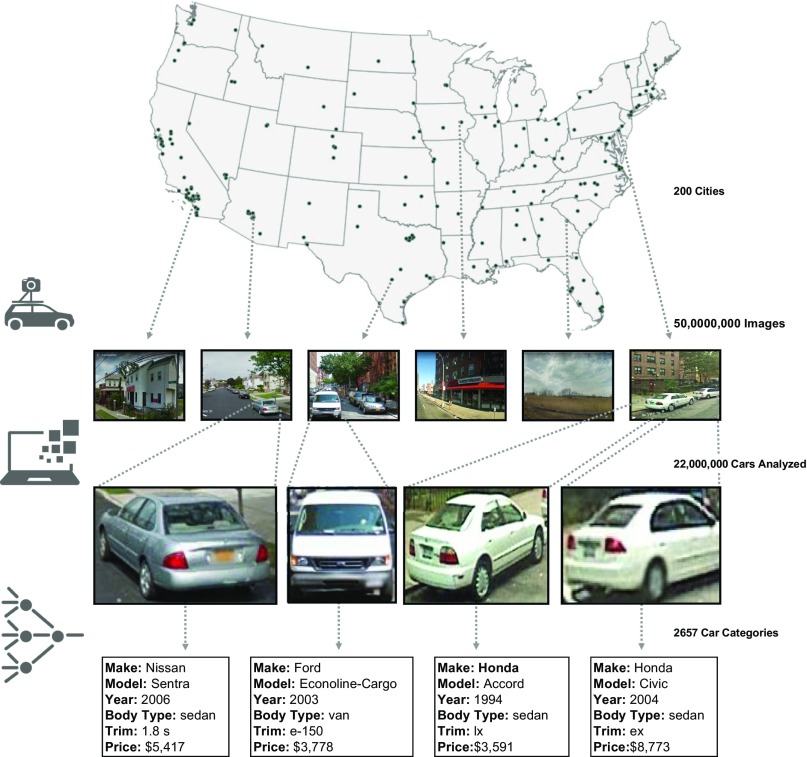
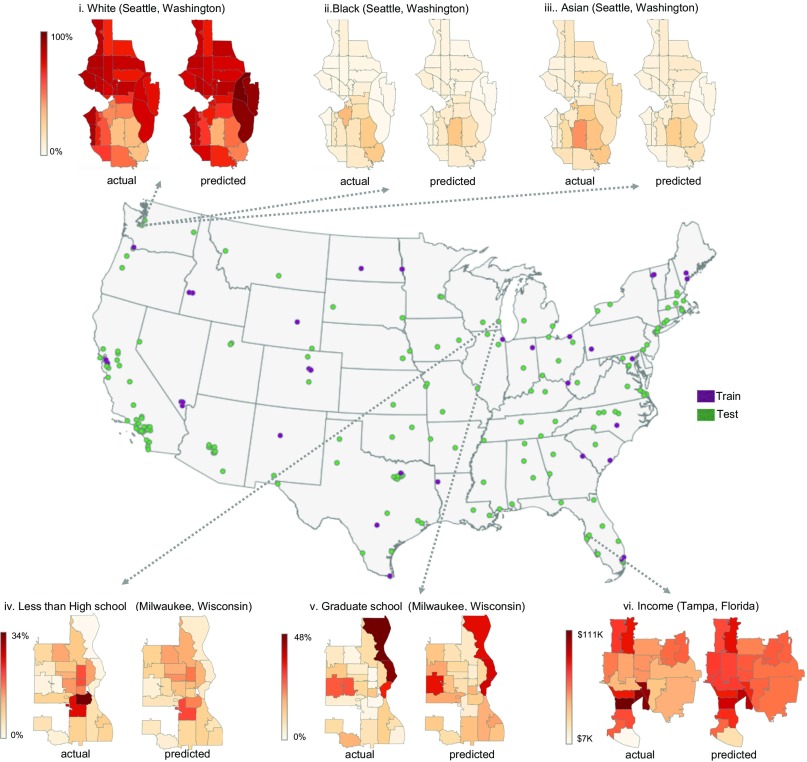
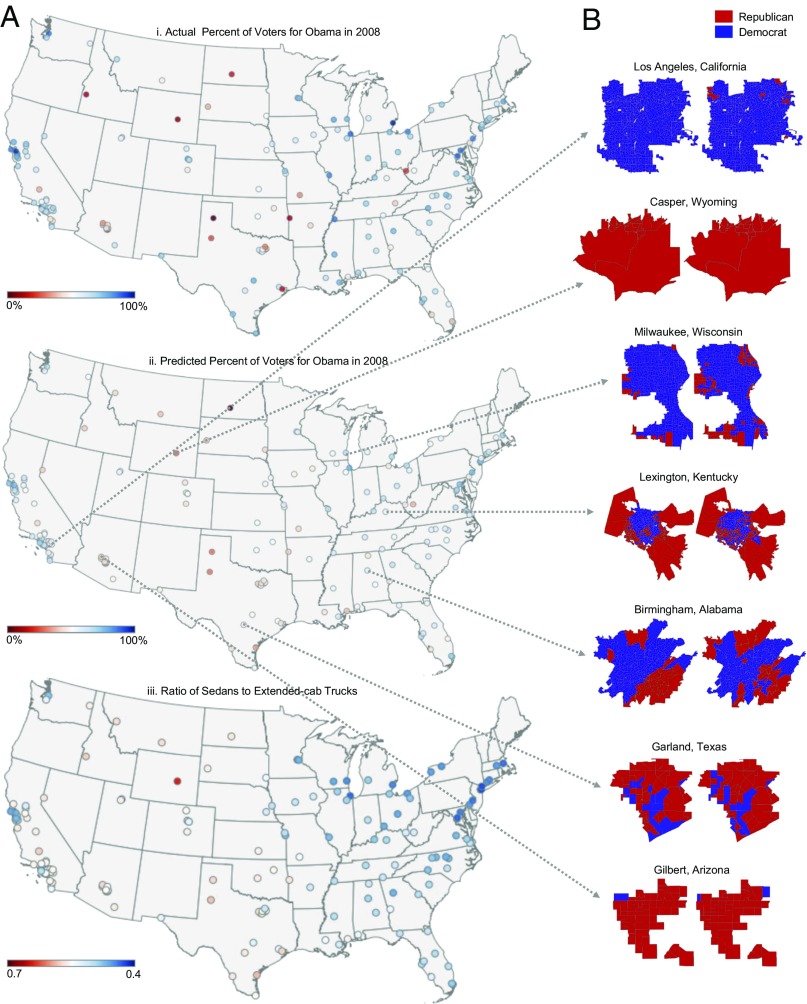
Significance: We show that socioeconomic attributes such as income, race, education, and voting patterns can be inferred from cars detected in Google Street View images using deep learning. Our model works by discovering associations between cars and people. For example, if the number of sedans in a city is higher than the number of pickup trucks, that city is likely to vote for a Democrat in the next presidential election (88% chance); if not, then the city is likely to vote for a Republican (82% chance).
Overview
The claims and statistics of this paper haven’t been checked yet.
Free: it reads the open-access text and checks the first 5 claims that cite a source we can check. Create a free account to check every claim.
Integrity signals
Registry
Cites
Statistics
Figures
Verification
Claims the paper makes
The claims and statistics of this paper haven’t been checked yet.
Free: it reads the open-access text and checks the first 5 claims that cite a source we can check. Create a free account to check every claim.
Self-check
Percentages, sums and reported differences re-computed from the paper’s own numbers.
The self-check needs the paper’s full text.
Citations
Cites
ImageNet classification with deep convolutional neural networks
Krizhevsky, A., Sutskever, I., & Hinton, G. E. (2017) · Communications of the ACM · doi:10.1145/3065386 · Cited by 112,155 · cited 4×
“However, the cost of annotating Street View photos makes it infeasible to collect enough images to train our CNN only using this source.”
MethodInfluentialFaster R-CNN: Towards Real-Time Object Detection with Region Proposal Networks
Ren, S., He, K., Girshick, R., & Sun, J. (2017) · IEEE Transactions on Pattern Analysis and Machine Intelligence · doi:10.1109/tpami.2016.2577031 · Cited by 73,472
Faster R-CNN: Towards Real-Time Object Detection with Region Proposal Networks
Ren, S., He, K., Girshick, R., & Sun, J. (2015) · arXiv · doi:10.48550/arxiv.1506.01497 · Cited by 70,812
Gradient-based learning applied to document recognition
Lecun, Y., Bottou, L., Bengio, Y., & Haffner, P. (1998) · Proceedings of the IEEE · doi:10.1109/5.726791 · Cited by 58,805 · cited 4×
“However, the cost of annotating Street View photos makes it infeasible to collect enough images to train our CNN only using this source.”
MethodInfluentialProceedings of IEEE Conference on Computer Vision and Pattern Recognition
(1993) · doi:10.1109/cvpr.1993 · Cited by 17,667
Object Detection with Discriminatively Trained Part-Based Models
Felzenszwalb, P. F., Girshick, R. B., McAllester, D., & Ramanan, D. (2010) · IEEE Transactions on Pattern Analysis and Machine Intelligence · doi:10.1109/tpami.2009.167 · Cited by 9,853 · cited 6×
“Using these images and annotated photos of cars, our object recognition algorithm [a “Deformable Part Model” (DPM) (11)] learned to automatically localize motor vehicles on the street (12) (see Materials and Methods).”
MethodInfluentialQuantitative Analysis of Culture Using Millions of Digitized Books
Michel, J.-B., Shen, Y. K., Aiden, A. P., Veres, A., Gray, M. K., The Google Books Team, Pickett, J. P., Hoiberg, D., Clancy, D., Norvig, P., et al. (2011) · Science · doi:10.1126/science.1199644 · Cited by 3,077 · cited 1×
“P (Democrat, r > 1) ≈ nds C (4) P (Republican, r < 1) ≈ nrp C (5) P (r > 1) ≈ ns C (6) P (r < 1) ≈ np C (7) Using these estimates, we calculate P (Democrat|r > 1) and P (Republican|r < 1) according to equations 2 and 3.”
BackgroundSelf-citationImageNet: A large-scale hierarchical image database
Deng, J. H., Dong, W. F., Socher, R., Li, L.-J., Li, K., & Fei-Fei, L. (2009) · IEEE Computer Society Conference on Computer Vision and Pattern Recognition/Proceedings - IEEE Computer Society Conference on Computer Vision and Pattern Recognition/Proceedings · doi:10.1109/cvprw.2009.5206848 · Cited by 2,714
Self-citationCombining satellite imagery and machine learning to predict poverty
Jean, N., Burke, M., Xie, M., Davis, W. M., Lobell, D. B., & Ermon, S. (2016) · Science · doi:10.1126/science.aaf7894 · Cited by 1,664 · cited 1×
“The model could also be improved by integrating other types of data, such as satellite images (22), social networks (4), and economic data pertaining to local consumer behavior in particular geographic regions.”
Frustratingly Easy Domain Adaptation
Daumé, H. (2009) · arXiv (Cornell University) · doi:10.48550/arxiv.0907.1815 · Cited by 1,383
Get another label? improving data quality and data mining using multiple, noisy labelers
Sheng, V. S., Provost, F., & Ipeirotis, P. G. (2008) · Proceedings of the 14th ACM SIGKDD international conference on Knowledge discovery and data mining · doi:10.1145/1401890.1401965 · Cited by 1,165
Statistical Inference under Order Restrictions (The Theory and Application of Isotonic Regression)
Vincze, I., Barlow, R. E., Bartholomew, D. J., Bremner, J. M., & Brunk, H. D. (1973) · International Statistical Review / Revue Internationale de Statistique · doi:10.2307/1402630 · Cited by 842 · cited 1×
“We converted these scores into estimated probabilities via isotonic regression (24) (see SI Appendix for details).”
MethodImageNet classification with deep convolutional neural networks
Krizhevsky (2012) · Medical Entomology and Zoology · Cited by 799
Predicting poverty and wealth from mobile phone metadata
Blumenstock, J., Cadamuro, G., & On, R. (2015) · Science · doi:10.1126/science.aac4420 · Cited by 698 · cited 1×
“(6) used mobile phone metadata to predict poverty rates in Rwanda.”
BackgroundFrustratingly Easy Domain Adaptation
Daum, H. (2007) · Cited by 601
Streetscore -- Predicting the Perceived Safety of One Million Streetscapes
Naik, N., Philipoom, J., Raskar, R., & Hidalgo, C. (2014) · 2014 IEEE Conference on Computer Vision and Pattern Recognition Workshops · doi:10.1109/cvprw.2014.121 · Cited by 453 · cited 1×
“(7) used publicly available imagery to quantify people’s subjective perceptions of a neighborhood’s physical appearance.”
BackgroundChoo, S., & Mokhtarian, P. L. (2004) · Transportation Research Part A: Policy and Practice · doi:10.1016/j.tra.2003.10.005 · Cited by 444 · cited 1×
“Of these objects, vehicles are among the most personalized expressions of American culture: Over 90% of American households own a motor vehicle (9), and their choice of automobile is influenced by disparate demographic factors including household needs, personal preferences, and economic wherewithal (10).”
BackgroundCrowdsourcing annotations for visual object detection
Su, H., Deng, J., & Fei-Fei, L. (2012) · National Conference on Artificial Intelligence · Cited by 328
Self-citationComputer vision uncovers predictors of physical urban change
Naik, N., Kominers, S. D., Raskar, R., Glaeser, E. L., & Hidalgo, C. A. (2017) · Proceedings of the National Academy of Sciences · doi:10.1073/pnas.1619003114 · Cited by 296 · cited 1×
“They then showed that changes in these perceptions correlate with changes in socioeconomic variables (8).”
BackgroundStatistical inference under order restrictions : the theory and application of isotonic regression
Barlow, R. E. (1972) · Cited by 234
Neuroaesthetics in fashion: Modeling the perception of fashionability
Simo-Serra, E., Fidler, S., Moreno-Noguer, F., & Urtasun, R. (2015) · 2015 IEEE Conference on Computer Vision and Pattern Recognition (CVPR) · doi:10.1109/cvpr.2015.7298688 · Cited by 206
Learning High-Level Judgments of Urban Perception
Ordóñez, V., & Berg, T. L. (2014) · Lecture notes in computer science · doi:10.1007/978-3-319-10599-4_32 · Cited by 177 · cited 1×
“Expanding our object recognition beyond vehicles 15 , incorporating global image features 16–19 , other types of imagery, such as satellite images 20 and social networks 4 could considerably strengthen the present approach.”
BackgroundRecognizing City Identity via Attribute Analysis of Geo-tagged Images
Zhou, B., Liu, L., Oliva, A., & Torralba, A. (2014) · Lecture Notes in Computer Science · doi:10.1007/978-3-319-10578-9_34 · Cited by 124 · cited 1×
“Expanding our object recognition beyond vehicles 15 , incorporating global image features 16–19 , other types of imagery, such as satellite images 20 and social networks 4 could considerably strengthen the present approach.”
BackgroundUsing Social Media to Measure Labor Market Flows
Antenucci, D., Cafarella, M., Levenstein, M. C., Ré, C., & Shapiro, M. D. (2014) · Cited by 119
StreetStyle: Exploring world-wide clothing styles from millions of photosPreprint
Matzen, K., Bala, K., & Snavely, N. (2017) · arXiv (Cornell University) · doi:10.48550/arxiv.1706.01869 · Cited by 104 · cited 1×
“The automated method we present could be substantially improved by expanding our object recognition beyond vehicles (17, 18) and incorporating global image features (7, 19–21).”
MethodUsing Social Media to Measure Labor Market Flows
Antenucci, D., Cafarella, M., Levenstein, M. C., Ré, C., & Shapiro, M. D. (2014) · National Bureau of Economic Research · doi:10.3386/w20010 · Cited by 94 · cited 2×
“(4) have predicted unemployment rates from Twitter; Michel et al.”
BackgroundFine-Grained Car Detection for Visual Census Estimation
Gebru, T., Krause, J., Wang, Y., Chen, D., Deng, J., & Fei-Fei, L. (2017) · Proceedings of the AAAI Conference on Artificial Intelligence · doi:10.1609/aaai.v31i1.11174 · Cited by 90 · cited 3×
“As we were willing to trade a couple of percentages in accuracy for efficiency (12), we turned to the previous state-of-the-art in object detection, DPMs (11), instead of recent algorithms such as ref.”
MethodSelf-citationLooking Beyond the Visible Scene
Khosla, A., An, B., Lim, J. J., & Torralba, A. B. (2014) · IEEE Computer Society Conference on Computer Vision and Pattern Recognition/Proceedings - IEEE Computer Society Conference on Computer Vision and Pattern Recognition/Proceedings · doi:10.1109/cvpr.2014.474 · Cited by 84
Scalable Annotation of Fine-Grained Categories Without Experts
Gebru, T., Krause, J., Deng, J., & Fei-Fei, L. (2017) · CHI Conference on Human Factors in Computing Systems · doi:10.1145/3025453.3025930 · Cited by 20
Self-citationFine-Grained Car Detection for Visual Census EstimationPreprint
Gebru, T., Krause, J., Wang, Y., et al. (2017) · arXiv (Cornell University) · doi:10.48550/arxiv.1709.02480 · Cited by 19 · cited 3×
“As we were willing to trade a couple of percentages in accuracy for efficiency (12), we turned to the previous state-of-the-art in object detection, DPMs (11), instead of recent algorithms such as ref.”
MethodSelf-citationPrecinct-Level Election Data, 2002-2012
Ansolabehere, S. D., Palmer, M., & Lee, A. (2014) · Harvard Dataverse · doi:10.7910/dvn/yn4tlr · Cited by 19
Research works printed but not linked: 1
- LeCun Y Bottou L Bengio Y Haffner P 1998 Gradient-based learning applied to document recognition Proc IEEE 86 2278 2324 · DOI · Paper page
Cited by
Algorithms at Work: The New Contested Terrain of Control
Kellogg, K. C., Valentine, M. A., & Christin, A. (2020) · Academy of Management Annals · doi:10.5465/annals.2018.0174 · Cited by 2,732
“These activists argued in favor of providing “ model cards, ” short (one to two page) documents for trained machine-learning models that would include core metrics about bias, fairness, and inclusion (Gebru et al., 2017; Mitchell et al., 2019).”
BackgroundStreet view imagery in urban analytics and GIS: A review
Biljecki, F., & Ito, K. (2021) · Landscape and Urban Planning · doi:10.1016/j.landurbplan.2021.104217 · Cited by 925
“…applications on contrasting sides of the spectrum of urban studies, e.g. real estate valuation (Law, Paige, & Russell, 2019), demographic studies (Gebru et al., 2017), collecting data on pedestrian counts (Yin, Cheng, Wang, & Shao, 2015), understanding crime (McKee et al., 2017), analysing…”
BackgroundJanowicz, K., Gao, S., McKenzie, G., Hu, Y., & Bhaduri, B. (2020) · International Journal of Geographical Information Science · doi:10.1080/13658816.2019.1684500 · Cited by 600
“2019), neighborhoods demographic information (Gebru et al .”
BackgroundHelbich, M., Yao, Y., Liu, Y., Zhang, J., Liu, P., & Wang, R. (2019) · Environment International · doi:10.1016/j.envint.2019.02.013 · Cited by 599
“To overcome these constraints, objective and automated assessments of street view data are favored (Doersch et al., 2012; Gebru et al., 2017; Gong et al., 2018; Middel et al., 2019).”
BackgroundYao, Y., Liang, Z., Yuan, Z., Liu, P., Bie, Y., Zhang, J., Wang, R., Wang, J., & Guan, Q. (2019) · International Journal of Geographical Information Science · doi:10.1080/13658816.2019.1643024 · Cited by 425
Metadata
- Authors
- Gebru, T., Krause, J., Wang, Y., Chen, D., Deng, J., Aiden, E. L., & Fei-Fei, L.
- Affiliations
- Stanford University (US)
- University of Michigan (US)
- Baylor College of Medicine (US)
- Corresponding author
- Gebru, Timnit
- Venue
- Proceedings of the National Academy of Sciences
- Publisher
- National Academy of Sciences
- Published
- 2017-11-28
- Volume
- 114
- Issue
- 50
- Pages
- 13108-13113
- ISSN
- 0027-8424 (ISSN-L)
- 1091-6490
- PMC
- PMC5740675
- OpenAlex
- W2770820547
- Cited by
- 518
- References
- 28
- Citations by year
- 2026: 42 · 2025: 50 · 2024: 54 · 2023: 66 · 2022: 68 · 2021: 76 · 2020: 55 · 2019: 59 · 2018: 41 · 2017: 7
- FWCI
- 65.00
- Type
- journal article
- Language
- en
- Open access
- hybrid
- doi.org
- Licence
- Locations
- Proceedings of the National Academy of Sciences (publishedVersion, cc-by-nc-nd)
- Europe PMC (PubMed Central) (publishedVersion, cc-by-nc-nd)
- PubMed Central (publishedVersion, cc-by-nc-nd)
- PubMed (publishedVersion)
- arXiv (Cornell University) (submittedVersion)
- arXiv (Cornell University)
- Funders
- National Science Foundation (IIS-1115493)
- Stanford DARE Fellowship (NA)
- Topics
- Social Sciences › Transportation › Human Mobility and Location-Based Analysis
- Physical Sciences › Computer Science › Computer Vision and Pattern Recognition › Advanced Neural Network Applications
- Social Sciences › Sociology and Political Science › Urban, Neighborhood, and Segregation Studies
- Keywords
- Google Street View, socioeconomic characteristics, income prediction, racial composition, educational attainment, voting patterns, American Community Survey
- MeSH terms
- Machine Learning, Automobiles, Demography, Humans, Population, Socioeconomic Factors, United States, Satellite Imagery
About these checks
Registry, retraction, Cites and statistics results are computed, not judged, with one exception: a printed reference that no index lists is read once by a model before it counts as a citation error. Claims are extracted by a model and kept only when their quote appears verbatim in the text; each cited source is then checked, with a model’s help, for whether it says what the claim relies on. Those verdicts can be wrong — read the claim’s quote and the cited source before relying on one.
Statistics and arithmetic are recomputed, not judged.
Confidence bands are shown only for fields calibrated on our annotated test set. None is calibrated yet, so no band is shown.
What counts as a claim ›How we measure confidence ›How we check this ›
Are you an author, or do you see a problem with this page? Request a review
Data sources
Bibliographic data: Semantic Scholar, OpenAlex, Crossref.
Contains information from the Semantic Scholar Academic Graph Datasets, made available under the ODC Attribution License (ODC-BY 1.0).
Semantic Scholar’s data is described in: Kinney, R., et al. (2023). The Semantic Scholar Open Data Platform. arXiv:2301.10140.
