

Developmental origins of mosaic evolution in the avian cranium
Open accessThe DOI matches its Crossref record; 47 of the 48 references it cites were found in a registry or an index; 15 of the 47 sources its claims cite were checked for support.
Abstract
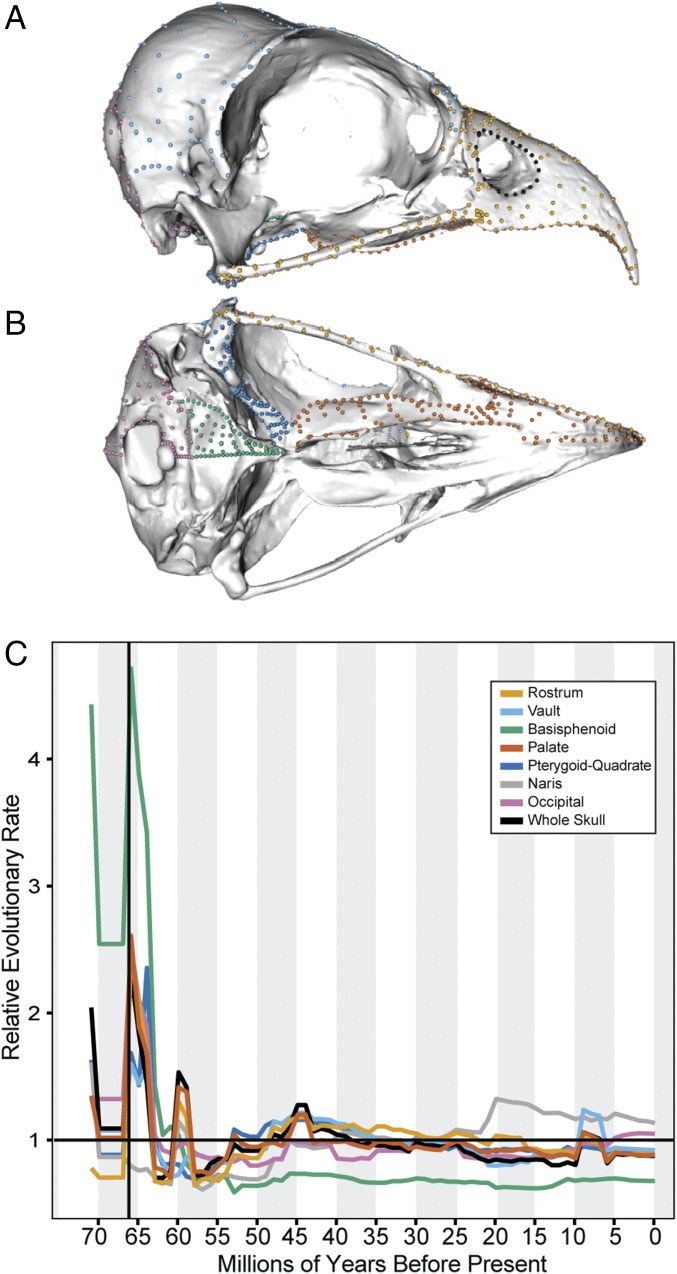
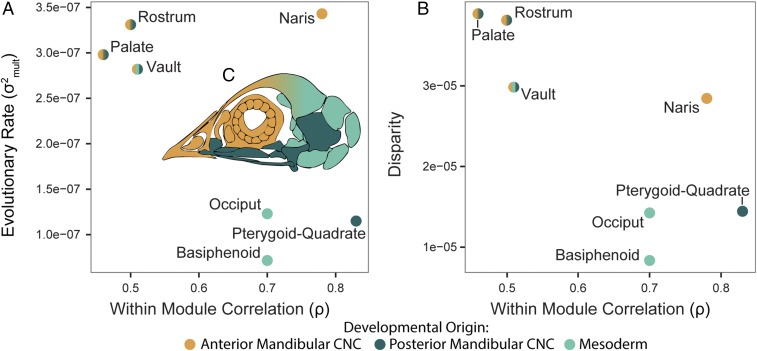
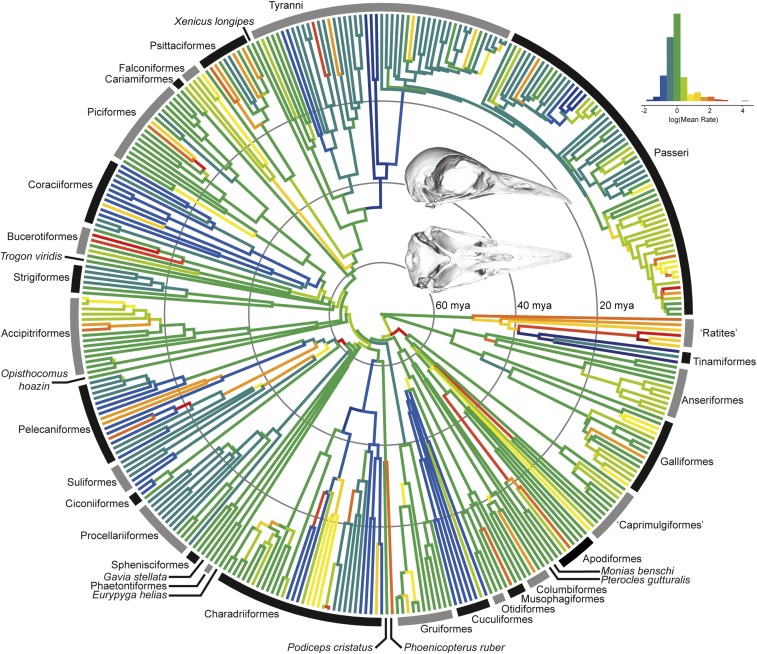
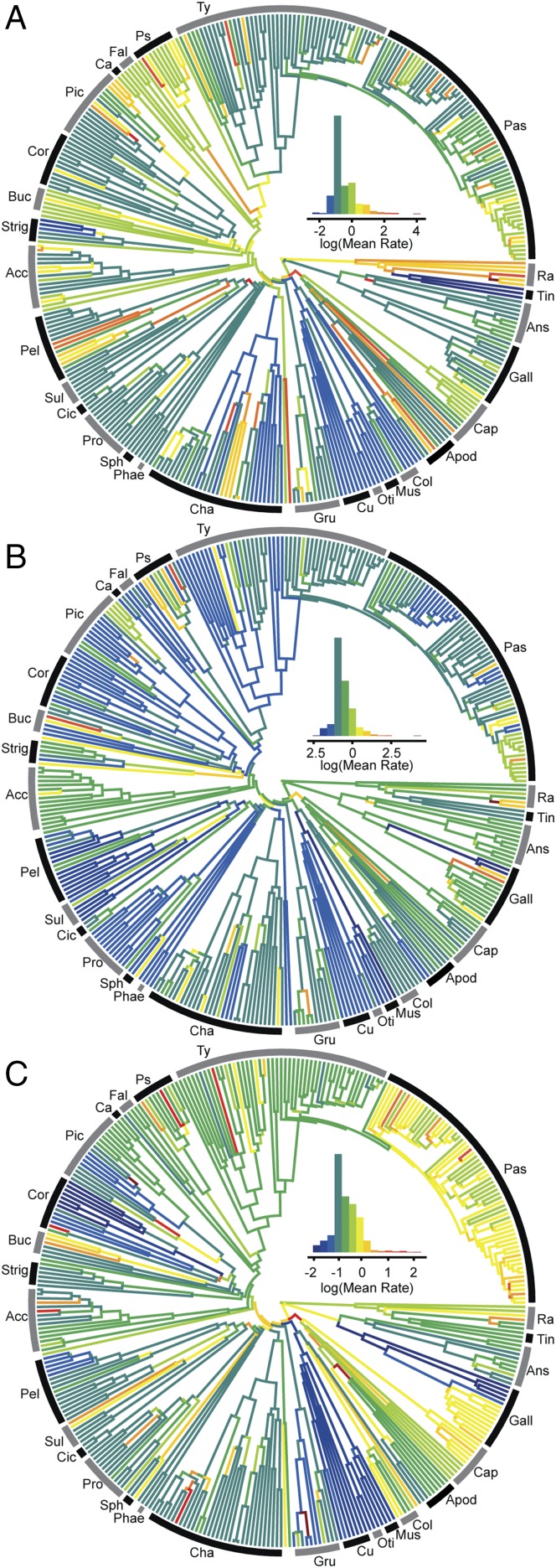
Mosaic evolution, which results from multiple influences shaping morphological traits and can lead to the presence of a mixture of ancestral and derived characteristics, has been frequently invoked in describing evolutionary patterns in birds. Mosaicism implies the hierarchical organization of organismal traits into semiautonomous subsets, or modules, which reflect differential genetic and developmental origins. Here, we analyze mosaic evolution in the avian skull using high-dimensional 3D surface morphometric data across a broad phylogenetic sample encompassing nearly all extant families. We find that the avian cranium is highly modular, consisting of seven independently evolving anatomical regions. The face and cranial vault evolve faster than other regions, showing several bursts of rapid evolution. Other modules evolve more slowly following an early burst. Both the evolutionary rate and disparity of skull modules are associated with their developmental origin, with regions derived from the anterior mandibular-stream cranial neural crest or from multiple embryonic cell populations evolving most quickly and into a greater variety of forms. Strong integration of traits is also associated with low evolutionary rate and low disparity. Individual clades are characterized by disparate evolutionary rates among cranial regions. For example, Psittaciformes (parrots) exhibit high evolutionary rates throughout the skull, but their close relatives, Falconiformes, exhibit rapid evolution in only the rostrum. Our dense sampling of cranial shape variation demonstrates that the bird skull has evolved in a mosaic fashion reflecting the developmental origins of cranial regions, with a semi-independent tempo and mode of evolution across phenotypic modules facilitating this hyperdiverse evolutionary radiation.
Overview
CoChat Summary
TL;DR
Using high-resolution 3D skull data from 352 bird species, the paper shows that the avian cranium is highly modular, with seven semi-independent anatomical modules that evolved at different rates and in different lineages. The authors also link these differences in evolvability to embryonic origin and reconstruct a hypothetical ancestral bird skull.
Key findings
- Likelihood-based modularity tests and covariance ratio analysis support a seven-module avian skull organization, with significant modularity between all pairs of modules (P = 0.001).
- Evolutionary rates differ strongly across modules: the rostrum, palate, naris, and cranial vault evolve fastest (σ2mult = 2.98 × 10⁻⁷–3.82 × 10⁻⁷), while the basisphenoid evolves slowest (0.72 × 10⁻⁷); the occipital and pterygoid-quadrate are about one-third as fast (1.15 × 10⁻⁷–1.23 × 10⁻⁷).
- Across modules, there is an inverse relationship between rate and within-module integration, and also between disparity (Procrustes variance) and integration.
- Fast-evolving modules tend to include regions derived from anterior mandibular-stream cranial neural crest cells or multiple embryonic cell types, whereas slower-evolving regions arise from posterior mandibular cranial neural crest only or mesoderm only.
Methods
- Collected skull shape data for 352 neornithine bird species representing 320 genera and 159 families; used laser surface scanning or microCT of one specimen per species and quantified shape with 757 aligned 3D landmarks after mirroring and Procrustes alignment.
- Built a bird phylogeny from a recent next-generation sequencing-based hypothesis, then pruned a 9,993-species tree to the sampled taxa; included Xenicus longipes by substituting it at the position of Xenicus gilviventri.
- Tested modularity with EMMLi and covariance ratio analysis, measured phylogenetic signal with Kmult, and estimated evolutionary rates with BayesTraitsV3 and multivariate rate calculations from landmark data.
Limitations
- The paper states that the ancestral skull reconstruction is only a “first attempt” and says its accuracy will improve with extinct species data and better-preserved or retrodeformed fossils.
- The text itself makes evident that the ancestral reconstruction is limited by the absence of well-preserved 3D fossils and by reliance on a reconstructed phylogeny rather than direct fossil cranial data (text-evident).
Model-written summary. Check it against the paper before relying on it.
Integrity signals
Registry
Cites
Statistics
Figures
Verification
Claims the paper makes
13 Valid · 1 Not valid · 15 Not checked · 38 Own results and interpretations
Every source the paper cites for this claim was checked and supports it.
In the paper
“Overall patterns of rostrum-shape evolution are comparable to those reconstructed in a recent study of bill evolution (30).”
§ Developmental origins of mosaic evolution in the avian cranium > Results
What the sources say
- Supportedcites [30] Cooney CR 2017 Mega-evolutionary dynamics of the adaptive radiation of birds Nature 542 344 347 28146475 PMC5321581 source
The paper’s discussion of disparity through time reports an early expansion of avian bill morphospace followed by niche packing; it also describes changes in rates of bill-shape evolution. It is therefore the cited study of bill evolution. The comparison with rostrum-shape evolution is the citing authors’ own assessment, not a finding attributed to this source. (LLM, conf=0.91)
plainstates an association- Asserted: passes — The authors put it forward as true.
- Checkable: passes — It can be checked against evidence.
- Load-bearing: unclear — It is unclear whether the paper’s conclusions depend on it.
- Based: passes — The paper gives a reason why it holds.
- Supported
The cited sources support only part of this claim — read each source’s verdict below.
In the paper
“Fossil evidence indicates that these clades had begun to acquire key phenotypic differences during this interval (26, 27).”
§ Developmental origins of mosaic evolution in the avian cranium > Results
What the sources say
- Partly supportedcites [26] Slack KE 2006 Early penguin fossils, plus mitochondrial genomes, calibrate avian evolution Mol Biol Evol 23 1144 1155 16533822 sourceExperimental — accuracy not yet measured
Our copy of Slack et al. (2006) supports only the Sphenisciformes part of the claim: the Discussion states that the four Waimanu fossils show penguins 'diverged from other Neornithes and acquired disparate features such as large body size, more upright stance, and wing-propelled diving habits by the early Paleocene', and the Horizon/Locality/Age section dates the Waipara Greensand material to ~58-60 Ma, matching 'around 60 Mya'. However, Coliiformes, Musophagiformes and Accipitriformes are not addressed anywhere in our copy (searched: mousebirds/turacos/coliids, Accipitriformes, divergence times; the taxon sampling is limited to seabirds/shorebirds, a falcon and buzzard, stork, loon, albatross, petrel, passerines, Galloanserae), so the attribution of fossil-based phenotypic divergence for those three clades to this source is unsupported. The falcon/buzzard ('falconiforms') placement in Fig. 2 is a molecular, not fossil, result and gives no ~60 Ma phenotypic-difference statement. (LLM, conf=0.78)
- Partly supportedcites [27] Ksepka DT Stidham TA Williamson TE 2017 Early Paleocene landbird supports rapid phylogenetic and morphological diversification of crown birds after the K-Pg mass extinction Proc Natl Acad Sci USA 114 8047 8052 28696285 PMC5544281 sourceExperimental — accuracy not yet measured
The Discussion (p. n/a) states that Tsidiiyazhi (62.221–62.517 Ma) 'pushes the hard minimum fossil ages of the lineages leading to four major landbird clades into the early Paleocene: Australaves, Accipitriformes, Strigiformes, and Cavitaves,' and slightly extends the minimum divergence ages of Columbaves/Aequorlitornithes (which contain Sphenisciformes) because it predates the stem penguin Waimanu (60.5–61.6 Ma); the abstract and Discussion also support early acquisition of phenotypic specializations (semizygodactyly in Coliiformes, accipitriform-like pedal phalanges) within <4 Myr of the K–Pg. So Coliiformes and Accipitriformes, and the ~62–60 Ma interval with morphological differentiation, are supported. However, Musophagiformes is never mentioned anywhere in our copy (searched: Musophagiformes, touracos, Cavitaves composition), and the paper offers no phenotypic-difference evidence for Sphenisciformes beyond citing Waimanu's age for calibration — that part of the attributed claim is not supported by this source. (LLM, conf=0.75)
hedged- Asserted: passes — The authors put it forward as true.
- Checkable: passes — It can be checked against evidence.
- Load-bearing: unclear — It is unclear whether the paper’s conclusions depend on it.
- Based: passes — The paper gives a reason why it holds.
- Partly supported
The cited sources support only part of this claim — read each source’s verdict below.
In the paper
“Rather, the macroevolutionary consequences of integration are likely to be highly dependent on the direction and magnitude of selection on each module (13).”
§ Developmental origins of mosaic evolution in the avian cranium > Discussion
What the sources say
- Partly supportedcites [13] Goswami A Smaers JB Soligo C Polly PD 2014 The macroevolutionary consequences of phenotypic integration: From development to deep time Philos Trans R Soc Lond B Biol Sci 369 20130254 25002699 PMC4084539 sourceExperimental — accuracy not yet measured
In “Phenotypic integration mediates evolutionary responses to selection” (page unavailable), the paper says that the direction of selection relative to the major axes of integrated traits affects the evolutionary response. It does not establish that macroevolutionary consequences depend on the magnitude of selection on each module: its simulations use selection vectors of unit length, and the magnitudes discussed are magnitudes of response or integration. (LLM, conf=0.85)
hedgedstates a possible cause- Asserted: passes — The authors put it forward as true.
- Checkable: passes — It can be checked against evidence.
- Load-bearing: unclear — It is unclear whether the paper’s conclusions depend on it.
- Based: passes — The paper gives a reason why it holds.
- Partly supported
Every source the paper cites for this claim was checked and supports it.
In the paper
“As in the avian bill, high rates of evolution are associated with the origin of divergent or unique phenotypes among the sampled taxa (30) including elongate or curved premaxillae (e.g., Phoenicopteridae), cranial ornaments (e.g., Bucorvus), or distinctive palates (e.g., Psittaciformes).”
§ Developmental origins of mosaic evolution in the avian cranium > Discussion
What the sources say
- Supportedcites [30] Cooney CR 2017 Mega-evolutionary dynamics of the adaptive radiation of birds Nature 542 344 347 28146475 PMC5321581 source
The supplied passage labeled Abstract reports that rapid rate increases along single branches produced major discontinuities in bill phenotype, sometimes yielding unusual bill shapes. This supports the cited comparison between high evolutionary rates and divergent phenotypes. The premaxilla, ornament, and palate examples follow citation (30) and describe the citing paper’s sampled taxa, not findings attributed to this source; no page number is provided. (LLM, conf=0.92)
plainstates an association- Asserted: passes — The authors put it forward as true.
- Checkable: passes — It can be checked against evidence.
- Load-bearing: unclear — It is unclear whether the paper’s conclusions depend on it.
- Based: passes — The paper gives a reason why it holds.
- Supported
The sources with a verdict support this claim; the rest weren’t checked yet, have no full text we could read, or their verdicts aren’t rated yet.
In the paper
“Mosaic evolution is possible because the cranium, like the brain (6) and postcranium (2–4), is composed of modular subunits that evolve at different rates in different lineages.”
§ Developmental origins of mosaic evolution in the avian cranium > Discussion
What the sources say
- Supportedcites [6] Balanoff AM Smaers JB Turner AH 2016 Brain modularity across the theropod-bird transition: Testing the influence of flight on neuroanatomical variation J Anat 229 204 214 26538376 PMC4948048 source
The Introduction describes neuroanatomical regions as evolving modularly and transforming differentially. The Discussion and Conclusions reports different changes in cerebral and cerebellar partitions across the bird lineage, supporting the brain-specific point attributed to citation (6). The cranium and postcranium are not attributed to this source. (LLM, conf=0.90)
- Not matchedcites [2] de Beer GR 1954 Archaeopteryx and evolution Adv Sci 11 160 170
We don’t have this paper’s reference list.
- Not checked — no full text of the sourcecites [3] Clarke JA Middleton KM 2008 Mosaicism, modules, and the evolution of birds: Results from a Bayesian approach to the study of morphological evolution using discrete character data Syst Biol 57 185 201 18404577 source
- Not checked — no full text of the sourcecites [4] Gatesy SM Dial KP 1996 Locomotor modules and the evolution of avian flight Evolution 50 331 340 28568886 source
hedgedstates a cause- Asserted: passes — The authors put it forward as true.
- Checkable: passes — It can be checked against evidence.
- Load-bearing: passes — The paper’s conclusions depend on it.
- Based: passes — The paper gives a reason why it holds.
- Supported
36 more claims
Create a free account to see all 67 claims and to verify the 8 references still open.
- It may state two separate claims as one. 21
- Probably not a substantial claim. 6
Citations
Cites
Phylogenies and the Comparative Method
Felsenstein, J. (1985) · The American Naturalist · doi:10.1086/284325 · Cited by 9,793 · cited 1×
“To test the effects of shared ancestry on trait correlations, we also carried out EMMLi analysis on the phylogenetic independent contrasts (45) of the landmark configurations.”
MethodExtensions of the procrustes method for the optimal superimposition of landmarks
Rohlf, F. J., & Slice, D. (1990) · Systematic Zoology · doi:10.2307/2992207 · Cited by 4,289 · cited 1×
“Tomitigate these effects, all right-side semilandmarks weremirrored to the left side, and then specimens were subjected to a Procrustes alignment (43).”
MethodThe global diversity of birds in space and time
Jetz, W., Thomas, G. H., Joy, J. B., Hartmann, K., & Mooers, A. O. (2012) · Nature · doi:10.1038/nature11631 · Cited by 3,934
geomorph: an r package for the collection and analysis of geometric morphometric shape data
Adams, D. C., & Otárola‐Castillo, E. (2013) · Methods in Ecology and Evolution · doi:10.1111/2041-210x.12035 · Cited by 2,168 · cited 1×
“S9) was warped (36) to match the ancestral character state, generating the reconstruction shown in Fig.”
MethodWilman, H., Belmaker, J., Simpson, J., de la Rosa, C., Rivadeneira, M. M., & Jetz, W. (2014) · Ecology · doi:10.1890/13-1917.1 · Cited by 1,994 · cited 1×
“Both are omnivorous passeriforms that are aerial and canopy foragers and range in mass from 64 to 79 g (37).”
BackgroundA comprehensive phylogeny of birds (Aves) using targeted next-generation DNA sequencing
Prum, R. O., Berv, J. S., Dornburg, A., Field, D. J., Townsend, J. P., Lemmon, E. M., & Lemmon, A. R. (2015) · Nature · doi:10.1038/nature15697 · Cited by 1,668
A comprehensive phylogeny of birds (Aves) using targeted next-generation DNA sequencing
Prum, R. O., Berv, J. S., Dornburg, A., Field, D. J., Townsend, J. P., Lemmon, E. M., & Lemmon, A. R. (2016) · Nature · doi:10.1038/nature19417 · Cited by 928 · cited 5×
“In contrast, Columbaves and Coraciiformes tend to evolve slowly in all modules.”
BackgroundMethodResultInfluentialMorpho and Rvcg – Shape Analysis in R
Schlager, S. (2017) · Statistical Shape and Deformation Analysis · doi:10.1016/b978-0-12-810493-4.00011-0 · Cited by 894
Semilandmarks in Three Dimensions
Gunz, P., Mitteroecker, P., & Bookstein, F. L. (2006) · Developments in Primatology: Progress and Prospects · doi:10.1007/0-387-27614-9_3 · Cited by 779 · cited 1×
“After application of surface semilandmarks, all surface landmarks were slid to reduce bending energy (41).”
MethodAdams, D. C. (2014) · Systematic Biology · doi:10.1093/sysbio/syu030 · Cited by 653 · cited 2×
“Phylogenetic signal was calculated for eachmodule using the Kmult statistic, a method specifically designed for the challenges of working with high-dimensional landmark configurations (24).”
BackgroundMethod
Research works printed but not linked: 1
- de Beer GR 1954 Archaeopteryx and evolution Adv Sci 11 160 170
Cited by
Ecomorphological diversification in squamates from conserved pattern of cranial integration
Watanabe, A., Fabre, A.-C., Felice, R. N., Maisano, J. A., Müller, J., Herrel, A., & Goswami, A. (2019) · Proceedings of the National Academy of Sciences · doi:10.1073/pnas.1820967116 · Cited by 175
“As previously described (28), we further inspected the estimated correlation (ρ) values within each partition and between each pair of partitions (SI Appendix, Table S7).”
BackgroundResultInfluentialSelf-citationA fly in a tube: Macroevolutionary expectations for integrated phenotypes
Felice, R. N., Randau, M., & Goswami, A. (2018) · Evolution · doi:10.1111/evo.13608 · Cited by 162
Self-citationA Practical Guide to Sliding and Surface Semilandmarks in Morphometric Analyses
Bardua, C., Felice, R. N., Watanabe, A., Fabre, A., & Goswami, A. (2019) · Integrative Organismal Biology · doi:10.1093/iob/obz016 · Cited by 179
“Results were consistently nearly identical across subsamples and the full datasets (Watanabe et al., 2019; Felice and Goswami 2018; Bardua et al. 2019; Marshall et al. 2019), indicating that they are robust to landmark sampling, but this should be checked separately for every dataset.”
BackgroundMethodInfluentialSelf-citationLate Cretaceous neornithine from Europe illuminates the origins of crown birds
Field, D. J., Benito, J., Chen, A., Jagt, J. W. M., & Ksepka, D. T. (2020) · Nature · doi:10.1038/s41586-020-2096-0 · Cited by 159
Dietary niche and the evolution of cranial morphology in birds
Felice, R. N., Tobias, J. A., Pigot, A. L., & Goswami, A. (2019) · Proceedings of the Royal Society B Biological Sciences · doi:10.1098/rspb.2018.2677 · Cited by 155
Self-citationPhylogenetic Comparative Methods and the Evolution of Multivariate Phenotypes
Adams, D. C., & Collyer, M. L. (2019) · Annual Review of Ecology, Evolution, and Systematics · doi:10.1146/annurev-ecolsys-110218-024555 · Cited by 133
“Typically, Brownian motion is used, where trait variation accumulates proportional to time under random (neutral) trait perturbations (Felsenstein 1973, 1981).”
BackgroundGoswami, A., Watanabe, A., Felice, R. N., Bardua, C., Fabre, A., & Polly, P. D. (2019) · Integrative and Comparative Biology · doi:10.1093/icb/icz120 · Cited by 134
“In contrast, many studies have used semilandmarks to quantify the relationships among different elements or regions of structures ranging from the vertebrate skulls and mandibles (e.g., Bardua et al. 2019a, 2019b; Felice and Goswami 2018; Marshall et al. 2019; Parr et al. 2016; Watanabe et al. 2019; Zelditch et al. 20…”
BackgroundSelf-citationAdams, D. C., & Collyer, M. L. (2019) · Evolution · doi:10.1111/evo.13867 · Cited by 118
Zelditch, M. L., & Goswami, A. (2021) · Evolution & Development · doi:10.1111/ede.12390 · Cited by 135
Self-citationMorphological evolution and modularity of the caecilian skull
Bardua, C., Wilkinson, M., Gower, D. J., Sherratt, E., & Goswami, A. (2019) · BMC Evolutionary Biology · doi:10.1186/s12862-018-1342-7 · Cited by 118
“However, as there is a tendency for analyses of densely sampled semilandmarks to favour highly parameterised models and because not all possible groupings of modules can be assessed in EMMLi analysis at present, we followed Felice and Goswami [19] and assessed the within- and between-region trait correlations for this…”
BackgroundMethodResultInfluentialSelf-citationComplete Ichthyornis skull illuminates mosaic assembly of the avian head
Field, D. J., Hanson, M., Burnham, D. A., Wilson, L. E., Super, K., Ehret, D. J., Ebersole, J. A., & Bhullar, B.-A. S. (2018) · Nature · doi:10.1038/s41586-018-0053-y · Cited by 122
Megaevolutionary dynamics and the timing of evolutionary innovation in reptiles
Simões, T. R., Vernygora, O. V., Caldwell, M. W., & Pierce, S. E. (2020) · Nature Communications · doi:10.1038/s41467-020-17190-9 · Cited by 107
Metamorphosis shapes cranial diversity and rate of evolution in salamanders
Fabre, A., Bardua, C., Bon, M., Clavel, J., Felice, R. N., Streicher, J. W., Bonnel, J., Stanley, E. L., Blackburn, D. C., & Goswami, A. (2020) · Nature Ecology & Evolution · doi:10.1038/s41559-020-1225-3 · Cited by 118
Self-citationPhylogenetically aligned component analysis
Collyer, M. L., & Adams, D. C. (2020) · Methods in Ecology and Evolution · doi:10.1111/2041-210x.13515 · Cited by 103
“…trends in more than one trait simultaneously (e.g. Caetano & Harmon, 2019; Friedman et al., 2016; Price et al., 2010), or describing evolutionary changes in complex multidimensional phenotypes (e.g. Felice & Goswami, 2018; Martinez et al., 2018; Sherratt et al., 2016; Zelditch et al., 2017).”
BackgroundNavalón, G., Marugán‐Lobón, J., Bright, J. A., Cooney, C. R., & Rayfield, E. J. (2020) · Nature Ecology & Evolution · doi:10.1038/s41559-019-1092-y · Cited by 95
Clavel, J., & Morlon, H. (2020) · Systematic Biology · doi:10.1093/sysbio/syaa010 · Cited by 87
Modularity promotes morphological divergence in ray-finned fishes
Larouche, O., Zelditch, M. L., & Cloutier, R. (2018) · Scientific Reports · doi:10.1038/s41598-018-25715-y · Cited by 96
Tsang, L. R., Wilson, L. A. B., Ledogar, J. A., Wroe, S., Attard, M. R. G., & Sansalone, G. (2019) · Scientific Reports · doi:10.1038/s41598-019-43654-0 · Cited by 86
Integration drives rapid phenotypic evolution in flatfishes
Evans, K. M., Larouche, O., Watson, S.-J., Farina, S. C., Habegger, M. L., & Friedman, M. (2021) · Proceedings of the National Academy of Sciences · doi:10.1073/pnas.2101330118 · Cited by 95
“The majority of our understanding of patterns of vertebrate trait diversification come from tetrapod systems, and primarily studies involving birds and mammals (14, 37 – 40).”
The Intertwined Evolution and Development of Sutures and Cranial Morphology
White, H., Goswami, A., & Tucker, A. S. (2021) · Frontiers in Cell and Developmental Biology · doi:10.3389/fcell.2021.653579 · Cited by 93
Self-citationDinosaur Macroevolution and Macroecology
Benson, R. (2018) · Annual Review of Ecology Evolution and Systematics · doi:10.1146/annurev-ecolsys-110617-062231 · Cited by 87
Dellinger, A. S., Artuso, S., Pamperl, S., Michelangeli, F. A., Penneys, D. S., Fernández‐Fernández, D., Alvear, M., Almeda, F., Armbruster, W. S., Staedler, Y. M., et al. (2019) · Communications Biology · doi:10.1038/s42003-019-0697-7 · Cited by 83
Bright, J. A., Marugán‐Lobón, J., Rayfield, E. J., & Cobb, S. N. (2019) · BMC Evolutionary Biology · doi:10.1186/s12862-019-1432-1 · Cited by 87
Integration and Modularity in Procrustes Shape Data: Is There a Risk of Spurious Results?
Cardini, A. (2018) · Evolutionary Biology · doi:10.1007/s11692-018-9463-x · Cited by 87
“For instance, in a very recent investigation of mosaic evolution in the avian cranium, Felice and Goswami (2018) analysed ca. 350 species of birds employing about 30 landmarks and almost 300 semilandmarks, a large number of points that should lead to “not simply a statistical artifact, but rather……”
BackgroundMorris, Z. S., Vliet, K. A., Abzhanov, A., & Pierce, S. E. (2019) · Proceedings of the Royal Society B Biological Sciences · doi:10.1098/rspb.2018.2389 · Cited by 82
Developmental bias, macroevolution, and the fossil record
Jablonski, D. (2019) · Evolution & Development · doi:10.1111/ede.12313 · Cited by 70
Does phenotypic plasticity initiate developmental bias?
Parsons, K. J., McWhinnie, K., Pilakouta, N., & Walker, L. (2019) · Evolution & Development · doi:10.1111/ede.12304 · Cited by 80
Evolutionary Integration and Modularity in the Archosaur Cranium
Felice, R. N., Watanabe, A., Cuff, A. R., Noirault, E., Pol, D., Witmer, L. M., Norell, M. A., O’Connor, P. M., & Goswami, A. (2019) · Integrative and Comparative Biology · doi:10.1093/icb/icz052 · Cited by 74
“Our approach revealed that each cranial module evolves with a unique tempo and mode and are variably associated with trophic ecology (Felice and Goswami 2018; Felice et al. 2019).”
BackgroundMethodInfluentialSelf-citationBayesian Estimation of Species Divergence Times Using Correlated Quantitative Characters
Álvarez-Carretero, S., Goswami, A., Yang, Z., & dos Reis, M. (2019) · Systematic Biology · doi:10.1093/sysbio/syz015 · Cited by 64
Self-citationSize, microhabitat, and loss of larval feeding drive cranial diversification in frogs
Bardua, C., Fabre, A., Clavel, J., Bon, M., Das, K., Stanley, E. L., Blackburn, D. C., & Goswami, A. (2021) · Nature Communications · doi:10.1038/s41467-021-22792-y · Cited by 66
Self-citationRhoda, D., Polly, P. D., Raxworthy, C. J., & Segall, M. (2020) · Evolution · doi:10.1111/evo.14130 · Cited by 59
Correlates of rate heterogeneity in avian ecomorphological traits
Chira, A. M., Cooney, C. R., Bright, J. A., Capp, E. J. R., Hughes, E. C., Moody, C. J. A., Nouri, L. O., Varley, Z. K., & Thomas, G. H. (2018) · Ecology Letters · doi:10.1111/ele.13131 · Cited by 52
“…evolution of morphologically distinct lineages might inhibit subsequent divergence when there are adaptive (Wright 2017) or developmental (Felice & Goswami 2018) constraints on phenotypic change, and also if distinctiveness links to specialisation to a narrow set of resources (Collar et…”
Reaney, A. M., Bouchenak‐Khelladi, Y., Tobias, J. A., & Abzhanov, A. (2020) · Ecology and Evolution · doi:10.1002/ece3.6994 · Cited by 54
Dobreva, M. P., Camacho, J. J., & Abzhanov, A. (2021) · Journal of Experimental Zoology Part B Molecular and Developmental Evolution · doi:10.1002/jez.b.23103 · Cited by 53
Orkney, A., Bjarnason, A., Tronrud, B. C., & Benson, R. (2021) · Nature Ecology & Evolution · doi:10.1038/s41559-021-01509-w · Cited by 56
Environmental signal in the evolutionary diversification of bird skeletons
Navalón, G., Bjarnason, A., Griffiths, E., & Benson, R. (2022) · Nature · doi:10.1038/s41586-022-05372-y · Cited by 52
Plateau, O., & Foth, C. (2020) · Communications Biology · doi:10.1038/s42003-020-0914-4 · Cited by 61
Evolutionary integration of the frog cranium
Bardua, C., Fabre, A., Bon, M., Das, K., Stanley, E. L., Blackburn, D. C., & Goswami, A. (2020) · Evolution · doi:10.1111/evo.13984 · Cited by 55
Self-citationMiller, C. V., & Pittman, M. (2021) · Biological reviews/Biological reviews of the Cambridge Philosophical Society · doi:10.1111/brv.12743 · Cited by 51
Evans, K. M., Vidal‐García, M., Tagliacollo., V. A., Taylor, S. J., & Fenolio, D. B. (2019) · Integrative and Comparative Biology · doi:10.1093/icb/icz026 · Cited by 47
Larouche, O., Gartner, S. M., Westneat, M. W., & Evans, K. M. (2022) · Systematic Biology · doi:10.1093/sysbio/syac061 · Cited by 50
Marshall, A. F., Bardua, C., Gower, D. J., Wilkinson, M., Sherratt, E., & Goswami, A. (2019) · Biological Journal of the Linnean Society · doi:10.1093/biolinnean/blz001 · Cited by 45
Self-citationLate Cretaceous bird from Madagascar reveals unique development of beaks
O’Connor, P. M., Turner, A. H., Groenke, J., Felice, R. N., Rogers, R. R., Krause, D. W., & Rahantarisoa, L. J. (2020) · Nature · doi:10.1038/s41586-020-2945-x · Cited by 46
Self-citationSensory adaptations reshaped intrinsic factors underlying morphological diversification in bats
Arbour, J. H., Curtis, A. A., & Santana, S. E. (2021) · BMC Biology · doi:10.1186/s12915-021-01022-3 · Cited by 49
“Bats show a pattern of mosaic evolution [63] across the skull; different parts of the cranium and mandible diversified at different rates.”
BackgroundA 3D geometric morphometric dataset quantifying skeletal variation in birds
Bjarnason, A., & Benson, R. (2021) · MorphoMuseuM · doi:10.18563/journal.m3.125 · Cited by 42
“The past decade has seen major advances in our understanding of avian macroevolution (e.g. Jetz et al., 2012; Jarvis et al., 2014; Prum et al., 2015; Bright et al., 2016; Cooney et al., 2017; Felice and Goswami, 2018; Felice et al., 2019; Oliveros et al., 2019; Navalón et al., 2020; Pigot et al., 2020), and future inv…”
BackgroundInfluentialPhylogenetic non-independence in rates of trait evolution
Sakamoto, M., & Venditti, C. (2018) · Biology Letters · doi:10.1098/rsbl.2018.0502 · Cited by 45
Ksepka, D. T., Grande, L., & Mayr, G. (2019) · Current Biology · doi:10.1016/j.cub.2018.12.040 · Cited by 46
Conith, A. J., Kidd, M. R., Kocher, T. D., & Albertson, R. C. (2020) · BMC Evolutionary Biology · doi:10.1186/s12862-020-01648-x · Cited by 45
“Empirical studies looking at the association between evolutionary rates and integration have produced mixed results, ranging from no association [7], to positive [60] or negative associations between the two [10].”
BackgroundResultMorphological variation under domestication: how variable are chickens?
Stange, M., Núñez‐León, D., Sánchez-Villagra, M. R., Jensen, P., & Wilson, L. A. B. (2018) · Royal Society Open Science · doi:10.1098/rsos.180993 · Cited by 43
“Given a broad coverage of variation and selective regimes in our sample, our result appears to indicate that domestication may have altered the magnitude of the relationship between skull shape and size, as compared to the strong allometric signal that has been demonstrated for birds [49,54].”
ResultRandau, M., Sanfelice, D., & Goswami, A. (2019) · Royal Society Open Science · doi:10.1098/rsos.190201 · Cited by 27
Self-citationSanger, T. J., & Rajakumar, R. (2018) · Biological reviews/Biological reviews of the Cambridge Philosophical Society · doi:10.1111/brv.12442 · Cited by 38
Evolution of cranial shape in a continental‐scale evolutionary radiation of Australian lizards
Gray, J. A., Sherratt, E., Hutchinson, M. N., & Jones, M. E. H. (2019) · Evolution · doi:10.1111/evo.13851 · Cited by 37
Decelerated dinosaur skull evolution with the origin of birds
Felice, R. N., Watanabe, A., Cuff, A. R., Hanson, M., Bhullar, B.-A. S., Rayfield, E. J., Witmer, L. M., Norell, M. A., & Goswami, A. (2020) · PLoS Biology · doi:10.1371/journal.pbio.3000801 · Cited by 38
“Whereas the fastest evolving part of the avian skull is the anterior rostrum [29,46], this is not the case for all dinosaurs.”
BackgroundResultInfluentialSelf-citationComplex macroevolutionary dynamics underly the evolution of the crocodyliform skull
Felice, R. N., Pol, D., & Goswami, A. (2021) · Proceedings of the Royal Society B Biological Sciences · doi:10.1098/rspb.2021.0919 · Cited by 35
“occipital, postorbital) are low in both non-avian dinosaurs and crocodyliforms [25], but high in birds [26], suggesting that this is a derived condition in birds potentially related to changes in development and cranial architecture and function [45].”
BackgroundSelf-citationMorphological Disparity of the Humerus in Modern Birds
Serrano, F. J., Costa-Pérez, M., Navalón, G., & Martín-Serra, A. (2020) · Diversity · doi:10.3390/d12050173 · Cited by 30
McAllister, C. A., McKain, M. R., Li, M., Bookout, B., & Kellogg, E. A. (2018) · Philosophical Transactions of the Royal Society B Biological Sciences · doi:10.1098/rstb.2017.0403 · Cited by 36
Martín‐Serra, A., & Benson, R. (2019) · The American Naturalist · doi:10.1086/707194 · Cited by 34
“3.0.1; http://www.evolution.rdg.ac.uk/BayesTraitsV3.0.1/Bayes TraitsV3.0.1.html) to estimate rates of multivariate evolution for the allometry-corrected residual shape data for each bone, broadly following the approach of Felice and Goswami (2018).”
MethodInfluentialEarly bursts of disparity and the reorganization of character integration
Wagner, P. J. (2018) · Proceedings of the Royal Society B Biological Sciences · doi:10.1098/rspb.2018.1604 · Cited by 32
Lee, H. W., Esteve‐Altava, B., & Abzhanov, A. (2020) · Scientific Reports · doi:10.1038/s41598-020-73083-3 · Cited by 32
Henderson, S., Dunne, E. M., Fasey, S. A., & Giles, S. (2022) · Biological reviews/Biological reviews of the Cambridge Philosophical Society · doi:10.1111/brv.12907 · Cited by 38
Ortega‐Hernández, J., Lerosey‐Aubril, R., Losso, S. R., & Weaver, J. C. (2022) · Nature Communications · doi:10.1038/s41467-022-28054-9 · Cited by 28
Mammalian forelimb evolution is driven by uneven proximal-to-distal morphological diversity
Rothier, P. S., Fabre, A., Clavel, J., Benson, R., & Herrel, A. (2023) · eLife · doi:10.7554/elife.81492 · Cited by 30
“Whereas some studies have shown clear positive associations between high integration and phenotypic variation (Fabre et al., 2021; Fabre et al., 2020; Randau and Goswami, 2017), negative associations have been also reported (Felice and Goswami, 2018; Goswami and Polly, 2010).”
ResultHead‐turning morphologies: Evolution of shape diversity in the mammalian atlas–axis complex
Linden, A. V., Campbell, K. M., Bryar, E. K., & Santana, S. E. (2019) · Evolution · doi:10.1111/evo.13815 · Cited by 28
“Clade-wide evolutionary analyses of anatomical structures have proven fruitful in understanding the ecological pressures that shape morphological diversity (e.g., Felice and Goswami 2018; Slater and Friscia 2019).”
BackgroundStructuralism and Adaptationism: Friends? Or foes?
Brown, R. L. (2022) · Seminars in Cell and Developmental Biology · doi:10.1016/j.semcdb.2022.02.022 · Cited by 24
A comparison of metrics for quantifying cranial suture complexity
White, H., Clavel, J., Tucker, A. S., & Goswami, A. (2020) · Journal of The Royal Society Interface · doi:10.1098/rsif.2020.0476 · Cited by 24
Self-citationCretaceous bird with dinosaur skull sheds light on avian cranial evolution
Wang, M., Stidham, T. A., Li, Z., Xu, X., & Zhou, Z. (2021) · Nature Communications · doi:10.1038/s41467-021-24147-z · Cited by 26
Developmental origin underlies evolutionary rate variation across the placental skull
Goswami, A., Noirault, E., Coombs, E. J., Clavel, J., Fabre, A., Halliday, T. J. D., Churchill, M., Curtis, A. A., Watanabe, A., Simmons, N. B., et al. (2023) · Philosophical Transactions of the Royal Society B Biological Sciences · doi:10.1098/rstb.2022.0083 · Cited by 22
“Previous studies in diverse vertebrate clades have explored how different cranial regions can display divergent macroe-volutionary dynamics and varying associations with ecological, developmental and life-history factors, from diet and locomotion to reproductive strategy [14,19 – 24].”
BackgroundInfluentialSelf-citationZelditch, M. L., & Swiderski, D. L. (2023) · Evolutionary Biology · doi:10.1007/s11692-023-09600-9 · Cited by 26
“Now, empirical studies often focus on modularity and integration of shape (Felice & Goswami, 2018; Klingenberg et al., 2004; Larouche et al., 2015; Neaux et al., 2015; Renaud et al., 2009).”
Snell‐Rood, E. C., & Ehlman, S. M. (2023) · Evolution & Development · doi:10.1111/ede.12434 · Cited by 25
“…of space, and the growth of individual units relates to the degree of independence — or modularity — of developing units, which can influence evolutionary divergence (Klingenberg, 2008; G. P. Wagner & Altenberg, 1996) and morphological patterns across species (e.g., Felice & Goswami, 2018).”
BackgroundFoth, C., Sookias, R. B., & Ezcurra, M. D. (2021) · Frontiers in Earth Science · doi:10.3389/feart.2021.723973 · Cited by 25
Cerio, D. G., & Witmer, L. M. (2019) · PeerJ · doi:10.7717/peerj.7355 · Cited by 27
Shatkovska, O. V., & Ghazali, M. (2019) · Journal of Anatomy · doi:10.1111/joa.13095 · Cited by 21
“…integration indicates a consolidated response of an organism to natural selection, whereas a low level of integration more likely shows the ability of individual subregions to evolve independently (Monteiro et al. 2005; Klingenberg, 2008; Klingenberg & Marug anLob on, 2013; Felice & Goswami, 2017).”
BackgroundMacroevolutionary bursts and constraints generate a rainbow in a clade of tropical birds
Merwin, J. T., Seeholzer, G. F., & Smith, B. T. (2020) · BMC Evolutionary Biology · doi:10.1186/s12862-020-1577-y · Cited by 27
Diversification of the ruminant skull along an evolutionary line of least resistance
Rhoda, D., Haber, A., & Angielczyk, K. D. (2023) · Science Advances · doi:10.1126/sciadv.ade8929 · Cited by 25
The origin of the bird's beak: new insights from dinosaur incubation periods
Yang, T.-R., & Sander, P. M. (2018) · Biology Letters · doi:10.1098/rsbl.2018.0090 · Cited by 25
A Common Endocrine Signature Marks the Convergent Evolution of an Elaborate Dance Display in Frogs
Anderson, N. K., Schuppe, E. R., Gururaja, K., Mangiamele, L. A., Cusi, J. C., Priti, H., von May, R., Preininger, D., & Fuxjager, M. J. (2021) · The American Naturalist · doi:10.1086/716213 · Cited by 20
“Next, we probe whether correlated evolution between foot-flagging and AR expression varies across the anuran phylogeny in a mosaic fashion, which refers to differences in coevolutionary linkage between variables among taxa (Thompson 2005; Swanson et al. 2006; Felice and Goswami 2018).”
Evolutionary bursts drive morphological novelty in the world’s largest skinks
Brennan, I. G., Chapple, D. G., Keogh, J. S., & Donnellan, S. C. (2024) · Current Biology · doi:10.1016/j.cub.2024.07.039 · Cited by 26
Evolution of tooth crown shape in Mesozoic birds, and its adaptive significance with respect to diet
Zhou, Y.-C., Sullivan, C., Zhou, Z., & Zhang, F. (2021) · Palaeoworld · doi:10.1016/j.palwor.2020.12.008 · Cited by 19
Evolution of the bovid cranium: morphological diversification under allometric constraint
Bibi, F., & Tyler, J. M. B. (2022) · Communications Biology · doi:10.1038/s42003-021-02877-6 · Cited by 23
Conith, A. J., Hope, S. A., & Albertson, R. C. (2022) · Evolution & Development · doi:10.1111/ede.12421 · Cited by 21
Burns, M. D., Collyer, M. L., & Sidlauskas, B. L. (2023) · Evolution · doi:10.1093/evolut/qpac070 · Cited by 23
Complex macroevolution of pterosaurs
Yu, Y., Zhang, C., & Xu, X. (2023) · Current Biology · doi:10.1016/j.cub.2023.01.007 · Cited by 19
Macroevolutionary drivers of morphological disparity in the avian quadrate
Kuo, P.-C., Navalón, G., Benson, R., & Field, D. J. (2024) · Proceedings of the Royal Society B Biological Sciences · doi:10.1098/rspb.2023.2250 · Cited by 19
“For instance, there is some evidence 406 that the bird quadrate may exhibit a comparatively stronger degree of evolutionary 407 integration with the palatine bones than the squamate quadrate [63-64] such that 408 quadrate form in birds may be dictated to a greater extent by complex patterns of 409 cranial structural i…”
BackgroundOrkney, A., & Hedrick, B. P. (2024) · Nature Communications · doi:10.1038/s41467-024-48324-y · Cited by 21
“1b; Head, Leg) is consistent with predictions under a proximo-distal gradient of embryogenesis 56 and previous observations of greater evolutionary variance in more rostral components of the avian cranium 8 .”
Du, T. Y., Tissandier, S., & Larsson, H. C. E. (2019) · Evolution · doi:10.1111/evo.13669 · Cited by 22
“We included reconstructed ancestral nodes in our calculation of disparity, where ancestral states were estimated using the maximum likelihood method (Felsenstein 1973; Schluter et al. 1997) as implemented by the “fastAnc” function in phytools (Revell 2012).”
MethodMartín‐Serra, A., Nanova, O. G., Varón‐González, C., Ortega, G., & Figueirido, B. (2019) · Biology Letters · doi:10.1098/rsbl.2019.0406 · Cited by 18
Newton, A. H., Weisbecker, V., Pask, A. J., & Hipsley, C. A. (2021) · Communications Biology · doi:10.1038/s42003-020-01569-x · Cited by 17
Green, T. L., & Gignac, P. M. (2020) · The Anatomical Record · doi:10.1002/ar.24477 · Cited by 17
Allometric conservatism in the evolution of bird beaks
Rombaut, L. M. K., Capp, E. J. R., Cooney, C. R., Hughes, E. C., Varley, Z. K., & Thomas, G. H. (2022) · Evolution Letters · doi:10.1002/evl3.267 · Cited by 20
Procrustes Shape Cannot be Analyzed, Interpreted or Visualized one Landmark at a Time
Cardini, A., & Marco, V. A. (2022) · Evolutionary Biology · doi:10.1007/s11692-022-09565-1 · Cited by 20
How to tuna fish: constraint, convergence, and integration in the neurocranium of pelagiarian fishes
Knapp, A., Lázaro, G. R., Friedman, M., Johanson, Z., Evans, K. M., Giles, S., Beckett, H. T., & Goswami, A. (2023) · Evolution · doi:10.1093/evolut/qpad056 · Cited by 16
Self-citationConith, A. J., Hope, S. A., Chhouk, B. H., & Albertson, R. C. (2020) · Molecular Ecology · doi:10.1111/mec.15748 · Cited by 19
Accelerated Brain Shape Evolution Is Associated with Rapid Diversification in an Avian Radiation
Eliason, C. M., McCullough, J. M., Andersen, M. J., & Hackett, S. J. (2021) · The American Naturalist · doi:10.1086/713664 · Cited by 17
“Our approach is similar to the semiautomated procedure of Felice and Goswami (2018), in which they place semilandmarks on the external surface of skulls.”
MethodCranial integration in the fire salamander, Salamandra salamandra (Caudata: Salamandridae)
Bon, M., Bardua, C., Goswami, A., & Fabre, A. (2020) · Biological Journal of the Linnean Society · doi:10.1093/biolinnean/blaa020 · Cited by 19
“This jaw joint region of both caecilians and birds exhibits coordinated movement through kinesis, which may be driving its strong integration (Felice & Goswami, 2018; Bardua et al. , 2019b).”
BackgroundMethodResultInfluentialSelf-citationEvolutionary integration and modularity in the diversity of the suckermouth armoured catfishes
Black, C. R., & Armbruster, J. W. (2022) · Royal Society Open Science · doi:10.1098/rsos.220713 · Cited by 18
Ferreira, M. M. D., Tambussi, C. P., Degrange, F. J., Pestoni, S., & Tirao, G. A. (2018) · Zoology · doi:10.1016/j.zool.2018.11.001 · Cited by 17
Edie, S. M., Khouja, S. C., Collins, K. S., Crouch, N. M. A., & Jablonski, D. (2022) · Proceedings of the Royal Society B Biological Sciences · doi:10.1098/rspb.2021.1199 · Cited by 18
A surrogate forelimb: Evolution, function and development of the avian cervical spine
Marek, R. D. (2023) · Journal of Morphology · doi:10.1002/jmor.21638 · Cited by 16
“…vertical climbing — members of Certhoidea (nuthatches and treecreepers) and Picidae (woodpeckers) climb using synchronous movements of the hindlimb (Fujita et al., 2007; Norberg, 1986), and Chukar partridges ( Alectoris chukar ) ascend surfaces via ‘ wing ‐ assisted incline running ’ (Dial,…”
Cerio, D. G., & Witmer, L. M. (2020) · Vision Research · doi:10.1016/j.visres.2019.11.007 · Cited by 14
Rutland, J. W., Delman, B. N., Bellaire, C. P., Napoli, J. G., Shuman, W. H., Rutland, E. A., Ranti, D. L., Margulies, I. G., Goel, P., Sayegh, F., et al. (2020) · Journal of Craniofacial Surgery · doi:10.1097/scs.0000000000006787 · Cited by 13
Metadata
- Authors
- Felice, R. N., & Goswami, A.
- Affiliations
- Natural History Museum (GB)
- Corresponding author
- Felice, Ryan N.
- Venue
- Proceedings of the National Academy of Sciences
- Publisher
- National Academy of Sciences
- Published
- 2017-12-26
- Volume
- 115
- Issue
- 3
- Pages
- 555-560
- ISSN
- 0027-8424 (ISSN-L)
- 1091-6490
- PMC
- PMC5776993
- OpenAlex
- W2777898995
- Semantic Scholar
- 1c8be682ced9bc24b0fe498403cec19720dbd096
- Cited by
- 249
- References
- 48
- Citations by year
- 2026: 17 · 2025: 27 · 2024: 19 · 2023: 26 · 2022: 27 · 2021: 43 · 2020: 31 · 2019: 39 · 2018: 19 · 2017: 1
- FWCI
- 34.09
- Type
- journal article
- Language
- en
- Open access
- hybrid
- doi.org
- Licence
- Locations
- Proceedings of the National Academy of Sciences (publishedVersion, cc-by-nc-nd)
- Europe PMC (PubMed Central) (publishedVersion, cc-by-nc-nd)
- PubMed Central (publishedVersion, cc-by-nc-nd)
- PubMed (publishedVersion)
- UCL Discovery (University College London) (submittedVersion)
- Funders
- H2020 European Research Council (637171)
- Topics
- Life Sciences › Agricultural and Biological Sciences › Ecology, Evolution, Behavior and Systematics › Morphological variations and asymmetry
- Physical Sciences › Earth and Planetary Sciences › Paleontology › Evolution and Paleontology Studies
- Physical Sciences › Earth and Planetary Sciences › Paleontology › Paleontology and Evolutionary Biology
- Keywords
- mosaic evolution, skull morphology, cranial neural crest, evolutionary rates, morphological disparity, parrots, Falconiformes, cranial integration, evolutionary radiation
- MeSH terms
- Animals, Birds, Biological Evolution, Mosaicism, Phenotype, Phylogeny, Skull
About these checks
Registry, retraction, Cites and statistics results are computed, not judged, with one exception: a printed reference that no index lists is read once by a model before it counts as a citation error. Claims are extracted by a model and kept only when their quote appears verbatim in the text; each cited source is then checked, with a model’s help, for whether it says what the claim relies on. Those verdicts can be wrong — read the claim’s quote and the cited source before relying on one.
The claim verdicts this report counts are experimental: their accuracy is not yet measured.
A language model drew the claims from the paper on 2026-10-10, under version 3 of the claim definition (model deepseek-v4.1-flash, prompt extract-v3).
A second model labelled each claim on 2026-10-10 (model jev-1.13-20260917, definition revision gold-guideline-v0.2).
Cited sources are checked with a language model’s help (gpt-6-sol and qwen3.8-omni-flash).
Statistics and arithmetic are recomputed, not judged.
Confidence bands are shown only for fields calibrated on our annotated test set. None is calibrated yet, so no band is shown.
What counts as a claim ›How we measure confidence ›How we check this ›
Are you an author, or do you see a problem with this page? Request a review
Data sources
Bibliographic data: Semantic Scholar, OpenAlex, Crossref.
Contains information from the Semantic Scholar Academic Graph Datasets, made available under the ODC Attribution License (ODC-BY 1.0).
Semantic Scholar’s data is described in: Kinney, R., et al. (2023). The Semantic Scholar Open Data Platform. arXiv:2301.10140.
