

Developmental origins of mosaic evolution in the avian cranium
Open accessThe DOI matches its Crossref record; 47 of the 48 references it cites were found in a registry or an index; 15 of the 47 sources its claims cite were checked for support.
Abstract
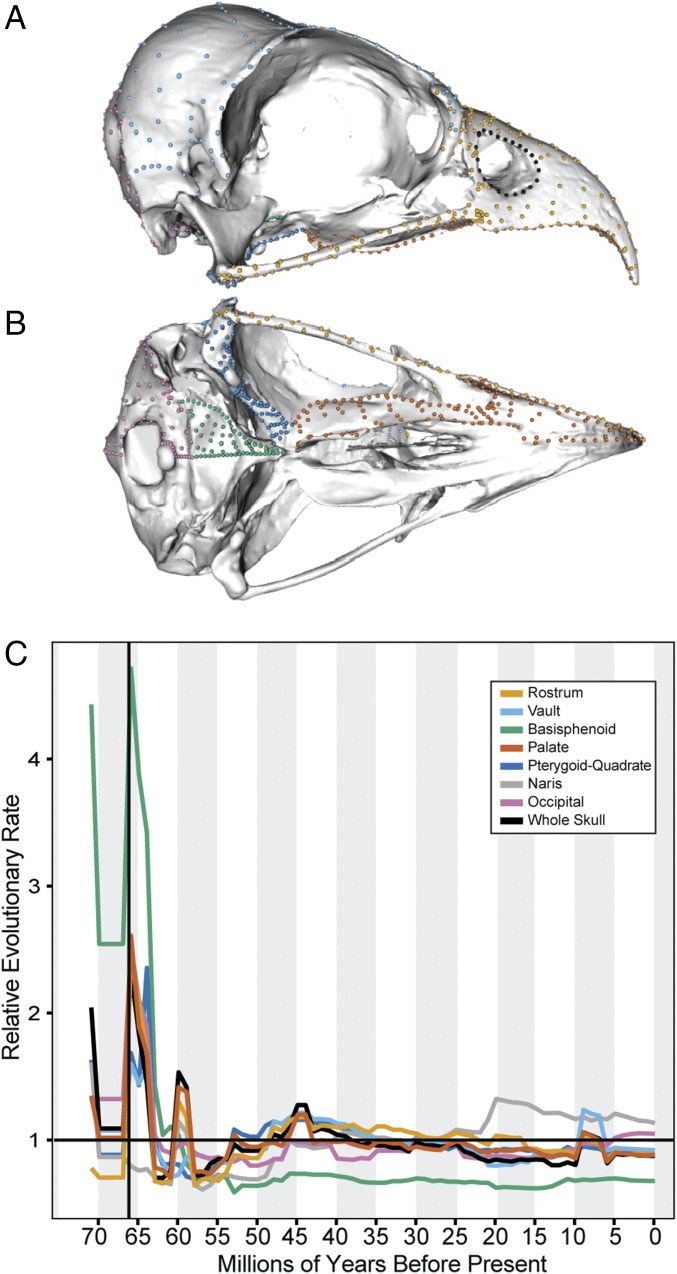
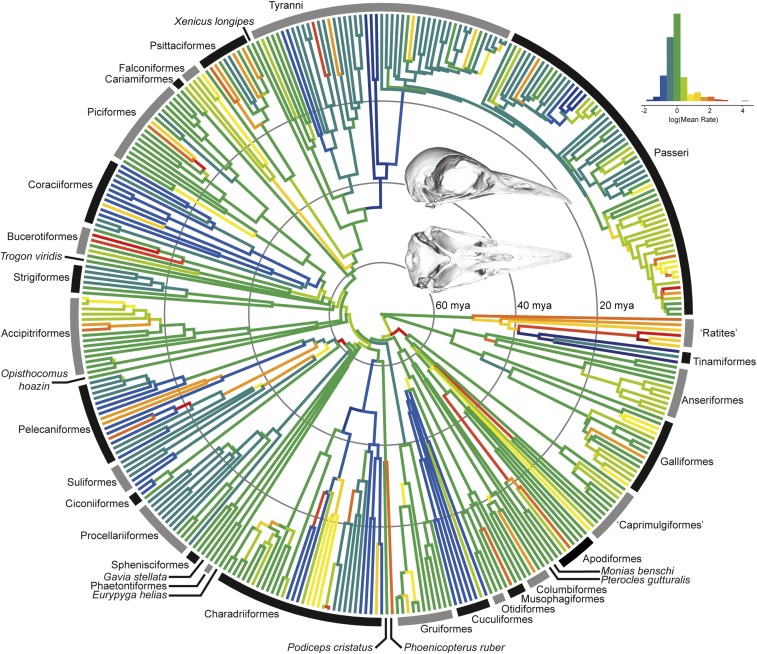
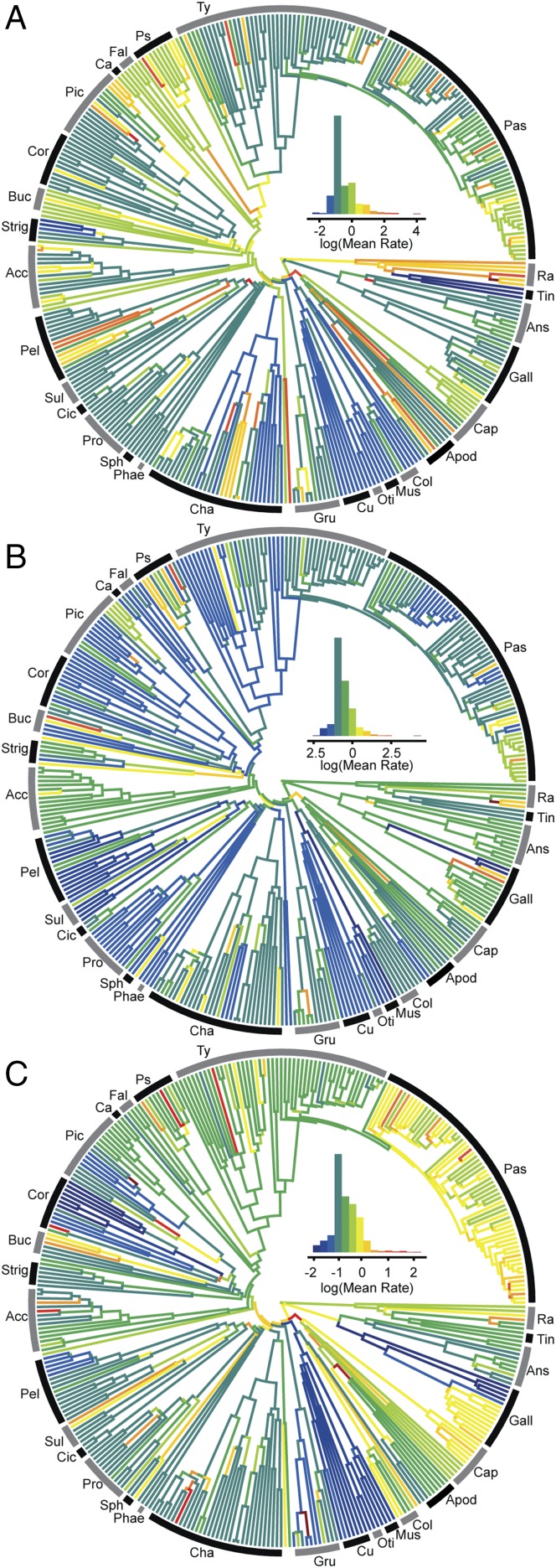
Mosaic evolution, which results from multiple influences shaping morphological traits and can lead to the presence of a mixture of ancestral and derived characteristics, has been frequently invoked in describing evolutionary patterns in birds. Mosaicism implies the hierarchical organization of organismal traits into semiautonomous subsets, or modules, which reflect differential genetic and developmental origins. Here, we analyze mosaic evolution in the avian skull using high-dimensional 3D surface morphometric data across a broad phylogenetic sample encompassing nearly all extant families. We find that the avian cranium is highly modular, consisting of seven independently evolving anatomical regions. The face and cranial vault evolve faster than other regions, showing several bursts of rapid evolution. Other modules evolve more slowly following an early burst. Both the evolutionary rate and disparity of skull modules are associated with their developmental origin, with regions derived from the anterior mandibular-stream cranial neural crest or from multiple embryonic cell populations evolving most quickly and into a greater variety of forms. Strong integration of traits is also associated with low evolutionary rate and low disparity. Individual clades are characterized by disparate evolutionary rates among cranial regions. For example, Psittaciformes (parrots) exhibit high evolutionary rates throughout the skull, but their close relatives, Falconiformes, exhibit rapid evolution in only the rostrum. Our dense sampling of cranial shape variation demonstrates that the bird skull has evolved in a mosaic fashion reflecting the developmental origins of cranial regions, with a semi-independent tempo and mode of evolution across phenotypic modules facilitating this hyperdiverse evolutionary radiation.
Overview
CoChat Summary
TL;DR
Using high-resolution 3D skull data from 352 bird species, the paper shows that the avian cranium is highly modular, with seven semi-independent anatomical modules that evolved at different rates and in different lineages. The authors also link these differences in evolvability to embryonic origin and reconstruct a hypothetical ancestral bird skull.
Key findings
- Likelihood-based modularity tests and covariance ratio analysis support a seven-module avian skull organization, with significant modularity between all pairs of modules (P = 0.001).
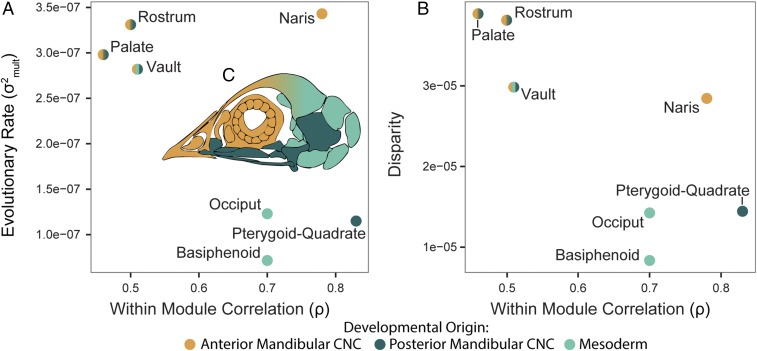
- Evolutionary rates differ strongly across modules: the rostrum, palate, naris, and cranial vault evolve fastest (σ2mult = 2.98 × 10⁻⁷–3.82 × 10⁻⁷), while the basisphenoid evolves slowest (0.72 × 10⁻⁷); the occipital and pterygoid-quadrate are about one-third as fast (1.15 × 10⁻⁷–1.23 × 10⁻⁷).
- Across modules, there is an inverse relationship between rate and within-module integration, and also between disparity (Procrustes variance) and integration.
- Fast-evolving modules tend to include regions derived from anterior mandibular-stream cranial neural crest cells or multiple embryonic cell types, whereas slower-evolving regions arise from posterior mandibular cranial neural crest only or mesoderm only.
Methods
- Collected skull shape data for 352 neornithine bird species representing 320 genera and 159 families; used laser surface scanning or microCT of one specimen per species and quantified shape with 757 aligned 3D landmarks after mirroring and Procrustes alignment.
- Built a bird phylogeny from a recent next-generation sequencing-based hypothesis, then pruned a 9,993-species tree to the sampled taxa; included Xenicus longipes by substituting it at the position of Xenicus gilviventri.
- Tested modularity with EMMLi and covariance ratio analysis, measured phylogenetic signal with Kmult, and estimated evolutionary rates with BayesTraitsV3 and multivariate rate calculations from landmark data.
Limitations
- The paper states that the ancestral skull reconstruction is only a “first attempt” and says its accuracy will improve with extinct species data and better-preserved or retrodeformed fossils.
- The text itself makes evident that the ancestral reconstruction is limited by the absence of well-preserved 3D fossils and by reliance on a reconstructed phylogeny rather than direct fossil cranial data (text-evident).
Model-written summary. Check it against the paper before relying on it.
Integrity signals
Registry
Cites
Statistics
Figures
Verification
Claims the paper makes
13 Valid · 1 Not valid · 15 Not checked · 38 Own results and interpretations
Every source the paper cites for this claim was checked and supports it.
In the paper
“Overall patterns of rostrum-shape evolution are comparable to those reconstructed in a recent study of bill evolution (30).”
§ Developmental origins of mosaic evolution in the avian cranium > Results
What the sources say
- Supportedcites [30] Cooney CR 2017 Mega-evolutionary dynamics of the adaptive radiation of birds Nature 542 344 347 28146475 PMC5321581 source
The paper’s discussion of disparity through time reports an early expansion of avian bill morphospace followed by niche packing; it also describes changes in rates of bill-shape evolution. It is therefore the cited study of bill evolution. The comparison with rostrum-shape evolution is the citing authors’ own assessment, not a finding attributed to this source. (LLM, conf=0.91)
plainstates an association- Asserted: passes — The authors put it forward as true.
- Checkable: passes — It can be checked against evidence.
- Load-bearing: unclear — It is unclear whether the paper’s conclusions depend on it.
- Based: passes — The paper gives a reason why it holds.
- Supported
The cited sources support only part of this claim — read each source’s verdict below.
In the paper
“Fossil evidence indicates that these clades had begun to acquire key phenotypic differences during this interval (26, 27).”
§ Developmental origins of mosaic evolution in the avian cranium > Results
What the sources say
- Partly supportedcites [26] Slack KE 2006 Early penguin fossils, plus mitochondrial genomes, calibrate avian evolution Mol Biol Evol 23 1144 1155 16533822 sourceExperimental — accuracy not yet measured
Our copy of Slack et al. (2006) supports only the Sphenisciformes part of the claim: the Discussion states that the four Waimanu fossils show penguins 'diverged from other Neornithes and acquired disparate features such as large body size, more upright stance, and wing-propelled diving habits by the early Paleocene', and the Horizon/Locality/Age section dates the Waipara Greensand material to ~58-60 Ma, matching 'around 60 Mya'. However, Coliiformes, Musophagiformes and Accipitriformes are not addressed anywhere in our copy (searched: mousebirds/turacos/coliids, Accipitriformes, divergence times; the taxon sampling is limited to seabirds/shorebirds, a falcon and buzzard, stork, loon, albatross, petrel, passerines, Galloanserae), so the attribution of fossil-based phenotypic divergence for those three clades to this source is unsupported. The falcon/buzzard ('falconiforms') placement in Fig. 2 is a molecular, not fossil, result and gives no ~60 Ma phenotypic-difference statement. (LLM, conf=0.78)
- Partly supportedcites [27] Ksepka DT Stidham TA Williamson TE 2017 Early Paleocene landbird supports rapid phylogenetic and morphological diversification of crown birds after the K-Pg mass extinction Proc Natl Acad Sci USA 114 8047 8052 28696285 PMC5544281 sourceExperimental — accuracy not yet measured
The Discussion (p. n/a) states that Tsidiiyazhi (62.221–62.517 Ma) 'pushes the hard minimum fossil ages of the lineages leading to four major landbird clades into the early Paleocene: Australaves, Accipitriformes, Strigiformes, and Cavitaves,' and slightly extends the minimum divergence ages of Columbaves/Aequorlitornithes (which contain Sphenisciformes) because it predates the stem penguin Waimanu (60.5–61.6 Ma); the abstract and Discussion also support early acquisition of phenotypic specializations (semizygodactyly in Coliiformes, accipitriform-like pedal phalanges) within <4 Myr of the K–Pg. So Coliiformes and Accipitriformes, and the ~62–60 Ma interval with morphological differentiation, are supported. However, Musophagiformes is never mentioned anywhere in our copy (searched: Musophagiformes, touracos, Cavitaves composition), and the paper offers no phenotypic-difference evidence for Sphenisciformes beyond citing Waimanu's age for calibration — that part of the attributed claim is not supported by this source. (LLM, conf=0.75)
hedged- Asserted: passes — The authors put it forward as true.
- Checkable: passes — It can be checked against evidence.
- Load-bearing: unclear — It is unclear whether the paper’s conclusions depend on it.
- Based: passes — The paper gives a reason why it holds.
- Partly supported
The cited sources support only part of this claim — read each source’s verdict below.
In the paper
“Rather, the macroevolutionary consequences of integration are likely to be highly dependent on the direction and magnitude of selection on each module (13).”
§ Developmental origins of mosaic evolution in the avian cranium > Discussion
What the sources say
- Partly supportedcites [13] Goswami A Smaers JB Soligo C Polly PD 2014 The macroevolutionary consequences of phenotypic integration: From development to deep time Philos Trans R Soc Lond B Biol Sci 369 20130254 25002699 PMC4084539 sourceExperimental — accuracy not yet measured
In “Phenotypic integration mediates evolutionary responses to selection” (page unavailable), the paper says that the direction of selection relative to the major axes of integrated traits affects the evolutionary response. It does not establish that macroevolutionary consequences depend on the magnitude of selection on each module: its simulations use selection vectors of unit length, and the magnitudes discussed are magnitudes of response or integration. (LLM, conf=0.85)
hedgedstates a possible cause- Asserted: passes — The authors put it forward as true.
- Checkable: passes — It can be checked against evidence.
- Load-bearing: unclear — It is unclear whether the paper’s conclusions depend on it.
- Based: passes — The paper gives a reason why it holds.
- Partly supported
Every source the paper cites for this claim was checked and supports it.
In the paper
“As in the avian bill, high rates of evolution are associated with the origin of divergent or unique phenotypes among the sampled taxa (30) including elongate or curved premaxillae (e.g., Phoenicopteridae), cranial ornaments (e.g., Bucorvus), or distinctive palates (e.g., Psittaciformes).”
§ Developmental origins of mosaic evolution in the avian cranium > Discussion
What the sources say
- Supportedcites [30] Cooney CR 2017 Mega-evolutionary dynamics of the adaptive radiation of birds Nature 542 344 347 28146475 PMC5321581 source
The supplied passage labeled Abstract reports that rapid rate increases along single branches produced major discontinuities in bill phenotype, sometimes yielding unusual bill shapes. This supports the cited comparison between high evolutionary rates and divergent phenotypes. The premaxilla, ornament, and palate examples follow citation (30) and describe the citing paper’s sampled taxa, not findings attributed to this source; no page number is provided. (LLM, conf=0.92)
plainstates an association- Asserted: passes — The authors put it forward as true.
- Checkable: passes — It can be checked against evidence.
- Load-bearing: unclear — It is unclear whether the paper’s conclusions depend on it.
- Based: passes — The paper gives a reason why it holds.
- Supported
The sources with a verdict support this claim; the rest weren’t checked yet, have no full text we could read, or their verdicts aren’t rated yet.
In the paper
“Mosaic evolution is possible because the cranium, like the brain (6) and postcranium (2–4), is composed of modular subunits that evolve at different rates in different lineages.”
§ Developmental origins of mosaic evolution in the avian cranium > Discussion
What the sources say
- Supportedcites [6] Balanoff AM Smaers JB Turner AH 2016 Brain modularity across the theropod-bird transition: Testing the influence of flight on neuroanatomical variation J Anat 229 204 214 26538376 PMC4948048 source
The Introduction describes neuroanatomical regions as evolving modularly and transforming differentially. The Discussion and Conclusions reports different changes in cerebral and cerebellar partitions across the bird lineage, supporting the brain-specific point attributed to citation (6). The cranium and postcranium are not attributed to this source. (LLM, conf=0.90)
- Not matchedcites [2] de Beer GR 1954 Archaeopteryx and evolution Adv Sci 11 160 170
We don’t have this paper’s reference list.
- Not checked — no full text of the sourcecites [3] Clarke JA Middleton KM 2008 Mosaicism, modules, and the evolution of birds: Results from a Bayesian approach to the study of morphological evolution using discrete character data Syst Biol 57 185 201 18404577 source
- Not checked — no full text of the sourcecites [4] Gatesy SM Dial KP 1996 Locomotor modules and the evolution of avian flight Evolution 50 331 340 28568886 source
hedgedstates a cause- Asserted: passes — The authors put it forward as true.
- Checkable: passes — It can be checked against evidence.
- Load-bearing: passes — The paper’s conclusions depend on it.
- Based: passes — The paper gives a reason why it holds.
- Supported
36 more claims
Create a free account to see all 67 claims and to verify the 8 references still open.
- It may state two separate claims as one. 21
- Probably not a substantial claim. 6
Citations
Cites
Phylogenies and the Comparative Method
Felsenstein, J. (1985) · The American Naturalist · doi:10.1086/284325 · Cited by 9,793 · cited 1×
“To test the effects of shared ancestry on trait correlations, we also carried out EMMLi analysis on the phylogenetic independent contrasts (45) of the landmark configurations.”
MethodExtensions of the procrustes method for the optimal superimposition of landmarks
Rohlf, F. J., & Slice, D. (1990) · Systematic Zoology · doi:10.2307/2992207 · Cited by 4,289 · cited 1×
“Tomitigate these effects, all right-side semilandmarks weremirrored to the left side, and then specimens were subjected to a Procrustes alignment (43).”
MethodThe global diversity of birds in space and time
Jetz, W., Thomas, G. H., Joy, J. B., Hartmann, K., & Mooers, A. O. (2012) · Nature · doi:10.1038/nature11631 · Cited by 3,934
geomorph: an r package for the collection and analysis of geometric morphometric shape data
Adams, D. C., & Otárola‐Castillo, E. (2013) · Methods in Ecology and Evolution · doi:10.1111/2041-210x.12035 · Cited by 2,168 · cited 1×
“S9) was warped (36) to match the ancestral character state, generating the reconstruction shown in Fig.”
MethodWilman, H., Belmaker, J., Simpson, J., de la Rosa, C., Rivadeneira, M. M., & Jetz, W. (2014) · Ecology · doi:10.1890/13-1917.1 · Cited by 1,994 · cited 1×
“Both are omnivorous passeriforms that are aerial and canopy foragers and range in mass from 64 to 79 g (37).”
BackgroundA comprehensive phylogeny of birds (Aves) using targeted next-generation DNA sequencing
Prum, R. O., Berv, J. S., Dornburg, A., Field, D. J., Townsend, J. P., Lemmon, E. M., & Lemmon, A. R. (2015) · Nature · doi:10.1038/nature15697 · Cited by 1,668
A comprehensive phylogeny of birds (Aves) using targeted next-generation DNA sequencing
Prum, R. O., Berv, J. S., Dornburg, A., Field, D. J., Townsend, J. P., Lemmon, E. M., & Lemmon, A. R. (2016) · Nature · doi:10.1038/nature19417 · Cited by 928 · cited 5×
“In contrast, Columbaves and Coraciiformes tend to evolve slowly in all modules.”
BackgroundMethodResultInfluentialMorpho and Rvcg – Shape Analysis in R
Schlager, S. (2017) · Statistical Shape and Deformation Analysis · doi:10.1016/b978-0-12-810493-4.00011-0 · Cited by 894
Semilandmarks in Three Dimensions
Gunz, P., Mitteroecker, P., & Bookstein, F. L. (2006) · Developments in Primatology: Progress and Prospects · doi:10.1007/0-387-27614-9_3 · Cited by 779 · cited 1×
“After application of surface semilandmarks, all surface landmarks were slid to reduce bending energy (41).”
MethodAdams, D. C. (2014) · Systematic Biology · doi:10.1093/sysbio/syu030 · Cited by 653 · cited 2×
“Phylogenetic signal was calculated for eachmodule using the Kmult statistic, a method specifically designed for the challenges of working with high-dimensional landmark configurations (24).”
BackgroundMethod
Research works printed but not linked: 1
- de Beer GR 1954 Archaeopteryx and evolution Adv Sci 11 160 170
Cited by
Items 201–240 of 240
Cardini, A. (2023) · EcoEvoRxiv · doi:10.32942/x22w2z · Cited by 1
Scaling and foraging behavior drive the evolution of humeral shape in hummingbirdsPreprint
Ríos‐Orjuela, J. C., Cadena, C. D., Rico‐Guevara, A., Berberi, I., Miner, L., & Dakin, R. (2025) · bioRxiv (Cold Spring Harbor Laboratory) · doi:10.1101/2025.08.11.669688 · Cited by 1
“However, bones may also evolve modularly when regions face distinct functional demands [34,40,41].”
Detecting mosaic patterns in macroevolutionary disparityPreprint
Parins-Fukuchi, C. (2018) · bioRxiv (Cold Spring Harbor Laboratory) · doi:10.1101/423228
“This has also been demonstrated empirically by Felice and Goswami (2018) in avian cranial modules, by revealing both mosaic and shared patterns between integrated modules.”
BackgroundMethodInfluentialEvolution of human commensalism in Passer sparrows - effects on skull morphology and brain size
Peña, M. D. L. C. (2019) · NORA - Norwegian Open Research Archives
Developments for the Next Generation of Evolutionary Paleobiology
Parins‐Fukuchi, C. (2019) · Deep Blue (University of Michigan)
Morphological and biomechanical predictions of cranial kinesis in reptile evolution
Cost, I. N. (2019) · MOspace Institutional Repository (University of Missouri) · doi:10.32469/10355/76243
Morphology and Evolution of the Ceratopsian Skull
Knapp, A. (2020) · Queen Mary Research Online (Queen Mary University of London)
Barnett, V. (2022) · Springer eBooks · doi:10.1007/978-3-319-55065-7_787
Plumage color evolves as distinct dorsal and ventral modules in Australasian honeyeatersPreprint
Friedman, N. R., & Remeš, V. (2022) · bioRxiv (Cold Spring Harbor Laboratory) · doi:10.1101/2022.08.23.504757
“In contrast, if dorsal and ventral coloration are influenced by different evolutionary processes, we should expect them to evolve as distinct evolutionary modules, with different rates and associations with the environment (10).”
BackgroundCardini, A. (2023) · EcoEvoRxiv · doi:10.32942/x2002c
Eliason, C. M., Marcondes, R. S., Eaton, M. D., Maia, R., Burns, K. J., & Shultz, A. J. (2023) · bioRxiv (Cold Spring Harbor Laboratory) · doi:10.1101/2023.08.02.551664
Ritchison, G. (2023) · Fascinating life sciences · doi:10.1007/978-3-031-14852-1_2
Correlated evolution of beak and braincase morphology is present only in select bird cladesPreprint
Xu, X., & Natale, R. (2023) · bioRxiv (Cold Spring Harbor Laboratory) · doi:10.1101/2023.11.19.567761
Elsherbini, J., Alvey, A. J., Black, C. R., Menez, L.-L. S., & Tan, M. (2024) · Ichthyology & Herpetology · doi:10.1643/i2024036 · Cited by 1
“…promotes adaptive diversification only when genetic/ phenotypic variance is parallel to the direction of selection; however, variance driven by integration in other directions will constrain adaptive diversification (Felice et al., 2018; Hedrick et al., 2020; Zelditch and Goswami, 2021).”
InfluentialShaping up: Morphometric approaches to understanding insect behavioural ecology and ecomorphology
Ospina‐Garcés, S. M., & Baena, M. L. (2025) · Elsevier eBooks · doi:10.1016/b978-0-443-18544-1.00001-6
Avian cranial evolution is influenced by trade-offs in shape between hard and soft tissue traitsPreprint
Knapp, A., West, T., Early, C. M., & Felice, R. N. (2025) · bioRxiv (Cold Spring Harbor Laboratory) · doi:10.1101/2025.03.21.644529
Self-citationCorrelated evolution of the neck, head and forelimb across the theropod-bird transitionPreprint
Marek, R. D., & Felice, R. N. (2025) · bioRxiv (Cold Spring Harbor Laboratory) · doi:10.1101/2025.04.04.647043
“There are numerous examples of separate anatomical modules co-evolving during the evolution of birds (5,9,10,15,16,18,39) in a mosaic fashion (whereby separate anatomical modules display distinct evolutionary modes and timings (39)) and these are key features of avian macroevolution (5,10,11,15).”
Self-citationLevels of Evolution (II): Megaevolution and Modular-Evolution
Ochoa, C. (2025) · Evolutionary Biology/Evolutionary biology · doi:10.1007/978-3-031-88723-9_12
Liendro‐Bataglia, N. A., Martini, L. N., Pereyra-Civiello, L. M., Ascune‐Wachsmuth, Z. C., Lois‐Milevicich, J., & Gómez, R. O. (2025) · Journal of Morphology · doi:10.1002/jmor.70092
“For instance, developmental aspects such as ontogenetic allometry (Genbrugge et al. 2011b) or morphological modularity/integration (Felice and Goswami 2018; Orkney et al. 2021) have been considered as potential drivers of cranio ‐ mandibular shape in birds, yet the mandible is typically regarded as…”
Harrison, S. L., Sutton, G. P., & Deeming, D. C. (2025) · Journal of Anatomy · doi:10.1111/joa.70063
Partial least squares analysis
Zelditch, M. L., Swiderski, D. L., & Sheets, H. D. (2025) · Elsevier eBooks · doi:10.1016/b978-0-443-28965-1.00019-1
Morphological diversity in the honeyeater hyolingual apparatus and its relationship with nectarivory
Hewes, A. E., Fieldson, C., Baldwin, M. W., Buttemer, W. A., & Rico‐Guevara, A. (2025) · PLoS ONE · doi:10.1371/journal.pone.0338219
Moore, A. C., Tourigny, M. S. G., Quinonez, D., Barr, K., Grol, M. W., & Willmore, K. E. (2025) · The Anatomical Record · doi:10.1002/ar.70115
Design biocêntrico para assistir o ensino de anatomia de golfinhos a pessoas com deficiência visual
Lacroix, Í., Vasques, M. T., Santos, M. C. D. O., et al. (2026) · DAT Journal · doi:10.29147/datjournal.v10i3.1077
Morphological convergence and dental simplification in myrmecophagous placentals
Ferreira‐Cardoso, S. (2019) · theses.fr (ABES) · doi:10.70675/23f080e4z1857z4a1az88e5z3210be50e8c4
Stefanini, M. I., Gómez, R. O., Tambussi, C. P., Carmona, P. S. M., Zyskowski, K., & Gómez‐Bahamón, V. (2026) · Evolution · doi:10.1093/evolut/qpag065
Scaling and foraging behaviour drive the evolution of humeral shape in hummingbirds
Ríos‐Orjuela, J. C., Cadena, C. D., Rico‐Guevara, A., Berberi, I., Miner, L., & Dakin, R. (2026) · Proceedings of the Royal Society B Biological Sciences · doi:10.1098/rspb.2026.0275 · Cited by 1
Morphological integration of the avian beak facilitates evolution along lines of least resistancePreprint
Ely, R., Sommer, S., & Hipsley, C. A. (2026) · bioRxiv (Cold Spring Harbor Laboratory) · doi:10.64898/2026.05.04.722668
“…of avian morphological integration have focused on covariation of the beak and neurocranium (Klingenberg and Marugán-Lobón 2013; Bright et al. 2016; Felice and Goswami 2018; Xu and Natale 2024) or other skeletal structures (Orkney et al. 2021), while integration of the beak itself has received…”
InfluentialDynamic Morphospaces for Animal Locomotion: A Case Study in Bird Flight
France, L. A., Harvey, C., & Taylor, G. K. (2026) · Integrative and Comparative Biology · doi:10.1093/icb/icag058
“…fishes, revealing that much of the variation can be described by a reduced set of axes capturing size-related allometry and putative functional trade-offs in feeding and sensory systems ( Stayton 2005 ; Sicuro and Oliveira 2011 ; Bright et al. 2016 ; Felice and Goswami 2018 ; Evans et al. 2019 ).”
Beyond species recognition hypothesis: evolutionary trends in Abelisauridae cranial ornamentation
Pereyra, E. E. S., Soto, I. M., & Pérez, D. E. (2026) · Paleobiology · doi:10.1017/pab.2026.10099 · Cited by 1
“Studies in birds have demonstrated not only a striking diversity of plumage coloration and ornate morphological traits (Greene et al. 2000; Felice and Goswami 2018) but also elaborate courtship behaviors (Price 1998).”
Structural Equation Modeling Reveals How Allometry Shapes Integration in Avian Cranial Evolution
Oyston, J. W., Thorson, J. T., Knapp, A., Marek, R. D., & Felice, R. N. (2026) · Integrative and Comparative Biology · doi:10.1093/icb/icag106
“For morphological traits, modules are often defined based on the function, mechanics, composition or shared development of biological structures ( Zelditch et al. 2008 ; Goswami et al. 2012 ; Felice and Goswami 2018 ; Evans et al. 2021 ).”
Self-citationComparative Skeletal Morphology of the Bees (Hymenoptera: Apoidea): A Phylogenetic Perspective
Porto, D. S., & Almeida, E. A. B. (2026) · Bulletin of the American Museum of Natural History · doi:10.1206/0003-0090.483.1.1
Evans, K. M., Duarte-Ribeiro, E., Chan, H., Friedman, M., Habegger, M. L., Ludt, W. B., Clardy, T. R., & Betancur‐R, R. (2026) · Science Advances · doi:10.1126/sciadv.aeh7825
“This pattern of high morphological disparity coupled with high evolutionary rate has also been reported in bird beaks that rapidly diversified in the face of strong evolutionary integration with the braincase ( 23 , 76 – 78 ).”
Freimuth, W. J., Lively, J. R., & Zanno, L. E. (2026) · PLoS ONE · doi:10.1371/journal.pone.0356471
Metadata
- Authors
- Felice, R. N., & Goswami, A.
- Affiliations
- Natural History Museum (GB)
- Corresponding author
- Felice, Ryan N.
- Venue
- Proceedings of the National Academy of Sciences
- Publisher
- National Academy of Sciences
- Published
- 2017-12-26
- Volume
- 115
- Issue
- 3
- Pages
- 555-560
- ISSN
- 0027-8424 (ISSN-L)
- 1091-6490
- PMC
- PMC5776993
- OpenAlex
- W2777898995
- Semantic Scholar
- 1c8be682ced9bc24b0fe498403cec19720dbd096
- Cited by
- 249
- References
- 48
- Citations by year
- 2026: 17 · 2025: 27 · 2024: 19 · 2023: 26 · 2022: 27 · 2021: 43 · 2020: 31 · 2019: 39 · 2018: 19 · 2017: 1
- FWCI
- 34.09
- Type
- journal article
- Language
- en
- Open access
- hybrid
- doi.org
- Licence
- Locations
- Proceedings of the National Academy of Sciences (publishedVersion, cc-by-nc-nd)
- Europe PMC (PubMed Central) (publishedVersion, cc-by-nc-nd)
- PubMed Central (publishedVersion, cc-by-nc-nd)
- PubMed (publishedVersion)
- UCL Discovery (University College London) (submittedVersion)
- Funders
- H2020 European Research Council (637171)
- Topics
- Life Sciences › Agricultural and Biological Sciences › Ecology, Evolution, Behavior and Systematics › Morphological variations and asymmetry
- Physical Sciences › Earth and Planetary Sciences › Paleontology › Evolution and Paleontology Studies
- Physical Sciences › Earth and Planetary Sciences › Paleontology › Paleontology and Evolutionary Biology
- Keywords
- mosaic evolution, skull morphology, cranial neural crest, evolutionary rates, morphological disparity, parrots, Falconiformes, cranial integration, evolutionary radiation
- MeSH terms
- Animals, Birds, Biological Evolution, Mosaicism, Phenotype, Phylogeny, Skull
About these checks
Registry, retraction, Cites and statistics results are computed, not judged, with one exception: a printed reference that no index lists is read once by a model before it counts as a citation error. Claims are extracted by a model and kept only when their quote appears verbatim in the text; each cited source is then checked, with a model’s help, for whether it says what the claim relies on. Those verdicts can be wrong — read the claim’s quote and the cited source before relying on one.
The claim verdicts this report counts are experimental: their accuracy is not yet measured.
A language model drew the claims from the paper on 2026-10-10, under version 3 of the claim definition (model deepseek-v4.1-flash, prompt extract-v3).
A second model labelled each claim on 2026-10-10 (model jev-1.13-20260917, definition revision gold-guideline-v0.2).
Cited sources are checked with a language model’s help (gpt-6-sol and qwen3.8-omni-flash).
Statistics and arithmetic are recomputed, not judged.
Confidence bands are shown only for fields calibrated on our annotated test set. None is calibrated yet, so no band is shown.
What counts as a claim ›How we measure confidence ›How we check this ›
Are you an author, or do you see a problem with this page? Request a review
Data sources
Bibliographic data: Semantic Scholar, OpenAlex, Crossref.
Contains information from the Semantic Scholar Academic Graph Datasets, made available under the ODC Attribution License (ODC-BY 1.0).
Semantic Scholar’s data is described in: Kinney, R., et al. (2023). The Semantic Scholar Open Data Platform. arXiv:2301.10140.
