

Land use strategies to mitigate climate change in carbon dense temperate forests
Open accessThe DOI matches its Crossref record; 41 of the 41 references it cites were found in a registry or an index.
Abstract
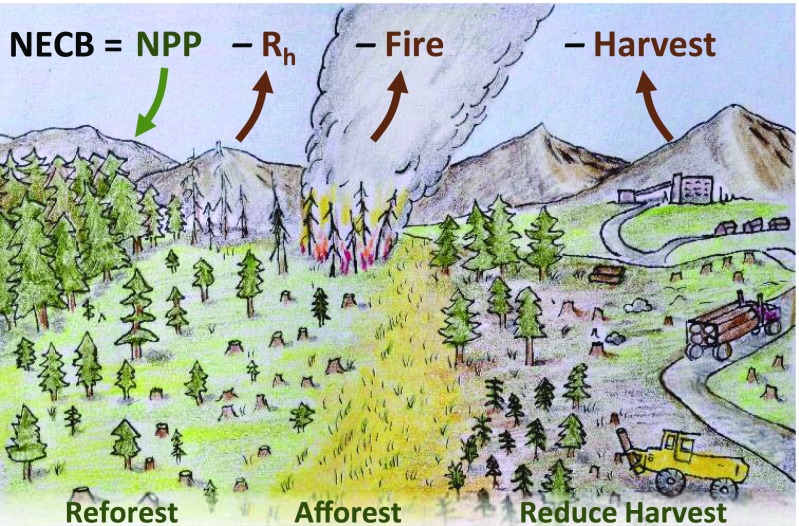
Significance: Regional quantification of feasibility and effectiveness of forest strategies to mitigate climate change should integrate observations and mechanistic ecosystem process models with future climate, CO 2 , disturbances from fire, and management. Here, we demonstrate this approach in a high biomass region, and found that reforestation, afforestation, lengthened harvest cycles on private lands, and restricting harvest on public lands increased net ecosystem carbon balance by 56% by 2100, with the latter two actions contributing the most. Forest sector emissions tracked with our life cycle assessment model decreased by 17%, partially meeting emissions reduction goals. Harvest residue bioenergy use did not reduce short-term emissions. Cobenefits include increased water availability and biodiversity of forest species. Our improved analysis framework can be used in other temperate regions.
Overview
The claims and statistics of this paper haven’t been checked yet.
Free: it reads the open-access text and checks the first 5 claims that cite a source we can check. Create a free account to check every claim.
Integrity signals
Registry
Cites
Statistics
Figures
Verification
Claims the paper makes
The claims and statistics of this paper haven’t been checked yet.
Free: it reads the open-access text and checks the first 5 claims that cite a source we can check. Create a free account to check every claim.
Claims other papers make about this one
Each is checked against this paper’s own text: does it say what the citing paper says it does?
The source backs part of the claim, not all of it — or backs it for a different population, condition or comparison.
In the citing paper
“The GHG mitigation potential of commercial and protection AR has been highlighted in the literature (3, 18–25), but their GHG mitigation efficacy has been debated (18, 26, 27).”
From Climate-smart forestry through innovative wood products and commercial afforestation and reforestation on marginal land (2023) · cites this paper as [3]
Experimental — accuracy not yet measuredThe cited source says what the claim attributes to it.
In the citing paper
“GHG mitigation efficacy of AR depends on regional contexts, such as local climate conditions (18, 26), forest plantation management strategies (3, 19, 27–30), tree species (28, 31), and wood product types and their life cycle activities [e.g., manufacturing processes, use phase, substitution benefits, and end of life (EOL)] (18, 19, 29, 30).”
From Climate-smart forestry through innovative wood products and commercial afforestation and reforestation on marginal land (2023) · cites this paper as [3]
In the citing paper
“The Intergovernmental Panel on Climate Change highlights afforestation and reforestation (AR) as a critical land-based greenhouse gas (GHG) mitigation strategy to limit global warming to 1.5 to 2 °C above preindustrial levels (1–3).”
From Climate-smart forestry through innovative wood products and commercial afforestation and reforestation on marginal land (2023) · cites this paper as [3]
In the citing paper
“This may not be the case as the decision to divert residual biomass to bioenergy could also reduce biosphere C stocks (Law et al., 2018;Pingoud et al., 2016).”
From Diverting residual biomass to energy use: Quantifying the global warming potential of biogenic CO2 (GWPbCO2) (2023) · cites this paper as Law et al., 2018
Self-check
Percentages, sums and reported differences re-computed from the paper’s own numbers.
The self-check needs the paper’s full text.
Citations
Cites
Managing Forests for Climate Change Mitigation
Canadell, J. G., & Raupach, M. R. (2008) · Science · doi:10.1126/science.1155458 · Cited by 1,393
Endangered Ecosystems of the United States: A Preliminary Assessment of Loss and Degradation
(1996) · Ecological Restoration · doi:10.3368/er.14.1.95 · Cited by 899
Re-evaluation of forest biomass carbon stocks and lessons from the world's most carbon-dense forests
Keith, H., Mackey, B. G., & Lindenmayer, D. B. (2009) · Proceedings of the National Academy of Sciences · doi:10.1073/pnas.0901970106 · Cited by 889
Climate, ecosystems, and planetary futures: The challenge to predict life in Earth system models
Bonan, G. B., & Doney, S. C. (2018) · Science · doi:10.1126/science.aam8328 · Cited by 698
Meta-analysis of greenhouse gas displacement factors of wood product substitution
Sathre, R., & O’Connor, J. (2010) · Environmental Science & Policy · doi:10.1016/j.envsci.2009.12.005 · Cited by 537 · cited 1×
“The displacement value for product substitution was assumed to be 2.1 Mg fossil C/Mg C wood use in long-term structures (46), and although it likely fluctuates over time, we assumed it was constant.”
InfluentialLocal temperature response to land cover and management change driven by non-radiative processes
Bright, R. M., Davin, E., O’Halloran, T., Pongratz, J., Zhao, K., & Cescatti, A. (2017) · Nature Climate Change · doi:10.1038/nclimate3250 · Cited by 411
Smith, J. E., Heath, L. S., Skog, K. E., & Birdsey, R. A. (2006) · doi:10.2737/ne-gtr-343 · Cited by 384
The role of forest and bioenergy strategies in the global carbon cycle
Schlamadinger, B., & Marland, G. (1996) · Biomass and Bioenergy · doi:10.1016/0961-9534(95)00113-1 · Cited by 348
Biomass-based negative emissions difficult to reconcile with planetary boundaries
Heck, V., Gerten, D., Lucht, W., & Popp, A. (2018) · Nature Climate Change · doi:10.1038/s41558-017-0064-y · Cited by 334
Lippke, B., Oneil, E., Harrison, R., Skog, K., Gustavsson, L., & Sathre, R. (2011) · Carbon Management · doi:10.4155/cmt.11.24 · Cited by 309 · cited 1×
“Our LCA accounts for losses in product substitution stores (PSSs) associated with building life span, and thus are considerably lower than when no losses are assumed (4, 34).”
Research works printed but not linked: 2
- Jaeger W Plantinga A Langpap C Bigelow D Moore K 2017 Water, Economics and Climate Change in the Willamette Basin Oregon State University Extension Service Corvallis, OR
- Arnold S Kagan J Taylor B 2000 Summary of current status of Oregon’s biodiversity Oregon State of the Environment Report Oregon Progress Board Salem, OR 121 126
Cited by
Getting the message right on nature‐based solutions to climate change
Seddon, N., Smith, A., Smith, P., Key, I., Chausson, A., Girardin, C., House, J., Srivastava, S., & Turner, B. (2021) · Global Change Biology · doi:10.1111/gcb.15513 · Cited by 1,073
Buildings as a global carbon sink
Churkina, G., Organschi, A., Reyer, C. P. O., Ruff, A., Vinke, K., Liu, Z., Reck, B. K., Graedel, T. E., & Schellnhuber, H. J. (2020) · Nature Sustainability · doi:10.1038/s41893-019-0462-4 · Cited by 1,045
The enduring world forest carbon sink
Pan, Y., Birdsey, R. A., Phillips, O. L., Houghton, R. A., Fang, J., Kauppi, P. E., Keith, H., Kurz, W. A., Ito, A., Lewis, S. L., et al. (2024) · Nature · doi:10.1038/s41586-024-07602-x · Cited by 706
Representativeness of Eddy-Covariance flux footprints for areas surrounding AmeriFlux sites
Chu, H., Luo, X., Ouyang, Z., Chan, W. S., Dengel, S., Biraud, S. C., Torn, M. S., Metzger, S., Kumar, J., Arain, M. A., et al. (2021) · Agricultural and Forest Meteorology · doi:10.1016/j.agrformet.2021.108350 · Cited by 497
Self-citationDomke, G. M., Oswalt, S. N., Walters, B. F., & Morin, R. S. (2020) · Proceedings of the National Academy of Sciences · doi:10.1073/pnas.2010840117 · Cited by 266
(2012) · Routledge eBooks · doi:10.4324/9781849771900 · Cited by 215
Wood buildings as a climate solution
Himes, A., & Busby, G. (2020) · Developments in the Built Environment · doi:10.1016/j.dibe.2020.100030 · Cited by 200
Bhattacharyya, R. (2021) · Green Finance · doi:10.3934/gf.2022001 · Cited by 175
Moomaw, W. R., Masino, S. A., & Faison, E. K. (2019) · Frontiers in Forests and Global Change · doi:10.3389/ffgc.2019.00027 · Cited by 168
“, 1990; Ford and Keeton, 2017)—even after the carbon stored in wood products is included in the calculation—stands managed with reduced harvest frequency and increased structural retention sequester more carbon than more intensively managed stands (Nunery and Keeton, 2010; Law et al., 2018).”
BackgroundMildrexler, D. J., Berner, L. T., Law, B. E., Birdsey, R. A., & Moomaw, W. R. (2020) · Frontiers in Forests and Global Change · doi:10.3389/ffgc.2020.594274 · Cited by 168
Self-citationHuman impacts and their interactions in the Baltic Sea region
Reckermann, M., Omstedt, A., Soomere, T., Aigars, J., Akhtar, N., Bełdowska, M., Bełdowski, J., Cronin, T., Czub, M. J., Eero, M., et al. (2022) · Earth System Dynamics · doi:10.5194/esd-13-1-2022 · Cited by 165
Cowie, A., Berndes, G., Bentsen, N. S., Brandão, M., Cherubini, F., Egnell, G., George, B. H., Gustavsson, L., Hanewinkel, M., Harris, Z. M., et al. (2021) · GCB Bioenergy · doi:10.1111/gcbb.12844 · Cited by 165
Plant responses to climate change, how global warming may impact on food security: a critical review
Janni, M., Maestri, E., Gullì, M., Marmiroli, M., & Marmiroli, N. (2024) · Frontiers in Plant Science · doi:10.3389/fpls.2023.1297569 · Cited by 160
Carbon sequestration and biodiversity co‐benefits of preserving forests in the western United States
Buotte, P. C., Law, B. E., Ripple, W. J., & Berner, L. T. (2020) · Ecological Applications · doi:10.1002/eap.2039 · Cited by 159
“S1) of the western United States (Ber-ner and Law 2016, Law et al. 2018, Buotte et al. 2019b), enhanced drought sensitivity through species-specific stomatal response to soil moisture and leaf shedding during periods of drought stress (Buotte et al. 2019b), and improved fire simulation by…”
InfluentialSelf-citationDaigneault, A., Baker, J. S., Guo, J., Lauri, P., Favero, A., Forsell, N., Johnston, C. M. T., Ohrel, S. B., & Sohngen, B. (2022) · Global Environmental Change · doi:10.1016/j.gloenvcha.2022.102582 · Cited by 159
Focus on the role of forests and soils in meeting climate change mitigation goals: summary
Moomaw, W. R., Law, B. E., & Goetz, S. J. (2020) · Environmental Research Letters · doi:10.1088/1748-9326/ab6b38 · Cited by 141
Self-citationWood product carbon substitution benefits: a critical review of assumptions
Howard, C., Dymond, C. C., Griess, V. C., Tolkien-Spurr, D., & van Kooten, G. C. (2021) · Carbon Balance and Management · doi:10.1186/s13021-021-00171-w · Cited by 141
Quantifying the effect of forest age in annual net forest carbon balance
Besnard, S., Carvalhais, N., Arain, M. A., Black, T. A., de Bruin, S., Buchmann, N., Cescatti, A., Chen, J., Clevers, J. G. P. W., Desai, A. R., et al. (2018) · Environmental Research Letters · doi:10.1088/1748-9326/aaeaeb · Cited by 121
Self-citationNear‐future forest vulnerability to drought and fire varies across the western United States
Buotte, P. C., Levis, S., Law, B. E., Hudiburg, T. W., Rupp, D. E., & Kent, J. J. (2019) · Global Change Biology · doi:10.1111/gcb.14490 · Cited by 108
Self-citationWuyts, W., Miatto, A., Sedlitzky, R., & Tanikawa, H. (2019) · Journal of Cleaner Production · doi:10.1016/j.jclepro.2019.05.258 · Cited by 114
Australian forests, megafires and the risk of dwindling carbon stocks
Bowman, D. M. J. S., Williamson, G. J., Price, O. F., Ndalila, M. N., & Bradstock, R. A. (2020) · Plant Cell & Environment · doi:10.1111/pce.13916 · Cited by 108
GHG displacement factors of harvested wood products: the myth of substitution
Leturcq, P. (2020) · Scientific Reports · doi:10.1038/s41598-020-77527-8 · Cited by 90
Case, M. J., Johnson, B. G., Bartowitz, K. J., & Hudiburg, T. W. (2021) · Forest Ecology and Management · doi:10.1016/j.foreco.2020.118886 · Cited by 108
Self-citationImproved forest management as a natural climate solution: A review
Kaarakka, L., Cornett, M. W., Domke, G. M., Ontl, T., & Dee, L. E. (2021) · Ecological Solutions and Evidence · doi:10.1002/2688-8319.12090 · Cited by 107
Kauffman, J. B., Giovanonni, L., Kelly, J., Dunstan, N., Borde, A. B., Diefenderfer, H. L., Cornu, C. E., Janousek, C. N., Apple, J. K., & Brophy, L. S. (2020) · Global Change Biology · doi:10.1111/gcb.15248 · Cited by 103
More Timber in Construction: Unanswered Questions and Future Challenges
Hart, J., & Pomponi, F. (2020) · Sustainability · doi:10.3390/su12083473 · Cited by 77
Change, I. P. O. C. (2022) · Cambridge University Press eBooks · doi:10.1017/9781009157988.006 · Cited by 98
Reforestation and surface cooling in temperate zones: Mechanisms and implications
Zhang, Q., Barnes, M. L., Benson, M., Burakowski, E. A., Oishi, A. C., Ouimette, A. P., Sanders‐DeMott, R., Stoy, P. C., Wenzel, M., Xiong, L., et al. (2020) · Global Change Biology · doi:10.1111/gcb.15069 · Cited by 91
Aboveground carbon loss associated with the spread of ghost forests as sea levels rise
Smart, L. S., Taillie, P. J., Poulter, B., Vukomanovic, J., Singh, K. K., Swenson, J. J., Mitášová, H., Smith, J. W., & Meentemeyer, R. K. (2020) · Environmental Research Letters · doi:10.1088/1748-9326/aba136 · Cited by 89
Carroll, C., & Ray, J. C. (2021) · Global Change Biology · doi:10.1111/gcb.15645 · Cited by 87
Fixing a snag in carbon emissions estimates from wildfires
Stenzel, J. E., Bartowitz, K. J., Hartman, M. D., Lutz, J. A., Kolden, C. A., Smith, A. M. S., Law, B. E., Swanson, M. E., Larson, A. J., Parton, W. J., et al. (2019) · Global Change Biology · doi:10.1111/gcb.14716 · Cited by 86
Self-citationManaging Land‐based CDR: BECCS, Forests and Carbon Sequestration
Brack, D., & King, R. (2020) · Global Policy · doi:10.1111/1758-5899.12827 · Cited by 80
Meeting GHG reduction targets requires accounting for all forest sector emissions
Hudiburg, T. W., Law, B. E., Moomaw, W. R., Harmon, M. E., & Stenzel, J. E. (2019) · Environmental Research Letters · doi:10.1088/1748-9326/ab28bb · Cited by 78
“Some states in theUShave set targets for reducingGHGs that include forest climate mitigation options (Anderson et al 2017, Law et al 2018), yet consistent, rigorous accounting methods are required for evaluating options.”
BackgroundMethodSelf-citationAsymmetric impacts of forest gain and loss on tropical land surface temperature
Zhang, Y., Wang, X., Lian, X., Li, S., Li, Y., Chen, C., & Piao, S. L. (2024) · Nature Geoscience · doi:10.1038/s41561-024-01423-3 · Cited by 77
Paleoecological and historical data as an important tool in ecosystem management
Słowiński, M., Lamentowicz, M., Łuców, D., Barabach, J., Brykała, D., Tyszkowski, S., Pieńczewska, A., Śnieszko, Z., Dietze, E., Jaźdźewski, K., et al. (2019) · Journal of Environmental Management · doi:10.1016/j.jenvman.2019.02.002 · Cited by 72
Teske, S., & Pregger, T. (2019) · Achieving the Paris Climate Agreement Goals · doi:10.1007/978-3-030-05843-2_1 · Cited by 70
Sánchez, J. J., Marcos-Martínez, R., Srivastava, L., & Soonsawad, N. (2021) · Trees Forests and People · doi:10.1016/j.tfp.2021.100123 · Cited by 70
Carbon removals from nature restoration are no substitute for steep emission reductions
Dooley, K., Nicholls, Z., & Meinshausen, M. A. (2022) · One Earth · doi:10.1016/j.oneear.2022.06.002 · Cited by 72
Abdullahi, M., Elnaggar, A., Omar, M. M., Animashaun, I. M., Lawal, M., & Mosa, A. A. (2023) · Egyptian Journal of Soil Science · doi:10.21608/ejss.2023.230986.1647 · Cited by 70
Li, J., Nie, M., & Pendall, E. G. (2020) · Geoderma · doi:10.1016/j.geoderma.2020.114201 · Cited by 70
Natural Climate Solutions for China: The Last Mile to Carbon Neutrality
Qin, Z., Deng, X., Griscom, B. W., Huang, Y., Li, T., Smith, P., Yuan, W., & Zhang, W. J. (2021) · Advances in Atmospheric Sciences · doi:10.1007/s00376-021-1031-0 · Cited by 70
Carbon sequestration and storage capacity of Chinese fir at different stand ages
Li, X., Aguila, L. C. R., Wu, D., Lie, Z., Xu, W., Tang, X., & Liu, J. (2023) · The Science of The Total Environment · doi:10.1016/j.scitotenv.2023.166962 · Cited by 68
Khorchani, M., Nadal‐Romero, E., Martínez, T. L., & Tague, C. (2021) · Environmental Research · doi:10.1016/j.envres.2021.112203 · Cited by 64
(IPCC), I. P. O. C. C. (2023) · Cambridge University Press eBooks · doi:10.1017/9781009325844.016 · Cited by 76
Kyker‐Snowman, E., Lombardozzi, D., Bonan, G. B., Cheng, S. J., Dukes, J. S., Frey, S. D., Jacobs, E. M., McNellis, R., Rady, J. M., Smith, N. G., et al. (2021) · Global Change Biology · doi:10.1111/gcb.15894 · Cited by 64
The role of forests in the mitigation of global climate change: Emprical evidence from Tanzania
Njana, M. A., Mbilinyi, B. P., & Zahabu, E. M. (2021) · Environmental Challenges · doi:10.1016/j.envc.2021.100170 · Cited by 63
Noë, J. L., Erb, K., Matej, S., Magerl, A., Bhan, M., & Gingrich, S. (2021) · Nature Communications · doi:10.1038/s41467-021-26398-2 · Cited by 61
Diaz, D. D., Loreno, S., Ettl, G. J., & Davies, B. (2018) · Forests · doi:10.3390/f9080447 · Cited by 58
Potential greenhouse gas reductions from Natural Climate Solutions in Oregon, USA
Graves, R. A., Haugo, R. D., Holz, A., Nielsen‐Pincus, M., Jones, A., Kellogg, B., Macdonald, C., Popper, K. J., & Schindel, M. (2020) · PLoS ONE · doi:10.1371/journal.pone.0230424 · Cited by 55
Law, B. E., Berner, L. T., Buotte, P. C., Mildrexler, D. J., & Ripple, W. J. (2021) · Communications Earth & Environment · doi:10.1038/s43247-021-00326-0 · Cited by 57
Self-citationInnovative wood use can enable carbon-beneficial forest management in California
Cabiyo, B., Fried, J. S., Collins, B. M., Stewart, W., Wong, J., & Sanchez, D. L. (2021) · Proceedings of the National Academy of Sciences · doi:10.1073/pnas.2019073118 · Cited by 54
“Estimates of how forest treatment will impact net carbon emissions from temperate forests vary substantially (10, 18, 19).”
BackgroundSecuring the climate benefits of stable forests
Funk, J., Aguilar‐Amuchastegui, N., Baldwin-Cantello, W., Busch, J., Chuvasov, E., Evans, T., Griffin, B., Harris, N. L., Ferreira, M. N., Petersen, K., et al. (2019) · Climate Policy · doi:10.1080/14693062.2019.1598838 · Cited by 55
Microbial community structure and functional genes drive soil priming effect following afforestation
Zhou, S., Wang, J., Chen, L., Wang, J., & Zhao, F. (2022) · The Science of The Total Environment · doi:10.1016/j.scitotenv.2022.153925 · Cited by 53
Yao, L., Tan, S., & Xu, Z. (2022) · Environmental Science and Pollution Research · doi:10.1007/s11356-022-23595-4 · Cited by 53
The Global Land Squeeze: Managing the Growing Competition for Land
Searchinger, T., Peng, L., Zionts, J., & Waite, R. (2023) · doi:10.46830/wrirpt.20.00042 · Cited by 52
World scientists’ warnings into action, local to global
Barnard, P., Moomaw, W. R., Fioramonti, L., Laurance, W. F., Mahmoud, M. I., O’Sullivan, J., Rapley, C. G., Rees, W. E., Rhodes, C. J., Ripple, W. J., et al. (2021) · Science Progress · doi:10.1177/00368504211056290 · Cited by 48
Disturbance and management effects on forest soil organic carbon stocks in the Pacific Northwest
Nave, L. E., DeLyser, K., Domke, G. M., Holub, S. M., Janowiak, M. K., Kittler, B. A., Ontl, T., Sprague, E., Sucre, E. B., Walters, B. F., et al. (2022) · Ecological Applications · doi:10.1002/eap.2611 · Cited by 47
Law, B. E., Moomaw, W. R., Hudiburg, T. W., Schlesinger, W. H., Sterman, J. D., & Woodwell, G. M. (2022) · Land · doi:10.3390/land11050721 · Cited by 47
Self-citationBirdsey, R. A., DellaSala, D. A., Walker, W., Gorelik, S. R., Rose, G., & Ramírez, C. E. (2023) · Frontiers in Forests and Global Change · doi:10.3389/ffgc.2022.1074508 · Cited by 47
Chen, M., Vernon, C., Huang, M., Calvin, K., & Kraucunas, I. P. (2019) · Geoscientific model development · doi:10.5194/gmd-12-1753-2019 · Cited by 45
Conterminous United States Land-Cover Change (1985–2016): New Insights from Annual Time Series
Auch, R. F., Wellington, D., Taylor, J. L., Stehman, S. V., Tollerud, H. J., Brown, J. F., Loveland, T. R., Pengra, B. W., Horton, J. A., Zhu, Z., et al. (2022) · Land · doi:10.3390/land11020298 · Cited by 45
Simmonds, M., Vittorio, A. D., Jahns, C., Johnston, E., Jones, A. D., & Nico, P. (2021) · Environmental Research Letters · doi:10.1088/1748-9326/abcc8d · Cited by 43
Papa, C. C., Nzokou, P., & Mbow, C. (2020) · Environmental Management · doi:10.1007/s00267-020-01302-8 · Cited by 42
Giuntoli, J., Searle, S., Jonsson, R., Agostini, A., Robert, N., Amaducci, S., Luisa, M., & Camia, A. (2020) · Renewable and Sustainable Energy Reviews · doi:10.1016/j.rser.2020.110368 · Cited by 40
Participatory scenario planning to facilitate human–wildlife coexistence
Jiren, T. S., Riechers, M., Kansky, R., & Fischer, J. (2021) · Conservation Biology · doi:10.1111/cobi.13725 · Cited by 40
Conflicting portrayals of remaining old growth: the British Columbia case
Price, K., Holt, R. F., & Daust, D. (2021) · Canadian Journal of Forest Research · doi:10.1139/cjfr-2020-0453 · Cited by 41
Circulating blame in the circular economy: The case of wood-waste biofuels and coal ash
Millward-Hopkins, J., & Purnell, P. (2019) · Energy Policy · doi:10.1016/j.enpol.2019.02.019 · Cited by 40
Changes in perspective needed to forge ‘no‐regret’ forest‐based climate change mitigation strategies
Erb, K., Haberl, H., Noë, J. L., Tappeiner, U., Tasser, E., & Gingrich, S. (2022) · GCB Bioenergy · doi:10.1111/gcbb.12921 · Cited by 41
What Is the Impact of Mass Timber Utilization on Climate and Forests?
Pasternack, R., Wishnie, M. H., Clarke, C., Wang, Y., Belair, E. P., Marshall, S., Gu, H., Nepal, P., Dolezal, F., Lomax, G., et al. (2022) · Sustainability · doi:10.3390/su14020758 · Cited by 39
Protect large trees for climate mitigation, biodiversity, and forest resilience
Mildrexler, D. J., Berner, L. T., Law, B. E., Birdsey, R. A., & Moomaw, W. R. (2023) · Conservation Science and Practice · doi:10.1111/csp2.12944 · Cited by 39
Self-citationHarta, I., Simon, B., Vinogradov, S., & Winkler, D. (2020) · Journal of Forestry Research · doi:10.1007/s11676-020-01238-z · Cited by 38
Mackey, B., Moomaw, W. R., Lindenmayer, D. B., & Keith, H. (2022) · Environmental Research Letters · doi:10.1088/1748-9326/ac661b · Cited by 38
A nature-based approach to mitigate flood risk and improve ecosystem services in Shiga, Japan
Huang, W., Hashimoto, S., Yoshida, T., Saitô, O., & Taki, K. (2021) · Ecosystem Services · doi:10.1016/j.ecoser.2021.101309 · Cited by 37
Bartowitz, K. J., Walsh, E. S., Stenzel, J. E., Kolden, C. A., & Hudiburg, T. W. (2022) · Frontiers in Forests and Global Change · doi:10.3389/ffgc.2022.867112 · Cited by 37
Self-citationDesie, E., Vancampenhout, K., Heyens, K., Hlava, J., Verheyen, K., & Muys, B. (2019) · Soil Biology and Biochemistry · doi:10.1016/j.soilbio.2019.107540 · Cited by 38
Zhang, B., Lan, K., Harris, T. B., Ashton, M. S., & Yao, Y. (2023) · Proceedings of the National Academy of Sciences · doi:10.1073/pnas.2221840120 · Cited by 36
Predicting effects of climate change on productivity and persistence of forest trees
Kramer, R. D., Ishii, H. T., Carter, K., Miyazaki, Y., Cavaleri, M. A., Araki, M. G., Azuma, W. A., Inoue, Y., & Hara, C. (2020) · Ecological Research · doi:10.1111/1440-1703.12127 · Cited by 36
Biogeophysical and biogeochemical impacts of land-use change simulated by MIROC-ES2L
Ito, A., & Hajima, T. (2020) · Progress in Earth and Planetary Science · doi:10.1186/s40645-020-00372-w · Cited by 35
Littleton, E. W., Dooley, K., Webb, G., Harper, A., Powell, T., Nicholls, Z., Meinshausen, M. A., & Lenton, T. M. (2021) · Environmental Research Letters · doi:10.1088/1748-9326/ac3c6c · Cited by 36
Rana, K., Kumar, M., & Kumar, A. (2020) · Water Air & Soil Pollution · doi:10.1007/s11270-020-04825-2 · Cited by 34
Accounting for inter‐annual variability alters long‐term estimates of climate suitability
Gardner, A. S., Gaston, K. J., & Maclean, I. M. D. (2021) · Journal of Biogeography · doi:10.1111/jbi.14125 · Cited by 34
Githumbi, E. N., Pirzamanbein, B., Lindström, J., Poska, A., Fyfe, R., Mazier, F., Nielsen, A. B., Sugita, S., Trondman, A., Woodbridge, J., et al. (2022) · Frontiers in Ecology and Evolution · doi:10.3389/fevo.2022.795794 · Cited by 34
Kauffman, J. B., Beschta, R. L., Lacy, P. M., & Liverman, M. (2022) · Environmental Management · doi:10.1007/s00267-022-01633-8 · Cited by 34
Sustained Biomass Carbon Sequestration by China’s Forests from 2010 to 2050
Zhang, C., Ju, W., Chen, J., Fang, M., Wu, M., Chang, X., Wang, T., & Wang, X. (2018) · Forests · doi:10.3390/f9110689 · Cited by 33
Mansingh, A., Pradhan, A., Sahoo, S., Cherwa, S. S., Mishra, B. P., Rath, L. P., Ekka, N. J., & Panda, B. P. (2025) · BMC Ecology and Evolution · doi:10.1186/s12862-025-02385-9 · Cited by 31
The Climate Emergency, Forests, and Transformative Change
Ripple, W. J., Wolf, C., Newsome, T. M., Barnard, P., Moomaw, W. R., Maas, B., & Law, B. E. (2020) · BioScience · doi:10.1093/biosci/biaa032 · Cited by 31
Self-citationGraves, R. A., Nielsen‐Pincus, M., Haugo, R. D., & Holz, A. (2022) · Forest Policy and Economics · doi:10.1016/j.forpol.2022.102778 · Cited by 30
Montibeller, B., Marshall, M., Mander, Ü., & Uuemaa, E. (2022) · Communications Earth & Environment · doi:10.1038/s43247-022-00535-1 · Cited by 30
Dębska, B., Kotwica, K., Banach-Szott, M., Spychaj‐Fabisiak, E., & Tobiašová, E. (2022) · Agriculture · doi:10.3390/agriculture12091478 · Cited by 30
Harris, S. H., & Betts, M. G. (2023) · Journal of Applied Ecology · doi:10.1111/1365-2664.14385 · Cited by 30
Qaswar, M., Li, D., Huang, J. Y., Han, T., Ahmed, W., Ali, S., Khan, M. N., Khan, Z. H., Xu, Y., Li, Q., et al. (2022) · Journal of Integrative Agriculture · doi:10.1016/s2095-3119(20)63501-8 · Cited by 30
Zhang, Y., Xu, Q. C., Zhang, B., Gao, D., Wang, T., Xu, W., Ren, R., & Wang, S. (2022) · Frontiers in Plant Science · doi:10.3389/fpls.2022.946508 · Cited by 29
Predicting potential climate change impacts of bioenergy from perennial grasses in 2050
Liu, W., Wang, K., Hao, H., Yan, Y., Zhang, H., Zhang, H., & Peng, C. H. (2022) · Resources Conservation and Recycling · doi:10.1016/j.resconrec.2022.106818 · Cited by 28
Ectomycorrhizal fungi integrate nitrogen mobilisation and mineral weathering in boreal forest soil
Mahmood, S., Fahad, Z. A., Bolou‐Bi, E. B., King, K., Köhler, S. J., Bishop, K., Ekblad, A., & Finlay, R. D. (2023) · New Phytologist · doi:10.1111/nph.19260 · Cited by 28
Hiltunen, M., Strandman, H., & Kilpeläinen, A. (2021) · Biomass and Bioenergy · doi:10.1016/j.biombioe.2021.106027 · Cited by 27
García-Duro, J., Ciceu, A., Chivulescu, Ş., Badea, O. N., Tanase, M. A., & Aponte, C. (2021) · Forests · doi:10.3390/f12111434 · Cited by 27
Quantifying forest degradation requires a long-term, landscape-scale approach
Betts, M. G., Yang, Z., Hadley, A. S., Hightower, J. N., Hua, F., Lindenmayer, D. B., Seo, E., & Healey, S. P. (2024) · Nature Ecology & Evolution · doi:10.1038/s41559-024-02409-5 · Cited by 27
Forster, E. J., Styles, D., & Healey, J. R. (2025) · Nature Communications · doi:10.1038/s41467-025-58463-5 · Cited by 26
Higher carbon storage in primary than secondary boreal forests in Sweden
Pascual, D., Hugelius, G., Canadell, J. G., Harden, J. W., Jackson, R. B., Georgiou, K., Jonshagen, A., Lindström, J., Ljung, K., Register, E., et al. (2026) · Science · doi:10.1126/science.adz8554 · Cited by 26
Pathways towards a Sustainable Future
Chan, K. W., Agard, J. B. R., Liu, J., de Aguiar, A. P., Armenteras, D., Boedhihartono, A. K., Cheung, W. L., Hashimoto, S., Pedraza, G. C. H., Hickler, T., et al. (2019) · IIASA PURE (International Institute of Applied Systems Analysis) · Cited by 26
Metadata
- Authors
- Law, B. E., Hudiburg, T. W., Berner, L. T., Kent, J. J., Buotte, P. C., & Harmon, M. E.
- Affiliations
- Oregon State University (US)
- University of Idaho (US)
- EcoSpatial Services L.L.C., Flagstaff, AZ 86004
- Corresponding author
- Law, Beverly E.
- ORCID
- Venue
- Proceedings of the National Academy of Sciences
- Publisher
- National Academy of Sciences
- Published
- 2018-03-19
- Volume
- 115
- Issue
- 14
- Pages
- 3663-3668
- ISSN
- 0027-8424 (ISSN-L)
- 1091-6490
- PMC
- PMC5889652
- OpenAlex
- W2794086441
- Cited by
- 252
- References
- 41
- Citations by year
- 2026: 17 · 2025: 18 · 2024: 30 · 2023: 30 · 2022: 42 · 2021: 48 · 2020: 36 · 2019: 23 · 2018: 8
- FWCI
- 16.82
- Type
- journal article
- Language
- en
- Open access
- hybrid
- doi.org
- Licence
- Locations
- Proceedings of the National Academy of Sciences (publishedVersion, cc-by-nc-nd)
- Europe PMC (PubMed Central) (publishedVersion, cc-by-nc-nd)
- PubMed Central (publishedVersion, cc-by-nc-nd)
- PubMed (publishedVersion)
- OSTI OAI (U.S. Department of Energy Office of Scientific and Technical Information) (submittedVersion)
- Funders
- US Department of Energy BER (DE-SC0012194)
- USDA NIFA (2014-67003-22065, 2014-35100-22066, and 2013-67003-20652)
- Topics
- Life Sciences › Agricultural and Biological Sciences › Forestry › Forest Management and Policy
- Life Sciences › Agricultural and Biological Sciences › Forestry › Forest ecology and management
- Life Sciences › Agricultural and Biological Sciences › Soil Science › Soil Carbon and Nitrogen Dynamics
- Keywords
- forest carbon sequestration, climate change mitigation, temperate forests, reforestation, afforestation, forest management, life cycle assessment, forest fire disturbance, water availability, biodiversity, carbon balance
- MeSH terms
- Agriculture, Carbon, Conservation of Natural Resources, Fires, Forestry, Ecosystem, Climate Change, Forests
About these checks
Registry, retraction, Cites and statistics results are computed, not judged, with one exception: a printed reference that no index lists is read once by a model before it counts as a citation error. Claims are extracted by a model and kept only when their quote appears verbatim in the text; each cited source is then checked, with a model’s help, for whether it says what the claim relies on. Those verdicts can be wrong — read the claim’s quote and the cited source before relying on one.
Statistics and arithmetic are recomputed, not judged.
Confidence bands are shown only for fields calibrated on our annotated test set. None is calibrated yet, so no band is shown.
What counts as a claim ›How we measure confidence ›How we check this ›
Are you an author, or do you see a problem with this page? Request a review
Data sources
Bibliographic data: Semantic Scholar, OpenAlex, Crossref.
Contains information from the Semantic Scholar Academic Graph Datasets, made available under the ODC Attribution License (ODC-BY 1.0).
Semantic Scholar’s data is described in: Kinney, R., et al. (2023). The Semantic Scholar Open Data Platform. arXiv:2301.10140.
