

Constraining the climate and ocean pH of the early Earth with a geological carbon cycle model
Open accessThe DOI matches its Crossref record; 146 of the 146 references it cites were found in a registry or an index.
Abstract
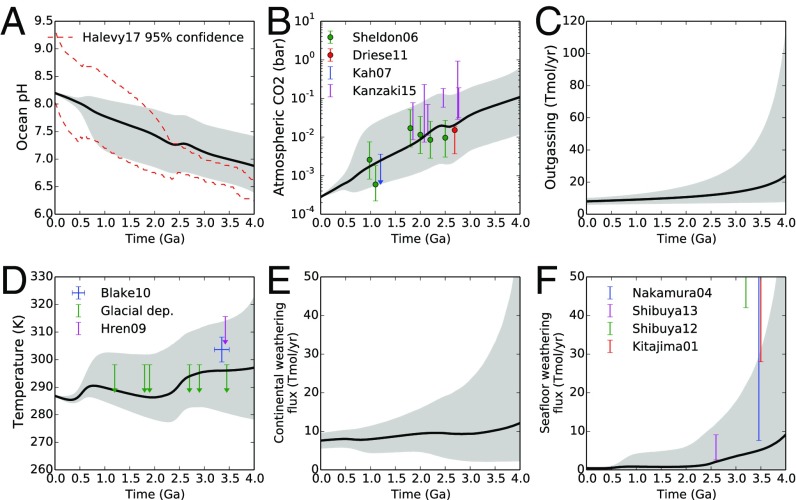
Significance: The climate and ocean pH of the early Earth are important for understanding the origin and early evolution of life. However, estimates of early climate range from below freezing to over 70 °C, and ocean pH estimates span from strongly acidic to alkaline. To better constrain environmental conditions, we applied a self-consistent geological carbon cycle model to the last 4 billion years. The model predicts a temperate (0–50 °C) climate and circumneutral ocean pH throughout the Precambrian due to stabilizing feedbacks from continental and seafloor weathering. These environmental conditions under which life emerged and diversified were akin to the modern Earth. Similar stabilizing feedbacks on climate and ocean pH may operate on earthlike exoplanets, implying life elsewhere could emerge in comparable environments.
Overview
The claims and statistics of this paper haven’t been checked yet.
Free: it reads the open-access text and checks the first 5 claims that cite a source we can check. Create a free account to check every claim.
Integrity signals
Registry
Cites
Statistics
Figures
Verification
Claims the paper makes
The claims and statistics of this paper haven’t been checked yet.
Free: it reads the open-access text and checks the first 5 claims that cite a source we can check. Create a free account to check every claim.
Claims other papers make about this one
Each is checked against this paper’s own text: does it say what the citing paper says it does?
The source backs part of the claim, not all of it — or backs it for a different population, condition or comparison.
In the citing paper
“In the Archean, with greater seafloor production than today, seafloor weathering could have been comparable to continental weathering (34, 35, 182), and negative feedback (Eq. 2) likely maintained average Archean surface temperatures between 0° and 40°C with seawater pH 6.4 to 7.4 (34).”
From The Archean atmosphere (2020) · cites this paper as [34]
Experimental — accuracy not yet measuredThe source backs part of the claim, not all of it — or backs it for a different population, condition or comparison.
In the citing paper
“The corresponding pCO2 would have been 0.006 to 0.6 bar 4 Ga ago, assuming that ~104-ppmv CH4 also contributed to the greenhouse effect.”
From The Archean atmosphere (2020) · cites this paper as [34]
Experimental — accuracy not yet measuredThe source backs part of the claim, not all of it — or backs it for a different population, condition or comparison.
In the citing paper
“CO2 alone could have solved the FYS problem with 0.004- to 0.03-bar CO2 at 2.5 Ga ago and 0.024- to 1-bar CO2 at 4 Ga ago, where the spread comes from uncertain carbonate-silicate model parameters.”
From The Archean atmosphere (2020) · cites this paper as [34]
Experimental — accuracy not yet measuredThe source backs part of the claim, not all of it — or backs it for a different population, condition or comparison.
In the citing paper
“In general, how CO2 outgassing changed with time dominates the uncertainty (34).”
From The Archean atmosphere (2020) · cites this paper as [34]
Experimental — accuracy not yet measured
5 more claims about this paper
Create a free account to see every claim other papers make about this one.
Self-check
Percentages, sums and reported differences re-computed from the paper’s own numbers.
The self-check needs the paper’s full text.
Citations
Cites
An early Cenozoic perspective on greenhouse warming and carbon-cycle dynamics
Zachos, J. C., Dickens, G. R., & Zeebe, R. E. (2008) · Nature · doi:10.1038/nature06588 · Cited by 3,550 · cited 2×
“e existence of glacial deposits anywhere on Earth bounds global average temperatures to <25°C. The glaciation of Antarctica occurred approximately 35 Ma when global temperatures crossed below 20°C (48), and so an upper limit of 25°C is a more conservative estimate allowing for variations due to paleogeography. Of c…”
BackgroundInfluentialClark, P. U., Dyke, A. S., Shakun, J. D., Carlson, A. E., Clark, J., Wohlfarth, B., Mitrovica, J. X., Hostetler, S. W., & McCabe, A. M. (2009) · Science · doi:10.1126/science.1172873 · Cited by 3,277 · cited 2×
“coupled atmosphere-ocean GCMs with complete ocean circulation. Paleocene-Eocene Thermal Maximum (PETM) temperatures were sourced from Jones, et al. (22), Last Glacial Maximum (LGM) from Clark, et al. (23), and Cretaceous proxies from a composite dataset described in Krissansen-Totton and Catling (1). See KrissansenTot…”
BackgroundMethodInfluentialA negative feedback mechanism for the long‐term stabilization of Earth's surface temperature
Walker, J. C. G., Hays, P. B., & Kasting, J. F. (1981) · Journal of Geophysical Research: Oceans · doi:10.1029/jc086ic10p09776 · Cited by 2,310 · cited 1×
“The conventional view of the carbon cycle is that carbon outgassing into the atmosphere– ocean system is balanced by continental silicate weathering and subsequent marine carbonate formation (30, 31).”
BackgroundThermal Equilibrium of the Atmosphere with a Given Distribution of Relative Humidity
Manabe, S., & Wetherald, R. T. (1967) · Journal of the Atmospheric Sciences · doi:10.1175/1520-0469(1967)024<0241:teotaw>2.0.co;2 · Cited by 1,735 · cited 1×
“n). 13 We assume an Earth-mass planet with a surface albedo of 0.32, which includes the radiative effects of water clouds (60). We apply a Manabe/Wetherald relative humidity model for the troposphere (71) and specify a surface relative humidity of 0.8. Our relative humidity parameterization is described in more detail…”
MethodInfluentialGEOCARB II; a revised model of atmospheric CO 2 over Phanerozoic time
Berner, R. A. (1994) · American Journal of Science · doi:10.2475/ajs.294.1.56 · Cited by 1,683
HABITABLE ZONES AROUND MAIN-SEQUENCE STARS: NEW ESTIMATES
Kopparapu, R. K., Ramirez, R., Kasting, J. F., Eymet, V., Robinson, T. D., Mahadevan, S., Terrien, R. C., Domagal-Goldman, S., Meadows, V., & Deshpande, R. (2013) · The Astrophysical Journal · doi:10.1088/0004-637x/765/2/131 · Cited by 1,615 · cited 1×
“We used a 1D radiative convective model (46) to create a grid of mean surface temperatures as a function of solar luminosity and pCO2.”
MethodMantle Convection in the Earth and Planets
Schubert, G., Turcotte, D. L., & Olson, P. (2001) · Cambridge University Press eBooks · doi:10.1017/cbo9780511612879 · Cited by 1,374
GEOCARB III: A revised model of atmospheric CO2 over Phanerozoic time
Berner, R. A. (2001) · American Journal of Science · doi:10.2475/ajs.301.2.182 · Cited by 1,323
Research works printed but not linked: 1
- 2. Knauth LP Lowe DR 2003 High Archean climatic temperature inferred from oxygen isotope geochemistry of cherts in the 3.5 Ga Swaziland Supergroup, South Africa Geol Soc Am Bull 115 566 580 · doi:10.1130/0016-7606(2003)115
Cited by
Catling, D. C., & Zahnle, K. J. (2020) · Science Advances · doi:10.1126/sciadv.aax1420 · Cited by 568
“5 Ga 9 5% confidence ranges from a carbon cycle model with 10(4)-ppmv Archean CH4 (34).”
BackgroundMethodInfluentialSelf-citationExoplanet Biosignatures: A Framework for Their Assessment
Catling, D. C., Krissansen-Totton, J., Kiang, N. Y., Crisp, D., Robinson, T. D., DasSarma, S., Rushby, A. J., Del Genio, A., Bains, W., & Domagal-Goldman, S. (2018) · Astrobiology · doi:10.1089/ast.2017.1737 · Cited by 225
“On Earth, environmental feedbacks on CO2 maintain long-term habitability over *1 m.y. timescales through the carbonate–silicate geochemical cycle (Walker et al., 1981; Kasting and Catling, 2003; Krissansen-Totton and Catling, 2017; Krissansen-Totton et al., 2018a).”
BackgroundMethodSelf-citationWay, M. J., & Del Genio, A. D. (2020) · Journal of Geophysical Research: Planets · doi:10.1029/2019je006276 · Cited by 171
A carbonate-rich lake solution to the phosphate problem of the origin of life
Toner, J. D., & Catling, D. C. (2020) · Proceedings of the National Academy of Sciences · doi:10.1073/pnas.1916109117 · Cited by 201
“01 to 1 bar CO2 on the early Earth (35), we find that corresponding phosphate concentrations in our experiments are between 20 and 100 mmol·kg, respectively.”
Self-citationHow temperature-dependent silicate weathering acts as Earth’s geological thermostat
Brantley, S. L., Shaughnessy, A., Lebedeva, M. I., & Balashov, V. N. (2023) · Science · doi:10.1126/science.add2922 · Cited by 180
Metadata
- Authors
- Krissansen-Totton, J., Arney, G. N., & Catling, D. C.
- Affiliations
- Department of Earth and Space Sciences, University of Washington, Seattle, WA 98195;
- Goddard Space Flight Center (US)
- NASA Astrobiology Institute (US)
- Venue
- Proceedings of the National Academy of Sciences
- Publisher
- National Academy of Sciences
- Published
- 2018-04-02
- Volume
- 115
- Issue
- 16
- Pages
- 4105-4110
- ISSN
- 0027-8424 (ISSN-L)
- 1091-6490
- PMC
- PMC5910859
- OpenAlex
- W2796394497
- Cited by
- 348
- References
- 140
- Citations by year
- 2026: 35 · 2025: 51 · 2024: 38 · 2023: 37 · 2022: 44 · 2021: 62 · 2020: 43 · 2019: 27 · 2018: 9
- FWCI
- 25.94
- Type
- journal article
- Language
- en
- Open access
- hybrid
- doi.org
- Licence
- Locations
- Proceedings of the National Academy of Sciences (publishedVersion, cc-by-nc-nd)
- Europe PMC (PubMed Central) (publishedVersion, cc-by-nc-nd)
- PubMed Central (publishedVersion, cc-by-nc-nd)
- PubMed (publishedVersion)
- arXiv (Cornell University) (submittedVersion)
- arXiv (Cornell University)
- Funders
- National Aeronautics and Space Administration (NNX15AL23G, NNX15AR63H, NNA13AA93A)
- Simons Foundation (511570)
- Topics
- Physical Sciences › Earth and Planetary Sciences › Paleontology › Paleontology and Stratigraphy of Fossils
- Physical Sciences › Environmental Science › Global and Planetary Change › Earth Systems and Cosmic Evolution
- Physical Sciences › Physics and Astronomy › Astronomy and Astrophysics › Origins and Evolution of Life
- Keywords
- early Earth climate, seawater pH, Precambrian, continental weathering, seafloor weathering, origin of life, early evolution of life, exoplanet habitability
About these checks
Registry, retraction, Cites and statistics results are computed, not judged, with one exception: a printed reference that no index lists is read once by a model before it counts as a citation error. Claims are extracted by a model and kept only when their quote appears verbatim in the text; each cited source is then checked, with a model’s help, for whether it says what the claim relies on. Those verdicts can be wrong — read the claim’s quote and the cited source before relying on one.
Statistics and arithmetic are recomputed, not judged.
Confidence bands are shown only for fields calibrated on our annotated test set. None is calibrated yet, so no band is shown.
What counts as a claim ›How we measure confidence ›How we check this ›
Are you an author, or do you see a problem with this page? Request a review
Data sources
Bibliographic data: Semantic Scholar, OpenAlex, Crossref.
Contains information from the Semantic Scholar Academic Graph Datasets, made available under the ODC Attribution License (ODC-BY 1.0).
Semantic Scholar’s data is described in: Kinney, R., et al. (2023). The Semantic Scholar Open Data Platform. arXiv:2301.10140.
