

Constraining the climate and ocean pH of the early Earth with a geological carbon cycle model
Open accessThe DOI matches its Crossref record; 146 of the 146 references it cites were found in a registry or an index.
Abstract
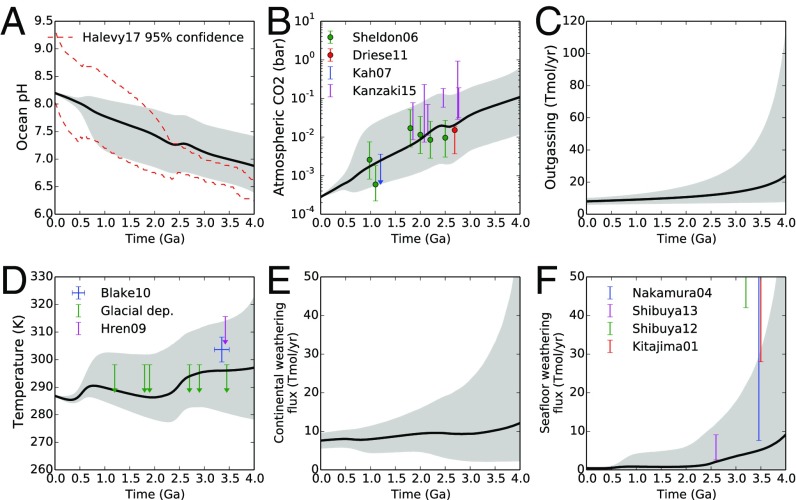
Significance: The climate and ocean pH of the early Earth are important for understanding the origin and early evolution of life. However, estimates of early climate range from below freezing to over 70 °C, and ocean pH estimates span from strongly acidic to alkaline. To better constrain environmental conditions, we applied a self-consistent geological carbon cycle model to the last 4 billion years. The model predicts a temperate (0–50 °C) climate and circumneutral ocean pH throughout the Precambrian due to stabilizing feedbacks from continental and seafloor weathering. These environmental conditions under which life emerged and diversified were akin to the modern Earth. Similar stabilizing feedbacks on climate and ocean pH may operate on earthlike exoplanets, implying life elsewhere could emerge in comparable environments.
Overview
The claims and statistics of this paper haven’t been checked yet.
Free: it reads the open-access text and checks the first 5 claims that cite a source we can check. Create a free account to check every claim.
Integrity signals
Registry
Cites
Statistics
Figures
Verification
Claims the paper makes
The claims and statistics of this paper haven’t been checked yet.
Free: it reads the open-access text and checks the first 5 claims that cite a source we can check. Create a free account to check every claim.
Claims other papers make about this one
Each is checked against this paper’s own text: does it say what the citing paper says it does?
The source backs part of the claim, not all of it — or backs it for a different population, condition or comparison.
In the citing paper
“In the Archean, with greater seafloor production than today, seafloor weathering could have been comparable to continental weathering (34, 35, 182), and negative feedback (Eq. 2) likely maintained average Archean surface temperatures between 0° and 40°C with seawater pH 6.4 to 7.4 (34).”
From The Archean atmosphere (2020) · cites this paper as [34]
Experimental — accuracy not yet measuredThe source backs part of the claim, not all of it — or backs it for a different population, condition or comparison.
In the citing paper
“The corresponding pCO2 would have been 0.006 to 0.6 bar 4 Ga ago, assuming that ~104-ppmv CH4 also contributed to the greenhouse effect.”
From The Archean atmosphere (2020) · cites this paper as [34]
Experimental — accuracy not yet measuredThe source backs part of the claim, not all of it — or backs it for a different population, condition or comparison.
In the citing paper
“CO2 alone could have solved the FYS problem with 0.004- to 0.03-bar CO2 at 2.5 Ga ago and 0.024- to 1-bar CO2 at 4 Ga ago, where the spread comes from uncertain carbonate-silicate model parameters.”
From The Archean atmosphere (2020) · cites this paper as [34]
Experimental — accuracy not yet measuredThe source backs part of the claim, not all of it — or backs it for a different population, condition or comparison.
In the citing paper
“In general, how CO2 outgassing changed with time dominates the uncertainty (34).”
From The Archean atmosphere (2020) · cites this paper as [34]
Experimental — accuracy not yet measured
5 more claims about this paper
Create a free account to see every claim other papers make about this one.
Self-check
Percentages, sums and reported differences re-computed from the paper’s own numbers.
The self-check needs the paper’s full text.
Citations
Cites
An early Cenozoic perspective on greenhouse warming and carbon-cycle dynamics
Zachos, J. C., Dickens, G. R., & Zeebe, R. E. (2008) · Nature · doi:10.1038/nature06588 · Cited by 3,550 · cited 2×
“e existence of glacial deposits anywhere on Earth bounds global average temperatures to <25°C. The glaciation of Antarctica occurred approximately 35 Ma when global temperatures crossed below 20°C (48), and so an upper limit of 25°C is a more conservative estimate allowing for variations due to paleogeography. Of c…”
BackgroundInfluentialClark, P. U., Dyke, A. S., Shakun, J. D., Carlson, A. E., Clark, J., Wohlfarth, B., Mitrovica, J. X., Hostetler, S. W., & McCabe, A. M. (2009) · Science · doi:10.1126/science.1172873 · Cited by 3,277 · cited 2×
“coupled atmosphere-ocean GCMs with complete ocean circulation. Paleocene-Eocene Thermal Maximum (PETM) temperatures were sourced from Jones, et al. (22), Last Glacial Maximum (LGM) from Clark, et al. (23), and Cretaceous proxies from a composite dataset described in Krissansen-Totton and Catling (1). See KrissansenTot…”
BackgroundMethodInfluentialA negative feedback mechanism for the long‐term stabilization of Earth's surface temperature
Walker, J. C. G., Hays, P. B., & Kasting, J. F. (1981) · Journal of Geophysical Research: Oceans · doi:10.1029/jc086ic10p09776 · Cited by 2,310 · cited 1×
“The conventional view of the carbon cycle is that carbon outgassing into the atmosphere– ocean system is balanced by continental silicate weathering and subsequent marine carbonate formation (30, 31).”
BackgroundThermal Equilibrium of the Atmosphere with a Given Distribution of Relative Humidity
Manabe, S., & Wetherald, R. T. (1967) · Journal of the Atmospheric Sciences · doi:10.1175/1520-0469(1967)024<0241:teotaw>2.0.co;2 · Cited by 1,735 · cited 1×
“n). 13 We assume an Earth-mass planet with a surface albedo of 0.32, which includes the radiative effects of water clouds (60). We apply a Manabe/Wetherald relative humidity model for the troposphere (71) and specify a surface relative humidity of 0.8. Our relative humidity parameterization is described in more detail…”
MethodInfluentialGEOCARB II; a revised model of atmospheric CO 2 over Phanerozoic time
Berner, R. A. (1994) · American Journal of Science · doi:10.2475/ajs.294.1.56 · Cited by 1,683
HABITABLE ZONES AROUND MAIN-SEQUENCE STARS: NEW ESTIMATES
Kopparapu, R. K., Ramirez, R., Kasting, J. F., Eymet, V., Robinson, T. D., Mahadevan, S., Terrien, R. C., Domagal-Goldman, S., Meadows, V., & Deshpande, R. (2013) · The Astrophysical Journal · doi:10.1088/0004-637x/765/2/131 · Cited by 1,615 · cited 1×
“We used a 1D radiative convective model (46) to create a grid of mean surface temperatures as a function of solar luminosity and pCO2.”
MethodMantle Convection in the Earth and Planets
Schubert, G., Turcotte, D. L., & Olson, P. (2001) · Cambridge University Press eBooks · doi:10.1017/cbo9780511612879 · Cited by 1,374
GEOCARB III: A revised model of atmospheric CO2 over Phanerozoic time
Berner, R. A. (2001) · American Journal of Science · doi:10.2475/ajs.301.2.182 · Cited by 1,323
Research works printed but not linked: 1
- 2. Knauth LP Lowe DR 2003 High Archean climatic temperature inferred from oxygen isotope geochemistry of cherts in the 3.5 Ga Swaziland Supergroup, South Africa Geol Soc Am Bull 115 566 580 · doi:10.1130/0016-7606(2003)115
Cited by
Catling, D. C., & Zahnle, K. J. (2020) · Science Advances · doi:10.1126/sciadv.aax1420 · Cited by 568
“5 Ga 9 5% confidence ranges from a carbon cycle model with 10(4)-ppmv Archean CH4 (34).”
BackgroundMethodInfluentialSelf-citationExoplanet Biosignatures: A Framework for Their Assessment
Catling, D. C., Krissansen-Totton, J., Kiang, N. Y., Crisp, D., Robinson, T. D., DasSarma, S., Rushby, A. J., Del Genio, A., Bains, W., & Domagal-Goldman, S. (2018) · Astrobiology · doi:10.1089/ast.2017.1737 · Cited by 225
“On Earth, environmental feedbacks on CO2 maintain long-term habitability over *1 m.y. timescales through the carbonate–silicate geochemical cycle (Walker et al., 1981; Kasting and Catling, 2003; Krissansen-Totton and Catling, 2017; Krissansen-Totton et al., 2018a).”
BackgroundMethodSelf-citationWay, M. J., & Del Genio, A. D. (2020) · Journal of Geophysical Research: Planets · doi:10.1029/2019je006276 · Cited by 171
A carbonate-rich lake solution to the phosphate problem of the origin of life
Toner, J. D., & Catling, D. C. (2020) · Proceedings of the National Academy of Sciences · doi:10.1073/pnas.1916109117 · Cited by 201
“01 to 1 bar CO2 on the early Earth (35), we find that corresponding phosphate concentrations in our experiments are between 20 and 100 mmol·kg, respectively.”
Self-citationHow temperature-dependent silicate weathering acts as Earth’s geological thermostat
Brantley, S. L., Shaughnessy, A., Lebedeva, M. I., & Balashov, V. N. (2023) · Science · doi:10.1126/science.add2922 · Cited by 180
Stepwise Earth oxygenation is an inherent property of global biogeochemical cycling
Alcott, L. J., Mills, B. J. W., & Poulton, S. W. (2019) · Science · doi:10.1126/science.aax6459 · Cited by 152
Habitability of Exoplanet Waterworlds
Kite, E. S., & Ford, E. B. (2018) · The Astrophysical Journal · doi:10.3847/1538-4357/aad6e0 · Cited by 136
A persistently low level of atmospheric oxygen in Earth’s middle age
Liu, X.-M., Kah, L. C., Knoll, A. H., Cui, H., Wang, C., Bekker, A., & Hazen, R. M. (2021) · Nature Communications · doi:10.1038/s41467-020-20484-7 · Cited by 116
Metals likely promoted protometabolism in early ocean alkaline hydrothermal systems
Kitadai, N., Nakamura, R., Yamamoto, M., Takai, K., Yoshida, N., & Oono, Y. (2019) · Science Advances · doi:10.1126/sciadv.aav7848 · Cited by 111
“Electrochemical experiments The Hadean ocean was rich in Fe (10 to 10 M) (23), mildly cool (0° to 50°C) (25), and slightly acidic (pH 6 to 7) (25) under CO2-rich (0.”
InfluentialDeal, A. M., Rapf, R. J., & Vaida, V. (2021) · The Journal of Physical Chemistry A · doi:10.1021/acs.jpca.1c02864 · Cited by 105
The biogeochemistry of ferruginous lakes and past ferruginous oceans
Swanner, E. D., Lambrecht, N., Wittkop, C. A., Harding, C., Katsev, S., Torgeson, J. M., & Poulton, S. W. (2020) · Earth-Science Reviews · doi:10.1016/j.earscirev.2020.103430 · Cited by 108
Earth’s Great Oxidation Event facilitated by the rise of sedimentary phosphorus recycling
Alcott, L., Mills, B. J. W., Bekker, A., & Poulton, S. W. (2022) · Nature Geoscience · doi:10.1038/s41561-022-00906-5 · Cited by 109
Nitrogen Oxide Concentrations in Natural Waters on Early Earth
Ranjan, S., Todd, Z. R., Rimmer, P. B., Sasselov, D. D., & Babbin, A. R. (2019) · Geochemistry, Geophysics, Geosystems · doi:10.1029/2018gc008082 · Cited by 94
“…of the early oceans, the physicochemical conditions at deep-sea hydrothermal vents, and the availability of sulfidic anions (Farquhar et al., 2000; Halevy & Bachan, 2017; Krissansen-Totton et al., 2018; Mojzsis et al., 2001; Martin et al., 2008; Ranjan & Sasselov, 2017; Ranjan et al., 2018).”
BackgroundMethodInfluentialA wet heterogeneous mantle creates a habitable world in the Hadean
Miyazaki, Y., & Korenaga, J. (2022) · Nature · doi:10.1038/s41586-021-04371-9 · Cited by 90
The Effect of Ocean Salinity on Climate and Its Implications for Earth's Habitability
Olson, S. L., Jansen, M. F., Abbot, D. S., Halevy, I., & Goldblatt, C. (2022) · Geophysical Research Letters · doi:10.1029/2021gl095748 · Cited by 98
Alkaline lake settings for concentrated prebiotic cyanide and the origin of life
Toner, J. D., & Catling, D. C. (2019) · Geochimica et Cosmochimica Acta · doi:10.1016/j.gca.2019.06.031 · Cited by 85
Self-citationIs the Faint Young Sun Problem for Earth Solved?
Charnay, B., Wolf, E. T., Marty, B. M., & Forget, F. (2020) · Space Science Reviews · doi:10.1007/s11214-020-00711-9 · Cited by 96
Hao, J., Knoll, A. H., Huang, F., Hazen, R. M., & Daniel, I. (2020) · Geochimica et Cosmochimica Acta · doi:10.1016/j.gca.2020.01.027 · Cited by 87
Camprubí, E., de Leeuw, J. W., House, C. H., Raulin, F., Russell, M. J., Spang, A., Tirumalai, M. R., & Westall, F. (2019) · Space Science Reviews · doi:10.1007/s11214-019-0624-8 · Cited by 84
Hao, J., Knoll, A. H., Huang, F., Schieber, J., Hazen, R. M., & Daniel, I. (2020) · Geochimica et Cosmochimica Acta · doi:10.1016/j.gca.2020.04.005 · Cited by 87
“Calculations were conducted assuming a warm climate (seawater temperature 25 C), supported by recent climate reconstructions (Krissansen-Totton et al., 2018).”
BackgroundPulletikurti, S., Yadav, M., Springsteen, G., & Krishnamurthy, R. (2022) · Nature Chemistry · doi:10.1038/s41557-022-00999-w · Cited by 78
Krissansen-Totton, J., & Catling, D. C. (2020) · Earth and Planetary Science Letters · doi:10.1016/j.epsl.2020.116181 · Cited by 75
“Unknown parameters were sampled exactly as described in Krissansen-Totton et al. (2018). The”
BackgroundMethodInfluentialSelf-citationKadoya, S., Krissansen‐Totton, J., & Catling, D. C. (2020) · Geochemistry, Geophysics, Geosystems · doi:10.1029/2019gc008734 · Cited by 72
“These assumptions do not meaningfully affect the results (Krissansen-Totton et al., 2018).”
BackgroundMethodResultSelf-citationBeyazay, T., Belthle, K. S., Farès, C., Preiner, M., Moran, J., Martin, W. F., & Tüysüz, H. (2023) · Nature Communications · doi:10.1038/s41467-023-36088-w · Cited by 72
Products of the iron cycle on the early Earth
Tosca, N. J., Jiang, C. Z., Rasmussen, B., & Muhling, J. R. (2019) · Free Radical Biology and Medicine · doi:10.1016/j.freeradbiomed.2019.05.005 · Cited by 78
“timates of pH and pCO2 for the Archean ocean-atmosphere system [41,75,76], seawater may have commonly exceeded the threshold required for heterogeneous Fe(II)-carbonate nucleation.”
BackgroundThe Role of N 2 as a Geo-Biosignature for the Detection and Characterization of Earth-like Habitats
Lammer, H., Sproß, L., Grenfell, J. L., Scherf, M., Fossati, L., Lendl, M., & Cubillos, P. E. (2019) · Astrobiology · doi:10.1089/ast.2018.1914 · Cited by 67
“…pH level, surface temperature, pressure, and alkalinity, such oceans can dissolve atmospheric CO 2 leading to possible seafloor weathering (Walker et al., 1981; Pierrehumbert, 2010; Kitzmann et al., 2015; Krissansen-Totton and Catling, 2017; Coogan and Gillis, 2018; Krissansen-Totton et al., 2018a).”
Krissansen‐Totton, J., & Fortney, J. J. (2022) · The Astrophysical Journal · doi:10.3847/1538-4357/ac69cb · Cited by 67
“As noted previously, these are testable predictions because dense O2, CO2, or steam-rich atmospheres may be detectable with JWST (Gialluca et al. 2021; Krissansen-Totton et al. 2018b; Lincowski et al. 2018; Lustig-Yaeger et al. 2019a; Morley et al. 2017; Wunderlich et al. 2019, 2020).”
BackgroundSelf-citationSelenium isotope fractionation during adsorption by Fe, Mn and Al oxides
Xu, W., Zhu, J., Johnson, T. M., Wang, X., Lin, Z.-Q., Tan, D., & Qin, H. (2020) · Geochimica et Cosmochimica Acta · doi:10.1016/j.gca.2020.01.001 · Cited by 68
Schwander, L., Brabender, M., Mrnjavac, N., Wimmer, J. L. E., Preiner, M., & Martin, W. F. (2023) · Frontiers in Microbiology · doi:10.3389/fmicb.2023.1257597 · Cited by 65
Marine phosphate availability and the chemical origins of life on Earth
Brady, M. P., Tostevin, R., & Tosca, N. J. (2022) · Nature Communications · doi:10.1038/s41467-022-32815-x · Cited by 67
Nutrient Supply to Planetary Biospheres From Anoxic Weathering of Mafic Oceanic Crust
Syverson, D. D., Reinhard, C. T., Isson, T. T., Holstege, C., Katchinoff, J. A. R., Tutolo, B. M., Etschmann, B. E., Brugger, J., & Planavsky, N. J. (2021) · Geophysical Research Letters · doi:10.1029/2021gl094442 · Cited by 60
“…from Earth's rock record indicate that P has been the ultimate limiting nutrient for the biosphere throughout Earth's history (Derry, 2015; Laakso & Schrag, 2014, 2018), and it has also been argued that P would be expected to limit the extent of life on exoplanets where oxygenic…”
BackgroundCarbon isotope evidence for large methane emissions to the Proterozoic atmosphere
Cadeau, P., Jézéquel, D., Leboulanger, C., Fouilland, É., Floc’h, E. L., Chaduteau, C., Milesi, V., Guélard, J., Sarazin, G., Katz, A., et al. (2020) · Scientific Reports · doi:10.1038/s41598-020-75100-x · Cited by 62
The future lifespan of Earth’s oxygenated atmosphere
Ozaki, K., & Reinhard, C. T. (2021) · Nature Geoscience · doi:10.1038/s41561-021-00693-5 · Cited by 64
Oxygen False Positives on Habitable Zone Planets Around Sun‐Like Stars
Krissansen‐Totton, J., Fortney, J. J., Nimmo, F., & Wogan, N. F. (2021) · AGU Advances · doi:10.1029/2020av000294 · Cited by 57
Self-citationLehmer, O., Catling, D. C., & Krissansen‐Totton, J. (2020) · Nature Communications · doi:10.1038/s41467-020-19896-2 · Cited by 60
“the internal heat of the planet relative to the modern Earth (see equation10for Q). Unless otherwise noted, each parameter range is justied in the original model derivation for the Earth through time[21]. *The justication for this parameter is given in the Methods, subsectionNumerical carbonate-silicate cycle modeling…”
BackgroundMethodInfluentialSelf-citationChemical Fractionation Modeling of Plumes Indicates a Gas-rich, Moderately Alkaline Enceladus Ocean
Fifer, L. M., Catling, D. C., & Toner, J. D. (2022) · The Planetary Science Journal · doi:10.3847/psj/ac7a9f · Cited by 61
“The pH we calculate for Enceladus’ ocean of 7.95–9.05 is closer to neutral and more Earth-like (and possibly early Earthlike; Krissansen-Totton et al. 2018a) than recent estimates, largely due to our higher oceanic CO2 content compared to most other estimates.”
MethodResultInfluentialSelf-citationStanton, C. L., Reinhard, C. T., Kasting, J. F., Ostrom, N. E., Haslun, J. A., Lyons, T. W., & Glass, J. B. (2018) · Geobiology · doi:10.1111/gbi.12311 · Cited by 55
Co-evolution of primitive methane-cycling ecosystems and early Earth’s atmosphere and climate
Sauterey, B., Charnay, B., Affholder, A., Mazevet, S., & Ferrière, R. (2020) · Nature Communications · doi:10.1038/s41467-020-16374-7 · Cited by 65
Lutier, M., Poi, C. D., Gazeau, F., Appolis, A., Luyer, J. L., & Pernet, F. (2022) · Global Change Biology · doi:10.1111/gcb.16101 · Cited by 58
“However, these pH tipping points are well below IPCC projections for 2100 and have unlikely been encountered by mollusks since their appearance on earth 500 million years ago when CO2 levels were much higher (IPCC, 2019; Krissansen-Totton et al., 2018).”
BackgroundCarbonate-rich crust subduction drives the deep carbon and chlorine cycles
Chen, C., Förster, M. W., Foley, S., & Shcheka, S. S. (2023) · Nature · doi:10.1038/s41586-023-06211-4 · Cited by 63
Was Venus Ever Habitable? Constraints from a Coupled Interior–Atmosphere–Redox Evolution Model
Krissansen‐Totton, J., Fortney, J. J., & Nimmo, F. (2021) · The Planetary Science Journal · doi:10.3847/psj/ac2580 · Cited by 55
Self-citationGraham, R. J., & Pierrehumbert, R. T. (2020) · The Astrophysical Journal · doi:10.3847/1538-4357/ab9362 · Cited by 60
“…should be addressed rigorously with a statistical methodology that accounts for the huge uncertainties in most parameters when modeling the ancient carbon cycle (see the approach taken in Krissansen-Totton & Catling (2017); Krissansen-Totton et al. (2018); Krissansen-Totton & Catling (2020)).”
BackgroundWogan, N. F., Catling, D. C., Zahnle, K. J., & Claire, M. W. (2022) · Proceedings of the National Academy of Sciences · doi:10.1073/pnas.2205618119 · Cited by 55
“1 uses Archean outgassing surface fluxes for CO, H2, H2S, and SO2 listed in Table 1, with the CO2 surface mixing ratio fixed to 1% for all model runs—a reasonable value for the Late Archean according to carbon cycle modeling (30).”
Self-citationCarbon isotope evidence for the global physiology of Proterozoic cyanobacteria
Hurley, S. J., Wing, B. A., Jasper, C. E., Hill, N. C., & Cameron, J. C. (2021) · Science Advances · doi:10.1126/sciadv.abc8998 · Cited by 56
“The distribution of equilibrium isotope effects between CO 2 (aq) and HCO 3 − ( HCO 3 − − CO 2 ( d ) ) ranged from 8.9 to 11.7‰ ( 57 ) assuming photic zone temperatures of 3° to 30°C [e.g., ( 38 )].”
InfluentialNitrogen isotope evidence for Earth’s heterogeneous accretion of volatiles
Shi, L., Lu, W., Kagoshima, T., Sano, Y., Gao, Z., Du, Z., Liu, Y., Fei, Y., & Li, Y. (2022) · Nature Communications · doi:10.1038/s41467-022-32516-5 · Cited by 56
Methane formation driven by light and heat prior to the origin of life and beyond
Ernst, L., Barayeu, U., Hädeler, J., Dick, T. P., Klatt, J. M., Keppler, F., & Rebelein, J. G. (2023) · Nature Communications · doi:10.1038/s41467-023-39917-0 · Cited by 51
Habitability of Earth-like Stagnant Lid Planets: Climate Evolution and Recovery from Snowball States
Foley, B. J. (2019) · The Astrophysical Journal · doi:10.3847/1538-4357/ab0f31 · Cited by 54
“In fact, seafloor weathering can buffer climate against changes in luminosity more effectively than continental weathering, because seafloor weathering contains only a very weak direct dependence on atmospheric CO2, through changes in ocean pH, and is instead much more sensitive to temperature; this results in stronge…”
BackgroundInfluentialDass, A. V., Wunnava, S., Langlais, J., von der Esch, B., Krusche, M., Ufer, L., Chrisam, N., Dubini, R. C. A., Gartner, F. M., Angerpointner, S., et al. (2022) · ChemSystemsChem · doi:10.1002/syst.202200026 · Cited by 49
Westall, F., Höning, D., Avice, G., Gentry, D. M., Gerya, T., Gillmann, C., Izenberg, N. R., Way, M. J., & Wilson, C. (2023) · Space Science Reviews · doi:10.1007/s11214-023-00960-4 · Cited by 48
“…time (Höning et al. 2021; Krissansen-Totton et al. 2021; Gillmann et al. 2022; Way et al. 2023, this journal), as for Earth, normally through some form of weathering (e.g. Walker et al. 1981; Kasting and Catling 2003; Krissansen-Totton et al. 2018; Höning 2020; Graham and Pierrehumbert 2020).”
BackgroundConstraints on Meso- to Neoproterozoic seawater from ancient evaporite deposits
Blättler, C. L., Bergmann, K. D., Kah, L. C., Gómez-Pérez, I., & Higgins, J. A. (2020) · Earth and Planetary Science Letters · doi:10.1016/j.epsl.2019.115951 · Cited by 46
Rates of seafloor and continental weathering govern Phanerozoic marine phosphate levels
Sharoni, S., & Halevy, I. (2022) · Nature Geoscience · doi:10.1038/s41561-022-01075-1 · Cited by 47
UV Transmission in Natural Waters on Prebiotic Earth
Ranjan, S., Kufner, C. L., Lozano, G. G., Todd, Z. R., Haseki, A., & Sasselov, D. D. (2022) · Astrobiology · doi:10.1089/ast.2020.2422 · Cited by 49
“Fe2+ is predicted to be the main ferrous species at circumneutral pH for solutions with oceanic Cl- and SO2 4 concentrations in equilibrium with 0.03 atm CO2, which approximates conditions for the Archean ocean (King, 1998; Halevy and Bachan, 2017; Krissansen-Totton et al., 2018).”
BackgroundInfluentialDynamic Environmental Conditions Affect the Composition of a Model Prebiotic Reaction Network
van Duppen, P., Daines, E., Robinson, W. E., & Huck, W. T. S. (2023) · Journal of the American Chemical Society · doi:10.1021/jacs.3c00908 · Cited by 46
How do Nucleotides Adsorb Onto Clays?
Pedreira-Segade, U., Hao, J., Razafitianamaharavo, A., Pelletier, M., Marry, V., Crom, S. L., Michot, L. J., & Daniel, I. (2018) · Life · doi:10.3390/life8040059 · Cited by 47
“[14] based on a geological carbon cycle model coupled with ocean chemistry calculated self-consistent histories of climate and ocean pH.”
BackgroundMethodCarbon cycling and interior evolution of water-covered plate tectonics and stagnant-lid planets
Höning, D., Tosi, N., & Spohn, T. (2019) · Astronomy and Astrophysics · doi:10.1051/0004-6361/201935091 · Cited by 52
“…than CO2 in the atmosphere (e.g., Haqq-Misra et al. 2008) or for a strongly temperature-dependent weathering rate (Krissansen-Totton & Catling 2017; Krissansen-Totton et al. 2018) in order to explain temperate conditions in the early evolution of the Earth, our model indicates that a hotter mantle…”
BackgroundTimescales for Prebiotic Photochemistry Under Realistic Surface Ultraviolet Conditions
Rimmer, P. B., Thompson, S. J., Xu, J., Russell, D. A., Green, N. J., Ritson, D. J., Sutherland, J. D., & Queloz, D. P. (2021) · Astrobiology · doi:10.1089/ast.2020.2335 · Cited by 47
“The changing gas-phase chemistry will affect the average pH of open bodies of water (Krissansen-Totton et al., 2018), although local lakes, ponds, and streams will plausibly have a wide range of pH, from highly acidic to alkaline (Cousins et al., 2013; Toner and Catling, 2019; Kadoya et al., 2020).”
BackgroundThioester synthesis through geoelectrochemical CO2 fixation on Ni sulfides
Kitadai, N., Nakamura, R., Yamamoto, M., Okada, S., Takahagi, W., Nakano, Y., Takahashi, Y., Takai, K., & Oono, Y. (2021) · Communications Chemistry · doi:10.1038/s42004-021-00475-5 · Cited by 43
Metal-Pyridoxal Cooperativity in Nonenzymatic Transamination
Dherbassy, Q., Mayer, R. J., Muchowska, K. B., & Moran, J. (2023) · Journal of the American Chemical Society · doi:10.1021/jacs.3c03542 · Cited by 40
Albedos, Equilibrium Temperatures, and Surface Temperatures of Habitable Planets
Genio, A. D. D., Kiang, N. Y.-L., Way, M. J., Amundsen, D. S., Sohl, L. E., Fujii, Y., Chandler, M. A., Aleinov, I., Colose, C. M., Guzewich, S. D., et al. (2019) · The Astrophysical Journal · doi:10.3847/1538-4357/ab3be8 · Cited by 43
Mineral–Lipid Interactions in the Origins of Life
Dalai, P., & Sahai, N. (2018) · Trends in Biochemical Sciences · doi:10.1016/j.tibs.2018.11.009 · Cited by 44
Krissansen‐Totton, J. (2023) · The Astrophysical Journal Letters · doi:10.3847/2041-8213/acdc26 · Cited by 41
“For planets that have retained substantial atmospheres, JWST may be capable of molecular detections and abundance constraints of CO2, H2O, CH4, CO, and O2 (Krissansen-Totton et al. 2018b; Lustig-Yaeger et al. 2019; Wunderlich et al. 2019, 2020; Gialluca et al. 2021).”
BackgroundSelf-citationEvolution of the crustal phosphorus reservoir
Walton, C. R., Hao, J., Huang, F., Jenner, F. E., Williams, H. M., Zerkle, A. L., Lipp, A., Hazen, R. M., Peters, S. E., & Shorttle, O. (2023) · Science Advances · doi:10.1126/sciadv.ade6923 · Cited by 43
“The phosphorus weathering flux was estimated using the geological carbon cycle model of Krissansen-Totton et al. ( 44 ), with some modifications for the quantification of P cycle ( 43 ).”
InfluentialWogan, N. F., & Catling, D. C. (2020) · The Astrophysical Journal · doi:10.3847/1538-4357/ab7b81 · Cited by 48
“14 2 2 2 3 2( ) ( ) The CH2O produced could have been processed by heterotrophs and methanogens yielding CH4, which would have added to the Archean CO2–N2–CH4–H2O disequilibrium without the need for additional volcanic outgassing (Krissansen-Totton et al. 2018c).”
BackgroundMethodResultSelf-citationAtmospheric CO 2 levels from 2.7 billion years ago inferred from micrometeorite oxidation
Lehmer, O. R., Catling, D. C., Buick, R., Brownlee, D. E., & Newport, S. (2020) · Science Advances · doi:10.1126/sciadv.aay4644 · Cited by 39
“, (2)] from a major atmospheric constituent in the Archean to a few hundred parts per million today.”
BackgroundMethodSelf-citationKrissansen‐Totton, J., Kipp, M. A., & Catling, D. C. (2021) · Geobiology · doi:10.1111/gbi.12440 · Cited by 38
“See discussion in main text Archean land fraction relative to modern, f Archean land ∕fmodern land 0.0 to 0.5 Krissansen- Totton et al. (2018) Timing of subaerial continent growth, tgrow 2.0 to 3.0 Ga Krissansen- Totton et al. (2018) Initial (late Hadean) pH 5.5 to 8.0 Halevy and Bachan (2017),…”
BackgroundMethodInfluentialSelf-citationNumerous chondritic impactors and oxidized magma ocean set Earth’s volatile depletion
Sakuraba, H., Kurokawa, H., Genda, H., & Ohta, K. (2021) · Scientific Reports · doi:10.1038/s41598-021-99240-w · Cited by 41
Herwartz, D., Pack, A., & Nagel, T. J. (2021) · Proceedings of the National Academy of Sciences · doi:10.1073/pnas.2023617118 · Cited by 40
“(C) The panel summarizes pCO2 estimates [adopted from Catling and Zahnle (4)] and proposed pCO2 evolution curves illustrated as dashed lines: a (2), b (18), and c (proposed here).”
BackgroundNanoparticulate apatite and greenalite in oldest, well-preserved hydrothermal vent precipitates
Rasmussen, B., Muhling, J. R., & Tosca, N. J. (2024) · Science Advances · doi:10.1126/sciadv.adj4789 · Cited by 38
“However, all estimates for the pH of seawater 3.5 Ga ago lie between about 6.5 and 6.75 ( 52 , 57 , 58 ).”
InfluentialCarbon cycling and interior evolution of water-covered plate tectonics and stagnant-lid planets
Höning, D., Tosi, N., & Spohn, T. (2019) · Springer Link (Chiba Institute of Technology) · doi:10.1051/0004-6361/201935091/pdf · Cited by 36
Synergies Between Venus & Exoplanetary Observations: Venus and Its Extrasolar Siblings
Way, M. J., Ostberg, C. M., Foley, B. J., Gillmann, C., Höning, D., Lammer, H., O'Rourke, J. G., Persson, M., Plesa, A., Salvador, A., et al. (2023) · Space Science Reviews · doi:10.1007/s11214-023-00953-3 · Cited by 36
Nucleic Acid Catalysis under Potential Prebiotic Conditions
Vay, K. K. L., Salibi, E., Song, E. Y., & Mutschler, H. (2019) · Chemistry - An Asian Journal · doi:10.1002/asia.201901205 · Cited by 36
Ferric iron triggers greenalite formation in simulated Archean seawater
Hinz, I. L., Nims, C., Theuer, S., Templeton, A. S., & Johnson, J. E. (2021) · Geology · doi:10.1130/g48495.1 · Cited by 38
Design of a minimal di-nickel hydrogenase peptide
Mancini, J. A., Pike, D. H., Poudel, S., Timm, J., Tyryshkin, A. M., Siess, J., Molinaro, P. M., McCann, J. J., Waldie, K. M., Koder, R. L., et al. (2023) · Science Advances · doi:10.1126/sciadv.abq1990 · Cited by 39
“In an ancient-Earth context, NB-2Ni would be expected to be stable over a range of predicted ocean pH values and temperatures that early peptide catalysts would encounter during the Archean Eon (11).”
BackgroundMicrobial processes during deposition and diagenesis of Banded Iron Formations
Dreher, C., Schad, M., Robbins, L. J., Konhauser, K. O., Kappler, A. A., & Joshi, P. (2021) · Paläontologische Zeitschrift · doi:10.1007/s12542-021-00598-z · Cited by 36
Life as the Only Reason for the Existence of N2–O2-Dominated Atmospheres
Sproß, L., Scherf, M., Shematovich, V. I., Bisikalo, D. V., & Lammer, H. (2021) · Astronomy Reports · doi:10.1134/s1063772921040077 · Cited by 36
Low volcanic outgassing rates for a stagnant lid Archean earth with graphite-saturated magmas
Guimond, C. M., Noack, L., Ortenzi, G., & Sohl, F. (2021) · Physics of The Earth and Planetary Interiors · doi:10.1016/j.pepi.2021.106788 · Cited by 36
Triple oxygen isotope evidence for a hot Archean ocean
McGunnigle, J., Cano, E. J., Sharp, Z. D., Muehlenbachs, K., Cole, D. R., Hardman, M. F., Stachel, T., & Pearson, D. G. (2022) · Geology · doi:10.1130/g50230.1 · Cited by 33
GTP before ATP: The energy currency at the origin of genes
Mrnjavac, N., & Martin, W. F. (2024) · Biochimica et Biophysica Acta (BBA) - Bioenergetics · doi:10.1016/j.bbabio.2024.149514 · Cited by 35
“But the biochemical reactions of cells themselves can also inform on early energetic evolution, if properties are sufficiently conserved to be identifiable in modern metabolism.”
Liquid Crystal Peptide/DNA Coacervates in the Context of Prebiotic Molecular Evolution
Jia, T. Z., & Fraccia, T. P. (2020) · Crystals · doi:10.3390/cryst10110964 · Cited by 34
“Indeed, Archean ocean temperatures have been predicted to be much higher than the current ocean temperature (up to 70–80 ◦C) [87], although the exact value is under debate, as other simulations place the Archean climate in a more temperate range of up to 50 ◦C [88].”
BackgroundConstraining exoplanet interiors using observations of their atmospheres
Lichtenberg, T., Shorttle, O., Teske, J. K., & Kempton, E. M.-R. (2025) · Science · doi:10.1126/science.ads3360 · Cited by 32
Bower, D. J., Thompson, M., Hakim, K., Tian, M., & Sossi, P. A. (2025) · The Astrophysical Journal · doi:10.3847/1538-4357/ae1479 · Cited by 33
“This establishes the initial budget of volatiles in the atmosphere and interior, which may subsequently participate in geological volatile cycling that further modulates their atmospheric abundances (e.g., Sleep & Zahnle 2001; Krissansen-Totton et al. 2018; Hakim et al. 2021).”
Early Habitability and Crustal Decarbonation of a Stagnant‐Lid Venus
Höning, D., Baumeister, P., Grenfell, J. L., Tosi, N., & Way, M. J. (2021) · Journal of Geophysical Research Planets · doi:10.1029/2021je006895 · Cited by 34
“However, even on Earth, the dependence of the rate of seafloor weathering on atmospheric 2 CO E , temperature, and/or ocean pH is a matter of debate (Brady & Gislason, 1997; Coogan & Dosso, 2015; Krissansen-Totton & Catling, 2017; Krissansen-Totton et al., 2018; Sleep & Zahnle, 2001).”
BackgroundJohnson, C. M., Zheng, X., Djokic, T., Kranendonk, M. J. V., Czaja, A. D., Roden, E., & Beard, B. L. (2022) · Earth-Science Reviews · doi:10.1016/j.earscirev.2022.103992 · Cited by 31
Robinson, T. D. (2005) · University of Arizona Press eBooks · doi:10.2458/azu_uapress_9780816540068-ch015 · Cited by 28
“Firm evidence for glaciation does not reappear until after the Archean-Proterozoic boundary, with a series of glacial deposits observed in North America (Young 2001) and South Africa (Rasmussen et al. 2013) between ∼2.4 − 2.3 Ga. Glaciogenic deposits found on the Kaapval craton, South Africa, recently dated to 2.426±0…”
BackgroundMethodResultInfluentialAncestral sequence reconstruction of ancient lipase from family I.3 bacterial lipolytic enzymes
Rozi, M. F. A. M., Rahman, R. N. Z. R. A., Leow, T. C., & Ali, M. S. M. (2021) · Molecular Phylogenetics and Evolution · doi:10.1016/j.ympev.2021.107381 · Cited by 31
Large-scale Volcanism and the Heat Death of Terrestrial Worlds
Way, M. J., Ernst, R. E., & Scargle, J. D. (2022) · The Planetary Science Journal · doi:10.3847/psj/ac6033 · Cited by 34
“…consideration for whether the planet is in a modern Earth-like plate tectonic mode with land and seafloor weathering (e.g., Walker et al. 1981; Berner & Caldeira 1997; Krissansen-Totton et al. 2018; Graham & Pierrehumbert 2020) or even a stagnant lid (e.g., Foley & Smye 2018; Höning et al. 2021).”
BackgroundMicronutrient availability in Precambrian oceans controlled by greenalite formation
Tostevin, R., & Ahmed, I. A. M. (2023) · Nature Geoscience · doi:10.1038/s41561-023-01294-0 · Cited by 32
“21,22).”
Experimentally modeling the emergence of prebiotically plausible phospholipid vesicles
Pulletikurti, S., Veena, K. S., Yadav, M., Deniz, A. A., & Krishnamurthy, R. (2024) · Chem · doi:10.1016/j.chempr.2024.02.007 · Cited by 31
Schad, M., Halama, M., Bishop, B., Konhauser, K. O., & Kappler, A. A. (2019) · Geochimica et Cosmochimica Acta · doi:10.1016/j.gca.2019.08.031 · Cited by 33
“These estimates are well within estimates given for the Archean ocean, which supposedly was temperate (Krissansen-Totton et al., 2018; Galili et al., 2019) with temperatures ranging from 10–33 C (Kasting et al.”
BackgroundBiological Weathering in the Terrestrial System
Zaharescu, D. G., Burghelea, C. I., Dontsova, K. M., Reinhard, C. T., Chorover, J., & Lybrand, R. A. (2020) · Geophysical monograph · doi:10.1002/9781119413332.ch1 · Cited by 37
Climate uncertainties caused by unknown land distribution on habitable M-Earths
Macdonald, E. J. R., Paradise, A., Kristen Menou, A., & Lee, C. (2022) · Monthly Notices of the Royal Astronomical Society · doi:10.1093/mnras/stac1040 · Cited by 27
Salinity variation and hydrographic dynamics in the early Cambrian Nanhua Basin (South China)
Cheng, M., Zhang, Z., Jin, C., Wei, W., Wang, H., Algeo, T. J., & Li, C. (2023) · Science China Earth Sciences · doi:10.1007/s11430-022-1044-9 · Cited by 28
“However, the early Cambrian was a period with a greenhouse climate, corresponding to high CO2 levels in the atmosphere and a seawater pH<8 (Hearing et al., 2018, 2021; Krissansen-Totton et al., 2018).”
BackgroundHao, J., Mokhtari, M., Pedreira-Segade, U., Michot, L. J., & Daniel, I. (2018) · ACS Earth and Space Chemistry · doi:10.1021/acsearthspacechem.8b00145 · Cited by 28
Lithologic Controls on Silicate Weathering Regimes of Temperate Planets
Hakim, K., Bower, D. J., Tian, M., Deitrick, R., Auclair-Desrotour, P., Kitzmann, D., Dorn, C., Mezger, K., & Heng, K. (2021) · The Planetary Science Journal · doi:10.3847/psj/abe1b8 · Cited by 28
“The extent of silicate weathering during the history of Earth and the contribution of seafloor weathering are debated (e.g., Sleep & Zahnle 2001; Berner & Kothavala 2001; Foley 2015; Coogan & Gillis 2018; Krissansen-Totton et al. 2018).”
BackgroundInfluentialWaterworlds May Have Better Climate Buffering Capacities than Their Continental Counterparts
Hayworth, B., & Foley, B. J. (2020) · The Astrophysical Journal Letters · doi:10.3847/2041-8213/abb882 · Cited by 29
“To isolate everything in terms of pCO2 we use the relationship derived by Krissansen-Totton et al. (2018): [ ] ( )=+ -”
BackgroundMethodRoué, L., Kurzweil, F., Wille, M., Wegwerth, A., Dellwig, O., Münker, C., & Schoenberg, R. (2021) · Geochimica et Cosmochimica Acta · doi:10.1016/j.gca.2021.05.013 · Cited by 27
Questioning the Paradigm of a Phosphate‐Limited Archean Biosphere
Crockford, P. W., & Halevy, I. (2022) · Geophysical Research Letters · doi:10.1029/2022gl099818 · Cited by 26
“In contrast, P/Ca seems to be significantly influenced by solution pH and Ca/Alk, both of which are thought to have differed between modern and Archean marine environments (Blättler et al., 2017; Halevy & Bachan, 2017; Isson & Planavsky, 2018; Krissansen-Totton et al., 2018).”
BackgroundSaha, A., Yi, R., Fahrenbach, A. C., Wang, A., & Jia, T. Z. (2022) · Life · doi:10.3390/life12101595 · Cited by 26
Koppenol, W. H., & Sies, H. (2023) · Redox Biology · doi:10.1016/j.redox.2023.103012 · Cited by 28
“The partial pressure of CO 2 was probably between 0.1 and 0.2 bar [25,27].”
BackgroundInfluentialCohen, M. L., Mashanova, E. V., Jagannathan, S. V., & Soto, W. (2020) · Microbiology · doi:10.1099/mic.0.000884 · Cited by 27
“For an acidic Archean ocean, possible values of pH 5.0 to 5.7 have been reported [61, 64].”
Influential
Metadata
- Authors
- Krissansen-Totton, J., Arney, G. N., & Catling, D. C.
- Affiliations
- Department of Earth and Space Sciences, University of Washington, Seattle, WA 98195;
- Goddard Space Flight Center (US)
- NASA Astrobiology Institute (US)
- Venue
- Proceedings of the National Academy of Sciences
- Publisher
- National Academy of Sciences
- Published
- 2018-04-02
- Volume
- 115
- Issue
- 16
- Pages
- 4105-4110
- ISSN
- 0027-8424 (ISSN-L)
- 1091-6490
- PMC
- PMC5910859
- OpenAlex
- W2796394497
- Cited by
- 348
- References
- 140
- Citations by year
- 2026: 35 · 2025: 51 · 2024: 38 · 2023: 37 · 2022: 44 · 2021: 62 · 2020: 43 · 2019: 27 · 2018: 9
- FWCI
- 25.94
- Type
- journal article
- Language
- en
- Open access
- hybrid
- doi.org
- Licence
- Locations
- Proceedings of the National Academy of Sciences (publishedVersion, cc-by-nc-nd)
- Europe PMC (PubMed Central) (publishedVersion, cc-by-nc-nd)
- PubMed Central (publishedVersion, cc-by-nc-nd)
- PubMed (publishedVersion)
- arXiv (Cornell University) (submittedVersion)
- arXiv (Cornell University)
- Funders
- National Aeronautics and Space Administration (NNX15AL23G, NNX15AR63H, NNA13AA93A)
- Simons Foundation (511570)
- Topics
- Physical Sciences › Earth and Planetary Sciences › Paleontology › Paleontology and Stratigraphy of Fossils
- Physical Sciences › Environmental Science › Global and Planetary Change › Earth Systems and Cosmic Evolution
- Physical Sciences › Physics and Astronomy › Astronomy and Astrophysics › Origins and Evolution of Life
- Keywords
- early Earth climate, seawater pH, Precambrian, continental weathering, seafloor weathering, origin of life, early evolution of life, exoplanet habitability
About these checks
Registry, retraction, Cites and statistics results are computed, not judged, with one exception: a printed reference that no index lists is read once by a model before it counts as a citation error. Claims are extracted by a model and kept only when their quote appears verbatim in the text; each cited source is then checked, with a model’s help, for whether it says what the claim relies on. Those verdicts can be wrong — read the claim’s quote and the cited source before relying on one.
Statistics and arithmetic are recomputed, not judged.
Confidence bands are shown only for fields calibrated on our annotated test set. None is calibrated yet, so no band is shown.
What counts as a claim ›How we measure confidence ›How we check this ›
Are you an author, or do you see a problem with this page? Request a review
Data sources
Bibliographic data: Semantic Scholar, OpenAlex, Crossref.
Contains information from the Semantic Scholar Academic Graph Datasets, made available under the ODC Attribution License (ODC-BY 1.0).
Semantic Scholar’s data is described in: Kinney, R., et al. (2023). The Semantic Scholar Open Data Platform. arXiv:2301.10140.
