

Multiple prebiotic metals mediate translation
Open accessPublished version of a preprint
The DOI matches its Crossref record; 67 of the 67 references it cites were found in a registry or an index.
Abstract
Significance: Ribosomes are found in every living organism, where they are responsible for the translation of messenger RNA into protein. The ribosome’s centrality to cell function is underscored by its evolutionary conservation; the core structure has changed little since its inception ∼4 billion years ago when ecosystems were anoxic and metal-rich. The ribosome is a model system for the study of bioinorganic chemistry, owing to the many highly coordinated divalent metal cations that are essential to its function. We studied the structure, function, and cation content of the ribosome under early Earth conditions (low O 2 , high Fe 2+ , and high Mn 2+ ). Our results expand the roles of Fe 2+ and Mn 2+ in ancient and extant biochemistry as cofactors for ribosomal structure and function.
Overview
The claims and statistics of this paper haven’t been checked yet.
Free: it reads the open-access text and checks the first 5 claims that cite a source we can check. Create a free account to check every claim.
Integrity signals
Registry
Cites
Statistics
Figures


Verification
Claims the paper makes
The claims and statistics of this paper haven’t been checked yet.
Free: it reads the open-access text and checks the first 5 claims that cite a source we can check. Create a free account to check every claim.
Claims other papers make about this one
Each is checked against this paper’s own text: does it say what the citing paper says it does?
The source backs part of the claim, not all of it — or backs it for a different population, condition or comparison.
In the citing paper
“In sum, the ribosome acts as a site of counterion condensation that buffers both K+ and Mg2+, and possibly other ions.70”
From Metals in Motion: Understanding Labile Metal Pools in Bacteria (2025) · cites this paper as [70]
Experimental — accuracy not yet measuredThe source backs part of the claim, not all of it — or backs it for a different population, condition or comparison.
In the citing paper
“These results suggest that the repertoire of ribosome-associated cations may be variable in cells, and that the ribosome may serve as a general cation buffer.70”
From Metals in Motion: Understanding Labile Metal Pools in Bacteria (2025) · cites this paper as [70]
Experimental — accuracy not yet measuredThe cited source says what the claim attributes to it.
In the citing paper
“In particular, the importance of relevant metals and metal clusters in the Hadean has settled in experimental work that recreates the origin of biochemistry in vitro, including carbon cycling [98,103,153], nitrogen fixation [154], ribosomal translation [155], and even the generation of pH gradients [156].”
From The Future of Origin of Life Research: Bridging Decades-Old Divisions (2020) · cites this paper as [155]
The cited source says what the claim attributes to it.
In the citing paper
“Similarly, ribosomes can bind >500 Fe2+ ions, although these ribosomes were less functional than those reconstituted with Mn2+.”
From Metals in Motion: Understanding Labile Metal Pools in Bacteria (2025) · cites this paper as [70]
The cited source says what the claim attributes to it.
In the citing paper
“Indeed, E. coli ribosomes can bind up to 500 Mn2+ ions and are still active in translation.70”
From Metals in Motion: Understanding Labile Metal Pools in Bacteria (2025) · cites this paper as [70]
Self-check
Percentages, sums and reported differences re-computed from the paper’s own numbers.
The self-check needs the paper’s full text.
Citations
Cites
The Complete Atomic Structure of the Large Ribosomal Subunit at 2.4 Å Resolution
Ban, N., Nissen, P., Hansen, J., Moore, P. B., & Steitz, T. A. (2000) · Science · doi:10.1126/science.289.5481.905 · Cited by 3,327 · cited 1×
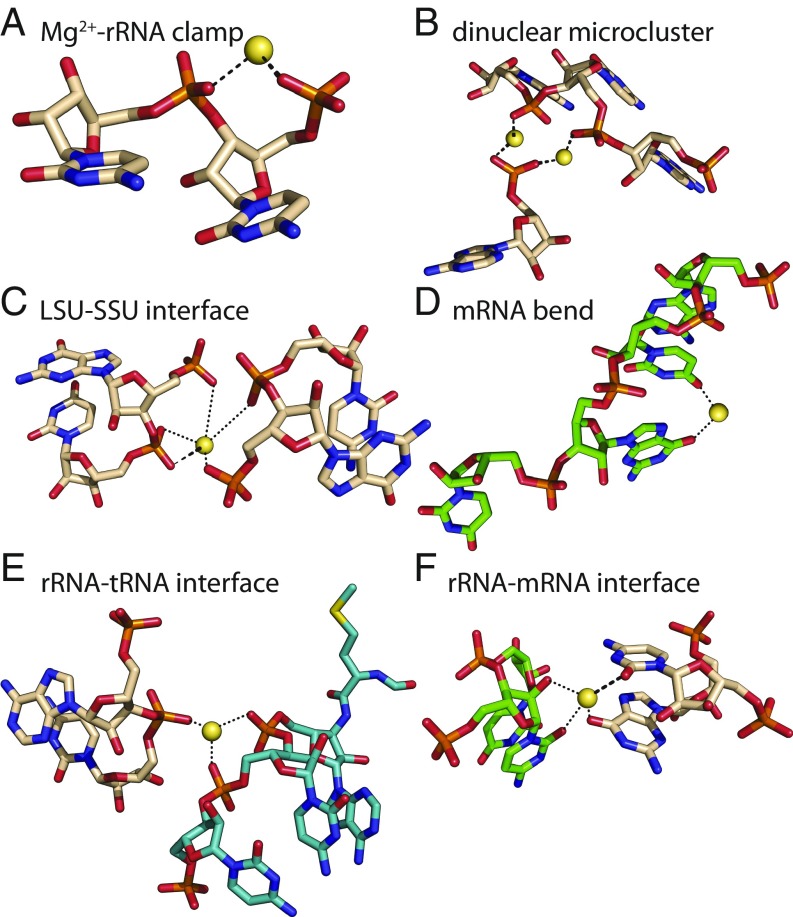
“The atomic coordinates of a Mg-rRNA clamp were initially 239 extracted from the X-ray structure of the Haloarcula marismortui LSU (PDB 1JJ2) (53).”
MethodThe Chemical Evolution of the Atmosphere and Oceans
Holland, H. D. (1984) · doi:10.1515/9780691220239 · Cited by 1,836
Femtomolar Sensitivity of Metalloregulatory Proteins Controlling Zinc Homeostasis
Outten, C. E., & O'Halloran, A. T. V. (2001) · Science · doi:10.1126/science.1060331 · Cited by 1,489
Structures of the Bacterial Ribosome at 3.5 Å Resolution
Schuwirth, B. S., Borovinskaya, M. A., Hau, C. W., Zhang, W., Vila-Sanjurjo, A., Holton, J. M., & Cate, J. H. D. (2005) · Science · doi:10.1126/science.1117230 · Cited by 1,418 · cited 1×
“1B), and at the small subunit−large subunit (SSU−LSU) interface (14) (Fig.”
The biological chemistry of the elements: the inorganic chemistry of life
(1992) · Choice Reviews Online · doi:10.5860/choice.30-0286 · Cited by 1,321 · cited 1×
“While intracellular Mg is around 10 M (46), specific physiological or environmental conditions can significantly elevate intracellular Fe and Mn.”
BackgroundStructure of the 70 S Ribosome Complexed with mRNA and tRNA
Selmer, M., Dunham, C. M., Murphy, F. V., Weixlbaumer, A., Petry, S., Kelley, A. C., Weir, J. R., & Ramakrishnan, V. (2006) · Science · doi:10.1126/science.1131127 · Cited by 1,283 · cited 2×
“SSU/mRNA Critical bend in mRNA between the P-site and A-site codons (16, 55) Maintains correct reading frame on mRNA ∼10 (34)”
Ferruginous conditions: a dominant feature of the ocean through Earth's history
Poulton, S. W., & Canfield, D. E. (2011) · Elements · doi:10.2113/gselements.7.2.107 · Cited by 1,018 · cited 2×
“173 Were Mg, Fe, and Mn collaborators as cofactors on the ancient Earth, when Fe and Mn were 174 more abundant (1-5), and Mg was less abundant (2), than today? What was the role of Fe and Mn in 175 the origin and early evolution of the translational system? Finally, what are the implications for ribosome176 bound Fe i…”
BackgroundTinoco, I., & Bustamante, C. (1999) · Journal of Molecular Biology · doi:10.1006/jmbi.1999.3001 · Cited by 1,010
The Biological Chemistry of the Elements: The Inorganic Chemistry of Life
Fraústo da Silva, J. J. R., & Williams, R. J. P. (2001) · doi:10.1093/oso/9780198508472.001.0001 · Cited by 1,005
Ribosome Structure and the Mechanism of Translation
Ramakrishnan, V. (2002) · Cell · doi:10.1016/s0092-8674(02)00619-0 · Cited by 938
Cited by
Oxidative Stress in Bacteria and the Central Dogma of Molecular Biology
Fasnacht, M., & Polacek, N. (2021) · Frontiers in Molecular Biosciences · doi:10.3389/fmolb.2021.671037 · Cited by 243
“However, it has been shown that these Mg ions can be replaced by Fe and Mn without significant loss of activity, mimicking the conditions of the early anoxic Earth (Athavale et al., 2012; Bray et al., 2018).”
BackgroundInfluentialRoot of the Tree: The Significance, Evolution, and Origins of the Ribosome
Bowman, J. C., Petrov, A. S., Frenkel-Pinter, M., Penev, P. I., & Williams, L. D. (2020) · Chemical Reviews · doi:10.1021/acs.chemrev.9b00742 · Cited by 197
Self-citationThe Impact of Oxidative Stress on Ribosomes: From Injury to Regulation
Shcherbik, N., & Pestov, D. G. (2019) · Cells · doi:10.3390/cells8111379 · Cited by 158
“When tested in anoxic conditions, Fe2+ ions can functionally substitute Mg2+ in rRNA folding and cell-free translation, owing to the close geometry of the RNA-Mg2+ and RNA-Fe2+ complexes and possibly reflecting the ribosome′s origins in an iron-rich and oxygen-poor prebiotic environment [104,105].”
BackgroundThe Future of Origin of Life Research: Bridging Decades-Old Divisions
Preiner, M., Asche, S., Becker, S., Betts, H. C., Boniface, A., Camprubi, E., Chandru, K., Erastova, V., Garg, S. G., Khawaja, N., et al. (2020) · Life · doi:10.3390/life10030020 · Cited by 140
“In particular, the importance of relevant metals and metal clusters in the Hadean has settled in experimental work that recreates the origin of biochemistry in vitro, including carbon cycling [98,103,153], nitrogen fixation [154], ribosomal translation [155], and even the generation of pH gradients [156].”
BackgroundCamprubí, E., de Leeuw, J. W., House, C. H., Raulin, F., Russell, M. J., Spang, A., Tirumalai, M. R., & Westall, F. (2019) · Space Science Reviews · doi:10.1007/s11214-019-0624-8 · Cited by 84
Metadata
- Authors
- Bray, M. S., Lenz, T. K., Haynes, J. W., Bowman, J. C., Petrov, A. S., Reddi, A. R., Hud, N. V., Williams, L. D., & Glass, J. B.
- Affiliations
- Georgia Institute of Technology (US)
- Corresponding author
- Williams, Loren Dean
- Glass, Jennifer B.
- ORCID
- Venue
- Proceedings of the National Academy of Sciences
- Publisher
- National Academy of Sciences
- Published
- 2018-11-09
- Volume
- 115
- Issue
- 48
- Pages
- 12164-12169
- ISSN
- 0027-8424 (ISSN-L)
- 1091-6490
- PMC
- PMC6275528
- OpenAlex
- W2846967238
- Cited by
- 58
- References
- 67
- Citations by year
- 2026: 4 · 2025: 5 · 2024: 7 · 2023: 5 · 2022: 7 · 2021: 14 · 2020: 8 · 2019: 8
- FWCI
- 2.67
- Type
- journal article
- Language
- en
- Open access
- hybrid
- doi.org
- Licence
- Locations
- Proceedings of the National Academy of Sciences (publishedVersion, cc-by-nc-nd)
- bioRxiv (Cold Spring Harbor Laboratory) (acceptedVersion)
- Europe PMC (PubMed Central) (publishedVersion, cc-by-nc-nd)
- PubMed Central (publishedVersion, cc-by-nc-nd)
- PubMed (publishedVersion)
- eScholarship (California Digital Library) (submittedVersion)
- eScholarship (California Digital Library) (submittedVersion, cc-by-nc-nd)
- Funders
- National Aeronautics and Space Administration (NNX14AJ87G, NNX16AJ28G, NNX16AJ29G)
- Topics
- Life Sciences › Biochemistry, Genetics and Molecular Biology › Molecular Biology › RNA and protein synthesis mechanisms
- Physical Sciences › Physics and Astronomy › Astronomy and Astrophysics › Origins and Evolution of Life
- Physical Sciences › Chemistry › Inorganic Chemistry › Metal-Catalyzed Oxygenation Mechanisms
- Keywords
- ribosome, iron, manganese, divalent metal cations, ribosomal translation, early Earth conditions, anoxia, bioinorganic chemistry
About these checks
Registry, retraction, Cites and statistics results are computed, not judged, with one exception: a printed reference that no index lists is read once by a model before it counts as a citation error. Claims are extracted by a model and kept only when their quote appears verbatim in the text; each cited source is then checked, with a model’s help, for whether it says what the claim relies on. Those verdicts can be wrong — read the claim’s quote and the cited source before relying on one.
Statistics and arithmetic are recomputed, not judged.
Confidence bands are shown only for fields calibrated on our annotated test set. None is calibrated yet, so no band is shown.
What counts as a claim ›How we measure confidence ›How we check this ›
Are you an author, or do you see a problem with this page? Request a review
How to cite
Cite CoChat for the checks on this page, and the paper for its own findings.
- This page
- CoChat. (2026). Citation check: Multiple prebiotic metals mediate translation. https://app.cochat.ai/papers/10.1073/pnas.1803636115
- The paper
- Bray, M. S., Lenz, T. K., Haynes, J. W., Bowman, J. C., Petrov, A. S., Reddi, A. R., Hud, N. V., Williams, L. D., & Glass, J. B. (2018). Multiple prebiotic metals mediate translation. Proceedings of the National Academy of Sciences. https://doi.org/10.1073/pnas.1803636115
Data sources
Bibliographic data: Semantic Scholar, OpenAlex, Crossref.
Contains information from the Semantic Scholar Academic Graph Datasets, made available under the ODC Attribution License (ODC-BY 1.0).
Semantic Scholar’s data is described in: Kinney, R., et al. (2023). The Semantic Scholar Open Data Platform. arXiv:2301.10140.
