

Integration in emerging social networks explains academic failure and success
Open accessThe DOI matches its Crossref record; 43 of the 44 references it cites were found in a registry or an index.
Abstract
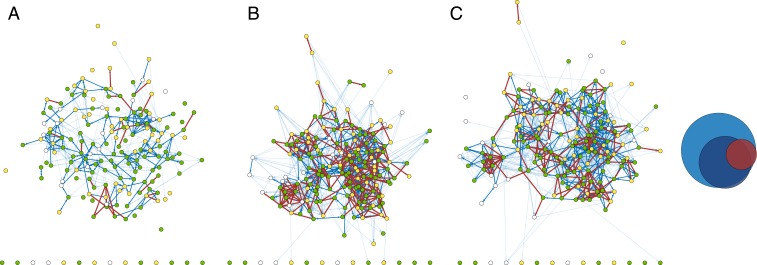
Significance: Understanding the factors that explain academic failure and success of university students is a core interest of educational researchers, teachers, and managers. We demonstrate how the dynamic social networks that informally evolve between students can affect their academic performance. We closely followed the emergence of multiple social networks within a cohort of 226 undergraduate university students. They were strangers to each other on their first day at university, but developed densely knit social networks through time. We show that functional studying relationships tended to evolve from informal friendship relations. In a critical examination period after one year, these networks proved to be crucial: Socially isolated students had significantly lower examination grades and were more likely to drop out of university.
Overview
The claims and statistics of this paper haven’t been checked yet.
Free: it reads the open-access text and checks the first 5 claims that cite a source we can check. Create a free account to check every claim.
Integrity signals
Registry
Cites
Statistics
Figures
Verification
Claims the paper makes
The claims and statistics of this paper haven’t been checked yet.
Free: it reads the open-access text and checks the first 5 claims that cite a source we can check. Create a free account to check every claim.
Claims other papers make about this one
Each is checked against this paper’s own text: does it say what the citing paper says it does?
The source backs part of the claim, not all of it — or backs it for a different population, condition or comparison.
In the citing paper
“The social networks of students have been argued to be an important factor in buffering stress and helping them to be more effective [5].”
From Students under lockdown: Comparisons of students’ social networks and mental health before and during the COVID-19 crisis in Switzerland (2020) · cites this paper as [5]
Experimental — accuracy not yet measuredThe source backs part of the claim, not all of it — or backs it for a different population, condition or comparison.
In the citing paper
“Friendship, interaction, social support, and studying with others have been argued to impact their well-being and academic success, but they often require meeting opportunities and informal settings to develop [5, 13].”
From Students under lockdown: Comparisons of students’ social networks and mental health before and during the COVID-19 crisis in Switzerland (2020) · cites this paper as [5]
Experimental — accuracy not yet measuredThe check wasn’t confident either way, so it gives no verdict — never disputed.
In the citing paper
“and concerns about their social networks [20, 21].”
From Psychological correlates of perceived loneliness in college students before and during the COVID-19 stay-at-home period: a longitudinal study (2023) · cites this paper as [21]
Experimental — accuracy not yet measured
Self-check
Percentages, sums and reported differences re-computed from the paper’s own numbers.
The self-check needs the paper’s full text.
Citations
Cites
Granovetter, M. S. (1973) · American Journal of Sociology · doi:10.1086/225469 · Cited by 40,491
Birds of a Feather: Homophily in Social Networks
McPherson, M., Smith-Lovin, L., & Cook, J. M. (2001) · Annual Review of Sociology · doi:10.1146/annurev.soc.27.1.415 · Cited by 18,567 · cited 1×
“To take into account that observations in the sample are not independent, but could be dependent through processes of homophily (27)—for example, high-achieving individuals choosing each other as study partners—or social influence (28)— individuals becoming more similar to their study partners—we additionally fit netw…”
(1990) · Choice Reviews Online · doi:10.5860/choice.27-6637 · Cited by 16,594
Gamst, F. C. (1991) · Anthropology of Work Review · doi:10.1525/awr.1991.12.3.19 · Cited by 7,932
Structural Holes and Good Ideas
Burt, R. S. (2004) · American Journal of Sociology · doi:10.1086/421787 · Cited by 5,642
Network Analysis in the Social Sciences
Borgatti, S. P., Mehra, A., Brass, D. J., & Labianca, G. (2009) · Science · doi:10.1126/science.1165821 · Cited by 4,254
Skill formation and the economics of investing in disadvantaged children
Heckman, J. J. (2006) · Science · doi:10.1126/science.1128898 · Cited by 3,559
Lazer, D., Pentland, A., Adamic, L., Aral, S., Barabási, A.-L., Brewer, D., Christakis, N., Contractor, N., Fowler, J., Gutmann, M., et al. (2009) · Science · doi:10.1126/science.1167742 · Cited by 3,365
A SOCIAL CAPITAL THEORY OF CAREER SUCCESS.
Seibert, S. E., Kraimer, M. L., & Liden, R. C. (2001) · Academy of Management Journal · doi:10.2307/3069452 · Cited by 2,414
Springer, L., Stanne, M. E., & Donovan, S. S. (1999) · Review of Educational Research · doi:10.3102/00346543069001021 · Cited by 1,943 · cited 1×
“Educational interventions therefore often focus on enforcing teamwork and collaboration within the classroom (32).”
Intelligence and educational achievement
Deary, I. J., Strand, S., Smith, P., & Fernandes, C. (2007) · Intelligence · doi:10.1016/j.intell.2006.02.001 · Cited by 1,723
Academically Adrift: Limited Learning on College Campuses
Arum, R., & Roksa, J. (2011) · Cited by 1,457
Academically Adrift: Limited Learning on College Campuses
Conn, S., & Wymore, J. (2012) · Growth: The Journal of the Association for Christians in Student Development · Cited by 1,239
Network Studies of Social Influence
MARSDEN, P. V., & FRIEDKIN, N. E. (1993) · Sociological Methods & Research · doi:10.1177/0049124193022001006 · Cited by 844 · cited 1×
“To take into account that observations in the sample are not independent, but could be dependent through processes of homophily (27)—for example, high-achieving individuals choosing each other as study partners—or social influence (28)— individuals becoming more similar to their study partners—we additionally fit netw…”
Exponential Random Graph Models for Social Networks: Theory, Methods, and Applications
(2012) · Cambridge University Press eBooks · doi:10.1017/cbo9780511894701 · Cited by 840
Does School Integration Generate Peer Effects? Evidence from Boston's Metco Program
Angrist, J. D., & Lang, K. (2004) · American Economic Review · doi:10.1257/0002828043052169 · Cited by 735 · cited 1×
“Prior work, for example, investigated the role of aggregated peer effects (14, 15),”
Modeling social influence through network autocorrelation: constructing the weight matrix
Leenders, R. T. A. J. (2002) · Social Networks · doi:10.1016/s0378-8733(01)00049-1 · Cited by 595 · cited 2×
“To take into account that observations in the sample are not independent, but could be dependent through processes of homophily (27)—for example, high-achieving individuals choosing each other as study partners—or social influence (28)— individuals becoming more similar to their study partners—we additionally fit netw…”
Ties that Bind: Correlates of Adolescents' Civic Commitments in Seven Countries
Flanagan, C. A., Bowes, J. M., Jonsson, B., Csapo, B., & Sheblanova, E. (1998) · Journal of Social Issues · doi:10.1111/j.1540-4560.1998.tb01230.x · Cited by 578
(2011) · doi:10.7208/chicago/9780226028576.001.0001 · Cited by 562
Morgan, S. L., & Sorensen, A. B. (1999) · American Sociological Review · doi:10.2307/2657368 · Cited by 431 · cited 1×
“Follow-up studies could further evaluate the interactions between the success factors that we identified in the linear models and explore more complex network effects that relate, for example, to an individuals’ level of embeddedness in groups (31).”
Improving academic achievement: Impact of psychological factors on education
Aronson, J. M. (2002) · Cited by 396
Goddard, R. D. (2003) · Educational Evaluation and Policy Analysis · doi:10.3102/01623737025001059 · Cited by 316 · cited 1×
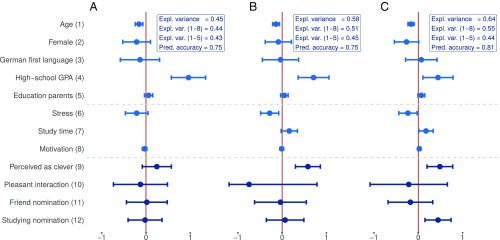
“Social science research has shown that access to social support is another important factor in academic success (4, 5) and that individuals’ positions in social networks can explain success in many domains of life (6– 9).”
Fundamental structures of dynamic social networks
Sekara, V., Stopczynski, A., & Lehmann, S. (2016) · Proceedings of the National Academy of Sciences · doi:10.1073/pnas.1602803113 · Cited by 313
Ties That Bind: A Social Network Approach to Understanding Student Integration and Persistence
Thomas, S. L. (2000) · The Journal of Higher Education · doi:10.1080/00221546.2000.11778854 · Cited by 261
Stochastic Actor-Oriented Models for Network Dynamics
Snijders, T. A. B. (2017) · Annual Review of Statistics and Its Application · doi:10.1146/annurev-statistics-060116-054035 · Cited by 242 · cited 12×
“For the SAOMs, we used three waves of network data, presented earlier as waves 3, 4, and 5 (collected in December, March, and May).”
InfluentialAcademic Achievement and Its Impact on Friend Dynamics
Flashman, J. (2012) · Sociology of Education · doi:10.1177/0038040711417014 · Cited by 220
Reciprocity, transitivity, and the mysterious three-cycle
Block, P. (2015) · Social Networks · doi:10.1016/j.socnet.2014.10.005 · Cited by 215 · cited 1×
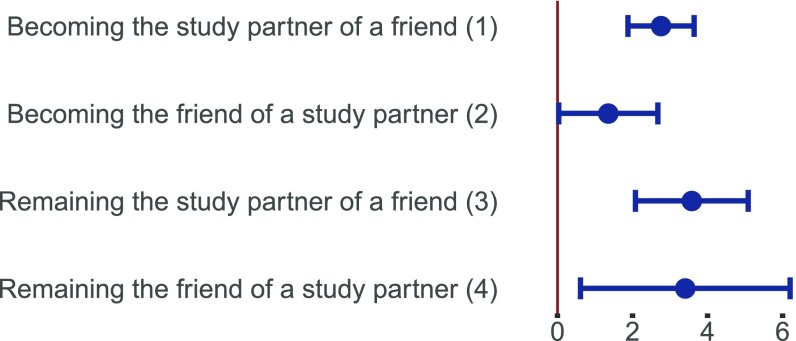
“We test whether the evolution of the two networks is coupled on the level of network ties, while controlling for a large number of dynamic network processes (22, 24).”
Lomi, A., Snijders, T. A. B., Steglich, C. E. G., & Torló, V. J. (2011) · Social Science Research · doi:10.1016/j.ssresearch.2011.06.010 · Cited by 192
Ties That Bind: A Social Network Approach to Understanding Student Integration and Persistence
Thomas, S. L. (2000) · The Journal of Higher Education · doi:10.2307/2649261 · Cited by 154
Academic performance and behavioral patterns
Kassarnig, V., Mones, E., Bjerre-Nielsen, A., Sapieżyński, P., Lassen, D. D., & Lehmann, S. (2018) · EPJ Data Science · doi:10.1140/epjds/s13688-018-0138-8 · Cited by 149
Forms of Dependence: Comparing SAOMs and ERGMs From Basic Principles
Block, P., Stadtfeld, C., & Snijders, T. A. B. (2016) · Sociological Methods & Research · doi:10.1177/0049124116672680 · Cited by 144
Self-citationExponential Random Graph Models for Social Networks
Koskinen, J. H., & Snijders, T. A. B. (2013) · Cambridge University Press eBooks · Cited by 132
DeLay, D., Zhang, L., Hanish, L. D., Miller, C. F., Fabes, R. A., Martin, C. L., Kochel, K. P., & Updegraff, K. A. (2016) · Prevention Science · doi:10.1007/s11121-016-0678-8 · Cited by 112
Exponential Random Graph Models for Social Networks
Robins, G. L. (2014) · SAGE Publications Ltd eBooks · doi:10.4135/9781446294413.n32 · Cited by 103
Improving Academic Achievement
Aronson, J. M. (2002) · Cited by 102
Gremmen, M. C., Berger, C., Ryan, A. M., Steglich, C., Veenstra, R., & Dijkstra, J. K. (2019) · Child Development · doi:10.1111/cdev.13045 · Cited by 100
Fresh Starts: Reinvestigating the Effects of the Transition to High School on Student Outcomes
Weiss, C. C., & Bearman, P. S. (2007) · American Journal of Education · doi:10.1086/512738 · Cited by 76 · cited 1×
“Prior work, for example, investigated the role of aggregated peer effects (14, 15),”
Statistical Power in Longitudinal Network Studies
Stadtfeld, C., Snijders, T. A. B., Steglich, C., & van Duijn, M. A. J. (2018) · Sociological Methods & Research · doi:10.1177/0049124118769113 · Cited by 72
Self-citationCluster analysis of multiplex networks: Defining composite network measures
Vörös, A., & Snijders, T. A. B. (2017) · Social Networks · doi:10.1016/j.socnet.2017.01.002 · Cited by 71 · cited 1×
“Friendship and studying ties are almost completely embedded in the network of positive interactions, as shown by the Venn diagram (23) in Fig.”
Self-citationStatus Perceptions Matter: Understanding Disliking Among Adolescents
Pál, J., Stadtfeld, C., Grow, A., & Takács, K. (2015) · Journal of Research on Adolescence · doi:10.1111/jora.12231 · Cited by 56 · cited 1×
“In the present analysis, we used an extension of SAOMs that estimates parameters related to the coevolution of multiple networks (22, 35, 36), allowing for processes operating between the networks (e.”
Self-citationExponential random graph models for social networks: theories, methods and applications
Lusher, D., Koskinen, J. H., & Robins, G. L. (2013) · Swinburne figshare (Swinburne University of Technology) · Cited by 55
Social Influence on Observed Race
Boda, Z. (2018) · Sociological Science · doi:10.15195/v5.a3 · Cited by 53
Self-citationSocial influence on observed race
Boda, Z. (2018) · Repository for Publications and Research Data (ETH Zurich) · doi:10.3929/ethz-b-000254294 · Cited by 16 · cited 1×
“In the present analysis, we used an extension of SAOMs that estimates parameters related to the coevolution of multiple networks (22, 35, 36), allowing for processes operating between the networks (e.”
Self-citationColladon, A. F., & Grippa, F. (2018) · The Journal of Psychology · doi:10.1080/00223980.2018.1459443 · Cited by 10
Research works printed but not linked: 2
- Robins G 2015 Doing Social Network Research SAGE London
- Ripley RM Snijders TAB Boda Z Vörös A Preciado Lopez P 2018 Manual for SIENA Version 4.0 (Nuffield College and Department of Statistics, University of Oxford, Oxford), Accessed May 24, 2018
Cited by
Elmer, T., Mepham, K., & Stadtfeld, C. (2020) · PLOS ONE · doi:10.1371/journal.pone.0236337 · Cited by 1,658
“Data were collected (a) prior to the COVID-19 outbreak as part of the Swiss StudentLife study (September 2017 to September 2019) [5], and (b) two weeks after the university and Swiss public life were largely shut down in response to the crisis (April 2020).”
BackgroundMethodSelf-citationDepressive symptoms are associated with social isolation in face-to-face interaction networks
Elmer, T., & Stadtfeld, C. (2020) · Scientific Reports · doi:10.1038/s41598-020-58297-9 · Cited by 266
Self-citationAqeel, M., Rehna, T., Shuja, K. H., & Abbas, J. (2022) · Frontiers in Psychiatry · doi:10.3389/fpsyt.2022.835585 · Cited by 142
Tülübaş, T., Karakose, T., & Papadakis, S. (2023) · European Journal of Investigation in Health, Psychology and Education · doi:10.3390/ejihpe13100143 · Cited by 90
“…cacy [90] Behavior-al-Intention [90], Problematic-Internet-Use [79], Mobile-Device-Use [77], Emotional Intelligence [79], Gender-Di ff erences [77], Academic-Success [93], and Communica-tion-Skill [90] illustrate the sub-themes in the Self-E ffi cacy cluster network. determine the relevant sub-themes.”
BackgroundBoda, Z., Elmer, T., Vörös, A., & Stadtfeld, C. (2020) · Scientific Reports · doi:10.1038/s41598-020-59594-z · Cited by 87
Self-citation
Metadata
- Authors
- Stadtfeld, C., Vörös, A., Elmer, T., Boda, Z., & Raabe, I. J.
- Affiliations
- ETH Zurich (CH)
- University of Zurich (CH)
- Corresponding author
- Stadtfeld, Christoph
- Venue
- Proceedings of the National Academy of Sciences
- Publisher
- National Academy of Sciences
- Published
- 2018-12-24
- Volume
- 116
- Issue
- 3
- Pages
- 792-797
- ISSN
- 0027-8424 (ISSN-L)
- 1091-6490
- PMC
- PMC6338824
- OpenAlex
- W2906675977
- Cited by
- 212
- References
- 42
- Citations by year
- 2026: 17 · 2025: 28 · 2024: 33 · 2023: 36 · 2022: 37 · 2021: 28 · 2020: 27 · 2019: 5
- FWCI
- 48.74
- Type
- journal article
- Language
- en
- Open access
- hybrid
- doi.org
- Licence
- Locations
- Proceedings of the National Academy of Sciences (publishedVersion, cc-by-nc-nd)
- Europe PMC (PubMed Central) (publishedVersion, cc-by-nc-nd)
- PubMed Central (publishedVersion, cc-by-nc-nd)
- PubMed (publishedVersion)
- Zurich Open Repository and Archive (University of Zurich) (acceptedVersion)
- RePEc: Research Papers in Economics (submittedVersion)
- University of Birmingham Research Portal (University of Birmingham) (submittedVersion)
- Research Explorer (The University of Manchester) (submittedVersion)
- Repository for Publications and Research Data (ETH Zurich) (submittedVersion, cc-by-nc-nd)
- Zurich Open Repository and Archive (University of Zurich) (submittedVersion)
- ETH Zürich Research Collection
- Funders
- Swiss National Science Foundation (10001A_169965)
- Topics
- Social Sciences › Education › Educational Outcomes and Influences
- Social Sciences › Education › Higher Education Research Studies
- Physical Sciences › Physics and Astronomy › Statistical and Nonlinear Physics › Complex Network Analysis Techniques
- Keywords
- social networks, academic performance, network integration, friendship formation, study groups, social ties, dynamic networks, undergraduate engineering students, university students, socioeconomic background, perceived intelligence
- MeSH terms
- Academic Failure, Academic Success, Humans, Students, Switzerland, Universities, Social Networking
About these checks
Registry, retraction, Cites and statistics results are computed, not judged, with one exception: a printed reference that no index lists is read once by a model before it counts as a citation error. Claims are extracted by a model and kept only when their quote appears verbatim in the text; each cited source is then checked, with a model’s help, for whether it says what the claim relies on. Those verdicts can be wrong — read the claim’s quote and the cited source before relying on one.
Statistics and arithmetic are recomputed, not judged.
Confidence bands are shown only for fields calibrated on our annotated test set. None is calibrated yet, so no band is shown.
What counts as a claim ›How we measure confidence ›How we check this ›
Are you an author, or do you see a problem with this page? Request a review
Data sources
Bibliographic data: Semantic Scholar, OpenAlex, Crossref.
Contains information from the Semantic Scholar Academic Graph Datasets, made available under the ODC Attribution License (ODC-BY 1.0).
Semantic Scholar’s data is described in: Kinney, R., et al. (2023). The Semantic Scholar Open Data Platform. arXiv:2301.10140.
