

Brain ventricular volume changes induced by long-duration spaceflight
Open accessThe DOI matches its Crossref record; 16 of the 16 references it cites were found in a registry or an index.
Abstract
Significance: Long-duration spaceflight induces detrimental changes in human physiology due to microgravity. One example is a cephalic fluid shift. Here, we prospectively investigated the quantitative changes in cerebrospinal fluid (CSF) volume of the brain ventricular regions in space crew by means of a region of interest, observer-independent analysis on structural brain MRI scans. MRI scans were collected before the mission, shortly after and 7 mo after return to Earth. We found a significant increase in lateral and third ventricles at postflight and a trend to normalization at follow-up, but still significantly increased ventricular volumes. The observed spatiotemporal pattern of CSF compartment enlargement and recovery points to a reduced CSF resorption in microgravity as the underlying cause.
Overview
The claims and statistics of this paper haven’t been checked yet.
Free: it reads the open-access text and checks the first 5 claims that cite a source we can check. Create a free account to check every claim.
Integrity signals
Registry
Cites
Statistics
Figures
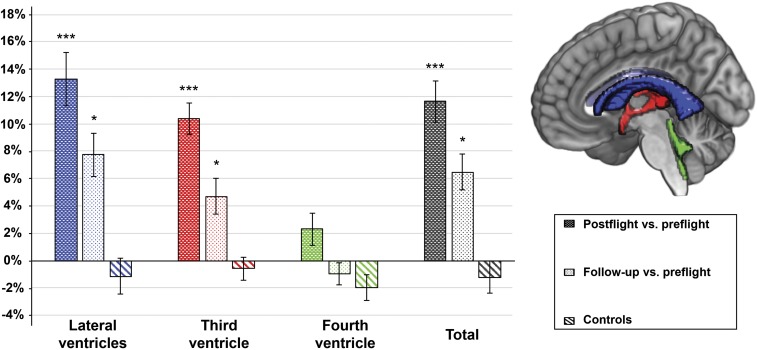
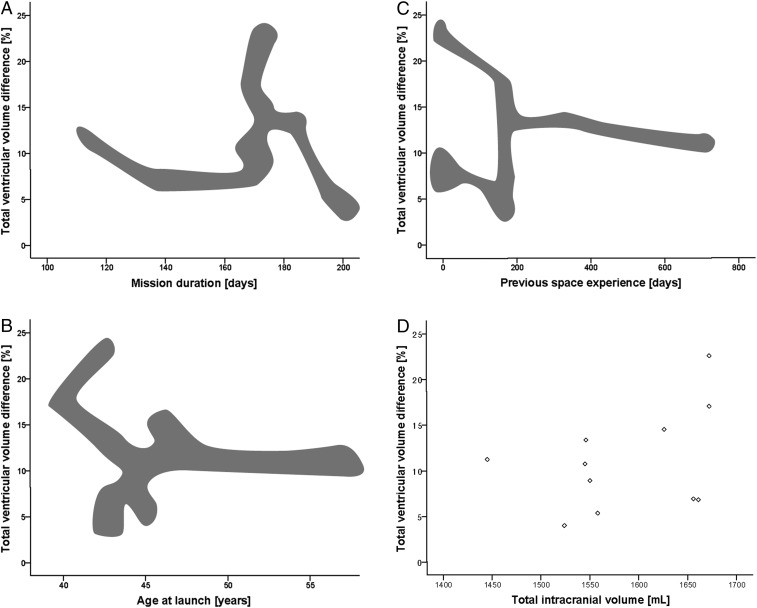
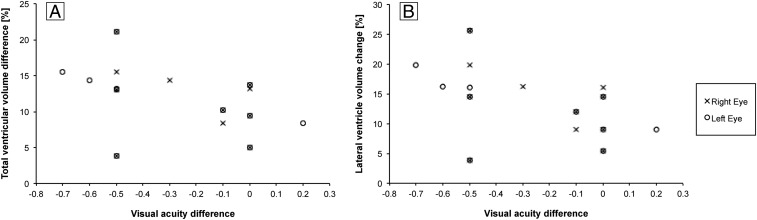
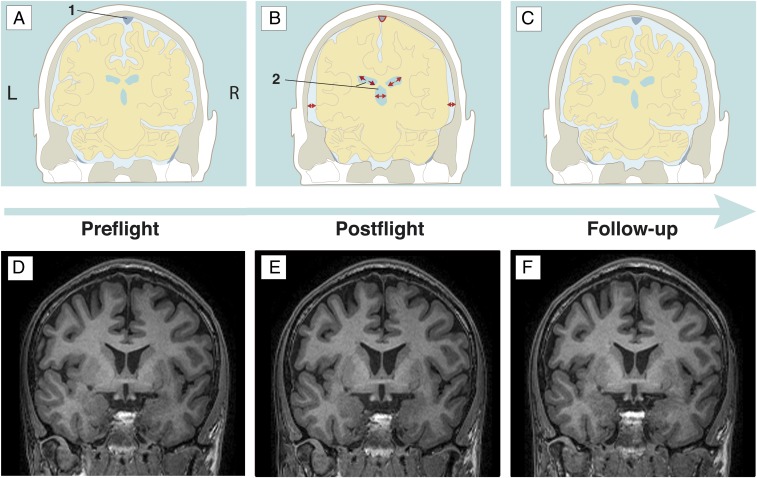
Verification
Claims the paper makes
The claims and statistics of this paper haven’t been checked yet.
Free: it reads the open-access text and checks the first 5 claims that cite a source we can check. Create a free account to check every claim.
Claims other papers make about this one
Each is checked against this paper’s own text: does it say what the citing paper says it does?
The source backs part of the claim, not all of it — or backs it for a different population, condition or comparison.
In the citing paper
“Most notably, a 10.7–14.6% ventricular enlargement (i.e., approximately a 2–3 ml increase) has been detected in astronauts and cosmonauts by multiple investigators56–59.”
From Red risks for a journey to the red planet: The highest priority human health risks for a mission to Mars (2020) · cites this paper as [57]
Experimental — accuracy not yet measured
Self-check
Percentages, sums and reported differences re-computed from the paper’s own numbers.
The self-check needs the paper’s full text.
Citations
Cites
Voxel-Based Morphometry—The Methods
Ashburner, J., & Friston, K. J. (2000) · NeuroImage · doi:10.1006/nimg.2000.0582 · Cited by 8,676
MRIQC: Advancing the automatic prediction of image quality in MRI from unseen sites
Esteban, O., Birman, D., Schaer, M., Koyejo, O. O., Poldrack, R. A., & Gorgolewski, K. J. (2017) · PLOS ONE · doi:10.1371/journal.pone.0184661 · Cited by 920
Anatomy and physiology of cerebrospinal fluid
Sakka, L., Coll, G., & Chazal, J. (2011) · European Annals of Otorhinolaryngology, Head and Neck Diseases · doi:10.1016/j.anorl.2011.03.002 · Cited by 815 · cited 1×
“This upward shift of the brain could lead to a compression of the superior sagittal sinus and Pachioni’s granulations, two structures responsible for the majority of CSF resorption (11).”
BackgroundMader, T. H., Gibson, C. R., Pass, A. F., Kramer, L. A., Lee, A. G., Fogarty, J., Tarver, W. J., Dervay, J. P., Hamilton, D. R., Sargsyan, A., et al. (2011) · Ophthalmology · doi:10.1016/j.ophtha.2011.06.021 · Cited by 748 · cited 3×
“2 and 3 for an overview), with a potential risk of permanent visual acuity changes (5).”
BackgroundEffects of Spaceflight on Astronaut Brain Structure as Indicated on MRI
Roberts, D. R., Albrecht, M. H., Collins, H. R., Asemani, D., Chatterjee, A. R., Spampinato, M. V., Zhu, X., Chimowitz, M. I., & Antonucci, M. U. (2017) · New England Journal of Medicine · doi:10.1056/nejmoa1705129 · Cited by 318 · cited 6×
“Another MRI study in ISS astronauts also observed a ventricular enlargement after spaceflight in combination with a narrowing of the central sulcus (6).”
BackgroundMethodInfluentialFundamentals of Space Medicine
Clément, G. (2011) · doi:10.1007/978-1-4419-9905-4 · Cited by 237
Microgravity-Induced Fluid Shift and Ophthalmic Changes
Nelson, E., Mulugeta, L., & Myers, J. (2014) · Life · doi:10.3390/life4040621 · Cited by 167 · cited 1×
“, arterial and venous structures) (2).”
Space flight-associated neuro-ocular syndrome (SANS)
Lee, A. G., Mader, T. H., Gibson, C. R., Brunstetter, T. J., & Tarver, W. J. (2018) · Eye · doi:10.1038/s41433-018-0070-y · Cited by 157 · cited 11×
“In addition, risk factors, such as age, body mass index, head size, gender, CSF turnover rate, and craniospinal compliance (12), should be assessed to determine a specific individual’s likelihood to develop VIIP/SANS.”
BackgroundInfluentialBrain Tissue–Volume Changes in Cosmonauts
Van Ombergen, A., Jillings, S., Jeurissen, B., Tomilovskaya, E., Rühl, R. M., Rumshiskaya, A., Nosikova, I., Litvinova, L., Annen, J., Pechenkova, E. V., et al. (2018) · New England Journal of Medicine · doi:10.1056/nejmc1809011 · Cited by 124 · cited 5×
“Previously, we reported alterations in total gray matter, white matter, and CSF tissue volumes after long-duration spaceflight (7).”
BackgroundMethodInfluentialSelf-citationSpaceflight-induced changes in white matter hyperintensity burden in astronauts
Alperin, N., Bagci, A. M., & Lee, S. H. (2017) · Neurology · doi:10.1212/wnl.0000000000004475 · Cited by 73 · cited 3×
“Lastly, the periventricular white matter changes previously reported in astronauts (16) might be a direct consequence of transependymal water diffusion from the enlarged ventricles into periventricular structures, due to pressure peaks in a backed up CSF circulation.”
BackgroundInfluential
Research works printed but not linked: 1
- Tarver W, Otto C (2012) NASA’s spaceflight visual impairment intracranial pressure (VIIP) risk: Clinical correlations and pathophysiology. Aerospace Medicine Grand Rounds (NASA, Washington, DC).
Cited by
Patel, Z. S., Brunstetter, T. J., Tarver, W. J., Whitmire, A. M., Zwart, S. R., Smith, S. M., & Huff, J. L. (2020) · npj Microgravity · doi:10.1038/s41526-020-00124-6 · Cited by 373
Challenges to the central nervous system during human spaceflight missions to Mars
Clement, G. R., Boyle, R. D., George, K. A., Nelson, G. A., Reschke, M. F., Williams, T. J., & Paloski, W. H. (2020) · Journal of Neurophysiology · doi:10.1152/jn.00476.2019 · Cited by 170
Imaging perivascular space structure and function using brain MRI
Barisano, G., Lynch, K. M., Sibilia, F., Lan, H., Shih, N., Sepehrband, F., & Choupan, J. (2022) · NeuroImage · doi:10.1016/j.neuroimage.2022.119329 · Cited by 158
Roy-O’Reilly, M. A., Mulavara, A. P., & Williams, T. J. (2021) · npj Microgravity · doi:10.1038/s41526-021-00133-z · Cited by 141
“Given the association between increased ventricular volumes and the smooth periventricular WMH and the absent deep WMH after spaceflight, it is possible that these alterations may represent trans-ependymal CSF diapedesis that are at least partially reversible after spaceflight.(14,21) Alperin et al.”
Intracranial Effects of Microgravity: A Prospective Longitudinal MRI Study
Kramer, L. A., Hasan, K. M., Stenger, M. B., Sargsyan, A., Laurie, S. S., Otto, C., Ploutz-Snyder, R. J., Marshall-Goebel, K., Riascos, R. F., & Macias, B. R. (2020) · Radiology · doi:10.1148/radiol.2020191413 · Cited by 123
The Effects of Long Duration Spaceflight on Sensorimotor Control and Cognition
Tays, G. D., Hupfeld, K. E., McGregor, H. R., Salazar, A. P., Dios, Y. E. D., Beltran, N. E., Reuter‐Lorenz, P. A., Kofman, I. S., Wood, S. J., Bloomberg, J. J., et al. (2021) · Frontiers in Neural Circuits · doi:10.3389/fncir.2021.723504 · Cited by 119
Microgravity Effects on the Human Brain and Behavior: Dysfunction and Adaptive Plasticity
Hupfeld, K. E., McGregor, H. R., Reuter‐Lorenz, P. A., & Seidler, R. D. (2020) · Neuroscience & Biobehavioral Reviews · doi:10.1016/j.neubiorev.2020.11.017 · Cited by 113
Spaide, R. F. (2020) · Retina · doi:10.1097/iae.0000000000002931 · Cited by 113
Macro- and microstructural changes in cosmonauts’ brains after long-duration spaceflight
Jillings, S., Ombergen, A. V., Tomilovskaya, E., Rumshiskaya, A. D., Litvinova, L., Nosikova, I., Pechenkova, E., Rukavishnikov, I. V., Kozlovskaya, I. B., Manko, O. M., et al. (2020) · Science Advances · doi:10.1126/sciadv.aaz9488 · Cited by 107
Self-citationBarisano, G., Sepehrband, F., Collins, H. R., Jillings, S., Jeurissen, B., Taylor, J. A., Schoenmaekers, C., Laet, C. D., Rukavishnikov, I. V., Nosikova, I., et al. (2022) · Proceedings of the National Academy of Sciences · doi:10.1073/pnas.2120439119 · Cited by 88
Self-citationEvaluation of deep space exploration risks and mitigations against radiation and microgravity
Dobney, W., Mols, L., Mistry, D., Tabury, K., Baselet, B., & Baatout, S. (2023) · Frontiers in Nuclear Medicine · doi:10.3389/fnume.2023.1225034 · Cited by 86
“Primarily due to microgravity, the anatomy of the human brain is known to change during space fl ight, according to several studies (56 – 60).”
BackgroundBrain and Behavioral Evidence for Reweighting of Vestibular Inputs with Long-Duration Spaceflight
Hupfeld, K. E., McGregor, H. R., Koppelmans, V., Beltran, N. E., Kofman, I. S., Dios, Y. E. D., Riascos, R., Reuter‐Lorenz, P. A., Wood, S. J., Bloomberg, J. J., et al. (2021) · Cerebral Cortex · doi:10.1093/cercor/bhab239 · Cited by 81
The Impact of 6 and 12 Months in Space on Human Brain Structure and Intracranial Fluid Shifts
Hupfeld, K. E., McGregor, H. R., Lee, J. K., Beltran, N. E., Kofman, I. S., Dios, Y. E. D., Reuter‐Lorenz, P. A., Riascos, R., Pasternak, O., Wood, S. J., et al. (2020) · Cerebral Cortex Communications · doi:10.1093/texcom/tgaa023 · Cited by 79
Stahn, A. C., & Kühn, S. (2021) · Cognitive Processing · doi:10.1007/s10339-021-01050-5 · Cited by 73
Spaceflight Associated Neuro-Ocular Syndrome (SANS): A Systematic Review and Future Directions
Paez, Y. M., Mudie, L. I., & Subramanian, P. S. (2020) · Eye and Brain · doi:10.2147/eb.s234076 · Cited by 72
Jones, C. W., Basner, M., Mollicone, D. J., Mott, C. M., & Dinges, D. F. (2022) · Sleep · doi:10.1093/sleep/zsac006 · Cited by 68
Neuro-consequences of the spaceflight environment
Mhatre, S. D., Iyer, J. S., Puukila, S., Paul, A. M., Tahimic, C. G. T., Rubinstein, L., Lowe, M. G., Alwood, J. S., Sowa, M. B., Bhattacharya, S., et al. (2021) · Neuroscience & Biobehavioral Reviews · doi:10.1016/j.neubiorev.2021.09.055 · Cited by 69
Effects of spaceflight on the brain
Seidler, R. D., Mao, X. W., Tays, G. D., Wang, T., & zu Eulenburg, P. (2024) · The Lancet Neurology · doi:10.1016/s1474-4422(24)00224-2 · Cited by 68
Persistent Globe Flattening in Astronauts following Long-Duration Spaceflight
Mader, T. H., Gibson, C. R., Barratt, M. R., Miller, N. R., Subramanian, P. S., Killer, H. E., Tarver, W. J., Sargsyan, A. E., Garcia, K., Hart, S. F., et al. (2020) · Neuro-Ophthalmology · doi:10.1080/01658107.2020.1791189 · Cited by 64
Longitudinal MRI-visible perivascular space (PVS) changes with long-duration spaceflight
Hupfeld, K. E., Richmond, S. B., McGregor, H. R., Schwartz, D. L., Luther, M. N., Beltran, N. E., Kofman, I. S., Dios, Y. E. D., Riascos, R., Wood, S. J., et al. (2022) · Scientific Reports · doi:10.1038/s41598-022-11593-y · Cited by 54
Basner, M., Dinges, D. F., Howard, K., Moore, T. M., Gur, R. C., Mühl, C., & Stahn, A. C. (2021) · Frontiers in Physiology · doi:10.3389/fphys.2021.643854 · Cited by 52
Impacts of spaceflight experience on human brain structure
McGregor, H. R., Hupfeld, K. E., Pasternak, O., Beltran, N. E., Dios, Y. E. D., Bloomberg, J. J., Wood, S. J., Mulavara, A. P., Riascos, R., Reuter‐Lorenz, P. A., et al. (2023) · Scientific Reports · doi:10.1038/s41598-023-33331-8 · Cited by 50
Persistent deterioration of visuospatial performance in spaceflight
Takács, E., Barkaszi, I., Czigler, I., Pató, L. G., Altbäcker, A., McIntyre, J., Cheron, G. A., & Balázs, L. (2021) · Scientific Reports · doi:10.1038/s41598-021-88938-6 · Cited by 50
Long‐duration spaceflight alters estimated intracranial pressure and cerebral blood velocity
Iwasaki, K., Ogawa, Y., Kurazumi, T., Imaduddin, S. M., Mukai, C. N., Furukawa, S., Yanagida, R., Kato, T., Konishi, T., Shinojima, A., et al. (2020) · The Journal of Physiology · doi:10.1113/jp280318 · Cited by 48
“There are some sex differences in cerebral blood flow autoregulation (Vavilala et al. 2005; Favre & Serrador, 2019).”
BackgroundMechanical countermeasures to headward fluid shifts
Marshall-Goebel, K. J., Macias, B. R., Laurie, S. S., Lee, S. M. C., Ebert, D. J., Kemp, D. T., Miller, A. E., Greenwald, S. H., Martin, D. S., Young, M., et al. (2021) · Journal of Applied Physiology · doi:10.1152/japplphysiol.00863.2020 · Cited by 47
Brain Connectometry Changes in Space Travelers After Long-Duration Spaceflight
Doroshin, A., Jillings, S., Jeurissen, B., Tomilovskaya, E., Pechenkova, E., Nosikova, I., Rumshiskaya, A. D., Litvinova, L., Rukavishnikov, I. V., Laet, C. D., et al. (2022) · Frontiers in Neural Circuits · doi:10.3389/fncir.2022.815838 · Cited by 47
Self-citationEffects of centrifugation and whole-body vibrations on blood–brain barrier permeability in mice
Dubayle, D., Vanden-Bossche, A., Beraneck, M., Vico, L., & Morel, J.-L. (2020) · npj Microgravity · doi:10.1038/s41526-019-0094-z · Cited by 44
Prolonged microgravity induces reversible and persistent changes on human cerebral connectivity
Jillings, S., Pechenkova, E., Tomilovskaya, E., Rukavishnikov, I. V., Jeurissen, B., Ombergen, A. V., Nosikova, I., Rumshiskaya, A. D., Litvinova, L., Annen, J., et al. (2023) · Communications Biology · doi:10.1038/s42003-022-04382-w · Cited by 44
Self-citationOptic Nerve Length before and after Spaceflight
Wåhlin, A., Holmlund, P., Fellows, A. M., Malm, J., Buckey, J. C., & Eklund, A. (2020) · Ophthalmology · doi:10.1016/j.ophtha.2020.07.007 · Cited by 43
The application of artificial gravity in medicine and space
Isasi, E., Isasi, M. E., & van Loon, J. J. W. A. (2022) · Frontiers in Physiology · doi:10.3389/fphys.2022.952723 · Cited by 40
“…e.g., bone, brain (morphology as well as function), vision or skin where the space related pathologies are especially more pronounced after long duration exposures to near weightlessness (Tronnier et al., 2008; Vico et al., 2017; Roberts et al., 2019; Van Ombergen et al., 2019; Paez et al., 2020).”
BackgroundBrains in space: impact of microgravity and cosmic radiation on the CNS during space exploration
Wuyts, F. L., Deblieck, C., Vandevoorde, C., & Durante, M. (2025) · Nature reviews. Neuroscience · doi:10.1038/s41583-025-00923-4 · Cited by 40
“This phenomenon, known as ‘fluid shift’, is characterized by alterations in cerebrospinal fluid (CSF) flow, ventricular expansion 26,29,32 and redistribution of CSF away from the top of the brain, leading to a cerebral displacement towards the vertex.”
InfluentialSelf-citationEffects of head-down tilt bed rest plus elevated CO2 on cognitive performance
Basner, M., Stahn, A. C., Nasrini, J., Dinges, D. F., Moore, T. M., Gur, R. C., Mühl, C., Macias, B. R., & Laurie, S. S. (2021) · Journal of Applied Physiology · doi:10.1152/japplphysiol.00865.2020 · Cited by 39
Zhang, X., Zhu, H., & Zhang, J. (2025) · Antioxidants · doi:10.3390/antiox14020231 · Cited by 37
“The transfer of body fluids to the head causes changes in the brain white matter microstructure [7], developing a hydrocephalus-like structure, which damages brain tissue and impairs brain function [8].”
Effect of gravity on brain structure as indicated on upright computed tomography
Yokoyama, Y., Yamada, Y., Kosugi, K., Yamada, M., Narita, K., Nakahara, T., Fujiwara, H., Toda, M., & Jinzaki, M. (2021) · Scientific Reports · doi:10.1038/s41598-020-79695-z · Cited by 37
Cognition in zero gravity: Effects of non-terrestrial gravity on human behaviour
Arshad, I., & Ferrè, E. R. (2022) · Quarterly Journal of Experimental Psychology · doi:10.1177/17470218221113935 · Cited by 37
“Ventricular volume changes (Alperin et al., 2017; Lee et al., 2021; Roberts et al., 2019) possibly due to a reduced reabsorption of cerebrospinal fluid have also been described (Schneider et al., 2013; Smith et al., 2013; Van Ombergen et al., 2019).”
BackgroundRoberts, D. R., Inglesby, D. C., Brown, T. R., Collins, H. R., Eckert, M. A., & Asemani, D. (2021) · Aging Brain · doi:10.1016/j.nbas.2021.100017 · Cited by 31
Eye-brain axis in microgravity and its implications for Spaceflight Associated Neuro-ocular Syndrome
Stern, C., Yücel, Y. H., zu Eulenburg, P., Traon, A. P., & Petersen, L. G. (2023) · npj Microgravity · doi:10.1038/s41526-023-00300-4 · Cited by 30
Wostyn, P., Gibson, C. R., & Mader, T. H. (2021) · Eye · doi:10.1038/s41433-021-01721-9 · Cited by 28
Spaceflight Associated Neuro-ocular Syndrome (SANS) and its countermeasures
Nguyen, T. N., Ong, J., Brunstetter, T. J., Gibson, C. R., Macias, B. R., Laurie, S. S., Mader, T. H., Hargens, A. R., Buckey, J. C., Lan, M., et al. (2025) · Progress in Retinal and Eye Research · doi:10.1016/j.preteyeres.2025.101340 · Cited by 27
Noninvasive indicators of intracranial pressure before, during, and after long-duration spaceflight
Jasien, J. V., Laurie, S. S., Lee, S. M. C., Martin, D. S., Kemp, D. T., Ebert, D. J., Ploutz-Snyder, R. J., Marshall-Goebel, K. J., Alferova, I. V., Sargsyan, A. E., et al. (2022) · Journal of Applied Physiology · doi:10.1152/japplphysiol.00625.2021 · Cited by 27
Roberts, D. R., Collins, H. R., Lee, J. K., Taylor, J. A., Turner, M. D., Zaharchuk, G., Wintermark, M., Antonucci, M. U., Mulder, E. R., Gerlach, D. A., et al. (2021) · Neuroradiology · doi:10.1007/s00234-021-02660-8 · Cited by 26
Stahn, A. C., Bucher, D., zu Eulenburg, P., Denise, P., Smith, N., Pagnini, F., & White, O. (2023) · npj Microgravity · doi:10.1038/s41526-023-00295-y · Cited by 26
Lee, J. K., Koppelmans, V., Pasternak, O., Beltran, N. E., Kofman, I. S., Dios, Y. E. D., Mulder, E. R., Mulavara, A. P., Bloomberg, J. J., & Seidler, R. D. (2021) · Cerebral Cortex Communications · doi:10.1093/texcom/tgab022 · Cited by 26
Seidler, R. D., Stern, C., Basner, M., Stahn, A. C., Wuyts, F. L., & zu Eulenburg, P. (2022) · Frontiers in Neural Circuits · doi:10.3389/fncir.2022.876789 · Cited by 26
Self-citationGravity, Microgravity and Artificial Gravity: Physiological Effects, Implementation and Applications
Goswami, N., Blaber, A. P., Valenti, G., Hinghofer-Szalkay, H., Evans, J., Bailey, D. M., Vernikos, J., Choukér, A., Green, D. A., White, O., et al. (2026) · Physiological Reviews · doi:10.1152/physrev.00055.2024 · Cited by 25
Ophthalmic changes in a spaceflight analog are associated with brain functional reorganization
McGregor, H. R., Lee, J. K., Mulder, E. R., Dios, Y. E. D., Beltran, N. E., Kofman, I. S., Bloomberg, J. J., Mulavara, A. P., Smith, S. M., Zwart, S. R., et al. (2021) · Human Brain Mapping · doi:10.1002/hbm.25546 · Cited by 24
Rodent retinal microcirculation and visual electrophysiology following simulated microgravity
Dai, X., Ye, S., Chen, X., Jiang, T. X., Huang, H., Li, W., Yu, H., Bao, J., & Chen, H. (2020) · Experimental Eye Research · doi:10.1016/j.exer.2020.108023 · Cited by 23
Neuropsychological considerations for long-duration deep spaceflight
Faerman, A., Clark, J. B., & Sutton, J. P. (2023) · Frontiers in Physiology · doi:10.3389/fphys.2023.1146096 · Cited by 22
“Van Ombergen et al. (Van Ombergen et al., 2019) found significant increases in ventricular volume, likely due to microgravity-related reductions in cerebrospinal fluid (CSF) resorption.”
BackgroundInfluentialSoares, B., Ong, J., Waisberg, E., Sarker, P., Zaman, N., Tavakkoli, A., & Lee, A. G. (2024) · Life Sciences in Space Research · doi:10.1016/j.lssr.2024.04.004 · Cited by 20
Navigating mental health in space: gut–brain axis and microbiome dynamics
Yang, J., Kim, H.-D., Barrila, J., Lee, S. M., Nickerson, C. A., Ott, C. M., Israel, S., Choukèr, A., & Yang, J. (2025) · Experimental & Molecular Medicine · doi:10.1038/s12276-025-01488-z · Cited by 20
Impaired Attentional Processing During Parabolic Flight
Friedl-Werner, A., Machado, M., Balestra, C., Liegard, Y., Philoxène, B., Brauns, K., Stahn, A. C., Hitier, M., & Besnard, S. (2021) · Frontiers in Physiology · doi:10.3389/fphys.2021.675426 · Cited by 20
Mahadevan, A. D., Hupfeld, K. E., Lee, J. K., Dios, Y. E. D., Kofman, I. S., Beltran, N. E., Mulder, E. R., Bloomberg, J. J., Mulavara, A. P., & Seidler, R. D. (2021) · Frontiers in Physiology · doi:10.3389/fphys.2021.654906 · Cited by 20
Rezaei, S., Seyedmirzaei, H., Gharepapagh, E., Mohagheghfard, F., Hasankhani, Z., Karbasi, M., Delavari, S., & Aarabi, M. H. (2024) · Brain Imaging and Behavior · doi:10.1007/s11682-024-00894-7 · Cited by 19
Venkatasubramanian, P. N., Keni, P., Gastfield, R. D., Li, L., Aksenov, D. P., Sherman, S. A., Bailes, J. E., Sindelar, B., Finan, J. D., Lee, J., et al. (2020) · ASN NEURO · doi:10.1177/1759091420922929 · Cited by 18
Tidwell, J., Taylor, J. A., Collins, H. R., Chamberlin, J., Barisano, G., Sepehrband, F., Turner, M. D., Gauthier, G., Mulder, E. R., Gerlach, D. A., et al. (2023) · American Journal of Neuroradiology · doi:10.3174/ajnr.a7949 · Cited by 17
“suggested to impair CSF resorption by compression of the superior sagittal sinus.(5,33) In this theory, the ventricular system may then act as a buffer for excess CSF resulting in ventricular enlarge-”
BackgroundMethodTocci, D. R., Ducai, T., Stoute, C. A. B., Hopkins, G., Sabbir, M. G., Beheshti, A., & Albensi, B. C. (2024) · Frontiers in Immunology · doi:10.3389/fimmu.2024.1422864 · Cited by 17
“Another study shows that the effects of microgravity include the crowding of brain tissue at the vertex and the expansion of the ventricular system due to the upward shift of the brain (60, 61).”
Structural damage to the rat eye following long-term simulated weightlessness.
Li, S.-Q., Song, Q., Wu, B., Kan, G.-H., Wang, F., Yang, J.-W., & Zhu, S.-Q. (2022) · Experimental Eye Research · doi:10.1016/j.exer.2022.109200 · Cited by 11
van Oosterhout, W. P. J., Perenboom, M. J. L., Terwindt, G. M., Ferrari, M. D., & Vein, A. A. (2024) · Neurology · doi:10.1212/wnl.0000000000209224 · Cited by 16
Rodrigues, G. A., Russomano, T., & Oliveira, E. S. (2025) · npj Microgravity · doi:10.1038/s41526-025-00464-1 · Cited by 16
The Unresolved Methodological Challenge of Detecting Neuroplastic Changes in Astronauts
Burles, F., Williams, R. J., Berger, L., Pike, G. B., Lebel, C. A., & Iaria, G. (2023) · Life · doi:10.3390/life13020500 · Cited by 17
“The first, ‘direct physical’, cause is best characterized by the mechanical forces exerted on the brain by the change in gravitational force, which produces a headward shift of fluid in the body, as well as causes the brain to shift upwards and creates local changes in CSF distribution; these changes may accumulate ov…”
BackgroundWostyn, P., Mader, T. H., Gibson, C. R., Wuyts, F. L., Ombergen, A. V., zu Eulenburg, P., & Deyn, P. P. D. (2020) · American Journal of Neuroradiology · doi:10.3174/ajnr.a6430 · Cited by 16
Self-citationBrain and cerebrospinal fluid 3D center of mass shift after spaceflight
Warthen, K., Sater, S. H., Kramer, L. A., Hasan, K. M., Williams, M. A., Young, M., Macias, B. R., Laurie, S. S., & Martin, B. A. (2025) · npj Microgravity · doi:10.1038/s41526-025-00468-x · Cited by 13
“These results have been replicated by several authors 1,2,10,11,17 .”
Transient gray matter decline during antarctic isolation: Roles of sleep, exercise, and cognition
Roalf, D. R., Basner, M., Beer, J. C., Shinohara, R. T., Ruparel, K., Moore, T. M., Dinges, D. F., Stahn, A. C., Nasrini, J., Hermosillo, E., et al. (2025) · npj Microgravity · doi:10.1038/s41526-025-00497-6 · Cited by 13
Gravity as a Factor in Evolutionary Adaptation of Animals to Living on the Earth
Виноградова, О. Л., Tomilovskaya, E., & Kozlovskaya, I. B. (2021) · Human Physiology · doi:10.1134/s0362119721070124 · Cited by 13
“cranial f luid volume and a higher resistance to venous outflow were observed in both earlier impedance studies and recent studies with high-tech methods [74, 80].”
BackgroundMethodResultSelf-citationArtificial gravity during a spaceflight analog alters brain sensory connectivity
McGregor, H. R., Lee, J. K., Mulder, E. R., Dios, Y. E. D., Beltran, N. E., Wood, S. J., Bloomberg, J. J., Mulavara, A. P., & Seidler, R. D. (2023) · NeuroImage · doi:10.1016/j.neuroimage.2023.120261 · Cited by 13
Spaceflight and Ground-Based Microgravity Simulation Impact on Cognition and Brain Plasticity
Hao, J., Chang, J., & Deng, Y. (2025) · International Journal of Molecular Sciences · doi:10.3390/ijms26199521 · Cited by 12
“…Van Ombergen and colleagues using both spaceflight data and ground-based microgravity simulations revealed brain gray matter volume shifts, cerebrospinal fluid (CSF) redistribution toward the head, and reduced resting-state functional connectivity in vestibular-related cortical areas [64,65,68,69].”
Suh, A., Ditelberg, S., Szeto, J. J., Kumar, D., Ong, J., Gibson, C. R., Mader, T. H., Waisberg, E., & Lee, A. G. (2024) · Survey of Ophthalmology · doi:10.1016/j.survophthal.2024.08.005 · Cited by 12
Neurofluids—Deep inspiration, cilia and preloading of the astrocytic network
Ludwig, H. C., Dreha‐Kulaczewski, S. F., & Bock, H. C. (2021) · Journal of Neuroscience Research · doi:10.1002/jnr.24935 · Cited by 12
Spaceflight-Associated Neuro-ocular Syndrome (SANS): a review of proposed mechanisms and analogs
Wojcik, P., Batliwala, S. Y., Rowsey, T. G., Galdamez, L. A., & Lee, A. G. (2020) · Expert Review of Ophthalmology · doi:10.1080/17469899.2020.1787155 · Cited by 11
Wostyn, P., Mader, T. H., Gibson, C. R., & Deyn, P. P. D. (2019) · Proceedings of the National Academy of Sciences · doi:10.1073/pnas.1908865116 · Cited by 11
The microgravity environment affects sensorimotor adaptation and its neural correlates
Tays, G. D., Hupfeld, K. E., McGregor, H. R., Banker, L., Dios, Y. E. D., Bloomberg, J. J., Reuter‐Lorenz, P. A., Mulavara, A. P., Wood, S. J., & Seidler, R. D. (2024) · Cerebral Cortex · doi:10.1093/cercor/bhae502 · Cited by 10
Yoshikawa, M., Ishikawa, C., Li, H., Kudo, T., Shiba, D., Shirakawa, M., Muratani, M., Takahashi, S., Aizawa, S., & Shiga, T. (2022) · Molecular and Cellular Neuroscience · doi:10.1016/j.mcn.2022.103745 · Cited by 10
Hydrocephalus Revisited: New Insights into Dynamics of Neurofluids on Macro- and Microscales
Ludwig, H. C., Bock, H. C., Gärtner, J., Schiller, S. A., Frahm, J., & Dreha‐Kulaczewski, S. F. (2021) · Neuropediatrics · doi:10.1055/s-0041-1731981 · Cited by 10
Breathing drives CSF: Impact on spaceflight disease and hydrocephalus
Ludwig, H.-C., Frahm, J., Gärtner, J., & Dreha‐Kulaczewski, S. F. (2019) · Proceedings of the National Academy of Sciences · doi:10.1073/pnas.1910305116 · Cited by 10
This was the year that was: brain barriers and brain fluid research in 2019
Keep, R. F., Jones, H. C., & Drewes, L. R. (2020) · Fluids and Barriers of the CNS · doi:10.1186/s12987-020-00181-9 · Cited by 10
Weighing the impact of microgravity on vestibular and visual functions
Dontre, A. J. (2023) · Life Sciences in Space Research · doi:10.1016/j.lssr.2023.12.003 · Cited by 9
Spaceflight associated neuro-ocular syndrome: connections with terrestrial eye and brain disorders
Joe, B. (2024) · Frontiers in Ophthalmology · doi:10.3389/fopht.2024.1487992 · Cited by 9
“An upward shift in the brain has been seen in astronauts that could result in compression of the superior sagittal sinus, causing impairment of CSF resorption (62).”
The Blood-Brain Barrier in Space: Implications for Space Travelers and for Human Health on Earth
Amselem, S., & Eyal, S. (2022) · Frontiers in Drug Delivery · doi:10.3389/fddev.2022.931221 · Cited by 9
Scarsoglio, S., Fois, M., & Ridolfi, L. (2023) · Acta Astronautica · doi:10.1016/j.actaastro.2023.06.018 · Cited by 9
An easy-to-use function to assess deep space radiation in human brains
Khaksarighiri, S., Guo, J., Wimmer-Schweingruber, R., & Narici, L. (2021) · Scientific Reports · doi:10.1038/s41598-021-90695-5 · Cited by 8
Benefits of a rotating – Partial gravity – Spacecraft
van Loon, J. J. W. A., Lobascio, C., Boscheri, G., Goujon, C., Voglino, S., Zeminiani, E., Cinca, R. G., & Ewald, R. (2024) · Acta Astronautica · doi:10.1016/j.actaastro.2024.04.041 · Cited by 8
“Changes in brain morphology (image: [18]).”
Chai, S., Guo, S., Yang, J., Lu, S., Yuan, Y., Li, H., Sun, P., Zhang, T., Xu, B., Sun, H., et al. (2021) · Europe PMC (PubMed Central) · Cited by 8
Shah, J., Lee, R. S., Pathuri, S., Zheng, J., Ong, J., Suh, A., Rezaei, K., Mudhar, G., Parsons, A. D., Park, J., et al. (2025) · Biology · doi:10.3390/biology14101434 · Cited by 7
Artificial gravity: an effective countermeasure for microgravity-induced headward fluid shift?
Kramer, L. A., Hasan, K. M., Zhang, X., Mulder, E. R., Gerlach, D. A., Marshall-Goebel, K. J., Macias, B. R., Laurie, S. S., Strangman, G. E., Iyer, R., et al. (2024) · Journal of Applied Physiology · doi:10.1152/japplphysiol.00441.2024 · Cited by 7
Wang, Y., Ke, S., Li, J., Zeng, J., Zhang, J., Niu, S., Yao, C., Zheng, J., Meersmann, T., Liu, G., et al. (2025) · Scientific Reports · doi:10.1038/s41598-025-07985-5 · Cited by 7
An eye on long‐duration spaceflight: Controversies, countermeasures and challenges
Ng, V., & Mollan, S. P. (2025) · Experimental Physiology · doi:10.1113/ep091561 · Cited by 7
“changes (Hupfeld et al., 2020; Kramer et al., 2015; 2020; Roberts et al., 2017; Van Ombergen et al., 2019).”
Bolin, P. K., Gosnell, S. N., Brandel-Ankrapp, K. L., Srinivasan, N., Castellanos, A., & Salas, R. (2022) · Chronic Stress · doi:10.1177/24705470221111092 · Cited by 7
Sun, P., Gao, X., Wei, D., Ge, J., Deng, X., Chen, H., Yang, H., Gao, J., & Yang, J. (2024) · Gastroenterology & Endoscopy · doi:10.1016/j.gande.2024.12.002 · Cited by 6
Robots as social companions for space exploration
Guitton, M. J. (2025) · Computers in Human Behavior Artificial Humans · doi:10.1016/j.chbah.2025.100124 · Cited by 6
Optimizing transcranial magnetic stimulation for spaceflight applications
Romanella, S. M., Mencarelli, L., Seyedmadani, K., Jillings, S., Tomilovskaya, E., Rukavishnikov, I. V., Sprugnoli, G., Rossi, S., Wuyts, F. L., & Santarnecchi, E. (2023) · npj Microgravity · doi:10.1038/s41526-023-00249-4 · Cited by 6
Self-citationBeyond the lab coat: methodological challenges in space life sciences
Puyvelde, M. V., van den Berg, N., Stas, L., Savieri, P., Corluy, H. C., Cutsem, J. V., Neyt, X., Simonelli, G., & Pattyn, N. (2025) · Frontiers in Physiology · doi:10.3389/fphys.2025.1663701 · Cited by 5
Neuroplasticity as a foundation for human enhancements in space
Rappaport, M. B., Szocik, K., & Corbally, C. J. (2020) · Acta Astronautica · doi:10.1016/j.actaastro.2020.06.011 · Cited by 5
The Anatomic Variability of the Lateral Ventricles of the Human Brain Depending on Age and Sex
Zhuravlova, I., & Montgomery, A. (2023) · Cureus · doi:10.7759/cureus.45915 · Cited by 5
“…are some limited data available showing the significant increase in the volume of the lateral and third ventricles following long-duration spaceflights in astronauts due to microgravity [18], which makes our effort in establishing the normal reference ranges even more valuable in this perspective.”
BackgroundInfluentialOmbergen, A. V., Jillings, S., Tomilovskaya, E., Wuyts, F. L., & zu Eulenburg, P. (2019) · Proceedings of the National Academy of Sciences · doi:10.1073/pnas.1909828116 · Cited by 5
Self-citationTang, G., Jillings, S., Jeurissen, B., Tomilovskaya, E., Nosikova, I., Riabova, A., Pechenkova, E., Petrovichev, V. S., Rukavishnikov, I. V., Sunaert, S. G., et al. (2026) · Experimental Physiology · doi:10.1113/ep093112 · Cited by 4
“Whether manifesting as left-sided changes (as observed in our study) or right-sided changes (as predominantly reported in the literature), this asymmetric pattern contradicts the bilateralsymmetryexpectedunderuniformICPelevation(Maderetal., 2017).”
InfluentialSelf-citationWostyn, P., Mader, T. H., Gibson, C. R., & Nedergaard, M. (2024) · Eye · doi:10.1038/s41433-024-03430-5 · Cited by 4
Neuro-ocular findings and mechanisms in Spaceflight Associated Neuro-Ocular Syndrome
Mader, T. H., & Gibson, C. R. (2022) · Elsevier eBooks · doi:10.1016/b978-0-323-91524-3.00013-2 · Cited by 4
Tandem Walk in Simulated Martian Gravity and Visual Environment
Rosenberg, M. J. F., Koslovsky, M. D., Noyes, M., Reschke, M. F., & Clement, G. R. (2022) · Brain Sciences · doi:10.3390/brainsci12101268 · Cited by 4
“Recent evidence suggests that spaceflight induces a change in neuroplasticity, specifically in the motor and the vestibular cortical regions [12].”
BackgroundLazarev, I. E. (2021) · Acta Astronautica · doi:10.1016/j.actaastro.2021.01.040 · Cited by 4
Case Report: No Evidence of Intracranial Fluid Shifts in an Astronaut Following an Aborted Launch
McGregor, H. R., Hupfeld, K. E., Pasternak, O., Wood, S. J., Mulavara, A. P., Bloomberg, J. J., Hague, T. N., & Seidler, R. D. (2021) · Frontiers in Neurology · doi:10.3389/fneur.2021.774805 · Cited by 4
“We leveraged these data to determine whether launch and landing contribute to previously-reported fluid shifts with spaceflight (1, 2, 10).”
Method
Metadata
- Authors
- Van Ombergen, A., Jillings, S., Jeurissen, B., Tomilovskaya, E., Rumshiskaya, A., Litvinova, L., Nosikova, I., Pechenkova, E., Rukavishnikov, I., Manko, O., Danylichev, S., Rühl, R. M., Kozlovskaya, I. B., Sunaert, S., Parizel, P. M., Sinitsyn, V., Laureys, S., Sijbers, J., zu Eulenburg, P., & Wuyts, F. L.
- Affiliations
- Lab for Equilibrium Investigations and Aerospace, University of Antwerp, 2610 Antwerp, Belgium;
- University of Antwerp (BE)
- Russian Academy of Sciences (RU)
- Radiology Department, Federal Center of Treatment and Rehabilitation, 125367 Moscow, Russia;
- National Research University Higher School of Economics (RU)
- Gagarin Research and Test Cosmonaut Training Center (RU)
- Ludwig-Maximilians-Universität München (DE)
- KU Leuven (BE)
- Lomonosov Moscow State University (RU)
- University of Liège (BE)
- Department of Neurology, Ludwig-Maximilians-University Munich, 81377 Munich, Germany;
- ORCID
- Venue
- Proceedings of the National Academy of Sciences
- Publisher
- National Academy of Sciences
- Published
- 2019-05-06
- Volume
- 116
- Issue
- 21
- Pages
- 10531-10536
- ISSN
- 0027-8424 (ISSN-L)
- 1091-6490
- PMC
- PMC6535034
- OpenAlex
- W2944370899
- Cited by
- 148
- References
- 16
- Citations by year
- 2026: 14 · 2025: 24 · 2024: 18 · 2023: 19 · 2022: 22 · 2021: 27 · 2020: 19 · 2019: 5
- FWCI
- 12.51
- Type
- journal article
- Language
- en
- Open access
- hybrid
- doi.org
- Licence
- Locations
- Proceedings of the National Academy of Sciences (publishedVersion, cc-by-nc-nd)
- Europe PMC (PubMed Central) (publishedVersion, cc-by-nc-nd)
- PubMed Central (publishedVersion, cc-by-nc-nd)
- PubMed (publishedVersion)
- Lirias (KU Leuven) (submittedVersion, cc-by-nc-nd)
- Open Repository and Bibliography (University of Liège) (submittedVersion, cc-by-nc-nd)
- Funders
- Bundesministerium für Bildung und Forschung (EO 0901, 01EO0901)
- Fonds Wetenschappelijk Onderzoek
- Russian Science Foundation
- Vlaamse regering
- Topics
- Health Sciences › Medicine › Physiology (medical) › Spaceflight effects on biology
- Health Sciences › Medicine › Clinical Neurology › Cerebrospinal fluid and hydrocephalus
- Health Sciences › Medicine › Cardiology and Cardiovascular Medicine › Cardiovascular Syncope and Autonomic Disorders
- Keywords
- long-duration spaceflight, microgravity, cerebrospinal fluid, lateral ventricle, third ventricle, post-flight recovery, space crews, structural MRI
- MeSH terms
- Adult, Cerebral Ventricles, Humans, Magnetic Resonance Imaging, Middle Aged, Prospective Studies, Space Flight, Case-Control Studies
About these checks
Registry, retraction, Cites and statistics results are computed, not judged, with one exception: a printed reference that no index lists is read once by a model before it counts as a citation error. Claims are extracted by a model and kept only when their quote appears verbatim in the text; each cited source is then checked, with a model’s help, for whether it says what the claim relies on. Those verdicts can be wrong — read the claim’s quote and the cited source before relying on one.
Statistics and arithmetic are recomputed, not judged.
Confidence bands are shown only for fields calibrated on our annotated test set. None is calibrated yet, so no band is shown.
What counts as a claim ›How we measure confidence ›How we check this ›
Are you an author, or do you see a problem with this page? Request a review
Data sources
Bibliographic data: Semantic Scholar, OpenAlex, Crossref.
Contains information from the Semantic Scholar Academic Graph Datasets, made available under the ODC Attribution License (ODC-BY 1.0).
Semantic Scholar’s data is described in: Kinney, R., et al. (2023). The Semantic Scholar Open Data Platform. arXiv:2301.10140.
