

The DOI matches its Crossref record; 66 of the 68 references it cites were found in a registry or an index.
Recurrence is required to capture the representational dynamics of the human visual system
Open accessAbstract
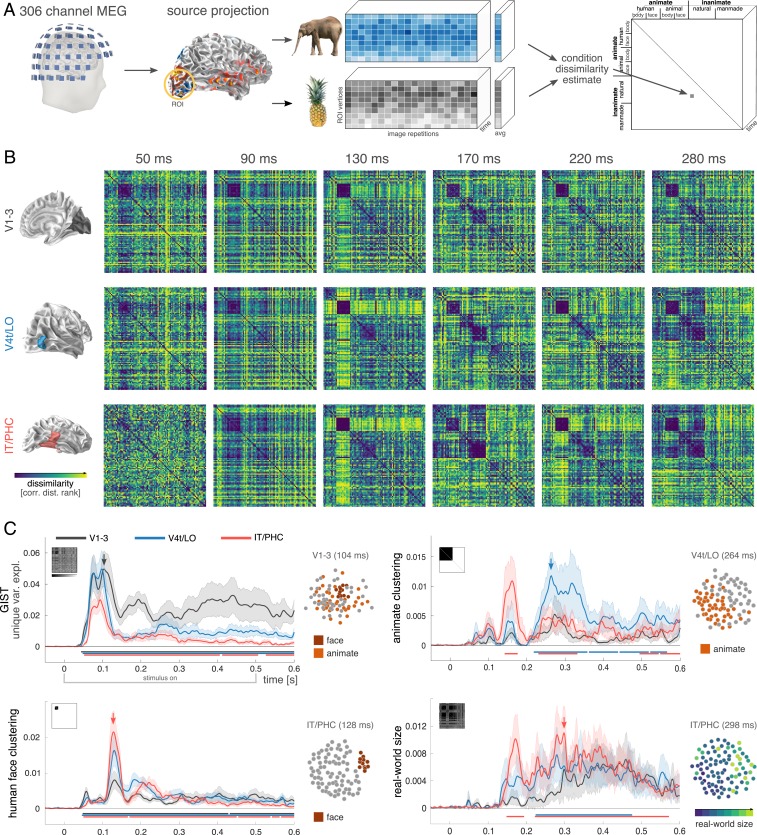
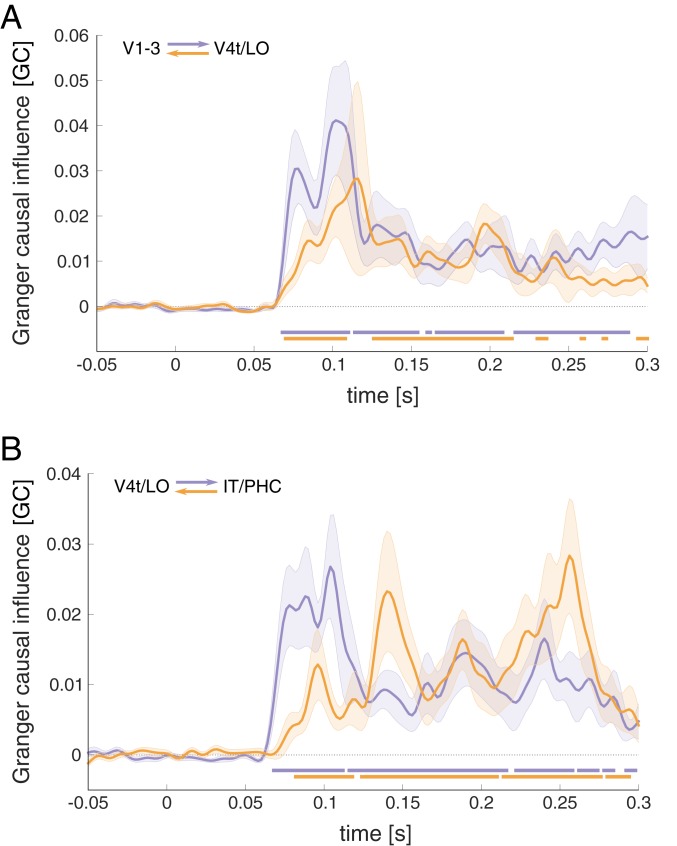
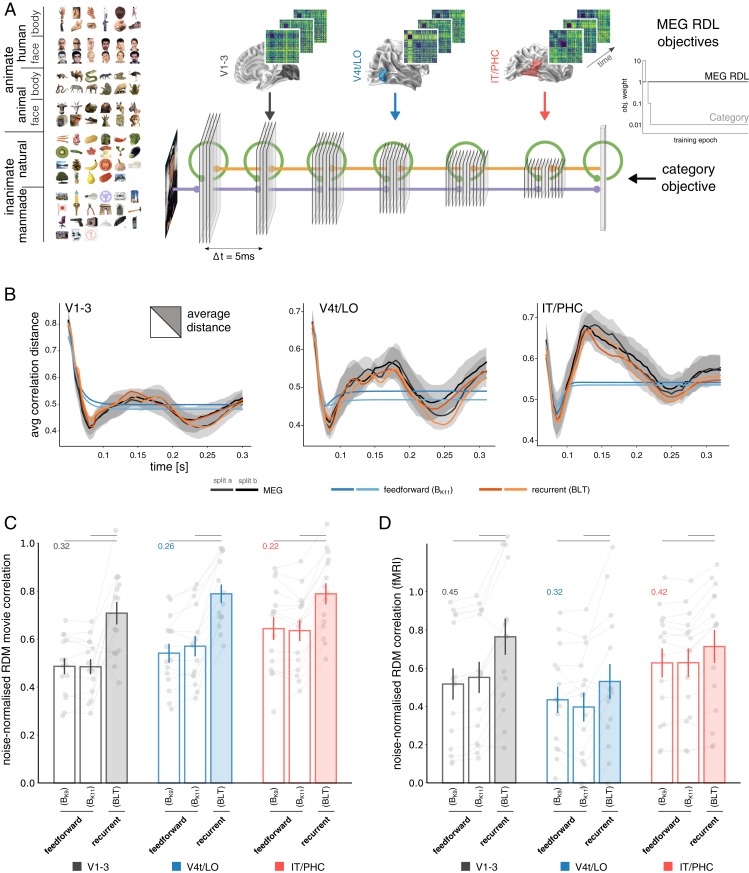
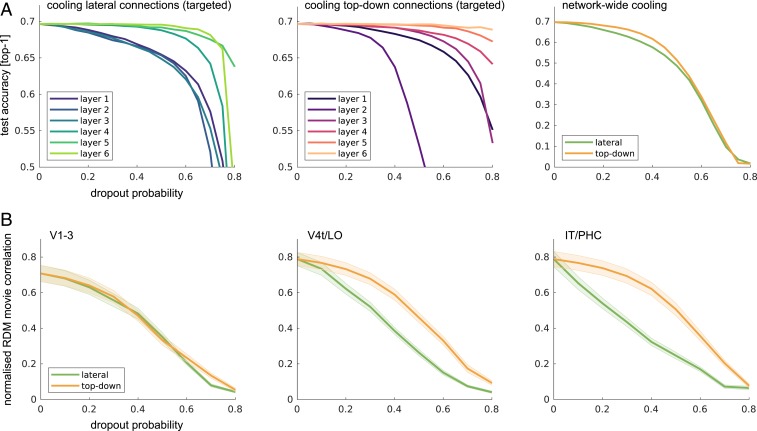
Significance: Understanding the computational principles that underlie human vision is a key challenge for neuroscience and could help improve machine vision. Feedforward neural network models process their input through a deep cascade of computations. These models can recognize objects in images and explain aspects of human rapid recognition. However, the human brain contains recurrent connections within and between stages of the cascade, which are missing from the models that dominate both engineering and neuroscience. Here, we measure and model the dynamics of human brain activity during visual perception. We compare feedforward and recurrent neural network models and find that only recurrent models can account for the dynamic transformations of representations among multiple regions of visual cortex.
Overview
The claims and statistics of this paper haven’t been checked yet.
Run the check — free, no account needed. It reads the open-access text and checks the sources it cites.
Integrity signals
Registry
Cites
Statistics
Figures
Verification
Claims the paper makes
The claims and statistics of this paper haven’t been checked yet.
Run the check — free, no account needed. It reads the open-access text and checks the sources it cites.
Claims other papers make about this one
Each is checked against this paper’s own text: does it say what the citing paper says it does?
The cited source says what the claim attributes to it.
In the citing paper
“artificial vision models such as deep convolutional neural networks (DCNNs), are already both highly successful and often claimed to be good models of human vision (Kietzmann et al. 2019, Lindsay 2021, Mehrer et al. 2021, Zhuang et al. 2021).”
From Consciousness in Artificial Intelligence: Insights from the Science of Consciousness (2023) · cites this paper as Kietzmann et al. 2019
Self-check
Percentages, sums and reported differences re-computed from the paper’s own numbers.
The self-check needs the paper’s full text.
Citations
Cites
Very Deep Convolutional Networks for Large-Scale Image Recognition
Simonyan, K., & Zisserman, A. (2014) · arXiv · doi:10.48550/arxiv.1409.1556 · Cited by 114,148
ImageNet classification with deep convolutional neural networks
Krizhevsky, A., Sutskever, I., & Hinton, G. E. (2017) · Communications of the ACM · doi:10.1145/3065386 · Cited by 112,155
TensorFlow: A system for large-scale machine learningPreprint
Abadi, M., Barham, P., Chen, J., Chen, Z., Davis, A., Dean, J., Devin, M., Ghemawat, S., Irving, G., Isard, M., et al. (2016) · arXiv (Cornell University) · doi:10.5555/3026877.3026899 · Cited by 16,548
Advances in Neural Information Processing Systems 19
(2007) · The MIT Press eBooks · doi:10.52202/085713 · Cited by 16,043
Cortical Surface-Based Analysis
Dale, A. M., Fischl, B., & Sereno, M. I. (1999) · NeuroImage · doi:10.1006/nimg.1998.0395 · Cited by 10,910
Oostenveld, R., Fries, P., Maris, E., & Schoffelen, J.-M. (2011) · Computational Intelligence and Neuroscience · doi:10.1155/2011/156869 · Cited by 10,323
Nonparametric statistical testing of EEG- and MEG-data
Maris, E., & Oostenveld, R. (2007) · Journal of Neuroscience Methods · doi:10.1016/j.jneumeth.2007.03.024 · Cited by 8,496
A multi-modal parcellation of human cerebral cortex
Glasser, M. F., Coalson, T. S., Robinson, E. C., Hacker, C. D., Harwell, J., Yacoub, E., Ugurbil, K., Andersson, J., Beckmann, C. F., Jenkinson, M., et al. (2016) · Nature · doi:10.1038/nature18933 · Cited by 5,111
MEG and EEG data analysis with MNE-Python
Gramfort, A. (2013) · Frontiers in Neuroscience · doi:10.3389/fnins.2013.00267 · Cited by 3,882
Representational similarity analysis-connecting the branches of systems neuroscience
Kriegeskorte, N. (2008) · Frontiers in Systems Neuroscience · doi:10.3389/neuro.06.004.2008 · Cited by 3,355
Self-citation
Research works printed but not linked: 2
- J. Mehrer, T. C. Kietzmann, N. Kriegeskorte, “Deep neural networks trained on ecologically relevant categories better explain human IT” in Cognitive Computational Neuroscience Meeting (Cognitive Computational Neuroscience, 2017), pp. 1–2.
- D. P. Kingma J. L. Ba Adam: A method for stochastic optimization. arXiv:1412.6980 (30 January 2017). · arXiv
Cited by
Sorted by citations
Items 101–200 of 406
Exploring the Brain-like Properties of Deep Neural Networks: A Neural Encoding Perspective
Zhou, Q., Du, C., & He, H. (2022) · Machine Intelligence Research · doi:10.1007/s11633-022-1348-x · Cited by 25
Is predictive coding falsifiable?
Bowman, H., Collins, D., Nayak, A. K., & Cruse, D. (2023) · Neuroscience & Biobehavioral Reviews · doi:10.1016/j.neubiorev.2023.105404 · Cited by 26
Feasibility of decoding visual information from EEG
Wilson, H., Chen, X., Golbabaee, M., Proulx, M. J., & O'Neill, E. J. (2023) · Brain-Computer Interfaces · doi:10.1080/2326263x.2023.2287719 · Cited by 30
The neural network RTNet exhibits the signatures of human perceptual decision-making
Rafiei, F., Shekhar, M., & Rahnev, D. (2024) · Nature Human Behaviour · doi:10.1038/s41562-024-01914-8 · Cited by 37
Core dimensions of human material perception
Schmidt, F., Hebart, M. N., Schmid, A. C., & Fleming, R. W. (2025) · Proceedings of the National Academy of Sciences · doi:10.1073/pnas.2417202122 · Cited by 30
Wang, T., Qin, S., & Chow, K. P. (2021) · IEEE International Conference on Computational Science and Engineering (CSE) · doi:10.1109/cse53436.2021.00030 · Cited by 30
Fakhar, K., & Hilgetag, C. C. (2022) · PLoS Computational Biology · doi:10.1371/journal.pcbi.1010250 · Cited by 25
Stability of motor representations after paralysis
Guan, C., Aflalo, T., Zhang, C. Y., Amoruso, E., Rosario, E. R., Pouratian, N., & Andersen, R. A. (2022) · eLife · doi:10.7554/elife.74478 · Cited by 23
Face-selective responses in combined EEG/MEG recordings with fast periodic visual stimulation (FPVS)
Hauk, O., Rice, G. E., Volfart, A., Magnabosco, F., Ralph, M. A. L., & Rossion, B. (2021) · NeuroImage · doi:10.1016/j.neuroimage.2021.118460 · Cited by 31
Self-citationThe Face of Image Reconstruction: Progress, Pitfalls, Prospects
Nestor, A., Lee, A. C. H., Plaut, D. C., & Behrmann, M. (2020) · Trends in Cognitive Sciences · doi:10.1016/j.tics.2020.06.006 · Cited by 27
Al-Tahan, H., & Mohsenzadeh, Y. (2021) · PLoS Computational Biology · doi:10.1371/journal.pcbi.1008775 · Cited by 23
Sigurdardottir, H. M., Ólafsdóttir, I. M., & Devillez, H. (2021) · Brain Sciences · doi:10.3390/brainsci11111427 · Cited by 26
Maintenance and transformation of representational formats during working memory prioritization
Pacheco, D., Fellner, M.-C., Kunz, L., Zhang, H., Reinacher, P. C., Roy, C., Brandt, A., Schulze‐Bonhage, A., Yang, L., Wang, S., et al. (2024) · Nature Communications · doi:10.1038/s41467-024-52541-w · Cited by 29
Predify: Augmenting deep neural networks with brain-inspired predictive coding dynamicsPreprint
Choksi, B., Mozafari, M., O’May, C. B., Ador, B., Alamia, A., & VanRullen, R. (2021) · arXiv (Cornell University) · doi:10.48550/arxiv.2106.02749 · Cited by 28
A comparative biology approach to DNN modeling of vision: A focus on differences, not similarities
Lonnqvist, B., Bornet, A., Doerig, A., & Herzog, M. H. (2021) · Journal of Vision · doi:10.1167/jov.21.10.17 · Cited by 24
Putative ratios of facial attractiveness in a deep neural network
Tong, S., Liang, X., Kumada, T., & Iwaki, S. (2020) · Vision Research · doi:10.1016/j.visres.2020.10.001 · Cited by 20
Ritchie, J. B., Masson, H. L., Bracci, S., & de Beeck, H. O. (2021) · NeuroImage · doi:10.1016/j.neuroimage.2021.118686 · Cited by 22
Invariant neural subspaces maintained by feedback modulation
Naumann, L., Keijser, J., & Sprekeler, H. (2022) · eLife · doi:10.7554/elife.76096 · Cited by 19
A modular neural network model of grasp movement generationPreprint
Michaels, J. A., Schaffelhofer, S., Agudelo-Toro, A., & Scherberger, H. (2019) · bioRxiv (Cold Spring Harbor Laboratory) · doi:10.1101/742189 · Cited by 21
Maier, M., Blume, F., Bideau, P., Hellwich, O., & Rahman, R. A. (2022) · Consciousness and Cognition · doi:10.1016/j.concog.2022.103301 · Cited by 20
Artificial neural network modelling of the neural population code underlying mathematical operations
Nakai, T., & Nishimoto, S. (2023) · NeuroImage · doi:10.1016/j.neuroimage.2023.119980 · Cited by 18
Mechanisms of human dynamic object recognition revealed by sequential deep neural networks
Sörensen, L. K. A., Bohté, S. M., de Jong, D., Slagter, H. A., & Scholte, H. S. (2023) · PLoS Computational Biology · doi:10.1371/journal.pcbi.1011169 · Cited by 20
Self-citationSemantic object processing is modulated by prior scene context
Krugliak, A., Draschkow, D., Võ, M. L. ‐., & Clarke, A. (2023) · Language Cognition and Neuroscience · doi:10.1080/23273798.2023.2279083 · Cited by 19
Ortho-Shot: Low Displacement Rank Regularization with Data Augmentation for Few-Shot Learning
Osahor, U., & Nasrabadi, N. M. (2022) · IEEE Winter Conference on Applications of Computer Vision · doi:10.1109/wacv51458.2022.00210 · Cited by 20
Individual differences among deep neural network modelsPreprint
Mehrer, J., Spoerer, C. J., Kriegeskorte, N., & Kietzmann, T. C. (2020) · bioRxiv (Cold Spring Harbor Laboratory) · doi:10.1101/2020.01.08.898288 · Cited by 22
Self-citationRecurrent connectivity supports higher-level visual and semantic object representations in the brain
von Seth, J., Nicholls, V. I., TYLER, L. K., & Clarke, A. (2023) · Communications Biology · doi:10.1038/s42003-023-05565-9 · Cited by 19
Neural signatures of vigilance decrements predict behavioural errors before they occur
Karimi-Rouzbahani, H., Woolgar, A., & Rich, A. N. (2021) · eLife · doi:10.7554/elife.60563 · Cited by 17
Caveats and Nuances of Model-Based and Model-Free Representational Connectivity Analysis
Karimi-Rouzbahani, H., Woolgar, A., Henson, R. N., & Nili, H. (2022) · Frontiers in Neuroscience · doi:10.3389/fnins.2022.755988 · Cited by 18
Predictive coding is a consequence of energy efficiency in recurrent neural networksPreprint
Ali, A. G., Ahmad, N., de Groot, E., van Gerven, M. A. J., & Kietzmann, T. C. (2021) · bioRxiv (Cold Spring Harbor Laboratory) · doi:10.1101/2021.02.16.430904 · Cited by 18
Self-citationOverlapping representations of observed actions and action‐related features
Kabulska, Z., Zhuang, T., & Lingnau, A. (2024) · Human Brain Mapping · doi:10.1002/hbm.26605 · Cited by 17
Raman, R., & Hosoya, H. (2020) · Communications Biology · doi:10.1038/s42003-020-0945-x · Cited by 18
Vinken, K., Boix, X., & Kreiman, G. (2020) · Science Advances · doi:10.1126/sciadv.abd4205 · Cited by 20
Brain-optimized extraction of complex sound features that drive continuous auditory perception
Berezutskaya, J., Freudenburg, Z. V., Güçlü, U., van Gerven, M. A. J., & Ramsey, N. F. (2020) · PLoS Computational Biology · doi:10.1371/journal.pcbi.1007992 · Cited by 16
Marques, T., Schrimpf, M., & DiCarlo, J. J. (2021) · bioRxiv (Cold Spring Harbor Laboratory) · doi:10.1101/2021.03.01.433495 · Cited by 21
Universal dimensions of visual representation
Chen, Z., & Bonner, M. F. (2025) · Science Advances · doi:10.1126/sciadv.adw7697 · Cited by 16
Bridging the gap between EEG and DCNNs reveals a fatigue mechanism of facial repetition suppression
Lu, Z., & Ku, Y. (2023) · iScience · doi:10.1016/j.isci.2023.108501 · Cited by 16
Duan, Y., Zhan, J., Groß, J., Ince, R. A. A., & Schyns, P. G. (2024) · Current Biology · doi:10.1016/j.cub.2024.06.050 · Cited by 17
How to incorporate biological insights into network models and why it matters
Timón, L. B., Ekelmans, P., Kraynyukova, N., Rose, T., Busse, L., & Tchumatchenko, T. (2022) · The Journal of Physiology · doi:10.1113/jp282755 · Cited by 17
Diverse task-driven modeling of macaque V4 reveals functional specialization towards semantic tasks
Cadena, S. A., Willeke, K. F., Restivo, K., Denfield, G. H., Sinz, F. H., Bethge, M., Tolias, A. S., & Ecker, A. S. (2024) · PLoS Computational Biology · doi:10.1371/journal.pcbi.1012056 · Cited by 31
The topology and geometry of neural representations
Lin, B., & Kriegeskorte, N. (2024) · Proceedings of the National Academy of Sciences · doi:10.1073/pnas.2317881121 · Cited by 25
Self-citationObstacles to inferring mechanistic similarity using Representational Similarity AnalysisPreprint
Dujmović, M., Bowers, J. S., Adolfi, F., & Malhotra, G. (2022) · bioRxiv (Cold Spring Harbor Laboratory) · doi:10.1101/2022.04.05.487135 · Cited by 15
Forms of explanation and understanding for neuroscience and artificial intelligence
Thompson, J. A. F. (2021) · Journal of Neurophysiology · doi:10.1152/jn.00195.2021 · Cited by 17
Frontopolar cortex shapes brain network structure across prefrontal and posterior cingulate cortex
Ainsworth, M., Wu, Z., Browncross, H., Mitchell, A. S., Bell, A. H., & Buckley, M. J. (2022) · Progress in Neurobiology · doi:10.1016/j.pneurobio.2022.102314 · Cited by 14
Crowding in humans is unlike that in convolutional neural networks
Lonnqvist, B., Clarke, A. D. F., & Chakravarthi, R. (2020) · Neural Networks · doi:10.1016/j.neunet.2020.03.021 · Cited by 18
Neural dynamics of semantic categorization in semantic variant of primary progressive aphasia
Borghesani, V., Dale, C., Lukic, S., Hinkley, L., Lauricella, M., Shwe, W., Mizuiri, D., Honma, S., Miller, Z., Miller, B. L., et al. (2021) · eLife · doi:10.7554/elife.63905 · Cited by 12
From CAPTCHA to Commonsense: How Brain Can Teach Us About Artificial Intelligence
George, D., Lázaro-Gredilla, M., & Guntupalli, J. S. (2020) · Frontiers in Computational Neuroscience · doi:10.3389/fncom.2020.554097 · Cited by 16
Reddy, L., Cichy, R. M., & VanRullen, R. (2021) · eNeuro · doi:10.1523/eneuro.0362-20.2021 · Cited by 11
Self-citationReinstatement and transformation of memory traces for recognition
Rau, E. M. B., Fellner, M.-C., Heinen, R. M., Zhang, H., Yin, Q., Vahidi, P., Kobelt, M., Asano, E., McManus, O. K., Sattar, S., et al. (2025) · Science Advances · doi:10.1126/sciadv.adp9336 · Cited by 12
First-person experience cannot rescue causal structure theories from the unfolding argument
Herzog, M. H., Schurger, A., & Doerig, A. (2022) · Consciousness and Cognition · doi:10.1016/j.concog.2021.103261 · Cited by 14
Nabé, M., Schwartz, J., & Diard, J. (2021) · Frontiers in Systems Neuroscience · doi:10.3389/fnsys.2021.653975 · Cited by 12
Higgins, C., van Es, M. W. J., Quinn, A. J., Vidaurre, D., & Woolrich, M. W. (2022) · NeuroImage · doi:10.1016/j.neuroimage.2022.119462 · Cited by 9
A brain-inspired object-based attention network for multiobject recognition and visual reasoning
Adeli, H., Ahn, S., & Zelinsky, G. J. (2023) · Journal of Vision · doi:10.1167/jov.23.5.16 · Cited by 13
Diverse task-driven modeling of macaque V4 reveals functional specialization towards semantic tasksPreprint
Cadena, S. A., Willeke, K. F., Restivo, K., Denfield, G. H., Sinz, F. H., Bethge, M., Tolias, A. S., & Ecker, A. S. (2022) · bioRxiv (Cold Spring Harbor Laboratory) · doi:10.1101/2022.05.18.492503 · Cited by 12
Wireless optically pumped magnetometer MEG
Cheng, H., He, K., Li, C., Ma, X., Zheng, F., Xu, W., Liao, P., Yang, R., Li, D., Qin, L., et al. (2024) · NeuroImage · doi:10.1016/j.neuroimage.2024.120864 · Cited by 11
Spoerer, C. J., Kietzmann, T. C., & Kriegeskorte, N. (2019) · Conference on Cognitive Computational Neuroscience (CCN) · doi:10.32470/ccn.2019.1068-0 · Cited by 13
Self-citationThe time-course of real-world scene perception: Spatial and semantic processing
Anderson, M. D., Elder, J. H., Graf, E. W., & Adams, W. J. (2022) · iScience · doi:10.1016/j.isci.2022.105633 · Cited by 11
Distributed network flows generate localized category selectivity in human visual cortex
Cocuzza, C. V., Sánchez-Romero, R., Ito, T., Mill, R. D., Keane, B. P., & Cole, M. W. (2024) · PLoS Computational Biology · doi:10.1371/journal.pcbi.1012507 · Cited by 11
Berezutskaya, J., Freudenburg, Z. V., Ambrogioni, L., Güçlü, U., van Gerven, M. A. J., & Ramsey, N. F. (2020) · Scientific Reports · doi:10.1038/s41598-020-68853-y · Cited by 13
Coupled Dynamics of Stimulus-Evoked Gustatory Cortical and Basolateral Amygdalar Activity
Mahmood, A., Steindler, J. R., Germaine, H., Miller, P. C., & Katz, D. B. (2022) · Journal of Neuroscience · doi:10.1523/jneurosci.1412-22.2022 · Cited by 12
Nara, S., & KAISER, D. H. (2024) · Science Advances · doi:10.1126/sciadv.adi9294 · Cited by 13
Insights from the Evolving Model of Two Cortical Visual Pathways
Baker, C. I., & Kravitz, D. J. (2024) · Journal of Cognitive Neuroscience · doi:10.1162/jocn_a_02192 · Cited by 11
Evaluating cognitive penetrability of perception across the senses
Vetter, P., Badde, S., Ferrè, E. R., Seubert, J., & Shinn‐Cunningham, B. G. (2024) · Nature Reviews Psychology · doi:10.1038/s44159-024-00382-1 · Cited by 14
Recurrent issues with deep neural network models of visual recognition
Maniquet, T., de Beeck, H. O., & Costantino, A. I. (2025) · Scientific Reports · doi:10.1038/s41598-025-20245-w · Cited by 11
Goddard, E., Contini, E. W., & Irish, M. (2022) · Journal of Neuroscience · doi:10.1523/jneurosci.2129-21.2022 · Cited by 10
Finding structure during incremental speech comprehension
Lyu, B., Marslen‐Wilson, W. D., Fang, Y., & TYLER, L. K. (2023) · eLife · doi:10.7554/elife.89311 · Cited by 12
Unveiling the neural dynamics of conscious perception in rapid object recognition
Motlagh, S. C., Joanisse, M. F., Wang, B., & Mohsenzadeh, Y. (2024) · NeuroImage · doi:10.1016/j.neuroimage.2024.120668 · Cited by 11
Recurrent connections facilitate symmetry perception in deep networks
Sundaram, S., Sinha, D., Groth, M., Sasaki, T., & Boix, X. (2022) · Scientific Reports · doi:10.1038/s41598-022-25219-w · Cited by 10
Karapetian, A., Boyanova, A., Pandaram, M., Obermayer, K., Kietzmann, T. C., & Cichy, R. M. (2023) · Journal of Cognitive Neuroscience · doi:10.1162/jocn_a_02043 · Cited by 9
Self-citationInformation redundancy across spatial scales modulates early visual cortical processing
Petras, K., ten Oever, S., Dalal, S. S., & Goffaux, V. (2021) · NeuroImage · doi:10.1016/j.neuroimage.2021.118613 · Cited by 9
Recurrent processing improves occluded object recognition and gives rise to perceptual hysteresis
Ernst, M., Burwick, T., & Triesch, J. (2021) · Journal of Vision · doi:10.1167/jov.21.13.6 · Cited by 12
Huang, L., Ma, Z., Yu, L., Zhou, H., & Tian, Y. (2023) · Proceedings of the AAAI Conference on Artificial Intelligence · doi:10.1609/aaai.v37i1.25073 · Cited by 10
Revealing rhythm categorization in human brain activity
Barbero, F. M., Lenc, T., Jacoby, N., Polak, R., Varlet, M., & Nozaradan, S. (2025) · Science Advances · doi:10.1126/sciadv.adu9838 · Cited by 14
Guo, L. L., Oghli, Y. S., Frost, A., & Niemeier, M. (2021) · Journal of Neuroscience · doi:10.1523/jneurosci.0992-21.2021 · Cited by 8
Sörensen, L. K. A., Zambrano, D., Slagter, H. A., Bohté, S. M., & Scholte, H. S. (2022) · Journal of Cognitive Neuroscience · doi:10.1162/jocn_a_01819 · Cited by 10
Self-citationIdentifying Objects and Remembering Images: Insights From Deep Neural Networks
Rust, N. C., & Jannuzi, B. G. L. (2022) · Current Directions in Psychological Science · doi:10.1177/09637214221083663 · Cited by 8
Guiding visual attention in deep convolutional neural networks based on human eye movements
van Dyck, L. E., Denzler, S. J., & Gruber, W. R. (2022) · Frontiers in Neuroscience · doi:10.3389/fnins.2022.975639 · Cited by 9
Alamia, A., Mozafari, M., Choksi, B., & VanRullen, R. (2022) · Neural Networks · doi:10.1016/j.neunet.2022.10.020 · Cited by 10
Neural tuning and representational geometryPreprint
Kriegeskorte, N., & Wei, X.-X. (2021) · arXiv (Cornell University) · doi:10.48550/arxiv.2104.09743 · Cited by 8
Self-citationCortical processing of reference in language revealed by computational modelsPreprint
Li, J., Wang, S., Luh, W., Liina Pylkkänen, A., Yang, Y., & Hale, J. (2020) · bioRxiv (Cold Spring Harbor Laboratory) · doi:10.1101/2020.11.24.396598 · Cited by 7
Rowland, J. M., van der Plas, T. L., Loidolt, M., Lees, R. M., Keeling, J., Dehning, J., Akam, T. E., Priesemann, V., & Packer, A. M. (2021) · bioRxiv (Cold Spring Harbor Laboratory) · doi:10.1101/2021.12.28.474343 · Cited by 8
Better artificial intelligence does not mean better models of biology
Linsley, D., Feng, P., & Serre, T. (2026) · Trends in Cognitive Sciences · doi:10.1016/j.tics.2025.11.016 · Cited by 7
Carota, F., Schoffelen, J., Oostenveld, R., & Indefrey, P. (2023) · Cognitive Neuropsychology · doi:10.1080/02643294.2023.2283239 · Cited by 8
Spiking representation learning for associative memories
Ravichandran, N. B., Lansner, A., & Herman, P. A. (2024) · Frontiers in Neuroscience · doi:10.3389/fnins.2024.1439414 · Cited by 10
Potential role of developmental experience in the emergence of the parvo-magno distinction
Vogelsang, M., Vogelsang, L., Pipa, G., DIAMOND, S. P., & Sinha, P. (2025) · Communications Biology · doi:10.1038/s42003-025-08382-4 · Cited by 7
Xie, S., Singer, J., Yilmaz, B., KAISER, D. H., & Cichy, R. M. (2025) · PLoS Biology · doi:10.1371/journal.pbio.3003354 · Cited by 15
Self-citationMahmood, A., Steindler, J. R., & Katz, D. B. (2026) · Journal of Neurophysiology · doi:10.1152/jn.00503.2025 · Cited by 10
Svanera, M., Morgan, A., Petro, L. S., & Muckli, L. F. (2021) · Journal of Vision · doi:10.1167/jov.21.7.5 · Cited by 9
Predicting identity-preserving object transformations across the human ventral visual stream
Mocz, V., Vaziri-Pashkam, M., Chun, M. M., & Yaoda Xu, A. (2021) · Journal of Neuroscience · doi:10.1523/jneurosci.2137-20.2021 · Cited by 7
Mariola, A., Fountas, Z., Barnett, L., & Roseboom, W. (2022) · PsyArXiv (OSF Preprints) · doi:10.31234/osf.io/t6fkg · Cited by 7
A Python Toolbox for Representational Similarity AnalysisPreprint
van den Bosch, J. J. F., Golan, T., Peters, B., Taylor, J., Shahbazi, M., Lin, B., Charest, I., Diedrichsen, J., Kriegeskorte, N., Mur, M., et al. (2025) · eLife · doi:10.7554/elife.107828.1 · Cited by 8
Self-citationMutual influence between language and perception in multi-agent communication games
Ohmer, X., Marino, M., Franke, M., & König, P. (2022) · PLOS Computational Biology · doi:10.1371/journal.pcbi.1010658 · Cited by 6
“Including recurrence improves object recognition, especially under challenging conditions [85], and is required to model the representational dynamics of the visual system [86].”
Antal, C., & de Almeida, R. G. (2024) · Cognitive Science · doi:10.1111/cogs.70002 · Cited by 6
Kim, J.-M., Choi, W., Park, S., Heo, K.-S., Son, Y.-H., Oh, J.-H., Shin, D.-H., & Kam, T. (2025) · IEEE International Conference on Computer Vision Workshops · doi:10.1109/iccvw69036.2025.00506 · Cited by 9
Magnabosco, F., & Hauk, O. (2024) · eNeuro · doi:10.1523/eneuro.0277-23.2023 · Cited by 6
Self-citationNeural computations in prosopagnosia
Faghel-Soubeyrand, S., Richoz, A.-R., Waeber, D., Woodhams, J., Caldara, R., Gosselin, F., & Charest, I. (2024) · Cerebral Cortex · doi:10.1093/cercor/bhae211 · Cited by 6
Mocz, V., Vaziri-Pashkam, M., Chun, M. M., & Xu, Y. (2022) · Journal of Cognitive Neuroscience · doi:10.1162/jocn_a_01916 · Cited by 6
Chen, C., Leys, G., Bracci, S., & de Beeck, H. O. (2023) · Imaging Neuroscience · doi:10.1162/imag_a_00006 · Cited by 6
Using unsupervised capsule neural network reveal spatial representations in the human brain
Wang, G., Jiang, N., Liu, T., Wang, L., Suo, D., Chen, D., Funahashi, S., & Yan, T. (2024) · Human Brain Mapping · doi:10.1002/hbm.26573 · Cited by 5
Zero-shot counting with a dual-stream neural network model
Thompson, J. A. F., Sheahan, H., Dumbalska, T., Sandbrink, J. D., Manuela Piazza, A., & Summerfield, C. (2024) · Neuron · doi:10.1016/j.neuron.2024.10.008 · Cited by 10
Loke, J., Seijdel, N., Snoek, L., van der Meer, M., van de Klundert, R., Quispel, E., Cappaert, N. L. M., & Scholte, H. S. (2022) · Journal of Cognitive Neuroscience · doi:10.1162/jocn_a_01914 · Cited by 7
Metadata
- Authors
- Kietzmann, T. C., Spoerer, C. J., Sörensen, L. K. A., Cichy, R. M., Hauk, O., & Kriegeskorte, N.
- Affiliations
- Radboud University Nijmegen (NL)
- MRC Cognition and Brain Sciences Unit (GB)
- University of Amsterdam (NL)
- Freie Universität Berlin (DE)
- Columbia University (US)
- Corresponding author
- Kietzmann, Tim C.
- ORCID
- Venue
- Proceedings of the National Academy of Sciences
- Publisher
- National Academy of Sciences
- Published
- 2019-10-07
- Volume
- 116
- Issue
- 43
- Pages
- 21854-21863
- ISSN
- 0027-8424 (ISSN-L)
- 1091-6490
- PMC
- PMC6815174
- OpenAlex
- W2979357328
- Cited by
- 406
- References
- 68
- Citations by year
- 2026: 44 · 2025: 60 · 2024: 66 · 2023: 57 · 2022: 58 · 2021: 66 · 2020: 50 · 2019: 5
- FWCI
- 26.02
- Type
- journal article
- Language
- en
- Open access
- hybrid
- doi.org
- Licence
- Locations
- Proceedings of the National Academy of Sciences (publishedVersion, cc-by-nc-nd)
- Europe PMC (PubMed Central) (publishedVersion, cc-by-nc-nd)
- PubMed Central (publishedVersion, cc-by-nc-nd)
- PubMed (publishedVersion)
- arXiv (Cornell University) (submittedVersion)
- Refubium (Universitätsbibliothek der Freien Universität Berlin) (submittedVersion, cc-by-nc-nd)
- UvA-DARE (University of Amsterdam) (submittedVersion, cc-by-nc-nd)
- Radboud Repository (Radboud University) (submittedVersion)
- Apollo (University of Cambridge) (submittedVersion, cc-by-nc-nd)
- Radboud Repository (Radboud University) (submittedVersion, other-oa)
- Data Archiving and Networked Services (DANS) (submittedVersion, other-oa)
- arXiv (Cornell University)
- Universitätsbibliothek der FU Berlin Hochschulschriftenstelle u. Dokumentenserver
- Apollo
- Funders
- European Commission (604102, 261352)
- Deutsche Forschungsgemeinschaft
- Medical Research Council (MC-A060- 5PR20)
- Topics
- Life Sciences › Neuroscience › Cognitive Neuroscience › Visual perception and processing mechanisms
- Life Sciences › Neuroscience › Cognitive Neuroscience › Face Recognition and Perception
- Physical Sciences › Computer Science › Computer Vision and Pattern Recognition › Visual Attention and Saliency Detection
- Keywords
- recurrent neural networks, ventral stream, representational dynamics, object recognition, Granger causality, bidirectional information flow, top-down connections
- MeSH terms
- Deep Learning, Adult, Female, Humans, Models, Neurological, Nerve Net, Visual Pathways, Visual Perception, Magnetoencephalography, Feedback, Sensory
About these checks
Registry, retraction, Cites and statistics results are computed, not judged, with one exception: a printed reference that no index lists is read once by a model before it counts as a citation error. Claims are extracted by a model and kept only when their quote appears verbatim in the text; each cited source is then checked, with a model’s help, for whether it says what the claim relies on. Those verdicts can be wrong — read the claim’s quote and the cited source before relying on one.
Statistics and arithmetic are recomputed, not judged.
Confidence bands are shown only for fields calibrated on our annotated test set. None is calibrated yet, so no band is shown.
What counts as a claim ›How we measure confidence ›How we check this ›
Are you an author, or do you see a problem with this page? Request a review
