

The DOI matches its Crossref record; 66 of the 68 references it cites were found in a registry or an index.
Recurrence is required to capture the representational dynamics of the human visual system
Open accessAbstract
Significance: Understanding the computational principles that underlie human vision is a key challenge for neuroscience and could help improve machine vision. Feedforward neural network models process their input through a deep cascade of computations. These models can recognize objects in images and explain aspects of human rapid recognition. However, the human brain contains recurrent connections within and between stages of the cascade, which are missing from the models that dominate both engineering and neuroscience. Here, we measure and model the dynamics of human brain activity during visual perception. We compare feedforward and recurrent neural network models and find that only recurrent models can account for the dynamic transformations of representations among multiple regions of visual cortex.
Overview
The claims and statistics of this paper haven’t been checked yet.
Run the check — free, no account needed. It reads the open-access text and checks the sources it cites.
Integrity signals
Registry
Cites
Statistics
Figures
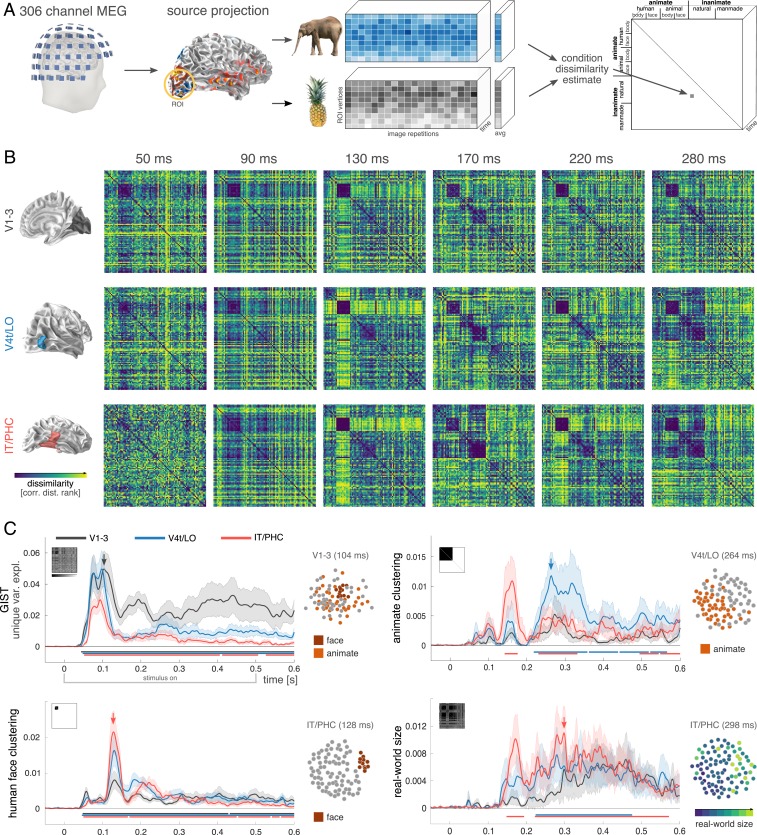
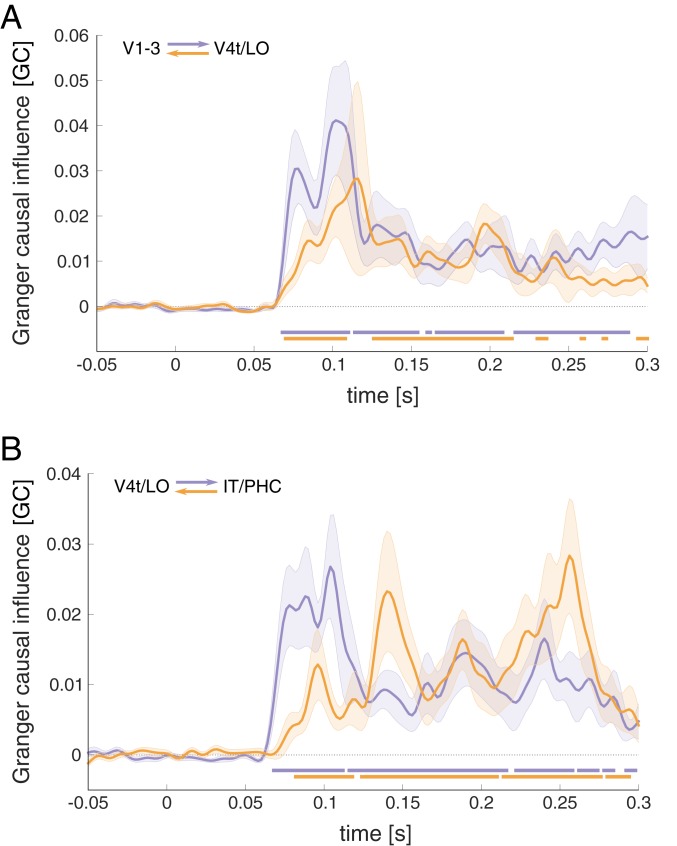
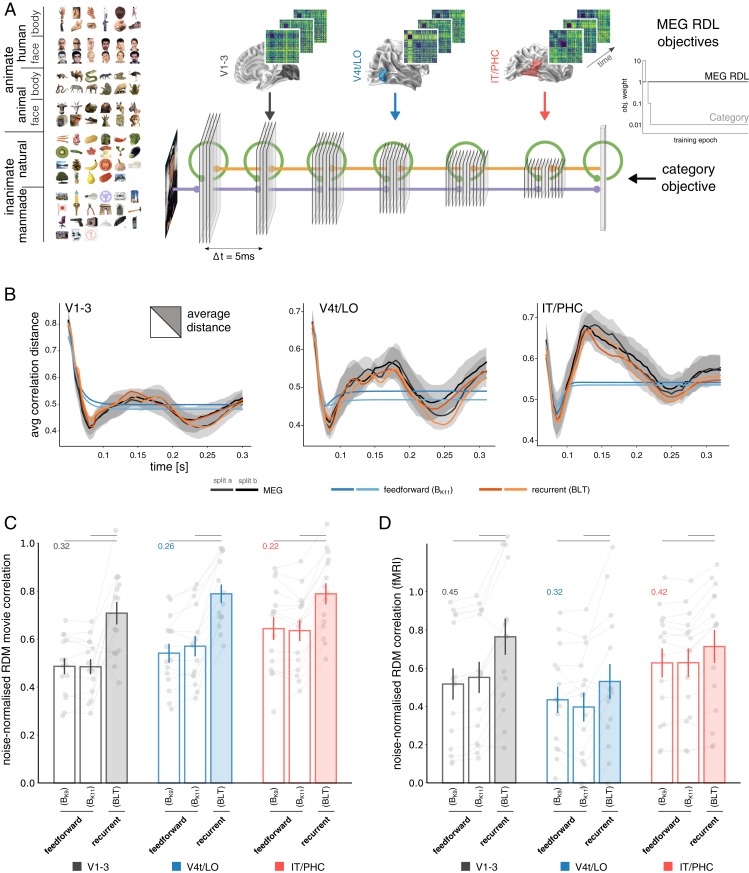
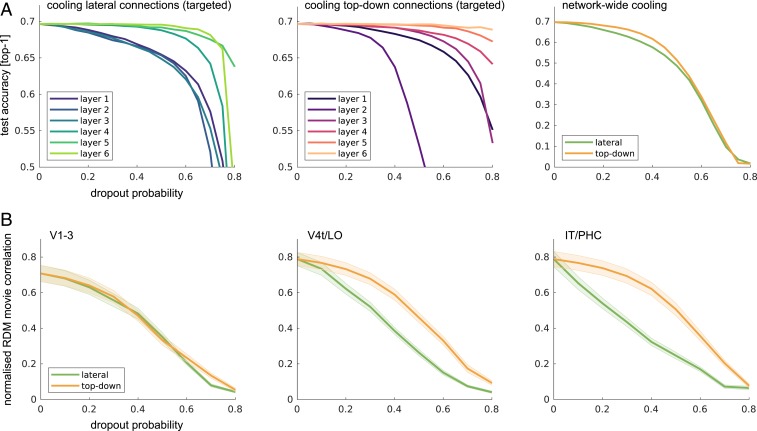
Verification
Claims the paper makes
The claims and statistics of this paper haven’t been checked yet.
Run the check — free, no account needed. It reads the open-access text and checks the sources it cites.
Claims other papers make about this one
Each is checked against this paper’s own text: does it say what the citing paper says it does?
The cited source says what the claim attributes to it.
In the citing paper
“artificial vision models such as deep convolutional neural networks (DCNNs), are already both highly successful and often claimed to be good models of human vision (Kietzmann et al. 2019, Lindsay 2021, Mehrer et al. 2021, Zhuang et al. 2021).”
From Consciousness in Artificial Intelligence: Insights from the Science of Consciousness (2023) · cites this paper as Kietzmann et al. 2019
Self-check
Percentages, sums and reported differences re-computed from the paper’s own numbers.
The self-check needs the paper’s full text.
Citations
Cites
Very Deep Convolutional Networks for Large-Scale Image Recognition
Simonyan, K., & Zisserman, A. (2014) · arXiv · doi:10.48550/arxiv.1409.1556 · Cited by 114,148
ImageNet classification with deep convolutional neural networks
Krizhevsky, A., Sutskever, I., & Hinton, G. E. (2017) · Communications of the ACM · doi:10.1145/3065386 · Cited by 112,155
TensorFlow: A system for large-scale machine learningPreprint
Abadi, M., Barham, P., Chen, J., Chen, Z., Davis, A., Dean, J., Devin, M., Ghemawat, S., Irving, G., Isard, M., et al. (2016) · arXiv (Cornell University) · doi:10.5555/3026877.3026899 · Cited by 16,548
Advances in Neural Information Processing Systems 19
(2007) · The MIT Press eBooks · doi:10.52202/085713 · Cited by 16,043
Cortical Surface-Based Analysis
Dale, A. M., Fischl, B., & Sereno, M. I. (1999) · NeuroImage · doi:10.1006/nimg.1998.0395 · Cited by 10,910
Oostenveld, R., Fries, P., Maris, E., & Schoffelen, J.-M. (2011) · Computational Intelligence and Neuroscience · doi:10.1155/2011/156869 · Cited by 10,323
Nonparametric statistical testing of EEG- and MEG-data
Maris, E., & Oostenveld, R. (2007) · Journal of Neuroscience Methods · doi:10.1016/j.jneumeth.2007.03.024 · Cited by 8,496
A multi-modal parcellation of human cerebral cortex
Glasser, M. F., Coalson, T. S., Robinson, E. C., Hacker, C. D., Harwell, J., Yacoub, E., Ugurbil, K., Andersson, J., Beckmann, C. F., Jenkinson, M., et al. (2016) · Nature · doi:10.1038/nature18933 · Cited by 5,111
MEG and EEG data analysis with MNE-Python
Gramfort, A. (2013) · Frontiers in Neuroscience · doi:10.3389/fnins.2013.00267 · Cited by 3,882
Representational similarity analysis-connecting the branches of systems neuroscience
Kriegeskorte, N. (2008) · Frontiers in Systems Neuroscience · doi:10.3389/neuro.06.004.2008 · Cited by 3,355
Self-citationA well-conditioned estimator for large-dimensional covariance matrices
Ledoit, O., & Wolf, M. (2004) · Journal of Multivariate Analysis · doi:10.1016/s0047-259x(03)00096-4 · Cited by 3,046 · cited 1×
“1 to 0 s with respect to stimulus onset) and regularized according to the Ledoit–Wolf procedure (52).”
Interpreting magnetic fields of the brain: minimum norm estimates
Hämäläinen, M. S., & Ilmoniemi, R. J. (1994) · Medical & Biological Engineering & Computing · doi:10.1007/bf02512476 · Cited by 1,995
cocor: A Comprehensive Solution for the Statistical Comparison of Correlations
Diedenhofen, B., & Musch, J. (2015) · PLOS ONE · doi:10.1371/journal.pone.0121945 · Cited by 1,919
The fusiform face area: a cortical region specialized for the perception of faces
Kanwisher, N., & Yovel, G. (2006) · Philosophical Transactions of the Royal Society B: Biological Sciences · doi:10.1098/rstb.2006.1934 · Cited by 1,718
Using goal-driven deep learning models to understand sensory cortex
Yamins, D. L. K., & DiCarlo, J. J. (2016) · Nature Neuroscience · doi:10.1038/nn.4244 · Cited by 1,621
Weight Normalization: A Simple Reparameterization to Accelerate Training of Deep Neural NetworksPreprint
Salimans, T., & Kingma, D. P. (2016) · arXiv (Cornell University) · doi:10.48550/arxiv.1602.07868 · Cited by 1,551
Chapter 2 Building the gist of a scene: the role of global image features in recognition
Oliva, A., & Torralba, A. B. (2006) · Progress in brain research · doi:10.1016/s0079-6123(06)55002-2 · Cited by 1,477
Matching Categorical Object Representations in Inferior Temporal Cortex of Man and Monkey
Kriegeskorte, N., Mur, M., Ruff, D. A., Kiani, R., Bodurka, J., Esteky, H., Tanaka, K., & Bandettini, P. A. (2008) · Neuron · doi:10.1016/j.neuron.2008.10.043 · Cited by 1,385
Self-citationThe ventral visual pathway: an expanded neural framework for the processing of object quality
Kravitz, D. J., Saleem, K. S., Baker, C. I., Ungerleider, L. G., & Mishkin, M. (2012) · Trends in Cognitive Sciences · doi:10.1016/j.tics.2012.10.011 · Cited by 1,204
Deep supervised, but not unsupervised, models may explain IT cortical representation
Khaligh-Razavi, S.-M., & Kriegeskorte, N. (2014) · PLoS Computational Biology · doi:10.1371/journal.pcbi.1003915 · Cited by 1,204
Self-citationKriegeskorte, N. (2015) · Annual Review of Vision Science · doi:10.1146/annurev-vision-082114-035447 · Cited by 1,093
Self-citationEvolution of life in urban environments
Johnson, M. T. J., & Munshi‐South, J. (2017) · Science · doi:10.1126/science.aam8327 · Cited by 1,018
A Toolbox for Representational Similarity Analysis
Nili, H., Wingfield, C., Walther, A., Su, L., Marslen‐Wilson, W. D., & Kriegeskorte, N. (2014) · PLoS Computational Biology · doi:10.1371/journal.pcbi.1003553 · Cited by 914
Self-citationThe functional architecture of the ventral temporal cortex and its role in categorization
Kalanit Grill-spector, A., & Weiner, K. S. (2014) · Nature reviews. Neuroscience · doi:10.1038/nrn3747 · Cited by 891
Resolving human object recognition in space and time
Cichy, R. M., Pantazis, D., & Oliva, A. (2014) · Nature Neuroscience · doi:10.1038/nn.3635 · Cited by 832
Self-citationGlobal and fine information coded by single neurons in the temporal visual cortex
Sugase, Y., Yamane, S., Ueno, S., & Kawano, K. (1999) · Nature · doi:10.1038/23703 · Cited by 788
Decoding Neural Representational Spaces Using Multivariate Pattern Analysis
Haxby, J. V., Connolly, A. C., & Guntupalli, J. S. (2014) · Annual Review of Neuroscience · doi:10.1146/annurev-neuro-062012-170325 · Cited by 717
How does nature program neuron types?
Borst, A. (2008) · Frontiers in Neuroscience · doi:10.3389/neuro.01.016.2008 · Cited by 705
Freiwald, W. A., & Tsao, D. Y. (2010) · Science · doi:10.1126/science.1194908 · Cited by 678
Autoreject: Automated artifact rejection for MEG and EEG data
Jas, M., Engemann, D. A., Bekhti, Y., Raimondo, F., & Gramfort, A. (2017) · NeuroImage · doi:10.1016/j.neuroimage.2017.06.030 · Cited by 611
Kiani, R., Esteky, H., Mirpour, K., & Tanaka, K. (2007) · Journal of Neurophysiology · doi:10.1152/jn.00024.2007 · Cited by 510
Kar, K., Kubilius, J., Schmidt, K., Issa, E. B., & DiCarlo, J. J. (2019) · Nature Neuroscience · doi:10.1038/s41593-019-0392-5 · Cited by 496
A Real-World Size Organization of Object Responses in Occipitotemporal Cortex
Konkle, T., & Oliva, A. (2012) · Neuron · doi:10.1016/j.neuron.2012.04.036 · Cited by 444
Representational dynamics of object vision: The first 1000 ms
Carlson, T. A., Tovar, D. A., Alink, A., & Kriegeskorte, N. (2013) · Journal of Vision · doi:10.1167/13.10.1 · Cited by 438
Self-citationA Monte Carlo Evaluation of Tests for Comparing Dependent Correlations
Hittner, J. B., May, K. O., & Silver, N. C. (2003) · The Journal of General Psychology · doi:10.1080/00221300309601282 · Cited by 427
Analyzing information flow in brain networks with nonparametric Granger causality
Dhamala, M., Govindan Rangarajan, C., & Ding, M. (2008) · NeuroImage · doi:10.1016/j.neuroimage.2008.02.020 · Cited by 392
Tripartite Organization of the Ventral Stream by Animacy and Object Size
Konkle, T., & Caramazza, A. (2013) · Journal of Neuroscience · doi:10.1523/jneurosci.0983-13.2013 · Cited by 341
Feedback Connections Act on the Early Part of the Responses in Monkey Visual Cortex
Hupé, J., James, A. C., Girard, P., Lomber, S. G., Payne, B. R., & Bullier, J. (2001) · Journal of Neurophysiology · doi:10.1152/jn.2001.85.1.134 · Cited by 318
A generative vision model that trains with high data efficiency and breaks text-based CAPTCHAs
George, D., Lehrach, W. P., Kansky, K., Lázaro-Gredilla, M., Laan, C., Marthi, B., Lou, X., Meng, Z., Liu, Y., Wang, H., et al. (2017) · Science · doi:10.1126/science.aag2612 · Cited by 289
Recurrent Convolutional Neural Networks: A Better Model of Biological Object Recognition
Spoerer, C. J., McClure, P., & Kriegeskorte, N. (2017) · Frontiers in Psychology · doi:10.3389/fpsyg.2017.01551 · Cited by 227
Self-citationRecurrent computations for visual pattern completion
Tang, H., Schrimpf, M., Lotter, W. E., Moerman, C., Paredes, A. L., Caro, J. O., Hardesty, W., Cox, D., & Kreiman, G. (2018) · Proceedings of the National Academy of Sciences · doi:10.1073/pnas.1719397115 · Cited by 225
ICA model order selection of task co-activation networks
Ray, K. L., McKay, D., Fox, P. M., Riedel, M. C., Uecker, A. M., Beckmann, C. F., Smith, S. M., Fox, P. T., & Laird, A. R. (2013) · Frontiers in Neuroscience · doi:10.3389/fnins.2013.00237 · Cited by 211
How parallel is visual processing in the ventral pathway?
Rousselet, G. A., Thorpe, S. J., & Fabre‐Thorpe, M. (2004) · Trends in Cognitive Sciences · doi:10.1016/j.tics.2004.06.003 · Cited by 205
Are Older Adults Less Embodied? A Review of Age Effects through the Lens of Embodied Cognition
Costello, M. C., & Bloesch, E. K. (2017) · Frontiers in Psychology · doi:10.3389/fpsyg.2017.00267 · Cited by 193
Deep neural networks in computational neuroscience
Kietzmann, T. C., McClure, P., & Kriegeskorte, N. (2019) · Oxford Research Encyclopedia of Neuroscience · doi:10.1093/acrefore/9780190264086.013.46 · Cited by 186
Self-citationBell, A. H., Hadj‐Bouziane, F., Frihauf, J. B., Tootell, R. B. H., & Ungerleider, L. G. (2008) · Journal of Neurophysiology · doi:10.1152/jn.90657.2008 · Cited by 183
Human Object-Similarity Judgments Reflect and Transcend the Primate-IT Object Representation
Mur, M., Meys, M., Bodurka, J., Goebel, R., Bandettini, P. A., & Kriegeskorte, N. (2013) · Frontiers in Psychology · doi:10.3389/fpsyg.2013.00128 · Cited by 179
Self-citationTask-Driven Convolutional Recurrent Models of the Visual SystemPreprint
Nayebi, A., Bear, D. M., Kubilius, J., Kar, K., Ganguli, S., Sussillo, D., DiCarlo, J. J., & Yamins, D. L. K. (2018) · arXiv (Cornell University) · doi:10.48550/arxiv.1807.00053 · Cited by 142
Early recurrent feedback facilitates visual object recognition under challenging conditions
Wyatte, D., Jilk, D. J., & O’Reilly, R. C. (2014) · Frontiers in Psychology · doi:10.3389/fpsyg.2014.00674 · Cited by 135
Dynamic Computational Time for Visual Attention
Li, Z., Yang, Y., Liu, X., Zhou, F., Wen, S., & Xu, W. (2017) · IEEE International Conference on Computer Vision Workshops · doi:10.1109/iccvw.2017.145 · Cited by 132
Recurrent neural networks can explain flexible trading of speed and accuracy in biological vision
Spoerer, C. J., Kietzmann, T. C., Mehrer, J., Charest, I., & Kriegeskorte, N. (2020) · PLoS Computational Biology · doi:10.1371/journal.pcbi.1008215 · Cited by 129
Self-citationWyatte, D., Curran, T., & O’Reilly, R. C. (2012) · Journal of Cognitive Neuroscience · doi:10.1162/jocn_a_00282 · Cited by 127
Beyond core object recognition: Recurrent processes account for object recognition under occlusion
Rajaei, K., Mohsenzadeh, Y., Ebrahimpour, R., & Khaligh‐Razavi, S. (2019) · PLoS Computational Biology · doi:10.1371/journal.pcbi.1007001 · Cited by 123
Toward an integration of deep learning and neuroscience
Marblestone, A. H., Wayne, G., & Kording, K. P. (2016) · Frontiers in Computational Neuroscience · doi:10.3389/fncom.2016.00094 · Cited by 119
Using human brain activity to guide machine learning
Fong, R., Scheirer, W. J., & Cox, D. (2018) · Scientific Reports · doi:10.1038/s41598-018-23618-6 · Cited by 108
Bankson, B., Hebart, M. N., Groen, I. I. A., & Baker, C. I. (2018) · NeuroImage · doi:10.1016/j.neuroimage.2018.05.037 · Cited by 88
Representational dynamics of object recognition: Feedforward and feedback information flows
Goddard, E., Carlson, T. A., Dermody, N., & Woolgar, A. (2016) · NeuroImage · doi:10.1016/j.neuroimage.2016.01.006 · Cited by 75
Curvature Processing Dynamics in Macaque Area V4
Yau, J. M., Pasupathy, A., Brincat, S. L., & Connor, C. E. (2012) · Cerebral Cortex · doi:10.1093/cercor/bhs004 · Cited by 69
(2017) · doi:10.3389/fncom.2016.00131 · Cited by 59
Self-citationDeep Predictive Coding Network with Local Recurrent Processing for Object RecognitionPreprint
Han, K., Wen, H., Zhang, Y., Fu, D., Culurciello, E., & Liu, Z. (2018) · arXiv (Cornell University) · doi:10.48550/arxiv.1805.07526 · Cited by 46
Recurrent Connections Aid Occluded Object Recognition by Discounting Occluders
Ernst, M., Triesch, J., & Burwick, T. (2019) · Lecture notes in computer science · doi:10.1007/978-3-030-30508-6_24 · Cited by 17
Linsley, D. A., Kim, J., Berson, D. M., & Serre, T. (2018) · arXiv (Cornell University) · doi:10.48550/arxiv.1811.11356 · Cited by 15
Recurrent convolutional neural networks: a better model of biological object recognitionPreprint
Spoerer, C. J., McClure, P., & Kriegeskorte, N. (2017) · bioRxiv (Cold Spring Harbor Laboratory) · doi:10.1101/133330 · Cited by 14
Self-citationSpoerer, C. J., Kietzmann, T. C., & Kriegeskorte, N. (2019) · Conference on Cognitive Computational Neuroscience (CCN) · doi:10.32470/ccn.2019.1068-0 · Cited by 13
Self-citationSample-efficient image segmentation through recurrencePreprint
Linsley, D. A., Kim, J., Berson, D. M., & Serre, T. (2018) · arXiv (Cornell University) · Cited by 6
High-resolution intersubject averaging and a coordinate system for the cortical surface
Fischl, B., Sereno, M. I., Tootell, R. B. H., & Dale, A. M. (1999) · Human Brain Mapping · doi:10.1002/(sici)1097-0193(1999)8:4
Research works printed but not linked: 2
- J. Mehrer, T. C. Kietzmann, N. Kriegeskorte, “Deep neural networks trained on ecologically relevant categories better explain human IT” in Cognitive Computational Neuroscience Meeting (Cognitive Computational Neuroscience, 2017), pp. 1–2.
- D. P. Kingma J. L. Ba Adam: A method for stochastic optimization. arXiv:1412.6980 (30 January 2017). · arXiv
Cited by
Sorted by citations
The neural architecture of language: Integrative modeling converges on predictive processing
Schrimpf, M., Blank, I. A., Tuckute, G., Kauf, C., Hosseini, E. A., Kanwisher, N., Tenenbaum, J. B., & Fedorenko, E. (2021) · Proceedings of the National Academy of Sciences · doi:10.1073/pnas.2105646118 · Cited by 517
If deep learning is the answer, what is the question?
Saxe, A., Nelli, S., & Summerfield, C. (2021) · Nature Reviews Neuroscience · doi:10.1038/s41583-020-00395-8 · Cited by 397
Artificial Neural Networks for Neuroscientists: A Primer
Yang, G. R., & Wang, X. (2020) · Neuron · doi:10.1016/j.neuron.2020.09.005 · Cited by 411
High-resolution image reconstruction with latent diffusion models from human brain activity
Takagi, Y., & Nishimoto, S. (2023) · IEEE Computer Society Conference on Computer Vision and Pattern Recognition/Proceedings - IEEE Computer Society Conference on Computer Vision and Pattern Recognition/Proceedings · doi:10.1109/cvpr52729.2023.01389 · Cited by 362
Integrative benchmarking to advance neurally mechanistic models of human intelligence
Schrimpf, M., Kubilius, J., Lee, M. J., Ratan Murty, N. A., Ajemian, R., & DiCarlo, J. J. (2020) · Neuron · doi:10.1016/j.neuron.2020.07.040 · Cited by 233
Metadata
- Authors
- Kietzmann, T. C., Spoerer, C. J., Sörensen, L. K. A., Cichy, R. M., Hauk, O., & Kriegeskorte, N.
- Affiliations
- Radboud University Nijmegen (NL)
- MRC Cognition and Brain Sciences Unit (GB)
- University of Amsterdam (NL)
- Freie Universität Berlin (DE)
- Columbia University (US)
- Corresponding author
- Kietzmann, Tim C.
- ORCID
- Venue
- Proceedings of the National Academy of Sciences
- Publisher
- National Academy of Sciences
- Published
- 2019-10-07
- Volume
- 116
- Issue
- 43
- Pages
- 21854-21863
- ISSN
- 0027-8424 (ISSN-L)
- 1091-6490
- PMC
- PMC6815174
- OpenAlex
- W2979357328
- Cited by
- 406
- References
- 68
- Citations by year
- 2026: 44 · 2025: 60 · 2024: 66 · 2023: 57 · 2022: 58 · 2021: 66 · 2020: 50 · 2019: 5
- FWCI
- 26.02
- Type
- journal article
- Language
- en
- Open access
- hybrid
- doi.org
- Licence
- Locations
- Proceedings of the National Academy of Sciences (publishedVersion, cc-by-nc-nd)
- Europe PMC (PubMed Central) (publishedVersion, cc-by-nc-nd)
- PubMed Central (publishedVersion, cc-by-nc-nd)
- PubMed (publishedVersion)
- arXiv (Cornell University) (submittedVersion)
- Refubium (Universitätsbibliothek der Freien Universität Berlin) (submittedVersion, cc-by-nc-nd)
- UvA-DARE (University of Amsterdam) (submittedVersion, cc-by-nc-nd)
- Radboud Repository (Radboud University) (submittedVersion)
- Apollo (University of Cambridge) (submittedVersion, cc-by-nc-nd)
- Radboud Repository (Radboud University) (submittedVersion, other-oa)
- Data Archiving and Networked Services (DANS) (submittedVersion, other-oa)
- arXiv (Cornell University)
- Universitätsbibliothek der FU Berlin Hochschulschriftenstelle u. Dokumentenserver
- Apollo
- Funders
- European Commission (604102, 261352)
- Deutsche Forschungsgemeinschaft
- Medical Research Council (MC-A060- 5PR20)
- Topics
- Life Sciences › Neuroscience › Cognitive Neuroscience › Visual perception and processing mechanisms
- Life Sciences › Neuroscience › Cognitive Neuroscience › Face Recognition and Perception
- Physical Sciences › Computer Science › Computer Vision and Pattern Recognition › Visual Attention and Saliency Detection
- Keywords
- recurrent neural networks, ventral stream, representational dynamics, object recognition, Granger causality, bidirectional information flow, top-down connections
- MeSH terms
- Deep Learning, Adult, Female, Humans, Models, Neurological, Nerve Net, Visual Pathways, Visual Perception, Magnetoencephalography, Feedback, Sensory
About these checks
Registry, retraction, Cites and statistics results are computed, not judged, with one exception: a printed reference that no index lists is read once by a model before it counts as a citation error. Claims are extracted by a model and kept only when their quote appears verbatim in the text; each cited source is then checked, with a model’s help, for whether it says what the claim relies on. Those verdicts can be wrong — read the claim’s quote and the cited source before relying on one.
Statistics and arithmetic are recomputed, not judged.
Confidence bands are shown only for fields calibrated on our annotated test set. None is calibrated yet, so no band is shown.
What counts as a claim ›How we measure confidence ›How we check this ›
Are you an author, or do you see a problem with this page? Request a review
