

Energy metabolism controls phenotypes by protein efficiency and allocation
Open accessThe DOI matches its Crossref record; 51 of the 51 references it cites were found in a registry or an index.
Abstract
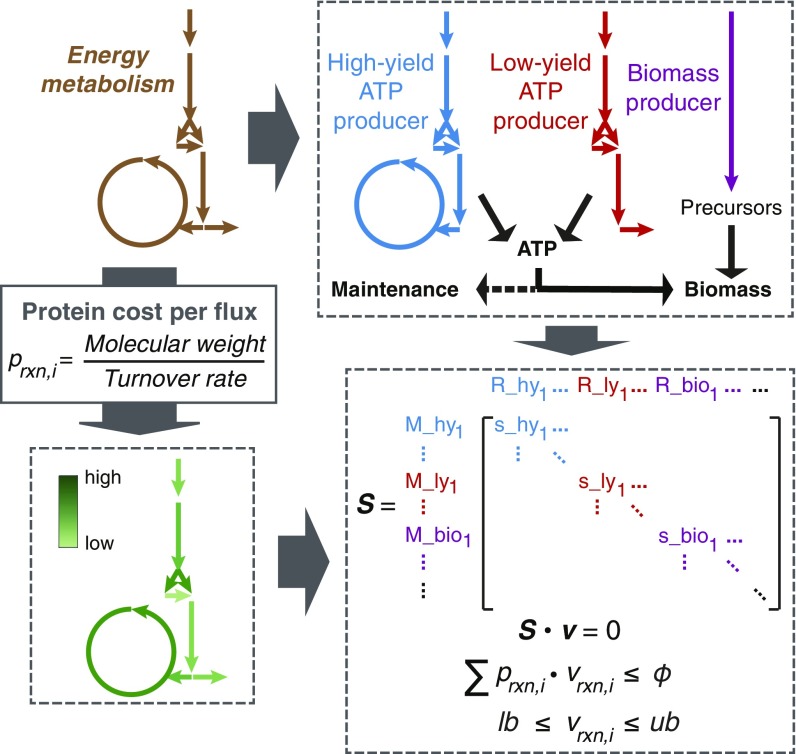
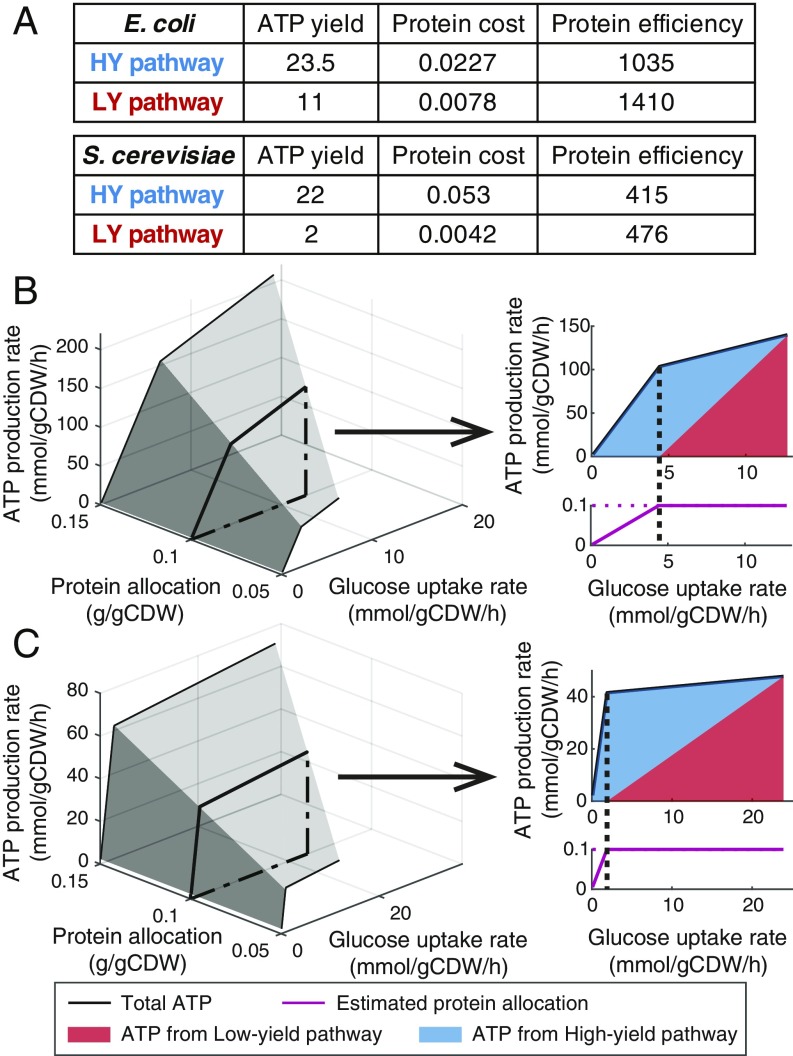
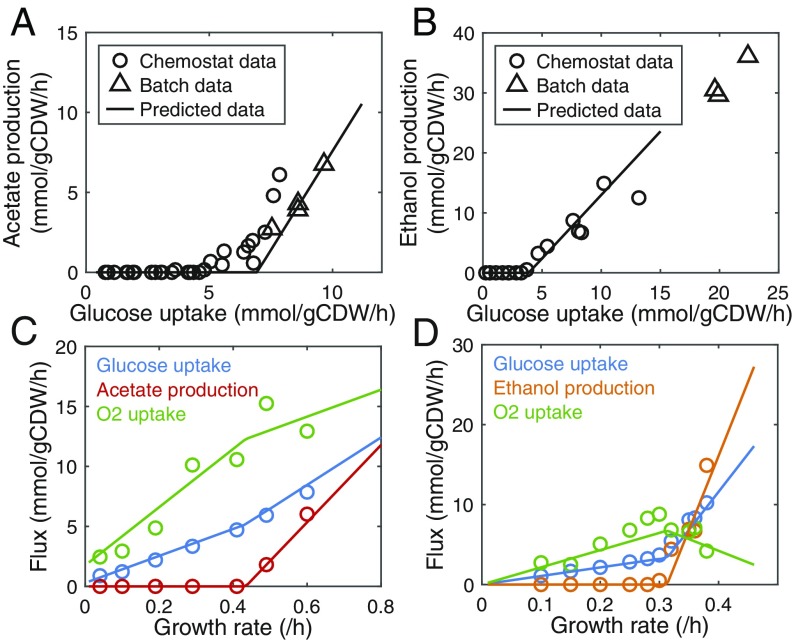
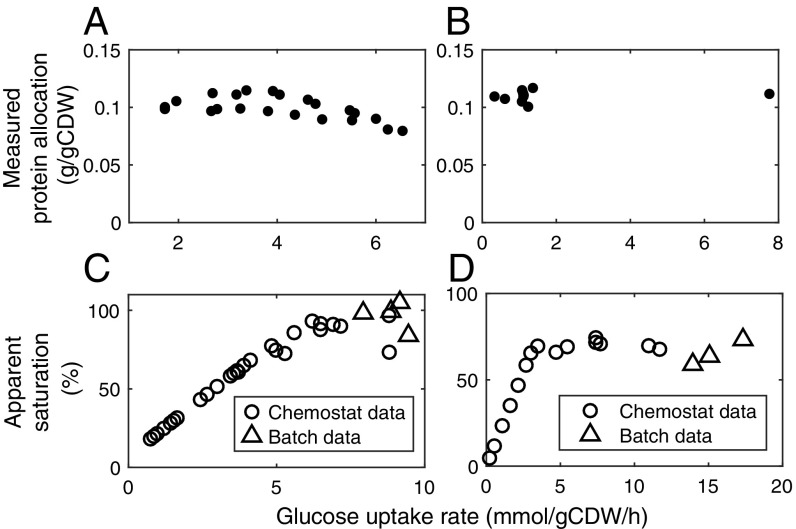
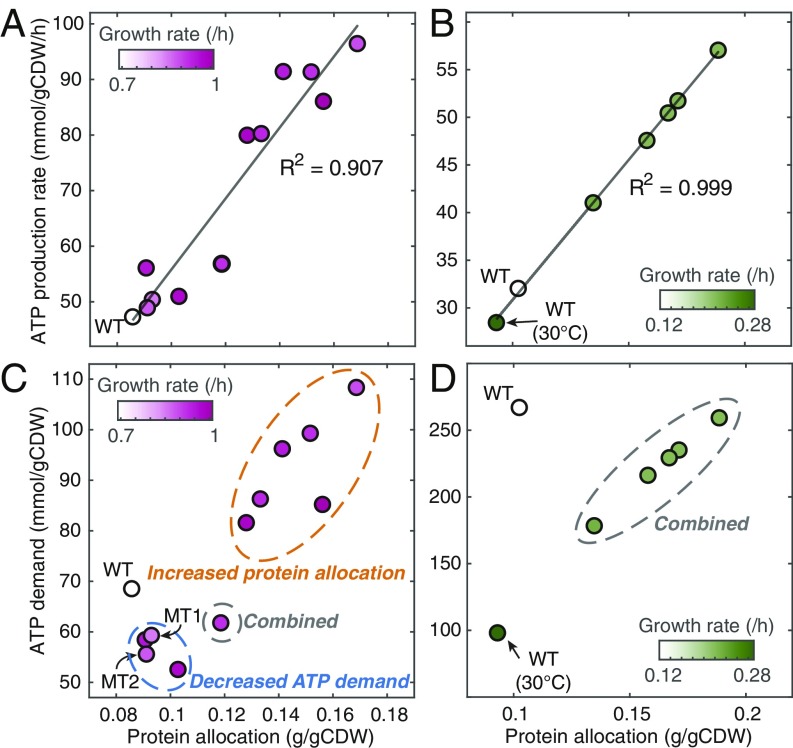
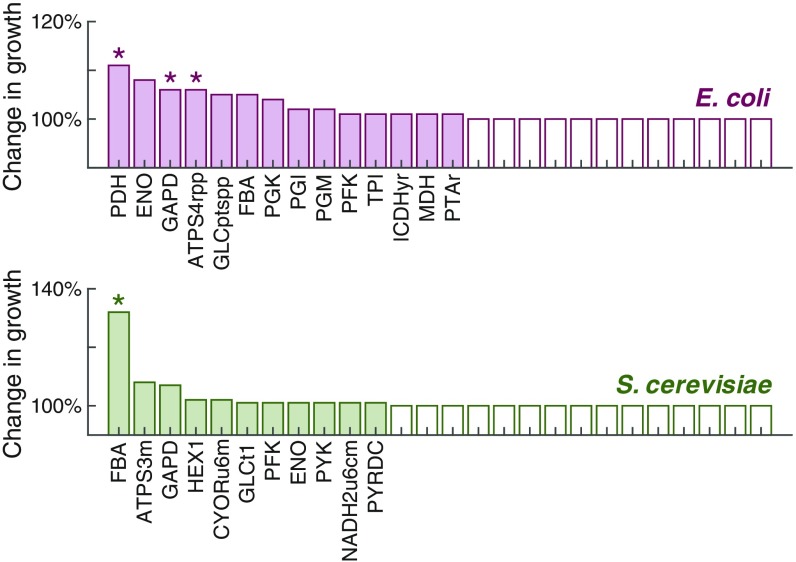
Significance: Organisms use the central carbon metabolism for both breakdown of substrate into biomass precursors and extraction of energy, making the pathways overlapping. We present a modeling concept that can decompose the overlapping pathways and hence account for protein cost for each of them. This enables comparisons between pathways within an organism or between organisms. Using this concept, we model energy metabolism for Escherichia coli and Saccharomyces cerevisiae , and accurately predict metabolic switches. Besides, we find that the total mass of the proteins involved in energy metabolism is conserved across conditions, which is simulated to correlate with ATP production rate in cells growing at unlimited conditions.
Overview
The claims and statistics of this paper haven’t been checked yet.
Free: it reads the open-access text and checks the first 5 claims that cite a source we can check. Create a free account to check every claim.
Integrity signals
Registry
Cites
Statistics
Figures
Verification
Claims the paper makes
The claims and statistics of this paper haven’t been checked yet.
Free: it reads the open-access text and checks the first 5 claims that cite a source we can check. Create a free account to check every claim.
Self-check
Percentages, sums and reported differences re-computed from the paper’s own numbers.
The self-check needs the paper’s full text.
Citations
Cites
Interdependence of Cell Growth and Gene Expression: Origins and Consequences
Scott, M., Gunderson, C. W., Mateescu, E. M., Zhang, Z., & Hwa, T. (2010) · Science · doi:10.1126/science.1192588 · Cited by 1,470
Cooperation and Competition in the Evolution of ATP-Producing Pathways
Pfeiffer, T., Schuster, S., & Bonhoeffer, S. (2001) · Science · doi:10.1126/science.1058079 · Cited by 1,354
Creation and analysis of biochemical constraint-based models using the COBRA Toolbox v.3.0
Heirendt, L., Arreckx, S., Pfau, T., Mendoza, S. N., Richelle, A., Heinken, A., Haraldsdóttir, H. S., Wachowiak, J., Keating, S. M., Vlasov, V., et al. (2019) · Nature Protocols · doi:10.1038/s41596-018-0098-2 · Cited by 1,242
Overflow metabolism in Escherichia coli results from efficient proteome allocation
Basan, M., Hui, S., Okano, H., Zhang, Z., Shen, Y., Williamson, J. R., & Hwa, T. (2015) · Nature · doi:10.1038/nature15765 · Cited by 785 · cited 5×
“This suggests that energy metabolism is sufficient to explain the metabolic switches in both E. coli and S. cerevisiae , which is consistent with the finding in E. coli based on a coarse-graining approach (14).”
InfluentialThe quantitative and condition-dependent Escherichia coli proteome
Schmidt, A., Kochanowski, K., Vedelaar, S., Ahrné, E., Volkmer, B., Callipo, L., Knoops, K., Bauer, M., Aebersold, R., & Heinemann, M. (2016) · Nature Biotechnology · doi:10.1038/nbt.3418 · Cited by 771
Shifts in growth strategies reflect tradeoffs in cellular economics
Molenaar, D., van Berlo, R., de Ridder, D., & Teusink, B. (2009) · Molecular Systems Biology · doi:10.1038/msb.2009.82 · Cited by 653 · cited 1×
“This may be explained by another tradeoff, which is between ATP yield and protein required for carrying the fluxes (11).”
iML1515, a knowledgebase that computes Escherichia coli traits
Monk, J. M., Lloyd, C. J., Brunk, E., Mih, N., Sastry, A., King, Z., Takeuchi, R., Nomura, W., Zhang, Z., Mori, H., et al. (2017) · Nature Biotechnology · doi:10.1038/nbt.3956 · Cited by 560
Glycolytic strategy as a tradeoff between energy yield and protein cost
Flamholz, A., Noor, E., Bar-Even, A., Liebermeister, W., & Milo, R. (2013) · Proceedings of the National Academy of Sciences · doi:10.1073/pnas.1215283110 · Cited by 531
Genome‐scale models of metabolism and gene expression extend and refine growth phenotype prediction
O'Brien, E. J., Lerman, J. A., Chang, R. L., Hyduke, D. R., & Palsson, B. Ø. (2013) · Molecular Systems Biology · doi:10.1038/msb.2013.52 · Cited by 471
Sánchez, B. J., Zhang, C., Nilsson, A., Lahtvee, P., Kerkhoven, E. J., & Nielsen, J. (2017) · Molecular Systems Biology · doi:10.15252/msb.20167411 · Cited by 466 · cited 5×
“Furthermore, genome-scale metabolic models (GEMs) with the integration of protein constraints have shown improved predictions of metabolic switches (15 – 18).”
InfluentialSelf-citation
Cited by
Deep learning-based kcat prediction enables improved enzyme-constrained model reconstruction
Li, F., Yuan, L., Lu, H., Li, G., Chen, Y., Engqvist, M. K. M., Kerkhoven, E. J., & Nielsen, J. (2022) · Nature Catalysis · doi:10.1038/s41929-022-00798-z · Cited by 466
“According to the classification of metabolic pathways, metabolic contexts were mainly divided into four different subsystems: (1) primary metabolism (carbohydrate and energy), involving the main carbon and energy metabolism, for example, glycolysis/gluconeogenesis, TCA cycle, pentose phosphate pathway, and so on; (2)…”
BackgroundMethodSelf-citationMetabolomics Reveal Nanoplastic-Induced Mitochondrial Damage in Human Liver and Lung Cells
Lin, S., Zhang, H., Wang, C., Su, X.-L., Song, Y., Wu, P., Yang, Z., Wong, M.-H., Cai, Z., & Zheng, C. (2022) · Environmental Science & Technology · doi:10.1021/acs.est.2c03980 · Cited by 391
Domenzain, I., Sánchez, B., Anton, M., Kerkhoven, E. J., Millán-Oropeza, A., Henry, C., Siewers, V., Morrissey, J. P., Sonnenschein, N., & Nielsen, J. (2021) · doi:10.1101/2021.03.05.433259 · Cited by 158
Self-citationElsemman, I. E., Rodriguez Prado, A., Grigaitis, P., Garcia Albornoz, M., Harman, V., Holman, S. W., van Heerden, J., Bruggeman, F. J., Bisschops, M. M. M., Sonnenschein, N., et al. (2022) · Nature Communications · doi:10.1038/s41467-022-28467-6 · Cited by 120
Self-citationOftadeh, O., Salvy, P., Masid, M., Curvat, M., Miskovic, L., & Hatzimanikatis, V. (2021) · Nature Communications · doi:10.1038/s41467-021-25158-6 · Cited by 99
The Warburg Effect is the result of faster ATP production by glycolysis than respiration
Kukurugya, M. A., Rosset, S., & Titov, D. V. (2024) · Proceedings of the National Academy of Sciences · doi:10.1073/pnas.2409509121 · Cited by 81
“22 and 23 , respectively): We used the method of Lagrange multipliers with Karush - Kuhn - Tucker conditions to solve this optimization problem with inequality constraints.”
Enzyme capacity-based genome scale modelling of CHO cells
Yeo, H. C., Hong, J., Lakshmanan, M., & Lee, D.-Y. (2020) · Metabolic Engineering · doi:10.1016/j.ymben.2020.04.005 · Cited by 75
Proteome constraints reveal targets for improving microbial fitness in nutrient‐rich environments
Chen, Y., van Pelt‐KleinJan, E., van Olst, B., Douwenga, S., Boeren, S., Bachmann, H., Molenaar, D., Nielsen, J., & Teusink, B. (2021) · Molecular Systems Biology · doi:10.15252/msb.202010093 · Cited by 73
Self-citationYeast optimizes metal utilization based on metabolic network and enzyme kinetics
Chen, Y., Li, F., Mao, J., Chen, Y., & Nielsen, J. (2021) · Proceedings of the National Academy of Sciences · doi:10.1073/pnas.2020154118 · Cited by 46
“We thus show in this study that iron cost of enzymes could be another factor leading to the shift between the two energy-producing pathways, while we showed previously that such a shift could also be caused by the protein cost of enzymes (25).”
BackgroundSelf-citationYeast metabolic innovations emerged via expanded metabolic network and gene positive selection
Lu, H., Li, F., Yuan, L., Domenzain, I., Yu, R., Wang, H., Li, G., Chen, Y., Ji, B., Kerkhoven, E. J., et al. (2021) · Molecular Systems Biology · doi:10.15252/msb.202110427 · Cited by 44
Self-citationMathematical modeling of proteome constraints within metabolism
Chen, Y., & Nielsen, J. (2021) · Current Opinion in Systems Biology · doi:10.1016/j.coisb.2021.03.003 · Cited by 44
Self-citationResource allocation in mammalian systems
Baghdassarian, H. M., & Lewis, N. E. (2024) · Biotechnology Advances · doi:10.1016/j.biotechadv.2023.108305 · Cited by 17
Casini, I., McCubbin, T., Esquivel-Elizondo, S., Luque, G. G., Evseeva, D., Fink, C., Beblawy, S., Youngblut, N. D., Aristilde, L., Huson, D. H., et al. (2023) · iScience · doi:10.1016/j.isci.2023.108016 · Cited by 14
(2022) · doi:10.1016/j.ymben.2022.09.002 · Cited by 13
(2025) · doi:10.1128/msystems.00690-25 · Cited by 7
Optimal protein allocation controls the inhibition of GltA and AcnB in Neisseria gonorrhoeae
Shahreen, N., Chowdhury, N. B., & Saha, R. (2024) · Pathogens and Disease · doi:10.1093/femspd/ftae023 · Cited by 6
Chowdhury, N. B., Pokorzynski, N., Rucks, E. A., Ouellette, S. P., Carabeo, R. A., & Saha, R. (2024) · mSystems · doi:10.1128/msystems.00717-24 · Cited by 3
Metadata
- Authors
- Chen, Y., & Nielsen, J.
- Affiliations
- Chalmers University of Technology (SE)
- Novo Nordisk Foundation (DK)
- Corresponding author
- Nielsen, Jens
- Venue
- Proceedings of the National Academy of Sciences
- Publisher
- National Academy of Sciences
- Published
- 2019-08-12
- Volume
- 116
- Issue
- 35
- Pages
- 17592-17597
- ISSN
- 0027-8424 (ISSN-L)
- 1091-6490
- PMC
- PMC6717264
- OpenAlex
- W2967764163
- Cited by
- 156
- References
- 51
- Citations by year
- 2026: 24 · 2025: 26 · 2024: 32 · 2023: 15 · 2022: 21 · 2021: 25 · 2020: 11 · 2019: 1
- FWCI
- 4.80
- Type
- journal article
- Language
- en
- Open access
- hybrid
- doi.org
- Licence
- Locations
- Proceedings of the National Academy of Sciences (publishedVersion, cc-by-nc-nd)
- Europe PMC (PubMed Central) (publishedVersion, cc-by-nc-nd)
- PubMed Central (publishedVersion, cc-by-nc-nd)
- PubMed (publishedVersion)
- Technical University of Denmark, DTU Orbit (Technical University of Denmark, DTU) (submittedVersion, other-oa)
- Chalmers Research (Chalmers University of Technology) (submittedVersion)
- Funders
- European Commission (HORIZON2020, 686070)
- Knut och Alice Wallenbergs Stiftelse (NNF10CC1016517)
- Novo Nordisk (NNF10CC1016517)
- Novo Nordisk Fonden (NNF17SA0032514-4, NNF10CC1016517)
- Topics
- Life Sciences › Biochemistry, Genetics and Molecular Biology › Molecular Biology › Microbial Metabolic Engineering and Bioproduction
- Life Sciences › Biochemistry, Genetics and Molecular Biology › Molecular Biology › Gene Regulatory Network Analysis
- Life Sciences › Biochemistry, Genetics and Molecular Biology › Molecular Biology › Fungal and yeast genetics research
- Keywords
- energy metabolism, central carbon metabolism, metabolic switch, Escherichia coli, Saccharomyces cerevisiae, ATP production, metabolic modeling
- MeSH terms
- Adenosine Triphosphate, Algorithms, Energy Metabolism, Escherichia coli, Models, Biological, Phenotype, Proteins, Saccharomyces cerevisiae, Protein Transport
About these checks
Registry, retraction, Cites and statistics results are computed, not judged, with one exception: a printed reference that no index lists is read once by a model before it counts as a citation error. Claims are extracted by a model and kept only when their quote appears verbatim in the text; each cited source is then checked, with a model’s help, for whether it says what the claim relies on. Those verdicts can be wrong — read the claim’s quote and the cited source before relying on one.
Statistics and arithmetic are recomputed, not judged.
Confidence bands are shown only for fields calibrated on our annotated test set. None is calibrated yet, so no band is shown.
What counts as a claim ›How we measure confidence ›How we check this ›
Are you an author, or do you see a problem with this page? Request a review
Data sources
Bibliographic data: Semantic Scholar, OpenAlex, Crossref.
Contains information from the Semantic Scholar Academic Graph Datasets, made available under the ODC Attribution License (ODC-BY 1.0).
Semantic Scholar’s data is described in: Kinney, R., et al. (2023). The Semantic Scholar Open Data Platform. arXiv:2301.10140.
