

The DOI matches its Crossref record; 88 of the 89 references it cites were found in a registry or an index.
Dynamics of life expectancy and life span equality
Open accessAbstract
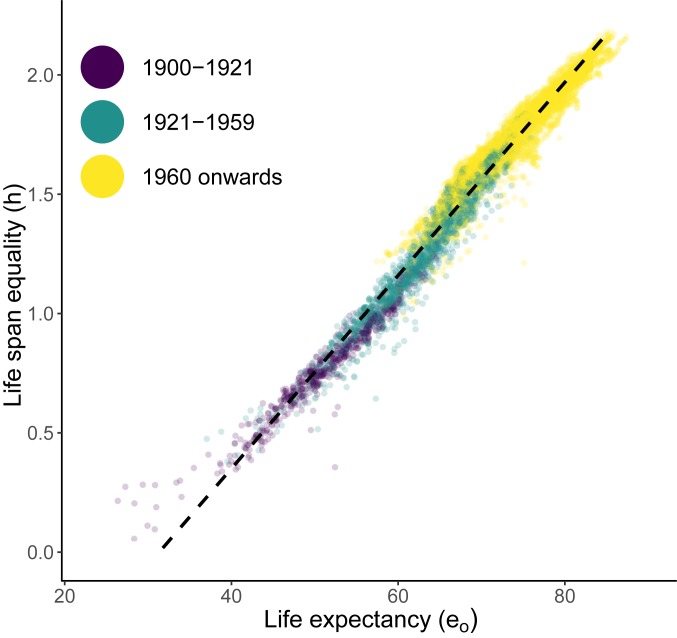
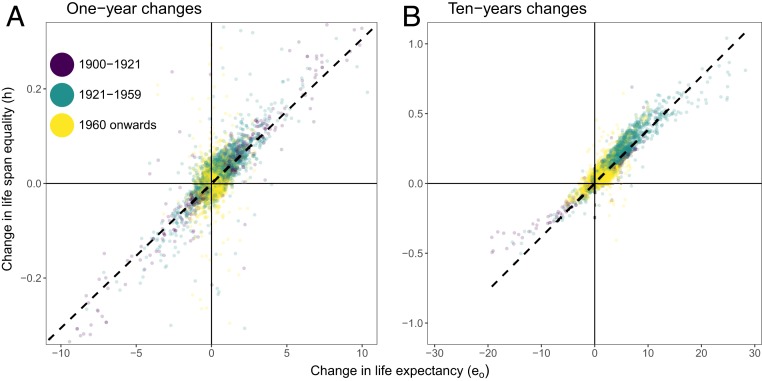
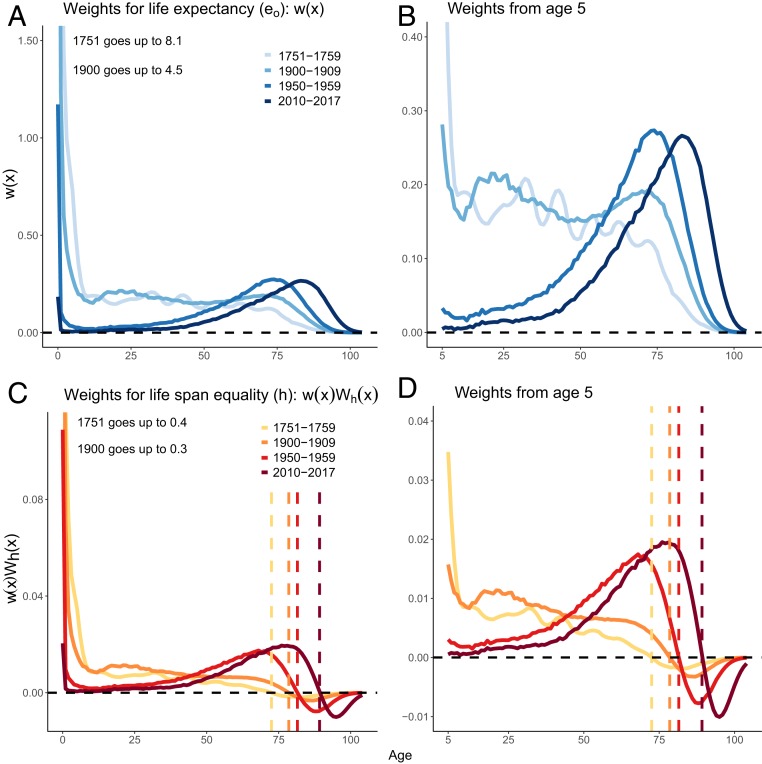
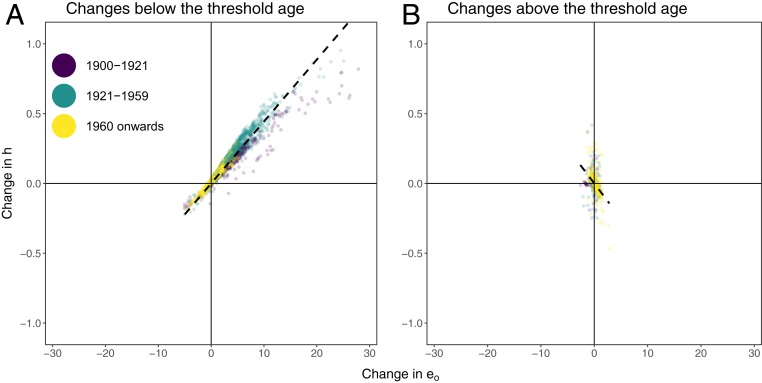
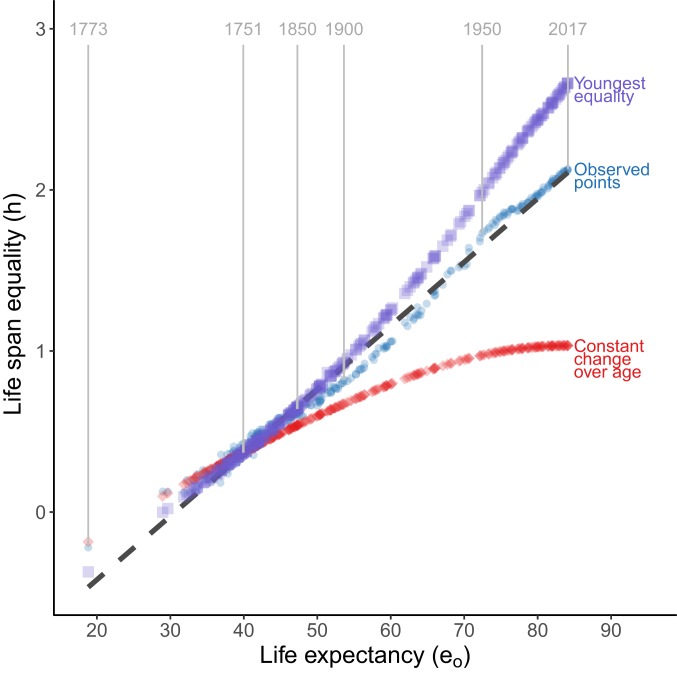
Significance: Why life expectancy and life span equality have increased together is a question of scientific interest. Both measures are calculated for a calendar year and might not describe a cohort’s actual life course. Nonetheless, life expectancy provides a useful measure of average life spans, and life span equality gives insights into uncertainty about age at death. We show how patterns of change in life expectancy and life span equality are described by trajectories of mortality improvements over age and time. The strength of the relationship between life expectancy and life span equality is not coincidental but rather a result of progress in saving lives at specific ages: the more lives saved at the youngest ages, the stronger the relationship is.
Overview
The claims and statistics of this paper haven’t been checked yet.
Run the check — free, no account needed. It reads the open-access text and checks the sources it cites.
Integrity signals
Registry
Cites
Statistics
Figures
Verification
Claims the paper makes
The claims and statistics of this paper haven’t been checked yet.
Run the check — free, no account needed. It reads the open-access text and checks the sources it cites.
Claims other papers make about this one
Each is checked against this paper’s own text: does it say what the citing paper says it does?
The source backs part of the claim, not all of it — or backs it for a different population, condition or comparison.
In the citing paper
“Yet, demographic indicators such as life expectancy and lifespan equality provide a more precise framework for evaluating environmental quality (Colchero et al., 2016, 2021; Aburto et al., 2020).”
From Evidence of long-term survival gains in Panthera from modern zoological facilities supports their role in integrated conservation (2026) · cites this paper as Aburto et al., 2020
Experimental — accuracy not yet measuredIn the citing paper
“Historically, life expectancy increases have been accompanied by reductions in lifespan inequality due to mortality improvements at younger ages, although more recent studies have found that life expectancy improvements can occur even without accompanying reductions in lifespan inequality.13”
From Estimating the burden of the COVID-19 pandemic on mortality, life expectancy and lifespan inequality in England and Wales: a population-level analysis (2021) · cites this paper as [13]
In the citing paper
“However, for lifespan inequality to decrease when life expectancy is increasing, more lives need to be saved at younger than older ages, usually below life expectancy.13”
From Estimating the burden of the COVID-19 pandemic on mortality, life expectancy and lifespan inequality in England and Wales: a population-level analysis (2021) · cites this paper as [13]
In the citing paper
“Consequently, mortality and survival rates serve as robust proxies for assessing population-level welfare and living conditions across species (Walker et al., 2012), including humans (Aburto et al., 2020).”
From Evidence of long-term survival gains in Panthera from modern zoological facilities supports their role in integrated conservation (2026) · cites this paper as Aburto et al., 2020
Self-check
Percentages, sums and reported differences re-computed from the paper’s own numbers.
The self-check needs the paper’s full text.
Citations
Cites
Distribution of the Estimators for Autoregressive Time Series with a Unit Root
Dickey, D. A., & Fuller, W. A. (1979) · Journal of the American Statistical Association · doi:10.1080/01621459.1979.10482531 · Cited by 23,211
Testing the null hypothesis of stationarity against the alternative of a unit root
Kwiatkowski, D., Phillips, P. C. B., Schmidt, P., & Shin, Y. (1992) · Journal of Econometrics · doi:10.1016/0304-4076(92)90104-y · Cited by 12,633
Spurious regressions in econometrics
Granger, C. W. J., & Newbold, P. (1974) · Journal of Econometrics · doi:10.1016/0304-4076(74)90034-7 · Cited by 6,423
The world health report 2000 - Health systems: improving performance
Reinhardt, U., & Cheng, T.-M. (2000) · Europe PMC (PubMed Central) · doi:10.1590/s0042-96862000000800020 · Cited by 3,218
Ageing populations: the challenges ahead
Christensen, K., Doblhammer, G., Rau, R., & Vaupel, J. W. (2009) · The Lancet · doi:10.1016/s0140-6736(09)61460-4 · Cited by 3,011
Self-citationBroken Limits to Life Expectancy
Oeppen, J., & Vaupel, J. W. (2002) · Science · doi:10.1126/science.1069675 · Cited by 2,819
Self-citationSome properties of time series data and their use in econometric model specification
Granger, C. W. J. (1981) · Journal of Econometrics · doi:10.1016/0304-4076(81)90079-8 · Cited by 2,427
(2005) · doi:10.1093/acprof:oso/9780198565895.001.0001 · Cited by 2,155
On the measurement of inequalities in health
Wagstaff, A., Paci, P., & van Doorslaer, E. (1991) · Social Science & Medicine · doi:10.1016/0277-9536(91)90212-u · Cited by 1,810
Demography, Measuring and Modeling Population Processes
Véron, J., Preston, S. H., Heuveline, P., & Guillot, M. (2002) · Population · doi:10.2307/1535065 · Cited by 1,709
Research works printed but not linked: 3
- F. W. Notestein, “Population—the long view” in Food for the World, T. Schulz, Ed. (University of Chicago Press, Chicago, 1945), pp. 36–57.
- E. M. Andreev, Metod komponent v analize prodoljitelnosty zjizni. [The method of components in the analysis of length of life]. Vestn. Statistiki 9, 42–47 (1982).
- M. Dribe M. Olsson P. Svensson Famines in the Nordic Countries AD 536–1875 (Lund Papers in Economic History Department of Economic History Lund University 2015) vol. 138.
Cited by
Sorted by citations
Aburto, J. M., Schöley, J., Kashnitsky, I., Zhang, L., Rahal, C., Missov, T. I., Mills, M. C., Dowd, J. B., & Kashyap, R. (2022) · International Journal of Epidemiology · doi:10.1093/ije/dyab207 · Cited by 531
Self-citationDemographic perspectives on the mortality of COVID-19 and other epidemics
Goldstein, J. R., & Lee, R. D. (2020) · Proceedings of the National Academy of Sciences · doi:10.1073/pnas.2006392117 · Cited by 287
Demographic perspectives on the rise of longevity
Vaupel, J. W., Villavicencio, F., & Bergeron-Boucher, M.-P. (2021) · Proceedings of the National Academy of Sciences · doi:10.1073/pnas.2019536118 · Cited by 253
Self-citationAburto, J. M., Kashyap, R., Schöley, J., Angus, C., Ermisch, J., Mills, M. C., & Dowd, J. B. (2021) · Journal of Epidemiology and Community Health · doi:10.1136/jech-2020-215505 · Cited by 159
Self-citationYouness, R. A., Dawoud, A., Eltahtawy, O., & Farag, M. A. (2022) · Nutrition & Metabolism · doi:10.1186/s12986-022-00696-y · Cited by 99
Metadata
- Authors
- Aburto, J. M., Villavicencio, F., Basellini, U., Kjærgaard, S., & Vaupel, J. W.
- Affiliations
- University of Southern Denmark (DK)
- Johns Hopkins University (US)
- Institut national d'études démographiques (FR)
- Duke University (US)
- Corresponding author
- Aburto, José Manuel
- Vaupel, James W.
- ORCID
- Venue
- Proceedings of the National Academy of Sciences
- Publisher
- National Academy of Sciences
- Published
- 2020-02-24
- Volume
- 117
- Issue
- 10
- Pages
- 5250-5259
- ISSN
- 0027-8424 (ISSN-L)
- 1091-6490
- PMC
- PMC7071894
- OpenAlex
- W3007082643
- Cited by
- 254
- References
- 89
- Citations by year
- 2026: 26 · 2025: 39 · 2024: 58 · 2023: 33 · 2022: 49 · 2021: 33 · 2020: 16
- FWCI
- 49.37
- Type
- journal article
- Language
- en
- Open access
- hybrid
- doi.org
- Licence
- Locations
- Proceedings of the National Academy of Sciences (publishedVersion, cc-by-nc-nd)
- Europe PMC (PubMed Central) (publishedVersion, cc-by-nc-nd)
- PubMed Central (publishedVersion, cc-by-nc-nd)
- PubMed (publishedVersion)
- LSHTM Research Online (London School of Hygiene and Tropical Medicine) (submittedVersion)
- HAL (submittedVersion, cc-by-nc-nd)
- RePEc: Research Papers in Economics (submittedVersion)
- Archined (submittedVersion, cc-by-nc-nd)
- University of Southern Denmark Research Portal (University of Southern Denmark) (submittedVersion, cc-by-nc-nd)
- Funders
- Max-Planck-Gesellschaft
- National Institute on Aging (P01AG031719)
- H2020 European Research Council (716323)
- Topics
- Social Sciences › Demography › Insurance, Mortality, Demography, Risk Management
- Social Sciences › Economics, Econometrics and Finance › Economics and Econometrics › Global Health Care Issues
- Social Sciences › Health › Health disparities and outcomes
- Keywords
- life expectancy, mortality decline, aging, age-specific mortality, Human Mortality Database, Sweden, public health policy
- MeSH terms
- Age Factors, Female, Humans, Life Expectancy, Longevity, Male, Mortality, Population Dynamics, Public Health, Sex Factors, Sweden, Databases, Factual
About these checks
Registry, retraction, Cites and statistics results are computed, not judged, with one exception: a printed reference that no index lists is read once by a model before it counts as a citation error. Claims are extracted by a model and kept only when their quote appears verbatim in the text; each cited source is then checked, with a model’s help, for whether it says what the claim relies on. Those verdicts can be wrong — read the claim’s quote and the cited source before relying on one.
Statistics and arithmetic are recomputed, not judged.
Confidence bands are shown only for fields calibrated on our annotated test set. None is calibrated yet, so no band is shown.
What counts as a claim ›How we measure confidence ›How we check this ›
Are you an author, or do you see a problem with this page? Request a review
