

CO 2 reduction driven by a pH gradient
Open accessPublished version of a preprint
The DOI matches its Crossref record; 59 of the 59 references it cites were found in a registry or an index.
Abstract
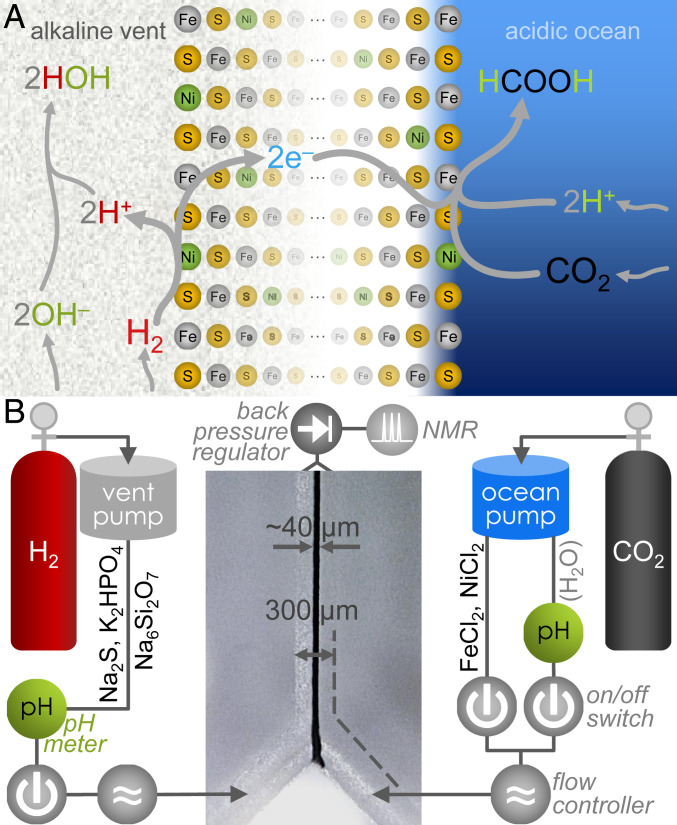
Significance: Biology is built of organic molecules, which originate primarily from the reduction of CO 2 through several carbon-fixation pathways. Only one of these—the Wood–Ljungdahl acetyl-CoA pathway—is energetically profitable overall and present in both Archaea and Bacteria, making it relevant to studies of the origin of life. We used geologically pertinent, life-like microfluidic pH gradients across freshly deposited Fe(Ni)S precipitates to demonstrate the first step of this pathway: the otherwise unfavorable production of formate (HCOO – ) from CO 2 and H 2 . By separating CO 2 and H 2 into acidic and alkaline conditions—as they would have been in early-Earth alkaline hydrothermal vents—we demonstrate a mild indirect electrochemical mechanism of pH-driven carbon fixation relevant to life’s emergence, industry, and environmental chemistry.
Overview
The claims and statistics of this paper haven’t been checked yet.
Free: it reads the open-access text and checks the first 5 claims that cite a source we can check. Create a free account to check every claim.
Integrity signals
Registry
Cites
Statistics
Figures
Verification
Claims the paper makes
The claims and statistics of this paper haven’t been checked yet.
Free: it reads the open-access text and checks the first 5 claims that cite a source we can check. Create a free account to check every claim.
Claims other papers make about this one
Each is checked against this paper’s own text: does it say what the citing paper says it does?
In the citing paper
“However, with a steady source of H2 from the underlying serpentinization, it does not seem that the proton gradient is needed as an energy source for the scenario to work (although it has been argued to play a role in the reduction of CO2 [95]).”
From ‘Whole Organism’, Systems Biology, and Top-Down Criteria for Evaluating Scenarios for the Origin of Life (2021) · cites this paper as [95]
Self-check
Percentages, sums and reported differences re-computed from the paper’s own numbers.
The self-check needs the paper’s full text.
Citations
Cites
Energy conservation in chemotrophic anaerobic bacteria
Thauer, R. K., Jungermann, K., & Decker, K. (1977) · Bacteriological Reviews · doi:10.1128/br.41.1.100-180.1977 · Cited by 4,146
Methanogenic archaea: ecologically relevant differences in energy conservation
Thauer, R. K., Kaster, A.-K., Seedorf, H., Buckel, W., & Hedderich, R. (2008) · Nature Reviews Microbiology · doi:10.1038/nrmicro1931 · Cited by 2,184
A Serpentinite-Hosted Ecosystem: The Lost City Hydrothermal Field
Kelley, D. S., Karson, J. A., Früh-Green, G. L., Yoerger, D. R., Shank, T. M., Butterfield, D. A., Hayes, J. M., Schrenk, M. O., Olson, E. J., Proskurowski, G., et al. (2005) · Science · doi:10.1126/science.1102556 · Cited by 1,288 · cited 1×
“Because the microscopic structure of hydrothermal vents is typically highly porous and reticulated (9, 41), we hypothesize that ocean fluids could have been actively pulled into the microfluidic system due to Venturi-effect suction.”
Why molecules move along a temperature gradient
Duhr, S., & Braun, D. (2006) · Proceedings of the National Academy of Sciences · doi:10.1073/pnas.0603873103 · Cited by 1,014 · cited 2×
“…are insufficient for reaction (31, 32), that heat gradients in hydrothermal systems can drive concentration increases by thermophoresis and capillary flow at gas – liquid interfaces (46 – 48), and that redox and pH gradients can drive early bioenergetics (49, 50) and amino acid synthesis (51).”
Self-citationCommon origins of RNA, protein and lipid precursors in a cyanosulfidic protometabolism
Patel, B. H., Percivalle, C., Ritson, D. J., Duffy, C. D., & Sutherland, J. D. (2015) · Nature Chemistry · doi:10.1038/nchem.2202 · Cited by 949 · cited 1×
“Further reaction of this latter mixture yields hydrogen cyanide (HCN), which is also at the core of a major alternative origin-of-life scenario (20).”
Schuchmann, K., & Müller, V. (2014) · Nature Reviews Microbiology · doi:10.1038/nrmicro3365 · Cited by 845 · cited 1×
“This reaction is endergonic, so multiple members of both Archaea and Bacteria use either electron bifurcation or a chemiosmotic pH gradient across the cell membrane to power the otherwise unfavorable step (14, 28, 29).”
BackgroundActivated Acetic Acid by Carbon Fixation on (Fe,Ni)S Under Primordial Conditions
Huber, C., & Wächtershäuser, G. (1997) · Science · doi:10.1126/science.276.5310.245 · Cited by 714 · cited 1×
“In turn, dehydration of formate yields carbon monoxide (CO), which features prominently in a separate hydrothermal-vent model for the origin of life (21).”
The occurrence and geoscience of natural hydrogen: A comprehensive review
Zgonnik, V. (2020) · Earth-Science Reviews · doi:10.1016/j.earscirev.2020.103140 · Cited by 581
H 2 -rich fluids from serpentinization: Geochemical and biotic implications
Sleep, N. H., Meibom, A., Fridriksson, T., Coleman, R. G., & Bird, D. K. (2004) · Proceedings of the National Academy of Sciences · doi:10.1073/pnas.0405289101 · Cited by 568
Origins of building blocks of life: A review
Kitadai, N., & Maruyama, S. (2018) · Geoscience Frontiers · doi:10.1016/j.gsf.2017.07.007 · Cited by 464
Research works printed but not linked: 1
- M. J. Russell, A. J. Hall, From geochemistry to biochemistry: Chemiosmotic coupling and transition element clusters in the onset of life and photosynthesis. Geochemical News 113, 6–12 (2002).
Cited by
Cofactors are Remnants of Life’s Origin and Early Evolution
Goldman, A. D., & Kaçar, B. (2021) · Journal of Molecular Evolution · doi:10.1007/s00239-020-09988-4 · Cited by 115
“The iron-sulfur minerals found within some types of hydrothermal vents could have helped convert carbon dioxide into organic carbon (Wächtershäuser 1992; Yamaguchi et al. 2014; Roldan et al. 2015; Li et al. 2018; Hudson et al. 2020), and the porous nature of certain hydrothermal chimneys (which may have contained iron…”
BackgroundZhang, J., Zeng, G., Zhu, S., Tao, H., Pan, Y. X., Lai, W., Bao, J., Lian, C., Su, D., Shao, M., et al. (2023) · Proceedings of the National Academy of Sciences · doi:10.1073/pnas.2218987120 · Cited by 105
A prebiotic basis for ATP as the universal energy currency
Pinna, S., Kunz, C., Halpern, A., Harrison, S. A., Jordan, S. F., Ward, J., Werner, F., & Lane, N. (2022) · PLOS Biology · doi:10.1371/journal.pbio.3001437 · Cited by 103
Self-citationKim, J., Kim, J. H., Oh, C., Yun, H., Lee, E., Oh, H., Park, J. H., & Hwang, Y. J. (2023) · Nature Communications · doi:10.1038/s41467-023-40415-6 · Cited by 83
“4 (CH 3 OH and CH 3 OOH could not be detected because of the sampling method) 36 .”
BackgroundTempleton, A. S., Ellison, E. T., Glombitza, C., Morono, Y., Rempfert, K. R., Hoehler, T. M., Zeigler, S. D., Kraus, E., Spear, J. R., Nothaft, D. B., et al. (2021) · Journal of Geophysical Research Biogeosciences · doi:10.1029/2021jg006315 · Cited by 75
Metadata
- Authors
- Hudson, R., de Graaf, R., Strandoo Rodin, M., Ohno, A., Lane, N., McGlynn, S. E., Yamada, Y. M. A., Nakamura, R., Barge, L. M., Braun, D., & Sojo, V.
- Affiliations
- College of the Atlantic (US)
- Department of Chemistry, College of the Atlantic, Bar Harbor, ME 04609;
- RIKEN Center for Sustainable Resource Science (JP)
- University College London (GB)
- Tokyo Institute of Technology (JP)
- California Institute of Technology (US)
- Center for NanoScience (DE)
- RIKEN Center for Sustainable Resource Science, 351-0198 Saitama, Japan;
- Corresponding author
- Hudson, Reuben
- ORCID
- Venue
- Proceedings of the National Academy of Sciences
- Publisher
- National Academy of Sciences
- Published
- 2020-09-08
- Volume
- 117
- Issue
- 37
- Pages
- 22873-22879
- ISSN
- 0027-8424 (ISSN-L)
- 1091-6490
- PMC
- PMC7502746
- OpenAlex
- W3084021238
- Cited by
- 158
- References
- 59
- Citations by year
- 2026: 24 · 2025: 26 · 2024: 30 · 2023: 31 · 2022: 24 · 2021: 21 · 2020: 2
- FWCI
- 8.69
- Type
- journal article
- Language
- en
- Open access
- hybrid
- doi.org
- Licence
- Locations
- Proceedings of the National Academy of Sciences (publishedVersion, cc-by-nc-nd)
- bioRxiv (Cold Spring Harbor Laboratory) (acceptedVersion, cc-by-nc-nd)
- PubMed Central (publishedVersion, cc-by-nc-nd)
- PubMed (publishedVersion)
- UCL Discovery (University College London) (submittedVersion)
- Funders
- Maine Space Grant Consortium (SG-19-14, SG-20-19)
- National Science Foundation (1415189, 1724300)
- MEXT | Japan Society for the Promotion of Science (FY2016-PE-16047)
- HHS | NIH | National Institute of General Medical Sciences (P20GM103423)
- Japan Society for the Promotion of Science London (FY2016-PE-16721)
- European Molecular Biology Organization (ALTF-1455-2015)
- Wissenschaftskolleg zu Berlin (CfLS-1819)
- Gerstner Family Foundation (AMNH-GSBCB-2019)
- Topics
- Physical Sciences › Physics and Astronomy › Astronomy and Astrophysics › Origins and Evolution of Life
- Physical Sciences › Energy › Renewable Energy, Sustainability and the Environment › CO2 Reduction Techniques and Catalysts
- Physical Sciences › Environmental Science › Environmental Engineering › Microbial Fuel Cells and Bioremediation
- Keywords
- CO2 reduction, pH gradient, Wood-Ljungdahl pathway, acetyl-CoA pathway, formate production, CO2 fixation, origin of life, alkaline hydrothermal vents, iron-nickel sulfide, electrochemical mechanism, early Earth
- MeSH terms
- Carbon Dioxide, Electron Transport, Hydrogen, Hydrogen-Ion Concentration, Oxidation-Reduction, Proton-Motive Force, Carbon Cycle, Hydrothermal Vents
About these checks
Registry, retraction, Cites and statistics results are computed, not judged, with one exception: a printed reference that no index lists is read once by a model before it counts as a citation error. Claims are extracted by a model and kept only when their quote appears verbatim in the text; each cited source is then checked, with a model’s help, for whether it says what the claim relies on. Those verdicts can be wrong — read the claim’s quote and the cited source before relying on one.
Statistics and arithmetic are recomputed, not judged.
Confidence bands are shown only for fields calibrated on our annotated test set. None is calibrated yet, so no band is shown.
What counts as a claim ›How we measure confidence ›How we check this ›
Are you an author, or do you see a problem with this page? Request a review
How to cite
Cite CoChat for the checks on this page, and the paper for its own findings.
- This page
- CoChat. (2026). Citation check: CO 2 reduction driven by a pH gradient. https://app.cochat.ai/papers/10.1073/pnas.2002659117
- The paper
- Hudson, R., de Graaf, R., Strandoo Rodin, M., Ohno, A., Lane, N., McGlynn, S. E., Yamada, Y. M. A., Nakamura, R., Barge, L. M., Braun, D., & Sojo, V. (2020). CO 2 reduction driven by a pH gradient. Proceedings of the National Academy of Sciences. https://doi.org/10.1073/pnas.2002659117
Data sources
Bibliographic data: Semantic Scholar, OpenAlex, Crossref.
Contains information from the Semantic Scholar Academic Graph Datasets, made available under the ODC Attribution License (ODC-BY 1.0).
Semantic Scholar’s data is described in: Kinney, R., et al. (2023). The Semantic Scholar Open Data Platform. arXiv:2301.10140.
