

CO 2 reduction driven by a pH gradient
Open accessPublished version of a preprint
The DOI matches its Crossref record; 59 of the 59 references it cites were found in a registry or an index.
Abstract
Significance: Biology is built of organic molecules, which originate primarily from the reduction of CO 2 through several carbon-fixation pathways. Only one of these—the Wood–Ljungdahl acetyl-CoA pathway—is energetically profitable overall and present in both Archaea and Bacteria, making it relevant to studies of the origin of life. We used geologically pertinent, life-like microfluidic pH gradients across freshly deposited Fe(Ni)S precipitates to demonstrate the first step of this pathway: the otherwise unfavorable production of formate (HCOO – ) from CO 2 and H 2 . By separating CO 2 and H 2 into acidic and alkaline conditions—as they would have been in early-Earth alkaline hydrothermal vents—we demonstrate a mild indirect electrochemical mechanism of pH-driven carbon fixation relevant to life’s emergence, industry, and environmental chemistry.
Overview
The claims and statistics of this paper haven’t been checked yet.
Free: it reads the open-access text and checks the first 5 claims that cite a source we can check. Create a free account to check every claim.
Integrity signals
Registry
Cites
Statistics
Figures
Verification
Claims the paper makes
The claims and statistics of this paper haven’t been checked yet.
Free: it reads the open-access text and checks the first 5 claims that cite a source we can check. Create a free account to check every claim.
Claims other papers make about this one
Each is checked against this paper’s own text: does it say what the citing paper says it does?
In the citing paper
“However, with a steady source of H2 from the underlying serpentinization, it does not seem that the proton gradient is needed as an energy source for the scenario to work (although it has been argued to play a role in the reduction of CO2 [95]).”
From ‘Whole Organism’, Systems Biology, and Top-Down Criteria for Evaluating Scenarios for the Origin of Life (2021) · cites this paper as [95]
Self-check
Percentages, sums and reported differences re-computed from the paper’s own numbers.
The self-check needs the paper’s full text.
Citations
Cites
Energy conservation in chemotrophic anaerobic bacteria
Thauer, R. K., Jungermann, K., & Decker, K. (1977) · Bacteriological Reviews · doi:10.1128/br.41.1.100-180.1977 · Cited by 4,146
Methanogenic archaea: ecologically relevant differences in energy conservation
Thauer, R. K., Kaster, A.-K., Seedorf, H., Buckel, W., & Hedderich, R. (2008) · Nature Reviews Microbiology · doi:10.1038/nrmicro1931 · Cited by 2,184
A Serpentinite-Hosted Ecosystem: The Lost City Hydrothermal Field
Kelley, D. S., Karson, J. A., Früh-Green, G. L., Yoerger, D. R., Shank, T. M., Butterfield, D. A., Hayes, J. M., Schrenk, M. O., Olson, E. J., Proskurowski, G., et al. (2005) · Science · doi:10.1126/science.1102556 · Cited by 1,288 · cited 1×
“Because the microscopic structure of hydrothermal vents is typically highly porous and reticulated (9, 41), we hypothesize that ocean fluids could have been actively pulled into the microfluidic system due to Venturi-effect suction.”
Why molecules move along a temperature gradient
Duhr, S., & Braun, D. (2006) · Proceedings of the National Academy of Sciences · doi:10.1073/pnas.0603873103 · Cited by 1,014 · cited 2×
“…are insufficient for reaction (31, 32), that heat gradients in hydrothermal systems can drive concentration increases by thermophoresis and capillary flow at gas – liquid interfaces (46 – 48), and that redox and pH gradients can drive early bioenergetics (49, 50) and amino acid synthesis (51).”
Self-citationCommon origins of RNA, protein and lipid precursors in a cyanosulfidic protometabolism
Patel, B. H., Percivalle, C., Ritson, D. J., Duffy, C. D., & Sutherland, J. D. (2015) · Nature Chemistry · doi:10.1038/nchem.2202 · Cited by 949 · cited 1×
“Further reaction of this latter mixture yields hydrogen cyanide (HCN), which is also at the core of a major alternative origin-of-life scenario (20).”
Schuchmann, K., & Müller, V. (2014) · Nature Reviews Microbiology · doi:10.1038/nrmicro3365 · Cited by 845 · cited 1×
“This reaction is endergonic, so multiple members of both Archaea and Bacteria use either electron bifurcation or a chemiosmotic pH gradient across the cell membrane to power the otherwise unfavorable step (14, 28, 29).”
BackgroundActivated Acetic Acid by Carbon Fixation on (Fe,Ni)S Under Primordial Conditions
Huber, C., & Wächtershäuser, G. (1997) · Science · doi:10.1126/science.276.5310.245 · Cited by 714 · cited 1×
“In turn, dehydration of formate yields carbon monoxide (CO), which features prominently in a separate hydrothermal-vent model for the origin of life (21).”
The occurrence and geoscience of natural hydrogen: A comprehensive review
Zgonnik, V. (2020) · Earth-Science Reviews · doi:10.1016/j.earscirev.2020.103140 · Cited by 581
H 2 -rich fluids from serpentinization: Geochemical and biotic implications
Sleep, N. H., Meibom, A., Fridriksson, T., Coleman, R. G., & Bird, D. K. (2004) · Proceedings of the National Academy of Sciences · doi:10.1073/pnas.0405289101 · Cited by 568
Origins of building blocks of life: A review
Kitadai, N., & Maruyama, S. (2018) · Geoscience Frontiers · doi:10.1016/j.gsf.2017.07.007 · Cited by 464
Volcanoes, Fluids, and Life at Mid-Ocean Ridge Spreading Centers
Kelley, D. S., Baross, J. A., & Delaney, J. R. (2002) · Annual Review of Earth and Planetary Sciences · doi:10.1146/annurev.earth.30.091201.141331 · Cited by 463
The rocky roots of the acetyl-CoA pathway
Russell, M. J., & Martin, W. (2004) · Trends in Biochemical Sciences · doi:10.1016/j.tibs.2004.05.007 · Cited by 432 · cited 2×
“The model suggests that on meeting at the vent–ocean interface, the reaction between the two dissolved gases would have produced hydrocarbons, which would in turn take roles in the transition from geochemistry to biochemistry (2, 12).”
Extreme accumulation of nucleotides in simulated hydrothermal pore systems
Baaske, P., Weinert, F. M., Duhr, S., Lemke, K. H., Russell, M. J., & Braun, D. (2007) · Proceedings of the National Academy of Sciences · doi:10.1073/pnas.0609592104 · Cited by 367 · cited 2×
“Further up, thermal gradients at gas bubbles (41) and elongated pores (39, 40) can lead to concentration increases of any organics”
BackgroundSelf-citationThe Origin of Life in Alkaline Hydrothermal Vents
Sojo, V., Herschy, B., Whicher, A., Camprubí, E., & Lane, N. (2016) · Astrobiology · doi:10.1089/ast.2015.1406 · Cited by 341 · cited 1×
“Highlighting its relevance to 65 studies of the emergence of life, the WL process is the only one of six known biological carbon66 fixation pathways that releases energy overall instead of consuming it, and variations of it are present 67 in extant members of both Archaea (methanogens) and Bacteria (acetogens) (2, 5,…”
BackgroundSelf-citationFormamide and the origin of life
Saladino, R., Crestini, C., Pino, S., Costanzo, G., & Di Mauro, E. (2012) · Physics of Life Reviews · doi:10.1016/j.plrev.2011.12.002 · Cited by 296 · cited 1×
“Alternatively, on heating in the presence of ammonia—itself also a predicted component of alkaline-vent effluents—formate yields formamide [HC(O)NH2], a highly reactive molecule central to a separate major theory for the emergence of life (19).”
Poehlein, A., Schmidt, S., Kaster, A.-K., Goenrich, M., Vollmers, J., Thürmer, A., Bertsch, J., Schuchmann, K., Voigt, B., Hecker, M., et al. (2012) · PLoS ONE · doi:10.1371/journal.pone.0033439 · Cited by 274 · cited 1×
“62 While there were multiple sources of reduced carbon on the early Earth that may have led to rich 63 chemistries (14–18), the scenario above is especially appealing because of its resemblance to the 64 Wood-Ljungdahl (WL) acetyl Co-A pathway of carbon fixation (2, 19).”
BackgroundA hydrogen-dependent geochemical analogue of primordial carbon and energy metabolism
Preiner, M., Igarashi, K., Muchowska, K. B., Yu, M., Varma, S. J., Kleinermanns, K., Nobu, M. K., Kamagata, Y., Tüysüz, H., Moran, J., et al. (2020) · Nature Ecology & Evolution · doi:10.1038/s41559-020-1125-6 · Cited by 272 · cited 1×
“An alternative one-pot batch (rather than microfluidic) system for the reduction of CO2 with H2 278 has been reported recently (36), elaborating on previous results (37, 38).”
ResultA hydrogen dependent geochemical analogue of primordial carbon and energy metabolism
Preiner, M., Igarashi, K., Muchowska, K. B., Yu, M., Varma, S. J., Kleinermanns, K., Nobu, M. K., Kamagata, Y., Tüysüz, H., Moran, J., et al. (2019) · doi:10.1101/682955 · Cited by 272
Experimental investigation of single carbon compounds under hydrothermal conditions
Seewald, J. S., Zolotov, M. Y., & McCollom, T. (2006) · Geochimica et Cosmochimica Acta · doi:10.1016/j.gca.2005.09.002 · Cited by 264
Formation and evolution of carbonate chimneys at the Lost City Hydrothermal Field
Ludwig, K. A., Kelley, D. S., Butterfield, D. A., Nelson, B. K., & Früh-Green, G. (2006) · Geochimica et Cosmochimica Acta · doi:10.1016/j.gca.2006.04.016 · Cited by 261
Native iron reduces CO2 to intermediates and end-products of the acetyl-CoA pathway
Varma, S. J., Muchowska, K. B., Chatelain, P., & Moran, J. (2018) · Nature Ecology & Evolution · doi:10.1038/s41559-018-0542-2 · Cited by 235
Metals promote sequences of the reverse Krebs cycle
Muchowska, K. B., Varma, S. J., Chevallot-Beroux, E., Lethuillier-Karl, L., Li, G., & Moran, J. (2017) · Nature Ecology & Evolution · doi:10.1038/s41559-017-0311-7 · Cited by 228 · cited 1×
“For example, formyl groups have been shown to yield intermediates of both the reverse citric acid (Krebs) cycle (17) and the Wood–Ljungdahl (WL) reductive acetyl-CoA pathway (18), offering a possible entry route into early biological metabolism.”
Serpentinite and the dawn of life
Sleep, N. H., Bird, D. K., & Pope, E. C. (2011) · Philosophical Transactions of the Royal Society B: Biological Sciences · doi:10.1098/rstb.2011.0129 · Cited by 211 · cited 1×
“Geological studies indicate that CO 2 was at comparatively high concentrations in the ocean during the Hadean eon, whereas H 2 was the product of multiple processes in the Earth ’ s crust and would have emanated as part of the efflux of alkaline hydrothermal vents (3, 7 – 11).”
MADEN, B. E. H. (2000) · Biochemical Journal · doi:10.1042/bj3500609 · Cited by 206 · cited 1×
“This reaction is endergonic, so multiple members of both Archaea and Bacteria use either electron bifurcation or a chemiosmotic pH gradient across the cell membrane to power the otherwise unfavorable step (14, 28, 29).”
BackgroundRedox and pH gradients drive amino acid synthesis in iron oxyhydroxide mineral systems
Barge, L. M., Flores, E., Baum, M. M., VanderVelde, D. G., & Russell, M. J. (2019) · Proceedings of the National Academy of Sciences · doi:10.1073/pnas.1812098116 · Cited by 203 · cited 1×
“These results tie in with previous findings that alkaline vent-like pH gradients can be kept at a microscale across Fe(Ni)S precipitates (30), that these pH gradients can provide the necessary overpotentials to drive the reaction between H2 and CO2 (15), that low pressures of the two gases are insufficient for reactio…”
Self-citationLife with CO or CO 2 and H 2 as a source of carbon and energy
Wood, H. G. (1991) · The FASEB Journal · doi:10.1096/fasebj.5.2.1900793 · Cited by 200
An origin-of-life reactor to simulate alkaline hydrothermal vents
Herschy, B., Whicher, A., Camprubi, E., Watson, C., Dartnell, L., Ward, J., Evans, J. R. G., & Lane, N. (2014) · Journal of Molecular Evolution · doi:10.1007/s00239-014-9658-4 · Cited by 194 · cited 2×
“Experimental confirmation of this hypothesis has proven elusive to date (5, 31, 32).”
Self-citationLu, W., Guo, H., Chou, I. M., Burruss, R. C., & Li, L. (2013) · Geochimica et Cosmochimica Acta · doi:10.1016/j.gca.2013.04.010 · Cited by 178 · cited 1×
“The diffusion coefficient of CO2 was calculated as described in (45) using: D(CO2) = D0[T/Ts – 1] where D0 = 13.”
CO2 Hydrogenation to Formic Acid on Ni(111)
Peng, G., Sibener, S. J., Schatz, G. C., Ceyer, S. T., & Mavrikakis, M. (2012) · The Journal of Physical Chemistry C · doi:10.1021/jp210408x · Cited by 174
The Emergence and Early Evolution of Biological Carbon-Fixation
Braakman, R., & Smith, E. (2012) · PLoS Computational Biology · doi:10.1371/journal.pcbi.1002455 · Cited by 173
A Bioenergetic Basis for Membrane Divergence in Archaea and Bacteria
Sojo, V., Pomiankowski, A., & Lane, N. (2014) · PLoS Biology · doi:10.1371/journal.pbio.1001926 · Cited by 154 · cited 1×
“291 These results tie in with previous findings that alkaline vent-like pH gradients can be kept at the 292 microscale across Fe(Ni)S precipitates (23), that these pH gradients can provide the necessary 293 overpotentials to drive the reaction between H2 and CO2 (12), that low pressures of the two gases are 294 insuff…”
ResultSelf-citationExtraterrestrial Flux of Potentially Prebiotic C, N, and P to the Early Earth
Pasek, M. A., & LAURETTA, D. S. (2007) · Origins of Life and Evolution of Biospheres · doi:10.1007/s11084-007-9110-5 · Cited by 149
Beating the acetyl coenzyme A-pathway to the origin of life
Nitschke, W., & Russell, M. J. (2013) · Philosophical Transactions of the Royal Society B: Biological Sciences · doi:10.1098/rstb.2012.0258 · Cited by 143 · cited 1×
“The model suggests that on meeting at the vent–ocean interface, the reaction between the two dissolved gases would have produced hydrocarbons, which would in turn take roles in the transition from geochemistry to biochemistry (2, 12).”
Yamaguchi, A., Yamamoto, M., Takai, K., Ishii, T., Hashimoto, K., & Nakamura, R. (2014) · Electrochimica Acta · doi:10.1016/j.electacta.2014.07.078 · Cited by 130
Self-citationA Mild Hydrothermal Route to Fix Carbon Dioxide to Simple Carboxylic Acids
He, C., Tian, G., Liu, Z., & Feng, S. (2010) · Organic Letters · doi:10.1021/ol9025414 · Cited by 116 · cited 1×
“An alternative one-pot batch (rather than microfluidic) system for the reduction of CO2 with H2 278 has been reported recently (36), elaborating on previous results (37, 38).”
ResultElectrical Current Generation across a Black Smoker Chimney
Nakamura, R., Takashima, T., Kato, S., Takai, K., Yamamoto, M., & Hashimoto, K. (2010) · Angewandte Chemie International Edition · doi:10.1002/anie.201003311 · Cited by 113 · cited 1×
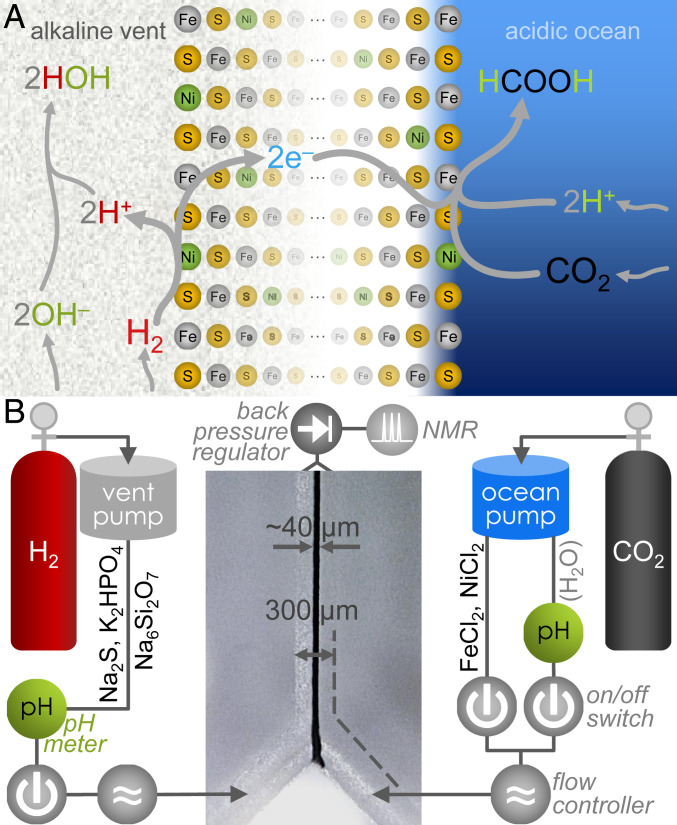
“Released electrons would travel across the micrometers- to centimeters-thick Fe(Ni)S network (53) (Center) to the more oxidizing acidic solution on the ocean side.”
Self-citationHighly efficient iron(0) nanoparticle-catalyzed hydrogenation in water in flow
Hudson, R., Hamasaka, G., Osako, T., Yamada, Y. M. A., LI, C. ‐., Uozumi, Y., & Moores, A. (2013) · Green Chemistry · doi:10.1039/c3gc40789f · Cited by 108
Self-citationCO2 hydrogenation to formic acid on Ni(110)
Peng, G., Sibener, S. J., Schatz, G. C., & Mavrikakis, M. (2012) · Surface Science · doi:10.1016/j.susc.2012.02.027 · Cited by 104
Kelsen, V., Wendt, B., Werkmeister, S., Junge, K., Beller, M., & Chaudret, B. N. (2013) · Chemical Communications · doi:10.1039/c3cc00152k · Cited by 103
Hudson, R., Rivière, A., Cirtiu, C. M., Luska, K. L., & Moores, A. (2012) · Chemical Communications · doi:10.1039/c2cc16438h · Cited by 99
Self-citationHigh Energy Radical Chemistry Formation of HCN-rich Atmospheres on early Earth
Ferus, M., Kubelík, P., Knížek, A., Pastorek, A., Sutherland, J., & Civiš, S. (2017) · Scientific Reports · doi:10.1038/s41598-017-06489-1 · Cited by 98
Heated gas bubbles enrich, crystallize, dry, phosphorylate and encapsulate prebiotic molecules
Morasch, M., Liu, J., Dirscherl, C. F., Ianeselli, A., Kühnlein, A., Le Vay, K., Schwintek, P., Islam, S., Corpinot, M. K., Scheu, B., et al. (2019) · Nature Chemistry · doi:10.1038/s41557-019-0299-5 · Cited by 96
Self-citationWorman, S. L., Pratson, L. F., Karson, J. A., & Schlesinger, W. H. (2020) · Proceedings of the National Academy of Sciences · doi:10.1073/pnas.2002619117 · Cited by 80 · cited 1×
“The exact sources and sinks of H2—and corresponding concentrations of the dissolved gas—on present-day and early-Earth hydrothermal systems remain areas of intensive research (11, 52).”
Steep pH gradients and directed colloid transport in a microfluidic alkaline hydrothermal pore
Möller, F. M., Kriegel, F., Kieß, M., Sojo, V., & Braun, D. (2017) · Angewandte Chemie International Edition · doi:10.1002/anie.201610781 · Cited by 78
Self-citationA seawater throttle on H 2 production in Precambrian serpentinizing systems
Tutolo, B. M., Seyfried, W. E., & Tosca, N. J. (2020) · Proceedings of the National Academy of Sciences · doi:10.1073/pnas.1921042117 · Cited by 67 · cited 2×
“The exact sources and sinks of H2—and corresponding concentrations of the dissolved gas—on present-day and early-Earth hydrothermal systems remain areas of intensive research (11, 52).”
BackgroundPrebiotic materials from on and off the early Earth
Bernstein, M. (2006) · Philosophical Transactions of the Royal Society B: Biological Sciences · doi:10.1098/rstb.2006.1913 · Cited by 62
Catalytic replacement of haplogen by diplogen in benzene
Horiuti, J., Ogden, G., & Polanyi, M. (1934) · Transactions of the Faraday Society · doi:10.1039/tf9343000663 · Cited by 54
Heated gas bubbles enrich, crystallize, dry, phosphorylate and encapsulate prebiotic molecules
Morasch, M., Liu, J., Dirscherl, C., Ianeselli, A., Kühnlein, A., Le Vay, K., Schwintek, P., Islam, S., Corpinot, M., Scheu, B., et al. (2019) · UCL Discovery (University College London) · Cited by 49
Self-citationThe origin of heredity in protocells
West, T., Sojo, V., Pomiankowski, A., & Lane, N. (2017) · Philosophical Transactions of the Royal Society B: Biological Sciences · doi:10.1098/rstb.2016.0419 · Cited by 48 · cited 1×
“These results tie in with previous findings that alkaline vent-like pH gradients can be kept at a microscale across Fe(Ni)S precipitates (30), that these pH gradients can provide the necessary overpotentials to drive the reaction between H2 and CO2 (15), that low pressures of the two gases are insufficient for reactio…”
Self-citationSteep pH Gradients and Directed Colloid Transport in a Microfluidic Alkaline Hydrothermal Pore
Möller, F. M., Kriegel, F., Kieß, M., Sojo, V., & Braun, D. (2017) · Angewandte Chemie · doi:10.1002/ange.201610781 · Cited by 40
Self-citationMaterials Synthesis and Catalysis in Microfluidic Devices: Prebiotic Chemistry in Mineral Membranes
Wang, Q., & Steinbock, O. (2019) · ChemCatChem · doi:10.1002/cctc.201901495 · Cited by 38
Ooka, H., McGlynn, S. E., & Nakamura, R. (2019) · ChemElectroChem · doi:10.1002/celc.201801432 · Cited by 35 · cited 1×
“Assisted by Fe(Ni)S minerals precipitated at the interface, a pH gradient of more than three units should have been enough to increase the viability of the reaction by ∼180 mV, thereby rendering it favorable (15, 16).”
BackgroundSelf-citationSojo, V., Ohno, A., McGlynn, S. E., Yamada, Y. M. A., & Nakamura, R. (2019) · Life · doi:10.3390/life9010016 · Cited by 32
Self-citationPossible mechanisms of CO 2 reduction by H 2 via prebiotic vectorial electrochemistry
Vasiliadou, R., Dimov, N., Szita, N., Jordan, S. F., & Lane, N. (2019) · Interface Focus · doi:10.1098/rsfs.2019.0073 · Cited by 27
Self-citationWächtershäuser, G. (2016) · Journal of Molecular Evolution · doi:10.1007/s00239-015-9727-3 · Cited by 21
Science of Synthesis: Catalytic Reduction in Organic Synthesis 1
(2018) · Focus on Catalysts · doi:10.1016/j.focat.2018.08.057 · Cited by 17
Catalytic Reduction in Organic Synthesis 1
de Vries, J. G., Bonrath, W., Cazin, C. S. J., Chen, Z.-P., Dai, X., de Vries, J. G., Ding, K., Ghosh, B., Hudson, R., Kaneda, K., et al. (2017) · Haug Verlag in Georg Thieme Verlag KG eBooks · doi:10.1055/b-005-145236 · Cited by 14
Self-citationThe Catalysis of the H2-D2O Exchange by Aqueous Buffer Solutions1
Miller, S. L., & Rittenberg, D. K. (1958) · Journal of the American Chemical Society · doi:10.1021/ja01534a018 · Cited by 12
What Can Carbon Isotopes Tell Us About Sources of Reduced Carbon in Rocks from the Early Earth?
McCollom, T. M. (2010) · Springer eBooks · doi:10.1007/978-90-481-8794-2_11 · Cited by 8
Research works printed but not linked: 1
- M. J. Russell, A. J. Hall, From geochemistry to biochemistry: Chemiosmotic coupling and transition element clusters in the onset of life and photosynthesis. Geochemical News 113, 6– 12 (2002).
Cited by
Cofactors are Remnants of Life’s Origin and Early Evolution
Goldman, A. D., & Kaçar, B. (2021) · Journal of Molecular Evolution · doi:10.1007/s00239-020-09988-4 · Cited by 117
“The iron-sulfur minerals found within some types of hydrothermal vents could have helped convert carbon dioxide into organic carbon (Wächtershäuser 1992; Yamaguchi et al. 2014; Roldan et al. 2015; Li et al. 2018; Hudson et al. 2020), and the porous nature of certain hydrothermal chimneys (which may have contained iron…”
BackgroundZhang, J., Zeng, G., Zhu, S., Tao, H., Pan, Y. X., Lai, W., Bao, J., Lian, C., Su, D., Shao, M., et al. (2023) · Proceedings of the National Academy of Sciences · doi:10.1073/pnas.2218987120 · Cited by 105
A prebiotic basis for ATP as the universal energy currency
Pinna, S., Kunz, C., Halpern, A., Harrison, S. A., Jordan, S. F., Ward, J., Werner, F., & Lane, N. (2022) · PLOS Biology · doi:10.1371/journal.pbio.3001437 · Cited by 103
Self-citationKim, J., Kim, J. H., Oh, C., Yun, H., Lee, E., Oh, H., Park, J. H., & Hwang, Y. J. (2023) · Nature Communications · doi:10.1038/s41467-023-40415-6 · Cited by 89
“4 (CH 3 OH and CH 3 OOH could not be detected because of the sampling method) 36 .”
BackgroundTempleton, A. S., Ellison, E. T., Glombitza, C., Morono, Y., Rempfert, K. R., Hoehler, T. M., Zeigler, S. D., Kraus, E., Spear, J. R., Nothaft, D. B., et al. (2021) · Journal of Geophysical Research Biogeosciences · doi:10.1029/2021jg006315 · Cited by 75
Metadata
- Authors
- Hudson, R., de Graaf, R., Strandoo Rodin, M., Ohno, A., Lane, N., McGlynn, S. E., Yamada, Y. M. A., Nakamura, R., Barge, L. M., Braun, D., & Sojo, V.
- Affiliations
- College of the Atlantic (US)
- Department of Chemistry, College of the Atlantic, Bar Harbor, ME 04609;
- RIKEN Center for Sustainable Resource Science (JP)
- University College London (GB)
- Tokyo Institute of Technology (JP)
- California Institute of Technology (US)
- Center for NanoScience (DE)
- RIKEN Center for Sustainable Resource Science, 351-0198 Saitama, Japan;
- Corresponding author
- Hudson, Reuben
- ORCID
- Venue
- Proceedings of the National Academy of Sciences
- Publisher
- National Academy of Sciences
- Published
- 2020-09-08
- Volume
- 117
- Issue
- 37
- Pages
- 22873-22879
- ISSN
- 0027-8424 (ISSN-L)
- 1091-6490
- PMC
- PMC7502746
- OpenAlex
- W3084021238
- Cited by
- 158
- References
- 59
- Citations by year
- 2026: 24 · 2025: 26 · 2024: 30 · 2023: 31 · 2022: 24 · 2021: 21 · 2020: 2
- FWCI
- 8.69
- Type
- journal article
- Language
- en
- Open access
- hybrid
- doi.org
- Licence
- Locations
- Proceedings of the National Academy of Sciences (publishedVersion, cc-by-nc-nd)
- bioRxiv (Cold Spring Harbor Laboratory) (acceptedVersion, cc-by-nc-nd)
- PubMed Central (publishedVersion, cc-by-nc-nd)
- PubMed (publishedVersion)
- UCL Discovery (University College London) (submittedVersion)
- Funders
- Maine Space Grant Consortium (SG-19-14, SG-20-19)
- National Science Foundation (1415189, 1724300)
- MEXT | Japan Society for the Promotion of Science (FY2016-PE-16047)
- HHS | NIH | National Institute of General Medical Sciences (P20GM103423)
- Japan Society for the Promotion of Science London (FY2016-PE-16721)
- European Molecular Biology Organization (ALTF-1455-2015)
- Wissenschaftskolleg zu Berlin (CfLS-1819)
- Gerstner Family Foundation (AMNH-GSBCB-2019)
- Topics
- Physical Sciences › Physics and Astronomy › Astronomy and Astrophysics › Origins and Evolution of Life
- Physical Sciences › Energy › Renewable Energy, Sustainability and the Environment › CO2 Reduction Techniques and Catalysts
- Physical Sciences › Environmental Science › Environmental Engineering › Microbial Fuel Cells and Bioremediation
- Keywords
- CO2 reduction, pH gradient, Wood-Ljungdahl pathway, acetyl-CoA pathway, formate production, CO2 fixation, origin of life, alkaline hydrothermal vents, iron-nickel sulfide, electrochemical mechanism, early Earth
- MeSH terms
- Carbon Dioxide, Electron Transport, Hydrogen, Hydrogen-Ion Concentration, Oxidation-Reduction, Proton-Motive Force, Carbon Cycle, Hydrothermal Vents
About these checks
Registry, retraction, Cites and statistics results are computed, not judged, with one exception: a printed reference that no index lists is read once by a model before it counts as a citation error. Claims are extracted by a model and kept only when their quote appears verbatim in the text; each cited source is then checked, with a model’s help, for whether it says what the claim relies on. Those verdicts can be wrong — read the claim’s quote and the cited source before relying on one.
Statistics and arithmetic are recomputed, not judged.
Confidence bands are shown only for fields calibrated on our annotated test set. None is calibrated yet, so no band is shown.
What counts as a claim ›How we measure confidence ›How we check this ›
Are you an author, or do you see a problem with this page? Request a review
Data sources
Bibliographic data: Semantic Scholar, OpenAlex, Crossref.
Contains information from the Semantic Scholar Academic Graph Datasets, made available under the ODC Attribution License (ODC-BY 1.0).
Semantic Scholar’s data is described in: Kinney, R., et al. (2023). The Semantic Scholar Open Data Platform. arXiv:2301.10140.
