

CO 2 reduction driven by a pH gradient
Open accessPublished version of a preprint
The DOI matches its Crossref record; 59 of the 59 references it cites were found in a registry or an index.
Abstract
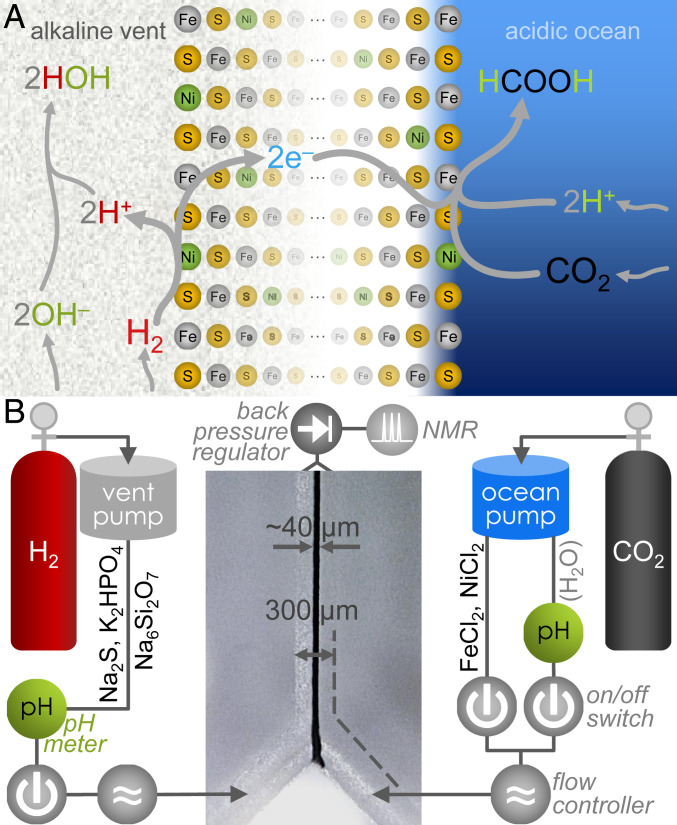
Significance: Biology is built of organic molecules, which originate primarily from the reduction of CO 2 through several carbon-fixation pathways. Only one of these—the Wood–Ljungdahl acetyl-CoA pathway—is energetically profitable overall and present in both Archaea and Bacteria, making it relevant to studies of the origin of life. We used geologically pertinent, life-like microfluidic pH gradients across freshly deposited Fe(Ni)S precipitates to demonstrate the first step of this pathway: the otherwise unfavorable production of formate (HCOO – ) from CO 2 and H 2 . By separating CO 2 and H 2 into acidic and alkaline conditions—as they would have been in early-Earth alkaline hydrothermal vents—we demonstrate a mild indirect electrochemical mechanism of pH-driven carbon fixation relevant to life’s emergence, industry, and environmental chemistry.
Overview
The claims and statistics of this paper haven’t been checked yet.
Free: it reads the open-access text and checks the first 5 claims that cite a source we can check. Create a free account to check every claim.
Integrity signals
Registry
Cites
Statistics
Figures
Verification
Claims the paper makes
The claims and statistics of this paper haven’t been checked yet.
Free: it reads the open-access text and checks the first 5 claims that cite a source we can check. Create a free account to check every claim.
Claims other papers make about this one
Each is checked against this paper’s own text: does it say what the citing paper says it does?
In the citing paper
“However, with a steady source of H2 from the underlying serpentinization, it does not seem that the proton gradient is needed as an energy source for the scenario to work (although it has been argued to play a role in the reduction of CO2 [95]).”
From ‘Whole Organism’, Systems Biology, and Top-Down Criteria for Evaluating Scenarios for the Origin of Life (2021) · cites this paper as [95]
Self-check
Percentages, sums and reported differences re-computed from the paper’s own numbers.
The self-check needs the paper’s full text.
Citations
Cites
Energy conservation in chemotrophic anaerobic bacteria
Thauer, R. K., Jungermann, K., & Decker, K. (1977) · Bacteriological Reviews · doi:10.1128/br.41.1.100-180.1977 · Cited by 4,146
Methanogenic archaea: ecologically relevant differences in energy conservation
Thauer, R. K., Kaster, A.-K., Seedorf, H., Buckel, W., & Hedderich, R. (2008) · Nature Reviews Microbiology · doi:10.1038/nrmicro1931 · Cited by 2,184
A Serpentinite-Hosted Ecosystem: The Lost City Hydrothermal Field
Kelley, D. S., Karson, J. A., Früh-Green, G. L., Yoerger, D. R., Shank, T. M., Butterfield, D. A., Hayes, J. M., Schrenk, M. O., Olson, E. J., Proskurowski, G., et al. (2005) · Science · doi:10.1126/science.1102556 · Cited by 1,288 · cited 1×
“Because the microscopic structure of hydrothermal vents is typically highly porous and reticulated (9, 41), we hypothesize that ocean fluids could have been actively pulled into the microfluidic system due to Venturi-effect suction.”
Why molecules move along a temperature gradient
Duhr, S., & Braun, D. (2006) · Proceedings of the National Academy of Sciences · doi:10.1073/pnas.0603873103 · Cited by 1,014 · cited 2×
“…are insufficient for reaction (31, 32), that heat gradients in hydrothermal systems can drive concentration increases by thermophoresis and capillary flow at gas – liquid interfaces (46 – 48), and that redox and pH gradients can drive early bioenergetics (49, 50) and amino acid synthesis (51).”
Self-citationCommon origins of RNA, protein and lipid precursors in a cyanosulfidic protometabolism
Patel, B. H., Percivalle, C., Ritson, D. J., Duffy, C. D., & Sutherland, J. D. (2015) · Nature Chemistry · doi:10.1038/nchem.2202 · Cited by 949 · cited 1×
“Further reaction of this latter mixture yields hydrogen cyanide (HCN), which is also at the core of a major alternative origin-of-life scenario (20).”
Schuchmann, K., & Müller, V. (2014) · Nature Reviews Microbiology · doi:10.1038/nrmicro3365 · Cited by 845 · cited 1×
“This reaction is endergonic, so multiple members of both Archaea and Bacteria use either electron bifurcation or a chemiosmotic pH gradient across the cell membrane to power the otherwise unfavorable step (14, 28, 29).”
BackgroundActivated Acetic Acid by Carbon Fixation on (Fe,Ni)S Under Primordial Conditions
Huber, C., & Wächtershäuser, G. (1997) · Science · doi:10.1126/science.276.5310.245 · Cited by 714 · cited 1×
“In turn, dehydration of formate yields carbon monoxide (CO), which features prominently in a separate hydrothermal-vent model for the origin of life (21).”
The occurrence and geoscience of natural hydrogen: A comprehensive review
Zgonnik, V. (2020) · Earth-Science Reviews · doi:10.1016/j.earscirev.2020.103140 · Cited by 581
H 2 -rich fluids from serpentinization: Geochemical and biotic implications
Sleep, N. H., Meibom, A., Fridriksson, T., Coleman, R. G., & Bird, D. K. (2004) · Proceedings of the National Academy of Sciences · doi:10.1073/pnas.0405289101 · Cited by 568
Origins of building blocks of life: A review
Kitadai, N., & Maruyama, S. (2018) · Geoscience Frontiers · doi:10.1016/j.gsf.2017.07.007 · Cited by 464
Research works printed but not linked: 1
- M. J. Russell, A. J. Hall, From geochemistry to biochemistry: Chemiosmotic coupling and transition element clusters in the onset of life and photosynthesis. Geochemical News 113, 6– 12 (2002).
Cited by
Cofactors are Remnants of Life’s Origin and Early Evolution
Goldman, A. D., & Kaçar, B. (2021) · Journal of Molecular Evolution · doi:10.1007/s00239-020-09988-4 · Cited by 117
“The iron-sulfur minerals found within some types of hydrothermal vents could have helped convert carbon dioxide into organic carbon (Wächtershäuser 1992; Yamaguchi et al. 2014; Roldan et al. 2015; Li et al. 2018; Hudson et al. 2020), and the porous nature of certain hydrothermal chimneys (which may have contained iron…”
BackgroundZhang, J., Zeng, G., Zhu, S., Tao, H., Pan, Y. X., Lai, W., Bao, J., Lian, C., Su, D., Shao, M., et al. (2023) · Proceedings of the National Academy of Sciences · doi:10.1073/pnas.2218987120 · Cited by 105
A prebiotic basis for ATP as the universal energy currency
Pinna, S., Kunz, C., Halpern, A., Harrison, S. A., Jordan, S. F., Ward, J., Werner, F., & Lane, N. (2022) · PLOS Biology · doi:10.1371/journal.pbio.3001437 · Cited by 103
Self-citationKim, J., Kim, J. H., Oh, C., Yun, H., Lee, E., Oh, H., Park, J. H., & Hwang, Y. J. (2023) · Nature Communications · doi:10.1038/s41467-023-40415-6 · Cited by 89
“4 (CH 3 OH and CH 3 OOH could not be detected because of the sampling method) 36 .”
BackgroundTempleton, A. S., Ellison, E. T., Glombitza, C., Morono, Y., Rempfert, K. R., Hoehler, T. M., Zeigler, S. D., Kraus, E., Spear, J. R., Nothaft, D. B., et al. (2021) · Journal of Geophysical Research Biogeosciences · doi:10.1029/2021jg006315 · Cited by 78
Beyazay, T., Belthle, K. S., Farès, C., Preiner, M., Moran, J., Martin, W. F., & Tüysüz, H. (2023) · Nature Communications · doi:10.1038/s41467-023-36088-w · Cited by 72
Spontaneous assembly of redox-active iron-sulfur clusters at low concentrations of cysteine
Jordan, S. F., Ioannou, I., Rammu, H., Halpern, A., Bogart, L. K., Ahn, M., Vasiliadou, R., Christodoulou, J., Maréchal, A., & Lane, N. (2021) · Nature Communications · doi:10.1038/s41467-021-26158-2 · Cited by 69
Self-citationShi, X., Ling, Y., Li, Y., Li, G., Li, J., Wang, L., Min, F., Hübner, R., Yuan, S., Zhan, J., et al. (2023) · Angewandte Chemie International Edition · doi:10.1002/anie.202316257 · Cited by 73
Prebiotic photoredox synthesis from carbon dioxide and sulfite
Liu, Z., Wu, L.-F., Kufner, C. L., Sasselov, D. D., Fischer, W. W., & Sutherland, J. D. (2021) · Nature Chemistry · doi:10.1038/s41557-021-00789-w · Cited by 64
Schwander, L., Brabender, M., Mrnjavac, N., Wimmer, J. L. E., Preiner, M., & Martin, W. F. (2023) · Frontiers in Microbiology · doi:10.3389/fmicb.2023.1257597 · Cited by 65
“Hudson et al. (2020) reported ca. 1 μ M formate in the presence of gradients, Sojo et al. (2019) obtained no gradient dependent CO 2 reduction.”
BackgroundThe protometabolic nature of prebiotic chemistry
Nogal, N., Sanz-Sánchez, M., Vela-Gallego, S., Ruiz-Mirazo, K., & de la Escosura, A. (2023) · Chemical Society Reviews · doi:10.1039/d3cs00594a · Cited by 61
Ju, Y., Zhang, H., Jiang, Y., Wang, W., Kan, G., Yu, K., Wang, X., Liu, J., & Jiang, J. (2023) · Nature Ecology & Evolution · doi:10.1038/s41559-023-02193-8 · Cited by 53
“4 and 5 and Supplementary Fig.”
Beyazay, T., Ochoa‐Hernández, C., Song, Y., Belthle, K. S., Martin, W. F., & Tüysüz, H. (2023) · Angewandte Chemie International Edition · doi:10.1002/anie.202218189 · Cited by 50
Russell, M. J., & Ponce, A. (2020) · Life · doi:10.3390/life10110291 · Cited by 47
In situ FTIR study of CO 2 reduction on inorganic analogues of carbon monoxide dehydrogenase
Lee, J., Yamaguchi, A., Ooka, H., Kazami, T., Miyauchi, M., Kitadai, N., & Nakamura, R. (2021) · Chemical Communications · doi:10.1039/d0cc07318k · Cited by 49
Self-citationLife as a Guide to Its Own Origins
Harrison, S. A., Rammu, H., Liu, F., Halpern, A., Palmeira, R. N., & Lane, N. J. (2023) · Annual Review of Ecology Evolution and Systematics · doi:10.1146/annurev-ecolsys-110421-101509 · Cited by 52
Self-citationThe “Water Problem”(sic), the Illusory Pond and Life’s Submarine Emergence—A Review
Russell, M. J. (2021) · Life · doi:10.3390/life11050429 · Cited by 48
Cohen, Z. R., Todd, Z. R., Wogan, N. F., Black, R. A., Keller, S. L., & Catling, D. C. (2022) · ACS Earth and Space Chemistry · doi:10.1021/acsearthspacechem.2c00168 · Cited by 47
Thioester synthesis through geoelectrochemical CO2 fixation on Ni sulfides
Kitadai, N., Nakamura, R., Yamamoto, M., Okada, S., Takahagi, W., Nakano, Y., Takahashi, Y., Takai, K., & Oono, Y. (2021) · Communications Chemistry · doi:10.1038/s42004-021-00475-5 · Cited by 43
Self-citationPurvis, G., Šiller, L., Crosskey, A., Vincent, J., Wills, C., Sheriff, J., Xavier, C. M., & Telling, J. P. (2024) · Communications Earth & Environment · doi:10.1038/s43247-023-01196-4 · Cited by 40
RetractedNanozymes and Their Potential Roles in the Origin of Life
Ma, L., Liang, Z., Hou, Y., Zhang, R., Fan, K., & Yan, X. (2024) · Advanced Materials · doi:10.1002/adma.202412211 · Cited by 42
Zimmermann, J., Werner, E., Sodei, S., & Moran, J. (2024) · Accounts of Chemical Research · doi:10.1021/acs.accounts.4c00423 · Cited by 42
Ge, Q., Liu, Y., You, W., Li, Y., Wang, W., Yang, L., Xie, L., Li, K., Wang, L., Ma, M., et al. (2025) · Science Advances · doi:10.1126/sciadv.adx5714 · Cited by 42
Metals in Prebiotic Catalysis: A Possible Evolutionary Pathway for the Emergence of Metalloproteins
Aithal, A., Dagar, S., & Rajamani, S. (2023) · ACS Omega · doi:10.1021/acsomega.2c07635 · Cited by 37
Altair, T., Borges, L. G. F., Galante, D., & Varela, H. (2021) · Life · doi:10.3390/life11080777 · Cited by 35
Beyazay, T., Martin, W. F., & Tüysüz, H. (2023) · Journal of the American Chemical Society · doi:10.1021/jacs.3c05412 · Cited by 34
Quantifying Catalysis at the Origin of Life**
de Graaf, R., Decker, Y. D., Sojo, V., & Hudson, R. (2023) · Chemistry - A European Journal · doi:10.1002/chem.202301447 · Cited by 37
Self-citationA biophysical basis for the emergence of the genetic code in protocells
Harrison, S. A., Palmeira, R. N., Halpern, A., & Lane, N. J. (2022) · Biochimica et Biophysica Acta (BBA) - Bioenergetics · doi:10.1016/j.bbabio.2022.148597 · Cited by 33
Self-citationNan, J., Luo, S., Tran, Q. P., Fahrenbach, A. C., Lu, W., Hu, Y., Yin, Z., Ye, J., & Kranendonk, M. J. V. (2024) · Nature Communications · doi:10.1038/s41467-024-54062-y · Cited by 35
“…hot spring scenario, the present study reveals that FeS can convert CO 2 to CH 3 OH without the need for an aqueous phase, thereby eliminating the requirement for dissolved H 2 and a steep pH gradient suggested to be necessary to drive carbon fi xation in deep-sea hydrothermal vents 12,13,15 .”
InfluentialVincent, L., Colón‐Santos, S. M., Cleaves, H. J., Baum, D., & Maurer, S. (2021) · Life · doi:10.3390/life11111221 · Cited by 29
“Experiments might be conducted in materially closed systems or may simulate the flow of soup through a primordial microenvironment, for example, by periodically replenishing reagents [19–21] or using a continuous flow reactor [22,23].”
BackgroundTrolard, F., Duval, S., Nitschke, W., Ménèz, B., Pisapia, C., Nacib, J. B., Andréani, M., & Bourrié, G. (2021) · Earth-Science Reviews · doi:10.1016/j.earscirev.2021.103910 · Cited by 27
Urability: A Property of Planetary Bodies That Can Support an Origin of Life
Deamer, D. W., Cary, F., & Damer, B. (2022) · Astrobiology · doi:10.1089/ast.2021.0173 · Cited by 29
“Hudson et al. (2020) tested this idea in a laboratory simulation in which hydrogen gas and carbon dioxide were added to simulated seawater at 1.5 bars of pressure.”
InfluentialCobalt: A must-have element for life and livelihood
Russell, M. J. (2022) · Proceedings of the National Academy of Sciences · doi:10.1073/pnas.2121307119 · Cited by 26
Aqueous electrochemistry: The toolbox for life's emergence from redox disequilibria
Nitschke, W., Schoepp‐Cothenet, B., Duval, S., Zuchan, K., Farr, O., Baymann, F., Panico, F., Minguzzi, A., Branscomb, E., & Russell, M. J. (2022) · Electrochemical Science Advances · doi:10.1002/elsa.202100192 · Cited by 28
Prebiotic Synthesis of Aspartate Using Life’s Metabolism as a Guide
Harrison, S. A., Webb, W. L., Rammu, H., & Lane, N. (2023) · Life · doi:10.3390/life13051177 · Cited by 25
“What is required is that they are formed continuously via protometabolic flux, driven by far-from-equilibrium conditions in the environment—ultimately the disequilibrium between H2 and CO2, which are the dominant precursors of core autotrophic metabolism [80,81,92,93].”
BackgroundSelf-citationBrunk, C. F., & Marshall, C. R. (2021) · Life · doi:10.3390/life11070690 · Cited by 23
“The fact that the oldest carbon fixation pathway known among organisms today, the acetyl-CoA pathway, uses H2 as an electron donor and CO2 as an electron acceptor, suggests that an acetyl-CoA-like pathway was present from the earliest stages [135–137] (Figure 4, step 1c).”
BackgroundInfluentialThe limits of metabolic heredity in protocells
Nunes Palmeira, R., Colnaghi, M., Harrison, S. A., Pomiankowski, A., & Lane, N. (2022) · Proceedings of the Royal Society B: Biological Sciences · doi:10.1098/rspb.2022.1469 · Cited by 23
Self-citationHolden, J. F., & Sistu, H. (2023) · Frontiers in Microbiology · doi:10.3389/fmicb.2023.1093018 · Cited by 23
“Formate is also generated across a pH gradient of more than three pH units using a mineral precipitate bridge at the interface of two fluids (Hudson et al., 2020).”
BackgroundMansor, M., Duverger, A., Pasquier, V., Gorlas, A., Guyot, F., Berg, J. S., Marin‐Carbonne, J., Cosmidis, J., & Picard, A. (2025) · Geo-Bio Interfaces · doi:10.1180/gbi.2024.9 · Cited by 26
Li, J., Zhu, P., Zhong, H., Yang, Y., Cheng, J., Wang, Y., & Jin, F. (2021) · ACS Sustainable Chemistry & Engineering · doi:10.1021/acssuschemeng.0c09353 · Cited by 25
Green extraction of chitin from hard spider crab shells
Campalani, C., Bertuol, I., Bersani, C., Calmanti, R., Filonenko, S., Rodríguez‐Padrón, D., Selva, M., & Perosa, A. (2024) · Carbohydrate Polymers · doi:10.1016/j.carbpol.2024.122565 · Cited by 23
Chemical Garden Membranes in Temperature-Controlled Microfluidic Devices
Wang, Q., & Steinbock, O. (2021) · Langmuir · doi:10.1021/acs.langmuir.0c03548 · Cited by 23
Russell, M. J. (2023) · Frontiers in Microbiology · doi:10.3389/fmicb.2023.1145915 · Cited by 25
“Exothermic serpentinization is the mega-engine operating within the ultramafic oceanic crust that works to drive alkaline hydrothermal convective systems bearing H2 > CH4 fuels to exhale into the then carbonic, phosphate, nitrate, NO, and N2O as well as metal complex-, and proton-bearing acidulous ocean—the disequilib…”
BackgroundInfluentialProtometabolism as out-of-equilibrium chemistry
Nader, S., Sebastianelli, L., & Mansy, S. S. (2022) · Philosophical Transactions of the Royal Society A Mathematical Physical and Engineering Sciences · doi:10.1098/rsta.2020.0423 · Cited by 23
Deamer, D. W. (2022) · Life · doi:10.3390/life12091429 · Cited by 22
“For example, hydrothermal vents have been proposed as a site conducive to the origin of life [6], and the hot seawater flowing through alkaline vents is a highly complex mixture with available free energy and reducing power [7,8].”
BackgroundChapter 4: A Geological and Chemical Context for the Origins of Life on Early Earth
Rodriguez, L. E., Altair, T., Hermis, N. Y., Jia, T. Z., Roche, T. P., Steller, L. H., & Weber, J. M. (2024) · Astrobiology · doi:10.1089/ast.2021.0139 · Cited by 24
“…generates OH - anions that would have resulted in pH gradients with early Earth’s slightly acidic waters, fu-eling CO 2 reduction to methane and potentially ATP production for the earliest forms of life (Martin et al., 2008; Russell et al., 2010; Sojo et al., 2016; Hudson et al., 2020).”
Three-Dimensional Analysis of a Simulated Prebiotic Hydrothermal Chimney
Barge, L. M., Jones, J., Pagano, J. J., Martinez, E., & Bescup, J. C. (2020) · ACS Earth and Space Chemistry · doi:10.1021/acsearthspacechem.0c00186 · Cited by 22
Self-citationLinking Catalysis in Biochemical and Geochemical CO2 Fixation at the Emergence of Life
Belthle, K. S., & Tüysüz, H. (2023) · ChemCatChem · doi:10.1002/cctc.202201462 · Cited by 17
Coşkuner, Ö., Castilla-Martinez, C. A., Sonzogni, O., Petit, E., Demirci, U. B., & Fıgen, A. K. (2022) · International Journal of Hydrogen Energy · doi:10.1016/j.ijhydene.2021.12.236 · Cited by 20
Changes in CO2 Adsorption Affinity Related to Ni Doping in FeS Surfaces: A DFT-D3 Study
Živković, A., Somers, M., Camprubí, E., King, H. E., Wolthers, M., & de Leeuw, N. H. (2021) · Catalysts · doi:10.3390/catal11040486 · Cited by 19
“[57] reported reduction of CO2 with H2 to formate (HCOO-) across Fe(Ni)S precipitates.”
BackgroundWang, H., & Surendranath, Y. (2025) · Nature Chemistry · doi:10.1038/s41557-025-01939-0 · Cited by 20
Osmotic energy conversion in serpentinite-hosted deep-sea hydrothermal vents
Lee, H., Okumura, T., Ooka, H., Adachi, K., Hikima, T., Hirata, K., Kawano, Y., Matsuura, H., Yamamoto, M., Yamamoto, M., et al. (2024) · Nature Communications · doi:10.1038/s41467-024-52332-3 · Cited by 19
“20 – 22).”
MethodSelf-citationTesting Abiotic Reduction of NAD + Directly Mediated by Iron/Sulfur Minerals
Weber, J. M., Henderson, B. L., LaRowe, D. E., Goldman, A. D., Perl, S. M., Billings, K. J., & Barge, L. M. (2021) · Astrobiology · doi:10.1089/ast.2021.0035 · Cited by 17
“…Rickard and Luther, 2007; Shibuya et al. , 2016), and are capable of reducing CO/CO 2 and mediating prebiotic organic synthesis reactions ( Wa¨chtersha¨user, 1990a, 1990b; Huber and Wa¨chtersha¨user, 1997, 1998; Cody et al. , 2000; Roldan et al. , 2015; Kitadai et al. , 2019; Hudson et al. , 2020).”
Self-citationDo Soluble Phosphates Direct the Formose Reaction towards Pentose Sugars?
Camprubí, E., Harrison, S. A., Jordan, S. F., Bonnel, J., Pinna, S., & Lane, N. J. (2022) · Astrobiology · doi:10.1089/ast.2021.0125 · Cited by 20
“Evidence for prebiotic formaldehyde is emerging with Hudson et al. (2020) recently demonstrating that formic acid can be synthesized under mild pressure ( < 1.5 bar) in simulated Hadean hydrothermal vent conditions.”
InfluentialSelf-citationTwing, K. I., Ward, L. M., Kane, Z. K., Sanders, A., Price, R. E., Pendleton, H. L., Giovannelli, D., Brazelton, W. J., & McGlynn, S. E. (2022) · Frontiers in Microbiology · doi:10.3389/fmicb.2022.960335 · Cited by 17
“, 2020), such as the Wood-Ljungdahl pathway shared by methanogens, acetogens, and sulfate-reducers (Martin and Russell, 2007; Adam et al., 2018; Hudson et al., 2020), which may be one of the most ancient metabolic pathways (Ward and Shih, 2019).”
BackgroundSelf-citationWeingart, M., Chen, S., Donat, C., Helmbrecht, V., Orsi, W. D., Braun, D., & Alim, K. (2023) · Science Advances · doi:10.1126/sciadv.adi1884 · Cited by 16
Self-citationEndergonic Hydrogenation at Ambient Conditions Using an Electrochemical Membrane Reactor
Hunt, C., Kurimoto, A., Wood, G., LeSage, N. E., Peterson, M., Luginbuhl, B. R., Horner, O., Issinski, S., & Berlinguette, C. P. (2023) · Journal of the American Chemical Society · doi:10.1021/jacs.3c02839 · Cited by 16
Song, Y., Beyazay, T., & Tüysüz, H. (2024) · Angewandte Chemie International Edition · doi:10.1002/anie.202316110 · Cited by 15
Flow-driven enhancement of neodymium and dysprosium separation from aqueous solutions
Wang, Q., & Subban, C. V. (2024) · RSC Sustainability · doi:10.1039/d3su00403a · Cited by 15
Intermediate stages in the origin of metabolism at a phosphorylating hydrothermal vent
Mrnjavac, N., Hoffmann, N. K., Schlikker, M. L., Burmeister, M., Schwander, L., García, C. G., Brabender, M., Steel, M., Huson, D. H., Metzger, S. U., et al. (2026) · Science Advances · doi:10.1126/sciadv.aef3128 · Cited by 14
Prebiotic Synthesis of Microdroplets from Formate over a Bimetallic Cobalt–Nickel Nanomotif
Zhu, P., Wang, C., Lang, J., He, D., & Jin, F. (2024) · Journal of the American Chemical Society · doi:10.1021/jacs.4c06989 · Cited by 14
Sanden, S., Szilagyi, R. K., Li, Y., Kitadai, N., Webb, S. M., Yano, T., Nakamura, R., Hara, M., & McGlynn, S. E. (2021) · Dalton Transactions · doi:10.1039/d1dt01684a · Cited by 16
Self-citationBiophysical Interactions Underpin the Emergence of Information in the Genetic Code
Halpern, A., Bartsch, L. R., Ibrahim, K., Harrison, S. A., Ahn, M., Christodoulou, J., & Lane, N. J. (2023) · Life · doi:10.3390/life13051129 · Cited by 15
“Mineral catalysts [65,66] or proton gradients across inorganic barriers [67] can drive CO2 fixation, directly generating the carboxylic acid intermediates of the acetyl CoA pathway [68] and reverse Krebs cycle [69,70].”
BackgroundSelf-citationEnceladus: Astrobiology Revisited
Dávila, A. F., & Eigenbrode, J. L. (2024) · Journal of Geophysical Research Biogeosciences · doi:10.1029/2023jg007677 · Cited by 16
“…the formation of metabolic precursors such as acetate and formate, and of biochemical building blocks such as amino acids and small carboxylic acids, through mineral‐catalyzed geochemical reactions on vent walls (Beyazay et al., 2023; Hudson et al., 2020; McCollom & Seewald, 2007; Simoneit, 2004).”
BackgroundTakahagi, W., Okada, S., Matsui, Y., Ono, S., Takai, K., Takahashi, Y., & Kitadai, N. (2023) · Proceedings of the National Academy of Sciences · doi:10.1073/pnas.2303302120 · Cited by 14
Heat flows solubilize apatite to boost phosphate availability for prebiotic chemistry
Matreux, T., Schmid, A., Rappold, M., Weller, D., Çalıșkanoǧlu, A. Z., Moore, K. R., Bosak, T., Dingwell, D. B., Karaghiosoff, K., Guyot, F., et al. (2025) · Nature Communications · doi:10.1038/s41467-025-57110-3 · Cited by 12
“…(1.5 – 2.5) 13,17 , as found in lacustrine environments, acidic lakes 18,19 , hot springs 20 , and hydrothermal systems 21 – 24 with steep pH gradients 25 – 28 , such environments are often incompatible with prebiotic chemistry, which commonly requires neutral to alkaline conditions 18,24,28 .”
InfluentialSelf-citationLee, T., Jeong, H.-I., Cha, Y.-A., Shin, D.-H., & Nam, D. (2025) · Chemical Communications · doi:10.1039/d5cc04387e · Cited by 12
The Chemistry of Tetragonal FeS
Rickard, D. T. (2025) · Chemical Reviews · doi:10.1021/acs.chemrev.5c00763 · Cited by 14
Fe2+ disproportionation within iron-rich alkaline vent analogues reveals proto-bioenergetic systems
Truong, C., Gaudu, N., Farr, O., Clouet, A., Ferry, D., Guyot, F., Ona-Nguéma, G., Ruby, C., Nitschke, W., Grauby, O., et al. (2025) · Nature Communications · doi:10.1038/s41467-025-65716-w · Cited by 13
Suppaso, C., Kamakura, Y., Ueno, M., Hongo, S., Akiyoshi, R., Ishiwari, F., Saeki, A., Tanaka, D., & Maeda, K. (2023) · Solar RRL · doi:10.1002/solr.202300710 · Cited by 12
Gutiérrez‐Ariza, C. M., Barge, L. M., Ding, Y., Cardoso, S. S. S., McGlynn, S. E., Nakamura, R., Giovanelli, D., Price, R. E., Lee, H., Huertas, F. J., et al. (2024) · Progress in Earth and Planetary Science · doi:10.1186/s40645-023-00603-w · Cited by 13
“…driven by Fe-hydroxide and Fe-sulfide minerals: e.g., carbon reduction, amino acid synthesis, peptide formation, phosphorous chemistry, have been discussed at length in the literature (e.g., Russell 2023, 2018; White et al. 2015; Roldan et al. 2015; Barge et al. 2019, 2020, Hudson et al 2020).”
BackgroundSelf-citationBeyazay, T., Ochoa‐Hernández, C., Song, Y., Belthle, K. S., Martin, W. F., & Tüysüz, H. (2023) · Angewandte Chemie · doi:10.1002/ange.202218189 · Cited by 11
Zimmermann, J., Basar, A. B., & Moran, J. (2024) · Angewandte Chemie International Edition · doi:10.1002/anie.202410698 · Cited by 11
Redox chemistry of early Earth and the origin of life
Moldogazieva, N. T., Terentiev, A. A., Mokhosoev, I. M., & Astakhov, D. V. (2026) · Communications Chemistry · doi:10.1038/s42004-026-01969-w · Cited by 12
“Additionally, under the experimentally simulated conditions of room temperature and moderate pressure (1.5 bars), freshly prepared synthetic precipitates of (Fe,Ni)S facilitated an electron transfer through an electrochemical-cell mechanism 275 .”
InfluentialGe, Q., Liu, Y., You, W., Wang, W., Li, K., Ruan, X., Xie, L., Wang, T., & Zhang, L. (2023) · PNAS Nexus · doi:10.1093/pnasnexus/pgad389 · Cited by 11
“Understanding such pathways and complicated environments that can facilitate the emergence of these primitive HCOOH organic molecules holds significant importance (42, 43, 54, 55).”
BackgroundLi, L., & Cui, C. (2025) · Angewandte Chemie International Edition · doi:10.1002/anie.202505042 · Cited by 11
Zheng, R., Pang, L., Peng, Z., Qu, D., Bao, Y., Sun, H., Sun, Z., Guo, S., & Niu, L. (2025) · Angewandte Chemie International Edition · doi:10.1002/anie.202511103 · Cited by 11
A fundamental limit to the search for the oldest fossils
McMahon, S., & Jordan, S. F. (2022) · Nature Ecology & Evolution · doi:10.1038/s41559-022-01777-0 · Cited by 13
Lingam, M. (2021) · Astrobiology · doi:10.1089/ast.2020.2392 · Cited by 10
“Lastly, experiments in microfluidic reactors have shown that pH gradients are generated over length scales of ∼ 10−4 m (Möller et al., 2017; Sojo et al., 2019; Barge et al., 2020b; Hudson et al., 2020), and we adopt this estimate for Lc although it is probably on the optimistic side if AHVs are viewed in toto.”
InfluentialAltair, T., Dragoti, E.-S., Sojo, V., Li, Y., Skiffington, S., Sullivan, W. A., Drozd, G. T., McGlynn, S. E., Galante, D., Varela, H., et al. (2025) · Journal of the American Chemical Society · doi:10.1021/jacs.5c01948 · Cited by 10
“10,32,33 For saturation of solutions, CO 2 and H 2 gases (purity: 99.99”
InfluentialSelf-citationShi, X., Ling, Y., Li, Y., Li, G., Li, J., Wang, L., Min, F., Hübner, R., Yuan, S., Zhan, J., et al. (2023) · Angewandte Chemie · doi:10.1002/ange.202316257 · Cited by 10
Pérez-Guzmán, S. M., Hernández‐Aguilar, E., Alvarado-Lassman, A., & Méndez-Contreras, J. M. (2024) · Water · doi:10.3390/w16111558 · Cited by 10
Incorporating Microbes into Laboratory-Grown Chimneys for Hydrothermal Microbiology Experiments
Dickson, J., Martinez, E., Pagano, J. J., Hudson, R., Perl, S. M., & Barge, L. M. (2022) · ACS Earth and Space Chemistry · doi:10.1021/acsearthspacechem.1c00354 · Cited by 9
Self-citationShape Evolution of Precipitate Membranes in Flow Systems
Nogueira, J. A., Batista, B. C., Cooper, M. A., & Steinbock, O. (2023) · The Journal of Physical Chemistry B · doi:10.1021/acs.jpcb.2c08433 · Cited by 9
Self-Oxidation of the Atmospheres of Rocky Planets with Implications for the Origin of Life
Johansen, A., Camprubí, E., van Kooten, E. M. M. E., & Hoeijmakers, H. J. (2024) · Astrobiology · doi:10.1089/ast.2023.0104 · Cited by 11
“Hence, we propose that the prebiotic chemistry of N that was globally available on the Hadean Earth would have relied on reductive amination of small organics (themselves probably derived from CO 2 reduction by H 2 , see Beyazay et al., 2023; Hudson et al., 2020) by NH 3 .”
Akbari, A., & Palsson, B. Ø. (2022) · PLoS Computational Biology · doi:10.1371/journal.pcbi.1010377 · Cited by 8
Prebiotic Chemistry Experiments Using Microfluidic Devices
Lerin-Morales, K. M., Olguín, L. F., Mateo‐Martí, E., & Colín-García, M. (2022) · Life · doi:10.3390/life12101665 · Cited by 10
“promoted by a pH gradient, was observed [80].”
BackgroundMinerals as Prebiotic Catalysts for Chemical Evolution towards the Origin of Life
Li, Y. (2022) · IntechOpen eBooks · doi:10.5772/intechopen.102389 · Cited by 8
Thomas-Keprta, K. L., Clemett, S. J., Gibson, E. K., Rahman, Z., Baskar, N., Wentworth, S. J., Keprta, N. T., & McKay, D. S. (2021) · Geochimica et Cosmochimica Acta · doi:10.1016/j.gca.2021.12.010 · Cited by 7
Preliminary Free Energy Map of Prebiotic Compounds Formed from CO2, H2 and H2S
Kua, J., & Miller, N. A. (2022) · Life · doi:10.3390/life12111763 · Cited by 7
Wenzel, M., Zaheer, M. A., Issayeva, D., Poppitz, D., Matysik, J., Gläser, R. J., & Dvoyashkin, M. (2021) · The Journal of Physical Chemistry C · doi:10.1021/acs.jpcc.1c00037 · Cited by 7
Nickel: Geochemistry, biochemistry and its role in chemical and biological evolutions
Neubeck, A., & Kirschning, A. (2025) · Earth-Science Reviews · doi:10.1016/j.earscirev.2025.105324 · Cited by 6
Pascal, R. (2025) · ChemSystemsChem · doi:10.1002/syst.202400096 · Cited by 6
Garibello, C. F., Eldridge, D. S., Malherbe, F., & Hocking, R. K. (2023) · Inorganic Chemistry Frontiers · doi:10.1039/d3qi01553j · Cited by 6
The evolutionary divergence of Mars, Venus, and Earth
Hamano, K., Gillmann, C., Golabek, G., Lourenço, D. L., & Westall, F. (2024) · Elsevier eBooks · doi:10.1016/b978-0-323-99762-1.00104-2 · Cited by 7
Database on mineral mediated carbon reduction: implications for future research
Prakash, M., Weber, J. M., Rodriguez, L. E., Sheppard, R. Y., & Barge, L. M. (2022) · International Journal of Astrobiology · doi:10.1017/s1473550422000052 · Cited by 8
Self-citationYaman, T., & Harvey, J. N. (2021) · Life · doi:10.3390/life11121343 · Cited by 7
“In terms of the availability of formate in prebiotic environments, it is known that formate was successfully synthesised under prebiotic conditions from hydrogen and carbon dioxide in a metabolism-first approach [56].”
BackgroundBradley, A. S. (2026) · Springer geochemistry · doi:10.1007/978-3-032-07705-9_8 · Cited by 5
Lee, H., Russell, M. J., & Nakamura, R. (2024) · ChemistryEurope · doi:10.1002/ceur.202400038 · Cited by 9
Self-citationJung, J., Lee, K. W., Sakamoto, N., Selvam, K., Wakabayashi, T., Kamada, K., Sekizawa, K., Sato, S., Suzuki, T. M., Morikawa, T., et al. (2024) · EES Catalysis · doi:10.1039/d4ey00261j · Cited by 6
Metadata
- Authors
- Hudson, R., de Graaf, R., Strandoo Rodin, M., Ohno, A., Lane, N., McGlynn, S. E., Yamada, Y. M. A., Nakamura, R., Barge, L. M., Braun, D., & Sojo, V.
- Affiliations
- College of the Atlantic (US)
- Department of Chemistry, College of the Atlantic, Bar Harbor, ME 04609;
- RIKEN Center for Sustainable Resource Science (JP)
- University College London (GB)
- Tokyo Institute of Technology (JP)
- California Institute of Technology (US)
- Center for NanoScience (DE)
- RIKEN Center for Sustainable Resource Science, 351-0198 Saitama, Japan;
- Corresponding author
- Hudson, Reuben
- ORCID
- Venue
- Proceedings of the National Academy of Sciences
- Publisher
- National Academy of Sciences
- Published
- 2020-09-08
- Volume
- 117
- Issue
- 37
- Pages
- 22873-22879
- ISSN
- 0027-8424 (ISSN-L)
- 1091-6490
- PMC
- PMC7502746
- OpenAlex
- W3084021238
- Cited by
- 158
- References
- 59
- Citations by year
- 2026: 24 · 2025: 26 · 2024: 30 · 2023: 31 · 2022: 24 · 2021: 21 · 2020: 2
- FWCI
- 8.69
- Type
- journal article
- Language
- en
- Open access
- hybrid
- doi.org
- Licence
- Locations
- Proceedings of the National Academy of Sciences (publishedVersion, cc-by-nc-nd)
- bioRxiv (Cold Spring Harbor Laboratory) (acceptedVersion, cc-by-nc-nd)
- PubMed Central (publishedVersion, cc-by-nc-nd)
- PubMed (publishedVersion)
- UCL Discovery (University College London) (submittedVersion)
- Funders
- Maine Space Grant Consortium (SG-19-14, SG-20-19)
- National Science Foundation (1415189, 1724300)
- MEXT | Japan Society for the Promotion of Science (FY2016-PE-16047)
- HHS | NIH | National Institute of General Medical Sciences (P20GM103423)
- Japan Society for the Promotion of Science London (FY2016-PE-16721)
- European Molecular Biology Organization (ALTF-1455-2015)
- Wissenschaftskolleg zu Berlin (CfLS-1819)
- Gerstner Family Foundation (AMNH-GSBCB-2019)
- Topics
- Physical Sciences › Physics and Astronomy › Astronomy and Astrophysics › Origins and Evolution of Life
- Physical Sciences › Energy › Renewable Energy, Sustainability and the Environment › CO2 Reduction Techniques and Catalysts
- Physical Sciences › Environmental Science › Environmental Engineering › Microbial Fuel Cells and Bioremediation
- Keywords
- CO2 reduction, pH gradient, Wood-Ljungdahl pathway, acetyl-CoA pathway, formate production, CO2 fixation, origin of life, alkaline hydrothermal vents, iron-nickel sulfide, electrochemical mechanism, early Earth
- MeSH terms
- Carbon Dioxide, Electron Transport, Hydrogen, Hydrogen-Ion Concentration, Oxidation-Reduction, Proton-Motive Force, Carbon Cycle, Hydrothermal Vents
About these checks
Registry, retraction, Cites and statistics results are computed, not judged, with one exception: a printed reference that no index lists is read once by a model before it counts as a citation error. Claims are extracted by a model and kept only when their quote appears verbatim in the text; each cited source is then checked, with a model’s help, for whether it says what the claim relies on. Those verdicts can be wrong — read the claim’s quote and the cited source before relying on one.
Statistics and arithmetic are recomputed, not judged.
Confidence bands are shown only for fields calibrated on our annotated test set. None is calibrated yet, so no band is shown.
What counts as a claim ›How we measure confidence ›How we check this ›
Are you an author, or do you see a problem with this page? Request a review
Data sources
Bibliographic data: Semantic Scholar, OpenAlex, Crossref.
Contains information from the Semantic Scholar Academic Graph Datasets, made available under the ODC Attribution License (ODC-BY 1.0).
Semantic Scholar’s data is described in: Kinney, R., et al. (2023). The Semantic Scholar Open Data Platform. arXiv:2301.10140.
