

CO 2 reduction driven by a pH gradient
Open accessPublished version of a preprint
The DOI matches its Crossref record; 59 of the 59 references it cites were found in a registry or an index.
Abstract
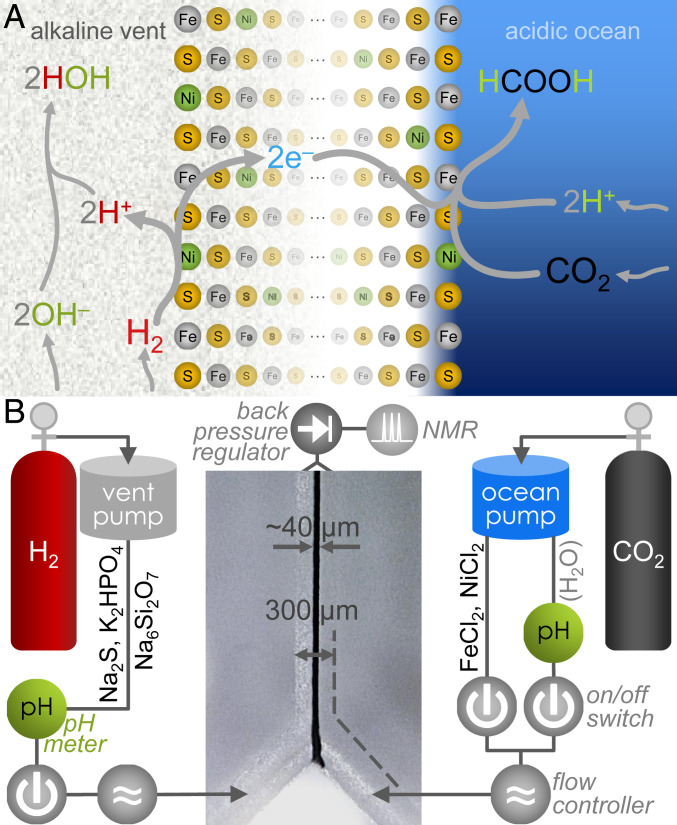
Significance: Biology is built of organic molecules, which originate primarily from the reduction of CO 2 through several carbon-fixation pathways. Only one of these—the Wood–Ljungdahl acetyl-CoA pathway—is energetically profitable overall and present in both Archaea and Bacteria, making it relevant to studies of the origin of life. We used geologically pertinent, life-like microfluidic pH gradients across freshly deposited Fe(Ni)S precipitates to demonstrate the first step of this pathway: the otherwise unfavorable production of formate (HCOO – ) from CO 2 and H 2 . By separating CO 2 and H 2 into acidic and alkaline conditions—as they would have been in early-Earth alkaline hydrothermal vents—we demonstrate a mild indirect electrochemical mechanism of pH-driven carbon fixation relevant to life’s emergence, industry, and environmental chemistry.
Overview
The claims and statistics of this paper haven’t been checked yet.
Free: it reads the open-access text and checks the first 5 claims that cite a source we can check. Create a free account to check every claim.
Integrity signals
Registry
Cites
Statistics
Figures
Verification
Claims the paper makes
The claims and statistics of this paper haven’t been checked yet.
Free: it reads the open-access text and checks the first 5 claims that cite a source we can check. Create a free account to check every claim.
Claims other papers make about this one
Each is checked against this paper’s own text: does it say what the citing paper says it does?
In the citing paper
“However, with a steady source of H2 from the underlying serpentinization, it does not seem that the proton gradient is needed as an energy source for the scenario to work (although it has been argued to play a role in the reduction of CO2 [95]).”
From ‘Whole Organism’, Systems Biology, and Top-Down Criteria for Evaluating Scenarios for the Origin of Life (2021) · cites this paper as [95]
Self-check
Percentages, sums and reported differences re-computed from the paper’s own numbers.
The self-check needs the paper’s full text.
Citations
Cites
Energy conservation in chemotrophic anaerobic bacteria
Thauer, R. K., Jungermann, K., & Decker, K. (1977) · Bacteriological Reviews · doi:10.1128/br.41.1.100-180.1977 · Cited by 4,146
Methanogenic archaea: ecologically relevant differences in energy conservation
Thauer, R. K., Kaster, A.-K., Seedorf, H., Buckel, W., & Hedderich, R. (2008) · Nature Reviews Microbiology · doi:10.1038/nrmicro1931 · Cited by 2,184
A Serpentinite-Hosted Ecosystem: The Lost City Hydrothermal Field
Kelley, D. S., Karson, J. A., Früh-Green, G. L., Yoerger, D. R., Shank, T. M., Butterfield, D. A., Hayes, J. M., Schrenk, M. O., Olson, E. J., Proskurowski, G., et al. (2005) · Science · doi:10.1126/science.1102556 · Cited by 1,288 · cited 1×
“Because the microscopic structure of hydrothermal vents is typically highly porous and reticulated (9, 41), we hypothesize that ocean fluids could have been actively pulled into the microfluidic system due to Venturi-effect suction.”
Why molecules move along a temperature gradient
Duhr, S., & Braun, D. (2006) · Proceedings of the National Academy of Sciences · doi:10.1073/pnas.0603873103 · Cited by 1,014 · cited 2×
“…are insufficient for reaction (31, 32), that heat gradients in hydrothermal systems can drive concentration increases by thermophoresis and capillary flow at gas – liquid interfaces (46 – 48), and that redox and pH gradients can drive early bioenergetics (49, 50) and amino acid synthesis (51).”
Self-citationCommon origins of RNA, protein and lipid precursors in a cyanosulfidic protometabolism
Patel, B. H., Percivalle, C., Ritson, D. J., Duffy, C. D., & Sutherland, J. D. (2015) · Nature Chemistry · doi:10.1038/nchem.2202 · Cited by 949 · cited 1×
“Further reaction of this latter mixture yields hydrogen cyanide (HCN), which is also at the core of a major alternative origin-of-life scenario (20).”
Schuchmann, K., & Müller, V. (2014) · Nature Reviews Microbiology · doi:10.1038/nrmicro3365 · Cited by 845 · cited 1×
“This reaction is endergonic, so multiple members of both Archaea and Bacteria use either electron bifurcation or a chemiosmotic pH gradient across the cell membrane to power the otherwise unfavorable step (14, 28, 29).”
BackgroundActivated Acetic Acid by Carbon Fixation on (Fe,Ni)S Under Primordial Conditions
Huber, C., & Wächtershäuser, G. (1997) · Science · doi:10.1126/science.276.5310.245 · Cited by 714 · cited 1×
“In turn, dehydration of formate yields carbon monoxide (CO), which features prominently in a separate hydrothermal-vent model for the origin of life (21).”
The occurrence and geoscience of natural hydrogen: A comprehensive review
Zgonnik, V. (2020) · Earth-Science Reviews · doi:10.1016/j.earscirev.2020.103140 · Cited by 581
H 2 -rich fluids from serpentinization: Geochemical and biotic implications
Sleep, N. H., Meibom, A., Fridriksson, T., Coleman, R. G., & Bird, D. K. (2004) · Proceedings of the National Academy of Sciences · doi:10.1073/pnas.0405289101 · Cited by 568
Origins of building blocks of life: A review
Kitadai, N., & Maruyama, S. (2018) · Geoscience Frontiers · doi:10.1016/j.gsf.2017.07.007 · Cited by 464
Research works printed but not linked: 1
- M. J. Russell, A. J. Hall, From geochemistry to biochemistry: Chemiosmotic coupling and transition element clusters in the onset of life and photosynthesis. Geochemical News 113, 6– 12 (2002).
Cited by
Items 101–165 of 165
Did Homocysteine Take Part in the Start of the Synthesis of Peptides on the Early Earth?
Youssef‐Saliba, S., Milet, A., & Vallée, Y. (2022) · Biomolecules · doi:10.3390/biom12040555 · Cited by 5
Considerations for Detecting Organic Indicators of Metabolism on Enceladus
Barge, L. M., & Fournier, G. P. (2024) · Astrobiology · doi:10.1089/ast.2023.0074 · Cited by 7
“…prebiotic C reduction driven by reactive Fe/Ni-sulfide minerals to products such as formate, acetate, pyruvate, and/or CH 4 (Huber and Wa¨chter-sha¨user, 1997,1998; Cody et al ., 2000; Roldan et al ., 2015; Yamaguchi et al ., 2015; Varma et al ., 2018; Hudson et al ., 2020; Prenier et al ., 2020).”
Self-citationFifer, L. M., & Wong, M. L. (2024) · Astrobiology · doi:10.1089/ast.2023.0109 · Cited by 5
“…2014; Nitschke et al., 2023), aided perhaps by natural proton gradients in alkaline hydrothermal systems ( e.g., Lane et al., 2010; Lane, 2017; Hudson et al., 2020), transition metal– bearing minerals ( e.g., Nitschke et al., 2013; Russell, 2018; Vasiliadou et al., 2019), and the presence of…”
Khanam, S. A., Kim, D., Park, Y., Das, A., Sarmah, K., Guha, A. K., & Bania, K. K. (2025) · ChemCatChem · doi:10.1002/cctc.202500505 · Cited by 4
Hara, E., & Templeton, A. S. (2024) · ACS Earth and Space Chemistry · doi:10.1021/acsearthspacechem.4c00038 · Cited by 4
Spark of Life: Role of Electrotrophy in the Emergence of Life
Pillot, G., Santiago, Ó., Kerzenmacher, S., & Liebgott, P.-P. (2023) · Life · doi:10.3390/life13020356 · Cited by 4
“[86,87], which reproduce the hydrothermal conditions with hydrothermal chimney material as a heterogeneous catalyst and clay-like matrix, fed with hydrothermal and seawater reactants, could help fill the gaps on the prebiotic synthesis pathways.”
BackgroundInfluentialNon-equilibrium Composition of Mixed Metal Hydroxide Membranes Grown in Flow Systems
Cooper, M. A., Batista, B. C., & Steinbock, O. (2023) · ACS Earth and Space Chemistry · doi:10.1021/acsearthspacechem.3c00188 · Cited by 4
N-formylation of isoquinoline derivatives with CO2 and H2 over a heterogeneous Ru/ZIF-8 catalyst
He, Z., Wei, Y., Li, N., Sun, Y., Yang, S., Wang, K., Wang, W., Ma, X., & Liu, Z. (2022) · Journal of Experimental Nanoscience · doi:10.1080/17458080.2022.2025781 · Cited by 4
Boltzmann's casino and the unbridgeable chasm in emergence of life researchPreprint
Branscomb, E. (2023) · arXiv (Cornell University) · doi:10.48550/arxiv.2312.00932 · Cited by 4
Song, Y., Beyazay, T., & Tüysüz, H. (2024) · Angewandte Chemie · doi:10.1002/ange.202316110 · Cited by 3
Biohybrids for sustainable chemical synthesis
Jiang, Y. G., Ren, G., Zhang, Y., Liang, P., & Zhou, S. (2025) · Energy & Environment Nexus · doi:10.48130/een-0025-0002 · Cited by 8
Shiny metal catalysts at the origin of metabolism
Martin, W. F., Hoffmann, N. K., & Schlikker, M. L. (2026) · Trends in Microbiology · doi:10.1016/j.tim.2026.07.012 · Cited by 3
“Studies suggesting a role for ion gradients in CO 2 fixation generate formate [87] and acetate [88] at yields several orders of magnitude lower than those obtained using shiny metals in pure water at eThe reaction only worked in stainless steel reactors, not in glass reactors [77], see [72].…”
Altair, T., Galante, D., & Varela, H. (2022) · IOP SciNotes · doi:10.1088/2633-1357/ac79e7 · Cited by 4
Ülgen, B. E., Filiz, B. C., Açıkalın, K., Yörüklü, H. C., & Fıgen, A. K. (2024) · International Journal of Hydrogen Energy · doi:10.1016/j.ijhydene.2024.12.237 · Cited by 4
Gaudu, N., Truong, C., Farr, O., Clouet, A., Grauby, O., Ferry, D., Parent, P., Laffon, C., Ona-Nguéma, G., Guyot, F., et al. (2025) · Life · doi:10.3390/life15040671 · Cited by 2
Zheng, R., Pang, L., Peng, Z., Qu, D., Bao, Y., Sun, H., Sun, Z., Guo, S., & Niu, L. (2025) · Angewandte Chemie · doi:10.1002/ange.202511103 · Cited by 3
Teece, B. L., Cannelli, S. M. C., Garibello, C. F., McGlynn, S. E., & Barge, L. M. (2025) · Earth-Science Reviews · doi:10.1016/j.earscirev.2025.105311 · Cited by 4
Self-citationOrganic Cofactors in the Electron Transport Chain: Properties and Connection to the Prebiotic World
Riazi‐Sekowski, S., Bundang, K., Chastain, J. L., Carman, N., Velling, S. J., Aguilera, J., Luna, M., Trejo, C., Alian, O. M., Teece, B. L., et al. (2026) · ChemSystemsChem · doi:10.1002/syst.202500037 · Cited by 2
Self-citationAsche, S., Bautista, C., Blanco, C., Boulesteix, D., Champagne-Ruel, A., Mathis, C., Markovitch, O., Peng, Z., Dass, A. V., Adams, A., et al. (2026) · Cell Reports Physical Science · doi:10.1016/j.xcrp.2026.103211 · Cited by 2
Unraveling electrochemical glycine conversion pathways for ammonia recovery from organic waste
Iriawan, H., Adjei, J., Haro, D. A. C., Donneys-Victoria, D., Ashley, A., Medford, A. J., Hatzell, M. C., Botte, G. G., & Shao‐Horn, Y. (2026) · EES Catalysis · doi:10.1039/d6ey00044d · Cited by 1
Shedding Light on the Kinetics of the Carboxysulfitic Scenario
White, S. B., Rimmer, P. B., & Liu, Z. (2024) · ACS Earth and Space Chemistry · doi:10.1021/acsearthspacechem.4c00083 · Cited by 3
Altair, T., Lindenfelser, E., Galante, D., Varela, H., Decker, Y. D., & Hudson, R. (2026) · Chemical Communications · doi:10.1039/d6cc04072a · Cited by 2
Self-citationKalapos, M. P., & Lidia de, B. A. R. I. (2024) · Biosystems · doi:10.1016/j.biosystems.2024.105288 · Cited by 2
Trolard, F., Duval, S., Nitschke, W., Ménèz, B., Pisapia, C., Nacib, J. B., Andréani, M., & Bourrié, G. (2023) · Earth-Science Reviews · doi:10.1016/j.earscirev.2023.104562 · Cited by 3
Mizuno, A., Nakayoshi, T., Kurimoto, E., Kato, K., & Oda, A. (2025) · The Journal of Physical Chemistry A · doi:10.1021/acs.jpca.4c07299 · Cited by 1
Arnau, M., Sans, J., Turón, P., & Alemán, C. (2025) · Sustainable Energy & Fuels · doi:10.1039/d5se00134j · Cited by 1
Talukdar, B., Chang, C., Chen, H., Juang, R., Chang, Y., Lii, K., & Kuo, C. (2025) · Materials Chemistry and Physics · doi:10.1016/j.matchemphys.2025.131191 · Cited by 1
Ortega, J., Ahmed, C., Bernal, R. A., & Noveron, J. C. (2026) · Molecular Catalysis · doi:10.1016/j.mcat.2026.115830 · Cited by 1
Abiotic CO2 reduction promoted by carbonate and phyllosilicate minerals on the primitive seafloor
Zhong, Y., Zhang, N., Huan, D., Low, J., Daniel, I., Cleaves, H. J., Zhang, C., Li, Y., Jiang, Y., Wang, X., et al. (2026) · Nature Communications · doi:10.1038/s41467-026-71130-7 · Cited by 1
“Thus, intensive alteration of the early crust could establish large chemical gradients of redox potential, pH, or temperature fl anking the serpentinization mineral products, inducing the geoelectricity to drive abiotic synthesis reactions 8,9 .”
Boé, G., Jansen, J., Erriguible, A., Glockner, S., Cario, A., Marre, S., & Tassaing, T. (2026) · Chemical Engineering Journal · doi:10.1016/j.cej.2026.176186 · Cited by 1
Concurrent Oxidative and Reductive Protometabolic Reactions Driven by Electrochemistry
Vega, C., Regnier, M., Sodei, S., Lowe, G., Noël, T., & Moran, J. (2026) · ChemSystemsChem · doi:10.1002/syst.70041 · Cited by 1
Camprubí, E., Pearce, B. K. D., & Preiner, M. (2026) · Astrobiology · doi:10.1177/15311074261454245 · Cited by 2
“Also, electron sources other than H 2 are feasible and include iron sul fi des (Huber and Wächtershäuser, 1998; Nan et al., 2024), pH gradients (Hudson et al., 2020), and native metals (Varma et al., 2018; Beyazay et al., 2023b).”
Held, C., Lima, R. J. D. S., & Lee, J. (2026) · Advanced Synthesis & Catalysis · doi:10.1002/adsc.70675 · Cited by 1
The Abiotic Background: Challenges and Opportunities in the Search for Evidence of Life Beyond Earth
Dávila, A. F., Hoehler, T. M., Shkolyar, S., Nuevo, M., Rogers, K. L., Barge, L. M., Bouquet, A., Buffo, J., Burton, A. S., Cable, M., et al. (2026) · Astrobiology · doi:10.1177/15311074261484864 · Cited by 1
“Reaction drivers include direct metal – surface catalysis and pH-gradient – driven electrochemical processes (Varma et al. , 2018; Hudson et al. , 2020; Preiner et al. , 2020; Beya-zay et al. , 2023).”
Self-citationPrebiotic chemistry: From dust to molecules and beyond
Camprubí, E., Markovitch, O., Muchowska, K. B., Otto, S., & ten Kate, I. L. (2022) · Elsevier eBooks · doi:10.1016/b978-0-12-824162-2.00005-1 · Cited by 1
Zimmermann, J., Basar, A. B., & Moran, J. (2024) · Angewandte Chemie · doi:10.1002/ange.202410698 · Cited by 1
Li, L., & Cui, C. (2025) · Angewandte Chemie · doi:10.1002/ange.202505042 · Cited by 2
Origin of electroneutrality in living systemPreprint
Akbari, A., & Palsson, B. Ø. (2021) · bioRxiv (Cold Spring Harbor Laboratory) · doi:10.1101/2021.09.21.461264
“Recently, experimental evidence has been found, suggesting that such pH gradients could have provided sufficient energy to drive the thermodynamically unfavorable carbon-fixation steps of early metabolism under prebiotic conditions [45].”
BackgroundMixed‐Valence Complexes in Biological and Bio‐mimic Systems
Kong, X., Guo, Y., Zhou, Z., & Liu, T. (2023) · Wiley eBooks · doi:10.1002/9783527835287.ch10
Graham, L. (2023) · Springer eBooks · doi:10.1007/978-3-031-38681-7_15
Liu, Z. (2024) · F1000Research · doi:10.12688/f1000research.151912.1
An Ensemble Approach to the Origin of Life
Alicea, B., Ahmad, B., & Gordon, R. (2024) · Wiley eBooks · doi:10.1002/9781119901228.ch8 · Cited by 1
Environmental Changes Impacting on, and Caused by, the Evolution of Photosynthetic Organisms
Raven, J. A. (2024) · Cambridge University Press eBooks · doi:10.1017/9781139049979.002
A niche construction-based perspective on chemical evolution before replication and reproductionPreprint
Papale, F., Kulish, Y., Bielawski, J. P., & Haraoui, L. (2025) · bioRxiv (Cold Spring Harbor Laboratory) · doi:10.1101/2025.07.29.667458
“Specifically, the various gradients maintained and strengthened by inorganic membranes coupled with the available H 2 promotes the reduction of CO 2 and therefore organic chemistry (44, 100, 101).”
Tran, Q. (2024) · The Conversation · doi:10.64628/aa.acjdvtngs
Bubble-guided chemical gardens growth in a confined space: straight tubes, worms and helices
Spanoudaki, D., Brau, F., & Wit, A. D. (2025) · Journal of Solid State Electrochemistry · doi:10.1007/s10008-025-06424-9
Rethinking the origin of life at seafloor hydrothermal vents
Tutolo, B. M. (2025) · Proceedings of the National Academy of Sciences · doi:10.1073/pnas.2613108123
Gutiérrez‐Ariza, C. M., Barge, L. M., Ding, Y., Cardoso, S. S. S., McGlynn, S. E., Nakamura, R., Giovanelli, D., Price, R. E., Lee, H. E., Huertas, F. J., et al. (2024) · Figshare · doi:10.6084/m9.figshare.26687046
Self-citationComparing distinct dissociation pathways of C 2 H 2 2 + under laser and electron impact
Xiangjie, C., Lei, J., Tao, C., Shuncheng, Y., Ma, Y., Fenghao, S., Liu, Q., & Shaofeng, Z. (2025) · Chinese Physics B · doi:10.1088/1674-1056/ae311d
Cacciari, R. D., Gonik, E., Beltrán, A. M., Mizrahi, M., Riega, S. D. E., Rodríguez, H. B., & Gonzalez, M. C. (2026) · RSC Advances · doi:10.1039/d5ra09148a
“C ] O) in formic acid 38 used as modulator.”
Self-Organized Criticality and Information Processing in Gypsum-Proteinoid AssembliesPreprint
Mougkogiannis, P., & Adamatzky, A. (2026) · SSRN Electronic Journal · doi:10.2139/ssrn.6177788
CAD-Enabled pH Control Optimization for Digital Microfluidic Lab-on-Chips
Pyne, S., & Bhattacharya, B. B. (2026) · International Conference on VLSI Design · doi:10.1109/vlsid68508.2026.00050
The influence of non-noble metal-induced MOF defectivity on light-driven CO2 reduction
Kroczewska-Gnatowska, M., Baluk, M. A., Luna‐Triguero, A., Vicent‐Luna, J. M., Pieczyńska, A., Matus, K., Zaleska‐Medynska, A., & Łuczak, J. (2026) · Journal of CO2 Utilization · doi:10.1016/j.jcou.2026.103409
From early Earth to Enceladus—mineral electrochemistry could drive organic synthesis
Velling, S. J. (2026) · Nature Communications · doi:10.1038/s41467-026-71131-6
Charge-Selective Adsorption of Organic Molecules in Microfluidic Mg(OH) 2 Precipitate Membranes
Cooper, M. A., Sehler, K. M., Hanson, K., & Steinbock, O. (2026) · ACS Earth and Space Chemistry · doi:10.1021/acsearthspacechem.6c00050
A Dynamical Principle for Life: Non-Normal Amplification of FluxesPreprint
Sornette, D., & Troude, V. (2026) · SSRN Electronic Journal · doi:10.2139/ssrn.6962562
Sudhakaran, A. K., Amin, S., Jayakrishnan, J. P., Sreekantan, S., Gunasekar, G. H., Krishnamurty, S., & Marimuthu, B. (2026) · Sustainable Energy & Fuels · doi:10.1039/d6se00754f
Kinetics of CO 2 reduction across Fe(Ni)S precipitates: the role of pH gradients
Decker, Y. D., Cantillon, V., Doneux, T., & Hudson, R. (2026) · Physical Chemistry Chemical Physics · doi:10.1039/d6cp00794e
Self-citationChemical Pathways to the Origin of Life
Zhu, S., & Liu, T. (2026) · Chinese Journal of Organic Chemistry · doi:10.6023/cjoc202605021
Enceladus: Exploring a Habitable Ocean Beyond Earth
Dávila, A. F., Neveu, M. F., Kang, W., Hoehler, T. M., MacKenzie, S., German, C. R., Hurford, T. A., & Eigenbrode, J. L. (2026) · Geosciences · doi:10.3390/geosciences16100405
Electric Field Catalysis and the Metabolic Origin of Life
Nogal, N., Dherbassy, Q., & Moran, J. (2026) · Journal of the American Chemical Society · doi:10.1021/jacs.6c15198
Twing, K. I., Ward, L. M., Kane, Z. K., Sanders, A., Price, R. E., Pendleton, H. L., Giovannelli, D., Brazelton, W. J., & McGlynn, S. E. (2022) · doi:10.3389/fmicb.2022.960335.s002
Self-citationPeer review history of A prebiotic basis for ATP as the universal energy currency (part 3)
Pinna, S., Kunz, C., Halpern, A., Harrison, S. A., Jordan, S. F., Ward, J., Werner, F., & Lane, N. (2022) · doi:10.1371/journal.pbio.3001437.r003
Self-citation
Metadata
- Authors
- Hudson, R., de Graaf, R., Strandoo Rodin, M., Ohno, A., Lane, N., McGlynn, S. E., Yamada, Y. M. A., Nakamura, R., Barge, L. M., Braun, D., & Sojo, V.
- Affiliations
- College of the Atlantic (US)
- Department of Chemistry, College of the Atlantic, Bar Harbor, ME 04609;
- RIKEN Center for Sustainable Resource Science (JP)
- University College London (GB)
- Tokyo Institute of Technology (JP)
- California Institute of Technology (US)
- Center for NanoScience (DE)
- RIKEN Center for Sustainable Resource Science, 351-0198 Saitama, Japan;
- Corresponding author
- Hudson, Reuben
- ORCID
- Venue
- Proceedings of the National Academy of Sciences
- Publisher
- National Academy of Sciences
- Published
- 2020-09-08
- Volume
- 117
- Issue
- 37
- Pages
- 22873-22879
- ISSN
- 0027-8424 (ISSN-L)
- 1091-6490
- PMC
- PMC7502746
- OpenAlex
- W3084021238
- Cited by
- 158
- References
- 59
- Citations by year
- 2026: 24 · 2025: 26 · 2024: 30 · 2023: 31 · 2022: 24 · 2021: 21 · 2020: 2
- FWCI
- 8.69
- Type
- journal article
- Language
- en
- Open access
- hybrid
- doi.org
- Licence
- Locations
- Proceedings of the National Academy of Sciences (publishedVersion, cc-by-nc-nd)
- bioRxiv (Cold Spring Harbor Laboratory) (acceptedVersion, cc-by-nc-nd)
- PubMed Central (publishedVersion, cc-by-nc-nd)
- PubMed (publishedVersion)
- UCL Discovery (University College London) (submittedVersion)
- Funders
- Maine Space Grant Consortium (SG-19-14, SG-20-19)
- National Science Foundation (1415189, 1724300)
- MEXT | Japan Society for the Promotion of Science (FY2016-PE-16047)
- HHS | NIH | National Institute of General Medical Sciences (P20GM103423)
- Japan Society for the Promotion of Science London (FY2016-PE-16721)
- European Molecular Biology Organization (ALTF-1455-2015)
- Wissenschaftskolleg zu Berlin (CfLS-1819)
- Gerstner Family Foundation (AMNH-GSBCB-2019)
- Topics
- Physical Sciences › Physics and Astronomy › Astronomy and Astrophysics › Origins and Evolution of Life
- Physical Sciences › Energy › Renewable Energy, Sustainability and the Environment › CO2 Reduction Techniques and Catalysts
- Physical Sciences › Environmental Science › Environmental Engineering › Microbial Fuel Cells and Bioremediation
- Keywords
- CO2 reduction, pH gradient, Wood-Ljungdahl pathway, acetyl-CoA pathway, formate production, CO2 fixation, origin of life, alkaline hydrothermal vents, iron-nickel sulfide, electrochemical mechanism, early Earth
- MeSH terms
- Carbon Dioxide, Electron Transport, Hydrogen, Hydrogen-Ion Concentration, Oxidation-Reduction, Proton-Motive Force, Carbon Cycle, Hydrothermal Vents
About these checks
Registry, retraction, Cites and statistics results are computed, not judged, with one exception: a printed reference that no index lists is read once by a model before it counts as a citation error. Claims are extracted by a model and kept only when their quote appears verbatim in the text; each cited source is then checked, with a model’s help, for whether it says what the claim relies on. Those verdicts can be wrong — read the claim’s quote and the cited source before relying on one.
Statistics and arithmetic are recomputed, not judged.
Confidence bands are shown only for fields calibrated on our annotated test set. None is calibrated yet, so no band is shown.
What counts as a claim ›How we measure confidence ›How we check this ›
Are you an author, or do you see a problem with this page? Request a review
Data sources
Bibliographic data: Semantic Scholar, OpenAlex, Crossref.
Contains information from the Semantic Scholar Academic Graph Datasets, made available under the ODC Attribution License (ODC-BY 1.0).
Semantic Scholar’s data is described in: Kinney, R., et al. (2023). The Semantic Scholar Open Data Platform. arXiv:2301.10140.
