

The effectiveness of China’s regional carbon market pilots in reducing firm emissions
Open accessThe DOI matches its Crossref record; 44 of the 45 references it cites were found in a registry or an index.
Abstract
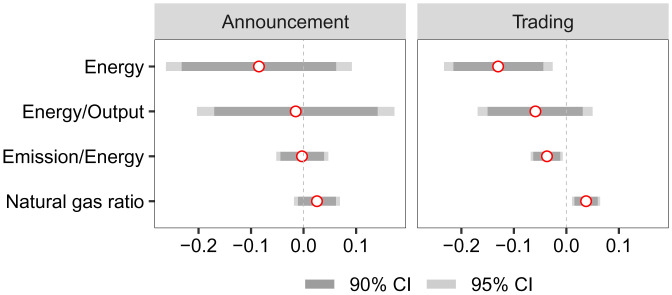
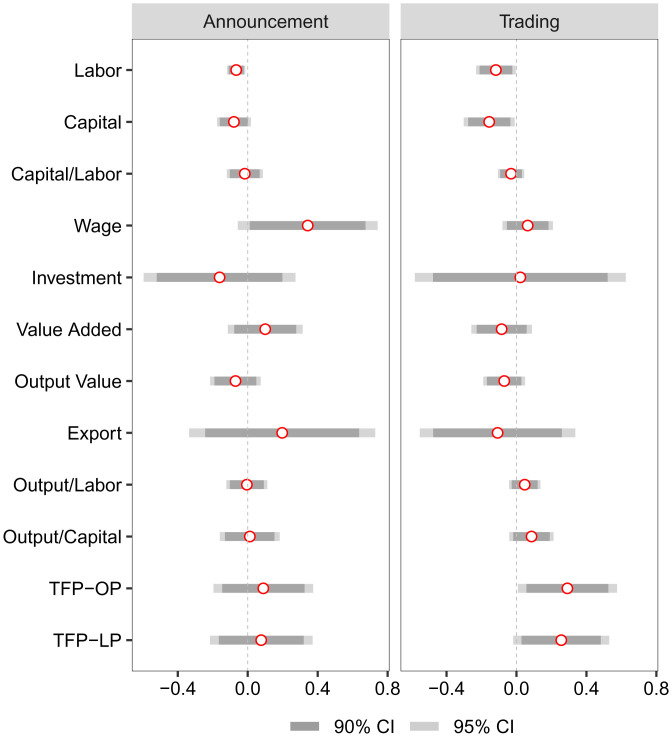
Significance: The emission trading system (ETS) is an important policy instrument for China to achieve its climate targets. However, the effectiveness of ETS in emission reductions and its economic consequences are unknown. Using a unique dataset of firm tax records, we comprehensively assess the impacts of China’s regional ETS pilots, taking advantage of the policy experiments in certain sectors across seven jurisdictions. We demonstrate unambiguous evidence that China’s ETS leads to a reduction in carbon emissions despite low carbon prices and infrequent trading. We also identify the channels through which firms respond to ETS by adjusting energy consumption and sources, employment, capital, and productivity. The lessons learned from the regional pilots shed light on the design of China’s national carbon ETS.
Overview
The claims and statistics of this paper haven’t been checked yet.
Free: it reads the open-access text and checks the first 5 claims that cite a source we can check. Create a free account to check every claim.
Integrity signals
Registry
Cites
Statistics
Figures
Verification
Claims the paper makes
The claims and statistics of this paper haven’t been checked yet.
Free: it reads the open-access text and checks the first 5 claims that cite a source we can check. Create a free account to check every claim.
Claims other papers make about this one
Each is checked against this paper’s own text: does it say what the citing paper says it does?
The source backs part of the claim, not all of it — or backs it for a different population, condition or comparison.
In the citing paper
“ETS-related policies on emission control have been generally considered to have a positive effect on both reducing emissions and promoting the presence of carbon sinks”
From The first compliance cycle of China's National Emissions Trading Scheme: insights and implications (2022) · cites this paper as [3]
Experimental — accuracy not yet measuredThe source backs part of the claim, not all of it — or backs it for a different population, condition or comparison.
In the citing paper
“On the other hand, the study shows evidence that China’s regional ETSs improve energy efficiency and increase the share of low-carbon fuel in energy consumption in regulated cities, thereby contributing to regional carbon abatement through local own efforts.17,20,22,23”
From Carbon Abatement and Leakage in China's Regional Carbon Emission Trading (2024) · cites this paper as [17]
Experimental — accuracy not yet measuredThe source backs part of the claim, not all of it — or backs it for a different population, condition or comparison.
In the citing paper
“Although China’s regional ETSs are criticized for the oversupply of allowance and low price,17 a rigorous penalty for noncompliance significantly improves ETS’s performance in local carbon abatement and meanwhile alleviates carbon leakage.40”
From Carbon Abatement and Leakage in China's Regional Carbon Emission Trading (2024) · cites this paper as [17]
Experimental — accuracy not yet measured
Self-check
Percentages, sums and reported differences re-computed from the paper’s own numbers.
The self-check needs the paper’s full text.
Citations
Cites
The Dynamics of Productivity in the Telecommunications Equipment Industry
Olley, G. S., & Pakes, A. (1996) · Econometrica · doi:10.2307/2171831 · Cited by 7,112
Estimating Production Functions Using Inputs to Control for Unobservables
Levinsohn, J., & Petrin, A. (2003) · Review of Economic Studies · doi:10.1111/1467-937x.00246 · Cited by 6,496
Propensity Score-Matching Methods for Nonexperimental Causal Studies
Dehejia, R. H., & Wahba, S. (2002) · Review of Economics and Statistics · doi:10.1162/003465302317331982 · Cited by 4,846
Creative accounting or creative destruction? Firm-level productivity growth in Chinese manufacturing
Brandt, L., Van Biesebroeck, J., & Zhang, Y. (2012) · Journal of Development Economics · doi:10.1016/j.jdeveco.2011.02.002 · Cited by 2,303
Environmental and technology policies for climate mitigation
Fischer, C., & Newell, R. G. (2008) · Journal of Environmental Economics and Management · doi:10.1016/j.jeem.2007.11.001 · Cited by 1,157
Environmental Policy and Directed Technological Change: Evidence from the European Carbon Market
Calel, R., & Dechezleprêtre, A. (2016) · Review of Economics and Statistics · doi:10.1162/rest_a_00470 · Cited by 1,147
Greenstone, M. (2002) · Journal of Political Economy · doi:10.1086/342808 · Cited by 1,122
Shapiro, J. S., & Walker, R. (2018) · American Economic Review · doi:10.1257/aer.20151272 · Cited by 950
Climate Change: The Ultimate Challenge for Economics
Nordhaus, W. (2019) · American Economic Review · doi:10.1257/aer.109.6.1991 · Cited by 941
Trade and the Environment: Theory and Evidence
McAusland, C., Copeland, B. R., & Taylor, M. S. (2004) · Canadian Public Policy / Analyse de Politiques · doi:10.2307/3552527 · Cited by 567
Cited by
Climate policies that achieved major emission reductions: Global evidence from two decades
Stechemesser, A., Koch, N., Mark, E., Dilger, E., Klösel, P., Menicacci, L., Nachtigall, D., Pretis, F., Ritter, N., Schwarz, M., et al. (2024) · Science · doi:10.1126/science.adl6547 · Cited by 322
Government environmental attention and carbon emissions governance: Firm-level evidence from China
Liu, X., Cifuentes-Faura, J., Zhao, S., & Wang, L. (2023) · Economic Analysis and Policy · doi:10.1016/j.eap.2023.07.016 · Cited by 247
Environmental regulation and green innovation: Evidence from China's carbon emissions trading policy
Liu, M., & Li, Y. (2022) · Finance Research Letters · doi:10.1016/j.frl.2022.103051 · Cited by 216
Xu, X., Huang, S., Lucey, B. M., & An, H. (2023) · International Review of Financial Analysis · doi:10.1016/j.irfa.2023.102671 · Cited by 161
RetractedLi, C., Ya-ping, Q., Liu, S., & Wang, X. (2022) · Energy Economics · doi:10.1016/j.eneco.2022.105931 · Cited by 156
Wang, H., Zhang, Y., Lin, W., & Wei, W. (2023) · Energy Economics · doi:10.1016/j.eneco.2023.106751 · Cited by 164
Price and scale effects of China's carbon emission trading system pilots on emission reduction
Wu, Q. (2022) · Journal of Environmental Management · doi:10.1016/j.jenvman.2022.115054 · Cited by 110
Power shortage and firm performance: Evidence from a Chinese city power shortage index
Guo, D., Li, Q., Liu, P., Shi, X., & Yu, J. (2023) · Energy Economics · doi:10.1016/j.eneco.2023.106593 · Cited by 110
Wang, X., Long, R., Sun, Q., Chen, H., Jiang, S., Wang, Y., Li, Q., & Yang, S. (2023) · Applied Energy · doi:10.1016/j.apenergy.2023.122457 · Cited by 99
Impacts of Market‐based Environmental Regulation on Green Total Factor Energy Efficiency in China
Li, G., Gao, D., & Li, Y. (2023) · China & World Economy · doi:10.1111/cwe.12485 · Cited by 94
Zhou, T., Huang, X., & Zhang, N. (2023) · Energy Economics · doi:10.1016/j.eneco.2023.106895 · Cited by 82
How to achieve emission reduction without hindering economic growth? The role of judicial quality
Yuan, H., Zou, L., & Feng, Y. (2023) · Ecological Economics · doi:10.1016/j.ecolecon.2023.107839 · Cited by 78
Curse to blessing: The carbon emissions trading system and resource-based cities' carbon mitigation
Wu, J., Nie, X., & Wang, H. (2023) · Energy Policy · doi:10.1016/j.enpol.2023.113796 · Cited by 74
Can carbon emission trading policy break China's urban carbon lock-in?
Zhou, C., & Qi, S. (2024) · Journal of Environmental Management · doi:10.1016/j.jenvman.2024.120129 · Cited by 86
Does China's regional emission trading scheme lead to carbon leakage? Evidence from conglomerates
He, L.-Y., & Chen, K.-X. (2023) · Energy Policy · doi:10.1016/j.enpol.2023.113481 · Cited by 66
Effect of China's carbon market on the promotion of green technological innovation
Weng, Z., Ma, Z., Xie, Y., & Cheng, C. (2022) · Journal of Cleaner Production · doi:10.1016/j.jclepro.2022.133820 · Cited by 71
How carbon emission prices accelerate net zero: Evidence from China's coal-fired power plants
Wu, Q., Tan, C., Wang, D., Wu, Y., Meng, J., & Zheng, H. (2023) · Energy Policy · doi:10.1016/j.enpol.2023.113524 · Cited by 61
Chen, M., & Wang, K. (2023) · Journal of Environmental Management · doi:10.1016/j.jenvman.2023.118188 · Cited by 67
The effect of carbon emission trading scheme on energy efficiency: Evidence from China
Tan, X., Liu, Y., Dong, H., & Zhang, Z. (2022) · Economic Analysis and Policy · doi:10.1016/j.eap.2022.06.012 · Cited by 57
Liu, X., Cifuentes‐Faura, J., Wang, C., & Wang, L. (2024) · The British Accounting Review · doi:10.1016/j.bar.2024.101540 · Cited by 79
Self-citationCould SO2 and CO2 emissions trading schemes achieve co-benefits of emissions reduction?
Hu, Y., Li, R., Du, L., Ren, S., & Chevallier, J. (2022) · Energy Policy · doi:10.1016/j.enpol.2022.113252 · Cited by 58
Wu, J., Nie, X., & Wang, H. (2023) · Journal of Policy Analysis and Management · doi:10.1002/pam.22535 · Cited by 61
Third-party environmental information disclosure and firms' carbon emissions
Ren, S., Wu, Y., Zhao, L., & Du, L. (2024) · Energy Economics · doi:10.1016/j.eneco.2024.107350 · Cited by 62
Han, Y., & Wei, T. (2025) · Journal of Environmental Management · doi:10.1016/j.jenvman.2025.124825 · Cited by 59
Digital transformation and carbon performance: evidence from firm-level data
He, L., & Chen, K. (2023) · Environment Development and Sustainability · doi:10.1007/s10668-023-03143-x · Cited by 70
Huang, H., Mbanyele, W., Zhang, L., Chen, X., & Song, M. (2025) · Journal of Environmental Management · doi:10.1016/j.jenvman.2025.124132 · Cited by 56
Ji, X., Wu, G., Lin, J., Zhang, J., & Su, P. (2022) · Journal of Environmental Management · doi:10.1016/j.jenvman.2022.116176 · Cited by 65
Self-citationQi, Y., Yuan, M., & Bai, T. (2023) · Journal of Environmental Management · doi:10.1016/j.jenvman.2023.117671 · Cited by 57
Three Decades of Climate Mitigation Policy: What Has It Delivered?
Hoppe, J., Hinder, B., Rafaty, R., Patt, A., & Grubb, M. J. (2023) · Annual Review of Environment and Resources · doi:10.1146/annurev-environ-112321-103821 · Cited by 85
Motivating for environmental protection: Evidence from county officials in China
Qi, Y., Yin, A., Chen, J.-W., Yang, C., & Zhan, P. (2024) · World Development · doi:10.1016/j.worlddev.2024.106760 · Cited by 41
Carbon pricing and enterprise productivity-The role of price stabilization mechanism
Mo, J., Tu, Q., & Wang, J. (2023) · Energy Economics · doi:10.1016/j.eneco.2023.106631 · Cited by 48
Environmental regulation, taxes, and activism
Adetutu, M. O., Odusanya, K. A., Stathopoulou, E., & Weyman–Jones, T. (2022) · Oxford Economic Papers · doi:10.1093/oep/gpac023 · Cited by 41
Optimizing the rolling out plan of China’s carbon market
Wang, K., Wang, Z., Xian, Y., Shi, X., Yu, J., Feng, K., Hubacek, K., & Wei, Y. (2022) · iScience · doi:10.1016/j.isci.2022.105823 · Cited by 54
Quan, Y., & Duan, M. (2023) · Journal of Environmental Management · doi:10.1016/j.jenvman.2023.118481 · Cited by 44
Tan, X., Wang, B., Wei, J., & Hesary, F. T. (2023) · Renewable and Sustainable Energy Reviews · doi:10.1016/j.rser.2023.113349 · Cited by 47
China’s emissions trading scheme, firms’ R&D investment and emissions reduction
Yu, J., Liu, P., Shi, X., & Ai, X. (2023) · Economic Analysis and Policy · doi:10.1016/j.eap.2023.09.039 · Cited by 46
Yu, W., Dong, P., & Lei, N. (2022) · Environmental Impact Assessment Review · doi:10.1016/j.eiar.2022.106983 · Cited by 41
Fan, L., Peng, B., Lin, Z., Zou, H., & Du, H. (2024) · International Review of Economics & Finance · doi:10.1016/j.iref.2024.103490 · Cited by 51
Zhao, L., Gao, Z., & Ren, S. (2024) · Energy Economics · doi:10.1016/j.eneco.2024.107850 · Cited by 47
Air quality improvement effect and future contributions of carbon trading pilot programs in China
Weng, Z., Liu, T., Wu, Y., & Cheng, C. (2022) · Energy Policy · doi:10.1016/j.enpol.2022.113264 · Cited by 42
Collaborative effect of the energy conservation and emission reduction fiscal policy in China
Ren, Y., Hu, Y., & Yu, Y. (2024) · Environmental Research · doi:10.1016/j.envres.2024.119431 · Cited by 40
How do power shortages affect CO2 emission intensity? Firm-level evidence from China
Yu, J., Liu, P., Fu, D., & Shi, X. (2023) · Energy · doi:10.1016/j.energy.2023.128927 · Cited by 41
Li, C., Lei, T., & Wang, L. (2024) · Technology Analysis and Strategic Management · doi:10.1080/09537325.2024.2346807 · Cited by 35
Zhou, T., Huang, X., & Zhang, N. (2023) · Environmental Impact Assessment Review · doi:10.1016/j.eiar.2023.107137 · Cited by 34
Wang, B., & Duan, M. (2024) · Applied Energy · doi:10.1016/j.apenergy.2024.124802 · Cited by 40
Zhu, H., Bao, W., & Yu, G. (2024) · Energy · doi:10.1016/j.energy.2024.134032 · Cited by 43
The impact of pilot carbon market on firms' performance in China
Luan, L., Liu, P. F., & Mei, Y. (2024) · Energy Economics · doi:10.1016/j.eneco.2024.108164 · Cited by 44
Can China achieve carbon neutrality without power shortage? A substitutability perspective
Zhao, Y. Z., Zhong, H., Kong, F., & Zhang, N. (2023) · Renewable and Sustainable Energy Reviews · doi:10.1016/j.rser.2023.113402 · Cited by 37
Can China's regional carbon market pilots improve power plants' energy efficiency?
Zhang, N., & Wang, S. (2023) · Energy Economics · doi:10.1016/j.eneco.2023.107262 · Cited by 32
The Effect of Carbon Emission Taxes on Environmental and Economic Systems
Tu, Z., Liu, B., Jin, D., Wei, W., & Kong, J. (2022) · International Journal of Environmental Research and Public Health · doi:10.3390/ijerph19063706 · Cited by 30
The joint impact of the carbon market on carbon emissions, energy mix, and copollutants
Zheng, Y., Tan, R., & Zhang, B. (2023) · Environmental Research Letters · doi:10.1088/1748-9326/acca98 · Cited by 30
Self-citationRethinking personal carbon trading (PCT) mechanism: A comprehensive review
Tang, Y.-E., Fan, R., Cai, A., Wang, L.-Y., Lin, R.-M., Meng, X., Chen, L., & Guo, R. (2023) · Journal of Environmental Management · doi:10.1016/j.jenvman.2023.118478 · Cited by 37
Huang, X., Zhou, T., & Zhang, N. (2024) · Applied Energy · doi:10.1016/j.apenergy.2024.124822 · Cited by 30
Impact of Economic Policy Uncertainty on Carbon Emissions: Evidence at China’s City Level
Fu, L., Chen, Y., Qing, X., & Miao, J. (2022) · Frontiers in Energy Research · doi:10.3389/fenrg.2022.866217 · Cited by 29
Effect of carbon market on air pollution: Firm-level evidence in China
Zhu, J., Li, X., Fan, Y., Shi, H., & Zhao, L. (2022) · Resources Conservation and Recycling · doi:10.1016/j.resconrec.2022.106321 · Cited by 30
Mao, J., Wang, C., & Yin, H. (2022) · Regional Science and Urban Economics · doi:10.1016/j.regsciurbeco.2022.103851 · Cited by 31
Self-citationZhao, T., Ke, H., & Zhang, N. (2024) · Applied Energy · doi:10.1016/j.apenergy.2024.124414 · Cited by 36
The impact of carbon market on city greening: Quasi-experimental evidence from China
Zheng, Y., & Zhang, B. (2023) · Resources Conservation and Recycling · doi:10.1016/j.resconrec.2023.106960 · Cited by 31
Self-citationRen, S., Zhao, L., Zhang, P., & Bai, C. (2025) · Journal of Development Economics · doi:10.1016/j.jdeveco.2025.103641 · Cited by 31
Niu, X., Zhang, Y., Li, B., Chen, Z., Ni, G., & Lyu, N. (2023) · Resources Policy · doi:10.1016/j.resourpol.2023.104542 · Cited by 29
Yu, Y., Zhang, X., Liu, Y., & Zhou, T. (2024) · Energy · doi:10.1016/j.energy.2024.132870 · Cited by 28
Can carbon market efficiency promote green technology innovation for Chinese companies?
Wang, D., Sun, M., Meng, B., An, Y., Cheng, W., & Ye, B. (2024) · Energy · doi:10.1016/j.energy.2024.133157 · Cited by 30
Liu, Y., Li, Q., & Zhang, Z. (2022) · Energies · doi:10.3390/en15155527 · Cited by 30
Carbon Abatement and Leakage in China's Regional Carbon Emission Trading
Jiang, J., Ye, B., Zeng, Z., Yang, X., Sun, Z., Shao, S., Feng, K., & Tan, X. (2024) · Environmental Science & Technology · doi:10.1021/acs.est.4c04738 · Cited by 23
The first compliance cycle of China's National Emissions Trading Scheme: insights and implications
Li, J., Yao, Y., & Wang, X. (2022) · Carbon Neutrality · doi:10.1007/s43979-022-00035-3 · Cited by 25
Tang, K. (2024) · Agricultural Systems · doi:10.1016/j.agsy.2024.103913 · Cited by 32
The European Union Emissions Trading System might yield large co-benefits from pollution reduction
Basaglia, P., Grunau, J., & Drupp, M. A. (2024) · Proceedings of the National Academy of Sciences · doi:10.1073/pnas.2319908121 · Cited by 30
The green paradox of time dimension: From pilot to national carbon emission trading system in China
Ge, X., Li, Y., & Yang, H. (2024) · Environmental Impact Assessment Review · doi:10.1016/j.eiar.2024.107642 · Cited by 26
Yin, H., Yin, Y., Li, H., Zhu, J., Xian, Z., Tang, Y., Xiao, L., Rong, J., Li, C., Zhang, H., et al. (2024) · Applied Energy · doi:10.1016/j.apenergy.2024.124357 · Cited by 26
Zhang, J., & Wei, Y. (2024) · China Finance Review International · doi:10.1108/cfri-02-2024-0056 · Cited by 25
Self-citationWhen and Under What Conditions Does an Emission Trading Scheme Become Cost Effective?
Zhang, H., Zhang, L., & Zhang, N. (2024) · The Energy Journal · doi:10.5547/01956574.45.2.hzha · Cited by 25
Shi, W., Zhang, Y., & Liu, J. (2024) · IEEE Transactions on Engineering Management · doi:10.1109/tem.2024.3450523 · Cited by 25
Does china’s national carbon market function well? A perspective on effective market design
Zheng, Y., & Zhang, B. (2023) · Journal of Chinese Governance · doi:10.1080/23812346.2023.2214023 · Cited by 26
Self-citationMa, Y., & Tao, P. (2023) · Sustainability · doi:10.3390/su15129417 · Cited by 32
Zhao, Y. Z., Ma, Y., Choi, Y., & Zhang, N. (2023) · The Energy Journal · doi:10.5547/01956574.45.3.yzha · Cited by 21
Cong, J., Zhang, W., Guo, H., & Zhao, Y. (2023) · Climate Policy · doi:10.1080/14693062.2023.2273939 · Cited by 21
Authoritarian environmentalism 2.0: An incremental transition of environmental governance in China
Xiang, C., & Lo, A. Y. H. (2024) · Environment and Planning C Politics and Space · doi:10.1177/23996544241286325 · Cited by 24
The development of China’s national carbon market: An overview
Zhang, X., Yu, R., & Karplus, V. J. (2025) · Energy and climate management. · doi:10.26599/ecm.2025.9400015 · Cited by 34
Emission Trading System, Carbon Market Efficiency, and Corporate Innovations
Zhu, R., Long, L., & Gong, Y. (2022) · International Journal of Environmental Research and Public Health · doi:10.3390/ijerph19159683 · Cited by 23
Has Chinese Certified Emission Reduction trading reduced rural poverty in China?
Zhang, Y., Liu, J., & Woodward, R. T. (2023) · Australian Journal of Agricultural and Resource Economics · doi:10.1111/1467-8489.12515 · Cited by 19
Hao, X., Sun, W., & Zhang, X. (2023) · Energy · doi:10.1016/j.energy.2023.128150 · Cited by 19
Supplier concentration and corporate carbon emissions
Guo, S., Xie, X., Chen, M., & Gong, Y. (2024) · Economic Analysis and Policy · doi:10.1016/j.eap.2024.03.026 · Cited by 21
Wu, H., Zhou, Y., Wang, X., Hu, X., Zhang, S., Ren, Y., Liu, J., Liu, Y., & Tao, S. (2024) · Applied Energy · doi:10.1016/j.apenergy.2024.123498 · Cited by 22
Comparative analysis of the marginal abatement cost modeling for coal-fired power plants in China
Liu, Q., Qi, R., Zhao, Y. Z., & Zhou, T. (2022) · Journal of Cleaner Production · doi:10.1016/j.jclepro.2022.131883 · Cited by 18
Zhang, K., Jiang, L., Jin, Y., & Liu, W. (2022) · International Journal of Environmental Research and Public Health · doi:10.3390/ijerph192416424 · Cited by 19
Li, Y., & Zhang, X. (2023) · Renewable Energy · doi:10.1016/j.renene.2023.119130 · Cited by 20
Easing financial constraints through carbon trading
Wu, Q., Ren, S., Hou, Y., Yang, Z., Zhao, C., & Yao, X. (2024) · Empirical Economics · doi:10.1007/s00181-024-02565-4 · Cited by 22
Zhou, C., Li, Y., & Wu, C. (2024) · Energy Efficiency · doi:10.1007/s12053-024-10232-x · Cited by 20
Wu, L., Huang, Z., Zhang, X., & Wang, Y. (2024) · Scientific Data · doi:10.1038/s41597-024-03411-z · Cited by 28
Li, X., & Xing, H. (2024) · Sustainable Production and Consumption · doi:10.1016/j.spc.2024.03.029 · Cited by 17
Ge, X., Xue, M., & Cao, R. (2024) · International Review of Financial Analysis · doi:10.1016/j.irfa.2024.103334 · Cited by 22
Wu, J. (2024) · Journal of Environmental Management · doi:10.1016/j.jenvman.2024.120306 · Cited by 22
Kukah, A. S. K., Xiaohua, J., Osei‐Kyei, R., & Perera, S. (2024) · Journal of Facilities Management · doi:10.1108/jfm-08-2023-0094 · Cited by 19
Does China's carbon emission trading scheme policy exacerbate financing costs for enterprises?
Ma, Y., Wang, S., Zhang, N., & Choi, Y. (2025) · Energy Economics · doi:10.1016/j.eneco.2025.108789 · Cited by 28
The effectiveness of carbon emission trading system: Evidence from China's regional markets
Li, Y., & Zhao, J. (2025) · Journal of Development Economics · doi:10.1016/j.jdeveco.2025.103631 · Cited by 20
Zhao, C., Yu, J., Liu, P., & Shen, B. (2025) · International Review of Financial Analysis · doi:10.1016/j.irfa.2025.104774 · Cited by 15
Zou, L., & Ma, J. (2024) · Environment Development and Sustainability · doi:10.1007/s10668-024-05327-5 · Cited by 20
The green bonus of tax incentives: Evidence from China
Wu, Q., Wang, Y., Jinxi, W., & Shen, G. (2024) · Journal of Economic Behavior & Organization · doi:10.1016/j.jebo.2024.106740 · Cited by 21
High-speed rail, technological improvement, and carbon emission efficiency
Su, W., Li, X., Zhang, Y., Zhang, Q., Wang, T., Magdziarczyk, M., & Smoliński, A. (2025) · Transportation Research Part D Transport and Environment · doi:10.1016/j.trd.2025.104685 · Cited by 15
Yang, W., & Zhang, N. (2023) · Green and Low-Carbon Economy · doi:10.47852/bonviewglce3202905 · Cited by 15
Metadata
- Authors
- Cui, J., Wang, C., Zhang, J., & Zheng, Y.
- Affiliations
- Duke Kunshan University (CN)
- Shanghai Jiao Tong University (CN)
- Duke University (US)
- London School of Economics and Political Science (GB)
- Corresponding author
- Cui, Jingbo
- Wang, Chunhua
- Zhang, Junjie
- Zheng, Yang
- Venue
- Proceedings of the National Academy of Sciences
- Publisher
- National Academy of Sciences
- Published
- 2021-12-20
- Volume
- 118
- Issue
- 52
- ISSN
- 0027-8424 (ISSN-L)
- 1091-6490
- PMC
- PMC8719898
- OpenAlex
- W4200452078
- Semantic Scholar
- f69be02b05a9797522b6e442367dcc2095c94661
- Cited by
- 349
- References
- 45
- Citations by year
- 2026: 72 · 2025: 92 · 2024: 85 · 2023: 60 · 2022: 38 · 2021: 1
- FWCI
- 35.06
- Type
- journal article
- Language
- en
- Open access
- hybrid
- doi.org
- Licence
- Locations
- Proceedings of the National Academy of Sciences (publishedVersion, cc-by-nc-nd)
- PubMed Central (publishedVersion, cc-by-nc-nd)
- PubMed (publishedVersion)
- London School of Economics and Political Science Research Online (London School of Economics and Political Science) (acceptedVersion)
- London School of Economics and Political Science Research Online (London School of Economics and Political Science) (submittedVersion)
- RePEc: Research Papers in Economics (submittedVersion)
- Funders
- National Natural Science Foundation of China (72073055, 71773043, 71773062)
- Energy Foundation China (G-1711-27079)
- Qinglan Project of Jiangsu Province (N/A)
- Topics
- Social Sciences › Economics, Econometrics and Finance › Economics and Econometrics › Climate Change Policy and Economics
- Social Sciences › Economics, Econometrics and Finance › Economics and Econometrics › Energy, Environment, Economic Growth
- Physical Sciences › Energy › Renewable Energy, Sustainability and the Environment › Renewable energy and sustainable power systems
- Keywords
- emissions trading, emission intensity, carbon price, allowance trading, energy conservation, employment effects, capital input, firm productivity, manufacturing companies, public utilities, China climate policy
About these checks
Registry, retraction, Cites and statistics results are computed, not judged, with one exception: a printed reference that no index lists is read once by a model before it counts as a citation error. Claims are extracted by a model and kept only when their quote appears verbatim in the text; each cited source is then checked, with a model’s help, for whether it says what the claim relies on. Those verdicts can be wrong — read the claim’s quote and the cited source before relying on one.
Statistics and arithmetic are recomputed, not judged.
Confidence bands are shown only for fields calibrated on our annotated test set. None is calibrated yet, so no band is shown.
What counts as a claim ›How we measure confidence ›How we check this ›
Are you an author, or do you see a problem with this page? Request a review
Data sources
Bibliographic data: Semantic Scholar, OpenAlex, Crossref.
Contains information from the Semantic Scholar Academic Graph Datasets, made available under the ODC Attribution License (ODC-BY 1.0).
Semantic Scholar’s data is described in: Kinney, R., et al. (2023). The Semantic Scholar Open Data Platform. arXiv:2301.10140.
