

The DOI matches its Crossref record; 14 of the 15 references it cites were found in a registry or an index.
Empathy-based counterspeech can reduce racist hate speech in a social media field experiment
Open accessAbstract
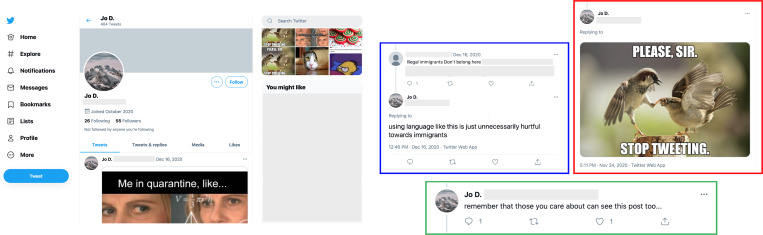
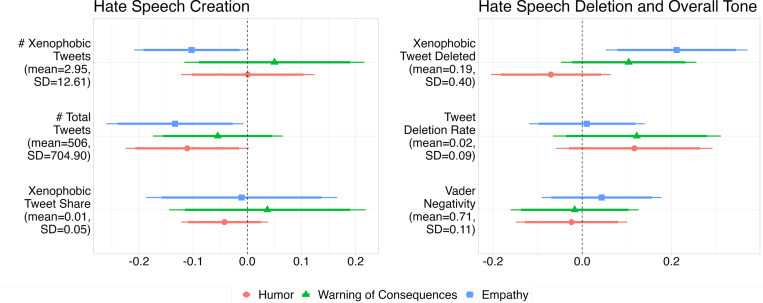
Despite heightened awareness of the detrimental impact of hate speech on social media platforms on affected communities and public discourse, there is little consensus on approaches to mitigate it. While content moderation—either by governments or social media companies—can curb online hostility, such policies may suppress valuable as well as illicit speech and might disperse rather than reduce hate speech. As an alternative strategy, an increasing number of international and nongovernmental organizations (I/NGOs) are employing counterspeech to confront and reduce online hate speech. Despite their growing popularity, there is scant experimental evidence on the effectiveness and design of counterspeech strategies (in the public domain). Modeling our interventions on current I/NGO practice, we randomly assign English-speaking Twitter users who have sent messages containing xenophobic (or racist) hate speech to one of three counterspeech strategies—empathy, warning of consequences, and humor—or a control group. Our intention-to-treat analysis of 1,350 Twitter users shows that empathy-based counterspeech messages can increase the retrospective deletion of xenophobic hate speech by 0.2 SD and reduce the prospective creation of xenophobic hate speech over a 4-wk follow-up period by 0.1 SD. We find, however, no consistent effects for strategies using humor or warning of consequences. Together, these results advance our understanding of the central role of empathy in reducing exclusionary behavior and inform the design of future counterspeech interventions.
Overview
The claims and statistics of this paper haven’t been checked yet.
Run the check — free, no account needed. It reads the open-access text and checks the sources it cites.
Integrity signals
Registry
Cites
Statistics
Figures
Verification
Claims the paper makes
The claims and statistics of this paper haven’t been checked yet.
Run the check — free, no account needed. It reads the open-access text and checks the sources it cites.
Claims other papers make about this one
Each is checked against this paper’s own text: does it say what the citing paper says it does?
The cited source says what the claim attributes to it.
In the citing paper
“Empathic and humanizing prompts have been shown to reduce affective polarization (Saveski et al., 2022) and racist harassment (Hangartner et al., 2021; Munger, 2017).”
From Social Drivers and Algorithmic Mechanisms on Digital Media. (2024) · cites this paper as Hangartner et al., 2021
The cited source says what the claim attributes to it.
In the citing paper
“For instance, identity-and empathy-based bystander interventions on social media can effectively reduce incivility (Munger 2020), hate speech (Hangartner et al. 2021, Munger 2017, Siegel & Badaan 2020), and misinformation (Pretus et al. 2022).”
From Social Media and Morality. (2024) · cites this paper as Hangartner et al. 2021
Self-check
Percentages, sums and reported differences re-computed from the paper’s own numbers.
The self-check needs the paper’s full text.
Citations
Cites
VADER: a parsimonious rule-based model for sentiment analysis of social media text
Hutto, C., & Gilbert, E. (2014) · Proceedings of the International AAAI Conference on Web and Social Media · doi:10.1609/icwsm.v8i1.14550 · Cited by 6,087
Inference on Treatment Effects after Selection among High-Dimensional Controls
Belloni, A., Chernozhukov, V., & Hansen, C. (2013) · The Review of Economic Studies · doi:10.1093/restud/rdt044 · Cited by 1,516
Prejudice Reduction: What Works? A Review and Assessment of Research and Practice
Paluck, E. L., & Green, D. P. (2009) · Annual Review of Psychology · doi:10.1146/annurev.psych.60.110707.163607 · Cited by 1,376
Durably reducing transphobia: A field experiment on door-to-door canvassing
Broockman, D., & Kalla, J. (2016) · Science · doi:10.1126/science.aad9713 · Cited by 798
Fanning the Flames of Hate: Social Media and Hate Crime
Müller, K., & Schwarz, C. (2021) · Journal of the European Economic Association · doi:10.1093/jeea/jvaa045 · Cited by 448
Tweetment Effects on the Tweeted: Experimentally Reducing Racist Harassment
Munger, K. (2017) · Political Behavior · doi:10.1007/s11109-016-9373-5 · Cited by 395
#No2Sectarianism: Experimental Approaches to Reducing Sectarian Hate Speech Online
Siegel, A. A., & Badaan, V. (2020) · American Political Science Review · doi:10.1017/s0003055420000283 · Cited by 135
Henson, B., Reyns, B. W., & Fisher, B. S. (2013) · Journal of Contemporary Criminal Justice · doi:10.1177/1043986213507403 · Cited by 123
Family Matters: How Immigrant Histories Can Promote Inclusion
Williamson, S., Adida, C. L., Lo, A., Izama, M. P., Prather, L., & Werfel, S. H. (2020) · American Political Science Review · doi:10.1017/s0003055420001057 · Cited by 102
Governing Online Speech: From 'Posts-As-Trumps' to Proportionality and ProbabilityPreprint
Douek, E. (2020) · SSRN Electronic Journal · doi:10.2139/ssrn.3679607 · Cited by 81
Research works printed but not linked: 2
- A. Siegel, Online Hate Speech in Social Media and Democracy: The State of the Field, Prospects for Reform (Cambridge University Press, 2020).
- I. Gagliardone, D. Gal, T. Alves, G. Martinez, Countering Online Hate Speech (United Nations Educational, Scientific and Cultural Organization, 2015).
Cited by
Sorted by citations
Social Drivers and Algorithmic Mechanisms on Digital Media.
Metzler, H., & Garcia, D. (2024) · Perspectives on Psychological Science · doi:10.1177/17456916231185057 · Cited by 204
“Empathic and humanizing prompts have been shown to reduce affective polarization (Saveski et al., 2022) and racist harassment (Hangartner et al., 2021; Munger, 2017).”
BackgroundVan Bavel, J. J., Robertson, C. E., del Rosario, K., Rasmussen, J., & Rathje, S. (2024) · Annual Review of Psychology · doi:10.1146/annurev-psych-022123-110258 · Cited by 121
Complaint De-Escalation Strategies on Social Media
Herhausen, D., Grewal, L. S., Cummings, K. H., Roggeveen, A. L., Ordenes, F. J. V., & Grewal, D. (2022) · Journal of Marketing · doi:10.1177/00222429221119977 · Cited by 83
Aridor, G., Jiménez-Durán, R., Levy, R., & Song, L. (2024) · Journal of Economic Literature · doi:10.1257/jel.20241743 · Cited by 85
ProsocialDialog: A prosocial backbone for conversational agents
Kim, H., Yu, Y., Jiang, L., Lu, X., Khashabi, D., Kim, G., Choi, Y., & Sap, M. (2022) · Proceedings of the 2022 Conference on Empirical Methods in Natural Language Processing · doi:10.18653/v1/2022.emnlp-main.267 · Cited by 80
X under Musk’s leadership: Substantial hate and no reduction in inauthentic activity
Hickey, D., Fessler, D. M. T., Lerman, K., & Burghardt, K. (2025) · PLoS ONE · doi:10.1371/journal.pone.0313293 · Cited by 88
The Virality of Hate Speech on Social Media
Maarouf, A., Pröllochs, N., & Feuerriegel, S. (2024) · Proceedings of the ACM on Human-Computer Interaction · doi:10.1145/3641025 · Cited by 35
The Economics of Content Moderation: Theory and Experimental Evidence from Hate Speech on TwitterPreprint
Jiménez-Durán, R. (2022) · Social Science Research Network · doi:10.2139/ssrn.4044098 · Cited by 35
Dancygier, R. M. (2023) · Proceedings of the National Academy of Sciences · doi:10.1073/pnas.2212757120 · Cited by 26
Personalized Interventions for Online Moderation
Cresci, S., Trujillo, A., & Fagni, T. (2022) · ACM Conference on Hypertext and Social Media (HT) · doi:10.1145/3511095.3536369 · Cited by 25
Morality in the anthropocene: The perversion of compassion and punishment in the online world
Robertson, C. E., Shariff, A., & Bavel, J. J. V. (2024) · PNAS Nexus · doi:10.1093/pnasnexus/pgae193 · Cited by 28
Towards Automatic Generation of Messages Countering Online Hate Speech and Microaggressions
Ashida, M., & Komachi, M. (2022) · Workshop on Online Abuse and Harms (WOAH) · doi:10.18653/v1/2022.woah-1.2 · Cited by 25
Pukallus, S., & Arthur, C. (2024) · Journalism and Media · doi:10.3390/journalmedia5020031 · Cited by 21
Reducing prejudice with counter‐stereotypical AI
Hermann, E., De Freitas, J., & Puntoni, S. (2025) · Consumer Psychology Review · doi:10.1002/arcp.1102 · Cited by 21
Norms of Democracy, Staged Democrats, and Supply of Exclusionary Ideology
Valentim, V. (2024) · Comparative Political Studies · doi:10.1177/00104140241283009 · Cited by 24
The impact of reflective practice on the development of nursing undergraduate students
Yang, Q., & Zou, W. (2025) · BMC Medical Education · doi:10.1186/s12909-025-07490-3 · Cited by 19
Negative social tipping dynamics resulting from and reinforcing Earth system destabilization
Spaiser, V., Juhola, S. K., Constantino, S. M., Guo, W., Watson, T., Sillmann, J., Craparo, A., Basel, A. M., Bruun, J. T., Krishnamurthy, P. K., et al. (2024) · Earth System Dynamics · doi:10.5194/esd-15-1179-2024 · Cited by 28
Chakraborty, T., & Masud, S. (2022) · ACM SIGWEB Newsletter · doi:10.1145/3522598.3522601 · Cited by 22
The Economics of Content Moderation: Theory and Experimental Evidence from Hate Speech on TwitterPreprint
Jiménez-Durán, R. (2023) · SSRN Electronic Journal · doi:10.2139/ssrn.4590147 · Cited by 18
Johansson, P., Enoch, F., Hale, S. A., Vidgen, B., Bereskin, C., Margetts, H. Z., & Bright, J. (2023) · SSRN Electronic Journal · doi:10.2139/ssrn.4648332 · Cited by 30
Proactively Reducing the Hate Intensity of Online Posts via Hate Speech Normalization
Masud, S., Bedi, M., Khan, M. A., Akhtar, M. S., & Chakraborty, T. (2022) · ACM SIGKDD Conference on Knowledge Discovery and Data Mining (KDD) · doi:10.1145/3534678.3539161 · Cited by 16
Counterspeakers’ Perspectives: Unveiling Barriers and AI Needs in the Fight against Online Hate
Mun, J., Buerger, C., Liang, J. T., Garland, J., & Sap, M. (2024) · CHI Conference on Human Factors in Computing Systems · doi:10.1145/3613904.3642025 · Cited by 24
Hatano, A. (2023) · The Australian Year Book of International Law Online · doi:10.1163/26660229-04101017 · Cited by 14
Combating Online Hate Speech: The Impact of Legislation on TwitterPreprint
Andres, R., & Slivko, O. (2021) · SSRN Electronic Journal · doi:10.2139/ssrn.4013662 · Cited by 18
Ciriello, R., Gal, U., Hannon, O., & Thatcher, J. B. (2024) · European Journal of Information Systems · doi:10.1080/0960085x.2024.2444249 · Cited by 23
The Economics of Social MediaPreprint
Aridor, G., Durán, R. J., Levy, R., & Song, L. (2024) · SSRN Electronic Journal · doi:10.2139/ssrn.4708840 · Cited by 13
Social norms and the expression of prejudice: How the norm changes
Álvarez-Benjumea, A. (2024) · Current Opinion in Psychology · doi:10.1016/j.copsyc.2024.101974 · Cited by 12
Merging public health and automated approaches to address online hate speech
Nguyen, T. (2023) · AI and Ethics · doi:10.1007/s43681-023-00281-w · Cited by 12
Political censorship feels acceptable when ideas seem harmful and false
Kubin, E., von Sikorski, C., & Gray, K. J. (2024) · Political Psychology · doi:10.1111/pops.13011 · Cited by 19
Making a Case for a Social Processes Approach to Online Hate
Walther, J. B. (2024) · Routledge eBooks · doi:10.4324/9781003472148-2 · Cited by 11
Combatting online hate: Crowd moderation and the public goods problem
Hansen, T. M., Lindekilde, L., Karg, S. T., Petersen, M. B., & Rasmussen, S. (2024) · Communications · doi:10.1515/commun-2023-0109 · Cited by 12
Gupta, R., Desai, S., Goel, M., Bandhakavi, A., Chakraborty, T., & Akhtar, M. S. (2023) · Proceedings of the conference - Association for Computational Linguistics. Meeting · doi:10.18653/v1/2023.acl-long.318 · Cited by 20
Citizen preferences for online hate speech regulation
Munzert, S., Traunmüller, R., Barberá, P., Guess, A., & Yang, J. (2025) · PNAS Nexus · doi:10.1093/pnasnexus/pgaf032 · Cited by 19
Risks and Protective Factors Associated to Homophobic Cyberbullying Among Youth
Amadori, A., Sherwood, S. H., Russell, S. T., & Brighi, A. (2025) · Aggressive Behavior · doi:10.1002/ab.70034 · Cited by 10
Shaping Social Media Minds: Scaffolding Empathy in Digitally Mediated Interactions?
Moßner, C., & Walter, S. (2024) · Topoi · doi:10.1007/s11245-024-10034-x · Cited by 9
Promoting civil discourse on social media using nudges: A tournament of seven interventions
Celadin, T., Panizza, F., & Capraro, V. (2024) · PNAS Nexus · doi:10.1093/pnasnexus/pgae380 · Cited by 9
The role of narcissism and motivated reasoning on misinformation propagation
Haupt, M. R., Cuomo, R. E., Mackey, T. K., & Seana Coulson, A. (2024) · Frontiers in Communication · doi:10.3389/fcomm.2024.1472631 · Cited by 10
Gennaro, G., Derksen, L., Abdelrahman, A., Broggini, E., Green, M. A., Haerter, V. A., Heer, E., Heidler, I., Kauer, F., Kim, H.-N., et al. (2025) · Scientific Reports · doi:10.1038/s41598-025-05041-w · Cited by 9
Self-citationSocial media governance and strategies to combat online hatespeech in Germany
Stockmann, D., Schlosser, S., & Ksatryo, P. (2023) · Policy & Internet · doi:10.1002/poi3.348 · Cited by 13
Propagation of Hate Speech on Social Network X: Trends and Approaches
Rodríguez‐Peral, E. M., Franco, T. G., & Bustos, D. R.-P. (2025) · Social Inclusion · doi:10.17645/si.9317 · Cited by 15
Beyond Denouncing Hate: Strategies for Countering Implied Biases and Stereotypes in Language
Mun, J., Allaway, E., Yerukola, A., Vianna, L., Leslie, S., & Sap, M. (2023) · Findings of the Association for Computational Linguistics: EMNLP (Findings of EMNLP) · doi:10.18653/v1/2023.findings-emnlp.653 · Cited by 8
From confronted to confronter? Examining the enduring effects of prejudice confrontations
Chaney, K. E., O’Dea, C. J., & Pereira‐Jorge, I. (2025) · Group Processes & Intergroup Relations · doi:10.1177/13684302241309872 · Cited by 7
Behind the Counter: Exploring Motivations and Barriers of Online Counterspeech Writing
Ping, K., Kumar, A., Ding, X., & Rho, E. H. R. (2025) · ACM Transactions on Computer-Human Interaction · doi:10.1145/3745769 · Cited by 10
Confront hate with AI: how AI-generated counter speech helps against hate speech on social Media?
Wu, C., Wang, Y., Zhang, Y., Wang, H., & Pang, Y. (2025) · Telematics and Informatics · doi:10.1016/j.tele.2025.102304 · Cited by 9
Stances on hate speech: Population opinions and attitudes
Zapatero, M. D. C., Brändle, G., & Rebollo, M. A. P. (2023) · El Profesional de la Informacion · doi:10.3145/epi.2023.jul.10 · Cited by 8
Tjaden, J. (2023) · International Migration Review · doi:10.1177/01979183231208428 · Cited by 7
Ruscher, J. B. (2024) · Cambridge University Press eBooks · doi:10.1017/9781009534666 · Cited by 8
Kirchmair, T., Koban, K., & Matthes, J. (2024) · Communications · doi:10.1515/commun-2023-0133 · Cited by 6
Empathic Responding for Digital Interpersonal Emotion Regulation via Content Recommendation
Verma, A., Islam, S., Moghaddam, V., Anwar, A., & Horwood, S. (2024) · International journal of human computer interactions · doi:10.1080/10447318.2024.2430428 · Cited by 6
Jia, Y., & Schumann, S. (2025) · Cyberpsychology Journal of Psychosocial Research on Cyberspace · doi:10.5817/cp2025-1-4 · Cited by 6
Tavares, M., & Rein, B. A. (2024) · Cognitive Affective & Behavioral Neuroscience · doi:10.3758/s13415-024-01212-w · Cited by 5
Chen, Y., Wang, L., Guo, S., & Gu, Q. (2025) · Frontiers in Psychology · doi:10.3389/fpsyg.2025.1577717 · Cited by 5
Perceiving and Countering Hate: The Role of Identity in Online Responses
Ping, K., E.Hawdon, J., & Rho, E. H. R. (2025) · Proceedings of the ACM on Human-Computer Interaction · doi:10.1145/3711045 · Cited by 6
The devil is in the detail: reconceptualising bystander reactions to online political hostility
Hansen, T. M., Lindekilde, L., & Karg, S. T. (2023) · Behavior and Information Technology · doi:10.1080/0144929x.2023.2282653 · Cited by 2
Young, A. I., Veit, K. M., Gassin, E. A., & Case, J. P. (2024) · Collabra Psychology · doi:10.1525/collabra.92328 · Cited by 5
Tahir, I., & Ramadhan, M. G. F. (2024) · LLT Journal A Journal on Language and Language Teaching · doi:10.24071/llt.v27i1.8180 · Cited by 13
Hate Cannot Drive Out Hate: Forecasting Conversation Incivility following Replies to Hate Speech
Yu, X., Blanco, E., & Hong, L. (2024) · Proceedings of the International AAAI Conference on Web and Social Media · doi:10.1609/icwsm.v18i1.31422 · Cited by 7
Collective moderation of hate, toxicity, and extremity in online discussions
Lasser, J., Herderich, A., Garland, J., Aroyehun, S. T., García, D., & Galešić, M. (2025) · PNAS Nexus · doi:10.1093/pnasnexus/pgaf369 · Cited by 5
IndicCONAN: A Multilingual Dataset for Combating Hate Speech in Indian Context
Sahoo, N. R., Beria, G. P., & Bhattacharyya, P. (2024) · Proceedings of the AAAI Conference on Artificial Intelligence · doi:10.1609/aaai.v38i20.30237 · Cited by 5
Promoting Civility in Formal And Informal Open Science ContextsPreprint
Darda, K. M., Conry‐Murray, C., Schmidt, K., Elsherif, M. M., Peverill, M., Yoneda, T. B., Lawson, K. M., DiGregory, E., Moreau, D., Shorter, G. W., et al. (2023) · PsyArXiv (OSF Preprints) · doi:10.31234/osf.io/rfkyu · Cited by 6
Mazzeo, O., Selva, G. L., Longo, M., & Monacis, L. (2025) · Frontiers in Psychology · doi:10.3389/fpsyg.2025.1562635 · Cited by 4
Public attitudes towards social media field experiments
Straub, V. J., Burton, J. W., Geers, M., & Lorenz-Spreen, P. (2024) · Scientific Reports · doi:10.1038/s41598-024-76948-z · Cited by 4
Frames and Triggers of Extreme Speech: The Case of Transphobia
Baider, F. H. (2025) · Social Inclusion · doi:10.17645/si.9379 · Cited by 4
Disentangling participation in online political discussions with a collective field experiment
Oswald, L., Schulz, W. S., & Lorenz-Spreen, P. (2025) · Science Advances · doi:10.1126/sciadv.ady8022 · Cited by 5
“An image hurts more than 1000 words?”
Oehmer, F., & Pedrazzi, S. (2024) · Communications · doi:10.1515/commun-2023-0117 · Cited by 3
Ryu, H.-Y., & Pratt, W. (2024) · Journal of Medical Internet Research · doi:10.2196/62716 · Cited by 5
Different Media Education Approaches Predict Distinct Aspects of Digital Citizenship
Consoli, T. (2024) · Frontline Learning Research · doi:10.14786/flr.v12i4.1555 · Cited by 3
5. Same tools, different target
Aguilera-Carnerero, C., Becker, M. J., & Scheiber, M. (2025) · Open Book Publishers · doi:10.11647/obp.0447.05 · Cited by 3
How to measure disagreement as a premise for learning from controversy in a social media context
Malzahn, N., Schwarze, V., Eimler, S. C., Aprin, F., Moder, S., & Hoppe, H. U. (2022) · Research and Practice in Technology Enhanced Learning · doi:10.58459/rptel.2023.18012 · Cited by 5
Making the impossible possible? Framing confrontations of racism on social media as norm-setting
Coles, S. M., & Lane, D. S. (2023) · New Media & Society · doi:10.1177/14614448231208707 · Cited by 4
CONTEMPORARY ENGLISH MEDIA DISCOURSE: LINGUISTIC, PRAGMATIC, SOCIAL AND DIGITAL ASPECTS
Mialkovska, L., Sternichuk, V., PETRUK, V., Honchar, K., Knysh, T., PANCHENKO, V., & Yanovets, A. (2024) · AD ALTA Journal of Interdisciplinary Research · doi:10.33543/140139151156 · Cited by 3
Analyzing Twitter Data to Understand Stigmatization of Schizophrenia Before and After Elon Musk
Mo, M., & Olivo, D. (2023) · Journal of Student Research · doi:10.47611/jsrhs.v12i3.4637 · Cited by 3
Alyahya, G., & Aldayel, A. (2025) · Proceedings of the International AAAI Conference on Web and Social Media · doi:10.1609/icwsm.v19i1.35803 · Cited by 3
Quantifying the spread of racist content on fringe social media: A case study of Parler
Kolluri, A., Murthy, D., & Vinton, K. (2025) · Big Data & Society · doi:10.1177/20539517251321752 · Cited by 2
Beyond Hate Speech: Online Rumors and Out-Group Resentment in Divided Societies
Mjelva, M. B., Schutte, S., Binningsbø, H. M., & Jensenius, F. R. (2025) · Comparative Political Studies · doi:10.1177/00104140251381753 · Cited by 2
Huang, P. Y., Deng, J., Yang, Y., & Williams, S. (2025) · Proceedings of the ACM on Human-Computer Interaction · doi:10.1145/3757589 · Cited by 2
Zhao, X., & Ma, R. (2025) · International Journal of Human-Computer Interaction · doi:10.1080/10447318.2025.2594153 · Cited by 2
Designing Human-AI Collaboration to Support Learning in Counterspeech Writing
Ding, X.-H., Ping, K.-K., Gunturi, U. S., Çarık, B., Stil, S., Wilhelm, L. T., Daryanto, T., Hawdon, J., Lee, S. W., & Rho, E. (2024) · IEEE Symposium on Visual Languages / Human-Centric Computing Languages and Environments · doi:10.1109/vl-hcc65237.2025.00052 · Cited by 2
“Studying Up” through Digital Ethnography: The Case of Conservative Caste Enclaves
Thuppilikkat, A. A., Solanki, A., & Chandra, P. (2026) · CHI Conference on Human Factors in Computing Systems · doi:10.1145/3772318.3791530 · Cited by 2
Empathy and Hate Speech in Social Media: The Case of Indonesia
Rahmi, K. H. (2024) · International Journal of Social Science and Human Research · doi:10.47191/ijsshr/v7-i03-29 · Cited by 2
Empathy, Kindness, and Dignity in a Connected World
James, C., Collier, A., Davis, K. S., Konrath, S., Milošević, T., Milovidov, E., Staksrud, E., & Weinstein, E. (2024) · Springer eBooks · doi:10.1007/978-3-031-69362-5_32 · Cited by 2
Schnyder, N., Wrede, N., Zick, A., und, M. K., & Albrecht, J. N. (2024) · Praxis der Rechtspsychologie · doi:10.1026/0939-9062/a000014 · Cited by 2
One-shot intervention reduces online engagement with distorted content
Hasan, E., Epping, G. P., Lorenzo‐Luaces, L., Bollen, J., & Trueblood, J. S. (2025) · PNAS Nexus · doi:10.1093/pnasnexus/pgaf068 · Cited by 2
Ryu, H., & Kang, S. (2025) · CHI Conference Extended Abstracts on Human Factors in Computing Systems (CHI EA) · doi:10.1145/3706599.3706702 · Cited by 2
Addressing Online Political HostilityPreprint
Rasmussen, J. S. (2023) · Thesis Commons (OSF Preprints) · doi:10.31237/osf.io/745px · Cited by 2
Measuring complex psychological and sociological constructs in large-scale textPreprint
Herderich, A., Lasser, J., Galešić, M., Aroyehun, S. T., García, D., & Garland, J. (2024) · PsyArXiv (OSF Preprints) · doi:10.31234/osf.io/tzc9p · Cited by 3
Towards Designing Social Interventions for Online Climate Change Denialism Discussions
Zhong, R., Phadke, S., Goldberg, B., & Mitra, T. (2025) · Proceedings of the ACM on Human-Computer Interaction · doi:10.1145/3757432 · Cited by 2
Plataformas digitales, la difusión del odio y la política: Un análisis crítico
Battista, D. (2025) · Perspectivas de la comunicación · doi:10.56754/0718-4867.2025.3757 · Cited by 1
The distribution of hate speech and its implications for content moderation
Gennaro, G., Bronner, L., Derksen, L., Kubli, M., Kotarcic, A., Kurer, S., Grech, P., Donnay, K., Gilardi, F., & Hangartner, D. (2025) · Political Science Research and Methods · doi:10.1017/psrm.2025.10063 · Cited by 1
Self-citationCicirelli, P. G., Sportelli, C., Paciello, M., Wachs, S., & D’Errico, F. (2026) · Social Psychology of Education · doi:10.1007/s11218-026-10220-2 · Cited by 1
To what extent do political elites influence public opinion about immigration?
Corre, T. L., Green, J., & Yeandle, A. (2026) · European Journal of Political Research · doi:10.1017/s1475676526101388 · Cited by 1
Unconscious Bias: Die Wirkweise unbewusster Verzerrungen
Salowski, C. (2022) · Quick Guide · doi:10.1007/978-3-662-65654-9_1 · Cited by 2
Counteracting Homophobic Discourse in Internet Comments: Fuelling or Mediating Conflict?
Ruzaitė, J. (2023) · Springer eBooks · doi:10.1007/978-3-031-38248-2_14 · Cited by 1
Kehopositiivisuusaktivistien strategioita vihapuhetta vastaan
Kosonen, H. S., & Nousiainen, S. M. (2024) · Media & viestintä · doi:10.23983/mv.136894 · Cited by 5
Countering Hate and Toxic Speech Online and Explainable Artificial Intelligence
Singh, B., & Kaunert, C. (2024) · Advances in electronic government, digital divide, and regional development book series · doi:10.4018/979-8-3693-7205-0.ch005 · Cited by 1
How to reduce discrimination? Evidence from a field experiment in amateur soccerPreprint
Dur, R. A. J., Gómez‐González, C., & Nesseler, C. (2022) · SSRN Electronic Journal · doi:10.2139/ssrn.4016564 · Cited by 1
How People Justify Online Political HostilityPreprint
Rasmussen, J. S. (2023) · PsyArXiv (OSF Preprints) · doi:10.31234/osf.io/r3y5u · Cited by 1
Had, humor og bystander-reaktioner: danske unges reaktioner på politisk hadefulde memes
Lindekilde, L. E., & Rasmussen, J. (2022) · Politica · doi:10.7146/politica.v54i2.132523
How to Reduce Discrimination? Evidence from a Field Experiment in Amateur SoccerPreprint
Dur, R. A. J., Gómez‐González, C., & Nesseler, C. (2022) · SSRN Electronic Journal · doi:10.2139/ssrn.4114747
Social Media Governance and Strategies to Combat Online Hate Speech in GermanyPreprint
Stockmann, D., Schlosser, S., & Ksatryo, P. (2022) · SSRN Electronic Journal · doi:10.2139/ssrn.4143379
Metadata
- Authors
- Hangartner, D., Gennaro, G., Alasiri, S., Bahrich, N., Bornhoft, A., Boucher, J., Demirci, B. B., Derksen, L., Hall, A., Jochum, M., Munoz, M. M., Richter, M., Vogel, F., Wittwer, S., Wüthrich, F., Gilardi, F., & Donnay, K.
- Affiliations
- ETH Zurich (CH)
- Center for Comparative and International Studies, Eidgenössische Technische Hochschule Zurich, 8092 Zurich, Switzerland;
- University of Zurich (CH)
- Corresponding author
- Hangartner, Dominik
- ORCID
- Venue
- Proceedings of the National Academy of Sciences
- Publisher
- National Academy of Sciences
- Published
- 2021-12-06
- Volume
- 118
- Issue
- 50
- ISSN
- 0027-8424 (ISSN-L)
- 1091-6490
- PMC
- PMC8685915
- OpenAlex
- W4200232392
- Cited by
- 144
- References
- 15
- Citations by year
- 2026: 20 · 2025: 44 · 2024: 42 · 2023: 23 · 2022: 13 · 2021: 2
- FWCI
- 7.07
- Type
- journal article
- Language
- en
- Open access
- hybrid
- doi.org
- Licence
- Locations
- Proceedings of the National Academy of Sciences (publishedVersion, cc-by-nc-nd)
- PubMed Central (publishedVersion, cc-by-nc-nd)
- PubMed (publishedVersion)
- Zurich Open Repository and Archive (University of Zurich) (acceptedVersion, cc-by-nc-nd)
- Repository for Publications and Research Data (ETH Zurich) (submittedVersion, cc-by-nc-nd)
- Zurich Open Repository and Archive (University of Zurich) (submittedVersion, cc-by-nc-nd)
- ETH Zürich Research Collection
- Zurich Open Repository and Archive (University of Zurich)
- Funders
- InnoSuisse (46165.1 IP-SBM)
- Swiss Federal Office of Communications (NA)
- Topics
- Physical Sciences › Computer Science › Artificial Intelligence › Hate Speech and Cyberbullying Detection
- Social Sciences › Sociology and Political Science › Social and Intergroup Psychology
- Social Sciences › Sociology and Political Science › Misinformation and Its Impacts
- Keywords
- counterspeech, hate speech, racism, xenophobia, empathy, humor, social media, Twitter, hate speech mitigation, online harassment
- MeSH terms
- Empathy, Hate, Humans, Language, Social Media, Racism
About these checks
Registry, retraction, Cites and statistics results are computed, not judged, with one exception: a printed reference that no index lists is read once by a model before it counts as a citation error. Claims are extracted by a model and kept only when their quote appears verbatim in the text; each cited source is then checked, with a model’s help, for whether it says what the claim relies on. Those verdicts can be wrong — read the claim’s quote and the cited source before relying on one.
Statistics and arithmetic are recomputed, not judged.
Confidence bands are shown only for fields calibrated on our annotated test set. None is calibrated yet, so no band is shown.
What counts as a claim ›How we measure confidence ›How we check this ›
Are you an author, or do you see a problem with this page? Request a review
