

The DOI matches its Crossref record; 14 of the 15 references it cites were found in a registry or an index.
Empathy-based counterspeech can reduce racist hate speech in a social media field experiment
Open accessAbstract
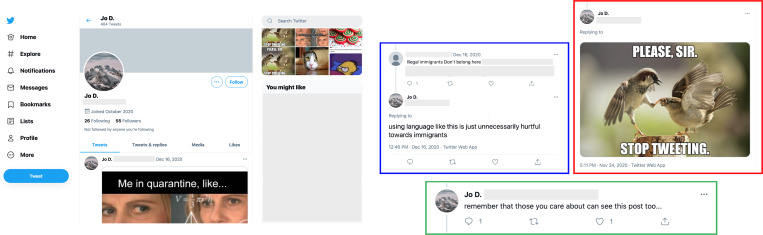
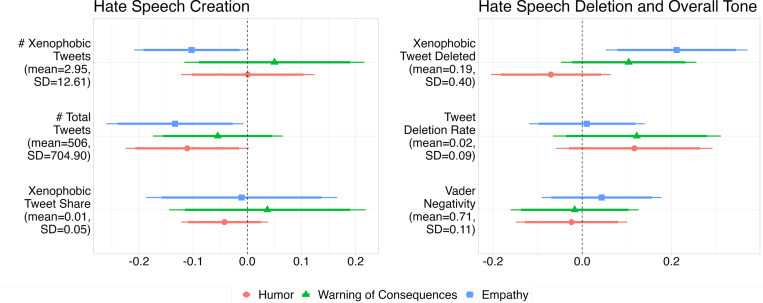
Despite heightened awareness of the detrimental impact of hate speech on social media platforms on affected communities and public discourse, there is little consensus on approaches to mitigate it. While content moderation—either by governments or social media companies—can curb online hostility, such policies may suppress valuable as well as illicit speech and might disperse rather than reduce hate speech. As an alternative strategy, an increasing number of international and nongovernmental organizations (I/NGOs) are employing counterspeech to confront and reduce online hate speech. Despite their growing popularity, there is scant experimental evidence on the effectiveness and design of counterspeech strategies (in the public domain). Modeling our interventions on current I/NGO practice, we randomly assign English-speaking Twitter users who have sent messages containing xenophobic (or racist) hate speech to one of three counterspeech strategies—empathy, warning of consequences, and humor—or a control group. Our intention-to-treat analysis of 1,350 Twitter users shows that empathy-based counterspeech messages can increase the retrospective deletion of xenophobic hate speech by 0.2 SD and reduce the prospective creation of xenophobic hate speech over a 4-wk follow-up period by 0.1 SD. We find, however, no consistent effects for strategies using humor or warning of consequences. Together, these results advance our understanding of the central role of empathy in reducing exclusionary behavior and inform the design of future counterspeech interventions.
Overview
The claims and statistics of this paper haven’t been checked yet.
Run the check — free, no account needed. It reads the open-access text and checks the sources it cites.
Integrity signals
Registry
Cites
Statistics
Figures
Verification
Claims the paper makes
The claims and statistics of this paper haven’t been checked yet.
Run the check — free, no account needed. It reads the open-access text and checks the sources it cites.
Claims other papers make about this one
Each is checked against this paper’s own text: does it say what the citing paper says it does?
The cited source says what the claim attributes to it.
In the citing paper
“Empathic and humanizing prompts have been shown to reduce affective polarization (Saveski et al., 2022) and racist harassment (Hangartner et al., 2021; Munger, 2017).”
From Social Drivers and Algorithmic Mechanisms on Digital Media. (2024) · cites this paper as Hangartner et al., 2021
The cited source says what the claim attributes to it.
In the citing paper
“For instance, identity-and empathy-based bystander interventions on social media can effectively reduce incivility (Munger 2020), hate speech (Hangartner et al. 2021, Munger 2017, Siegel & Badaan 2020), and misinformation (Pretus et al. 2022).”
From Social Media and Morality. (2024) · cites this paper as Hangartner et al. 2021
Self-check
Percentages, sums and reported differences re-computed from the paper’s own numbers.
The self-check needs the paper’s full text.
Citations
Cites
VADER: a parsimonious rule-based model for sentiment analysis of social media text
Hutto, C., & Gilbert, E. (2014) · Proceedings of the International AAAI Conference on Web and Social Media · doi:10.1609/icwsm.v8i1.14550 · Cited by 6,087
Inference on Treatment Effects after Selection among High-Dimensional Controls
Belloni, A., Chernozhukov, V., & Hansen, C. (2013) · The Review of Economic Studies · doi:10.1093/restud/rdt044 · Cited by 1,516
Prejudice Reduction: What Works? A Review and Assessment of Research and Practice
Paluck, E. L., & Green, D. P. (2009) · Annual Review of Psychology · doi:10.1146/annurev.psych.60.110707.163607 · Cited by 1,376
Durably reducing transphobia: A field experiment on door-to-door canvassing
Broockman, D., & Kalla, J. (2016) · Science · doi:10.1126/science.aad9713 · Cited by 798
Fanning the Flames of Hate: Social Media and Hate Crime
Müller, K., & Schwarz, C. (2021) · Journal of the European Economic Association · doi:10.1093/jeea/jvaa045 · Cited by 448
Tweetment Effects on the Tweeted: Experimentally Reducing Racist Harassment
Munger, K. (2017) · Political Behavior · doi:10.1007/s11109-016-9373-5 · Cited by 395
#No2Sectarianism: Experimental Approaches to Reducing Sectarian Hate Speech Online
Siegel, A. A., & Badaan, V. (2020) · American Political Science Review · doi:10.1017/s0003055420000283 · Cited by 135
Henson, B., Reyns, B. W., & Fisher, B. S. (2013) · Journal of Contemporary Criminal Justice · doi:10.1177/1043986213507403 · Cited by 123
Family Matters: How Immigrant Histories Can Promote Inclusion
Williamson, S., Adida, C. L., Lo, A., Izama, M. P., Prather, L., & Werfel, S. H. (2020) · American Political Science Review · doi:10.1017/s0003055420001057 · Cited by 102
Governing Online Speech: From 'Posts-As-Trumps' to Proportionality and ProbabilityPreprint
Douek, E. (2020) · SSRN Electronic Journal · doi:10.2139/ssrn.3679607 · Cited by 81
Considerations for Successful Counterspeech
Ruths, D. A., Saleem, H. M., Dillon, K. P., Wright, L. W., & Benesch, S. (2016) · doi:10.15868/socialsector.34065 · Cited by 40
Don’t @ Me: Experimentally Reducing Partisan Incivility on Twitter
Munger, K. (2021) · Journal of Experimental Political Science · doi:10.1017/xps.2020.14 · Cited by 31
Kim, J. S. (2021) · Democratic Legal Studies · doi:10.15756/dls.2021..75.222 · Cited by 8
Gennaro, G., & Hangartner, D. (2021) · Harvard Dataverse · doi:10.7910/dvn/arz9pu · Cited by 3
Self-citation
Research works printed but not linked: 2
- A. Siegel, Online Hate Speech in Social Media and Democracy: The State of the Field, Prospects for Reform (Cambridge University Press, 2020).
- I. Gagliardone, D. Gal, T. Alves, G. Martinez, Countering Online Hate Speech (United Nations Educational, Scientific and Cultural Organization, 2015).
Cited by
Sorted by citations
Social Drivers and Algorithmic Mechanisms on Digital Media.
Metzler, H., & Garcia, D. (2024) · Perspectives on Psychological Science · doi:10.1177/17456916231185057 · Cited by 204
“Empathic and humanizing prompts have been shown to reduce affective polarization (Saveski et al., 2022) and racist harassment (Hangartner et al., 2021; Munger, 2017).”
BackgroundVan Bavel, J. J., Robertson, C. E., del Rosario, K., Rasmussen, J., & Rathje, S. (2024) · Annual Review of Psychology · doi:10.1146/annurev-psych-022123-110258 · Cited by 121
Complaint De-Escalation Strategies on Social Media
Herhausen, D., Grewal, L. S., Cummings, K. H., Roggeveen, A. L., Ordenes, F. J. V., & Grewal, D. (2022) · Journal of Marketing · doi:10.1177/00222429221119977 · Cited by 83
Aridor, G., Jiménez-Durán, R., Levy, R., & Song, L. (2024) · Journal of Economic Literature · doi:10.1257/jel.20241743 · Cited by 85
ProsocialDialog: A prosocial backbone for conversational agents
Kim, H., Yu, Y., Jiang, L., Lu, X., Khashabi, D., Kim, G., Choi, Y., & Sap, M. (2022) · Proceedings of the 2022 Conference on Empirical Methods in Natural Language Processing · doi:10.18653/v1/2022.emnlp-main.267 · Cited by 80
Metadata
- Authors
- Hangartner, D., Gennaro, G., Alasiri, S., Bahrich, N., Bornhoft, A., Boucher, J., Demirci, B. B., Derksen, L., Hall, A., Jochum, M., Munoz, M. M., Richter, M., Vogel, F., Wittwer, S., Wüthrich, F., Gilardi, F., & Donnay, K.
- Affiliations
- ETH Zurich (CH)
- Center for Comparative and International Studies, Eidgenössische Technische Hochschule Zurich, 8092 Zurich, Switzerland;
- University of Zurich (CH)
- Corresponding author
- Hangartner, Dominik
- ORCID
- Venue
- Proceedings of the National Academy of Sciences
- Publisher
- National Academy of Sciences
- Published
- 2021-12-06
- Volume
- 118
- Issue
- 50
- ISSN
- 0027-8424 (ISSN-L)
- 1091-6490
- PMC
- PMC8685915
- OpenAlex
- W4200232392
- Cited by
- 144
- References
- 15
- Citations by year
- 2026: 20 · 2025: 44 · 2024: 42 · 2023: 23 · 2022: 13 · 2021: 2
- FWCI
- 7.07
- Type
- journal article
- Language
- en
- Open access
- hybrid
- doi.org
- Licence
- Locations
- Proceedings of the National Academy of Sciences (publishedVersion, cc-by-nc-nd)
- PubMed Central (publishedVersion, cc-by-nc-nd)
- PubMed (publishedVersion)
- Zurich Open Repository and Archive (University of Zurich) (acceptedVersion, cc-by-nc-nd)
- Repository for Publications and Research Data (ETH Zurich) (submittedVersion, cc-by-nc-nd)
- Zurich Open Repository and Archive (University of Zurich) (submittedVersion, cc-by-nc-nd)
- ETH Zürich Research Collection
- Zurich Open Repository and Archive (University of Zurich)
- Funders
- InnoSuisse (46165.1 IP-SBM)
- Swiss Federal Office of Communications (NA)
- Topics
- Physical Sciences › Computer Science › Artificial Intelligence › Hate Speech and Cyberbullying Detection
- Social Sciences › Sociology and Political Science › Social and Intergroup Psychology
- Social Sciences › Sociology and Political Science › Misinformation and Its Impacts
- Keywords
- counterspeech, hate speech, racism, xenophobia, empathy, humor, social media, Twitter, hate speech mitigation, online harassment
- MeSH terms
- Empathy, Hate, Humans, Language, Social Media, Racism
About these checks
Registry, retraction, Cites and statistics results are computed, not judged, with one exception: a printed reference that no index lists is read once by a model before it counts as a citation error. Claims are extracted by a model and kept only when their quote appears verbatim in the text; each cited source is then checked, with a model’s help, for whether it says what the claim relies on. Those verdicts can be wrong — read the claim’s quote and the cited source before relying on one.
Statistics and arithmetic are recomputed, not judged.
Confidence bands are shown only for fields calibrated on our annotated test set. None is calibrated yet, so no band is shown.
What counts as a claim ›How we measure confidence ›How we check this ›
Are you an author, or do you see a problem with this page? Request a review
