

Evaluating the structure-coefficient theorem of evolutionary game theory
Open accessThe DOI matches its Crossref record; 118 of the 120 references it cites were found in a registry or an index.
Abstract
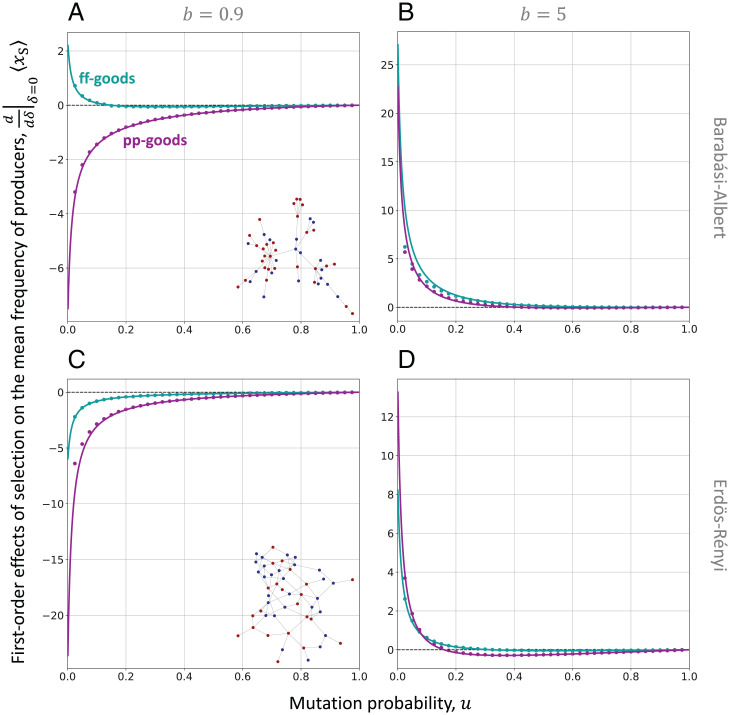
In order to accommodate the empirical fact that population structures are rarely simple, modern studies of evolutionary dynamics allow for complicated and highly heterogeneous spatial structures. As a result, one of the most difficult obstacles lies in making analytical deductions, either qualitative or quantitative, about the long-term outcomes of evolution. The “structure-coefficient” theorem is a well-known approach to this problem for mutation–selection processes under weak selection, but a general method of evaluating the terms it comprises is lacking. Here, we provide such a method for populations of fixed (but arbitrary) size and structure, using easily interpretable demographic measures. This method encompasses a large family of evolutionary update mechanisms and extends the theorem to allow for asymmetric contests to provide a better understanding of the mutation–selection balance under more realistic circumstances. We apply the method to study social goods produced and distributed among individuals in spatially heterogeneous populations, where asymmetric interactions emerge naturally and the outcome of selection varies dramatically, depending on the nature of the social good, the spatial topology, and the frequency with which mutations arise.
Overview
The claims and statistics of this paper haven’t been checked yet.
Free: it reads the open-access text and checks the first 5 claims that cite a source we can check. Create a free account to check every claim.
Integrity signals
Registry
Cites
Statistics
Figures

Verification
Claims the paper makes
The claims and statistics of this paper haven’t been checked yet.
Free: it reads the open-access text and checks the first 5 claims that cite a source we can check. Create a free account to check every claim.
Claims other papers make about this one
Each is checked against this paper’s own text: does it say what the citing paper says it does?
The cited source says what the claim attributes to it.
In the citing paper
“Furthermore, weak-mutation dynamics do not necessarily predict what happens when mutation rates are larger [36, 58].”
From Strategy evolution on dynamic networks (2023) · cites this paper as [36]
The cited source says what the claim attributes to it.
In the citing paper
“Calculating these coefficients is not straightforward, and only recently has a method been proposed for doing so on static networks [36].”
From Strategy evolution on dynamic networks (2023) · cites this paper as [36]
Self-check
Percentages, sums and reported differences re-computed from the paper’s own numbers.
The self-check needs the paper’s full text.
Citations
Cites
The genetical theory of natural selection
Fisher, R. A. (1930) · doi:10.5962/bhl.title.27468 · Cited by 17,617
The genetical evolution of social behaviour. I
Hamilton, W. D. (1964) · Journal of Theoretical Biology · doi:10.1016/0022-5193(64)90038-4 · Cited by 15,725
EVOLUTION IN MENDELIAN POPULATIONS
Wright, S. (1931) · Genetics · doi:10.1093/genetics/16.2.97 · Cited by 8,916
Evolution and the Theory of Games
Smith, J. M. (1988) · Did Darwin Get It Right? · doi:10.1007/978-1-4684-7862-4_22 · Cited by 7,906 · cited 1×
“Since its genesis in modeling animal conflict [53, 54], evolutionary game theory has proven itself to be a tremendous resource in the study of social evolution.”
BackgroundEvolution and the Theory of Games
Smith, J. M. (1982) · Cambridge University Press eBooks · doi:10.1017/cbo9780511806292 · Cited by 6,922 · cited 2×
“Since its genesis in modeling animal conflict (31, 76), evolutionary game theory has proven itself to be a tremendous resource in the study of social evolution.”
BackgroundEvolutionary Games and Population Dynamics
Hofbauer, J., & Sigmund, K. (1998) · doi:10.1017/cbo9781139173179 · Cited by 5,502 · cited 1×
“Deterministic approaches, such as those based on the replicator equation [55], often render the resulting models amenable to standard techniques from the theory of dynamical systems [56].”
BackgroundWright, S. (1943) · Genetics · doi:10.1093/genetics/28.2.114 · Cited by 5,479
SMITH, J. M., & PRICE, G. R. (1973) · Nature · doi:10.1038/246015a0 · Cited by 5,089
The genetical evolution of social behaviour. II
Hamilton, W. D. (1964) · Journal of Theoretical Biology · doi:10.1016/0022-5193(64)90039-6 · Cited by 4,144
Gene Flow and the Geographic Structure of Natural Populations
Slatkin, M. (1987) · Science · doi:10.1126/science.3576198 · Cited by 3,859 · cited 1×
“Decades of subsequent research clarified the empirical facts of population structure, as well as its importance in theoretical models of evolution (15, 16).”
Background
Research works printed but not linked: 1
- A. McAvoy, J. Wakeley, Code from Evaluating the structure-coefficient of evolutionary game theory. GitHub. https://github.com/alexmcavoy/sigma. Deposited 21 July 2021. PMC9282417 35787041
Cited by
Strategy evolution on higher-order networks
Sheng, A., Su, Q., Wang, L., & Plotkin, J. B. (2024) · Nature Computational Science · doi:10.1038/s43588-024-00621-8 · Cited by 141
“There has been less theoretical research on higher-order interactions than on strictly pairwise interactions 66,67 , with some notable exceptions 22–24 .”
Evolutionary dynamics of any multiplayer game on regular graphs
Wang, C., Perc, M., & Szolnoki, A. (2024) · Nature Communications · doi:10.1038/s41467-024-49505-5 · Cited by 117
Strategy evolution on dynamic networks
Su, Q., McAvoy, A., & Plotkin, J. B. (2023) · Nature Computational Science · doi:10.1038/s43588-023-00509-z · Cited by 97
“Calculating these coefficients is not straightforward, and only recently has a method been proposed for doing so on static networks 36 .”
BackgroundMethodSelf-citationPromoting collective cooperation through temporal interactions
Meng, Y., McAvoy, A., & Li, A. (2025) · Proceedings of the National Academy of Sciences · doi:10.1073/pnas.2509575122 · Cited by 38
Self-citationEffects of stochastic games on evolutionary dynamics in structured populations
Zhang, Y., Feng, M., Li, Q., Perc, M., & Szolnoki, A. (2026) · Communications Physics · doi:10.1038/s42005-026-02536-4 · Cited by 20
Metadata
- Authors
- McAvoy, A., & Wakeley, J.
- Affiliations
- Harvard University (US)
- Corresponding author
- McAvoy, Alex
- Wakeley, John
- ORCID
- McAvoy, Alex
- Venue
- Proceedings of the National Academy of Sciences
- Publisher
- National Academy of Sciences
- Published
- 2022-07-05
- Volume
- 119
- Issue
- 28
- Pages
- e2119656119-e2119656119
- ISSN
- 0027-8424 (ISSN-L)
- 1091-6490
- PMC
- PMC9282417
- OpenAlex
- W3096390162
- Cited by
- 23
- References
- 120
- Citations by year
- 2026: 6 · 2025: 4 · 2024: 7 · 2023: 4 · 2022: 2
- FWCI
- 6.12
- Type
- journal article
- Language
- en
- Open access
- hybrid
- doi.org
- Licence
- Locations
- Proceedings of the National Academy of Sciences (publishedVersion, cc-by-nc-nd)
- PubMed Central (publishedVersion, cc-by-nc-nd)
- PubMed (publishedVersion)
- arXiv (Cornell University) (submittedVersion)
- arXiv (Cornell University)
- Topics
- Social Sciences › Sociology and Political Science › Evolutionary Game Theory and Cooperation
- Life Sciences › Biochemistry, Genetics and Molecular Biology › Genetics › Evolution and Genetic Dynamics
- Physical Sciences › Mathematics › Applied Mathematics › Mathematical and Theoretical Epidemiology and Ecology Models
- Keywords
- evolutionary game theory, spatial structure, weak selection, mutation-selection balance, asymmetric contests, social good, population size, spatial topology, mutation rate
- MeSH terms
- Animals, Biological Evolution, Game Theory, Genetics, Population, Mutation
About these checks
Registry, retraction, Cites and statistics results are computed, not judged, with one exception: a printed reference that no index lists is read once by a model before it counts as a citation error. Claims are extracted by a model and kept only when their quote appears verbatim in the text; each cited source is then checked, with a model’s help, for whether it says what the claim relies on. Those verdicts can be wrong — read the claim’s quote and the cited source before relying on one.
Statistics and arithmetic are recomputed, not judged.
Confidence bands are shown only for fields calibrated on our annotated test set. None is calibrated yet, so no band is shown.
What counts as a claim ›How we measure confidence ›How we check this ›
Are you an author, or do you see a problem with this page? Request a review
How to cite
Cite CoChat for the checks on this page, and the paper for its own findings.
- This page
- CoChat. (2026). Citation check: Evaluating the structure-coefficient theorem of evolutionary game theory. https://app.cochat.ai/papers/10.1073/pnas.2119656119
- The paper
- McAvoy, A., & Wakeley, J. (2022). Evaluating the structure-coefficient theorem of evolutionary game theory. Proceedings of the National Academy of Sciences. https://doi.org/10.1073/pnas.2119656119
Data sources
Bibliographic data: Semantic Scholar, OpenAlex, Crossref.
Contains information from the Semantic Scholar Academic Graph Datasets, made available under the ODC Attribution License (ODC-BY 1.0).
Semantic Scholar’s data is described in: Kinney, R., et al. (2023). The Semantic Scholar Open Data Platform. arXiv:2301.10140.
