

Evaluating the structure-coefficient theorem of evolutionary game theory
Open accessThe DOI matches its Crossref record; 118 of the 120 references it cites were found in a registry or an index.
Abstract
In order to accommodate the empirical fact that population structures are rarely simple, modern studies of evolutionary dynamics allow for complicated and highly heterogeneous spatial structures. As a result, one of the most difficult obstacles lies in making analytical deductions, either qualitative or quantitative, about the long-term outcomes of evolution. The “structure-coefficient” theorem is a well-known approach to this problem for mutation–selection processes under weak selection, but a general method of evaluating the terms it comprises is lacking. Here, we provide such a method for populations of fixed (but arbitrary) size and structure, using easily interpretable demographic measures. This method encompasses a large family of evolutionary update mechanisms and extends the theorem to allow for asymmetric contests to provide a better understanding of the mutation–selection balance under more realistic circumstances. We apply the method to study social goods produced and distributed among individuals in spatially heterogeneous populations, where asymmetric interactions emerge naturally and the outcome of selection varies dramatically, depending on the nature of the social good, the spatial topology, and the frequency with which mutations arise.
Overview
The claims and statistics of this paper haven’t been checked yet.
Free: it reads the open-access text and checks the first 5 claims that cite a source we can check. Create a free account to check every claim.
Integrity signals
Registry
Cites
Statistics
Figures
Verification
Claims the paper makes
The claims and statistics of this paper haven’t been checked yet.
Free: it reads the open-access text and checks the first 5 claims that cite a source we can check. Create a free account to check every claim.
Claims other papers make about this one
Each is checked against this paper’s own text: does it say what the citing paper says it does?
The cited source says what the claim attributes to it.
In the citing paper
“Furthermore, weak-mutation dynamics do not necessarily predict what happens when mutation rates are larger [36, 58].”
From Strategy evolution on dynamic networks (2023) · cites this paper as [36]
The cited source says what the claim attributes to it.
In the citing paper
“Calculating these coefficients is not straightforward, and only recently has a method been proposed for doing so on static networks [36].”
From Strategy evolution on dynamic networks (2023) · cites this paper as [36]
Self-check
Percentages, sums and reported differences re-computed from the paper’s own numbers.
The self-check needs the paper’s full text.
Citations
Cites
The genetical theory of natural selection
Fisher, R. A. (1930) · doi:10.5962/bhl.title.27468 · Cited by 17,617
The genetical evolution of social behaviour. I
Hamilton, W. D. (1964) · Journal of Theoretical Biology · doi:10.1016/0022-5193(64)90038-4 · Cited by 15,725
EVOLUTION IN MENDELIAN POPULATIONS
Wright, S. (1931) · Genetics · doi:10.1093/genetics/16.2.97 · Cited by 8,916
Evolution and the Theory of Games
Smith, J. M. (1988) · Did Darwin Get It Right? · doi:10.1007/978-1-4684-7862-4_22 · Cited by 7,906 · cited 1×
“Since its genesis in modeling animal conflict [53, 54], evolutionary game theory has proven itself to be a tremendous resource in the study of social evolution.”
BackgroundEvolution and the Theory of Games
Smith, J. M. (1982) · Cambridge University Press eBooks · doi:10.1017/cbo9780511806292 · Cited by 6,922 · cited 2×
“Since its genesis in modeling animal conflict (31, 76), evolutionary game theory has proven itself to be a tremendous resource in the study of social evolution.”
BackgroundEvolutionary Games and Population Dynamics
Hofbauer, J., & Sigmund, K. (1998) · doi:10.1017/cbo9781139173179 · Cited by 5,502 · cited 1×
“Deterministic approaches, such as those based on the replicator equation [55], often render the resulting models amenable to standard techniques from the theory of dynamical systems [56].”
BackgroundWright, S. (1943) · Genetics · doi:10.1093/genetics/28.2.114 · Cited by 5,479
SMITH, J. M., & PRICE, G. R. (1973) · Nature · doi:10.1038/246015a0 · Cited by 5,089
The genetical evolution of social behaviour. II
Hamilton, W. D. (1964) · Journal of Theoretical Biology · doi:10.1016/0022-5193(64)90039-6 · Cited by 4,144
Gene Flow and the Geographic Structure of Natural Populations
Slatkin, M. (1987) · Science · doi:10.1126/science.3576198 · Cited by 3,859 · cited 1×
“Decades of subsequent research clarified the empirical facts of population structure, as well as its importance in theoretical models of evolution (15, 16).”
BackgroundEvolutionary stable strategies and game dynamics
Taylor, P. D., & Jonker, L. B. (1978) · Mathematical Biosciences · doi:10.1016/0025-5564(78)90077-9 · Cited by 3,450 · cited 2×
“The replicator equation has been generalized to include mutation (91), bridging the gap between replicator dynamics (77) for frequency-dependent selection (without mutation) and quasispecies evolution under strong mutation and frequency-independent selection.”
BackgroundMeasurement and analysis of online social networks
Mislove, A., Marcon, M., Gummadi, K. P., Druschel, P., & Bhattacharjee, B. (2007) · Proceedings of the 7th ACM SIGCOMM conference on Internet measurement · doi:10.1145/1298306.1298311 · Cited by 3,057 · cited 1×
“On a very different scale, global human social networks are known to consist of many highly-connected clusters, often held together by dense cores [5], which can in turn affect both public opinion [6] and disease transmission [7, 8].”
BackgroundSzabó, G., & Fáth, G. (2007) · Physics Reports · doi:10.1016/j.physrep.2007.04.004 · Cited by 2,974 · cited 1×
“This trade-off between model complexity and tractability has prompted a variety of approaches ranging from approximation techniques [39, 40] to exact results on homogeneous population structures [41–44] to the analysis of simulation algorithms [45].”
MethodA Strategic Model of Social and Economic Networks
Jackson, M. O., & Wolinsky, A. (1996) · Journal of Economic Theory · doi:10.1006/jeth.1996.0108 · Cited by 2,588 · cited 1×
“For other kinds of divisible goods, such as food shared among vampire bats (28) or the time and effort a researcher allocates across several collaborations (29), a more natural assumption might be that the good is produced once, and the benefit, b, is divided among neighbors (30).”
BackgroundA simple rule for the evolution of cooperation on graphs and social networks
Ohtsuki, H., Hauert, C., Lieberman, E., & Nowak, M. A. (2006) · Nature · doi:10.1038/nature04605 · Cited by 2,208 · cited 1×
“This trade-off between model complexity and tractability has prompted a variety of approaches, ranging from approximation techniques (37, 38) to exact results on homogeneous population structures (39–43) to the analysis of simulation algorithms (44).”
BackgroundGene Flow in Natural Populations
Slarkin, M. (1985) · Annual Review of Ecology and Systematics · doi:10.1146/annurev.es.16.110185.002141 · Cited by 2,058 · cited 1×
“Decades of subsequent research clarified the empirical facts of population structure, as well as its importance in theoretical models of evolution (15, 16).”
BackgroundThe logic of asymmetric contests
Smith, J. M., & Parker, G. A. (1976) · Animal Behaviour · doi:10.1016/s0003-3472(76)80110-8 · Cited by 1,945 · cited 2×
“J. Maynard Smith, G. A. Parker, The logic of asymmetric contests.”
BackgroundGene genealogies and the coalescent process.
Hudson, R. R. (1990) · Medical Entomology and Zoology · Cited by 1,838
Kimura, M., & Weiss, G. H. (1964) · Genetics · doi:10.1093/genetics/49.4.561 · Cited by 1,709
Local dispersal promotes biodiversity in a real-life game of rock–paper–scissors
Kerr, B., Riley, M. A., Feldman, M. W., & Bohannan, B. J. M. (2002) · Nature · doi:10.1038/nature00823 · Cited by 1,623 · cited 1×
“That interaction structure and reproductive structure may work together nonindependently has been further emphasized by laboratory experiments (25, 26).”
BackgroundThe Genetical Theory of Natural Selection.
H., A. B., & Fisher, R. A. (1931) · Journal of the Royal Statistical Society · doi:10.2307/2341823 · Cited by 1,526
Emergence of cooperation and evolutionary stability in finite populations
Nowak, M. A., Sasaki, A., Taylor, C., & Fudenberg, D. (2004) · Nature · doi:10.1038/nature02414 · Cited by 1,399 · cited 2×
“When selection is weak and mutations appear sufficiently infrequently, the problem can be reduced to a consideration of fixation probabilities (46, 47, 51, 52).”
BackgroundEvolutionary dynamics on graphs
Lieberman, E., Hauert, C., & Nowak, M. A. (2005) · Nature · doi:10.1038/nature03204 · Cited by 1,337 · cited 1×
“New areas of research have emerged since the introduction of graphs to represent general population structures in evolutionary game theory [24–27].”
BackgroundReciprocal food sharing in the vampire bat
Wilkinson, G. S. (1984) · Nature · doi:10.1038/308181a0 · Cited by 1,016 · cited 1×
“For other kinds of divisible goods, such as food shared among vampire bats (28) or the time and effort a researcher allocates across several collaborations (29), a more natural assumption might be that the good is produced once, and the benefit, b, is divided among neighbors (30).”
BackgroundEVOLUTION IN MENDELIAN POPULATIONS
Wright, S. (1931) · Genetics · doi:10.1093/genetics/16.3.290 · Cited by 770
Les mathématiques de l'hérédité
Malécot, G. (1948) · Masson eBooks · Cited by 676
Eigen, M., McCaskill, J., & Schuster, P. (1988) · The Journal of Physical Chemistry · doi:10.1021/j100335a010 · Cited by 670 · cited 1×
“If it is high enough, the resulting “quasispecies” crosses an error threshold beyond which adaptation is impossible [84].”
BackgroundHow to Make a Kin Selection Model
Taylor, P. D., & Frank, S. A. (1996) · Journal of Theoretical Biology · doi:10.1006/jtbi.1996.0075 · Cited by 581
Sigmund, K. (2010) · doi:10.1515/9781400832255 · Cited by 570
A note on evolutionarily stable strategies in asymmetric animal conflicts
Selten, R. (1980) · Journal of Theoretical Biology · doi:10.1016/s0022-5193(80)81038-1 · Cited by 556 · cited 1×
“It was subsequently shown that if two opposing individuals always have different roles, such as “owner” and “intruder,” then an evolutionarily stable strategy must be a pure strategy [90].”
BackgroundEvolutionary dynamics on any population structure
Allen, B., Lippner, G., Chen, Y.-T., Fotouhi, B., Momeni, N., Yau, S.-T., & Nowak, M. A. (2017) · Nature · doi:10.1038/nature21723 · Cited by 534 · cited 1×
“Recent techniques allow one to compute fixation probabilities in populations with arbitrary spatial structure (53, 54).”
MethodSocial Media, Network Heterogeneity, and Opinion Polarization
Lee, J. K., Choi, J., Kim, C., & Kim, Y. (2014) · Journal of Communication · doi:10.1111/jcom.12077 · Cited by 457
Evolutionary game dynamics in finite populations
TAYLOR, C., FUDENBERG, D., SASAKI, A., & NOWAK, M. (2004) · Bulletin of Mathematical Biology · doi:10.1016/j.bulm.2004.03.004 · Cited by 427 · cited 1×
“When selection is weak, neutral probabilities of identity by state play a key role in the outcome of frequencydependent selection (46, 74).”
BackgroundTHE PRICE EQUATION, FISHER'S FUNDAMENTAL THEOREM, KIN SELECTION, AND CAUSAL ANALYSIS
Frank, S. A. (1997) · Evolution · doi:10.1111/j.1558-5646.1997.tb05096.x · Cited by 356
Group size, grooming and social cohesion in primates
Lehmann, J., Korstjens, A. H., & Dunbar, R. I. M. (2007) · Animal Behaviour · doi:10.1016/j.anbehav.2006.10.025 · Cited by 339
Evolutionary games with environmental feedbacks
Tilman, A. R., Plotkin, J. B., & Akçay, E. (2020) · Nature Communications · doi:10.1038/s41467-020-14531-6 · Cited by 337 · cited 1×
“Related to this point, another interesting extension would account for feedback between individuals and the environment as a way to capture ecosystem engineering [71–73].”
BackgroundThe Evolution of Cooperation in a Lattice-Structured Population
Nakamaru, M., Matsuda, H., & Iwasa, Y. (1997) · Journal of Theoretical Biology · doi:10.1006/jtbi.1996.0243 · Cited by 335
Imitation processes with small mutations
Fudenberg, D., & Imhof, L. A. (2006) · Journal of Economic Theory · doi:10.1016/j.jet.2005.04.006 · Cited by 335 · cited 2×
“When selection is weak and mutations appear sufficiently infrequently, the problem can be reduced to a consideration of fixation probabilities (46, 47, 51, 52).”
BackgroundFranklin, R. B., & Mills, A. L. (2003) · FEMS Microbiology Ecology · doi:10.1016/s0168-6496(03)00074-6 · Cited by 322 · cited 1×
“Microbes exhibit strong spatial heterogeneity in response to variation in temperature, pH, and vegetation cover in terrestrial soils [3] and to harsh environmental gradients and patchy habitats at deep-sea hydrothermal vents [4].”
BackgroundUnifying Evolutionary Dynamics
PAGE, K. M., & NOWAK, M. A. (2002) · Journal of Theoretical Biology · doi:10.1006/jtbi.2002.3112 · Cited by 315 · cited 1×
“The replicator equation has been generalized to include mutation (91), bridging the gap between replicator dynamics (77) for frequency-dependent selection (without mutation) and quasispecies evolution under strong mutation and frequency-independent selection.”
BackgroundEvolution of cooperation in a finite homogeneous graph
Taylor, P. D., Day, T., & Wild, G. (2007) · Nature · doi:10.1038/nature05784 · Cited by 302
Adaptive Genetic Variation on the Landscape: Methods and Cases
Schoville, S. D., Bonin, A., François, O., Lobreaux, S., Melodelima, C., & Manel, S. (2012) · Annual Review of Ecology, Evolution, and Systematics · doi:10.1146/annurev-ecolsys-110411-160248 · Cited by 297 · cited 1×
“Recent interest has focused on the interplay of natural selection and population structure [15, 16] and on the effects of explicitly spatial structure on organismal relationships [17].”
BackgroundStrategy selection in structured populations
Tarnita, C. E., Ohtsuki, H., Antal, T., Fu, F., & Nowak, M. A. (2009) · Journal of Theoretical Biology · doi:10.1016/j.jtbi.2009.03.035 · Cited by 281 · cited 6×
“(58) elegantly boiled down the question of whether a trait is favored to a single quantity called the structure coefficient.”
BackgroundMethodInfluentialFixation of Strategies for an Evolutionary Game in Finite Populations
Antal, T., & Scheuring, I. (2006) · Bulletin of Mathematical Biology · doi:10.1007/s11538-006-9061-4 · Cited by 279 · cited 1×
“For instance, it is known that for some kinds of frequency-dependent interactions, in which coexistence is possible for extended periods of time, the maximum allowable mutation probability decays exponentially in the population size (55, 56).”
BackgroundBreaking the Symmetry between Interaction and Replacement in Evolutionary Dynamics on Graphs
Ohtsuki, H., Nowak, M. A., & Pacheco, J. M. (2007) · Physical Review Letters · doi:10.1103/physrevlett.98.108106 · Cited by 271 · cited 1×
“New areas of research have emerged since the introduction of graphs to represent general population structures in evolutionary game theory [24–27].”
BackgroundExploration dynamics in evolutionary games
Traulsen, A., Hauert, C., De Silva, H., Nowak, M. A., & Sigmund, K. (2009) · Proceedings of the National Academy of Sciences · doi:10.1073/pnas.0808450106 · Cited by 271 · cited 1×
“(60) also found nonmonotonicity, but only in games with more than two traits.”
BackgroundHuss, J. M. (2017) · Cited by 265
Allele-Frequency Change in a Class-Structured Population
Taylor, P. D. (1990) · The American Naturalist · doi:10.1086/285034 · Cited by 255
Unifying Evolutionary Dynamics
Page, K. M. (2002) · Journal of Theoretical Biology · doi:10.1016/s0022-5193(02)93112-7 · Cited by 241
Game-Theoretical Models in Biology
Broom, M., & Rychtar, J. (2013) · Chapman & Hall/CRC eBooks · doi:10.1201/b14069 · Cited by 227 · cited 1×
“producer versus nonproducer) but on other factors as well, including group sizes [31, 32].”
BackgroundEvolution of cooperation by phenotypic similarity
Antal, T., Ohtsuki, H., Wakeley, J., Taylor, P. D., & Nowak, M. A. (2009) · Proceedings of the National Academy of Sciences · doi:10.1073/pnas.0902528106 · Cited by 224 · cited 1×
“One fruitful way forward is to assume that selection is weak, in which case the fundamental property of increased local relatedness can be captured with relative ease [34–39].”
BackgroundSelf-citationThe hawk-dove game played between relatives
Grafen, A. (1979) · Animal Behaviour · doi:10.1016/0003-3472(79)90028-9 · Cited by 219 · cited 1×
“The models of evolutionary game theory are models of frequency-dependent selection, and similar notions of non-uniform interaction have been proposed even in models of infinite populations [20–23].”
BackgroundNowak, M. A. (1992) · Trends in Ecology & Evolution · doi:10.1016/0169-5347(92)90145-2 · Cited by 192
Evolutionary graph theory: Breaking the symmetry between interaction and replacement
Ohtsuki, H., Pacheco, J. M., & Nowak, M. A. (2007) · Journal of Theoretical Biology · doi:10.1016/j.jtbi.2007.01.024 · Cited by 192
Rousset, & Billiard (2000) · Journal of Evolutionary Biology · doi:10.1046/j.1420-9101.2000.00219.x · Cited by 189 · cited 4×
“When selection is weak, neutral probabilities of identity by state play a key role in outcome of selection via a game [47, 71].”
BackgroundInfluentialThe selection mutation equation
Hofbauer, J. (1985) · Journal of Mathematical Biology · doi:10.1007/bf00276557 · Cited by 173 · cited 1×
“Mutation has long been recognized as an integral part of evolutionary game theory, in both deterministic [58, 59] and stochastic [60–62] models.”
BackgroundAn analysis of the fixation probability of a mutant on special classes of non-directed graphs
Broom, M., & Rychtář, J. (2008) · Proceedings of the Royal Society A: Mathematical, Physical and Engineering Sciences · doi:10.1098/rspa.2008.0058 · Cited by 173 · cited 1×
“New areas of research have emerged since the introduction of graphs to represent general population structures in evolutionary game theory [24–27].”
BackgroundMutation-selection equilibrium in games with multiple strategies
Antal, T., Traulsen, A., Ohtsuki, H., Tarnita, C. E., & Nowak, M. A. (2009) · Journal of Theoretical Biology · doi:10.1016/j.jtbi.2009.02.010 · Cited by 153 · cited 1×
“Mutation has long been recognized as an integral part of evolutionary game theory, in both deterministic [58, 59] and stochastic [60–62] models.”
BackgroundSpatial Population Genetics: It's About Time
Bradburd, G. S., & Ralph, P. L. (2019) · Annual Review of Ecology Evolution and Systematics · doi:10.1146/annurev-ecolsys-110316-022659 · Cited by 149 · cited 1×
“Recent interest has focused on the interplay of natural selection and population structure [15, 16] and on the effects of explicitly spatial structure on organismal relationships [17].”
BackgroundSocial evolution in structured populations
Débarre, F., Hauert, C., & Doebeli, M. (2014) · Nature Communications · doi:10.1038/ncomms4409 · Cited by 147 · cited 2×
“If one models the effects of selection on fecundity and survival separately, using different payoff matrices for each, then the structure-coefficient theorem involves two weights, one for each step of the life cycle (41).”
BackgroundMethodHarmsen, H., Prieur, D., & Jeanthon, C. (1997) · Applied and Environmental Microbiology · doi:10.1128/aem.63.7.2876-2883.1997 · Cited by 140 · cited 1×
“Microbes exhibit strong spatial heterogeneity in response to variation in temperature, pH, and vegetation cover in terrestrial soils [3] and to harsh environmental gradients and patchy habitats at deep-sea hydrothermal vents [4].”
BackgroundAN EXPERIMENTAL STUDY OF KIN SELECTION
Wade, M. J. (1980) · Evolution · doi:10.1111/j.1558-5646.1980.tb04023.x · Cited by 130 · cited 1×
“That interaction structure and reproductive structure may work together nonindependently has been further emphasized by laboratory experiments (25, 26).”
BackgroundEvolutionary Game Dynamics in Populations with Heterogenous Structures
Maciejewski, W., Fu, F., & Hauert, C. (2014) · PLoS Computational Biology · doi:10.1371/journal.pcbi.1003567 · Cited by 129 · cited 2×
“These two forms of Fi are equivalent under weak selection, so we do not need to explicitly choose one (75).”
BackgroundAsymmetric evolutionary games with environmental feedback
Hauert, C., Saade, C., & McAvoy, A. (2018) · Journal of Theoretical Biology · doi:10.1016/j.jtbi.2018.11.019 · Cited by 124 · cited 1×
“Related to this point, another interesting extension would account for feedback between individuals and the environment as a way to capture ecosystem engineering [71–73].”
BackgroundSelf-citationHigh mutation rates limit evolutionary adaptation in Escherichia coli
Sprouffske, K., Aguilar-Rodríguez, J., Sniegowski, P., & Wagner, A. (2018) · PLoS Genetics · doi:10.1371/journal.pgen.1007324 · Cited by 121
Dynamics of COVID-19 under social distancing measures are driven by transmission network structure
Nande, A., Adlam, B., Sheen, J. K., Levy, M. Z., & Hill, A. L. (2021) · PLoS Computational Biology · doi:10.1371/journal.pcbi.1008684 · Cited by 121 · cited 1×
“On a very different scale, global human social networks are known to consist of many highly-connected clusters, often held together by dense cores [5], which can in turn affect both public opinion [6] and disease transmission [7, 8].”
BackgroundThe formal darwinism project in outline
Grafen, A. (2014) · Biology & Philosophy · doi:10.1007/s10539-013-9414-y · Cited by 117 · cited 1×
“This effect is conceptually similar to the ways in which the infidelity of Mendelian transmission of diploid phenotypes can alter evolutionary game-theoretic predictions relative to those based on simple haploid systems (87, 88).”
BackgroundHow small are small mutation rates?
Wu, B., Gokhale, C. S., Wang, L., & Traulsen, A. (2011) · Journal of Mathematical Biology · doi:10.1007/s00285-011-0430-8 · Cited by 116 · cited 1×
“For instance, it is known that for some kinds of frequency-dependent interactions, in which coexistence is possible for extended periods of time, the maximum allowable mutation probability decays exponentially in the population size (55, 56).”
BackgroundMcAvoy, A., & Hauert, C. (2015) · PLoS Computational Biology · doi:10.1371/journal.pcbi.1004349 · Cited by 108 · cited 1×
“In such an asymmetric [75] (or bimatrix [76]) game, the total payoff to individual i in state x is”
BackgroundSelf-citationEnvironmentally Mediated Social Dilemmas
Estrela, S., Libby, E., Van Cleve, J., Débarre, F., Deforet, M., Harcombe, W. R., Peña, J., Brown, S. P., & Hochberg, M. E. (2019) · Trends in Ecology & Evolution · doi:10.1016/j.tree.2018.10.004 · Cited by 107 · cited 1×
“Related to this point, another interesting extension would account for feedback between individuals and the environment as a way to capture ecosystem engineering [71–73].”
BackgroundMultiple strategies in structured populations
Tarnita, C. E., Wage, N., & Nowak, M. A. (2011) · Proceedings of the National Academy of Sciences · doi:10.1073/pnas.1016008108 · Cited by 106 · cited 9×
“[1, 2] and give an example of a natural model of finite-population evolution that falls outside of its original scope but is covered by the methods presented here.”
BackgroundMethodInfluentialThe probability of fixation of a single mutant in an exchangeable selection model
Lessard, S., & Ladret, V. (2007) · Journal of Mathematical Biology · doi:10.1007/s00285-007-0069-7 · Cited by 105 · cited 1×
“One fruitful way forward is to assume that selection is weak, in which case the fundamental property of increased local relatedness can be captured with relative ease [34–39].”
BackgroundReproductive Value and the Stochastic Demography of Age-Structured Populations
Engen, S., Lande, R., Sæther, B., & Dobson, F. S. (2009) · The American Naturalist · doi:10.1086/647930 · Cited by 103
Measures of success in a class of evolutionary models with fixed population size and structure
Allen, B., & Tarnita, C. E. (2012) · Journal of Mathematical Biology · doi:10.1007/s00285-012-0622-x · Cited by 100 · cited 1×
“This “replacement rule” (65, 66) depends on the state of the population because individual fecundities are affected by game payoffs.”
BackgroundRoze, D., & Rousset, F. (2003) · Genetics · doi:10.1093/genetics/165.4.2153 · Cited by 99
Game-Theoretical Models in Biology
Broom, M., & Rychtář, J. (2022) · Chapman & Hall/CRC eBooks · doi:10.1201/9781003024682 · Cited by 96
Social goods dilemmas in heterogeneous societies
McAvoy, A., Allen, B., & Nowak, M. A. (2020) · Nature Human Behaviour · doi:10.1038/s41562-020-0881-2 · Cited by 94 · cited 3×
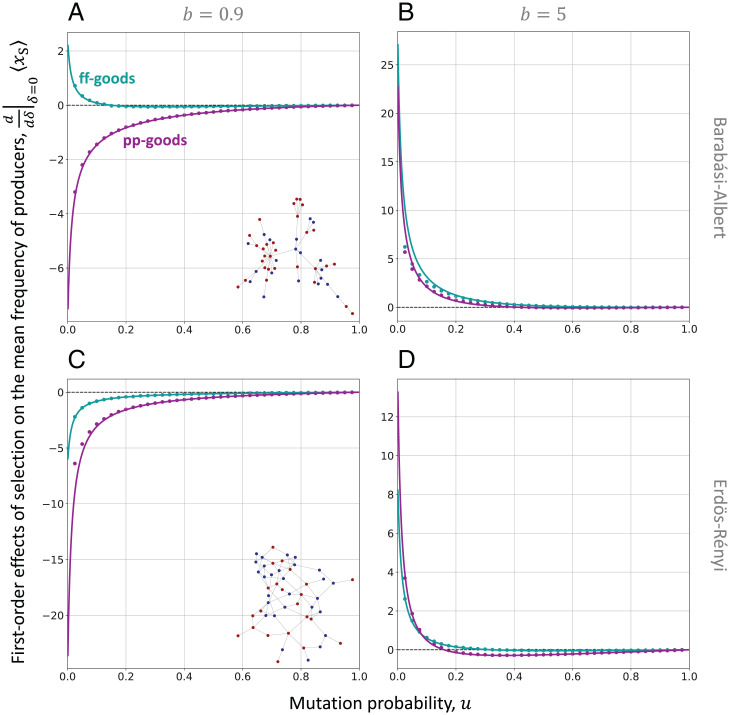
“This seemingly paradoxical behavior is consistent with what is observed for ff-goods from an analysis of fixation probabilities in the weak-mutation limit (63)—namely, that they benefit from the existence of a small number of highly connected hubs.”
BackgroundResultInfluentialSelf-citationHines, W. G. S., & Smith, J. M. (1979) · Journal of Theoretical Biology · doi:10.1016/0022-5193(79)90254-6 · Cited by 92
Evolutionary game dynamics with non-uniform interaction rates
Taylor, C., & Nowak, M. A. (2006) · Theoretical Population Biology · doi:10.1016/j.tpb.2005.06.009 · Cited by 91 · cited 1×
“The models of evolutionary game theory are models of frequency-dependent selection, and similar notions of non-uniform interaction have been proposed even in models of infinite populations [20–23].”
BackgroundHow mutation affects evolutionary games on graphs
Allen, B., Traulsen, A., Tarnita, C. E., & Nowak, M. A. (2012) · Journal of Theoretical Biology · doi:10.1016/j.jtbi.2011.03.034 · Cited by 90 · cited 1×
“Mutation has long been recognized as an integral part of evolutionary game theory, in both deterministic [58, 59] and stochastic [60–62] models.”
BackgroundReplicator-mutator equation, universality property and population dynamics of learning
Komarova, N. L. (2004) · Journal of Theoretical Biology · doi:10.1016/j.jtbi.2004.05.004 · Cited by 82 · cited 1×
“A notable application is to language learning in populations (92).”
BackgroundA social network analysis of the spread of COVID-19 in South Korea and policy implications
Jo, W., Chang, D., You, M., & Ghim, G.-H. (2021) · Scientific Reports · doi:10.1038/s41598-021-87837-0 · Cited by 80
Social evolution and genetic interactions in the short and long term
Cleve, J. V. (2014) · Theoretical Population Biology · doi:10.1016/j.tpb.2015.05.002 · Cited by 77
The Relation Between Reproductive Value and Genetic Contribution
Barton, N., & Etheridge, A. M. (2011) · Genetics · doi:10.1534/genetics.111.127555 · Cited by 75
Evolution of discrete populations and the canonical diffusion of adaptive dynamics
Champagnat, N., & Lambert, A. (2007) · The Annals of Applied Probability · doi:10.1214/105051606000000628 · Cited by 74 · cited 1×
“Mutation probabilities, especially in a genetic context, are often small, which can serve as partial justification for why a theoretician might consider only rare-mutation dynamics [63–67].”
BackgroundFixation probabilities in evolutionary dynamics under weak selection
McAvoy, A., & Allen, B. (2021) · Journal of Mathematical Biology · doi:10.1007/s00285-021-01568-4 · Cited by 74 · cited 1×
“Recent techniques allow one to compute fixation probabilities in populations with arbitrary spatial structure (53, 54).”
MethodSelf-citationSocial goods dilemmas in heterogeneous societies
McAvoy, A., Allen, B., & Nowak, M. A. (2020) · RePEc: Research Papers in Economics · Cited by 73
Self-citationComputation and Simulation of Evolutionary Game Dynamics in Finite Populations
Hindersin, L., Wu, B., Traulsen, A., & García, J. (2019) · Scientific Reports · doi:10.1038/s41598-019-43102-z · Cited by 69
The Relative Value of the Processes Causing Evolution
Hagedoorn, A. L., & Brand, A. C. H.-V. L. (1921) · Springer eBooks · doi:10.1007/978-94-017-4728-8 · Cited by 68
Maruyama, T. (1971) · Annals of Human Genetics · doi:10.1111/j.1469-1809.1956.tb01391.x · Cited by 67
Computational complexity of ecological and evolutionary spatial dynamics
Ibsen-Jensen, R., Chatterjee, K., & Nowak, M. A. (2015) · Proceedings of the National Academy of Sciences · doi:10.1073/pnas.1511366112 · Cited by 66 · cited 1×
“Outside of the realm of weak selection, there need not be any efficient algorithm for evaluating a population’s evolutionary dynamics in general (79), a conclusion that has prompted other kinds of computational techniques, such as the development of more efficient algorithms for numerical simulation (44).”
BackgroundAnalysis of population structure: One‐dimensional stepping‐stone models of finite length*
Maruyama, T. (1970) · Annals of Human Genetics · doi:10.1111/j.1469-1809.1970.tb00235.x · Cited by 55
Reproductive value in graph-structured populations
Maciejewski, W. (2014) · Journal of Theoretical Biology · doi:10.1016/j.jtbi.2013.09.032 · Cited by 51 · cited 1×
“The quantity v∗ i is a type of reproductive value [65, 70] but one that depends on the mutation probability because it accounts for identity by descent.”
BackgroundReciprocity and behavioral heterogeneity govern the stability of social networks
Dakin, R., & Ryder, T. B. (2020) · Proceedings of the National Academy of Sciences · doi:10.1073/pnas.1913284117 · Cited by 51 · cited 1×
“Today there is ample evidence that heterogeneity in both interactions and trait transmission is widespread in nature, ranging from the scale of microbial populations [2, 3] to global human social networks [4, 5].”
BackgroundReproductive Value and the Stochastic Demography of Age-Structured Populations
Engen, Lande, Sæther, & Dobson (2009) · The American Naturalist · doi:10.2307/27735895 · Cited by 49
Collapse and rescue of cooperation in evolving dynamic networks
Akçay, E. (2018) · Nature Communications · doi:10.1038/s41467-018-05130-7 · Cited by 47 · cited 1×
“For other kinds of divisible goods, such as food shared among vampire bats (28) or the time and effort a researcher allocates across several collaborations (29), a more natural assumption might be that the good is produced once, and the benefit, b, is divided among neighbors (30).”
BackgroundStochastic evolutionary dynamics of bimatrix games
Ohtsuki, H. (2010) · Journal of Theoretical Biology · doi:10.1016/j.jtbi.2010.01.016 · Cited by 46 · cited 1×
“In such an asymmetric [75] (or bimatrix [76]) game, the total payoff to individual i in state x is”
BackgroundEvolutionary prisoner’s dilemma games coevolving on adaptive networks
Lee, H., Malik, N., & Mucha, P. J. (2017) · Journal of Complex Networks · doi:10.1093/comnet/cnx018 · Cited by 46
Sharp benefit-to-cost rules for the evolution of cooperation on regular graphs
Chen, Y.-T. (2013) · The Annals of Applied Probability · doi:10.1214/12-aap849 · Cited by 42 · cited 1×
“This trade-off between model complexity and tractability has prompted a variety of approaches ranging from approximation techniques [28, 29] to exact results on simplified population structures [30–33].”
MethodFisher's Malthusian parameter and reproductive value
Price, G., & Smith, C. A. B. (1972) · Annals of Human Genetics · doi:10.1111/j.1469-1809.1972.tb00577.x · Cited by 40
The Structure of Mutations and the Evolution of Cooperation
García, J., & Traulsen, A. (2012) · PLoS ONE · doi:10.1371/journal.pone.0035287 · Cited by 38
The phenotypic gambit: selective pressures and ESS methodology in evolutionary game theory
Rubin, H. (2016) · Biology & Philosophy · doi:10.1007/s10539-016-9524-4 · Cited by 38
A mathematical formalism for natural selection with arbitrary spatial and genetic structure
Allen, B., & McAvoy, A. (2019) · Journal of Mathematical Biology · doi:10.1007/s00285-018-1305-z · Cited by 37 · cited 12×
“A. McAvoy, B. Allen, Fixation probabilities in evolutionary dynamics under weak selection.”
BackgroundMethodInfluentialSelf-citationDistribution of repetitions of ancestors in genealogical trees
Derrida, B., Manrubia, S. C., & Zanette, D. H. (2000) · Physica A Statistical Mechanics and its Applications · doi:10.1016/s0378-4371(00)00031-5 · Cited by 35
Finite-population evolution with rare mutations in asymmetric games
Veller, C., & Hayward, L. K. (2016) · Journal of Economic Theory · doi:10.1016/j.jet.2015.12.005 · Cited by 34
Measures of Relative Fitness of Social Behaviors in Finite Structured Population Models
Tarnita, C. E., & Taylor, P. (2014) · The American Naturalist · doi:10.1086/677924 · Cited by 34 · cited 1×
“Mutation has long been recognized as an integral part of evolutionary game theory, in both deterministic [58, 59] and stochastic [60–62] models.”
BackgroundAkçay, E. (2019) · The American Naturalist · doi:10.1086/706811 · Cited by 34 · cited 1×
“These considerations are among many that would be necessary for a deeper understanding of social evolution (86).”
BackgroundOrigin and Structure of Dynamic Cooperative Networks
Wardil, L., & Hauert, C. (2014) · Scientific Reports · doi:10.1038/srep05725 · Cited by 33 · cited 1×
“Dynamic population structures are both realistic and recognized (largely through numerical simulations) as having a strong impact on the evolution of prosocial traits like cooperation [69, 70].”
BackgroundMullon, C., & Lehmann, L. (2014) · Journal of Evolutionary Biology · doi:10.1111/jeb.12462 · Cited by 25
Spatial evolutionary games with small selection coefficients
Durrett, R. (2014) · Electronic Journal of Probability · doi:10.1214/ejp.v19-3621 · Cited by 25 · cited 1×
“One fruitful way forward is to assume that selection is weak, in which case the fundamental property of increased local relatedness can be captured with relative ease [34–39].”
BackgroundSelection in a Subdivided Population With Dominance or Local Frequency Dependence
Cherry, J. L. (2003) · Genetics · doi:10.1093/genetics/163.4.1511 · Cited by 24
Structural symmetry in evolutionary games
McAvoy, A., & Hauert, C. (2015) · Journal of The Royal Society Interface · doi:10.1098/rsif.2015.0420 · Cited by 24 · cited 2×
“We have the following structure coefficient theorem for asymmetric matrix games, such as those described in [52]:”
MethodSelf-citationFixation Probabilities for Any Configuration of Two Strategies on Regular Graphs
Chen, Y.-T., McAvoy, A., & Nowak, M. A. (2016) · Scientific Reports · doi:10.1038/srep39181 · Cited by 22 · cited 1×
“This trade-off between model complexity and tractability has prompted a variety of approaches ranging from approximation techniques [28, 29] to exact results on simplified population structures [30–33].”
MethodSelf-citationCoevolution of Cooperation and Partner Rewiring Range in Spatial Social Networks
Khoo, T., Fu, F., & Pauls, S. D. (2016) · Scientific Reports · doi:10.1038/srep36293 · Cited by 18
The relative value of the processes causing evolution,
Hagedoorn, A. L., & Hagedoorn, A. C. (1921) · M. Nijhoff eBooks · doi:10.5962/bhl.title.22446 · Cited by 14
Débarre, F. (2017) · Journal of Theoretical Biology · doi:10.1016/j.jtbi.2017.02.027 · Cited by 10 · cited 1×
“Débarre (61) observed only monotonic effects of mutation probabilities on mean frequencies, but the structures considered there are homogeneous, which can obscure the difference between social goods.”
BackgroundFrequency-dependent Selection in Sexual Family-structured Populations
Tao, Y., & Lessard, S. (2002) · Journal of Theoretical Biology · doi:10.1006/jtbi.2002.3041 · Cited by 6 · cited 1×
“The models of evolutionary game theory are models of frequency-dependent selection, and similar notions of non-uniform interaction have been proposed even in models of infinite populations [20–23].”
BackgroundDébarre, F. (2020) · Dynamic Games and Applications · doi:10.1007/s13235-019-00326-y · Cited by 2 · cited 8×
“F. Débarre, Imperfect strategy transmission can reverse the role of population viscosity on the evolution of altruism.”
ResultInfluential
Research works printed but not linked: 1
- A. McAvoy, J. Wakeley, Code from Evaluating the structure-coefficient of evolutionary game theory. GitHub. https://github.com/alexmcavoy/sigma. Deposited 21 July 2021. PMC9282417 35787041
Cited by
Strategy evolution on higher-order networks
Sheng, A., Su, Q., Wang, L., & Plotkin, J. B. (2024) · Nature Computational Science · doi:10.1038/s43588-024-00621-8 · Cited by 141
“There has been less theoretical research on higher-order interactions than on strictly pairwise interactions 66,67 , with some notable exceptions 22–24 .”
Evolutionary dynamics of any multiplayer game on regular graphs
Wang, C., Perc, M., & Szolnoki, A. (2024) · Nature Communications · doi:10.1038/s41467-024-49505-5 · Cited by 117
Strategy evolution on dynamic networks
Su, Q., McAvoy, A., & Plotkin, J. B. (2023) · Nature Computational Science · doi:10.1038/s43588-023-00509-z · Cited by 97
“Calculating these coefficients is not straightforward, and only recently has a method been proposed for doing so on static networks 36 .”
BackgroundMethodSelf-citationPromoting collective cooperation through temporal interactions
Meng, Y., McAvoy, A., & Li, A. (2025) · Proceedings of the National Academy of Sciences · doi:10.1073/pnas.2509575122 · Cited by 38
Self-citationEffects of stochastic games on evolutionary dynamics in structured populations
Zhang, Y., Feng, M., Li, Q., Perc, M., & Szolnoki, A. (2026) · Communications Physics · doi:10.1038/s42005-026-02536-4 · Cited by 20
Metadata
- Authors
- McAvoy, A., & Wakeley, J.
- Affiliations
- Harvard University (US)
- Corresponding author
- McAvoy, Alex
- Wakeley, John
- ORCID
- McAvoy, Alex
- Venue
- Proceedings of the National Academy of Sciences
- Publisher
- National Academy of Sciences
- Published
- 2022-07-05
- Volume
- 119
- Issue
- 28
- Pages
- e2119656119-e2119656119
- ISSN
- 0027-8424 (ISSN-L)
- 1091-6490
- PMC
- PMC9282417
- OpenAlex
- W3096390162
- Cited by
- 23
- References
- 120
- Citations by year
- 2026: 6 · 2025: 4 · 2024: 7 · 2023: 4 · 2022: 2
- FWCI
- 6.12
- Type
- journal article
- Language
- en
- Open access
- hybrid
- doi.org
- Licence
- Locations
- Proceedings of the National Academy of Sciences (publishedVersion, cc-by-nc-nd)
- PubMed Central (publishedVersion, cc-by-nc-nd)
- PubMed (publishedVersion)
- arXiv (Cornell University) (submittedVersion)
- arXiv (Cornell University)
- Topics
- Social Sciences › Sociology and Political Science › Evolutionary Game Theory and Cooperation
- Life Sciences › Biochemistry, Genetics and Molecular Biology › Genetics › Evolution and Genetic Dynamics
- Physical Sciences › Mathematics › Applied Mathematics › Mathematical and Theoretical Epidemiology and Ecology Models
- Keywords
- evolutionary game theory, spatial structure, weak selection, mutation-selection balance, asymmetric contests, social good, population size, spatial topology, mutation rate
- MeSH terms
- Animals, Biological Evolution, Game Theory, Genetics, Population, Mutation
About these checks
Registry, retraction, Cites and statistics results are computed, not judged, with one exception: a printed reference that no index lists is read once by a model before it counts as a citation error. Claims are extracted by a model and kept only when their quote appears verbatim in the text; each cited source is then checked, with a model’s help, for whether it says what the claim relies on. Those verdicts can be wrong — read the claim’s quote and the cited source before relying on one.
Statistics and arithmetic are recomputed, not judged.
Confidence bands are shown only for fields calibrated on our annotated test set. None is calibrated yet, so no band is shown.
What counts as a claim ›How we measure confidence ›How we check this ›
Are you an author, or do you see a problem with this page? Request a review
Data sources
Bibliographic data: Semantic Scholar, OpenAlex, Crossref.
Contains information from the Semantic Scholar Academic Graph Datasets, made available under the ODC Attribution License (ODC-BY 1.0).
Semantic Scholar’s data is described in: Kinney, R., et al. (2023). The Semantic Scholar Open Data Platform. arXiv:2301.10140.
