

Multifaceted role for p53 in pancreatic cancer suppression
Open accessThe DOI matches its Crossref record; 60 of the 61 references it cites were found in a registry or an index.
Abstract
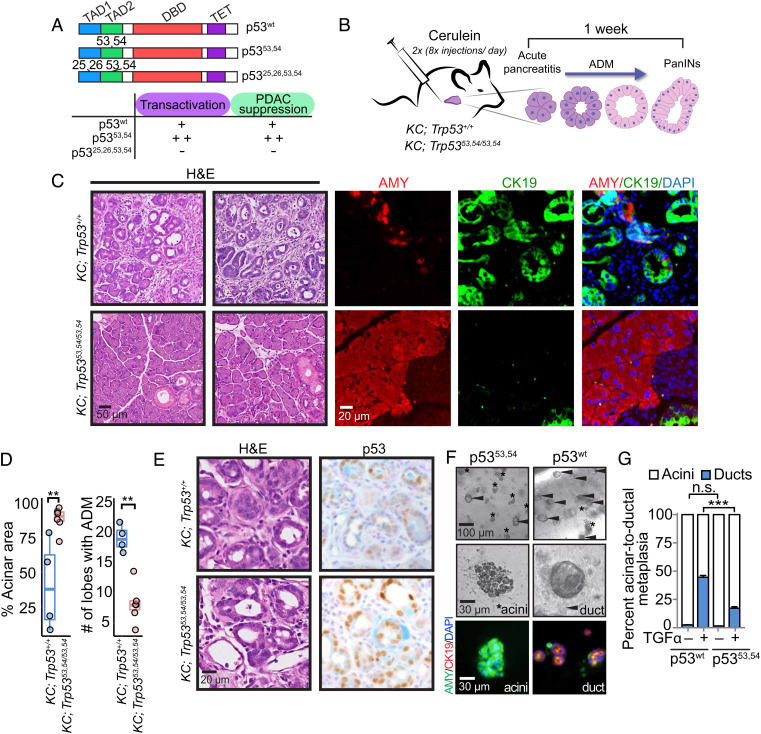
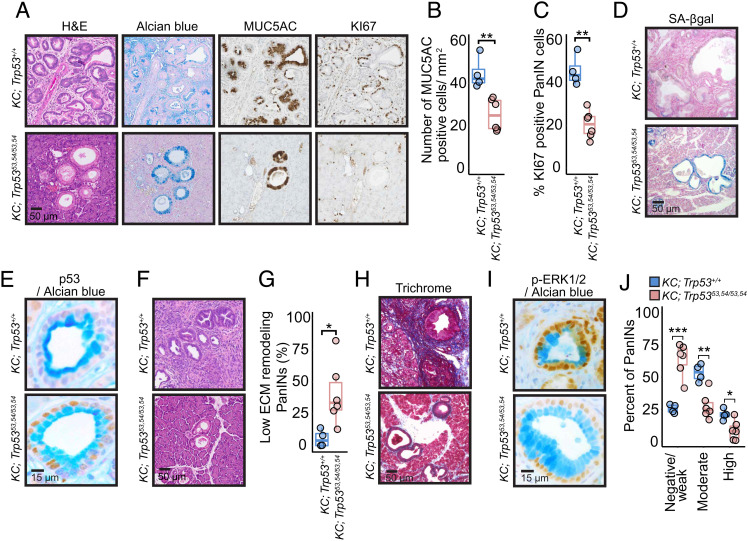
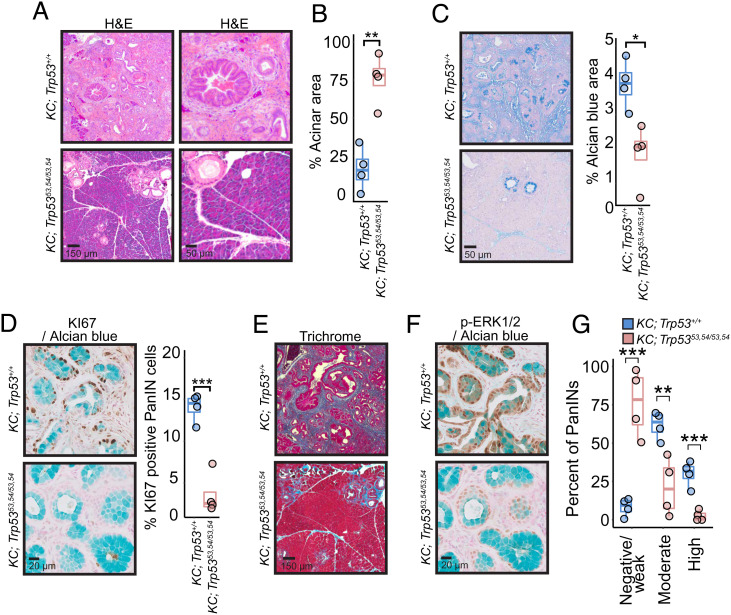
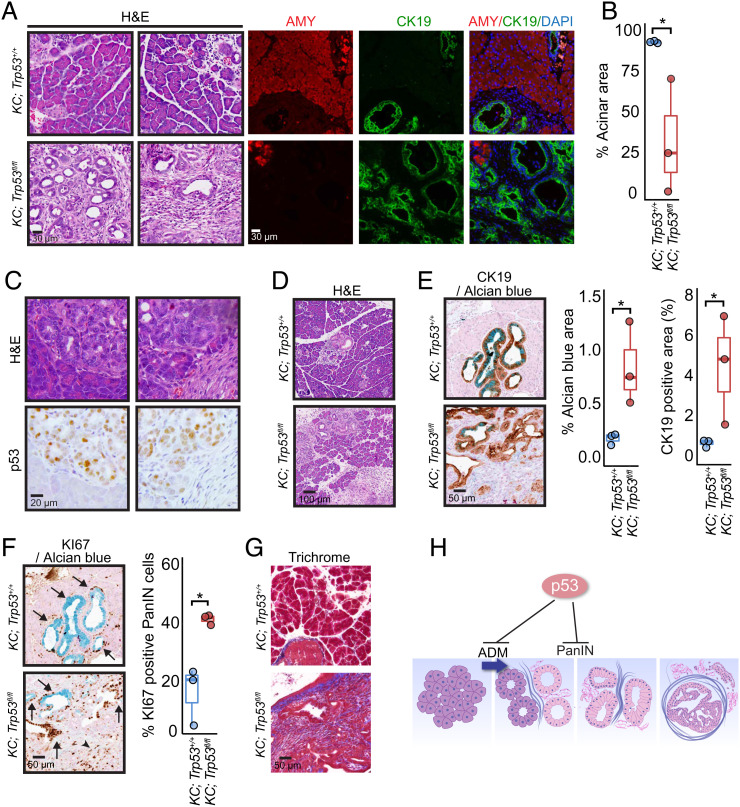
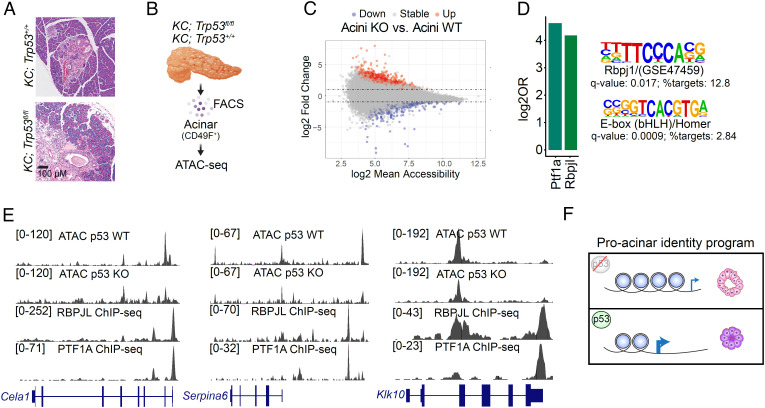
The vast majority of human pancreatic ductal adenocarcinomas (PDACs) harbor TP53 mutations, underscoring p53’s critical role in PDAC suppression. PDAC can arise when pancreatic acinar cells undergo acinar-to-ductal metaplasia (ADM), giving rise to premalignant pancreatic intraepithelial neoplasias (PanINs), which finally progress to PDAC. The occurrence of TP53 mutations in late-stage PanINs has led to the idea that p53 acts to suppress malignant transformation of PanINs to PDAC. However, the cellular basis for p53 action during PDAC development has not been explored in detail. Here, we leverage a hyperactive p53 variant—p53 53,54 —which we previously showed is a more robust PDAC suppressor than wild-type p53, to elucidate how p53 acts at the cellular level to dampen PDAC development. Using both inflammation-induced and KRAS G12D -driven PDAC models, we find that p53 53,54 both limits ADM accumulation and suppresses PanIN cell proliferation and does so more effectively than wild-type p53. Moreover, p53 53,54 suppresses KRAS signaling in PanINs and limits effects on the extracellular matrix (ECM) remodeling. While p53 53,54 has highlighted these functions, we find that pancreata in wild-type p53 mice similarly show less ADM, as well as reduced PanIN cell proliferation, KRAS signaling, and ECM remodeling relative to Trp53 -null mice. We find further that p53 enhances chromatin accessibility at sites controlled by acinar cell identity transcription factors. These findings reveal that p53 acts at multiple stages to suppress PDAC, both by limiting metaplastic transformation of acini and by dampening KRAS signaling in PanINs, thus providing key new understanding of p53 function in PDAC.
Overview
The claims and statistics of this paper haven’t been checked yet.
Free: it reads the open-access text and checks the first 5 claims that cite a source we can check. Create a free account to check every claim.
Integrity signals
Registry
Cites
Statistics
Figures
Verification
Claims the paper makes
The claims and statistics of this paper haven’t been checked yet.
Free: it reads the open-access text and checks the first 5 claims that cite a source we can check. Create a free account to check every claim.
Claims other papers make about this one
Each is checked against this paper’s own text: does it say what the citing paper says it does?
The source backs part of the claim, not all of it — or backs it for a different population, condition or comparison.
In the citing paper
“TP53 mutations, found in 50–90% of pancreatic ductal adenocarcinomas, significantly affect carcinogenesis, prognosis and treatment response [17,21,34,35].”
From Significance of TP53, CDKN2A, SMAD4 and KRAS in Pancreatic Cancer (2024) · cites this paper as [17]
Experimental — accuracy not yet measuredThe source backs part of the claim, not all of it — or backs it for a different population, condition or comparison.
In the citing paper
“TP53 mutations, detected in 60–70% of cases, play a crucial role in suppressing malignant transformation, affecting carcinogenesis and prognosis [17,36].”
From Significance of TP53, CDKN2A, SMAD4 and KRAS in Pancreatic Cancer (2024) · cites this paper as [17]
Experimental — accuracy not yet measuredThe source backs part of the claim, not all of it — or backs it for a different population, condition or comparison.
In the citing paper
“TP53’s multifaceted roles include limiting preneoplastic lesion development, regulating their character and influencing the tumor microenvironment to restrain invasive cancer progression [17].”
From Significance of TP53, CDKN2A, SMAD4 and KRAS in Pancreatic Cancer (2024) · cites this paper as [17]
Experimental — accuracy not yet measuredThe cited source says what the claim attributes to it.
In the citing paper
“Mutations occur in late-stage PanINs, indicating the p53’s role in inhibiting transformation into PDAC.”
From Significance of TP53, CDKN2A, SMAD4 and KRAS in Pancreatic Cancer (2024) · cites this paper as [17]
The cited source says what the claim attributes to it.
In the citing paper
“In mouse models, intact p53 protects against pancreatic cancer progression, confirming its role in suppressing malignant transformation [17,29,36].”
From Significance of TP53, CDKN2A, SMAD4 and KRAS in Pancreatic Cancer (2024) · cites this paper as [17]
1 more claim about this paper
Create a free account to see every claim other papers make about this one.
Self-check
Percentages, sums and reported differences re-computed from the paper’s own numbers.
The self-check needs the paper’s full text.
Citations
Cites
Moderated estimation of fold change and dispersion for RNA-seq data with DESeq2
Love, M. I., Huber, W., & Anders, S. (2014) · Genome Biology · doi:10.1186/s13059-014-0550-8 · Cited by 95,106 · cited 1×
“2211937120 9 of 9 To assess differential accessibility, DESeq2 was applied (60) using a model to account for mouse model, cell type, and batch.”
Fast gapped-read alignment with Bowtie 2
Langmead, B., & Salzberg, S. L. (2012) · Nature Methods · doi:10.1038/nmeth.1923 · Cited by 56,400 · cited 1×
“FASTQ files were aligned to the mouse genome mm10 using bowtie (56).”
MethodHeinz, S., Benner, C., Spann, N., Bertolino, E., Lin, Y. C., Laslo, P., Cheng, J. X., Murre, C., Singh, H., & Glass, C. K. (2010) · Molecular Cell · doi:10.1016/j.molcel.2010.05.004 · Cited by 13,382 · cited 1×
“Peaks with significant changes in accessibility between p53-proficient and deficient acinar cells were further analyzed for motif enrichment using the program HOMER (61).”
MethodBuenrostro, J. D., Giresi, P. G., Zaba, L. C., Chang, H. Y., & Greenleaf, W. J. (2013) · Nature Methods · doi:10.1038/nmeth.2688 · Cited by 6,422 · cited 2×
“To create sequencing libraries, transposed DNA was amplified and indexed with Illumina Nextera sequencing primers as previously described (55).”
MethodSelf-citationHingorani, S. R., Wang, L., Multani, A. S., Combs, C., Deramaudt, T. B., Hruban, R. H., Rustgi, A. K., Chang, S., & Tuveson, D. A. (2005) · Cancer Cell · doi:10.1016/j.ccr.2005.04.023 · Cited by 2,609
Preinvasive and invasive ductal pancreatic cancer and its early detection in the mouse
Hingorani, S. R., Petricoin, E. F., Maitra, A., Rajapakse, V., King, C., Jacobetz, M. A., Ross, S., Conrads, T. P., Veenstra, T. D., Hitt, B. A., et al. (2003) · Cancer Cell · doi:10.1016/s1535-6108(03)00309-x · Cited by 2,471 · cited 4×
“p53(53,54) (27, 28) and p53 mice (50) were bred to a mouse model for pancreatic cancer carrying Kras (51) and a Ptf1a allele (6) that induces the expression of mutant Kras specifically in the pancreas.”
BackgroundMethodInfluentialIntegrated genomic characterization of pancreatic ductal adenocarcinoma
Raphael, B. J., Hruban, R. H., Aguirre, A. J., Moffitt, R. A., Yeh, J. J., Stewart, C., Robertson, A. G., Cherniack, A. D., Gupta, M., Getz, G., et al. (2017) · Cancer Cell · doi:10.1016/j.ccell.2017.07.007 · Cited by 2,019 · cited 1×
“After KRAS, mutations in the TP53, CDKN2A, and SMAD4 tumor suppressor genes (TSGs) are the most prevalent in human PDAC, with estimated mutation frequencies of 72, 30, and 32%, respectively (17).”
BackgroundAnalysis of lung tumor initiation and progression using conditional expression of oncogenic K-ras
Jackson, E. L., Willis, N., Mercer, K., Bronson, R. T., Crowley, D., Montoya, R., Jacks, T., & Tuveson, D. A. (2001) · Genes & Development · doi:10.1101/gad.943001 · Cited by 1,898 · cited 19×
“Wild-Type p53 Restrains ADM and PanINs in Aging KrasG12D Mice.”
BackgroundInfluentialPark, W., Chawla, A., & O’Reilly, E. M. (2021) · JAMA · doi:10.1001/jama.2021.13027 · Cited by 1,882
Genetics and biology of pancreatic ductal adenocarcinoma
Hezel, A. F., Kimmelman, A. C., Stanger, B. Z., Bardeesy, N., & DePinho, R. A. (2006) · Genes & Development · doi:10.1101/gad.1415606 · Cited by 1,577
Research works printed but not linked: 2
- Cancer Genome Atlas Research Network, Integrated genomic characterization of pancreatic ductal adenocarcinoma. Cancer Cell 32, 185– 203.e113 (2017). 28810144 PMC5964983
- S. S. Mello, F. Müller, S. K. Denny, W. J. Greenleaf, L. D. Attardi, The role of p53 in pancreatic cancer suppression. GEO. https://www.ncbi.nlm.nih.gov/geo/query/acc.cgi?acc=GSE224744. Deposited 7 February 2023. PMC10013849 36848578
Cited by
Chromatin accessibility: biological functions, molecular mechanisms and therapeutic application
Chen, Y., Liang, R., Li, Y., Jiang, L., Ma, D., Luo, Q., & Song, G. (2024) · Signal Transduction and Targeted Therapy · doi:10.1038/s41392-024-02030-9 · Cited by 223
Significance of TP53, CDKN2A, SMAD4 and KRAS in Pancreatic Cancer
Stefanoudakis, D., Frountzas, M., Schizas, D., Michalopoulos, N. V., Drakaki, A., & Toutouzas, K. G. (2024) · Current Issues in Molecular Biology · doi:10.3390/cimb46040177 · Cited by 110
“TP53 mutations, detected in 60–70% of cases, play a crucial role in suppressing malignant transformation, affecting carcinogenesis and prognosis [17,36].”
BackgroundInfluentialMARSTRAND-DAUCE, L., Lorenzo, D., Chassac, A., Nicole, P., Couvelard, A., & Haumaître, C. (2023) · International Journal of Molecular Sciences · doi:10.3390/ijms24129946 · Cited by 119
“Recently, a “super-tumor suppressor” P53 mutant was found to inhibit ADM and PanIN proliferation driven by KrasG12D [162].”
BackgroundDecoding p53 tumor suppression: a crosstalk between genomic stability and epigenetic control?
Janic, A., Abad, E., & Amelio, I. (2024) · Cell Death and Differentiation · doi:10.1038/s41418-024-01259-9 · Cited by 100
Laila, U. E., An, W., & Xu, Z.-X. (2024) · Frontiers in Immunology · doi:10.3389/fimmu.2024.1448489 · Cited by 40
Metadata
- Authors
- Mello, S. S., Flowers, B. M., Mazur, P. K., Lee, J. J., Müller, F., Denny, S. K., Ferreira, S., Hanson, K., Kim, S. K., Greenleaf, W. J., Wood, L. D., & Attardi, L. D.
- Affiliations
- University of Rochester Medicine (US)
- Stanford Medicine (US)
- The University of Texas MD Anderson Cancer Center (US)
- Johns Hopkins University (US)
- Corresponding author
- Attardi, Laura D.
- ORCID
- Venue
- Proceedings of the National Academy of Sciences
- Publisher
- National Academy of Sciences
- Published
- 2023-02-27
- Volume
- 120
- Issue
- 10
- Pages
- e2211937120-e2211937120
- ISSN
- 0027-8424 (ISSN-L)
- 1091-6490
- PMC
- PMC10013849
- OpenAlex
- W4322421452
- Cited by
- 55
- References
- 61
- Citations by year
- 2026: 18 · 2025: 17 · 2024: 16 · 2023: 4
- FWCI
- 6.71
- Type
- journal article
- Language
- en
- Open access
- hybrid
- doi.org
- Licence
- Locations
- Proceedings of the National Academy of Sciences (publishedVersion, cc-by-nc-nd)
- PubMed Central (publishedVersion, cc-by-nc-nd)
- PubMed (publishedVersion)
- Digital Commons-TMC (Texas Medical Center) (submittedVersion)
- Funders
- HHS | NIH | National Cancer Institute (R21 CA169673, R01 CA140875, R35 CA197591)
- Topics
- Health Sciences › Medicine › Oncology › Pancreatic and Hepatic Oncology Research
- Health Sciences › Medicine › Oncology › Cancer-related Molecular Pathways
- Life Sciences › Biochemistry, Genetics and Molecular Biology › Molecular Biology › Signaling Pathways in Disease
- Keywords
- p53, pancreatic ductal adenocarcinoma, TP53 mutation, acinar-to-ductal metaplasia, pancreatic intraepithelial neoplasia, KRAS G12D, KRAS signaling, extracellular matrix remodeling, chromatin accessibility, premalignant pancreatic lesions, tumor suppression
- MeSH terms
- Animals, Anophthalmos, Humans, Lung Diseases, Metaplasia, Microphthalmos, Pancreas, Pancreatic Neoplasms, Precancerous Conditions, Tumor Suppressor Protein p53, Proto-Oncogene Proteins p21(ras), Mice, Knockout, Mice
About these checks
Registry, retraction, Cites and statistics results are computed, not judged, with one exception: a printed reference that no index lists is read once by a model before it counts as a citation error. Claims are extracted by a model and kept only when their quote appears verbatim in the text; each cited source is then checked, with a model’s help, for whether it says what the claim relies on. Those verdicts can be wrong — read the claim’s quote and the cited source before relying on one.
Statistics and arithmetic are recomputed, not judged.
Confidence bands are shown only for fields calibrated on our annotated test set. None is calibrated yet, so no band is shown.
What counts as a claim ›How we measure confidence ›How we check this ›
Are you an author, or do you see a problem with this page? Request a review
Data sources
Bibliographic data: Semantic Scholar, OpenAlex, Crossref.
Contains information from the Semantic Scholar Academic Graph Datasets, made available under the ODC Attribution License (ODC-BY 1.0).
Semantic Scholar’s data is described in: Kinney, R., et al. (2023). The Semantic Scholar Open Data Platform. arXiv:2301.10140.
