

Superhuman artificial intelligence can improve human decision-making by increasing novelty
Open accessPublished version of a preprint
The DOI matches its Crossref record; 32 of the 33 references it cites were found in a registry or an index.
Abstract
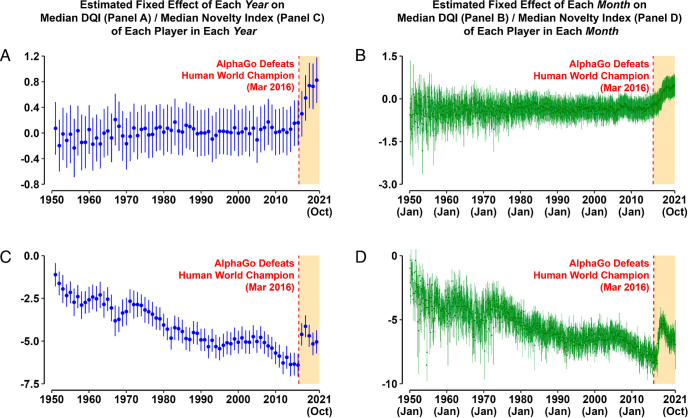
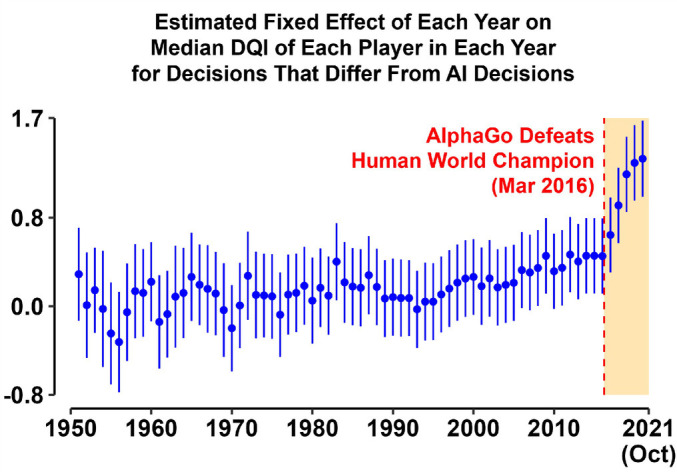
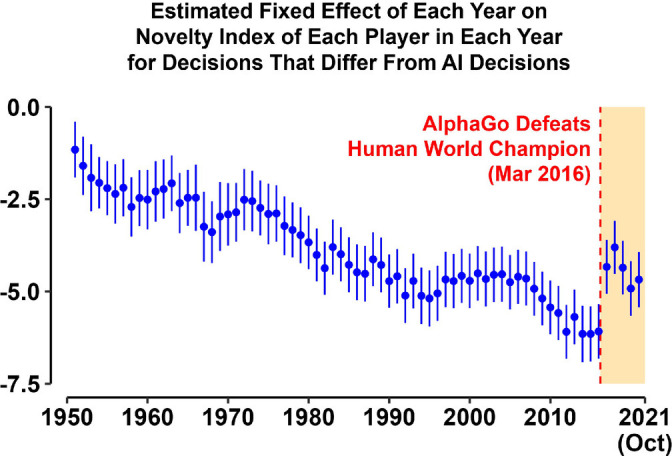
How will superhuman artificial intelligence (AI) affect human decision-making? And what will be the mechanisms behind this effect? We address these questions in a domain where AI already exceeds human performance, analyzing more than 5.8 million move decisions made by professional Go players over the past 71 y (1950 to 2021). To address the first question, we use a superhuman AI program to estimate the quality of human decisions across time, generating 58 billion counterfactual game patterns and comparing the win rates of actual human decisions with those of counterfactual AI decisions. We find that humans began to make significantly better decisions following the advent of superhuman AI. We then examine human players' strategies across time and find that novel decisions (i.e., previously unobserved moves) occurred more frequently and became associated with higher decision quality after the advent of superhuman AI. Our findings suggest that the development of superhuman AI programs may have prompted human players to break away from traditional strategies and induced them to explore novel moves, which in turn may have improved their decision-making.
Overview
The claims and statistics of this paper haven’t been checked yet.
Free: it reads the open-access text and checks the first 5 claims that cite a source we can check. Create a free account to check every claim.
Integrity signals
Registry
Cites
Statistics
Figures
Verification
Claims the paper makes
The claims and statistics of this paper haven’t been checked yet.
Free: it reads the open-access text and checks the first 5 claims that cite a source we can check. Create a free account to check every claim.
Claims other papers make about this one
Each is checked against this paper’s own text: does it say what the citing paper says it does?
The source backs part of the claim, not all of it — or backs it for a different population, condition or comparison.
In the citing paper
“A similar pattern was previously observed for AlphaGo, which has led humans to become better players in the board game Go (Shin et al. 2023).”
From Generative AI (2024) · cites this paper as Shin et al. 2023
Experimental — accuracy not yet measuredIn the citing paper
“The innovations generated by AlphaGo and AlphaGo Zero soon entered human culture, as shown by research comparing human gameplay before and after the algorithms' introduction 31 .”
From Machine culture (2023) · cites this paper as [31]
Self-check
Percentages, sums and reported differences re-computed from the paper’s own numbers.
The self-check needs the paper’s full text.
Citations
Cites
LeCun, Y., Bengio, Y., & Hinton, G. (2015) · Nature · doi:10.1038/nature14539 · Cited by 84,126
Highly accurate protein structure prediction with AlphaFold
Jumper, J., Evans, R., Pritzel, A., Green, T., Figurnov, M., Ronneberger, O., Tunyasuvunakool, K., Bates, R., Žídek, A., Potapenko, A., et al. (2021) · Nature · doi:10.1038/s41586-021-03819-2 · Cited by 43,764
Language Models are Few-Shot Learners
Brown, T. B., Mann, B., Ryder, N., Subbiah, M., Kaplan, J., Dhariwal, P., Neelakantan, A., Shyam, P., Sastry, G., Askell, A., et al. (2020) · arXiv · doi:10.48550/arxiv.2005.14165 · Cited by 23,372 · cited 1×
“, ChatGPT based on GPT-3) (4), and natural sciences (e.”
Kaugeranna, R., Kaugeranna, E., & Aion, (. S. 4. 6. (2023) · DROPS (Schloss Dagstuhl – Leibniz Center for Informatics) · doi:10.4230/lipics.giscience.2023.43 · Cited by 13,690
Mastering the game of Go without human knowledge
Silver, D., Schrittwieser, J., Simonyan, K., Antonoglou, I., Huang, A., Guez, A., Hubert, T., Baker, L., Lai, M., Bolton, A., et al. (2017) · Nature · doi:10.1038/nature24270 · Cited by 9,084 · cited 1×
“human decisions are available and where the advent of superhuman AI (7) can be connected to a”
Not by Genes Alone: How Culture Transformed Human Evolution
Levinson, M. H. (2006) · ETC.: A Review of General Semantics · doi:10.66774/etc_6303_351 · Cited by 3,553 · cited 1×
“This literature shows that there is no guarantee that human decision-making will improve in response to innovations, despite the human ability to accumulate knowledge within and across generations (8, 9).”
International evaluation of an AI system for breast cancer screening
McKinney, S. M., Sieniek, M., Godbole, V., Godwin, J., Antropova, N., Ashrafian, H., Back, T., Chesus, M., Corrado, G. S., Darzi, A., et al. (2020) · Nature · doi:10.1038/s41586-019-1799-6 · Cited by 3,287 · cited 2×
“, diagnosing diseases) (2), transportation (e.”
The cultural niche: Why social learning is essential for human adaptation
Boyd, R., Richerson, P. J., & Henrich, J. (2011) · Proceedings of the National Academy of Sciences · doi:10.1073/pnas.1100290108 · Cited by 1,303
Creativity and artificial intelligence
Boden, M. A. (1998) · Artificial Intelligence · doi:10.1016/s0004-3702(98)00055-1 · Cited by 846
Why Copy Others? Insights from the Social Learning Strategies Tournament
Rendell, L., Boyd, R., Cownden, D., Enquist, M., Eriksson, K., Feldman, M. W., Fogarty, L., Ghirlanda, S., Lillicrap, T., & Laland, K. N. (2010) · Science · doi:10.1126/science.1184719 · Cited by 811 · cited 1×
“Often, cumulative cultural evolution does occur, as superior forms of decision-making are transferred from one group of individuals to another (10, 11).”
Research works printed but not linked: 2
- G. Burgess, The Mammoth Book of Chess (Constable& Robinson, Ltd., 2009), pp. 924–929.
- M. Shin, J. Kim, M. Kim, “Human learning from artificial intelligence: Evidence from human Go players’ decisions after AlphaGo” in Proceedings of the Annual Meeting of the Cognitive Science Society (2021), vol. 43.
Cited by
Items 101–127 of 127
Richtiges Handeln vs. statistische Maschinen
Milkau, U. (2025) · Springer eBooks · doi:10.1007/978-3-658-48335-7_3
AI’s Impact on the Go Community in South Korea: A Preliminary Study of AlphaGo’s Legacy
Oh, C.-M. (2026) · Philosophia Scientae · doi:10.4000/15o0k
Wie begründe ich meine Entscheidung? Argumentation und Kommunikation
Zambito, A. (2026) · Essentials · doi:10.1007/978-3-658-50677-3_6
Brown, C., & Luzmore, R. (2026) · Emerald Group Publishing Limited eBooks · doi:10.1108/978-1-83549-382-320261010
Will AI accelerate or undermine the way humans have always innovated?
Bentley, R. A. (2026) · The Conversation · doi:10.64628/aai.mjsrjrqw3
Zhou, Y. J., XINGLIANG, D., Minshall, T., & Xu, G. (2026) · SSRN Electronic Journal · doi:10.2139/ssrn.6487431
Simulated emotional reactions affect (dis)honesty in speech-free human–agent interactions
Cartaud, A., Chaby, L., Pécune, F., & Pélachaud, C. (2026) · Computers in Human Behavior Artificial Humans · doi:10.1016/j.chbah.2026.100293 · Cited by 1
Tamames, J. F. (2026) · PhilPapers (PhilPapers Foundation) · doi:10.5281/zenodo.19445607
Vinchon, F. (2025) · theses.fr (ABES) · doi:10.70675/f69138a5zad55z4fc3za001zf269264a3892
Reconfiguring Empathy: Affective Outcomes of AI-Mediated Decision-Making
Schmidt, E. (2026) · CHI Conference Extended Abstracts on Human Factors in Computing Systems (CHI EA) · doi:10.1145/3772363.3799185
“This tendency is visible in current AI systems: AI excels in logic-based tasks, such as strategic reasoning [54], and humans often adopt such strategies [53].”
Probing Emergent World Representations in Go Life-and-Death Problems
Yang, Z., Meng, Z., & Wen, Z. (2026) · AI · doi:10.3390/ai7050170
“Inspired by the fact that Transformer models can learn effective chess or Othello moves by simply observing game records [18], we explore whether similar strategies are applicable to localized Go life-and-death problems.”
Beyond Machine: The Inseparability of Humans and Computers in The Digital Age
Musa, A. J. (2026) · Iconic Research and Engineering Journals · doi:10.64388/irev9i11-1718083
Tamames, J. F. (n.d.) · PhilPapers (PhilPapers Foundation)
Deadline credibility and trade efficiency
Yoshida, M. (2026) · International Journal of Game Theory · doi:10.1007/s00182-026-00992-4
Jiang, S., Lakhiwal, A., Liu, C., & Duan, J. (2026) · Information Systems Research · doi:10.1287/isre.2024.1200
Beyond Text: Embodiment and Robots
Perry, A., & Cameron, C. D. (2026) · Cambridge University Press eBooks · doi:10.1017/9781009639057.016
Anticipating Children’s Beliefs about Artificial Empathy
Reinecke, M. G. (2026) · Cambridge University Press eBooks · doi:10.1017/9781009639057.022
Human Decision Making against AI Opponents in International DraughtsAn Exploratory Study in ZambiaPreprint
Kaziya, K., & Lungu, N. (2026) · SSRN Electronic Journal · doi:10.2139/ssrn.7466238
The Reversed Turing Test: Measuring Superhuman AI Performance Beyond Imitation
León, M. (2026) · WSEAS TRANSACTIONS ON COMPUTER RESEARCH · doi:10.37394/232018.2026.14.53
AI Agent Swarms as Researchers: Progress, Challenges, and Open QuestionsPreprint
Gusev, S., & Neira, D. E. B. (2026) · arXiv (Cornell University) · doi:10.48550/arxiv.2609.35719
Diminishing returns: the impact of artificial intelligence on cognitive and decision-making skills
Agrawal, V. (2026) · Journal of Science and Technology Policy Management · doi:10.1108/jstpm-02-2025-0057
Farid, M. T., & Harajli, D. A. (2025) · Journal of excellence in management sciences. · doi:10.69565/jems.v4i3.425 · Cited by 1
Humanoid AI with Humanity Modeling: Bridging Humans and Virtual–Physical Humanoids
Cao, L. (2026) · ACM Transactions on Intelligent Systems and Technology · doi:10.1145/3856812 · Cited by 1
“Humanity modeling supports and is essential for the development of artificial general intelligence (AGI) [48, 54] and artificial superintelligence (ASI) [98, 115], enabling naturalistic, realistic, and futuristic humanlike to human-level AI and humanoids.”
Yan, J., Kang, Y., Yu, L., Tian, Y., Lian, J., & Song, Z. (2026) · Applied Energy · doi:10.1016/j.apenergy.2026.129046
Three tensions in unlocking creativity with GenAI
Clegg, M. (2026) · Current Opinion in Psychology · doi:10.1016/j.copsyc.2026.102481
Relating to AI: A relationship-orientation view of its impact on humans
Zhang, R. Z., Kyung, E. J., & Longoni, C. (2026) · Current Opinion in Psychology · doi:10.1016/j.copsyc.2026.102498
Multimorbidity Measurement Strategies for Predicting Hospital Visits
Neves, B., Moreira, J. M., Gonçalves, S., Cerejo, J., Mota, I., Silva, N. A., Leite, F., & Silva, M. J. (2025) · doi:10.21203/rs.3.rs-6515465/v1
Metadata
- Authors
- Shin, M., Kim, J., van Opheusden, B., & Griffiths, T. L.
- Affiliations
- City University of Hong Kong (HK)
- Tongji University (CN)
- Department of Psychology, Princeton University, Princeton, NJ 08540
- Princeton University (US)
- Corresponding author
- Shin, Minkyu
- Kim, Jin
- Venue
- Proceedings of the National Academy of Sciences
- Publisher
- National Academy of Sciences
- Published
- 2023-03-13
- Volume
- 120
- Issue
- 12
- Pages
- e2214840120-e2214840120
- ISSN
- 0027-8424 (ISSN-L)
- 1091-6490
- PMC
- PMC10041097
- OpenAlex
- W4324028585
- Cited by
- 106
- References
- 33
- Citations by year
- 2026: 30 · 2025: 37 · 2024: 25 · 2023: 14
- FWCI
- 9.99
- Type
- journal article
- Language
- en
- Open access
- hybrid
- doi.org
- Licence
- Locations
- Proceedings of the National Academy of Sciences (publishedVersion, cc-by-nc-nd)
- PubMed Central (publishedVersion, cc-by-nc-nd)
- PubMed (publishedVersion)
- RePEc: Research Papers in Economics (submittedVersion)
- arXiv (Cornell University) (submittedVersion)
- CityU Scholars (submittedVersion, cc-by-nc-nd)
- PsyArXiv (OSF Preprints) (submittedVersion, cc-by)
- PsyArXiv (OSF Preprints) (submittedVersion)
- arXiv (Cornell University)
- Topics
- Physical Sciences › Computer Science › Artificial Intelligence › Artificial Intelligence in Games
- Physical Sciences › Computer Science › Artificial Intelligence › Artificial Intelligence Applications
- Social Sciences › Psychology › Developmental and Educational Psychology › Sport Psychology and Performance
- Keywords
- human decision-making, Go, novelty, counterfactual analysis, human-AI interaction, professional Go players, game strategy
- MeSH terms
- Artificial Intelligence, Decision Making, Humans
About these checks
Registry, retraction, Cites and statistics results are computed, not judged, with one exception: a printed reference that no index lists is read once by a model before it counts as a citation error. Claims are extracted by a model and kept only when their quote appears verbatim in the text; each cited source is then checked, with a model’s help, for whether it says what the claim relies on. Those verdicts can be wrong — read the claim’s quote and the cited source before relying on one.
Statistics and arithmetic are recomputed, not judged.
Confidence bands are shown only for fields calibrated on our annotated test set. None is calibrated yet, so no band is shown.
What counts as a claim ›How we measure confidence ›How we check this ›
Are you an author, or do you see a problem with this page? Request a review
Data sources
Bibliographic data: Semantic Scholar, OpenAlex, Crossref.
Contains information from the Semantic Scholar Academic Graph Datasets, made available under the ODC Attribution License (ODC-BY 1.0).
Semantic Scholar’s data is described in: Kinney, R., et al. (2023). The Semantic Scholar Open Data Platform. arXiv:2301.10140.
