

Rapid single-particle chemical imaging of nanoplastics by SRS microscopy
Open accessThe DOI matches its Crossref record; 84 of the 85 references it cites were found in a registry or an index; 10 of the 32 sources its claims cite were checked for support.
Abstract
Plastics are now omnipresent in our daily lives. The existence of microplastics (1 µm to 5 mm in length) and possibly even nanoplastics (<1 μm) has recently raised health concerns. In particular, nanoplastics are believed to be more toxic since their smaller size renders them much more amenable, compared to microplastics, to enter the human body. However, detecting nanoplastics imposes tremendous analytical challenges on both the nano-level sensitivity and the plastic-identifying specificity, leading to a knowledge gap in this mysterious nanoworld surrounding us. To address these challenges, we developed a hyperspectral stimulated Raman scattering (SRS) imaging platform with an automated plastic identification algorithm that allows micro-nano plastic analysis at the single-particle level with high chemical specificity and throughput. We first validated the sensitivity enhancement of the narrow band of SRS to enable high-speed single nanoplastic detection below 100 nm. We then devised a data-driven spectral matching algorithm to address spectral identification challenges imposed by sensitive narrow-band hyperspectral imaging and achieve robust determination of common plastic polymers. With the established technique, we studied the micro-nano plastics from bottled water as a model system. We successfully detected and identified nanoplastics from major plastic types. Micro-nano plastics concentrations were estimated to be about 2.4 ± 1.3 × 10 5 particles per liter of bottled water, about 90% of which are nanoplastics. This is orders of magnitude more than the microplastic abundance reported previously in bottled water. High-throughput single-particle counting revealed extraordinary particle heterogeneity and nonorthogonality between plastic composition and morphologies; the resulting multidimensional profiling sheds light on the science of nanoplastics.
Overview
CoChat Summary
TL;DR
The paper introduces data-driven hyperspectral stimulated Raman scattering (SRS) microscopy for rapid, single-particle chemical imaging of nanoplastics, combining narrowband SRS sensitivity with an SRS-tailored spectral matching algorithm. Applied to bottled water, it detects individual particles of seven common plastics and estimates about 2.4 ± 1.3 × 10^5 plastic particles per liter, mostly nanoplastics.
Key findings
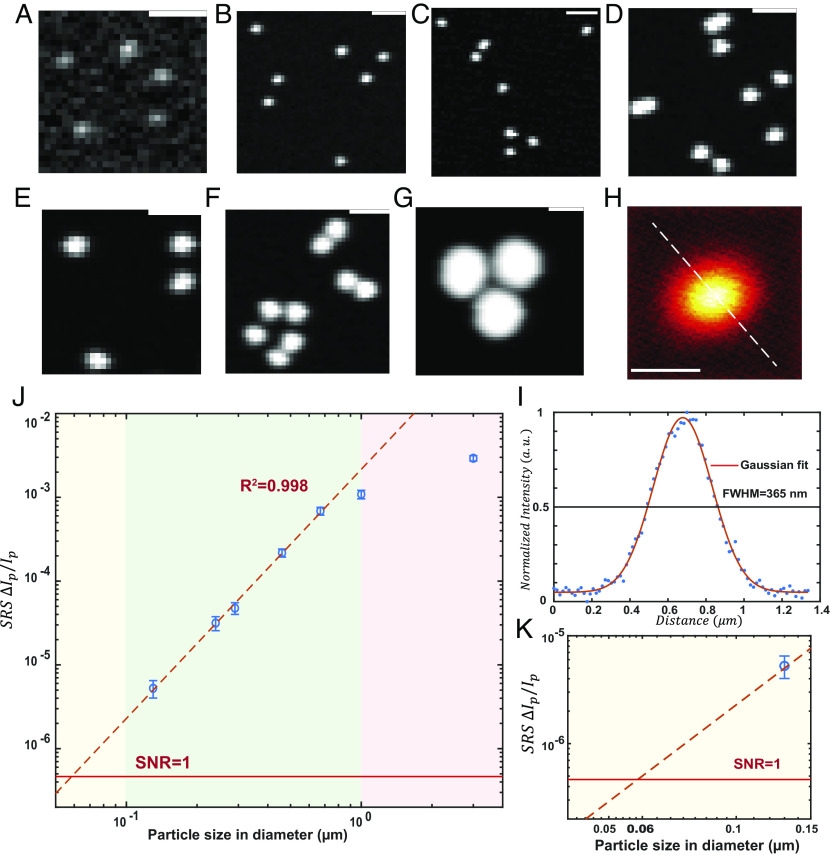
- Narrowband SRS detects polystyrene nanospheres down to a 60-nm detection limit and can recognize single particles down to 100 nm; imaging speed is ~1,000 particles in a 51 × 51 µm field of view within 2 s, with measured spatial resolution of 365 nm.
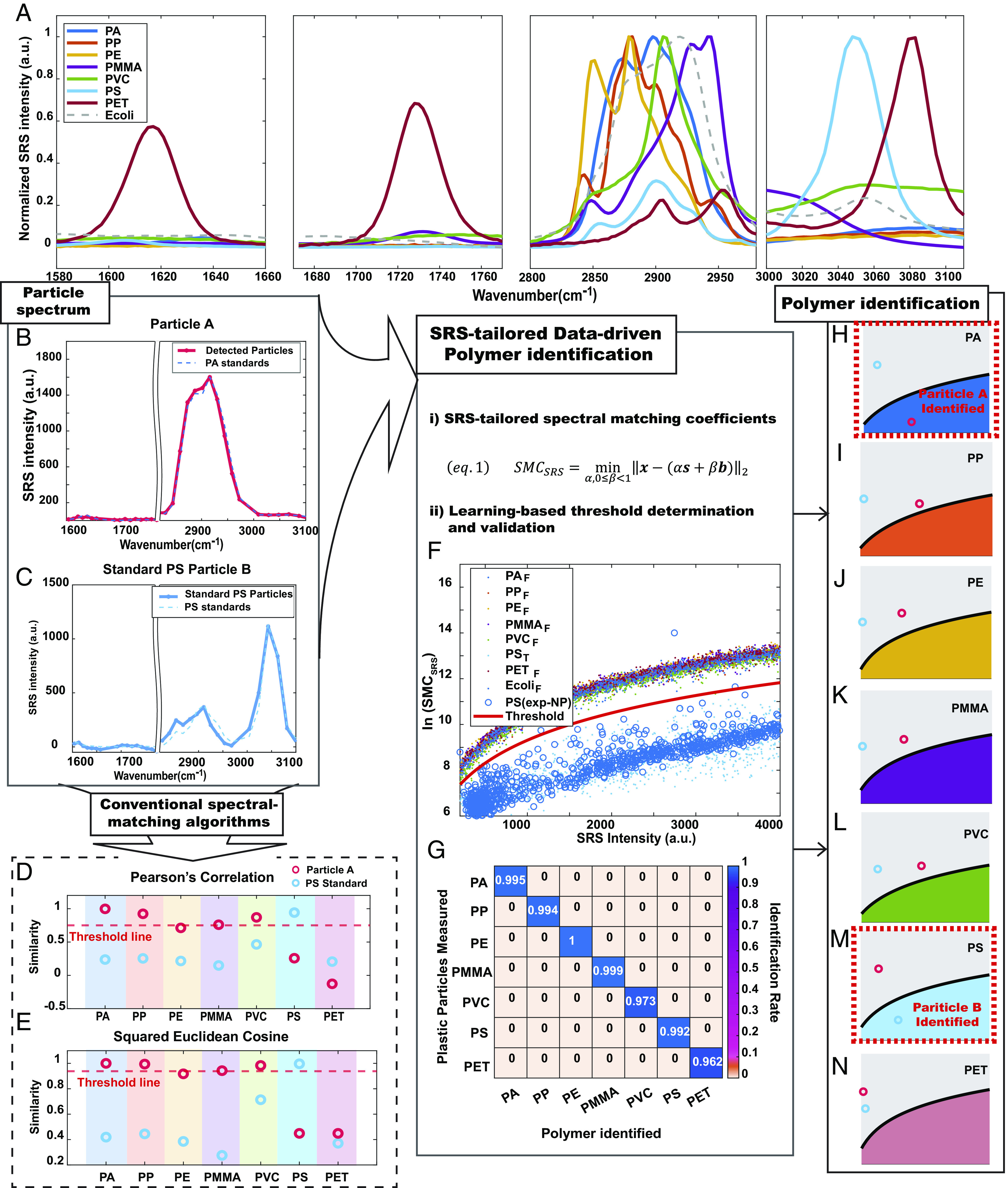
- The SRS-tailored spectral matching algorithm (SMCSRS) achieved >96% identification rate with <1% false positives for all polymers in the seven-plastic library; nonplastic *E. coli* spectra were misidentified as plastic in no more than 0.5% of cases, versus >97% with conventional Pearson’s correlation or squared Euclidean cosine matching.
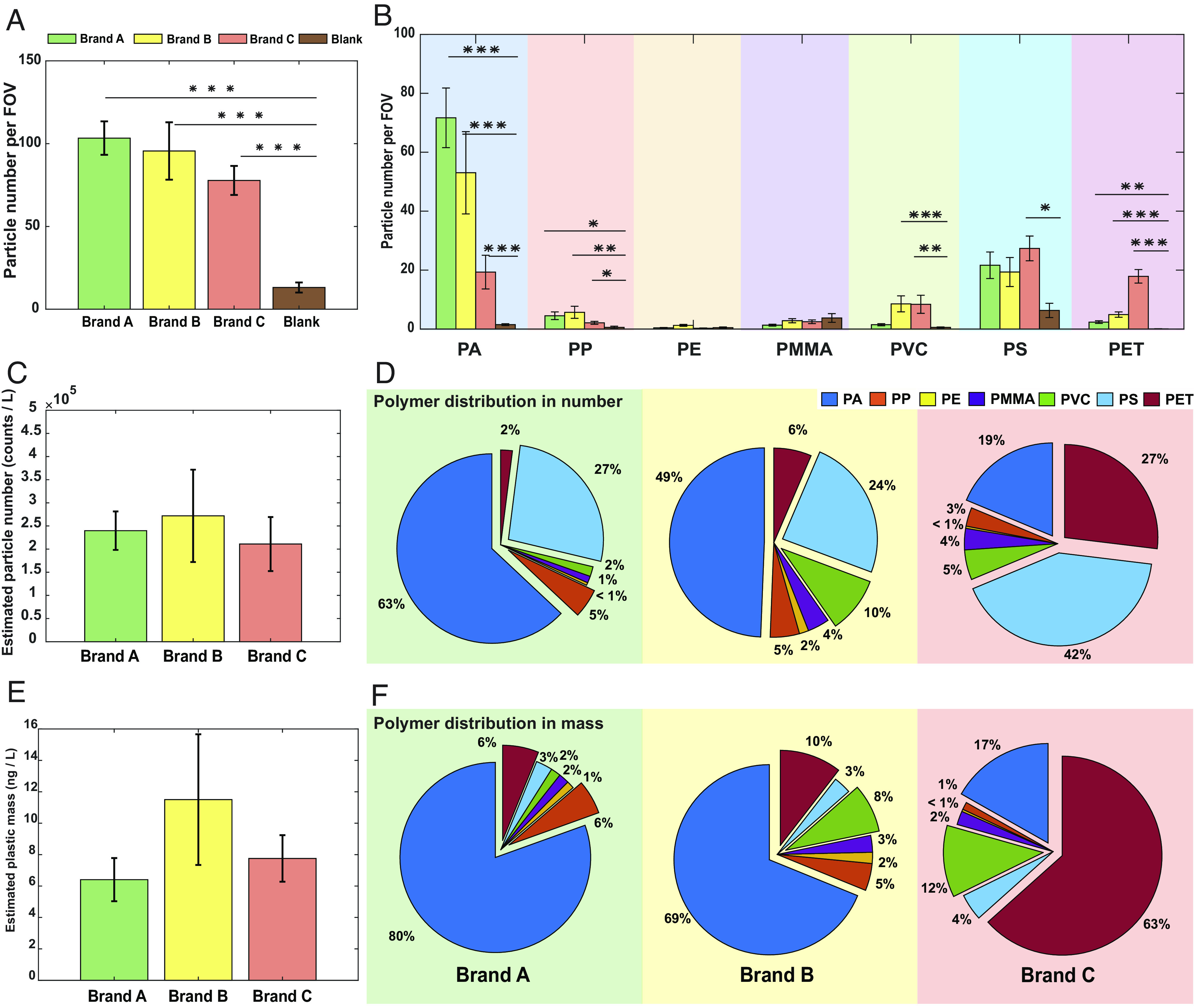
- In bottled water from three brands, 78–103 plastic particles were identified per 0.2 mm × 0.2 mm field of view, significantly higher than blank samples (P < 0.001), yielding an estimated 2.4 ± 1.3 × 10^5 particles per liter and mass exposure around 10 ng/L.
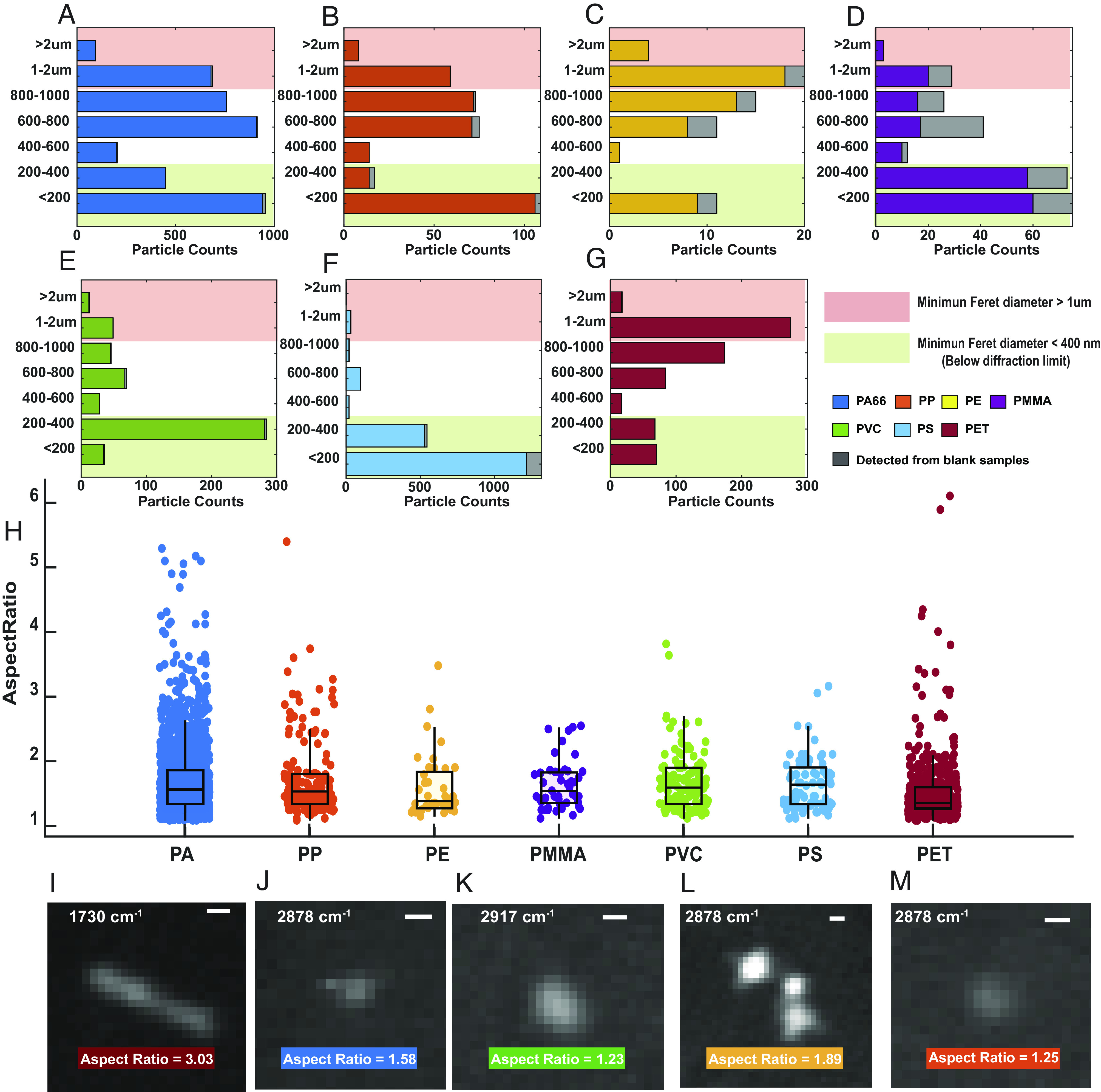
- Nanoplastics dominated the detected plastic particle population (~90%), and polymer-specific size distributions differed: polystyrene centered around 100–200 nm, whereas polyethylene terephthalate tended toward 1–2 µm; particle aspect ratios ranged from 1 to 6, with an average around 1.7.
Methods
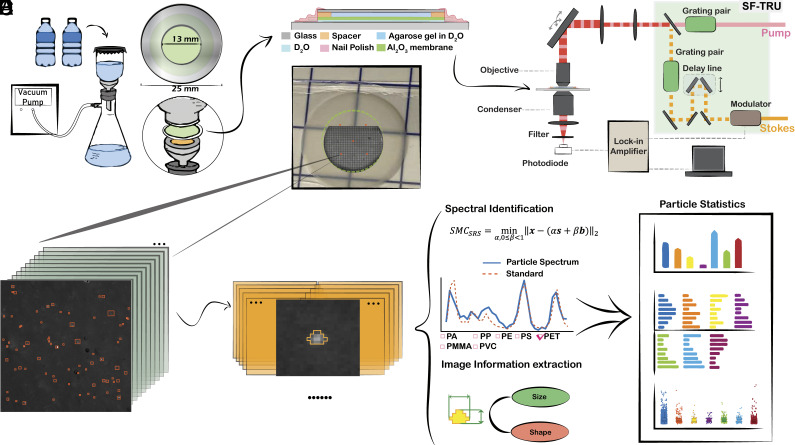
- Hyperspectral SRS imaging used a dual-output femtosecond laser with spectral focusing and four central wavelengths (793, 804, 886, and 897 nm) to cover C–H, ester, and double-bond vibrational features; polystyrene was imaged at 3,050 cm−1, with D2O-prepared agarose gel to reduce water background.
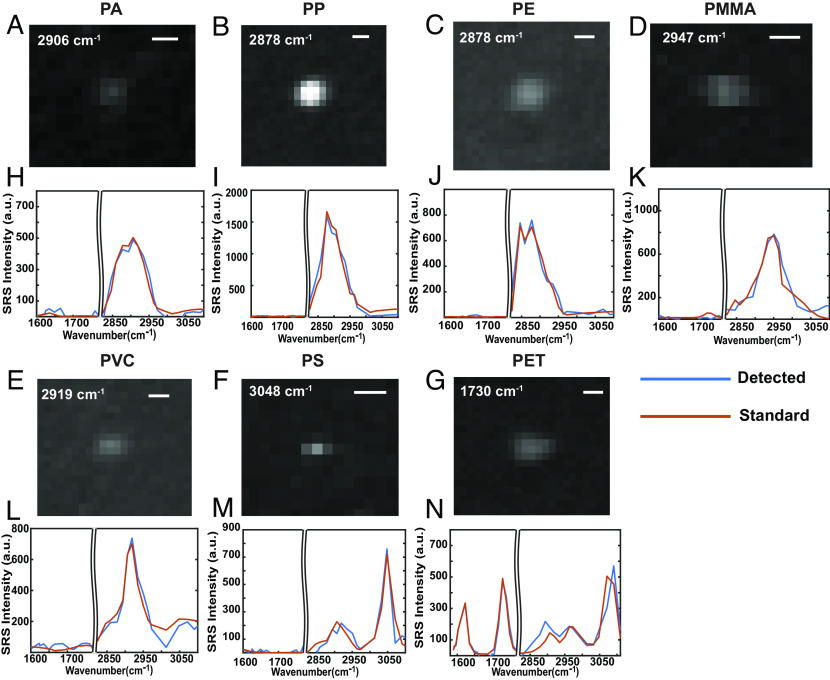
- Standards included polystyrene micro-nano spheres from 100 nm to 3 µm, seven common plastic polymers (PA, PP, PE, PMMA, PVC, PS, PET), and *E. coli* as a nonplastic control; microplastic standards were prepared by cryo-milling, and bottled water samples were filtered onto Anodisc membranes.
- Data analysis used the SMCSRS algorithm with synthetic spectra generated from bulk standards and learned threshold conditions for automated particle segmentation and polymer identification; MATLAB code is available on GitHub.
Limitations
- The paper states that only polystyrene nanospheres were commercially available as well-characterized nanoplastic standards, so experimental validation for other polymers relied on ground microplastics prepared from bulk standards.
- The seven-polymer library accounted for only about 10% of total imaged particles; unidentified particles and possible heteroaggregates remain, and the authors state that rigorous identification will require expanding the spectral library and analytical algorithms.
- The authors note no access to plastic-free water in the lab, so Anodisc filters were used as blank controls; quantification assumes uniform particle distribution on the membrane, and size estimation for diffraction-limited particles assumes solid spheres.
- Evident from the text: the bottled-water analysis covers three brands acquired at one time, and mass calibration depends on polystyrene-based density and relative SRS intensity assumptions.
Model-written summary. Check it against the paper before relying on it.
Integrity signals
Registry
Cites
Statistics
Figures
Verification
Claims the paper makes
7 Valid · 1 Not valid · 8 Not checked · 74 Own results and interpretations
At least one cited source doesn’t support this claim or points to a different paper, and none confirmed it — see the verdicts below.
In the paper
“Specifically in drinking water production, plastic contamination is confirmed in every step from the well to the bottle (77).”
§ Rapid single-particle chemical imaging of nanoplastics by SRS microscopy > Discussions and Conclusions
What the sources say
- Disputedcites [77] J. Weisser, From the well to the bottle: Identifying sources of microplastics in mineral water. Water 13, 841 (2021). sourceExperimental — accuracy not yet measured
Section 3.2 (page unavailable) reports microplastics at the sampled stages of mineral-water bottling except in cleaned bottles. It also says some raw and deferrized water measurements were below the detection limit. The paper therefore does not confirm contamination at every step as claimed. (LLM, conf=0.88)
Checked by a reasoning model — may be wrong.
plain- Asserted: passes — The authors put it forward as true.
- Checkable: passes — It can be checked against evidence.
- Load-bearing: unclear — It is unclear whether the paper’s conclusions depend on it.
- Based: passes — The paper gives a reason why it holds.
- Disputed
The cited sources support only part of this claim — read each source’s verdict below.
In the paper
“which is two to three orders of magnitude more than the previously reported results merely focusing on large microplastics (SI Appendix, Table S4) (58, 59, 61, 69, 70).”
§ Rapid single-particle chemical imaging of nanoplastics by SRS microscopy > Discussions and Conclusions
What the sources say
- Not checked — no full text of the sourcecites [58] A. Yusuf, Updated review on microplastics in water, their occurrence, detection, measurement, environmental pollution, and the need for regulatory standards. Environ. Pollut. 292, 118421 (2022). 34756874 source
- Partly supportedcites [59] S. A. Mason, V. G. Welch, J. Neratko, Synthetic polymer contamination in bottled water. Front. Chem. 6, 407 (2018). 30255015 PMC6141690 sourceExperimental — accuracy not yet measured
The Conclusions (page unavailable) report that smaller particles made up about 95% of those found, supporting the point that counting smaller particles raises the bottled-water total. But the Discussion compares 325 particles/L with a previous study’s 14 particles/L—about 23 times higher, not two to three orders of magnitude—and does not establish the claimed magnitude relative to earlier large-particle-only results. (LLM, conf=0.86)
- Not checked — no full text of the sourcecites [61] B. E. Ossmann, Small-sized microplastics and pigmented particles in bottled mineral water. Water Res. 141, 307– 316 (2018). 29803096 source
plain- Asserted: passes — The authors put it forward as true.
- Checkable: passes — It can be checked against evidence.
- Load-bearing: passes — The paper’s conclusions depend on it.
- Based: passes — The paper gives a reason why it holds.
A result the paper reports from its own data — it cites no other source for it, so there is none to check. The quote shows it is in the paper.
In the paper
“As a result, we find that plastic particles of different chemical compositions actually have different size distribution patterns (Fig. 6 A–G).”
§ Rapid single-particle chemical imaging of nanoplastics by SRS microscopy > Multidimensional Profiling of Micro-Nano Plastic in Bottled Water
plainstates an association- Asserted: passes — The authors put it forward as true.
- Checkable: passes — It can be checked against evidence.
- Load-bearing: passes — The paper’s conclusions depend on it.
- Based: passes — The paper gives a reason why it holds.
- Rests on an assumption not shown here.
A result the paper states — it cites no source for it, so there is none to check. The quote shows it is in the paper.
In the paper
“Embedding the particles on the membrane surface in situ with agarose gel prepared with D2O further enabled stationary SRS imaging of individual particles with minimal imaging background.”
§ Rapid single-particle chemical imaging of nanoplastics by SRS microscopy > Developing Workflow for Micro-Nano Plastic Detection from Bottled Water
plainstates a cause- Asserted: passes — The authors put it forward as true.
- Checkable: passes — It can be checked against evidence.
- Load-bearing: passes — The paper’s conclusions depend on it.
- Based: passes — The paper gives a reason why it holds.
- Rests on an assumption not shown here.
A result the paper reports from its own data — it cites no other source for it, so there is none to check. The quote shows it is in the paper.
In the paper
“A linear relationship was observed between the logarithm of SRS signal ( ΔIp/Ip ) and the logarithm of diameter for PS particles smaller than 0.7 µm (Fig. 1J and SI Appendix, Supplementary Note 3).”
- Also stated in: § SRS Imaging of Polystyrene Nanospheres with Single-Particle Sensitivity · hedged
“The trendline with a slope of 2.98 within the range indicates the SRS signal ( ΔIp/Ip ) increase linearly with the particles’ volume, which scales in cubic as the particles’ diameters increase.”
§ Rapid single-particle chemical imaging of nanoplastics by SRS microscopy > SRS Imaging of Polystyrene Nanospheres with Single-Particle Sensitivity
plainstates a cause- Asserted: passes — The authors put it forward as true.
- Checkable: passes — It can be checked against evidence.
- Load-bearing: passes — The paper’s conclusions depend on it.
- Based: passes — The paper gives a reason why it holds.
- Also stated in: § SRS Imaging of Polystyrene Nanospheres with Single-Particle Sensitivity · hedged
48 more claims
Create a free account to see all 90 claims and to verify the 1 reference still open.
- Probably not a substantial claim. 7
- It may state two separate claims as one. 32
- The quote only partly states this claim. 1
Citations
Cites
Production, use, and fate of all plastics ever made
Geyer, R., Jambeck, J. R., & Law, K. L. (2017) · Science Advances · doi:10.1126/sciadv.1700782 · Cited by 18,606
Plasticenta: First evidence of microplastics in human placenta
Ragusa, A., Svelato, A., Santacroce, C., Catalano, P., Notarstefano, V., Carnevali, O., Papa, F., Rongioletti, M. C. A., Baiocco, F., Draghi, S., et al. (2021) · Environment International · doi:10.1016/j.envint.2020.106274 · Cited by 3,474 · cited 1×
“Microplastic contaminations have been identified to prevalently from almost everywhere in the environments and even human biological samples (2–4).”
Cellular uptake of nanoparticles: Journey inside the cell
Behzadi, S., Serpooshan, V., Tao, W., Hamaly, M. A., Alkawareek, M. Y., Dreaden, E. C., Brown, D., Alkilany, A. M., Farokhzad, O. C., & Mahmoudi, M. (2017) · Chemical Society Reviews · doi:10.1039/c6cs00636a · Cited by 2,859 · cited 1×
“…prepared in laboratory as model systems, real nanoplastics in the environment are intrinsically label - free and have significant heterogeneity in both chemical composition and particle morphologies (11), which are likely to endure correspondingly different toxicity implications (12, 13).”
BackgroundHuman Consumption of Microplastics
Cox, K. D., Covernton, G. A., Davies, H. L., Dower, J. F., Juanes, F., & Dudas, S. E. (2019) · Environmental Science & Technology · doi:10.1021/acs.est.9b01517 · Cited by 2,745 · cited 1×
“As it pertains to the estimation of human exposure, these values are substantially higher than those currently reported in the literature (56, 71), which is a result from the newly detected nanoplastic fraction of plastic particulate.”
Microplastics in Freshwaters and Drinking Water: Critical Review and Assessment of Data Quality
Koelmans, A. A., Mohamed Nor, N. H., Hermsen, E., Kooi, M., Mintenig, S. M., & De France, J. (2019) · Water Research · doi:10.1016/j.watres.2019.02.054 · Cited by 2,535
Label-Free Biomedical Imaging with High Sensitivity by Stimulated Raman Scattering Microscopy
Freudiger, C. W., Min, W., Saar, B. G., Lu, S., Holtom, G. R., He, C., Tsai, J. C., Kang, J. X., & Xie, X. S. (2008) · Science · doi:10.1126/science.1165758 · Cited by 2,255
Self-citationEffective uptake of submicrometre plastics by crop plants via a crack-entry mode
Li, L., Luo, Y., Li, R., Zhou, Q., Peijnenburg, W. J. G. M., Yin, N., Yang, J., Tu, C., & Zhang, Y. (2020) · Nature Sustainability · doi:10.1038/s41893-020-0567-9 · Cited by 1,479 · cited 1×
“Polystyrene particles of specified sizes are commercially available as analytical standards and have been routinely used as a model material to study micro - nanoplastics (35, 36).”
Key principles and methods for studying the endocytosis of biological and nanoparticle therapeutics
Rennick, J. J., Johnston, A. P. R., & Parton, R. G. (2021) · Nature Nanotechnology · doi:10.1038/s41565-021-00858-8 · Cited by 1,477
Schymanski, D., Goldbeck, C., Humpf, H.-U., & Fürst, P. (2018) · Water Research · doi:10.1016/j.watres.2017.11.011 · Cited by 1,410
Presence of airborne microplastics in human lung tissue
Amato-Lourenço, L. F., Carvalho-Oliveira, R., Júnior, G. R., dos Santos Galvão, L., Ando, R. A., & Mauad, T. (2021) · Journal of Hazardous Materials · doi:10.1016/j.jhazmat.2021.126124 · Cited by 1,329
Research works printed but not linked: 2
- J. X. Cheng, W. Min, Y. Ozeki, D. Poll, Eds., Stimulated Raman Scattering Microscopy: Techniques and Applications (Elsevier, 2021).
- S. B. Fournier, Nanopolystyrene translocation and fetal deposition after acute lung exposure during late-stage pregnancy. Particle Fibre Toxicol. 17, 1– 11 (2020). PMC7585297 33099312 · DOI · Paper page
Cited by
Items 201–300 of 453
Quantum theory of stimulated Raman scattering microscopy
Gao, X., & Min, W. (2025) · Chemical Physics Reviews · doi:10.1063/5.0248085 · Cited by 8
Self-citationYu, S., Gao, S., Zhang, Y., Zhang, S., Sun, J., Zhang, W., Li, T., Cui, K., Xiao, Z., & Lü, W. (2025) · Advanced Science · doi:10.1002/advs.202505467 · Cited by 7
Scalenghe, R. (2024) · Heliyon · doi:10.1016/j.heliyon.2024.e40647 · Cited by 5
“Developments in detection methods, such as laser direct infrared spectroscopy [45] and hyperspectral stimulated Raman scattering imaging [51], now allow for the identification and characterization of microplastics at the single-particle level, even in complex environments and biological samples.”
O’Brien, C. M., Venkataramanan, V., Ruen, C. T., McCotter, E., Mittu, A., Singh, R., Gonzalez, L. M. H., Packman, A. I., Miller, W. M., & Young, S. L. (2025) · Community Science · doi:10.1029/2024csj000090 · Cited by 6
Kieserling, H., Sieg, H., Heilscher, J., et al. (2025) · Colloids and Surfaces B Biointerfaces · doi:10.1016/j.colsurfb.2025.114702 · Cited by 5
Newson, J. J., Marinova, Z., & Thiagarajan, T. C. (2025) · Neuroscience & Biobehavioral Reviews · doi:10.1016/j.neubiorev.2025.106290 · Cited by 6
Zhongjie, W. U., Janssen, S. E., Tate, M. T., Qin, M., & Wei, H. (2025) · Environmental Science & Technology · doi:10.1021/acs.est.5c05396 · Cited by 7
Polystyrene-Induced Dehydration of Lipid Membranes: Insights from Atomistic Simulations
Piskulich, Z. A., Rosenzweig, Z., & Cui, Q. (2025) · The Journal of Physical Chemistry B · doi:10.1021/acs.jpcb.5c03171 · Cited by 7
The impact of microplastics on small organism dispersal: mechanisms, risks, and research gaps
Lange, M. L., Brenninger, F. A., Cao, C., & Li, X. (2025) · Evolutionary Ecology · doi:10.1007/s10682-025-10358-z · Cited by 6
“3 × 10 5 particles per liter of bottled water, 90% of which are nanoplastics (Qian et al. 2024).”
The stealthy journey of nanoplastics in bivalves: accumulation dynamics and toxic burden
Shi, Y., Jiao, K., Li, L., Guo, W., Abo‐Raya, M. H., Lee, J., Amouri, R. E. L., Hu, M., & Wang, Y. (2025) · Environmental Science Nano · doi:10.1039/d5en00673b · Cited by 10
Wang, L., Peng, J., Ji, W., Tahir, M. A., Wang, J., Wang, T., Weng, M., & Zhang, L. (2025) · Journal of Hazardous Materials · doi:10.1016/j.jhazmat.2025.140136 · Cited by 8
The dark matter in water, air and land: from microplastic to invisible nanoplastics
Stenzel, M. H. (2026) · Materials Horizons · doi:10.1039/d5mh01544h · Cited by 8
A critical review of micro- and nanoplastic permeation in the human body
Pan, Y., Janjua, T. I., Thomas, K. V., Shepherd, C. E., & Rauert, C. (2026) · Microplastics and Nanoplastics · doi:10.1186/s43591-026-00177-6 · Cited by 17
“For example, PS has a unit molecular weight of 104.15 g/mol, and a 100 nm solid nanosphere contains around 3 × 10 6 repeating units [164].”
InfluentialAslam, I., & Roeffaers, M. B. J. (2026) · Environmental Science Nano · doi:10.1039/d5en01205h · Cited by 6
Impact of microplastics and nanoplastics on cardiovascular health
Simonato, M., Brener, M. I., Ferrari, G. M., Graves, C., Yan, B. Y. B., & George, I. (2026) · Trends in Cardiovascular Medicine · doi:10.1016/j.tcm.2026.02.008 · Cited by 7
Self-citationCavalcante, F. T. T., Ferreira, A. M., Rocha-Santos, T., de Santiago-Aguiar, R. S., & Coutinho, J. A. P. (2026) · TrAC Trends in Analytical Chemistry · doi:10.1016/j.trac.2026.118823 · Cited by 8
A Call for Pediatric Clinicians to Address Environmental Health Concerns in Rural Settings
Criswell, R. L., Gleason, K. M., Abuawad, A. K., Karagas, M. R., Grene, K., Mora, A. M., Eskenazi, B., Senechal, K., Mullin, A. M., Rokoff, L. B., et al. (2024) · Pediatric Clinics of North America · doi:10.1016/j.pcl.2024.07.030 · Cited by 6
“78 79–82 Surfactants contain alkylphenol ethoxylates, a family of synthetic organic chemicals that accumulate in US biosolids in amounts that far exceed limits set for European countries.”
Solar thermoplasmonic convection for sustainable removal of microplastics
Zhang, S., Liu, Q., Chen, T., Liu, G., & Liu, G. (2025) · Solar Energy Materials and Solar Cells · doi:10.1016/j.solmat.2025.113416 · Cited by 5
Peller, J. R., Durlam, N., Flaherty, Y., Valicevic, A., Davis, C. M., Watson-Sanders, S., Tournebise, J. E., Medina-Garcia, J. A., Dadmun, M., & Mezyk, S. P. (2025) · The Science of The Total Environment · doi:10.1016/j.scitotenv.2025.178923 · Cited by 5
Foladori, P., Torboli, A., & Bruni, L. (2025) · Bioresource Technology Reports · doi:10.1016/j.biteb.2025.102170 · Cited by 6
Okano, F., Harusato, A., NAKANISHI, Y., Abo, H., Etienne‐Mesmin, L., Kato, M., & Itoh, Y. (2025) · Journal of Hazardous Materials · doi:10.1016/j.jhazmat.2025.139809 · Cited by 6
Nanoscale plastic pollution: sources, identification and potential mitigation
Boakye, G., Trotta, E., Ambagahawatta, N., Venkataraman, A., Cheeptham, N., & Papadopoulos, C. (2025) · Nanotechnology · doi:10.1088/1361-6528/ae0c1b · Cited by 5
“…of the spectroscopic methods described above in 3.1 are also often integrated with optical microscopy to allow mapping of signals versus sample features: figure 18 shows data from Raman microscopy using SRS to detect plastic particles in bottled water, 90% of which were identified as NPs [130].”
InfluentialBottled or tap? Comparison of 64 DBPs, total organic halogen, and calculated toxicity
Bollar, G. E., Kocur, A. M., Allen, J. M., Cuthbertson, A. A., Aziz, M. T., & Richardson, S. D. (2025) · Water Research · doi:10.1016/j.watres.2025.125105 · Cited by 6
Manono, B. O., Gichana, Z. M., Theuri, A., & Kithaka, K. M. (2026) · Pollutants · doi:10.3390/pollutants6010015 · Cited by 7
“Bottled water contains higher concentrations of NMPs than tap water, largely because the bottling process and materials (specifically PET bottles and polypropylene caps) shed plastic particles directly into the water [8,27,49].”
Watson-Sanders, S., Johnson, K., Taylor, T., Barber, S. J., & Dadmun, M. (2026) · ACS Sustainable Chemistry & Engineering · doi:10.1021/acssuschemeng.5c12510 · Cited by 4
Matondo, J. D., Issa-Zacharia, A., & Chacha, J. S. (2026) · Trends in Food Science & Technology · doi:10.1016/j.tifs.2026.105836 · Cited by 6
Bibliometrics and visualization analysis of microplastics research in water from 2011 to 2023
Jiang, L., Wang, M., He, S., Ren, J., Zhang, T., & cheng, Z. (2025) · Journal of Water and Health · doi:10.2166/wh.2025.211 · Cited by 10
About the effects of true-to-life polyethylene terephthalate nanoparticles on macrophages
Collin‐Faure, V., Villacorta, A., Vitipon, M., Diemer, H., Cianférani, S., Marcos, R., Darrouzet, É., Hernández, A., & Rabilloud, T. (2025) · Environmental Science Nano · doi:10.1039/d4en01063a · Cited by 5
Li, C., Liu, Y., Wang, L., Dai, Q., Piao, Z. H., Zhang, Y., & Wang, H. (2025) · Journal of environmental chemical engineering · doi:10.1016/j.jece.2025.118876 · Cited by 9
Examining Drinking Water Preferences among University Students: A Comparative Assessment
Mahmood, R., Hassan, N., Chamseddine, A., Rangarajan, R., & Yassoub, R. (2024) · International Journal of Environmental Research and Public Health · doi:10.3390/ijerph21101271 · Cited by 9
“With the observed global trend of ~30% of the students being unaware of environmental concerns like plastics contribution to global warming, plastic pollution, including microplastics and nanoplastics in food and water sources [63,64], and the ever-increasing anthropogenic impacts on the…”
BackgroundMicroplastics may reduce the fish bioaccumulation of organic pollutants
Yang, B., Zhou, X., Hu, X., Qin, C., Jian, W., & Gao, Y. (2024) · Science China Technological Sciences · doi:10.1007/s11431-024-2704-0 · Cited by 3
Polystyrene nanoplastics aggravate liver damage in obese mice by interfering with lipid metabolism
Liu, P., Wang, Y., Xu, Z., Cai, G., Zou, H., Gu, J., Yuan, Y., Liu, Z., & Bian, J. (2025) · Food Bioscience · doi:10.1016/j.fbio.2025.106801 · Cited by 3
Probiotics in the Management of Microplastics-Induced Enteritis
Deng, X., Sheng, X., Meng, L., Li, Y., & Yang, J. (2025) · Food Reviews International · doi:10.1080/87559129.2025.2511908 · Cited by 5
“[11] Takeaway food has emerged as a burgeoning industry in recent years, garnering popularity among the younger demographic due to its inherent convenience and various advantages.”
Zarate-Bermudez, M., Casillas, G. A., Hils, J., Yeh, M., & Carroll, Y. I. (2025) · Microplastics · doi:10.3390/microplastics4030060 · Cited by 5
“…effects requires the accurate characterization and quantification of MNPs. Recently, a Columbia University research group developed a hyperspectral stimulated Raman scattering imaging platform to analyze NPs in bottled water with high chemical specificity and throughput [85], which is promising.”
Llewellyn, M. J., Meyer, D. N., Paquette, A., Wu, C., Banerjee, D., Pedersen, A. F., Petriv, A.-M. V., Soto, A. L., & Baker, T. R. (2025) · Environmental Pollution · doi:10.1016/j.envpol.2025.127223 · Cited by 3
Microplastics Exposure Is Harmful to Male Reproductive Health
Muhammad, Z., Yang, Q., & Liu, N. (2025) · IntechOpen eBooks · doi:10.5772/intechopen.1012349 · Cited by 4
Shi, Y., Su, Z., Zhu, S., Zhao, X., Zhou, J., Wang, P., Xia, H., Tong, X., Lv, F., & Gu, J. (2025) · Veterinary Sciences · doi:10.3390/vetsci12111043 · Cited by 4
邢飞跃, Duan, W., Hu, Z., Tang, P., Xiong, J. B., & Fan, M. (2026) · Analytical Chemistry · doi:10.1021/acs.analchem.5c05660 · Cited by 4
Shin, G., Seo, J., Lim, J., Jin, E., & Shin, D. (2026) · Analytical Chemistry · doi:10.1021/acs.analchem.5c05839 · Cited by 5
Timarac-Popovic, J., Hiesberger, J., Sesto, E., et al. (2025) · Proceedings of IEEE Sensors/Proceedings of IEEE Sensors ... · doi:10.1109/sensors59705.2025.11331052 · Cited by 3
“…due to their small size and low mass. Conventional techniques such as pyrolysis-GC/MS [1], IR-laser scanning spectroscopy [2,3], or Raman spectroscopy [4] often require extensive sample preparation, long acquisition or scanning times, or lack sufficient sensitivity to detect nanoparticles.”
Zhiming, Chen, X., Yang, X., Huang, X., Ye, R., Du, J., Tang, S., Qiu, A., Huang, Y., Deng, Y., et al. (2026) · Environment International · doi:10.1016/j.envint.2026.110083 · Cited by 3
The regulation of the environmental behavior of NPs by humic acid: A review
Chen, X., Zhu, L., Li, H., & Xiong, S. (2026) · Environmental Research · doi:10.1016/j.envres.2026.123921 · Cited by 4
Kumar, A., Nehra, M., Singhal, N. K., & Kumar, S. (2026) · Advances in Colloid and Interface Science · doi:10.1016/j.cis.2026.103817 · Cited by 5
Lu, Y., Tu, N., Zhang, H., Li, B., Qi, G., Chen, S., Pang, Y., & Chen, L. (2026) · Environment & Health · doi:10.1021/envhealth.5c00716 · Cited by 3
Ardıçlı, S., Babayev, H., Chang, L., Ardıçlı, Ö., Zeyneloglu, C., Pat, Y., Yazıcı, D., Liu, X., Bektas, E. I., Beha, C., et al. (2026) · Allergy · doi:10.1111/all.70291 · Cited by 6
Recyclable amyloid-based magnetic nanonets for active capture and removal of nanoplastics from water
Xuan, Q., Yu, X., Feng, Y., Qiao, X., Gao, Y., Cai, J., Peydayesh, M., Zhan, L., Jin, T., Hu, Q., et al. (2026) · Nature Water · doi:10.1038/s44221-026-00620-1 · Cited by 6
Xia, H., Li, Y., Wang, F., Li, G., Tan, Z., & Song, M. (2026) · Environment & Health · doi:10.1021/envhealth.6c00122 · Cited by 5
Estrogenic activity of plastic nanoparticle mixtures under in vitro settings
Božičević, L., Altmann, K., Hildebrandt, J., Knigge, X., Vrček, V., Peranić, N., Kalčec, N., & Vrček, I. V. (2024) · Environmental Science Nano · doi:10.1039/d3en00883e · Cited by 6
Transport of Nanoplastics in Saturated Zeolite: Effects of Flow Rate and Hydro-Chemical Conditions
Lu, T., Bai, X., Peng, H., Xu, Z., Niu, G., & Frei, S. (2024) · International Journal of Environmental Research · doi:10.1007/s41742-024-00698-z · Cited by 3
“Research has shown that nanoplastics (NPs) can penetrate cell membranes, raising concerns about their potential harmful effects, which have attracted significant global attention (Qiana et al. 2024).”
abdulrahman, A. (2024) · Toxicology Research · doi:10.1093/toxres/tfae211 · Cited by 8
Tracing the journey of nano- and microplastics: from environmental prevalence to human intake
Hong, J., Ju, M., Oh, M. Y., Ha, K., & Hong, S. (2025) · Molecular & Cellular Toxicology · doi:10.1007/s13273-025-00572-9 · Cited by 3
“Reported NMP concentrations range from as low as 4.60 ± 3.85 particles/L to as high as 240,000 ± 130,000 particles/L (Altunisik 2023; Qiana et al. 2024).”
InfluentialThe challenges and perspectives of nanoplastic analysis
Cai, H., Du, F., Gigault, J., & Shi, H. (2024) · Elsevier eBooks · doi:10.1016/b978-0-443-15779-0.00023-7 · Cited by 4
Lipid-nanoparticle-induced vacuolization in microglia
Kerschbaum, H., Gerner, C., Oberascher, K., Steiner, P., Schürz, M., & Bresgen, N. (2024) · Communications Biology · doi:10.1038/s42003-024-07271-6 · Cited by 2
Ice nucleation onto model nanoplastics in the cirrus cloud regime
Girlanda, O., Li, G., Mitrano, D. M., Dreimol, C. H., & Kanji, Z. A. (2025) · Environmental Science Atmospheres · doi:10.1039/d4ea00132j · Cited by 7
Micro-and nanoplastic contamination in beverages in Vietnam
Nguyen, V. T. T., Hoang, H. M., & Duong, D. D. (2025) · Environmental Monitoring and Assessment · doi:10.1007/s10661-025-14315-9 · Cited by 3
“The quantities of nanoparticles detected in this work were similar to previously published studies, which reported concentrations ranging from 10 5 to 10 8 particles/mL (Chen et al., 2023; Qian et al., 2024; H.-P. Wang et al., 2023).”
Gqomfa, B., Ntwampe, S. K. O., Chidi, B. S., Maphanga, T., & Dlangamandla, C. (2025) · Discover Environment · doi:10.1007/s44274-025-00293-9 · Cited by 4
“Microplastics (MPs) are plastic particles smaller than 5 mm, while nanoplastics (NPs) are even smaller, usually between 1 nm and 1 µm, and both these types of plastics come in a variety of shapes, sizes, colours, and polymer types [13].”
Yadav, D. S., & Mantri, V. A. (2025) · Environmental Science and Pollution Research · doi:10.1007/s11356-025-35981-9 · Cited by 3
“…to marine crabs, infant food mixes to beer, and human lungs to breastmilk (Bergmann et al. 2023; Jiang 2018; Karbalaei et al. 2018; Ragusa et al. 2021, 2022; Lim 2021; Amato-Lourenço et al. 2021; Liu et al. 2023, 2022; Qian et al. 2024; Li et al. 2022a, b; Rabari et al. 2023; Zhang et al. 2023).”
Aslam, I., Wouters, Q., Eede, I. V. D., Vandezande, W., Yuan, H., & Roeffaers, M. B. J. (2025) · Small Methods · doi:10.1002/smtd.202500465 · Cited by 4
Rasheduzzaman, M., Lytton, B., Wilcox, E., Das, A., Wirth, M., Hurtado, A., Krometis, L., & Cohen, A. (2025) · ACS ES&T Water · doi:10.1021/acsestwater.5c00536 · Cited by 4
Song, R., Xie, M., Xu, H. N., Liu, J., Su, A., Zeng, X., & Yang, W. (2025) · Food Bioscience · doi:10.1016/j.fbio.2025.107830 · Cited by 3
Label-free multiphoton microscopy with a visible femtosecond laser
Nguyen, L. T., Magnus, J. H., Donner, C. L., & Kieu, K. Q. (2025) · Optics Express · doi:10.1364/oe.578335 · Cited by 2
Hyperspectral TERS Imaging Reveals Strain Heterogeneity in Individual Nanoplastic Particles
Dutta, A., Bienz, S., Kumar, N., & Zenobi, R. (2025) · Nano Letters · doi:10.1021/acs.nanolett.5c05003 · Cited by 2
Cui, Y., Tong, X., Ding, J., Li, B., Wang, W., Ma, C., Li, Z., & Zhang, Y. (2025) · International Journal of Nanomedicine · doi:10.2147/ijn.s567996 · Cited by 3
“8,57 Assuming a daily intake of 2L, annual exposure may reach 1.75×10 8 particles—already exceeding the modeled threshold for a 70 kg individual.”
InfluentialNanoplastics in biological systems: What laboratory mechanisms reveal about real-world toxicity
Arellano, F. M., Arcadio, C. G. L. A., Chen, Y.-T., Hsieh, S., Bacosa, H. P., & Hsieh, S. (2026) · Journal of Hazardous Materials · doi:10.1016/j.jhazmat.2026.141464 · Cited by 7
Tang, Z., Guo, K., Zhang, Z., Fang, D., & Zhou, Y. (2026) · Food and Chemical Toxicology · doi:10.1016/j.fct.2026.116015 · Cited by 3
Rathor, P., Tiwari, A., Patel, R. P., Verma, A. K., Singh, S. P., & Ch, R. (2026) · Free Radical Biology and Medicine · doi:10.1016/j.freeradbiomed.2026.03.023 · Cited by 7
Oil‐Coated Nanoplastics Induce Rapid Membrane Disruption and Severe Intestinal Injury
Xie, R., Yilihan, G., Chen, Q., Lin, D., Liu, Z., Yuan, M., Wang, Y., Xu, H., Zhou, W., Gong, W., et al. (2026) · Advanced Science · doi:10.1002/advs.202520935 · Cited by 5
Self-citationEffects of ubiquitous plasticizers on olfactory perception in the buff-tailed bumble bee
Javal, M., Vanderplanck, M., Bachelet, T., Dolfi, M., Fernandes, J., Lapeyre, B., Roux, L., Cuvillier‐Hot, V., & Proffit, M. (2026) · Ecotoxicology · doi:10.1007/s10646-026-03050-7 · Cited by 2
Purushothaman, R., & Nishant, S. (2026) · Chemistry and Ecology · doi:10.1080/02757540.2026.2622478 · Cited by 3
“Their nano-sized derivatives ( 1 µm) were proven to enter cellular membranes and induce oxidative stress, inflammation, and genotoxicity in aquatic organisms and mammals [21].”
Feng, J., & Chen, Y. (2026) · Food Research International · doi:10.1016/j.foodres.2026.119443 · Cited by 3
Božić, A., Hadžić, B., Lazarević, Z., & Ćurčić, M. (2026) · Microplastics · doi:10.3390/microplastics5020099 · Cited by 4
Jüngling, I. S., Schmitt, L., De Franceschi, F., Da Costa Filho, P. A., Lei, L., Coic, L., Benismail, N., Dubascoux, S., Ambühl, M. E., & Ivleva, N. P. (2026) · Analytical and Bioanalytical Chemistry · doi:10.1007/s00216-026-06567-2 · Cited by 4
“Raman imaging based on stimulated Raman scattering (SRS) has been used for the detection of MNPs, but at the expense of spectral information [55].”
Jin, H. (2024) · Transactions on Materials Biotechnology and Life Sciences · doi:10.62051/78e2m545 · Cited by 2
“Qian et al. [13] developed a new method for the detection and classification of nanoplastic particles.”
MethodMathematical modelling and simulations for microplastic environmental research: a systematic review
de Oliveira, M. M., de Souza, N. G. S., Lugon, J., Neto, A. J. D. S., & Neves, R. J. D. J. (2025) · Environmental Reviews · doi:10.1139/er-2024-0034 · Cited by 4
Fukugaichi, S., Kurisu, S., Yamashita, N., & Aono, H. (2025) · Next Materials · doi:10.1016/j.nxmate.2025.100788 · Cited by 3
Hagelskjær, O., Hagelskjær, F., Margenat, H., Yakovenko, N., Sonke, J. E., & Roux, G. L. (2024) · doi:10.31223/x5098j · Cited by 2
Human Exposures to Microplastics
Chowdhury, S. D., Mishra, S. K., Bhunia, P., Surampalli, R. Y., & Zhang, T. C. (2025) · Wiley eBooks · doi:10.1002/9781394251100.ch13 · Cited by 4
Salvia, R., Soriano, C., Casanovas, I., Sorigué, M., Evans, E., de Pablo, J. G., Ward, M. D., & Pétriz, J. (2025) · Microplastics · doi:10.3390/microplastics4040108 · Cited by 2
“(C) Packaging Leaching: The plastic bottles themselves (typically PET, polyethylene terephthalate) and their caps can shed nanoplastics into the water over time, especially when exposed to temperature fluctuations, UV light, or physical agitation during transport and storage [34,35].”
The Price We Pay for the Convenience of Plastics
Zoeller, R. T. (2024) · Journal of the Endocrine Society · doi:10.1210/jendso/bvae022 · Cited by 1
“A recent study even found that water bot-tled in plastic contains about 25 million plastic particles per liter [4].”
BackgroundZhang, X., Zhao, L. Z., Gao, J. C., et al. (2024) · The Analyst · doi:10.1039/d4an00279b · Cited by 1
Jeong, H., Jang, D., Kim, S., et al. (2025) · ChemSusChem · doi:10.1002/cssc.202500693 · Cited by 1
lncRNA-mRNA-miRNA Networks in Arabidopsis thaliana Exposed to Micro-Nanoplastics
Galbo, R., Giosa, D., Gargiulo, G. M., Bonomo, A., Basso, M. F., Negussu, M., Giovino, A., Vergata, C., Colzi, I., Gonnelli, C., et al. (2025) · International Journal of Plant Biology · doi:10.3390/ijpb16020070 · Cited by 1
“For knowledge, microplastics ( 5 mm in size) and nanoplastics ( 100 nm in size) originate from plastic bottles, bags, films, textiles, and degrading packaging [5,42].”
Hiki, K., Yaginuma, E., Namba, N., Watanabe, H., Yamagishi, T., & Yamamoto, H. (2025) · Environmental Toxicology and Chemistry · doi:10.1093/etojnl/vgaf187 · Cited by 1
Zhu, H., Qian, H., & Yang, Z. (2025) · Food Frontiers · doi:10.1002/fft2.70108 · Cited by 1
Self‐Propelling μ‐Catbots Targeting On‐The‐Fly Energy Harvesting
Dubey, S., Sharma, S. K., Kumar, R., De, S., Deka, R., Ahmed, M. M., Deshmukh, O. S., & Bandyopadhyay, D. (2025) · ChemCatChem · doi:10.1002/cctc.202500767 · Cited by 2
Ragusa, A. (2025) · Toxics · doi:10.3390/toxics13090776 · Cited by 1
“Originat-ing from both the fragmentation of larger plastic debris and primary microplastic products, these particles have been detected in marine, freshwater, terrestrial, and atmospheric compartments [95].”
The Silent Conquest: The Journey of Micro- and Nanoplastics Through Children’s Organs
Esposito, E., Comisi, F. F., Fanos, V., & Ragusa, A. (2025) · Toxics · doi:10.3390/toxics13100812 · Cited by 4
“Using advanced microscopy, Qian et al. [20] detected approximately 240,000 particles per liter (including nanoplastics <1 µ m), with 90% of particles falling in the nanoplastic range [21].”
Secondary Risk Theory: The Role of Personal Relevance as a Boundary Condition
Shah, P., Dong, X., Leong, Y. Y., & Yang, J. Z. (2025) · Journal of Health Communication · doi:10.1080/10810730.2025.2578621 · Cited by 1
“However, this response may pose additional risk of exposure to microplastics (Qian et al., 2024).”
Presence of Microplastics in Drinking Water and Its Impact on Human Health
Bakshi, A., Halder, P., & Panigrahi, A. K. (2025) · doi:10.52756/lbsopf.2025.v04.009 · Cited by 1
Ao, S., Cowger, W., Resh, V. H., Chiu, M., Zhang, D., Xu, Y., Patil, A. J., Guo, Z., Sun, X., & Xu, Y. (2025) · Water Research · doi:10.1016/j.watres.2025.125115 · Cited by 3
Kim, D., Park, J. Y., Park, J. Y., et al. (2025) · Materials Today · doi:10.1016/j.mattod.2025.12.008 · Cited by 1
Chang, Y., & Yang, J. (2025) · Water Environment Research · doi:10.1002/wer.70237 · Cited by 4
Interdisciplinary Nanomaterials for Biomedical Imaging and Sensing Applications
Chen, X., Helmuth, A., Luka, G., & Fung, A. A. (2025) · Nanomaterials · doi:10.3390/nano16010021 · Cited by 4
“Raman nanoscopy has achieved single-molecule detection for several years and has recently seen several novel biomedical applications, including microplastic pollution, organelle phenotypic states, label-free histopathology, and glycomics [9–12].”
Jiang, S., Wang, H., Xia, T., Ning, P., Lu, H., Rui, A., Zhou, S., Bai, X., & Hou, Q. (2025) · Land Degradation and Development · doi:10.1002/ldr.70351 · Cited by 2
“Recently, a hyperspectral stimulated Raman scattering (SRS) imaging with an automated plastic identification algorithm has been established for effective recognition and quantitation of MNPs at the single-particle level with high sensitivity and specificity (Qian et al. 2024).”
Predicting bio-corona-induced adsorption and uptake of nanoplastics
Zhang, W., & Duraes, A. D. S. (2026) · Soft Matter · doi:10.1039/d5sm01170a · Cited by 2
Calikanzaros, E., Donat‐Vargas, C., Chevance, G., Tonne, C. C., Boleda, M. R., Dalmau, J., Borrell, X., Mazigh, R., Llorca, M., Farré, M., et al. (2026) · PLOS Water · doi:10.1371/journal.pwat.0000469 · Cited by 2
“…MNP polymers in human feces and urine down to 0.7 µm, providing a robust and highly sensitive methodology for detecting plastic particles in the nano-range, which is the biologically relevant fraction, as smaller particles are more abundant and more likely to cross biological barriers [48–50].”
InfluentialElucidating the role of microplastics as reservoirs of brominated flame retardants in river sediment
Jin, J., Wang, S., Ma, Y., Onoja, S., Stubbings, W. A., Abdallah, M. A., & Harrad, S. (2026) · Journal of Hazardous Materials · doi:10.1016/j.jhazmat.2026.141303 · Cited by 2
Chen, M., Dong, R., & Lai, W. (2026) · Environmental Research · doi:10.1016/j.envres.2026.123988 · Cited by 2
Collin‐Faure, V., Villacorta, A., Diemer, H., Cianférani, S., Marcos, R., Hernández, A., Carrière, M., Darrouzet, É., & Rabilloud, T. (2026) · NanoImpact · doi:10.1016/j.impact.2026.100615 · Cited by 4
Zhang, H., Cao, H., Luo, Y., Cao, Y., Meng, X., Wang, X., Du, R., Yan, X., Gao, Y., Fang, Z., et al. (2026) · Ecotoxicology and Environmental Safety · doi:10.1016/j.ecoenv.2026.119921 · Cited by 2
Metadata
- Authors
- Qian, N., Gao, X., Lang, X., Deng, H., Bratu, T. M., Chen, Q., Stapleton, P., Yan, B., & Min, W.
- Affiliations
- Columbia University (US)
- Lamont-Doherty Earth Observatory (US)
- Rutgers, The State University of New Jersey (US)
- Corresponding author
- Yan, Beizhan
- Min, Wei
- Venue
- Proceedings of the National Academy of Sciences
- Publisher
- National Academy of Sciences
- Published
- 2024-01-08
- Volume
- 121
- Issue
- 3
- Pages
- e2300582121-e2300582121
- ISSN
- 0027-8424 (ISSN-L)
- 1091-6490
- PMC
- PMC10801917
- OpenAlex
- W4390658983
- Cited by
- 467
- References
- 81
- Citations by year
- 2026: 164 · 2025: 175 · 2024: 127
- FWCI
- 46.27
- Type
- journal article
- Language
- en
- Open access
- hybrid
- doi.org
- Licence
- Locations
- Proceedings of the National Academy of Sciences (publishedVersion, cc-by)
- PubMed Central (publishedVersion, cc-by)
- PubMed (publishedVersion)
- Rutgers University Community Repository (Rutgers University) (submittedVersion, cc-by)
- Funders
- River Foundation
- National Institute of Environmental Health Sciences (ES-005022, ES009089, P30ES005022, P30ES009089)
- Topics
- Physical Sciences › Environmental Science › Pollution › Microplastics and Plastic Pollution
- Life Sciences › Biochemistry, Genetics and Molecular Biology › Biophysics › Spectroscopy Techniques in Biomedical and Chemical Research
- Social Sciences › Arts and Humanities › Archeology (arts and humanities) › Cultural Heritage Materials Analysis
- Keywords
- nanoplastics, microplastics, stimulated Raman scattering microscopy, hyperspectral imaging, single-particle detection, bottled water contamination, particle heterogeneity
- MeSH terms
- Microplastics, Algorithms, Humans, Microscopy, Plastics, Drinking Water
About these checks
Registry, retraction, Cites and statistics results are computed, not judged, with one exception: a printed reference that no index lists is read once by a model before it counts as a citation error. Claims are extracted by a model and kept only when their quote appears verbatim in the text; each cited source is then checked, with a model’s help, for whether it says what the claim relies on. Those verdicts can be wrong — read the claim’s quote and the cited source before relying on one.
The claim verdicts this report counts are experimental: their accuracy is not yet measured.
A language model drew the claims from the paper on 2026-10-10, under version 3 of the claim definition (model deepseek-v4.1-flash, prompt extract-v3).
A second model labelled each claim on 2026-10-10 (model jev-1.13-20260917, definition revision gold-guideline-v0.2).
Cited sources are checked with a language model’s help (gpt-6-sol).
Statistics and arithmetic are recomputed, not judged.
Confidence bands are shown only for fields calibrated on our annotated test set. None is calibrated yet, so no band is shown.
What counts as a claim ›How we measure confidence ›How we check this ›
Are you an author, or do you see a problem with this page? Request a review
Data sources
Bibliographic data: Semantic Scholar, OpenAlex, Crossref.
Contains information from the Semantic Scholar Academic Graph Datasets, made available under the ODC Attribution License (ODC-BY 1.0).
Semantic Scholar’s data is described in: Kinney, R., et al. (2023). The Semantic Scholar Open Data Platform. arXiv:2301.10140.
