

The DOI matches its Crossref record; 15 of the 15 references it cites were found in a registry or an index; none of the 1 sources its claims cite is checked for support yet.
ChatGPT outperforms crowd workers for text-annotation tasks
Open accessAbstract
Many NLP applications require manual text annotations for a variety of tasks, notably to train classifiers or evaluate the performance of unsupervised models. Depending on the size and degree of complexity, the tasks may be conducted by crowd workers on platforms such as MTurk as well as trained annotators, such as research assistants. Using four samples of tweets and news articles ( n = 6,183), we show that ChatGPT outperforms crowd workers for several annotation tasks, including relevance, stance, topics, and frame detection. Across the four datasets, the zero-shot accuracy of ChatGPT exceeds that of crowd workers by about 25 percentage points on average, while ChatGPT’s intercoder agreement exceeds that of both crowd workers and trained annotators for all tasks. Moreover, the per-annotation cost of ChatGPT is less than $0.003—about thirty times cheaper than MTurk. These results demonstrate the potential of large language models to drastically increase the efficiency of text classification.
Overview
AI snapshot
Written from the paper’s full text.
TL;DR
Using four datasets of tweets and news articles (n = 6,183), the paper finds that zero-shot ChatGPT annotations outperform MTurk crowd workers on several text-annotation tasks and achieve higher intercoder agreement than both crowd workers and trained annotators. ChatGPT is also far cheaper, at less than $0.003 per annotation, about thirty times cheaper than MTurk.
Key findings
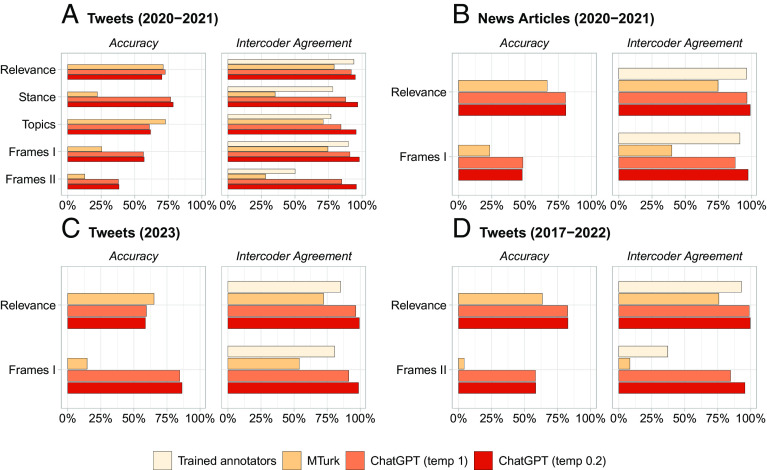
- Across four datasets, ChatGPT’s zero-shot accuracy exceeds MTurk’s by about 25 percentage points on average, and it outperforms MTurk for most tasks.
- ChatGPT’s intercoder agreement averages 91% at temperature = 1 and 97% at temperature = 0.2, compared with about 56% for MTurk and 79% for trained annotators.
- Relevance-task accuracy rates were 70% for content moderation tweets, 81% for content moderation news articles, 83% for US Congress tweets, and 59% for 2023 content moderation tweets.
- Per-annotation cost for ChatGPT is less than $0.003, about thirty times cheaper than MTurk. Correlations reported: intercoder agreement and accuracy r = 0.36; ChatGPT accuracy and trained-annotator intercoder agreement r = 0.46; ChatGPT overperformance vs. MTurk and trained-annotator intercoder agreement r = −0.37.
Methods
- Design: compare zero-shot ChatGPT annotations against MTurk crowd workers and trained annotators on the same codebooks and tasks, using trained annotators as the gold standard.
- Data: four datasets totaling n = 6,183, including a random sample of 2,382 content-moderation tweets from 2020–2021; 1,856 US Congress tweets from 2017–2022; 1,606 newspaper articles on content moderation from 2020–2021; and 500 tweets from January 2023, of which 339 were in English.
- Analysis: tasks included relevance, topic detection, stance, general frame detection, and policy frame detection. ChatGPT used the “gpt-3.5-turbo” API with temperature 1 and 0.2, two responses per temperature per tweet, and a new chat session for every tweet. MTurk workers were restricted to “MTurk Masters,” >90% HIT approval rate with at least 50 approved HITs, and US location. Metrics were accuracy against trained annotators and intercoder agreement.
Limitations
- The paper states that further research is needed to understand how ChatGPT and other LLMs perform in a broader range of contexts, and it lists future questions including multiple languages, few-shot learning, semiautomated labeling, chain-of-thought prompting, and comparison across LLM types.
- The paper states that in the 2023 sample, ChatGPT struggled with misclassifying tweets about specific user suspensions in the relevance task due to a lack of examples in the prompt, underscoring the importance of high-quality prompts.
- Evident from the text: the evaluation uses one ChatGPT model version (“gpt-3.5-turbo”) and does not report testing in languages other than English; the paper itself lists performance across multiple languages as a future question.
Model-written summary. Check it against the paper before relying on it.
Integrity signals
Registry
Cites
Statistics
Figures
Verification
Claims the paper makes
10 Own result · 8 Own method · 7 Own interpretation · 2 No basis given · 1 Not checked yet
A result the paper reports from its own data — it cites no other source for it, so there is none to check. The quote shows it is in the paper.
In the paper
“Regarding accuracy, Fig. 1 shows that ChatGPT outperforms MTurk for most tasks across the four datasets.”
- Also stated in: § Abstract · plain
“We find that across the four datasets, ChatGPT’s zero-shot accuracy is higher than that of MTurk for most tasks.”
§ ChatGPT outperforms crowd workers for text-annotation tasks > Results
plain- Asserted: passes — The authors put it forward as true.
- Checkable: passes — It can be checked against evidence.
- Load-bearing: passes — The paper’s conclusions depend on it.
- Based: passes — The paper gives a reason why it holds.
- Also stated in: § Abstract · plain
A result the paper reports from its own data — it cites no other source for it, so there is none to check. The quote shows it is in the paper.
In the paper
“ChatGPT’s intercoder agreement exceeds that of both crowd workers and trained annotators for all tasks.”
- Also stated in: § Abstract · plain
“For all tasks, ChatGPT’s intercoder agreement exceeds that of both MTurk and trained annotators.”
§ ChatGPT outperforms crowd workers for text-annotation tasks > Abstract
plaincorrelationaln = 4- Asserted: passes — The authors put it forward as true.
- Checkable: passes — It can be checked against evidence.
- Load-bearing: passes — The paper’s conclusions depend on it.
- Based: passes — The paper gives a reason why it holds.
- Also stated in: § Abstract · plain
A result the paper reports from its own data — it cites no other source for it, so there is none to check. The quote shows it is in the paper.
In the paper
“ChatGPT’s accuracy is positively correlated with the intercoder agreement of trained annotators (Pearson’s r = 0.46), suggesting better performance for easier tasks.”
§ ChatGPT outperforms crowd workers for text-annotation tasks > Results
hedgedcorrelational- Asserted: passes — The authors put it forward as true.
- Checkable: passes — It can be checked against evidence.
- Load-bearing: unclear — It is unclear whether the paper’s conclusions depend on it.
- Based: passes — The paper gives a reason why it holds.
A result the paper reports from its own data — it cites no other source for it, so there is none to check. The quote shows it is in the paper.
In the paper
“Conversely, ChatGPT’s outperformance of MTurk is negatively correlated with the intercoder agreement of trained annotators (Pearson’s r = -0.37), potentially indicating stronger overperformance for more complex tasks.”
§ ChatGPT outperforms crowd workers for text-annotation tasks > Results
hedgedcorrelational- Asserted: passes — The authors put it forward as true.
- Checkable: passes — It can be checked against evidence.
- Load-bearing: unclear — It is unclear whether the paper’s conclusions depend on it.
- Based: passes — The paper gives a reason why it holds.
A result the paper reports from its own data — it cites no other source for it, so there is none to check. The quote shows it is in the paper.
In the paper
“Across the four datasets, the zero-shot accuracy of ChatGPT exceeds that of crowd workers by about 25 percentage points on average”
- Also stated in: § Results · plain
“On average, ChatGPT’s accuracy exceeds that of MTurk by about 25 percentage points.”
§ ChatGPT outperforms crowd workers for text-annotation tasks > Abstract
plaincorrelationaln = 4- Asserted: passes — The authors put it forward as true.
- Checkable: passes — It can be checked against evidence.
- Load-bearing: passes — The paper’s conclusions depend on it.
- Based: passes — The paper gives a reason why it holds.
- Also stated in: § Results · plain
A result the paper reports from its own data — it cites no other source for it, so there is none to check. The quote shows it is in the paper.
In the paper
“The correlation between intercoder agreement and accuracy is positive (Pearson’s r = 0.36).”
§ ChatGPT outperforms crowd workers for text-annotation tasks > Results
plaincorrelational- Asserted: passes — The authors put it forward as true.
- Checkable: passes — It can be checked against evidence.
- Load-bearing: passes — The paper’s conclusions depend on it.
- Based: passes — The paper gives a reason why it holds.
A conclusion the paper draws from its own results — it cites no other source for it, so there is none to check. The quote shows it is in the paper.
In the paper
“This paper demonstrates the potential of LLMs to transform text-annotation procedures for a variety of tasks common to many research projects.”
- Also stated in: § Abstract · boosted
“These results demonstrate the potential of large language models to drastically increase the efficiency of text classification.”
§ ChatGPT outperforms crowd workers for text-annotation tasks > Discussion
boostedconditionaln = 4- Asserted: passes — The authors put it forward as true.
- Checkable: unclear — It is unclear whether it could be checked against evidence.
- Load-bearing: passes — The paper’s conclusions depend on it.
- Based: passes — The paper gives a reason why it holds.
- Also stated in: § Abstract · boosted
A conclusion the paper draws from its own results — it cites no other source for it, so there is none to check. The quote shows it is in the paper.
In the paper
“While these findings do not suggest that memorization is a major issue, they underscore the importance of high-quality prompts.”
§ ChatGPT outperforms crowd workers for text-annotation tasks > Results
hedged- Asserted: passes — The authors put it forward as true.
- Checkable: passes — It can be checked against evidence.
- Load-bearing: unclear — It is unclear whether the paper’s conclusions depend on it.
- Based: passes — The paper gives a reason why it holds.
- Rests on an assumption: The 2023 tweets were not included in ChatGPT's training data.
A conclusion the paper draws from its own results — it cites no other source for it, so there is none to check. The quote shows it is in the paper.
In the paper
“Conversely, ChatGPT’s outperformance of MTurk is negatively correlated with the intercoder agreement of trained annotators (Pearson’s r = -0.37), potentially indicating stronger overperformance for more complex tasks.”
§ ChatGPT outperforms crowd workers for text-annotation tasks > Results
hedgedcorrelational- Asserted: passes — The authors put it forward as true.
- Checkable: passes — It can be checked against evidence.
- Load-bearing: unclear — It is unclear whether the paper’s conclusions depend on it.
- Based: passes — The paper gives a reason why it holds.
A conclusion the paper draws from its own results — it cites no other source for it, so there is none to check. The quote shows it is in the paper.
In the paper
“ChatGPT’s accuracy is positively correlated with the intercoder agreement of trained annotators (Pearson’s r = 0.46), suggesting better performance for easier tasks.”
§ ChatGPT outperforms crowd workers for text-annotation tasks > Results
hedgedcorrelational- Asserted: passes — The authors put it forward as true.
- Checkable: passes — It can be checked against evidence.
- Load-bearing: unclear — It is unclear whether the paper’s conclusions depend on it.
- Based: passes — The paper gives a reason why it holds.
- It may state two separate claims as one. 8
- Probably not a substantial claim. 10
The paper states this without a source or data behind it here, so there is nothing to check it against. The quote shows it is in the paper.
In the paper
“In the 2023 sample, ChatGPT performed much better than MTurk in the second task but struggled with misclassifying tweets about specific user suspensions in the relevance task due to a lack of examples in the prompt.”
§ ChatGPT outperforms crowd workers for text-annotation tasks > Results
plaindirect- Asserted: passes — The authors put it forward as true.
- Checkable: passes — It can be checked against evidence.
- Load-bearing: unclear — It is unclear whether the paper’s conclusions depend on it.
- Based: passes — The paper gives a reason why it holds.
It may state two separate claims as one.
A result the paper reports from its own data — it cites no other source for it, so there is none to check. The quote shows it is in the paper.
In the paper
“On average, intercoder agreement is about 56% for MTurk, 79% for trained annotators, 91% for ChatGPT with temperature = 1, and 97% for ChatGPT with temperature = 0.2.”
§ ChatGPT outperforms crowd workers for text-annotation tasks > Results
hedged- Asserted: passes — The authors put it forward as true.
- Checkable: passes — It can be checked against evidence.
- Load-bearing: passes — The paper’s conclusions depend on it.
- Based: passes — The paper gives a reason why it holds.
It may state two separate claims as one.
A result the paper reports from its own data — it cites no other source for it, so there is none to check. The quote shows it is in the paper.
In the paper
“Accuracy rates for relevance tasks, with two classes (relevant/irrelevant) are 70% for content moderation tweets, 81% for content moderation news articles, 83% for US Congress tweets, and 59% for 2023 content moderation tweets.”
§ ChatGPT outperforms crowd workers for text-annotation tasks > Results
plain- Asserted: passes — The authors put it forward as true.
- Checkable: passes — It can be checked against evidence.
- Load-bearing: passes — The paper’s conclusions depend on it.
- Based: passes — The paper gives a reason why it holds.
It may state two separate claims as one.
A result the paper reports from its own data — it cites no other source for it, so there is none to check. The quote shows it is in the paper.
In the paper
“Using four samples of tweets and news articles (n = 6,183), we show that ChatGPT outperforms crowd workers for several annotation tasks, including relevance, stance, topics, and frame detection.”
§ ChatGPT outperforms crowd workers for text-annotation tasks > Abstract
plainn = 4- Asserted: passes — The authors put it forward as true.
- Checkable: passes — It can be checked against evidence.
- Load-bearing: passes — The paper’s conclusions depend on it.
- Based: passes — The paper gives a reason why it holds.
It may state two separate claims as one.
A result the paper reports from its own data — it cites no other source for it, so there is none to check. The quote shows it is in the paper.
In the paper
“Moreover, the per-annotation cost of ChatGPT is less than $0.003—about thirty times cheaper than MTurk.”
- Also stated in: § Abstract · plain
“ChatGPT’s per-annotation cost is about $0.003 or a third of a cent—about thirty times cheaper than MTurk, with higher quality.”
§ ChatGPT outperforms crowd workers for text-annotation tasks > Abstract
plainn = 6,183- Asserted: passes — The authors put it forward as true.
- Checkable: passes — It can be checked against evidence.
- Load-bearing: passes — The paper’s conclusions depend on it.
- Based: passes — The paper gives a reason why it holds.
It may state two separate claims as one.
- Also stated in: § Abstract · plain
The paper states this without a source or data behind it here, so there is nothing to check it against. The quote shows it is in the paper.
In the paper
“The evidence is consistent across different types of texts and time periods.”
§ ChatGPT outperforms crowd workers for text-annotation tasks > Discussion
plain- Asserted: passes — The authors put it forward as true.
- Checkable: passes — It can be checked against evidence.
- Load-bearing: fails — The paper’s conclusions may not depend on it.
- Based: fails — The paper may give no reason why it holds.
Probably not a substantial claim. The paper’s conclusions may not depend on it. The paper may give no reason why it holds.
What the paper did — it cites no source for this, so there is none to check. The quote shows it is in the paper.
In the paper
“The sample size was determined by the number of texts needed to build a training set for a machine learning classifier.”
§ ChatGPT outperforms crowd workers for text-annotation tasks > Materials and Methods > Datasets.
plaindirect- Asserted: passes — The authors put it forward as true.
- Checkable: passes — It can be checked against evidence.
- Load-bearing: fails — The paper’s conclusions may not depend on it.
- Based: passes — The paper gives a reason why it holds.
Probably not a substantial claim. The paper’s conclusions may not depend on it.
A conclusion the paper draws from its own results — it cites no other source for it, so there is none to check. The quote shows it is in the paper.
In the paper
“This suggests that a lower temperature value may be preferable for annotation tasks, as it seems to increase consistency without decreasing accuracy.”
§ ChatGPT outperforms crowd workers for text-annotation tasks > Results
hedgedconditional- Asserted: passes — The authors put it forward as true.
- Checkable: passes — It can be checked against evidence.
- Load-bearing: fails — The paper’s conclusions may not depend on it.
- Based: passes — The paper gives a reason why it holds.
Probably not a substantial claim. The paper’s conclusions may not depend on it. It may state two separate claims as one.
What the paper did — it cites no source for this, so there is none to check. The quote shows it is in the paper.
In the paper
“Moreover, we ensured that no worker could annotate more than 20% of the tweets for a given task.”
§ ChatGPT outperforms crowd workers for text-annotation tasks > Materials and Methods > Crowd Workers.
plain- Asserted: passes — The authors put it forward as true.
- Checkable: passes — It can be checked against evidence.
- Load-bearing: fails — The paper’s conclusions may not depend on it.
- Based: passes — The paper gives a reason why it holds.
Probably not a substantial claim. The paper’s conclusions may not depend on it.
What the paper did — it cites no source for this, so there is none to check. The quote shows it is in the paper.
In the paper
“We intentionally avoided adding any ChatGPT-specific prompts to ensure comparability between ChatGPT and MTurk crowd workers.”
§ ChatGPT outperforms crowd workers for text-annotation tasks > Materials and Methods > ChatGPT.
plain- Asserted: passes — The authors put it forward as true.
- Checkable: passes — It can be checked against evidence.
- Load-bearing: passes — The paper’s conclusions depend on it.
- Based: passes — The paper gives a reason why it holds.
Probably not a substantial claim.
In the paper
“Moreover, some of the tasks involve a large number of classes and exhibit lower levels of intercoder agreement, which indicates a higher degree of annotation difficulty (11).”
§ ChatGPT outperforms crowd workers for text-annotation tasks > Results
What the sources say
- Not checked yetcites [11] P. S. Bayerl, K. I. Paul, What determines inter-coder agreement in manual annotations? A meta-analytic investigation Comput. Linguist. 37, 699– 725 (2011).
hedgedcorrelational- Asserted: passes — The authors put it forward as true.
- Checkable: passes — It can be checked against evidence.
- Load-bearing: passes — The paper’s conclusions depend on it.
- Based: passes — The paper gives a reason why it holds.
It may state two separate claims as one.
What the paper did — it cites no source for this, so there is none to check. The quote shows it is in the paper.
In the paper
“As with the trained human annotators, each tweet was annotated by two different crowd workers.”
§ ChatGPT outperforms crowd workers for text-annotation tasks > Materials and Methods > Crowd Workers.
plain- Asserted: passes — The authors put it forward as true.
- Checkable: passes — It can be checked against evidence.
- Load-bearing: passes — The paper’s conclusions depend on it.
- Based: passes — The paper gives a reason why it holds.
Probably not a substantial claim.
What the paper did — it cites no source for this, so there is none to check. The quote shows it is in the paper.
In the paper
“The coders annotated the tweets independently task by task.”
§ ChatGPT outperforms crowd workers for text-annotation tasks > Materials and Methods > Trained Annotators.
plain- Asserted: passes — The authors put it forward as true.
- Checkable: passes — It can be checked against evidence.
- Load-bearing: fails — The paper’s conclusions may not depend on it.
- Based: passes — The paper gives a reason why it holds.
Probably not a substantial claim. The paper’s conclusions may not depend on it.
What the paper did — it cites no source for this, so there is none to check. The quote shows it is in the paper.
In the paper
“First, we computed average accuracy (i.e., percentage of correct predictions), that is, the number of correctly classified instances over the total number of cases to be classified, using trained human annotations as our gold standard and considering only texts that both annotators agreed upon.”
§ ChatGPT outperforms crowd workers for text-annotation tasks > Materials and Methods > Evaluation Metrics.
plain- Asserted: passes — The authors put it forward as true.
- Checkable: passes — It can be checked against evidence.
- Load-bearing: passes — The paper’s conclusions depend on it.
- Based: passes — The paper gives a reason why it holds.
Probably not a substantial claim.
What the paper did — it cites no source for this, so there is none to check. The quote shows it is in the paper.
In the paper
“To ensure annotation quality, we restricted access to the tasks to workers who are classified as “MTurk Masters” by Amazon, who have an HIT (Human Intelligence Task) approval rate greater than 90% with at least 50 approved HITs, and who are located in the United States.”
§ ChatGPT outperforms crowd workers for text-annotation tasks > Materials and Methods > Crowd Workers.
plain- Asserted: passes — The authors put it forward as true.
- Checkable: passes — It can be checked against evidence.
- Load-bearing: passes — The paper’s conclusions depend on it.
- Based: passes — The paper gives a reason why it holds.
Probably not a substantial claim. It may state two separate claims as one.
What the paper did — it cites no source for this, so there is none to check. The quote shows it is in the paper.
In the paper
“We created a new chat session for every tweet to ensure that the ChatGPT results are not influenced by the history of annotations.”
§ ChatGPT outperforms crowd workers for text-annotation tasks > Materials and Methods > ChatGPT.
plaindirect- Asserted: passes — The authors put it forward as true.
- Checkable: passes — It can be checked against evidence.
- Load-bearing: fails — The paper’s conclusions may not depend on it.
- Based: passes — The paper gives a reason why it holds.
Probably not a substantial claim. The paper’s conclusions may not depend on it.
The paper relies on this without support.
The trained annotators' annotations constitute a valid gold standard for correctness.
“using trained human annotations as our gold standard”
“using our trained annotators as a benchmark”
The paper relies on this without support.
The 2023 tweets were not included in ChatGPT's training data.
“a new sample of tweets posted in 2023 to address the concern that ChatGPT might be relying on memorization for texts potentially included in the model’s training dataset.”
Claims other papers make about this one
Each is checked against this paper’s own text: does it say what the citing paper says it does?
The source backs part of the claim, not all of it — or backs it for a different population, condition or comparison.
In the citing paper
“LLMs have been shown to perform well on diverse text-analysis tasks 36 , often matching or exceeding state-of-the-art models and crowd workers 37,38 , even with zero-shot prompts 39 .”
From Quantifying the prevalence and impact of overreaching causal claims in social science (2026) · cites this paper as [38]
Experimental — accuracy not yet measuredThe source backs part of the claim, not all of it — or backs it for a different population, condition or comparison.
In the citing paper
“we employ GPT-4 for automated evaluation, where both the generated hypotheses and the provided background are evaluated across these aspects.”
From Large Language Models as Biomedical Hypothesis Generators: A Comprehensive Evaluation (2024) · cites this paper as Gilardi et al., 2023
Experimental — accuracy not yet measuredThe cited source says what the claim attributes to it.
In the citing paper
“These models mitigate many of the above mentioned limitations associated with human coders by leveraging their computational efficiency, consistency, and scalability [34–36].”
From The quantum technology job market: data driven analysis of 3641 job posts (2026) · cites this paper as [34]
The cited source says what the claim attributes to it.
In the citing paper
“LLM-assisted annotation shows a similar tension: LLMs can match or outperform crowd workers on some text-classification tasks, yet may introduce systematic bias in qualitative coding (Ashwin et al., 2025;Gilardi et al., 2023).”
From Beyond Human-Likeness: Mapping the Scientific Critique Profiles of LLMs and Human Reviewers (2026) · cites this paper as Gilardi et al., 2023
The cited source says what the claim attributes to it.
In the citing paper
“Prior studies have also reported that LLM evaluations can be competitive with crowdworker annotations (Gilardi et al., 2023).”
From MAPLE: Multi-Aspect Panels of LLM Evaluators for Open-Ended Questions (2026) · cites this paper as Gilardi et al., 2023
The check wasn’t confident either way, so it gives no verdict — never disputed.
In the citing paper
“LLM-assisted annotation shows a similar tension: LLMs can match or outperform crowd workers on some text-classification tasks, yet may introduce systematic bias in qualitative coding (Ashwin et al., 2025;Gilardi et al., 2023).”
From Beyond Human-Likeness: Mapping the Scientific Critique Profiles of LLMs and Human Reviewers (2026) · cites this paper as Gilardi et al., 2023
Experimental — accuracy not yet measuredIn the citing paper
“They find this model performs better than human workers trained with such materials on Amazon Mechanical Turk—though such coders are known to be less accurate than those trained directly by researchers in small group settings.”
From Can Generative AI improve social science? (2024) · cites this paper as [51]
In the citing paper
“Gilardi et al. argue GPT 3.5-turbo can accurately measure the topic of tweets, the stance or opinions of their authors, and the “frames” used to organize the message in a narrative manner (51).”
From Can Generative AI improve social science? (2024) · cites this paper as [51]
In the citing paper
“Some LLMs have been found as good as human annotators [41] in some tasks.”
From Harnessing the power of llms in practice: a survey on chatGPT and beyond (2024) · cites this paper as [41]
Citations
Cites
Large Language Models are Zero-Shot Reasoners
Kojima, T., Gu, S. S., Reid, M., Matsuo, Y., & Iwasawa, Y. (2022) · arXiv · doi:10.48550/arxiv.2205.11916 · Cited by 2,013
An MTurk Crisis? Shifts in Data Quality and the Impact on Study Results
Chmielewski, M., & Kucker, S. C. (2020) · Social Psychological and Personality Science · doi:10.1177/1948550619875149 · Cited by 1,027
Out of One, Many: Using Language Models to Simulate Human Samples
Argyle, L. P., Busby, E. C., Fulda, N., Gubler, J. R., Rytting, C., & Wingate, D. (2023) · Political Analysis · doi:10.1017/pan.2023.2 · Cited by 783
Using cognitive psychology to understand GPT-3
Binz, M., & Schulz, E. (2023) · Proceedings of the National Academy of Sciences · doi:10.1073/pnas.2218523120 · Cited by 559 · cited 2×
“…very well for a wide range of purposes, including ideological scaling (Wu et al., 2023), the classification of legislative proposals (Nay, 2023), the resolution of cognitive psychology tasks, (Binz and Schulz, 2023), and the simulation of human samples for survey research (Argyle et al., 2023).”
BackgroundCrowd-sourced Text Analysis: Reproducible and Agile Production of Political Data
Benoit, K. R., Conway, D., Lauderdale, B. E., Laver, M., & Mikhaylov, S. (2016) · American Political Science Review · doi:10.1017/s0003055416000058 · Cited by 296
Huang, F., Kwak, H., & An, J. (2023) · International World Wide Web Conference (WWW) · doi:10.1145/3543873.3587368 · Cited by 247
Huang, F., Kwak, H., & An, J. (2023) · arXiv · doi:10.48550/arxiv.2302.07736 · Cited by 231
The Media Frames Corpus: Annotations of Frames Across Issues
Card, D., Boydstun, A. E., Gross, J. H., Resnik, P., & Smith, N. A. (2015) · doi:10.3115/v1/p15-2072 · Cited by 224
Kuzman, T., Mozetič, I., & Ljubešić, N. (2023) · arXiv (Cornell University) · doi:10.48550/arxiv.2303.03953 · Cited by 137
What Determines Inter-Coder Agreement in Manual Annotations? A Meta-Analytic Investigation
Bayerl, P. S., & Paul, K. I. (2011) · Computational Linguistics · doi:10.1162/coli_a_00074 · Cited by 126
Research works printed but not linked: 1
- M. Desmond, E. Duesterwald, K. Brimijoin, M. Brachman, Q. Pan, Semi-automateddatalabeling, in NeurIPS 2020 Competition and Demonstration Track, (PMLR, 2021), pp. 156–169.
Cited by
Sorted by citations
Items 901–1,000 of 1,025
Zhu, C., Taniguchi, T., Ohkuma, T., & Shimada, K. (2025) · Lecture notes in computer science · doi:10.1007/978-3-031-97144-0_2
Repurposing Annotation Guidelines to Instruct LLM Annotators: A Case Study
Kim, K. W., Islamaj, R., Kim, J.-D., Boudin, F., & Aizawa, A. (2025) · Lecture notes in computer science · doi:10.1007/978-3-031-97144-0_13
Vulnerability and the computational logic of fear: insights from the horror genrePreprint
Dubourg, E., & Scrivner, C. (2025) · doi:10.31234/osf.io/9e2tx_v1
Huang, H., Meng, J., & He, X. (2025) · SSRN Electronic Journal · doi:10.2139/ssrn.5341517
Lu, W., Zheng, G., & Yuan, L. (2025) · SSRN Electronic Journal · doi:10.2139/ssrn.5347308
Building Healthcare Educational Scenarios by Tagging Clinical Narratives Using Large Language Models
Buendía, F., Gayoso-Cabada, J., & Sierra, J. L. (2025) · Lecture notes in educational technology · doi:10.1007/978-981-96-5658-5_25
Oh, Y. J., Rasul, M. E., McKinley, E., & Calabrese, C. R. (2025) · Frontiers in Artificial Intelligence · doi:10.3389/frai.2025.1602984
Zhang, X., Lee, M., Zhou, M., & Lee, G. M. (2025) · SSRN Electronic Journal · doi:10.2139/ssrn.5357471
luo, Y., Li, T., Lu, J., Lv, D., & Chen, Y. (2025) · SSRN Electronic Journal · doi:10.2139/ssrn.5352879
Computational Methods and Nationalism Studies
Ho, J. C. (2025) · Studies on National Movements · doi:10.21825/snm.95476
Huang, H., & Meng, J. (2025) · SSRN Electronic Journal · doi:10.2139/ssrn.5341505
Reliable Annotations with Less Effort: Evaluating LLM-Human Collaboration in Search Clarifications
Tavakoli, L., & Zamani, H. (2025) · ACM SIGIR International Conference on Theory of Information Retrieval (ICTIR) · doi:10.1145/3731120.3744574 · Cited by 4
Large Language Models Are Democracy Coders with Attitudes
Weidmann, N. B., Faulborn, M., & García, D. (2025) · PS Political Science & Politics · doi:10.1017/s1049096525101248
Once Upon a Time: Introducing the Historical Values SurveyPreprint
Khesali, M., Voigt, S., & von Jacobi, N. (2025) · SSRN Electronic Journal · doi:10.2139/ssrn.5378791 · Cited by 1
Evaluation of Large Language Models in Annotating Metaphorical Sentences
Eğin, F., Onan, A., & Durak, H. Y. (2025) · Communications in computer and information science · doi:10.1007/978-3-031-93601-2_1
Heo, S., Jeon, M., Lee, S.-B., Kim, J., Ha, S., Cho, S., Heo, N., & Park, J. (2025) · International Conference on Automatic Face and Gesture Recognition · doi:10.1109/fg61629.2025.11099406
The Price of Pride: Corporate Responses to Politicized Social IssuesPreprint
Chattopadhyay, S., & Borwankar, S. (2025) · SSRN Electronic Journal · doi:10.2139/ssrn.5342180
Challenging Embodied Cognition: Insights from Human and ChatGPT Conceptual RepresentationsPreprint
Repetto, C., Riva, G., Hampton, J. A., & Scerrati, E. (2025) · SSRN Electronic Journal · doi:10.2139/ssrn.5338994
Partisan Bias in Juror Decision-Making
Rhodes, J. H., Nteta, T. M., & Rice, D. R. (2025) · Journal of law & empirical analysis. · doi:10.1177/2755323x251366728
High-Confidence Labelling of Pathology Reports Using LLM-Based Unanimous Ensembles with Limited Data
Greatrix, T., Langbein, F. C., Whitaker, R. M., Colombo, G. B., & Turner, L. D. (2025) · Lecture notes in computer science · doi:10.1007/978-3-032-00652-3_27
The Evolution of Research on the Digital EconomyPreprint
Kaiser, F. (2025) · SSRN Electronic Journal · doi:10.2139/ssrn.5399959
Li, Y. (2026) · Journal of Research in Personality · doi:10.1016/j.jrp.2026.104744 · Cited by 1
AviBERT: Transformer-based Aircraft Text Classification
Ünal, M. C., Yurtalan, G., Karataş, Y. B., Karamanlıoğlu, A., & Demirel, B. (2025) · Signal Processing and Communications Applications Conference (SIU) · doi:10.1109/siu66497.2025.11112276
Comparing Human and Generative AI Analysis of Emotions in U.S. Abortion Tweets
Kurt, Ş., & Duris, M. (2025) · doi:10.31274/isudp.2025.211.13
Barkar, A., Chollet, M., Labeau, M., Biancardi, B., & Clavel, C. (2025) · Research Square · doi:10.21203/rs.3.rs-7139734/v1
Munzlinger, E., Narcizo, F. B., Briet, R., Shimanuki, M. T., Vucurevich, T., & Hansen, D. W. (2025) · Lecture notes in computer science · doi:10.1007/978-3-032-05005-2_22
Content analysis and natural language processing
Németh, R. (2025) · Elsevier eBooks · doi:10.1016/b978-0-443-26629-4.00056-3
LLM–Based Framework for Synthetic Data Generation in Portuguese Clinical NER
Henriques, L. F. M. O., Guimar�ães, N., & Jorge, A. (2025) · Lecture notes in computer science · doi:10.1007/978-3-032-05176-9_26
Cunha, N. S. D. S., & Rossi, R. G. (2024) · doi:10.11606/003227127
Navigating Online Dialogue: Employing Counterspeech in Mitigating Digital Violence with LLMsPreprint
Svetasheva, A., & Lee, K. (2025) · SSRN Electronic Journal · doi:10.2139/ssrn.5494231
Does ChatGPT get it? LLM-driven annotation of HumorPreprint
Bianco, A., Brocca, N., & Garassino, D. (2025) · SSRN Electronic Journal · doi:10.2139/ssrn.5500673
Neuro-Symbolic Federated Research Artifact Search
Keya, F., Auer, S., & Jaradeh, M. Y. (2025) · Lecture notes in computer science · doi:10.1007/978-3-032-05409-8_10
Vranić, A., Reis, J. M., Damião, Í., Almeida, P., & Gonçalves-Sá, J. (2025) · doi:10.1145/3746275.3762201
Evolving Compliance Processes through LLM-Supported Transformation of Regulations into SBVRPreprint
dos Santos, A., & Silva, P. S. M. (2025) · doi:10.22541/au.176051910.04955057/v1
AnnoLoom : Augmenting Codebook Generation and Annotation with Large Language Models
Wang, L., Lynch, D., Aghakhani, E., Demiris, G., Washington, K., Rezapour, R., & Huh, J. (2025) · Proceedings of the Association for Information Science and Technology · doi:10.1002/pra2.1517
Larsson, A. O. (2025) · Social Science Computer Review · doi:10.1177/08944393251390890 · Cited by 1
Identify, Isolate, and Purge: Mitigating Hallucinations in LVLMs via Self-Evolving Distillation
Li, W., Su, X. Q., Wu, J., Yang, F., Liu, Y., Chen, Y., You, S., & Xu, C. (2025) · ACM International Conference on Multimedia (ACM MM) · doi:10.1145/3746027.3754784 · Cited by 2
ICL-Bandit: Relevance Labeling in Advertisement Recommendation Systems via LLM
Wang, L., Duan, C., Zhao, P., Yang, F., Shi, Y., Luo, X., Xu, B., Deng, W., Lin, Q., & Zhang, D. (2025) · Findings of the Association for Computational Linguistics: EMNLP (Findings of EMNLP) · doi:10.18653/v1/2025.findings-emnlp.1273
Episodes of sustained protest: temporal patterns of online mobilization on X
Eckardt, J., Turgeon, M., Abul‐Fottouh, D., & Rana, F. (2025) · Information Communication & Society · doi:10.1080/1369118x.2025.2585094
Evaluating LLMs for Multi-label Text Classification
Wang, M., & Liu, M. Z. (2025) · Lecture notes in computer science · doi:10.1007/978-981-95-3055-7_24
Towards Realistic Generation: A Multi-Task Agent for Imitating Diverse Character Linguistic Styles
Chen, S., Si, Q., Yang, C., Lin, Z., Liang, Y., Tao, S., Zhang, Z., & Wang, W. (2025) · International Joint Conference on Neural Networks (IJCNN) · doi:10.1109/ijcnn64981.2025.11228654
Read Between the Tokens: Differentiable Text Pruning via Perturbed Top-k Selection
Italiani, P., Ragazzi, L., & Moro, G. (2025) · IEEE Transactions on Audio Speech and Language Processing · doi:10.1109/taslpro.2025.3629289
Xie, Z., Chan, T.-T., & Yu, P. L. H. (2025) · Computers and Education Artificial Intelligence · doi:10.1016/j.caeai.2025.100510
Size Matters(?): Utilizing Small LLMs for Annotation in Social SciencePreprint
Käßmaier, J. (2025) · Preprints.org · doi:10.20944/preprints202511.2016.v1
Exploring the Role of Errors in Programming Learning
Sha, A. S., Nunes, B. P., & Shen, J. (2025) · ACM Transactions on Computing Education · doi:10.1145/3778857
Aurelia, M., Monica, S., Girsang, A. S., Rita, R., & Puspita, V. (2025) · Journal of Location Based Services · doi:10.1080/17489725.2025.2595182
Investigating and comparing user experiences at EV charging and petroleum fueling stations
Rabinowitz, A. I., Karanam, V. C., Nordhoff, S., Hardman, S., & Tal, G. (2026) · Transportation Research Part D Transport and Environment · doi:10.1016/j.trd.2026.105580
Private Ownership of Public Trust Wildlife Habitat in Montana, U.S.A. (2004–2023)
Metcalf, A. L., Chandler, J., & Birdsong, M. H. (2025) · Environmental Management · doi:10.1007/s00267-025-02336-6
Oh, Y. J., Rasul, M. E., Lim, J. I., Calabrese, C., McKinley, E. K., Stevens, H., Turner, M. M., Lapinski, M. K., & Peng, T. (2025) · PLoS ONE · doi:10.1371/journal.pone.0338183
Position: LLM-in-the-Loop is All You Need for Machine Learning ApplicationsPreprint
Hong, M., Ng, W., Zhang, C. J., Wang, Y., Song, Y., & Jiang, D. (2025) · doi:10.36227/techrxiv.174495034.42657551/v1
Additional file 1 of Large language models for generating medical examinations: systematic review
Artsi, Y., Sorin, V., Konen, E., Glicksberg, B. S., Nadkarni, G., & Klang, E. (2024) · Figshare · doi:10.6084/m9.figshare.26699639
Additional file 3 of Large language models for generating medical examinations: systematic review
Artsi, Y., Sorin, V., Konen, E., Glicksberg, B. S., Nadkarni, G., & Klang, E. (2024) · Figshare · doi:10.6084/m9.figshare.26699645
Additional file 2 of Large language models for generating medical examinations: systematic review
Artsi, Y., Sorin, V., Konen, E., Glicksberg, B. S., Nadkarni, G., & Klang, E. (2024) · Figshare · doi:10.6084/m9.figshare.26699642
Heseltine, M. (2025) · OSF Preprints (OSF Preprints) · doi:10.31219/osf.io/jvgc5_v2
Goyanes, M., Domínguez‐Díaz, A., & de-Marcos, L. (2025) · Human Behavior and Emerging Technologies · doi:10.1155/hbe2/5761832
The Task Space: An Integrative Framework for Team ResearchPreprint
Gandhi, L., Hu, X. E., Almaatouq, A., Watts, D. J., & Whiting, M. E. (2026) · PsyArXiv (OSF Preprints)
Toxicity Ahead: Forecasting Conversational Derailment on GitHub
Imran, M. M., Zita, R., Rahman, R. R., Chatterjee, P., & Damevski, K. (2026) · ACM/IEEE International Conference on Software Engineering: Companion Proceedings (ICSE-Companion) · doi:10.1145/3744916.3787839 · Cited by 3
Ghosh, S., Luo, X., Maeyama, J., Jhalani, S., Oshiro, C. J., Venkatesh, T., & Patel, R. (2025) · Lecture notes in social networks · doi:10.1007/978-3-032-13509-4_11
Geandra, A. R., Siregar, A. M., & Nooraeni, R. (2025) · Proceedings of The International Conference on Data Science and Official Statistics · doi:10.34123/icdsos.v2025i1.684
Baik, K., & Kim, J. (2025) · Lecture notes in social networks · doi:10.1007/978-3-032-13509-4_24
Swot analysis of ChatGPT usage among employees
Ainooson-Noonoo, D. K., & Nanor, D. (2025) · Journal of Educational Technology and Online Learning · doi:10.31681/jetol.1774638
A Study on Diabetes Health Management Dialogue Data Annotation Method Based on Few-shot-CoT
Sheng, G., & Yang, J. (2025) · International Conference on Big Data and Intelligent Medicine (BDIMed) · doi:10.1109/bdimed67722.2025.11309335
Xie, H., Cao, H., & Zhao, H. (2025) · Systems · doi:10.3390/systems14010036
Alshaqhaa, A., Hassan, R. B., Qamar, F., & Ibrahim, A. H. (2026) · IEEE Access · doi:10.1109/access.2025.3650186 · Cited by 1
GDPR120Q: An Annotated Q&A Corpus for Privacy Compliance
Gyory, R., Lewkowicz, G., Amariles, D. R., Meeùs, S., Casalena, S., & Bersini, H. (2026) · Lecture notes in computer science · doi:10.1007/978-3-032-12795-2_3
Bjørkholt, S. (2026) · Regulation & Governance · doi:10.1111/rego.70123
HALO-GPT:Hindi Active Learning with Oracle GPT-3.5
Maurya, A., Saradhi, V. V., & Anand, A. (2025) · Annual Meeting of the Forum for Information Retrieval Evaluation (FIRE) · doi:10.1145/3777867.3777878
Human- vs. AI-generated tests: dimensionality and information accuracy in latent trait evaluation
Angelelli, M., Oliva, M., Arima, S., & Ciavolino, E. (2026) · Statistics · doi:10.1080/02331888.2025.2610647
Nachaithong, C., Pranee, J., Watthayu, W., Dilokpatpongsa, P., Worasucheep, C., & Wattanapornprom, W. (2025) · International Joint Symposium on Artificial Intelligence and Natural Language Processing (iSAI-NLP) · doi:10.1109/isai-nlp66160.2025.11320754
Yap, S. C., & Low, Y.-C. (2025) · IEEE International Conference on Computing (ICOCO) · doi:10.1109/icoco67189.2025.11334090
From Words to Watts: How Green-Oriented Policy Narratives Affect Urban Energy Intensity
Cai, X., Sun, S., & Cai, G. (2026) · Sustainability · doi:10.3390/su18020924
Aleksandric, A., Dangal, A., Nilizadeh, S., & Wilson, G. M. (2026) · Online Journal of Public Health Informatics · doi:10.2196/72465
Multi-scale steering of large vision language models via visual information intervention
Zhao, D., Sun, B., He, J., & Zhang, Y. (2026) · Neurocomputing · doi:10.1016/j.neucom.2026.132780
Administración de la innovación para el desarrollo sostenible. Fundamentos estratégicos
Aguilar-Navarro, C. O., Borbón-Morales, C. G., & Mejía-Trejo, J. (2026) · doi:10.55965/abib.9786076934128
Leveraging LLMs for Automated Detection of Offensive Language in Educational Platforms
Wang, L., Ye, X., & Manoharan, S. (2025) · IEEE International Conference on Teaching, Assessment, and Learning for Engineering · doi:10.1109/tale66047.2025.11346640
Can LLMs Reliably Label YouTube Videos? A Committee-Based Evaluation
Mourthé, A., Mello, C. E., & Jorge, A. (2026) · Lecture notes in computer science · doi:10.1007/978-3-032-13513-1_23
Thakur, A., Murray, T., Rodriguez, P., & Hilbert, M. (2026) · SSRN Electronic Journal · doi:10.2139/ssrn.6083909
He, Q., Yue, Y., Zheng, B., Tipoe, G. L., Ganotice, F. A., & Cheung, P. Y. J. (2026) · Research Square · doi:10.21203/rs.3.rs-8425435/v1
Enhancing Machine Learning-based Drug-Drug Interaction Prediction via Feature Selection
Kim, H., Kim, J., & Yoon, Y. (2026) · Asia-pacific Journal of Convergent Research Interchange · doi:10.47116/apjcri.2026.01.30
YALÇIN, M. F., & Parmaksız, H. (2026) · TRT Akademi · doi:10.37679/trta.1832541
MTCCM: A multi-task conflict control model for Web API recommendation with semantic enhancement
Chen, K., Zhang, H., Chen, Z., Cheng, L., & Lu, X. (2026) · Applied Soft Computing · doi:10.1016/j.asoc.2026.114749
When Better Performance Feels the Same: Performance Underestimation in Human-AI CollaborationPreprint
Voigt, J., & Berger, S. (2026) · SSRN Electronic Journal · doi:10.2139/ssrn.6164246
Kimeli, P., Rai, T., Boyden, L., Mwacalimba, K. K., Tiernan, R., Kalule, F., Street, T., Cook, A. J. C., & Wells, K. (2026) · doi:10.12688/verixiv.1867.2
Preaching to the choirs. Political parties’ online targeting strategies in multi-party systems
Hove, M. F., HOBOLT, S. B., van Dalen, A., & de Vreese, C. H. (2026) · Party Politics · doi:10.1177/13540688251408777
Digital Trace Data in Social Media Research: Constructing Opportunities and Contributions
Mirbabaie, M., & Rieskamp, J. (2026) · Progress in IS · doi:10.1007/978-3-032-05497-5_9
Syme, K., Motos, N., & Placek, C. D. (2026) · Royal Society Open Science · doi:10.1098/rsos.251766
Marchlewski, E., Olow, E., & Yim, M. (2026) · SSRN Electronic Journal · doi:10.2139/ssrn.6219005
Lange, M., Koutsouleris, N., Carter, B., & Twumasi, R. (2026) · Healthcare Technology Letters · doi:10.1049/htl2.70058
Wiktor, S., & Dorodchi, M. (2026) · ACM Technical Symposium on Computer Science Education (SIGCSE) · doi:10.1145/3770762.3772606
Adeseye, A., Isoaho, J., Virtanen, S., & Tahir, M. (2026) · IEEE International Conference on AI in Cybersecurity (ICAIC) · doi:10.1109/icaic67076.2026.11395706
An Experimental Evaluation of Prompt Injection Attacks on LLM-Based Content Moderation Systems
Tortora, F., & Angelis, V. D. (2025) · International Conference on Social Networks Analysis, Management and Security (SNAMS) · doi:10.1109/snams67467.2025.11390931
Nuovo, E. D., Sanguinetti, M., Balestrucci, P. F., Luca Anselma, A., Bernareggi, C., & Mazzei, A. (2024) · Language Resources and Evaluation Conference (LREC) · doi:10.63317/4n9wkr5nnmxg
Enhancing Knowledge Selection via Multi-level Document Semantic Graph
Zhang, H., & Yongmei, T. (2024) · Language Resources and Evaluation Conference (LREC) · doi:10.63317/3beoy7pqe8qt
Herrero-Vidal, P., Chen, Y.-L., Liu, C., Xu, B., Sen, P., & Wang, L. (2026) · Big Data · doi:10.1177/2167647x261423127
Jung, H., Lee, J., Lee, S., & Chung, D. (2026) · SSRN Electronic Journal · doi:10.2139/ssrn.6344776
Amure, R., & Agarwal, N. (2026) · Social Network Analysis and Mining · doi:10.1007/s13278-026-01591-7
Metadata
- Authors
- Gilardi, F., Alizadeh, M., & Kubli, M.
- Affiliations
- Harvard University (US)
- Corresponding author
- Gilardi, Fabrizio
- Venue
- Proceedings of the National Academy of Sciences
- Publisher
- National Academy of Sciences
- Published
- 2023-07-18
- Volume
- 120
- Issue
- 30
- Pages
- e2305016120-e2305016120
- ISSN
- 0027-8424 (ISSN-L)
- 1091-6490
- PMC
- PMC10372638
- OpenAlex
- W4384662964
- Cited by
- 1,197
- References
- 12
- Citations by year
- 2026: 440 · 2025: 356 · 2024: 274 · 2023: 125
- FWCI
- 554.15
- Type
- journal article
- Language
- en
- Open access
- hybrid
- doi.org
- Licence
- Locations
- Proceedings of the National Academy of Sciences (publishedVersion, cc-by)
- PubMed Central (publishedVersion, cc-by)
- PubMed (publishedVersion)
- Zurich Open Repository and Archive (University of Zurich) (acceptedVersion, cc-by-nc-nd)
- arXiv (Cornell University) (submittedVersion, cc-by)
- Zurich Open Repository and Archive (University of Zurich) (submittedVersion, other-oa)
- arXiv (Cornell University) (cc-by)
- Zurich Open Repository and Archive (University of Zurich)
- Funders
- EC | European Research Council (883121)
- Topics
- Social Sciences › General Social Sciences › Computational and Text Analysis Methods
- Physical Sciences › Computer Science › Artificial Intelligence › Topic Modeling
- Physical Sciences › Computer Science › Artificial Intelligence › Sentiment Analysis and Opinion Mining
- Keywords
- ChatGPT, large language models, textual annotation, crowd workers, Amazon Mechanical Turk, automatic annotation, inter-coder agreement, annotation cost, stance detection, topic extraction, frame detection, tweets, news articles, text classification
About these checks
Registry, retraction, Cites and statistics results are computed, not judged, with one exception: a printed reference that no index lists is read once by a model before it counts as a citation error. Claims are extracted by a model and kept only when their quote appears verbatim in the text; each cited source is then checked, with a model’s help, for whether it says what the claim relies on. Those verdicts can be wrong — read the claim’s quote and the cited source before relying on one.
A language model drew the claims from the paper on 2026-10-09, under version 3 of the claim definition (model deepseek-v4.1-flash, prompt extract-v3).
A second model labelled each claim on 2026-10-09 (model jev-1.13-20260917, definition revision gold-guideline-v0.2).
Statistics and arithmetic are recomputed, not judged.
Confidence bands are shown only for fields calibrated on our annotated test set. None is calibrated yet, so no band is shown.
What counts as a claim ›How we measure confidence ›How we check this ›
Are you an author, or do you see a problem with this page? Request a review
