

The DOI matches its Crossref record; 15 of the 15 references it cites were found in a registry or an index; none of the 1 sources its claims cite is checked for support yet.
ChatGPT outperforms crowd workers for text-annotation tasks
Open accessAbstract
Many NLP applications require manual text annotations for a variety of tasks, notably to train classifiers or evaluate the performance of unsupervised models. Depending on the size and degree of complexity, the tasks may be conducted by crowd workers on platforms such as MTurk as well as trained annotators, such as research assistants. Using four samples of tweets and news articles ( n = 6,183), we show that ChatGPT outperforms crowd workers for several annotation tasks, including relevance, stance, topics, and frame detection. Across the four datasets, the zero-shot accuracy of ChatGPT exceeds that of crowd workers by about 25 percentage points on average, while ChatGPT’s intercoder agreement exceeds that of both crowd workers and trained annotators for all tasks. Moreover, the per-annotation cost of ChatGPT is less than $0.003—about thirty times cheaper than MTurk. These results demonstrate the potential of large language models to drastically increase the efficiency of text classification.
Overview
AI snapshot
Written from the paper’s full text.
TL;DR
Using four datasets of tweets and news articles (n = 6,183), the paper finds that zero-shot ChatGPT annotations outperform MTurk crowd workers on several text-annotation tasks and achieve higher intercoder agreement than both crowd workers and trained annotators. ChatGPT is also far cheaper, at less than $0.003 per annotation, about thirty times cheaper than MTurk.
Key findings
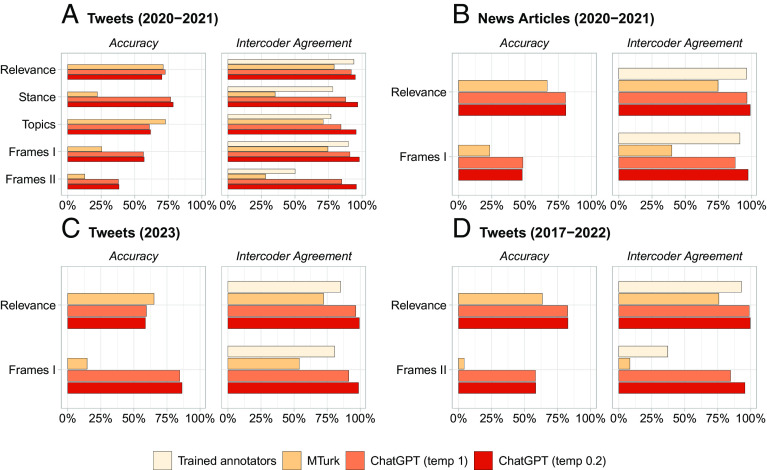
- Across four datasets, ChatGPT’s zero-shot accuracy exceeds MTurk’s by about 25 percentage points on average, and it outperforms MTurk for most tasks.
- ChatGPT’s intercoder agreement averages 91% at temperature = 1 and 97% at temperature = 0.2, compared with about 56% for MTurk and 79% for trained annotators.
- Relevance-task accuracy rates were 70% for content moderation tweets, 81% for content moderation news articles, 83% for US Congress tweets, and 59% for 2023 content moderation tweets.
- Per-annotation cost for ChatGPT is less than $0.003, about thirty times cheaper than MTurk. Correlations reported: intercoder agreement and accuracy r = 0.36; ChatGPT accuracy and trained-annotator intercoder agreement r = 0.46; ChatGPT overperformance vs. MTurk and trained-annotator intercoder agreement r = −0.37.
Methods
- Design: compare zero-shot ChatGPT annotations against MTurk crowd workers and trained annotators on the same codebooks and tasks, using trained annotators as the gold standard.
- Data: four datasets totaling n = 6,183, including a random sample of 2,382 content-moderation tweets from 2020–2021; 1,856 US Congress tweets from 2017–2022; 1,606 newspaper articles on content moderation from 2020–2021; and 500 tweets from January 2023, of which 339 were in English.
- Analysis: tasks included relevance, topic detection, stance, general frame detection, and policy frame detection. ChatGPT used the “gpt-3.5-turbo” API with temperature 1 and 0.2, two responses per temperature per tweet, and a new chat session for every tweet. MTurk workers were restricted to “MTurk Masters,” >90% HIT approval rate with at least 50 approved HITs, and US location. Metrics were accuracy against trained annotators and intercoder agreement.
Limitations
- The paper states that further research is needed to understand how ChatGPT and other LLMs perform in a broader range of contexts, and it lists future questions including multiple languages, few-shot learning, semiautomated labeling, chain-of-thought prompting, and comparison across LLM types.
- The paper states that in the 2023 sample, ChatGPT struggled with misclassifying tweets about specific user suspensions in the relevance task due to a lack of examples in the prompt, underscoring the importance of high-quality prompts.
- Evident from the text: the evaluation uses one ChatGPT model version (“gpt-3.5-turbo”) and does not report testing in languages other than English; the paper itself lists performance across multiple languages as a future question.
Model-written summary. Check it against the paper before relying on it.
Integrity signals
Registry
Cites
Statistics
Figures
Verification
Claims the paper makes
10 Own result · 8 Own method · 7 Own interpretation · 2 No basis given · 1 Not checked yet
A result the paper reports from its own data — it cites no other source for it, so there is none to check. The quote shows it is in the paper.
In the paper
“Regarding accuracy, Fig. 1 shows that ChatGPT outperforms MTurk for most tasks across the four datasets.”
- Also stated in: § Abstract · plain
“We find that across the four datasets, ChatGPT’s zero-shot accuracy is higher than that of MTurk for most tasks.”
§ ChatGPT outperforms crowd workers for text-annotation tasks > Results
plain- Asserted: passes — The authors put it forward as true.
- Checkable: passes — It can be checked against evidence.
- Load-bearing: passes — The paper’s conclusions depend on it.
- Based: passes — The paper gives a reason why it holds.
- Also stated in: § Abstract · plain
A result the paper reports from its own data — it cites no other source for it, so there is none to check. The quote shows it is in the paper.
In the paper
“ChatGPT’s intercoder agreement exceeds that of both crowd workers and trained annotators for all tasks.”
- Also stated in: § Abstract · plain
“For all tasks, ChatGPT’s intercoder agreement exceeds that of both MTurk and trained annotators.”
§ ChatGPT outperforms crowd workers for text-annotation tasks > Abstract
plaincorrelationaln = 4- Asserted: passes — The authors put it forward as true.
- Checkable: passes — It can be checked against evidence.
- Load-bearing: passes — The paper’s conclusions depend on it.
- Based: passes — The paper gives a reason why it holds.
- Also stated in: § Abstract · plain
A result the paper reports from its own data — it cites no other source for it, so there is none to check. The quote shows it is in the paper.
In the paper
“ChatGPT’s accuracy is positively correlated with the intercoder agreement of trained annotators (Pearson’s r = 0.46), suggesting better performance for easier tasks.”
§ ChatGPT outperforms crowd workers for text-annotation tasks > Results
hedgedcorrelational- Asserted: passes — The authors put it forward as true.
- Checkable: passes — It can be checked against evidence.
- Load-bearing: unclear — It is unclear whether the paper’s conclusions depend on it.
- Based: passes — The paper gives a reason why it holds.
A result the paper reports from its own data — it cites no other source for it, so there is none to check. The quote shows it is in the paper.
In the paper
“Conversely, ChatGPT’s outperformance of MTurk is negatively correlated with the intercoder agreement of trained annotators (Pearson’s r = -0.37), potentially indicating stronger overperformance for more complex tasks.”
§ ChatGPT outperforms crowd workers for text-annotation tasks > Results
hedgedcorrelational- Asserted: passes — The authors put it forward as true.
- Checkable: passes — It can be checked against evidence.
- Load-bearing: unclear — It is unclear whether the paper’s conclusions depend on it.
- Based: passes — The paper gives a reason why it holds.
A result the paper reports from its own data — it cites no other source for it, so there is none to check. The quote shows it is in the paper.
In the paper
“Across the four datasets, the zero-shot accuracy of ChatGPT exceeds that of crowd workers by about 25 percentage points on average”
- Also stated in: § Results · plain
“On average, ChatGPT’s accuracy exceeds that of MTurk by about 25 percentage points.”
§ ChatGPT outperforms crowd workers for text-annotation tasks > Abstract
plaincorrelationaln = 4- Asserted: passes — The authors put it forward as true.
- Checkable: passes — It can be checked against evidence.
- Load-bearing: passes — The paper’s conclusions depend on it.
- Based: passes — The paper gives a reason why it holds.
- Also stated in: § Results · plain
A result the paper reports from its own data — it cites no other source for it, so there is none to check. The quote shows it is in the paper.
In the paper
“The correlation between intercoder agreement and accuracy is positive (Pearson’s r = 0.36).”
§ ChatGPT outperforms crowd workers for text-annotation tasks > Results
plaincorrelational- Asserted: passes — The authors put it forward as true.
- Checkable: passes — It can be checked against evidence.
- Load-bearing: passes — The paper’s conclusions depend on it.
- Based: passes — The paper gives a reason why it holds.
A conclusion the paper draws from its own results — it cites no other source for it, so there is none to check. The quote shows it is in the paper.
In the paper
“This paper demonstrates the potential of LLMs to transform text-annotation procedures for a variety of tasks common to many research projects.”
- Also stated in: § Abstract · boosted
“These results demonstrate the potential of large language models to drastically increase the efficiency of text classification.”
§ ChatGPT outperforms crowd workers for text-annotation tasks > Discussion
boostedconditionaln = 4- Asserted: passes — The authors put it forward as true.
- Checkable: unclear — It is unclear whether it could be checked against evidence.
- Load-bearing: passes — The paper’s conclusions depend on it.
- Based: passes — The paper gives a reason why it holds.
- Also stated in: § Abstract · boosted
A conclusion the paper draws from its own results — it cites no other source for it, so there is none to check. The quote shows it is in the paper.
In the paper
“While these findings do not suggest that memorization is a major issue, they underscore the importance of high-quality prompts.”
§ ChatGPT outperforms crowd workers for text-annotation tasks > Results
hedged- Asserted: passes — The authors put it forward as true.
- Checkable: passes — It can be checked against evidence.
- Load-bearing: unclear — It is unclear whether the paper’s conclusions depend on it.
- Based: passes — The paper gives a reason why it holds.
- Rests on an assumption: The 2023 tweets were not included in ChatGPT's training data.
A conclusion the paper draws from its own results — it cites no other source for it, so there is none to check. The quote shows it is in the paper.
In the paper
“Conversely, ChatGPT’s outperformance of MTurk is negatively correlated with the intercoder agreement of trained annotators (Pearson’s r = -0.37), potentially indicating stronger overperformance for more complex tasks.”
§ ChatGPT outperforms crowd workers for text-annotation tasks > Results
hedgedcorrelational- Asserted: passes — The authors put it forward as true.
- Checkable: passes — It can be checked against evidence.
- Load-bearing: unclear — It is unclear whether the paper’s conclusions depend on it.
- Based: passes — The paper gives a reason why it holds.
A conclusion the paper draws from its own results — it cites no other source for it, so there is none to check. The quote shows it is in the paper.
In the paper
“ChatGPT’s accuracy is positively correlated with the intercoder agreement of trained annotators (Pearson’s r = 0.46), suggesting better performance for easier tasks.”
§ ChatGPT outperforms crowd workers for text-annotation tasks > Results
hedgedcorrelational- Asserted: passes — The authors put it forward as true.
- Checkable: passes — It can be checked against evidence.
- Load-bearing: unclear — It is unclear whether the paper’s conclusions depend on it.
- Based: passes — The paper gives a reason why it holds.
- It may state two separate claims as one. 8
- Probably not a substantial claim. 10
The paper states this without a source or data behind it here, so there is nothing to check it against. The quote shows it is in the paper.
In the paper
“In the 2023 sample, ChatGPT performed much better than MTurk in the second task but struggled with misclassifying tweets about specific user suspensions in the relevance task due to a lack of examples in the prompt.”
§ ChatGPT outperforms crowd workers for text-annotation tasks > Results
plaindirect- Asserted: passes — The authors put it forward as true.
- Checkable: passes — It can be checked against evidence.
- Load-bearing: unclear — It is unclear whether the paper’s conclusions depend on it.
- Based: passes — The paper gives a reason why it holds.
It may state two separate claims as one.
A result the paper reports from its own data — it cites no other source for it, so there is none to check. The quote shows it is in the paper.
In the paper
“On average, intercoder agreement is about 56% for MTurk, 79% for trained annotators, 91% for ChatGPT with temperature = 1, and 97% for ChatGPT with temperature = 0.2.”
§ ChatGPT outperforms crowd workers for text-annotation tasks > Results
hedged- Asserted: passes — The authors put it forward as true.
- Checkable: passes — It can be checked against evidence.
- Load-bearing: passes — The paper’s conclusions depend on it.
- Based: passes — The paper gives a reason why it holds.
It may state two separate claims as one.
A result the paper reports from its own data — it cites no other source for it, so there is none to check. The quote shows it is in the paper.
In the paper
“Accuracy rates for relevance tasks, with two classes (relevant/irrelevant) are 70% for content moderation tweets, 81% for content moderation news articles, 83% for US Congress tweets, and 59% for 2023 content moderation tweets.”
§ ChatGPT outperforms crowd workers for text-annotation tasks > Results
plain- Asserted: passes — The authors put it forward as true.
- Checkable: passes — It can be checked against evidence.
- Load-bearing: passes — The paper’s conclusions depend on it.
- Based: passes — The paper gives a reason why it holds.
It may state two separate claims as one.
A result the paper reports from its own data — it cites no other source for it, so there is none to check. The quote shows it is in the paper.
In the paper
“Using four samples of tweets and news articles (n = 6,183), we show that ChatGPT outperforms crowd workers for several annotation tasks, including relevance, stance, topics, and frame detection.”
§ ChatGPT outperforms crowd workers for text-annotation tasks > Abstract
plainn = 4- Asserted: passes — The authors put it forward as true.
- Checkable: passes — It can be checked against evidence.
- Load-bearing: passes — The paper’s conclusions depend on it.
- Based: passes — The paper gives a reason why it holds.
It may state two separate claims as one.
A result the paper reports from its own data — it cites no other source for it, so there is none to check. The quote shows it is in the paper.
In the paper
“Moreover, the per-annotation cost of ChatGPT is less than $0.003—about thirty times cheaper than MTurk.”
- Also stated in: § Abstract · plain
“ChatGPT’s per-annotation cost is about $0.003 or a third of a cent—about thirty times cheaper than MTurk, with higher quality.”
§ ChatGPT outperforms crowd workers for text-annotation tasks > Abstract
plainn = 6,183- Asserted: passes — The authors put it forward as true.
- Checkable: passes — It can be checked against evidence.
- Load-bearing: passes — The paper’s conclusions depend on it.
- Based: passes — The paper gives a reason why it holds.
It may state two separate claims as one.
- Also stated in: § Abstract · plain
The paper states this without a source or data behind it here, so there is nothing to check it against. The quote shows it is in the paper.
In the paper
“The evidence is consistent across different types of texts and time periods.”
§ ChatGPT outperforms crowd workers for text-annotation tasks > Discussion
plain- Asserted: passes — The authors put it forward as true.
- Checkable: passes — It can be checked against evidence.
- Load-bearing: fails — The paper’s conclusions may not depend on it.
- Based: fails — The paper may give no reason why it holds.
Probably not a substantial claim. The paper’s conclusions may not depend on it. The paper may give no reason why it holds.
What the paper did — it cites no source for this, so there is none to check. The quote shows it is in the paper.
In the paper
“The sample size was determined by the number of texts needed to build a training set for a machine learning classifier.”
§ ChatGPT outperforms crowd workers for text-annotation tasks > Materials and Methods > Datasets.
plaindirect- Asserted: passes — The authors put it forward as true.
- Checkable: passes — It can be checked against evidence.
- Load-bearing: fails — The paper’s conclusions may not depend on it.
- Based: passes — The paper gives a reason why it holds.
Probably not a substantial claim. The paper’s conclusions may not depend on it.
A conclusion the paper draws from its own results — it cites no other source for it, so there is none to check. The quote shows it is in the paper.
In the paper
“This suggests that a lower temperature value may be preferable for annotation tasks, as it seems to increase consistency without decreasing accuracy.”
§ ChatGPT outperforms crowd workers for text-annotation tasks > Results
hedgedconditional- Asserted: passes — The authors put it forward as true.
- Checkable: passes — It can be checked against evidence.
- Load-bearing: fails — The paper’s conclusions may not depend on it.
- Based: passes — The paper gives a reason why it holds.
Probably not a substantial claim. The paper’s conclusions may not depend on it. It may state two separate claims as one.
What the paper did — it cites no source for this, so there is none to check. The quote shows it is in the paper.
In the paper
“Moreover, we ensured that no worker could annotate more than 20% of the tweets for a given task.”
§ ChatGPT outperforms crowd workers for text-annotation tasks > Materials and Methods > Crowd Workers.
plain- Asserted: passes — The authors put it forward as true.
- Checkable: passes — It can be checked against evidence.
- Load-bearing: fails — The paper’s conclusions may not depend on it.
- Based: passes — The paper gives a reason why it holds.
Probably not a substantial claim. The paper’s conclusions may not depend on it.
What the paper did — it cites no source for this, so there is none to check. The quote shows it is in the paper.
In the paper
“We intentionally avoided adding any ChatGPT-specific prompts to ensure comparability between ChatGPT and MTurk crowd workers.”
§ ChatGPT outperforms crowd workers for text-annotation tasks > Materials and Methods > ChatGPT.
plain- Asserted: passes — The authors put it forward as true.
- Checkable: passes — It can be checked against evidence.
- Load-bearing: passes — The paper’s conclusions depend on it.
- Based: passes — The paper gives a reason why it holds.
Probably not a substantial claim.
In the paper
“Moreover, some of the tasks involve a large number of classes and exhibit lower levels of intercoder agreement, which indicates a higher degree of annotation difficulty (11).”
§ ChatGPT outperforms crowd workers for text-annotation tasks > Results
What the sources say
- Not checked yetcites [11] P. S. Bayerl, K. I. Paul, What determines inter-coder agreement in manual annotations? A meta-analytic investigation Comput. Linguist. 37, 699– 725 (2011).
hedgedcorrelational- Asserted: passes — The authors put it forward as true.
- Checkable: passes — It can be checked against evidence.
- Load-bearing: passes — The paper’s conclusions depend on it.
- Based: passes — The paper gives a reason why it holds.
It may state two separate claims as one.
What the paper did — it cites no source for this, so there is none to check. The quote shows it is in the paper.
In the paper
“As with the trained human annotators, each tweet was annotated by two different crowd workers.”
§ ChatGPT outperforms crowd workers for text-annotation tasks > Materials and Methods > Crowd Workers.
plain- Asserted: passes — The authors put it forward as true.
- Checkable: passes — It can be checked against evidence.
- Load-bearing: passes — The paper’s conclusions depend on it.
- Based: passes — The paper gives a reason why it holds.
Probably not a substantial claim.
What the paper did — it cites no source for this, so there is none to check. The quote shows it is in the paper.
In the paper
“The coders annotated the tweets independently task by task.”
§ ChatGPT outperforms crowd workers for text-annotation tasks > Materials and Methods > Trained Annotators.
plain- Asserted: passes — The authors put it forward as true.
- Checkable: passes — It can be checked against evidence.
- Load-bearing: fails — The paper’s conclusions may not depend on it.
- Based: passes — The paper gives a reason why it holds.
Probably not a substantial claim. The paper’s conclusions may not depend on it.
What the paper did — it cites no source for this, so there is none to check. The quote shows it is in the paper.
In the paper
“First, we computed average accuracy (i.e., percentage of correct predictions), that is, the number of correctly classified instances over the total number of cases to be classified, using trained human annotations as our gold standard and considering only texts that both annotators agreed upon.”
§ ChatGPT outperforms crowd workers for text-annotation tasks > Materials and Methods > Evaluation Metrics.
plain- Asserted: passes — The authors put it forward as true.
- Checkable: passes — It can be checked against evidence.
- Load-bearing: passes — The paper’s conclusions depend on it.
- Based: passes — The paper gives a reason why it holds.
Probably not a substantial claim.
What the paper did — it cites no source for this, so there is none to check. The quote shows it is in the paper.
In the paper
“To ensure annotation quality, we restricted access to the tasks to workers who are classified as “MTurk Masters” by Amazon, who have an HIT (Human Intelligence Task) approval rate greater than 90% with at least 50 approved HITs, and who are located in the United States.”
§ ChatGPT outperforms crowd workers for text-annotation tasks > Materials and Methods > Crowd Workers.
plain- Asserted: passes — The authors put it forward as true.
- Checkable: passes — It can be checked against evidence.
- Load-bearing: passes — The paper’s conclusions depend on it.
- Based: passes — The paper gives a reason why it holds.
Probably not a substantial claim. It may state two separate claims as one.
What the paper did — it cites no source for this, so there is none to check. The quote shows it is in the paper.
In the paper
“We created a new chat session for every tweet to ensure that the ChatGPT results are not influenced by the history of annotations.”
§ ChatGPT outperforms crowd workers for text-annotation tasks > Materials and Methods > ChatGPT.
plaindirect- Asserted: passes — The authors put it forward as true.
- Checkable: passes — It can be checked against evidence.
- Load-bearing: fails — The paper’s conclusions may not depend on it.
- Based: passes — The paper gives a reason why it holds.
Probably not a substantial claim. The paper’s conclusions may not depend on it.
The paper relies on this without support.
The trained annotators' annotations constitute a valid gold standard for correctness.
“using trained human annotations as our gold standard”
“using our trained annotators as a benchmark”
The paper relies on this without support.
The 2023 tweets were not included in ChatGPT's training data.
“a new sample of tweets posted in 2023 to address the concern that ChatGPT might be relying on memorization for texts potentially included in the model’s training dataset.”
Claims other papers make about this one
Each is checked against this paper’s own text: does it say what the citing paper says it does?
The source backs part of the claim, not all of it — or backs it for a different population, condition or comparison.
In the citing paper
“LLMs have been shown to perform well on diverse text-analysis tasks 36 , often matching or exceeding state-of-the-art models and crowd workers 37,38 , even with zero-shot prompts 39 .”
From Quantifying the prevalence and impact of overreaching causal claims in social science (2026) · cites this paper as [38]
Experimental — accuracy not yet measuredThe source backs part of the claim, not all of it — or backs it for a different population, condition or comparison.
In the citing paper
“we employ GPT-4 for automated evaluation, where both the generated hypotheses and the provided background are evaluated across these aspects.”
From Large Language Models as Biomedical Hypothesis Generators: A Comprehensive Evaluation (2024) · cites this paper as Gilardi et al., 2023
Experimental — accuracy not yet measuredThe cited source says what the claim attributes to it.
In the citing paper
“These models mitigate many of the above mentioned limitations associated with human coders by leveraging their computational efficiency, consistency, and scalability [34–36].”
From The quantum technology job market: data driven analysis of 3641 job posts (2026) · cites this paper as [34]
The cited source says what the claim attributes to it.
In the citing paper
“LLM-assisted annotation shows a similar tension: LLMs can match or outperform crowd workers on some text-classification tasks, yet may introduce systematic bias in qualitative coding (Ashwin et al., 2025;Gilardi et al., 2023).”
From Beyond Human-Likeness: Mapping the Scientific Critique Profiles of LLMs and Human Reviewers (2026) · cites this paper as Gilardi et al., 2023
The cited source says what the claim attributes to it.
In the citing paper
“Prior studies have also reported that LLM evaluations can be competitive with crowdworker annotations (Gilardi et al., 2023).”
From MAPLE: Multi-Aspect Panels of LLM Evaluators for Open-Ended Questions (2026) · cites this paper as Gilardi et al., 2023
The check wasn’t confident either way, so it gives no verdict — never disputed.
In the citing paper
“LLM-assisted annotation shows a similar tension: LLMs can match or outperform crowd workers on some text-classification tasks, yet may introduce systematic bias in qualitative coding (Ashwin et al., 2025;Gilardi et al., 2023).”
From Beyond Human-Likeness: Mapping the Scientific Critique Profiles of LLMs and Human Reviewers (2026) · cites this paper as Gilardi et al., 2023
Experimental — accuracy not yet measuredIn the citing paper
“They find this model performs better than human workers trained with such materials on Amazon Mechanical Turk—though such coders are known to be less accurate than those trained directly by researchers in small group settings.”
From Can Generative AI improve social science? (2024) · cites this paper as [51]
In the citing paper
“Gilardi et al. argue GPT 3.5-turbo can accurately measure the topic of tweets, the stance or opinions of their authors, and the “frames” used to organize the message in a narrative manner (51).”
From Can Generative AI improve social science? (2024) · cites this paper as [51]
In the citing paper
“Some LLMs have been found as good as human annotators [41] in some tasks.”
From Harnessing the power of llms in practice: a survey on chatGPT and beyond (2024) · cites this paper as [41]
Citations
Cites
Large Language Models are Zero-Shot Reasoners
Kojima, T., Gu, S. S., Reid, M., Matsuo, Y., & Iwasawa, Y. (2022) · arXiv · doi:10.48550/arxiv.2205.11916 · Cited by 2,013
An MTurk Crisis? Shifts in Data Quality and the Impact on Study Results
Chmielewski, M., & Kucker, S. C. (2020) · Social Psychological and Personality Science · doi:10.1177/1948550619875149 · Cited by 1,027
Out of One, Many: Using Language Models to Simulate Human Samples
Argyle, L. P., Busby, E. C., Fulda, N., Gubler, J. R., Rytting, C., & Wingate, D. (2023) · Political Analysis · doi:10.1017/pan.2023.2 · Cited by 783
Using cognitive psychology to understand GPT-3
Binz, M., & Schulz, E. (2023) · Proceedings of the National Academy of Sciences · doi:10.1073/pnas.2218523120 · Cited by 559 · cited 2×
“…very well for a wide range of purposes, including ideological scaling (Wu et al., 2023), the classification of legislative proposals (Nay, 2023), the resolution of cognitive psychology tasks, (Binz and Schulz, 2023), and the simulation of human samples for survey research (Argyle et al., 2023).”
BackgroundCrowd-sourced Text Analysis: Reproducible and Agile Production of Political Data
Benoit, K. R., Conway, D., Lauderdale, B. E., Laver, M., & Mikhaylov, S. (2016) · American Political Science Review · doi:10.1017/s0003055416000058 · Cited by 296
Huang, F., Kwak, H., & An, J. (2023) · International World Wide Web Conference (WWW) · doi:10.1145/3543873.3587368 · Cited by 247
Huang, F., Kwak, H., & An, J. (2023) · arXiv · doi:10.48550/arxiv.2302.07736 · Cited by 231
The Media Frames Corpus: Annotations of Frames Across Issues
Card, D., Boydstun, A. E., Gross, J. H., Resnik, P., & Smith, N. A. (2015) · doi:10.3115/v1/p15-2072 · Cited by 224
Kuzman, T., Mozetič, I., & Ljubešić, N. (2023) · arXiv (Cornell University) · doi:10.48550/arxiv.2303.03953 · Cited by 137
What Determines Inter-Coder Agreement in Manual Annotations? A Meta-Analytic Investigation
Bayerl, P. S., & Paul, K. I. (2011) · Computational Linguistics · doi:10.1162/coli_a_00074 · Cited by 126
Research works printed but not linked: 1
- M. Desmond, E. Duesterwald, K. Brimijoin, M. Brachman, Q. Pan, Semi-automateddatalabeling, in NeurIPS 2020 Competition and Demonstration Track, (PMLR, 2021), pp. 156–169.
Cited by
Sorted by citations
Items 801–900 of 1,025
Tanasa, A.-M., Oprea, S., & Bârã, A. (2026) · Machine Learning and Knowledge Extraction · doi:10.3390/make8060165 · Cited by 1
Cui, Z., Gao, E., Yang, F., Liu, Q., & Yao, H. (2026) · International Journal of Human-Computer Interaction · doi:10.1080/10447318.2026.2674836 · Cited by 1
Reich, A., Thoms, C., & Schrimpf, T. (2026) · Communication Methods and Measures · doi:10.1080/19312458.2026.2693637 · Cited by 1
Mai, K. M., Lin, Y., Zhang, K., & Zhang, R. (2026) · Journal of Applied Psychology · doi:10.1037/apl0001387 · Cited by 1
Evaluation Validity in Information Retrieval
Thomas, P., Craswell, N., Sanderson, M., Spielman, S. E., Sim, R., & White, R. W. (2026) · International ACM SIGIR Conference on Research and Development in Information Retrieval (SIGIR) · doi:10.1145/3805712.3808538 · Cited by 1
Estebanez, P. P. (2026) · Revista Española de Sociología · doi:10.22325/fes/res.2026.311 · Cited by 1
Li, Y., Zhou, M., & He, Y. (2026) · Chinese Journal of Sociology · doi:10.1177/2057150x261457270 · Cited by 1
Beyond AI Narratives: AI Washing and Organizational Resilience
Xia, Y., Sun, J. F., Liu, J. J., Fang, K., Shi, H., & Li, N. (2026) · Systems · doi:10.3390/systems14070853 · Cited by 1
Wang, C., & Liu, X. (2026) · International Journal of Human-Computer Interaction · doi:10.1080/10447318.2026.2707710 · Cited by 1
Shah, A. M. (2026) · Behaviour and Information Technology · doi:10.1080/0144929x.2026.2718320 · Cited by 2
When AI suspends the floor: users' interactional management of guideline disruptions in ChatGPT
Chung, Y., & Lee, Y. (2026) · AI & Society · doi:10.1007/s00146-026-03246-9 · Cited by 1
The Media Bias Detector: A framework for annotating and analyzing the news
Haider, S., Tohidi, A., Wang, J. S., Dorr, T. G., Rothschild, D. M., Callison-Burch, C., & Watts, D. J. (2026) · Science Advances · doi:10.1126/sciadv.aea7456 · Cited by 1
Tang, Z., He, G., & Pan, X. (2026) · BMC Health Services Research · doi:10.1186/s12913-026-15613-9 · Cited by 1
The Left Misunderstood: How Voters’ Perceptions of What Matters to the Left Benefit the Right
Kamphorst, J. (2026) · The Journal of Politics · doi:10.1086/744574 · Cited by 1
WIKITIDE: A WIKIPEDIA-BASED TIMESTAMPED DEFINITION Pairs Dataset
Borkakoty, H., Espinosa-Anke, L., & AMPLYFI, U. (2023) · International conference Recent advances in natural language processing · doi:10.26615/978-954-452-092-2_023 · Cited by 1
Zero-Shot Data Maps. Efficient Dataset Cartography Without Model Training
Basile, A., Franco-Salvador, M., & Rosso, P. (2023) · Findings of the Association for Computational Linguistics: EMNLP (Findings of EMNLP) · doi:10.18653/v1/2023.findings-emnlp.554 · Cited by 1
Li, D., Zhu, Z. L., van de Loo, J., Gomez, A. M., Yadav, V., Tsatsaronis, G., & Afzal, Z. (2023) · Conference on Empirical Methods in Natural Language Processing (EMNLP) · doi:10.18653/v1/2023.emnlp-industry.30 · Cited by 1
Expert Evaluation of Export Control-Related Question Answering Capabilities of LLMs
Rzepka, R., Muraji, S., & Obayashi, A. (2023) · IEEE Asia-Pacific Conference on Computer Science and Data Engineering (CSDE) · doi:10.1109/csde59766.2023.10487735 · Cited by 1
Detecting the Rumor Patterns Integrating Features of User, Content, and the Spreading Structure
Yan, P., Guo, Y., Jiang, Z., Lin, T., Yuan, W., & Liu, X. (2024) · Lecture notes in computer science · doi:10.1007/978-3-031-57860-1_18 · Cited by 1
Research on the Development and Application of ChatGPT
Gao, Y. (2024) · Lecture Notes in Education Psychology and Public Media · doi:10.54254/2753-7048/52/20241540 · Cited by 1
XAL: EXplainable Active Learning Makes Classifiers Better Low-resource Learners
Luo, Y., Yang, Z., Meng, F., Li, Y., Guo, F., Qi, Q., Zhou, J., & Zhang, Y. (2024) · Conference of the North American Chapter of the Association for Computational Linguistics: Human Language Technologies (NAACL-HLT) · doi:10.18653/v1/2024.naacl-long.372 · Cited by 2
Larrondo, P., Frank, B. M., & Ortíz, J. M. (2024) · ASEE Annual Conference & Exposition · doi:10.18260/1-2--48541 · Cited by 1
Zydroń, P. W., & Protasiewicz, J. (2024) · Lecture notes in networks and systems · doi:10.1007/978-3-031-66594-3_6 · Cited by 1
Social media versus surveys: A new scalable approach to understanding legislators' discourse
González‐Rostani, V., Incio, J., & Lezama, G. (2024) · Legislative Studies Quarterly · doi:10.1111/lsq.12481 · Cited by 1
Toward a Multi-dimensional Humor Dataset for Social Robots
Zhang, H., Hei, X., Cárdenas, J. J. G., Miao, X., & Tapus, A. (2024) · IEEE RO-MAN · doi:10.1109/ro-man60168.2024.10731268 · Cited by 1
Towards Goal-Oriented Volunteering - LLMs to the Rescue?
Schönböck, J., Gassner, C., Augstein, M., Bodenhofer, U., Altmann, J., Retschitzegger, W., Schwinger, W., Kapsammer, E., Pröll, B., Lechner, M., et al. (2024) · International Conference on Electrical, Computer, Communications and Mechatronics Engineering (ICECCME) · doi:10.1109/iceccme62383.2024.10796604 · Cited by 1
Veri, F., & Maier, F. (2025) · Political Psychology · doi:10.1111/pops.70004 · Cited by 1
Barile, R., d’Amato, C., & Fanizzi, N. (2025) · International World Wide Web Conference (WWW) · doi:10.1145/3696410.3714667 · Cited by 1
Cheap Learning: Maximizing Performance of Language Models for Social Data Science Using Minimal Data
Castro-González, L., Chung, Y.-L., Kirk, H. R., Francis, J., Williams, A. R., Johansson, P., & Bright, J. (2025) · Sociological Methods & Research · doi:10.1177/00491241251340608 · Cited by 2
Wei, Y., & Fan, J. (2025) · Journal Of Big Data · doi:10.1186/s40537-025-01236-0 · Cited by 1
Entity–Relation Joint Extraction from Urban Planning Standards without Annotated Data Resources
Zhang, M., Zhang, X., Wang, L., Han, X., Xu, D., & Liu, Y. (2025) · Transactions in GIS · doi:10.1111/tgis.70111 · Cited by 1
From OSS to Open Source AI: an Exploratory Study of Collaborative Development Paradigm Divergence
Ye, H., & Zhou, M. (2026) · Proceedings of the ACM on Human-Computer Interaction · doi:10.1145/3816938 · Cited by 1
Li, Q., Ji, C., & Liu, X. (2026) · Engineering Applications of Artificial Intelligence · doi:10.1016/j.engappai.2026.116203 · Cited by 1
Timoneda, J. C. (2026) · Political Analysis · doi:10.1017/pan.2026.10057 · Cited by 1
Doolittle: Benchmarks and Corpora for Academic Writing Formalization
Diao, S., Lei, Y., Pan, L., Fang, T., Zhou, W., Keh, S. S., Kan, M., & Zhang, T. (2023) · Conference on Empirical Methods in Natural Language Processing (EMNLP) · doi:10.18653/v1/2023.emnlp-main.809 · Cited by 1
Jain, S., Keh, S. S., Chhetri, S., Dewan, K., Izquierdo, P., Prüssmann, J., Shrestha, P., Suárez, C. F., Shi, Z. R., Li, L., et al. (2024) · Proceedings of the AAAI Conference on Artificial Intelligence · doi:10.1609/aaai.v38i20.30218 · Cited by 2
A Queer Response to ‘the Moral Untouchability of the Responsibility to Protect'
Gifkins, J., & Cooper-Cunningham, D. (2024) · Journal of Intervention and Statebuilding · doi:10.1080/17502977.2024.2324567 · Cited by 1
Hierarchical Multi-label Classification of Online Vaccine Concerns
Zhu, C. Q., Stureborg, R., & Dhingra, B. (2024) · Studies in computational intelligence · doi:10.1007/978-3-031-63592-2_19 · Cited by 1
Choczyńska, A. (2025) · Economics and Politics · doi:10.1111/ecpo.12342 · Cited by 1
VolDoGER: LLM-Assisted Datasets for Domain Generalization in Vision-Language Tasks
Choi, J., Kwon, J., Yun, J., Yu, S., & Kim, Y. (2025) · IEEE International Conference on Computer Vision Workshops · doi:10.1109/iccvw69036.2025.00712 · Cited by 2
Tasks Beyond Taxonomies: A Multidimensional Design Space for Team TasksPreprint
Hu, X. E., Gandhi, L., Whiting, M. E., Watts, D. J., & Almaatouq, A. (2023) · PsyArXiv (OSF Preprints) · doi:10.31234/osf.io/543sz · Cited by 1
Huang, J., Yi, B., Sun, W., Wan, B., Xu, Y., Feng, Y., Ye, W., & Qin, Q. (2024) · SSRN Electronic Journal · doi:10.2139/ssrn.5002351 · Cited by 2
Engineering of Inquiry: The “Transformation” of Social Science through Generative AIPreprint
Broska, D., & McFarland, D. A. (2025) · OSF Preprints (OSF Preprints) · doi:10.31219/osf.io/uy4c7 · Cited by 2
Large Language Models in the Workplace: A Social PerspectivePreprint
Li, M., Wei, L., & Yao, Y. (2025) · SSRN Electronic Journal · doi:10.2139/ssrn.5222006 · Cited by 1
Scaling Open-ended Survey Responses Using LLM-Paired ComparisonsPreprint
DiGiuseppe, M. R., & Flynn, M. E. (2025) · SocArXiv (OSF Preprints) · doi:10.31235/osf.io/39ajg_v2 · Cited by 1
Cherry, G., Rai, T., Boyden, L., Mwacalimba, K. K., Tiernan, R., Kimeli, P., Street, T., Cook, A. J. C., & Wells, K. (2025) · doi:10.12688/verixiv.1867.1 · Cited by 1
Evaluating and Improving the Reasoning Abilities of Language Models
Helwe, C. (2024) · theses.fr (ABES) · doi:10.70675/7fc70e59zdd27z4b0fza38dz03a2c67cda50 · Cited by 1
Randomness In Large Language Models: What Researchers Need to Know (And Report)Preprint
Coqueret, G., Llull, J., Oswald, F., Pérignon, C., Scheuch, C., & Vilhuber, L. (2026) · SSRN Electronic Journal · doi:10.2139/ssrn.7191580 · Cited by 1
Quantifying the prevalence and impact of overreaching causal claims in social science
Isch, C., Dörr, T., Fasching, N., Jennings, G., & Watts, D. J. (2026) · Nature Human Behaviour · doi:10.1038/s41562-026-02553-x
Limits to scalable evaluation at the frontier: LLM as Judge won't beat twice the data
Dorner, F. E., Nastl, V. Y., & Hardt, M. (2024) · arXiv · doi:10.48550/arxiv.2410.13341 · Cited by 31
“The use of LLM judges rather than experts or crowd workers is often justified by high agreement rates (Gilardi et al., 2023; Zheng et al., 2024) between both types of judges.”
Beyond Human-Likeness: Mapping the Scientific Critique Profiles of LLMs and Human Reviewers
Yang, Y., Thelwall, M., & He, G. (2026) · arXiv · doi:10.48550/arxiv.2609.01895
“LLM-assisted annotation shows a similar tension: LLMs can match or outperform crowd workers on some text-classification tasks, yet may introduce systematic bias in qualitative coding (Ashwin et al., 2025; Gilardi et al., 2023).”
MAPLE: Multi-Aspect Panels of LLM Evaluators for Open-Ended Questions
Jinji, M., Atarashi, K., Takeuchi, K., & Kashima, H. (2026) · Findings of the Association for Computational Linguistics: ACL 2026 · doi:10.18653/v1/2026.findings-acl.1351
“Prior studies have also reported that LLM evaluations can be competitive with crowd-worker annotations (Gilardi et al., 2023).”
A Multi-Task Role-Playing Agent Capable of Imitating Character Linguistic Styles
Chen, S., Si, Q., Yang, C., Liang, Y., Lin, Z., Liu, H., & Wang, W. (2024) · arXiv · doi:10.48550/arxiv.2411.02457
“We utilized GPT as the evaluator, as its reliability has been demonstrated (Fu et al., 2023; Gilardi et al., 2023).”
MethodInformation Type and the Geography of Price DiscoveryPreprint
Jones, H., Martinez, J. V., & Qian, M. (2021) · SSRN Electronic Journal · doi:10.2139/ssrn.3946491
DiVa: An Iterative Framework to Harvest More Diverse and Valid Labels from User Comments for Music
Liang, H., Liu, J., Xiang, Y., Du, J., Zhou, L., Pan, S., & Lei, W. (2023) · ACM International Conference on Multimedia (ACM MM) · doi:10.1145/3581783.3613750
Sudmann, A., Echterhölter, A., Ramsauer, M., Retkowski, F., & Schröter, J. (2023) · AI critique · doi:10.1515/9783839467664-003
Dallest, B., Chabrier, S., Gabillon, A., & Ghewy, P. (2023) · Lecture notes in computer science · doi:10.1007/978-981-99-8085-7_11
Stepping Stones for Self-Learning
Hai-Jew, S. (2023) · Advances in educational technologies and instructional design book series · doi:10.4018/979-8-3693-0074-9.ch005
Learning to Correct Noisy Labels for Fine-Grained Entity Typing via Co-Prediction Prompt Tuning
Tang, M., He, Y., Xu, Y., Xu, H., Zhang, W., & Lin, Y. (2023) · Findings of the Association for Computational Linguistics: EMNLP (Findings of EMNLP) · doi:10.18653/v1/2023.findings-emnlp.389
NarrativeXL: a Large-scale Dataset for Long-Term Memory Models
Moskvichev, A., & Mai, K.-V. (2023) · Findings of the Association for Computational Linguistics: EMNLP (Findings of EMNLP) · doi:10.18653/v1/2023.findings-emnlp.1005 · Cited by 2
Dynamic Few-shot Learning for Computational Social SciencePreprint
Malla, R., Coan, T., Srinivasan, V., & Boussalis, C. (2024) · SocArXiv (OSF Preprints) · doi:10.31235/osf.io/nfhe8
LEAF: A Less Expert Annotation Framework with Active Learning
Maoliniyazi, A., Ma, C., Meng, X., & Peng, Y. (2024) · Lecture notes in computer science · doi:10.1007/978-981-97-2259-4_28
Makowski, P. T., Hensel, A., & Zaei, M. E. (2024) · SSRN Electronic Journal · doi:10.2139/ssrn.4813964
Sinharoy, S. (2024) · International Journal of Community Medicine and Public Health · doi:10.18203/2394-6040.ijcmph20241164
Leveraging edutainment and social networks to foster interethnic harmony
Siddique, A., Vlassopoulos, M., & Zénou, Y. (2024) · doi:10.1920/wp/ifs.2024.2024
Song, Q., & Jia, K. (2024) · SocArXiv (OSF Preprints) · doi:10.31235/osf.io/k9ye4
Tree-Based Synthesis of Web Test Sequences from Manual Actions
Jiang, P., Wang, S., & Liu, Y. (2024) · Lecture notes in computer science · doi:10.1007/978-3-031-64626-3_14
Lee, A. S. G., Kirkland, K., Stanley, S. K., Robinson, A., Leviston, Z., & Walker, I. A. (2024) · PsyArXiv (OSF Preprints) · doi:10.31234/osf.io/wsyqd
Advancing low resource information extraction and dialogue system using data efficient methods
Ding, B. (2024) · DR-NTU (Nanyang Technological University) · doi:10.32657/10356/179560
Kabir, M., Kader, F. B., Nujat, N. H., Sogir, T. B., Shams, F. A., Mahmud, H., & Hasan, K. (2024) · Lecture notes in computer science · doi:10.1007/978-3-031-70239-6_6
ViFoodNLI: A Dataset for Vietnamese Natural Language Inference in Local Cuisine
Phan, L., & Do, P. (2024) · Communications in computer and information science · doi:10.1007/978-981-97-9616-8_22
Intent Identification Using Few-Shot and Active Learning with User Feedback
Yuvaraj, S. G., Benatallah, B., Motahari‐Nezhad, H. R., & Rabhi, F. (2024) · Lecture notes in computer science · doi:10.1007/978-981-96-0573-6_4
Ishida, T. (2024) · Denshi Jouhou Tsuushin Gakkai Tsuushin Sosaieti magajin/B-plus/Denshi Jouhou Tsuushin Gakkai Tsuushin Sosaeti magajin · doi:10.1587/bplus.18.232
Waltermann, J., & Henkel, S. (2024) · SSRN Electronic Journal · doi:10.2139/ssrn.5037485
Семеновна, Р. А., & Воронин, А. Н. (2024) · Research Square · doi:10.21203/rs.3.rs-5425532/v1
Jia, Y., & Shang, L. (2024) · SSRN Electronic Journal · doi:10.2139/ssrn.5053766
Jia, Y., & Shang, L. (2024) · SSRN Electronic Journal · doi:10.2139/ssrn.5055860
Alizadeh, M., Asgari, Y., Samei, Z., Yari, S., Dehghani, S., Kubli, M., Zare, D., Bermeo, J. D., Batzdorfer, V., & Gilardi, F. (2025) · Lecture notes in computer science · doi:10.1007/978-3-031-78541-2_28
Self-citationPARALLAX: Leveraging Polarization Knowledge for Misinformation Detection
Paschalides, D., Pallis, G., & Dikaiakos, M. D. (2025) · Lecture notes in computer science · doi:10.1007/978-3-031-78541-2_6
Scaling Open-ended Survey Responses Using LLM-Paired ComparisonsPreprint
DiGiuseppe, M. R., & Flynn, M. E. (2025) · doi:10.31235/osf.io/39ajg
Choucair, T. D. S., Kathirgamalingam, A., Lind, F., Bernhard-Harrer, J., Boomgaarden, H. G., Oliveira, B., Maia, R. C. M., Vodden, L., Esau, K., Bruns, A., et al. (2025) · AoIR Selected Papers of Internet Research · doi:10.5210/spir.v2024i0.14102
A Generalised Approach to Scaling Political Actors with Embedding RepresentationsPreprint
Bruun, M. (2025) · SSRN Electronic Journal · doi:10.2139/ssrn.5132792
Crowdsourced Homophily Ties Based Graph Annotation Via Large Language Model
Bu, Y., Zhu, Y., & Zhou, K. (2025) · IEEE International Conference on Acoustics Speech and Signal Processing · doi:10.1109/icassp49660.2025.10889118
Zeng, Y., Guo, B., Yao, J., Wang, H., Ding, Y., Liang, Y., & Yu, Z. (2024) · IEEE Smart World Congress (SWC) · doi:10.1109/swc62898.2024.00194
Influence Assessment of Pornography-Related Cryptograms Based on ChatGPT-4o
Chen, G., Wang, Y., Yang, Y., Yin, S., Li, S., & Xu, H. (2025) · Highlights in Science Engineering and Technology · doi:10.54097/zvhh5r29
Ko, H., & Williams, N. W. (2025) · SSRN Electronic Journal · doi:10.2139/ssrn.5118151
Components of Character: Exploring the Computational Similarity of Austen's Characters
Anderson, C. J. (2025) · Journal of Data Mining & Digital Humanities · doi:10.46298/jdmdh.15015
Large Language Models Are Human-Like Annotators
Marreddy, M., Oota, S. R., & Gupta, M. (2025) · Lecture notes in computer science · doi:10.1007/978-3-031-88720-8_45
Sušnjak, T., Palffy, C., Zimina, T., Altynbekova, N., Garg, K., & Gilbert, L. K. (2025) · medRxiv · doi:10.1101/2025.04.03.25325216
Birkenmaier, L., & Lechner, C. M. (2025) · OSF Preprints (OSF Preprints) · doi:10.31219/osf.io/7nhjz_v1
Birkenmaier, L., & Lechner, C. M. (2025) · OSF Preprints (OSF Preprints) · doi:10.31219/osf.io/7nhjz_v2
How to Measure the Meanings of Voting?
Plescia, C., & Abdala, M. B. (2025) · Oxford University Press eBooks · doi:10.1093/9780198946335.003.0003
A Survey of LLM-Based Methods for Synthetic Data Generation and the Rise of Agentic Workflows
Alismail, A., & Lanquillon, C. (2025) · Lecture notes in computer science · doi:10.1007/978-3-031-93418-6_9 · Cited by 3
Tasks Beyond Taxonomies: A Multidimensional Design Space for Team TasksPreprint
Hu, X. E., Gandhi, L., Whiting, M. E., Watts, D. J., & Almaatouq, A. (2023) · PsyArXiv (OSF Preprints) · doi:10.31234/osf.io/543sz_v1
Chen, J., Liu, X., Qi, X., & Zhang, Y. (2025) · Proceedings. · doi:10.22318/icls2025.329393
On replacing humans with human simulators in human-in-the-loop systems built to interact with humans
Huang, S.-H., & Huang, T.-H. (2025) · Elsevier eBooks · doi:10.1016/b978-0-44-340553-2.00017-4
Voices from the Pulpit: Discourse on Racial Justice and Gun Violence from American Clergy
Mrchkovska, N., & Quezada-Llanes, E. (2025) · Sociological Focus · doi:10.1080/00380237.2025.2516814
Gong, Y., Zhang, J., Lin, Y.-F. F., & Wang, H. (2025) · International Conference on Computer Supported Cooperative Work in Design (CSCWD) · doi:10.1109/cscwd64889.2025.11033332
When IR Meets GenAIPreprint
Jia, N., Li, N., Xu, D., & Zhang, Y. (2025) · SSRN Electronic Journal · doi:10.2139/ssrn.5317057
Metadata
- Authors
- Gilardi, F., Alizadeh, M., & Kubli, M.
- Affiliations
- Harvard University (US)
- Corresponding author
- Gilardi, Fabrizio
- Venue
- Proceedings of the National Academy of Sciences
- Publisher
- National Academy of Sciences
- Published
- 2023-07-18
- Volume
- 120
- Issue
- 30
- Pages
- e2305016120-e2305016120
- ISSN
- 0027-8424 (ISSN-L)
- 1091-6490
- PMC
- PMC10372638
- OpenAlex
- W4384662964
- Cited by
- 1,197
- References
- 12
- Citations by year
- 2026: 440 · 2025: 356 · 2024: 274 · 2023: 125
- FWCI
- 554.15
- Type
- journal article
- Language
- en
- Open access
- hybrid
- doi.org
- Licence
- Locations
- Proceedings of the National Academy of Sciences (publishedVersion, cc-by)
- PubMed Central (publishedVersion, cc-by)
- PubMed (publishedVersion)
- Zurich Open Repository and Archive (University of Zurich) (acceptedVersion, cc-by-nc-nd)
- arXiv (Cornell University) (submittedVersion, cc-by)
- Zurich Open Repository and Archive (University of Zurich) (submittedVersion, other-oa)
- arXiv (Cornell University) (cc-by)
- Zurich Open Repository and Archive (University of Zurich)
- Funders
- EC | European Research Council (883121)
- Topics
- Social Sciences › General Social Sciences › Computational and Text Analysis Methods
- Physical Sciences › Computer Science › Artificial Intelligence › Topic Modeling
- Physical Sciences › Computer Science › Artificial Intelligence › Sentiment Analysis and Opinion Mining
- Keywords
- ChatGPT, large language models, textual annotation, crowd workers, Amazon Mechanical Turk, automatic annotation, inter-coder agreement, annotation cost, stance detection, topic extraction, frame detection, tweets, news articles, text classification
About these checks
Registry, retraction, Cites and statistics results are computed, not judged, with one exception: a printed reference that no index lists is read once by a model before it counts as a citation error. Claims are extracted by a model and kept only when their quote appears verbatim in the text; each cited source is then checked, with a model’s help, for whether it says what the claim relies on. Those verdicts can be wrong — read the claim’s quote and the cited source before relying on one.
A language model drew the claims from the paper on 2026-10-09, under version 3 of the claim definition (model deepseek-v4.1-flash, prompt extract-v3).
A second model labelled each claim on 2026-10-09 (model jev-1.13-20260917, definition revision gold-guideline-v0.2).
Statistics and arithmetic are recomputed, not judged.
Confidence bands are shown only for fields calibrated on our annotated test set. None is calibrated yet, so no band is shown.
What counts as a claim ›How we measure confidence ›How we check this ›
Are you an author, or do you see a problem with this page? Request a review
