

The DOI matches its Crossref record; 15 of the 15 references it cites were found in a registry or an index; none of the 1 sources its claims cite is checked for support yet.
ChatGPT outperforms crowd workers for text-annotation tasks
Open accessAbstract
Many NLP applications require manual text annotations for a variety of tasks, notably to train classifiers or evaluate the performance of unsupervised models. Depending on the size and degree of complexity, the tasks may be conducted by crowd workers on platforms such as MTurk as well as trained annotators, such as research assistants. Using four samples of tweets and news articles ( n = 6,183), we show that ChatGPT outperforms crowd workers for several annotation tasks, including relevance, stance, topics, and frame detection. Across the four datasets, the zero-shot accuracy of ChatGPT exceeds that of crowd workers by about 25 percentage points on average, while ChatGPT’s intercoder agreement exceeds that of both crowd workers and trained annotators for all tasks. Moreover, the per-annotation cost of ChatGPT is less than $0.003—about thirty times cheaper than MTurk. These results demonstrate the potential of large language models to drastically increase the efficiency of text classification.
Overview
AI snapshot
Written from the paper’s full text.
TL;DR
Using four datasets of tweets and news articles (n = 6,183), the paper finds that zero-shot ChatGPT annotations outperform MTurk crowd workers on several text-annotation tasks and achieve higher intercoder agreement than both crowd workers and trained annotators. ChatGPT is also far cheaper, at less than $0.003 per annotation, about thirty times cheaper than MTurk.
Key findings
- Across four datasets, ChatGPT’s zero-shot accuracy exceeds MTurk’s by about 25 percentage points on average, and it outperforms MTurk for most tasks.
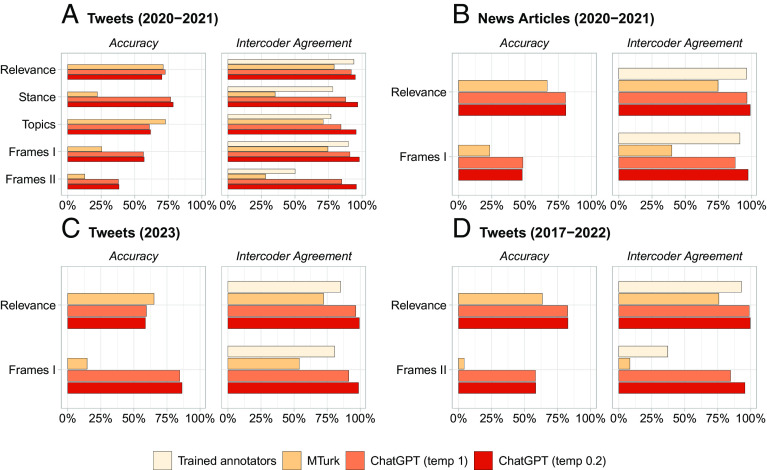
- ChatGPT’s intercoder agreement averages 91% at temperature = 1 and 97% at temperature = 0.2, compared with about 56% for MTurk and 79% for trained annotators.
- Relevance-task accuracy rates were 70% for content moderation tweets, 81% for content moderation news articles, 83% for US Congress tweets, and 59% for 2023 content moderation tweets.
- Per-annotation cost for ChatGPT is less than $0.003, about thirty times cheaper than MTurk. Correlations reported: intercoder agreement and accuracy r = 0.36; ChatGPT accuracy and trained-annotator intercoder agreement r = 0.46; ChatGPT overperformance vs. MTurk and trained-annotator intercoder agreement r = −0.37.
Methods
- Design: compare zero-shot ChatGPT annotations against MTurk crowd workers and trained annotators on the same codebooks and tasks, using trained annotators as the gold standard.
- Data: four datasets totaling n = 6,183, including a random sample of 2,382 content-moderation tweets from 2020–2021; 1,856 US Congress tweets from 2017–2022; 1,606 newspaper articles on content moderation from 2020–2021; and 500 tweets from January 2023, of which 339 were in English.
- Analysis: tasks included relevance, topic detection, stance, general frame detection, and policy frame detection. ChatGPT used the “gpt-3.5-turbo” API with temperature 1 and 0.2, two responses per temperature per tweet, and a new chat session for every tweet. MTurk workers were restricted to “MTurk Masters,” >90% HIT approval rate with at least 50 approved HITs, and US location. Metrics were accuracy against trained annotators and intercoder agreement.
Limitations
- The paper states that further research is needed to understand how ChatGPT and other LLMs perform in a broader range of contexts, and it lists future questions including multiple languages, few-shot learning, semiautomated labeling, chain-of-thought prompting, and comparison across LLM types.
- The paper states that in the 2023 sample, ChatGPT struggled with misclassifying tweets about specific user suspensions in the relevance task due to a lack of examples in the prompt, underscoring the importance of high-quality prompts.
- Evident from the text: the evaluation uses one ChatGPT model version (“gpt-3.5-turbo”) and does not report testing in languages other than English; the paper itself lists performance across multiple languages as a future question.
Model-written summary. Check it against the paper before relying on it.
Integrity signals
Registry
Cites
Statistics
Figures
Verification
Claims the paper makes
10 Own result · 8 Own method · 7 Own interpretation · 2 No basis given · 1 Not checked yet
A result the paper reports from its own data — it cites no other source for it, so there is none to check. The quote shows it is in the paper.
In the paper
“Regarding accuracy, Fig. 1 shows that ChatGPT outperforms MTurk for most tasks across the four datasets.”
- Also stated in: § Abstract · plain
“We find that across the four datasets, ChatGPT’s zero-shot accuracy is higher than that of MTurk for most tasks.”
§ ChatGPT outperforms crowd workers for text-annotation tasks > Results
plain- Asserted: passes — The authors put it forward as true.
- Checkable: passes — It can be checked against evidence.
- Load-bearing: passes — The paper’s conclusions depend on it.
- Based: passes — The paper gives a reason why it holds.
- Also stated in: § Abstract · plain
A result the paper reports from its own data — it cites no other source for it, so there is none to check. The quote shows it is in the paper.
In the paper
“ChatGPT’s intercoder agreement exceeds that of both crowd workers and trained annotators for all tasks.”
- Also stated in: § Abstract · plain
“For all tasks, ChatGPT’s intercoder agreement exceeds that of both MTurk and trained annotators.”
§ ChatGPT outperforms crowd workers for text-annotation tasks > Abstract
plaincorrelationaln = 4- Asserted: passes — The authors put it forward as true.
- Checkable: passes — It can be checked against evidence.
- Load-bearing: passes — The paper’s conclusions depend on it.
- Based: passes — The paper gives a reason why it holds.
- Also stated in: § Abstract · plain
A result the paper reports from its own data — it cites no other source for it, so there is none to check. The quote shows it is in the paper.
In the paper
“ChatGPT’s accuracy is positively correlated with the intercoder agreement of trained annotators (Pearson’s r = 0.46), suggesting better performance for easier tasks.”
§ ChatGPT outperforms crowd workers for text-annotation tasks > Results
hedgedcorrelational- Asserted: passes — The authors put it forward as true.
- Checkable: passes — It can be checked against evidence.
- Load-bearing: unclear — It is unclear whether the paper’s conclusions depend on it.
- Based: passes — The paper gives a reason why it holds.
A result the paper reports from its own data — it cites no other source for it, so there is none to check. The quote shows it is in the paper.
In the paper
“Conversely, ChatGPT’s outperformance of MTurk is negatively correlated with the intercoder agreement of trained annotators (Pearson’s r = -0.37), potentially indicating stronger overperformance for more complex tasks.”
§ ChatGPT outperforms crowd workers for text-annotation tasks > Results
hedgedcorrelational- Asserted: passes — The authors put it forward as true.
- Checkable: passes — It can be checked against evidence.
- Load-bearing: unclear — It is unclear whether the paper’s conclusions depend on it.
- Based: passes — The paper gives a reason why it holds.
A result the paper reports from its own data — it cites no other source for it, so there is none to check. The quote shows it is in the paper.
In the paper
“Across the four datasets, the zero-shot accuracy of ChatGPT exceeds that of crowd workers by about 25 percentage points on average”
- Also stated in: § Results · plain
“On average, ChatGPT’s accuracy exceeds that of MTurk by about 25 percentage points.”
§ ChatGPT outperforms crowd workers for text-annotation tasks > Abstract
plaincorrelationaln = 4- Asserted: passes — The authors put it forward as true.
- Checkable: passes — It can be checked against evidence.
- Load-bearing: passes — The paper’s conclusions depend on it.
- Based: passes — The paper gives a reason why it holds.
- Also stated in: § Results · plain
A result the paper reports from its own data — it cites no other source for it, so there is none to check. The quote shows it is in the paper.
In the paper
“The correlation between intercoder agreement and accuracy is positive (Pearson’s r = 0.36).”
§ ChatGPT outperforms crowd workers for text-annotation tasks > Results
plaincorrelational- Asserted: passes — The authors put it forward as true.
- Checkable: passes — It can be checked against evidence.
- Load-bearing: passes — The paper’s conclusions depend on it.
- Based: passes — The paper gives a reason why it holds.
A conclusion the paper draws from its own results — it cites no other source for it, so there is none to check. The quote shows it is in the paper.
In the paper
“This paper demonstrates the potential of LLMs to transform text-annotation procedures for a variety of tasks common to many research projects.”
- Also stated in: § Abstract · boosted
“These results demonstrate the potential of large language models to drastically increase the efficiency of text classification.”
§ ChatGPT outperforms crowd workers for text-annotation tasks > Discussion
boostedconditionaln = 4- Asserted: passes — The authors put it forward as true.
- Checkable: unclear — It is unclear whether it could be checked against evidence.
- Load-bearing: passes — The paper’s conclusions depend on it.
- Based: passes — The paper gives a reason why it holds.
- Also stated in: § Abstract · boosted
A conclusion the paper draws from its own results — it cites no other source for it, so there is none to check. The quote shows it is in the paper.
In the paper
“While these findings do not suggest that memorization is a major issue, they underscore the importance of high-quality prompts.”
§ ChatGPT outperforms crowd workers for text-annotation tasks > Results
hedged- Asserted: passes — The authors put it forward as true.
- Checkable: passes — It can be checked against evidence.
- Load-bearing: unclear — It is unclear whether the paper’s conclusions depend on it.
- Based: passes — The paper gives a reason why it holds.
- Rests on an assumption: The 2023 tweets were not included in ChatGPT's training data.
A conclusion the paper draws from its own results — it cites no other source for it, so there is none to check. The quote shows it is in the paper.
In the paper
“Conversely, ChatGPT’s outperformance of MTurk is negatively correlated with the intercoder agreement of trained annotators (Pearson’s r = -0.37), potentially indicating stronger overperformance for more complex tasks.”
§ ChatGPT outperforms crowd workers for text-annotation tasks > Results
hedgedcorrelational- Asserted: passes — The authors put it forward as true.
- Checkable: passes — It can be checked against evidence.
- Load-bearing: unclear — It is unclear whether the paper’s conclusions depend on it.
- Based: passes — The paper gives a reason why it holds.
A conclusion the paper draws from its own results — it cites no other source for it, so there is none to check. The quote shows it is in the paper.
In the paper
“ChatGPT’s accuracy is positively correlated with the intercoder agreement of trained annotators (Pearson’s r = 0.46), suggesting better performance for easier tasks.”
§ ChatGPT outperforms crowd workers for text-annotation tasks > Results
hedgedcorrelational- Asserted: passes — The authors put it forward as true.
- Checkable: passes — It can be checked against evidence.
- Load-bearing: unclear — It is unclear whether the paper’s conclusions depend on it.
- Based: passes — The paper gives a reason why it holds.
- It may state two separate claims as one. 8
- Probably not a substantial claim. 10
The paper states this without a source or data behind it here, so there is nothing to check it against. The quote shows it is in the paper.
In the paper
“In the 2023 sample, ChatGPT performed much better than MTurk in the second task but struggled with misclassifying tweets about specific user suspensions in the relevance task due to a lack of examples in the prompt.”
§ ChatGPT outperforms crowd workers for text-annotation tasks > Results
plaindirect- Asserted: passes — The authors put it forward as true.
- Checkable: passes — It can be checked against evidence.
- Load-bearing: unclear — It is unclear whether the paper’s conclusions depend on it.
- Based: passes — The paper gives a reason why it holds.
It may state two separate claims as one.
A result the paper reports from its own data — it cites no other source for it, so there is none to check. The quote shows it is in the paper.
In the paper
“On average, intercoder agreement is about 56% for MTurk, 79% for trained annotators, 91% for ChatGPT with temperature = 1, and 97% for ChatGPT with temperature = 0.2.”
§ ChatGPT outperforms crowd workers for text-annotation tasks > Results
hedged- Asserted: passes — The authors put it forward as true.
- Checkable: passes — It can be checked against evidence.
- Load-bearing: passes — The paper’s conclusions depend on it.
- Based: passes — The paper gives a reason why it holds.
It may state two separate claims as one.
A result the paper reports from its own data — it cites no other source for it, so there is none to check. The quote shows it is in the paper.
In the paper
“Accuracy rates for relevance tasks, with two classes (relevant/irrelevant) are 70% for content moderation tweets, 81% for content moderation news articles, 83% for US Congress tweets, and 59% for 2023 content moderation tweets.”
§ ChatGPT outperforms crowd workers for text-annotation tasks > Results
plain- Asserted: passes — The authors put it forward as true.
- Checkable: passes — It can be checked against evidence.
- Load-bearing: passes — The paper’s conclusions depend on it.
- Based: passes — The paper gives a reason why it holds.
It may state two separate claims as one.
A result the paper reports from its own data — it cites no other source for it, so there is none to check. The quote shows it is in the paper.
In the paper
“Using four samples of tweets and news articles (n = 6,183), we show that ChatGPT outperforms crowd workers for several annotation tasks, including relevance, stance, topics, and frame detection.”
§ ChatGPT outperforms crowd workers for text-annotation tasks > Abstract
plainn = 4- Asserted: passes — The authors put it forward as true.
- Checkable: passes — It can be checked against evidence.
- Load-bearing: passes — The paper’s conclusions depend on it.
- Based: passes — The paper gives a reason why it holds.
It may state two separate claims as one.
A result the paper reports from its own data — it cites no other source for it, so there is none to check. The quote shows it is in the paper.
In the paper
“Moreover, the per-annotation cost of ChatGPT is less than $0.003—about thirty times cheaper than MTurk.”
- Also stated in: § Abstract · plain
“ChatGPT’s per-annotation cost is about $0.003 or a third of a cent—about thirty times cheaper than MTurk, with higher quality.”
§ ChatGPT outperforms crowd workers for text-annotation tasks > Abstract
plainn = 6,183- Asserted: passes — The authors put it forward as true.
- Checkable: passes — It can be checked against evidence.
- Load-bearing: passes — The paper’s conclusions depend on it.
- Based: passes — The paper gives a reason why it holds.
It may state two separate claims as one.
- Also stated in: § Abstract · plain
The paper states this without a source or data behind it here, so there is nothing to check it against. The quote shows it is in the paper.
In the paper
“The evidence is consistent across different types of texts and time periods.”
§ ChatGPT outperforms crowd workers for text-annotation tasks > Discussion
plain- Asserted: passes — The authors put it forward as true.
- Checkable: passes — It can be checked against evidence.
- Load-bearing: fails — The paper’s conclusions may not depend on it.
- Based: fails — The paper may give no reason why it holds.
Probably not a substantial claim. The paper’s conclusions may not depend on it. The paper may give no reason why it holds.
What the paper did — it cites no source for this, so there is none to check. The quote shows it is in the paper.
In the paper
“The sample size was determined by the number of texts needed to build a training set for a machine learning classifier.”
§ ChatGPT outperforms crowd workers for text-annotation tasks > Materials and Methods > Datasets.
plaindirect- Asserted: passes — The authors put it forward as true.
- Checkable: passes — It can be checked against evidence.
- Load-bearing: fails — The paper’s conclusions may not depend on it.
- Based: passes — The paper gives a reason why it holds.
Probably not a substantial claim. The paper’s conclusions may not depend on it.
A conclusion the paper draws from its own results — it cites no other source for it, so there is none to check. The quote shows it is in the paper.
In the paper
“This suggests that a lower temperature value may be preferable for annotation tasks, as it seems to increase consistency without decreasing accuracy.”
§ ChatGPT outperforms crowd workers for text-annotation tasks > Results
hedgedconditional- Asserted: passes — The authors put it forward as true.
- Checkable: passes — It can be checked against evidence.
- Load-bearing: fails — The paper’s conclusions may not depend on it.
- Based: passes — The paper gives a reason why it holds.
Probably not a substantial claim. The paper’s conclusions may not depend on it. It may state two separate claims as one.
What the paper did — it cites no source for this, so there is none to check. The quote shows it is in the paper.
In the paper
“Moreover, we ensured that no worker could annotate more than 20% of the tweets for a given task.”
§ ChatGPT outperforms crowd workers for text-annotation tasks > Materials and Methods > Crowd Workers.
plain- Asserted: passes — The authors put it forward as true.
- Checkable: passes — It can be checked against evidence.
- Load-bearing: fails — The paper’s conclusions may not depend on it.
- Based: passes — The paper gives a reason why it holds.
Probably not a substantial claim. The paper’s conclusions may not depend on it.
What the paper did — it cites no source for this, so there is none to check. The quote shows it is in the paper.
In the paper
“We intentionally avoided adding any ChatGPT-specific prompts to ensure comparability between ChatGPT and MTurk crowd workers.”
§ ChatGPT outperforms crowd workers for text-annotation tasks > Materials and Methods > ChatGPT.
plain- Asserted: passes — The authors put it forward as true.
- Checkable: passes — It can be checked against evidence.
- Load-bearing: passes — The paper’s conclusions depend on it.
- Based: passes — The paper gives a reason why it holds.
Probably not a substantial claim.
In the paper
“Moreover, some of the tasks involve a large number of classes and exhibit lower levels of intercoder agreement, which indicates a higher degree of annotation difficulty (11).”
§ ChatGPT outperforms crowd workers for text-annotation tasks > Results
What the sources say
- Not checked yetcites [11] P. S. Bayerl, K. I. Paul, What determines inter-coder agreement in manual annotations? A meta-analytic investigation Comput. Linguist. 37, 699– 725 (2011).
hedgedcorrelational- Asserted: passes — The authors put it forward as true.
- Checkable: passes — It can be checked against evidence.
- Load-bearing: passes — The paper’s conclusions depend on it.
- Based: passes — The paper gives a reason why it holds.
It may state two separate claims as one.
What the paper did — it cites no source for this, so there is none to check. The quote shows it is in the paper.
In the paper
“As with the trained human annotators, each tweet was annotated by two different crowd workers.”
§ ChatGPT outperforms crowd workers for text-annotation tasks > Materials and Methods > Crowd Workers.
plain- Asserted: passes — The authors put it forward as true.
- Checkable: passes — It can be checked against evidence.
- Load-bearing: passes — The paper’s conclusions depend on it.
- Based: passes — The paper gives a reason why it holds.
Probably not a substantial claim.
What the paper did — it cites no source for this, so there is none to check. The quote shows it is in the paper.
In the paper
“The coders annotated the tweets independently task by task.”
§ ChatGPT outperforms crowd workers for text-annotation tasks > Materials and Methods > Trained Annotators.
plain- Asserted: passes — The authors put it forward as true.
- Checkable: passes — It can be checked against evidence.
- Load-bearing: fails — The paper’s conclusions may not depend on it.
- Based: passes — The paper gives a reason why it holds.
Probably not a substantial claim. The paper’s conclusions may not depend on it.
What the paper did — it cites no source for this, so there is none to check. The quote shows it is in the paper.
In the paper
“First, we computed average accuracy (i.e., percentage of correct predictions), that is, the number of correctly classified instances over the total number of cases to be classified, using trained human annotations as our gold standard and considering only texts that both annotators agreed upon.”
§ ChatGPT outperforms crowd workers for text-annotation tasks > Materials and Methods > Evaluation Metrics.
plain- Asserted: passes — The authors put it forward as true.
- Checkable: passes — It can be checked against evidence.
- Load-bearing: passes — The paper’s conclusions depend on it.
- Based: passes — The paper gives a reason why it holds.
Probably not a substantial claim.
What the paper did — it cites no source for this, so there is none to check. The quote shows it is in the paper.
In the paper
“To ensure annotation quality, we restricted access to the tasks to workers who are classified as “MTurk Masters” by Amazon, who have an HIT (Human Intelligence Task) approval rate greater than 90% with at least 50 approved HITs, and who are located in the United States.”
§ ChatGPT outperforms crowd workers for text-annotation tasks > Materials and Methods > Crowd Workers.
plain- Asserted: passes — The authors put it forward as true.
- Checkable: passes — It can be checked against evidence.
- Load-bearing: passes — The paper’s conclusions depend on it.
- Based: passes — The paper gives a reason why it holds.
Probably not a substantial claim. It may state two separate claims as one.
What the paper did — it cites no source for this, so there is none to check. The quote shows it is in the paper.
In the paper
“We created a new chat session for every tweet to ensure that the ChatGPT results are not influenced by the history of annotations.”
§ ChatGPT outperforms crowd workers for text-annotation tasks > Materials and Methods > ChatGPT.
plaindirect- Asserted: passes — The authors put it forward as true.
- Checkable: passes — It can be checked against evidence.
- Load-bearing: fails — The paper’s conclusions may not depend on it.
- Based: passes — The paper gives a reason why it holds.
Probably not a substantial claim. The paper’s conclusions may not depend on it.
The paper relies on this without support.
The trained annotators' annotations constitute a valid gold standard for correctness.
“using trained human annotations as our gold standard”
“using our trained annotators as a benchmark”
The paper relies on this without support.
The 2023 tweets were not included in ChatGPT's training data.
“a new sample of tweets posted in 2023 to address the concern that ChatGPT might be relying on memorization for texts potentially included in the model’s training dataset.”
Claims other papers make about this one
Each is checked against this paper’s own text: does it say what the citing paper says it does?
The source backs part of the claim, not all of it — or backs it for a different population, condition or comparison.
In the citing paper
“LLMs have been shown to perform well on diverse text-analysis tasks 36 , often matching or exceeding state-of-the-art models and crowd workers 37,38 , even with zero-shot prompts 39 .”
From Quantifying the prevalence and impact of overreaching causal claims in social science (2026) · cites this paper as [38]
Experimental — accuracy not yet measuredThe source backs part of the claim, not all of it — or backs it for a different population, condition or comparison.
In the citing paper
“we employ GPT-4 for automated evaluation, where both the generated hypotheses and the provided background are evaluated across these aspects.”
From Large Language Models as Biomedical Hypothesis Generators: A Comprehensive Evaluation (2024) · cites this paper as Gilardi et al., 2023
Experimental — accuracy not yet measuredThe cited source says what the claim attributes to it.
In the citing paper
“These models mitigate many of the above mentioned limitations associated with human coders by leveraging their computational efficiency, consistency, and scalability [34–36].”
From The quantum technology job market: data driven analysis of 3641 job posts (2026) · cites this paper as [34]
The cited source says what the claim attributes to it.
In the citing paper
“LLM-assisted annotation shows a similar tension: LLMs can match or outperform crowd workers on some text-classification tasks, yet may introduce systematic bias in qualitative coding (Ashwin et al., 2025;Gilardi et al., 2023).”
From Beyond Human-Likeness: Mapping the Scientific Critique Profiles of LLMs and Human Reviewers (2026) · cites this paper as Gilardi et al., 2023
The cited source says what the claim attributes to it.
In the citing paper
“Prior studies have also reported that LLM evaluations can be competitive with crowdworker annotations (Gilardi et al., 2023).”
From MAPLE: Multi-Aspect Panels of LLM Evaluators for Open-Ended Questions (2026) · cites this paper as Gilardi et al., 2023
The check wasn’t confident either way, so it gives no verdict — never disputed.
In the citing paper
“LLM-assisted annotation shows a similar tension: LLMs can match or outperform crowd workers on some text-classification tasks, yet may introduce systematic bias in qualitative coding (Ashwin et al., 2025;Gilardi et al., 2023).”
From Beyond Human-Likeness: Mapping the Scientific Critique Profiles of LLMs and Human Reviewers (2026) · cites this paper as Gilardi et al., 2023
Experimental — accuracy not yet measuredIn the citing paper
“They find this model performs better than human workers trained with such materials on Amazon Mechanical Turk—though such coders are known to be less accurate than those trained directly by researchers in small group settings.”
From Can Generative AI improve social science? (2024) · cites this paper as [51]
In the citing paper
“Gilardi et al. argue GPT 3.5-turbo can accurately measure the topic of tweets, the stance or opinions of their authors, and the “frames” used to organize the message in a narrative manner (51).”
From Can Generative AI improve social science? (2024) · cites this paper as [51]
In the citing paper
“Some LLMs have been found as good as human annotators [41] in some tasks.”
From Harnessing the power of llms in practice: a survey on chatGPT and beyond (2024) · cites this paper as [41]
Citations
Cites
Large Language Models are Zero-Shot Reasoners
Kojima, T., Gu, S. S., Reid, M., Matsuo, Y., & Iwasawa, Y. (2022) · arXiv · doi:10.48550/arxiv.2205.11916 · Cited by 2,013
An MTurk Crisis? Shifts in Data Quality and the Impact on Study Results
Chmielewski, M., & Kucker, S. C. (2020) · Social Psychological and Personality Science · doi:10.1177/1948550619875149 · Cited by 1,027
Out of One, Many: Using Language Models to Simulate Human Samples
Argyle, L. P., Busby, E. C., Fulda, N., Gubler, J. R., Rytting, C., & Wingate, D. (2023) · Political Analysis · doi:10.1017/pan.2023.2 · Cited by 783
Using cognitive psychology to understand GPT-3
Binz, M., & Schulz, E. (2023) · Proceedings of the National Academy of Sciences · doi:10.1073/pnas.2218523120 · Cited by 559 · cited 2×
“…very well for a wide range of purposes, including ideological scaling (Wu et al., 2023), the classification of legislative proposals (Nay, 2023), the resolution of cognitive psychology tasks, (Binz and Schulz, 2023), and the simulation of human samples for survey research (Argyle et al., 2023).”
BackgroundCrowd-sourced Text Analysis: Reproducible and Agile Production of Political Data
Benoit, K. R., Conway, D., Lauderdale, B. E., Laver, M., & Mikhaylov, S. (2016) · American Political Science Review · doi:10.1017/s0003055416000058 · Cited by 296
Huang, F., Kwak, H., & An, J. (2023) · International World Wide Web Conference (WWW) · doi:10.1145/3543873.3587368 · Cited by 247
Huang, F., Kwak, H., & An, J. (2023) · arXiv · doi:10.48550/arxiv.2302.07736 · Cited by 231
The Media Frames Corpus: Annotations of Frames Across Issues
Card, D., Boydstun, A. E., Gross, J. H., Resnik, P., & Smith, N. A. (2015) · doi:10.3115/v1/p15-2072 · Cited by 224
Kuzman, T., Mozetič, I., & Ljubešić, N. (2023) · arXiv (Cornell University) · doi:10.48550/arxiv.2303.03953 · Cited by 137
What Determines Inter-Coder Agreement in Manual Annotations? A Meta-Analytic Investigation
Bayerl, P. S., & Paul, K. I. (2011) · Computational Linguistics · doi:10.1162/coli_a_00074 · Cited by 126
Research works printed but not linked: 1
- M. Desmond, E. Duesterwald, K. Brimijoin, M. Brachman, Q. Pan, Semi-automateddatalabeling, in NeurIPS 2020 Competition and Demonstration Track, (PMLR, 2021), pp. 156–169.
Cited by
Sorted by citations
Items 301–400 of 1,025
MotionChain: Conversational Motion Controllers via Multimodal Prompts
Jiang, B., Chen, X., Zhang, C., Yin, F., Li, Z., Yu, G., & Fan, J. (2024) · Lecture notes in computer science · doi:10.1007/978-3-031-73347-5_4 · Cited by 20
Park, H., Huh, J.-Y., Chae, G., & Choi, M. G. (2024) · PLoS ONE · doi:10.1371/journal.pone.0314136 · Cited by 13
Li, J., Gao, X., Dou, T., Gao, Y., Xu, L., & Zhu, W. (2024) · BMJ Open · doi:10.1136/bmjopen-2023-082344 · Cited by 13
Zero-shot LLM-guided Counterfactual Generation: A Case Study on NLP Model Evaluation
Bhattacharjee, A., Moraffah, R., Garland, J., & Liu, H. (2024) · IEEE International Conference on Big Data (BigData) · doi:10.1109/bigdata62323.2024.10825537 · Cited by 25
Mapping (A)Ideology: A Taxonomy of European Parties Using Generative LLMs as Zero-Shot Learners
Leo, R. D., Zeng, C., Dinas, E., & Tamtam, R. (2025) · Political Analysis · doi:10.1017/pan.2025.7 · Cited by 13
Rethinking Emotion Annotations in the Era of Large Language Models
Niu, M., El-Tawil, Y., Romana, A., & Provost, E. M. (2025) · IEEE Transactions on Affective Computing · doi:10.1109/taffc.2025.3584775 · Cited by 17
Bertaglia, T., Huber, S., Goanță, C., Spanakis, G., & Iamnitchi, A. (2023) · Communications in computer and information science · doi:10.1007/978-3-031-44067-0_11 · Cited by 13
Evidence, my Dear Watson: Abstractive dialogue summarization on learnable relevant utterances
Italiani, P., Frisoni, G., Moro, G., Carbonaro, A., & Sartori, C. (2023) · Neurocomputing · doi:10.1016/j.neucom.2023.127132 · Cited by 13
International organizations in national parliamentary debates
Hunter, T., & Walter, S. (2025) · The Review of International Organizations · doi:10.1007/s11558-024-09577-w · Cited by 13
Yao, Z., Parashar, A., Zhou, H., Jang, W. S., Ouyang, F., Yang, Z., & Yu, H. (2025) · Proceedings of the 2025 Conference of the Nations of the Americas Chapter of the Association for Computational Linguistics: Human Language Technologies (Volume 1: Long Papers) · doi:10.18653/v1/2025.naacl-long.538 · Cited by 27
Text-to-structure interpretation of user requests in BIM interaction
Wei, Y., Li, X., & Petzold, F. (2025) · Automation in Construction · doi:10.1016/j.autcon.2025.106119 · Cited by 17
Artificial Intelligence, CEO Turnover, and Exploration Orientation in Firm Innovation
Lou, B., Ma, X., & Wu, L. (2025) · Information Systems Research · doi:10.1287/isre.2024.0970 · Cited by 14
Rolling Memory: A New Approach to Annotation with Generative LLMs in Social and Political Research
Timoneda, J. C., & Vera, S. V. (2026) · Chinese Political Science Review · doi:10.1007/s41111-025-00327-w · Cited by 13
Evaluating LLMs' divergent thinking capabilities for scientific idea generation with minimal context
Ruan, K., Wang, X., Hong, J., Wang, P., Liu, Y., & Sun, H. (2026) · Nature Communications · doi:10.1038/s41467-026-70245-1 · Cited by 50
Pattison, A., Cipolli, W., Marichal, J., & Cherniakov, C. (2023) · Politics & Policy · doi:10.1111/polp.12555 · Cited by 12
Sharing is Not Always Caring: Delving Into Personal Data Transfer Compliance in Android Apps
Rodríguez, D., Álamo, J. M. D., Fernández-Aller, C., & Sadeh, N. (2024) · IEEE Access · doi:10.1109/access.2024.3349425 · Cited by 16
Classifying Sentiments on Social Media Texts: A GPT-4 Preliminary Study
Maceda, L. L., Llovido, J. L., Artiaga, M. B., & Abisado, M. (2023) · International Conference on Natural Language Processing and Information Retrieval (NLPIR) · doi:10.1145/3639233.3639353 · Cited by 12
AI-Driven Sentiment Trend Analysis: Enhancing Topic Modeling Interpretation with ChatGPT
Alharbi, A., Hai, A. A., Aljurbua, R., & Zoran Obradovic, A. (2024) · IFIP advances in information and communication technology · doi:10.1007/978-3-031-63215-0_1 · Cited by 12
Is It Safe to Cross? Interpretable Risk Assessment with GPT-4V for Safety-Aware Street Crossing
Hwang, H., Kwon, S., Kim, Y., & Kim, D. (2024) · International Conference on Ubiquitous Robots (UR) · doi:10.1109/ur61395.2024.10597464 · Cited by 16
ChatGPT’s Potential for Quantitative Content Analysis: Categorizing Actors in German News Articles
Hohenwalde, C. E., Leidecker-Sandmann, M., Promies, N., & Lehmkuhl, M. (2025) · Journal of Science Communication · doi:10.22323/2.24020201 · Cited by 12
Cai, C., Hong, S., Ma, M., Feng, H., Du, S., Chow, M., Teo, W. L.-L., Liu, S., & Fan, X. (2025) · Education and Information Technologies · doi:10.1007/s10639-025-13633-2 · Cited by 13
Artificial intelligence can emulate human normative judgments on emotional visual scenes
Romeo, Z., & Testolin, A. (2025) · Royal Society Open Science · doi:10.1098/rsos.250128 · Cited by 13
Political DEBATE: Efficient Zero-Shot and Few-Shot Classifiers for Political Text
Burnham, M., Kahn, K., Wang, R. Y., & Peng, R. X. (2025) · Political Analysis · doi:10.1017/pan.2025.10028 · Cited by 12
Leveraging Large Language Models for Automated Dialogue Analysis
Finch, S. E., Paek, E. S., & Choi, J. D. (2023) · Annual Meeting of the Special Interest Group on Discourse and Dialogue · doi:10.18653/v1/2023.sigdial-1.20 · Cited by 19
Exploring the challenges faced by Dutch truck drivers in the era of technological advancement
de Winter, J., Driessen, T., Dodou, D., & Cannoo, A. (2024) · Frontiers in Public Health · doi:10.3389/fpubh.2024.1352979 · Cited by 15
The Shift to Commitment Politics and Populism: Theory and EvidencePreprint
Bellodi, L., Morelli, M., Nicolò, A., & Roberti, P. (2023) · SSRN Electronic Journal · doi:10.2139/ssrn.4520441 · Cited by 12
Proceedings of the 4th New Frontiers in Summarization Workshop
(2023) · doi:10.18653/v1/2023.newsum-1 · Cited by 12
A Large-Scale Study of Relevance Assessments with Large Language Models Using UMBRELA
Upadhyay, S., Pradeep, R., Thakur, N., Campos, D., Craswell, N., Soboroff, I., & Lin, J. (2025) · Proceedings of the 2025 International ACM SIGIR Conference on Innovative Concepts and Theories in Information Retrieval (ICTIR) · doi:10.1145/3731120.3744605 · Cited by 11
Linde, P., Fichter, F., Dietlein, M., Sudbrock, F., Afshar, K., Dapper, H., Fokas, E., Hillebrecht, A., Raupach, T., & Laupichler, M. C. (2026) · npj Digital Medicine · doi:10.1038/s41746-025-02313-7 · Cited by 14
Definitions Matter: Guiding GPT for Multi-label Classification
Peskine, Y., Korenčić, D., Grubišić, I., Papotti, P., Raphaël Troncy, A., & Rosso, P. (2023) · Findings of the Association for Computational Linguistics: EMNLP (Findings of EMNLP) · doi:10.18653/v1/2023.findings-emnlp.267 · Cited by 14
Identifying textual disinformation using Large Language Models
Ernst, M. (2024) · Conference on Human Information Interaction and Retrieval · doi:10.1145/3627508.3638315 · Cited by 11
Report on the Search Futures Workshop at ECIR 2024
Azzopardi, L. A., Clarke, C. L. A., Kantor, P. B., Mitra, B., Trippas, J. R., Ren, Z., Aliannejadi, M., Arabzadeh, N., Chandrasekar, R., de Rijke, M., et al. (2024) · ACM SIGIR Forum · doi:10.1145/3687273.3687288 · Cited by 14
Fairness in crowdwork: Making the human AI supply chain more humane
Gonzalez-Cabello, M., Siddiq, A., Corbett, C. J., & Hu, C. (2024) · Business Horizons · doi:10.1016/j.bushor.2024.09.003 · Cited by 14
Prinzing, M., Bounds, E. M., Melton, K. K., Glanzer, P. L., Fredrickson, B. L., & Schnitker, S. A. (2024) · Journal of Personality · doi:10.1111/jopy.13006 · Cited by 12
BVQA: Connecting Language and Vision Through Multimodal Attention for Open-Ended Question Answering
Bhuyan, M. S. M., Hossain, E., Sathi, K. A., Hossain, M. A., & Dewan, M. A. A. (2025) · IEEE Access · doi:10.1109/access.2025.3540388 · Cited by 11
Generative AI outperforms humans in social media engagement: Evidence from GPT-4 and the FIIT model
Huang, J., & Zhou, A. Y. (2025) · Public Relations Review · doi:10.1016/j.pubrev.2025.102643 · Cited by 12
Tekumalla, R., & Banda, J. M. (2023) · Lecture notes in computer science · doi:10.1007/978-3-031-48044-7_26 · Cited by 11
Data Sorting Influence on Short Text Manual Labeling Quality for Hierarchical Classification
Narushynska, O., Teslyuk, V., Doroshenko, A., & Arzubov, M. (2024) · Big Data and Cognitive Computing · doi:10.3390/bdcc8040041 · Cited by 11
Cantini, R., Cosentino, C., & Marozzo, F. (2024) · IFIP advances in information and communication technology · doi:10.1007/978-3-031-63215-0_8 · Cited by 12
Human-in-the-Loop Synthetic Text Data Inspection with Provenance Tracking
Kang, H. J., Harel-Canada, F., Gulzar, M. A., Peng, N., & Kim, M. (2024) · Findings of the Association for Computational Linguistics: NAACL · doi:10.18653/v1/2024.findings-naacl.197 · Cited by 12
Learning Interpretable Style Embeddings via Prompting LLMs
Patel, A., Rao, D., Kothary, A., McKeown, K., & Callison-Burch, C. (2023) · arXiv · doi:10.48550/arxiv.2305.12696 · Cited by 10
From silicon to solutions: AI's impending impact on research and discovery
Markowitz, D. M., Boyd, R. L., & Blackburn, K. G. (2024) · Frontiers in Social Psychology · doi:10.3389/frsps.2024.1392128 · Cited by 17
The Aha Moment! The Effects of Serendipity and Innovation on Crowdfunding Performance
Oo, P. P., Sahaym, A., Hmieleski, K. M., Chan, C.-S. R., & Parhankangas, A. (2024) · Entrepreneurship Theory and Practice · doi:10.1177/10422587241254069 · Cited by 10
Bodell, M. H., Magnusson, M., & Keuschnigg, M. (2024) · Sociological Methods & Research · doi:10.1177/00491241241268453 · Cited by 12
Engine of Innovation in Hospital Pharmacy: Applications and Reflections of ChatGPT
Li, X., Guo, H., Li, D., & Zheng, Y. (2024) · Journal of Medical Internet Research · doi:10.2196/51635 · Cited by 12
Mapping Employable Skills in Higher Education Curriculum Using LLMs
Zamecnik, A., Barthakur, A., Wang, H., & Dawson, S. (2024) · Lecture notes in computer science · doi:10.1007/978-3-031-72312-4_2 · Cited by 12
Karell, D., Sachs, J. D., & Barrett, R. (2024) · Poetics · doi:10.1016/j.poetic.2024.101966 · Cited by 11
Zero-Shot Classification of Art With Large Language Models
Tojima, T., & Yoshida, M. (2025) · IEEE Access · doi:10.1109/access.2025.3532995 · Cited by 10
Embracing large language model (LLM) technologies in hydrology research
Ma, Z., Peng, B., Yue, Z., Zeng, H., Pan, M., Wu, X., Yang, J., Mai, L., & Guan, K. (2025) · Environmental Research Water · doi:10.1088/3033-4942/addd43 · Cited by 12
Prompting the Machine: Introducing an LLM Data Extraction Method for Social Scientists
Foisy, L.-O. M., Proulx, É., Cadieux, H., Gilbert, J., Rivest, J., Bouillon, A., & Dufresne, Y. (2025) · Social Science Computer Review · doi:10.1177/08944393251344865 · Cited by 11
Revolutionizing the future: unleashing the potential of generative AI ChatGPT in disaster management
Abid, S. K., & Sulaiman, N. (2025) · Environmental Science and Pollution Research · doi:10.1007/s11356-025-36566-2 · Cited by 10
Prompt selection matters: enhancing text annotations for social sciences with large language models
Abraham, L., Arnal, C., & Marie, A. (2025) · Journal of Computational Social Science · doi:10.1007/s42001-025-00388-6 · Cited by 14
Fuchs, S., Werth, A., Méndez, C., & Butcher, J. T. (2025) · Journal of Engineering Education · doi:10.1002/jee.70033 · Cited by 10
Qin, M., Feng, L., Lü, J., Sun, Z., Yu, Z., & Han, L. (2025) · Computer Methods and Programs in Biomedicine · doi:10.1016/j.cmpb.2025.109070 · Cited by 11
Bornea, A.-L., Ayed, F., Domenico, A. D., Piovesan, N., Salem, T., & Maatouk, A. (2025) · IEEE Journal on Selected Areas in Communications · doi:10.1109/jsac.2025.3641573 · Cited by 10
How Does AI Disclosure Shape Trust? Unpacking the Role of Legitimacy
Schilke, O. S., & Reimann, M. (2026) · Social Psychology Quarterly · doi:10.1177/01902725261425997 · Cited by 10
Can ChatGPT Understand Causal Language in Science Claims?
Kim, Y., Guo, L., Yu, B., & Li, Y. (2023) · Workshop on Computational Approaches to Subjectivity, Sentiment and Social Media Analysis (WASSA) · doi:10.18653/v1/2023.wassa-1.33 · Cited by 10
The Importance of Human-Labeled Data in the Era of LLMs
Liu, Y. (2023) · International Joint Conference on Artificial Intelligence · doi:10.24963/ijcai.2023/802 · Cited by 16
Evaluation of ChatGPT and BERT-based Models for Turkish Hate Speech Detection
Çam, N. B., & Özgür, A. (2023) · International Conference on Computer Science and Engineering (UBMK) · doi:10.1109/ubmk59864.2023.10286663 · Cited by 11
Modeling Empathic Similarity in Personal Narratives
Shen, J. J., Sap, M., Colon-Hernandez, P., Park, H. W., & Breazeal, C. (2023) · Conference on Empirical Methods in Natural Language Processing (EMNLP) · doi:10.18653/v1/2023.emnlp-main.383 · Cited by 15
SeqGPT: An Out-of-the-Box Large Language Model for Open Domain Sequence Understanding
Yu, T., Jiang, C., Lou, C., Huang, S., Wang, X., Liu, W., Cai, J., Li, Y., Li, Y., Tu, K., et al. (2024) · Proceedings of the AAAI Conference on Artificial Intelligence · doi:10.1609/aaai.v38i17.29917 · Cited by 15
Shedding Light on Software Engineering-specific Metaphors and Idioms
Imran, M. M., Chatterjee, P., & Damevski, K. (2024) · ACM/IEEE International Conference on Software Engineering: Companion Proceedings (ICSE-Companion) · doi:10.1145/3597503.3639585 · Cited by 11
Open-Ethical AI: Advancements in Open-Source Human-Centric Neural Language Models
Sicari, S., Moreno, J. F. C., Rizzardi, A., & Coen‐Porisini, A. (2024) · ACM Computing Surveys · doi:10.1145/3703454 · Cited by 13
Pérez, A., Fernández-Pichel, M., Parapar, J., & Losada, D. E. (2025) · Language Resources and Evaluation · doi:10.1007/s10579-025-09831-6 · Cited by 18
Judgments of learning distinguish humans from large language models in predicting memory
Huff, M., & Ulakci, E. (2025) · Scientific Reports · doi:10.1038/s41598-025-22290-x · Cited by 9
Hostility on Twitter in the aftermath of terror attacks
Czymara, C. S., & Gorodzeisky, A. (2024) · Journal of Computational Social Science · doi:10.1007/s42001-024-00272-9 · Cited by 10
Makanda, I. L. D., Yang, M., Shi, H., & Jiang, P. (2024) · Journal of Manufacturing Systems · doi:10.1016/j.jmsy.2024.05.020 · Cited by 9
Reliable Confidence Intervals for Information Retrieval Evaluation Using Generative A.I.
Oosterhuis, H., Jagerman, R., Qin, Z., Wang, X., & Bendersky, M. (2024) · ACM SIGKDD Conference on Knowledge Discovery and Data Mining (KDD) · doi:10.1145/3637528.3671883 · Cited by 15
Leveraging ChatGPT to Predict Requirements Testability with Differential In-Context Learning
Dahiya, M., Gill, R., Niu, N., Gudaparthi, H., & Peng, Z. (2024) · IEEE International Conference on Information Reuse and Integration (IRI) · doi:10.1109/iri62200.2024.00044 · Cited by 9
Estimation of disciplinary similarity with large language models
Cantone, G. G., Zheng, E.-T., Tomaselli, V., & Nightingale, P. (2025) · Scientometrics · doi:10.1007/s11192-025-05385-0 · Cited by 9
Comparative analysis of smart city scientific research trends in the USA and China
Lai, Y., & Zhao, H. (2025) · Nature Cities · doi:10.1038/s44284-025-00305-y · Cited by 9
Zheng, E., Fu, H., Thelwall, M. A., & Fang, Z. (2025) · Journal of the Association for Information Science and Technology · doi:10.1002/asi.70028 · Cited by 13
Qualitative research with LLM chatbots: Technological reflexivity for interpretative technology
Ibrahim, E. I., & Voyer, A. M. (2025) · Qualitative Research · doi:10.1177/14687941251390794 · Cited by 13
Walker, C., & Timoneda, J. C. (2025) · Political Science Research and Methods · doi:10.1017/psrm.2025.10057 · Cited by 9
Zhang, P., Wei, Z., & Kong, F. (2026) · International Journal of Disaster Risk Science · doi:10.1007/s13753-026-00693-2 · Cited by 9
Ding, X., Carik, B., Gunturi, U. S., Reyna, V. F., & Rho, E. H. R. (2024) · CHI Conference on Human Factors in Computing Systems · doi:10.1145/3613904.3642117 · Cited by 9
van Hoof, M., Trilling, D., Meppelink, C. S., Möller, J. E., & Löecherbach, F. (2024) · Communication Methods and Measures · doi:10.1080/19312458.2024.2363776 · Cited by 12
Attentional Uniqueness and Firm Performance: The Mediating Role of Growth Actions
Shimizu, T., Nagayama, S., & Yamanoi, J. (2024) · Journal of Management Studies · doi:10.1111/joms.13122 · Cited by 9
Incivility in Open Source Projects: A Comprehensive Annotated Dataset of Locked GitHub Issue Threads
Ehsani, R., Imran, M. M., Zita, R., Damevski, K., & Chatterjee, P. (2024) · International Conference on Mining Software Repositories (MSR) · doi:10.1145/3643991.3644887 · Cited by 9
Malik, M., Youk, S., & Weber, R. (2024) · Journal of Media Psychology Theories Methods and Applications · doi:10.1027/1864-1105/a000430 · Cited by 10
Zhao, J., Zhao, W., Drozdov, A., Rozonoyer, B., Sultan, M. A., Lee, J. Y., Iyyer, M., & McCallum, A. (2024) · Proceedings of the conference - Association for Computational Linguistics. Meeting · doi:10.18653/v1/2024.acl-long.766 · Cited by 9
Jaradat, S., Elhenawy, M. M. Z., Nayak, R., Paz, A., Ashqar, H. I., & Glaser, S. (2025) · AI · doi:10.3390/ai6040072 · Cited by 9
Corporate responses to generative AI: early evidence from conference calls
Jia, N., Li, N., Ma, G., & Xu, D. (2025) · Review of Accounting Studies · doi:10.1007/s11142-025-09916-1 · Cited by 9
Graham, S., Yates, D., & El-Roby, A. (2023) · Open Research Europe · doi:10.12688/openreseurope.16003.1 · Cited by 9
Wang, J., Yao, Z., Mitra, A., Osebe, S., Yang, Z., & Yu, H. Q. (2023) · Clinical Natural Language Processing Workshop (ClinicalNLP) · doi:10.18653/v1/2023.clinicalnlp-1.49 · Cited by 15
Using Artificial Intelligence to Unlock Crowdfunding Success for Small BusinessesPreprint
Ye, T., Zheng, J., Jin, J., Qiu, J., Ai, W., & Mei, Q. (2024) · SSRN Electronic Journal · doi:10.2139/ssrn.4806426 · Cited by 9
Allaway, E., Bhagavatula, C., Hwang, J. D., McKeown, K. R., & Leslie, S. (2024) · Computational Linguistics · doi:10.1162/coli_a_00530 · Cited by 9
Feng, R., Brennan, K., Azizi, Z., Goyal, J., Deb, B., Chang, H. J., Ganesan, P., Clopton, P., Pedron, M., Ruipérez-Campillo, S., et al. (2024) · Circulation Arrhythmia and Electrophysiology · doi:10.1161/circep.124.013023 · Cited by 10
Adapting Generative Information Retrieval Systems to Users, Tasks, and Scenarios
Trippas, J. R., Spina, D., & Scholer, F. (2024) · The information retrieval series · doi:10.1007/978-3-031-73147-1_4 · Cited by 10
VLDBench Evaluating multimodal disinformation with regulatory alignment
Raza, S., Vayani, A., Jain, A., Narayanan, A., Khazaie, V. R., Bashir, S. R., Dolatabadi, E., Uddin, G., Emmanouilidis, C., Qureshi, R., et al. (2025) · Information Fusion · doi:10.1016/j.inffus.2025.104092 · Cited by 8
Measuring, Modeling, and Helping People Account for Privacy Risks in Online Self-Disclosures with AI
Krsek, I., Kabra, A., Dou, Y., Naous, T., Dabbish, L., Ritter, A., Xu, W. H., & Das, S. (2025) · Proceedings of the ACM on Human-Computer Interaction · doi:10.1145/3711029 · Cited by 12
Automating Industrial Quality Control: A Multimodal LLM and RAG Framework for Anomaly Detection
Bianchini, F., Calamo, M., Marinacci, M., Rossi, J., & Mecella, M. (2025) · IFIP advances in information and communication technology · doi:10.1007/978-3-031-96235-6_19 · Cited by 8
AI Alignment at Your Discretion
Buyl, M., Khalaf, H., Verdun, C. M., Paes, L. M., Machado, C. C. V., & Calmon, F. P. (2025) · ACM Conference on Fairness, Accountability, and Transparency (FAccT) · doi:10.1145/3715275.3732194 · Cited by 18
A Simple Ensemble Strategy for LLM Inference: Towards More Stable Text Classification
Niimi, J. (2025) · Lecture notes in computer science · doi:10.1007/978-3-031-97144-0_17 · Cited by 11
Cross-lingual effects of AI-generated content on human work
Koo, W. W.-Y. (2025) · Scientific Reports · doi:10.1038/s41598-025-16650-w · Cited by 8
Creativeable: Leveraging AI for Personalized Creativity Enhancement
Nitzav, A. K., & Kenett, Y. N. (2025) · AI · doi:10.3390/ai6100247 · Cited by 8
Text-to-SQL Domain Adaptation via Human-LLM Collaborative Data Annotation
Tian, Y., Lee, D. W., Wu, F., Mai, T., Qian, K., Sahai, S., Zhang, T., & Li, Y. (2025) · ACM International Conference on Intelligent User Interfaces (IUI) · doi:10.1145/3708359.3712083 · Cited by 8
The AI Annotator: Large Language Models’ Potential in Scoring Sustainability Reports
Wu, Y., Hu, P., & Wang, D. D. (2025) · Systems · doi:10.3390/systems13100899 · Cited by 11
Automated robustness testing for LLM-based natural language processing software
Xiao, M., Xiao, Y., Ji, S., Cai, H., Xue, L., & Zhang, P. (2025) · Expert Systems with Applications · doi:10.1016/j.eswa.2025.130642 · Cited by 8
Are Large Language Model-based Evaluators the Solution to Scaling Up Multilingual Evaluation?
Hada, R., Gumma, V., de Wynter, A., Diddee, H., Ahmed, M., Choudhury, M., Bali, K., & Sitaram, S. (2024) · Findings of the Association for Computational Linguistics: EACL · doi:10.18653/v1/2024.findings-eacl.71 · Cited by 16
Metadata
- Authors
- Gilardi, F., Alizadeh, M., & Kubli, M.
- Affiliations
- Harvard University (US)
- Corresponding author
- Gilardi, Fabrizio
- Venue
- Proceedings of the National Academy of Sciences
- Publisher
- National Academy of Sciences
- Published
- 2023-07-18
- Volume
- 120
- Issue
- 30
- Pages
- e2305016120-e2305016120
- ISSN
- 0027-8424 (ISSN-L)
- 1091-6490
- PMC
- PMC10372638
- OpenAlex
- W4384662964
- Cited by
- 1,197
- References
- 12
- Citations by year
- 2026: 440 · 2025: 356 · 2024: 274 · 2023: 125
- FWCI
- 554.15
- Type
- journal article
- Language
- en
- Open access
- hybrid
- doi.org
- Licence
- Locations
- Proceedings of the National Academy of Sciences (publishedVersion, cc-by)
- PubMed Central (publishedVersion, cc-by)
- PubMed (publishedVersion)
- Zurich Open Repository and Archive (University of Zurich) (acceptedVersion, cc-by-nc-nd)
- arXiv (Cornell University) (submittedVersion, cc-by)
- Zurich Open Repository and Archive (University of Zurich) (submittedVersion, other-oa)
- arXiv (Cornell University) (cc-by)
- Zurich Open Repository and Archive (University of Zurich)
- Funders
- EC | European Research Council (883121)
- Topics
- Social Sciences › General Social Sciences › Computational and Text Analysis Methods
- Physical Sciences › Computer Science › Artificial Intelligence › Topic Modeling
- Physical Sciences › Computer Science › Artificial Intelligence › Sentiment Analysis and Opinion Mining
- Keywords
- ChatGPT, large language models, textual annotation, crowd workers, Amazon Mechanical Turk, automatic annotation, inter-coder agreement, annotation cost, stance detection, topic extraction, frame detection, tweets, news articles, text classification
About these checks
Registry, retraction, Cites and statistics results are computed, not judged, with one exception: a printed reference that no index lists is read once by a model before it counts as a citation error. Claims are extracted by a model and kept only when their quote appears verbatim in the text; each cited source is then checked, with a model’s help, for whether it says what the claim relies on. Those verdicts can be wrong — read the claim’s quote and the cited source before relying on one.
A language model drew the claims from the paper on 2026-10-09, under version 3 of the claim definition (model deepseek-v4.1-flash, prompt extract-v3).
A second model labelled each claim on 2026-10-09 (model jev-1.13-20260917, definition revision gold-guideline-v0.2).
Statistics and arithmetic are recomputed, not judged.
Confidence bands are shown only for fields calibrated on our annotated test set. None is calibrated yet, so no band is shown.
What counts as a claim ›How we measure confidence ›How we check this ›
Are you an author, or do you see a problem with this page? Request a review
