

Promotional language and the adoption of innovative ideas in science
Open accessThe DOI matches its Crossref record; 61 of the 62 references it cites were found in a registry or an index.
Abstract
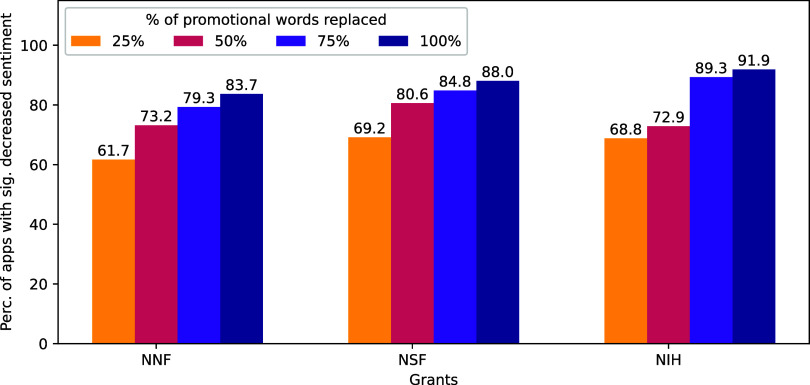
How are the merits of innovative ideas communicated in science? Here, we conduct semantic analyses of grant application success with a focus on scientific promotional language, which may help to convey an innovative idea’s originality and significance. Our analysis attempts to surmount the limitations of prior grant studies by examining the full text of tens of thousands of both funded and unfunded grants from three leading public and private funding agencies: the NIH, the NSF, and the Novo Nordisk Foundation, one of the world’s largest private science funding foundations. We find a robust association between promotional language and the support and adoption of innovative ideas by funders and other scientists. First, a grant proposal’s percentage of promotional language is associated with up to a doubling of the grant’s probability of being funded. Second, a grant’s promotional language reflects its intrinsic innovativeness. Third, the percentage of promotional language is predictive of the expected citation and productivity impact of publications that are supported by funded grants. Finally, a computer-assisted experiment that manipulates the promotional language in our data demonstrates how promotional language can communicate the merit of ideas through cognitive activation. With the incidence of promotional language in science steeply rising, and the pivotal role of grants in converting promising and aspirational ideas into solutions, our analysis provides empirical evidence that promotional language is associated with effectively communicating the merits of innovative scientific ideas.
Overview
The claims and statistics of this paper haven’t been checked yet.
Free: it reads the open-access text and checks the first 5 claims that cite a source we can check. Create a free account to check every claim.
Integrity signals
Registry
Cites
Statistics
Figures
Verification
Claims the paper makes
The claims and statistics of this paper haven’t been checked yet.
Free: it reads the open-access text and checks the first 5 claims that cite a source we can check. Create a free account to check every claim.
Claims other papers make about this one
Each is checked against this paper’s own text: does it say what the citing paper says it does?
The source backs part of the claim, not all of it — or backs it for a different population, condition or comparison.
In the citing paper
“We additionally obtained the information on records’ features that have been previously associated with higher impact and / or promotional language in prior studies2,24,52,53: journal (Science, Nature, PNAS), publication year, word count (number of words in the abstract), number of authors, institutional diversity (number of listed affiliations divided by the number of authors; higher score”
From Scientific publications that use promotional language in the abstract receive more citations and public attention (2025) · cites this paper as [24]
Experimental — accuracy not yet measuredThe source backs part of the claim, not all of it — or backs it for a different population, condition or comparison.
In the citing paper
“Peng et al. have shown that grant proposals that use promotional language tend to include citations from more diverse disciplines, speaking to these proposals’ higher innovative potential24.”
From Scientific publications that use promotional language in the abstract receive more citations and public attention (2025) · cites this paper as [24]
Experimental — accuracy not yet measuredThe cited source says what the claim attributes to it.
In the citing paper
“Further, Peng et al. reported that grant proposals with more promotional language were more likely to result in publications in high impact journals24.”
From Scientific publications that use promotional language in the abstract receive more citations and public attention (2025) · cites this paper as [24]
The cited source says what the claim attributes to it.
In the citing paper
“Recent analyses of grant applications connected the use of promotional words in grant proposals with increased funding rates 23–25.”
From Scientific publications that use promotional language in the abstract receive more citations and public attention (2025) · cites this paper as [24]
The cited source says what the claim attributes to it.
In the citing paper
“The dictionary has been extensively validated in prior work1,23,24.”
From Scientific publications that use promotional language in the abstract receive more citations and public attention (2025) · cites this paper as [24]
1 more claim about this paper
Create a free account to see every claim other papers make about this one.
Self-check
Percentages, sums and reported differences re-computed from the paper’s own numbers.
The self-check needs the paper’s full text.
Citations
Cites
Convergent and discriminant validation by the multitrait-multimethod matrix.
Campbell, D. T., & Fiske, D. W. (1959) · Psychological Bulletin · doi:10.1037/h0046016 · Cited by 17,116 · cited 2×
“First, to externally validate the dictionary, we used the multitrait–mul-timethod approach (MTMM) (31).”
Bayesian model selection in social research
Raftery, A. E. (1995) · Sociological Methodology · doi:10.2307/271063 · Cited by 6,823 · cited 1×
“The fact that the “promo-tional word only” regression (regression two) had the lowest BIC of all three regressions provides further evidence that the percentage of promotional words is the stronger predictor of funding (49).”
Lazer, D. M. J., Baum, M. A., Benkler, Y., Berinsky, A. J., Greenhill, K. M., Menczer, F., Metzger, M. J., Nyhan, B., Pennycook, G., Rothschild, D., et al. (2018) · Science · doi:10.1126/science.aao2998 · Cited by 4,160 · cited 1×
“Indeed, a lack of effective communication and factors associated with communication skills may partly explain the observed increase in career setbacks (6, 14), inequality in science (17, 53, 54), and resistance to scientific facts (55).”
SciBERT: A Pretrained Language Model for Scientific Text
Beltagy, I., Lo, K., & Cohan, A. (2019) · Proceedings of the 2019 Conference on Empirical Methods in Natural Language Processing and the 9th International Joint Conference on Natural Language Processing (EMNLP-IJCNLP) · doi:10.18653/v1/d19-1371 · Cited by 3,218 · cited 1×
“…methods offer a different innovation and will be a game-changer in the…” We used SciBert to estimate a grant’s positive sentiment, which is a contextual word embedding model pre-trained on scientific publications and can be used to evaluate the sentence-level sentiment of scientific text (47).”
MethodLerner, J. S., Li, Y., Valdesolo, P., & Kassam, K. S. (2015) · Annual Review of Psychology · doi:10.1146/annurev-psych-010213-115043 · Cited by 2,913
Psychological Aspects of Natural Language Use: Our Words, Our Selves
Pennebaker, J. W., Mehl, M. R., & Niederhoffer, K. G. (2003) · Annual Review of Psychology · doi:10.1146/annurev.psych.54.101601.145041 · Cited by 2,624 · cited 3×
“Our work offers a unique demonstration of a growing research area (20) by demonstrating how data analytics, linguistic theory, NLP, and machine learning technologies can provide intriguing approaches for advancing science and its contributions to society.”
Fortunato, S., Bergstrom, C. T., Börner, K., Evans, J. A., Helbing, D., Milojević, S., Petersen, A. M., Radicchi, F., Sinatra, R., Uzzi, B., et al. (2018) · Science · doi:10.1126/science.aao0185 · Cited by 1,497
Self-citationAtypical Combinations and Scientific Impact
Uzzi, B., Mukherjee, S., Stringer, M., & Jones, B. (2013) · Science · doi:10.1126/science.1240474 · Cited by 1,457 · cited 6×
“…the astonishing growth of scientific knowledge and changes in search technology and the proliferation of subfield journals have led to the observation that reviewers’ attention is becoming a scarce commodity— changes that can make the recognition of innovation harder and more parochial (35, 59–62).”
InfluentialSelf-citationUsing narratives and storytelling to communicate science with nonexpert audiences
Dahlstrom, M. F. (2014) · Proceedings of the National Academy of Sciences · doi:10.1073/pnas.1320645111 · Cited by 1,159 · cited 1×
“On the one hand, if promotional language helps to convey the merits of complex and risky ideas, it can facilitate the adoption of novel ideas in science and society (26, 27).”
Team Assembly Mechanisms Determine Collaboration Network Structure and Team Performance
Guimerà, R., Uzzi, B., Spiro, J., & Amaral, L. A. N. (2005) · Science · doi:10.1126/science.1106340 · Cited by 1,126 · cited 1×
“Related questions for future research are why language has increased and how it propagates through in science (51).”
Self-citation
Research works printed but not linked: 1
- Y. Ma, D. F. Oliveira, T. K. Woodruff, B. Uzzi, Women who win prizes get less money and prestige. Nature 565, 287– 288 (2019). 30651627 · DOI
Cited by
Terwiesch, C., Meincke, L., Girotra, K., Mollick, E., Nave, G., & Ulrich, K. T. (2026) · Production and Operations Management · doi:10.1177/10591478261474243 · Cited by 240
AI and Its Impact on Creativity and Diversity: An Empirical Study of LLM-Generated Product Ideas
Terwiesch, C., Meincke, L., Girotra, K., Mollick, E. R., Nave, G., & Ulrich, K. T. (2023) · doi:10.2139/ssrn.4526071 · Cited by 174
Scientific production in the era of large language models
Kusumegi, K., Yang, X., Ginsparg, P., de Vaan, M., Stuart, T., & Yin, Y. (2025) · Science · doi:10.1126/science.adw3000 · Cited by 83
“We also found the same pattern for the use of promotional language, further confirming that LLM adoption erodes traditional quality signals across multiple linguistic dimensions ( 33 ).”
The gender gap in scholarly self-promotion on social media
Peng, H., Teplitskiy, M., Romero, D. M., & Horvát, E.-Á. (2025) · Nature Communications · doi:10.1038/s41467-025-60590-y · Cited by 17
“As an initial exploration, our linguistic analysis of self-promotional tweets shows that men use more promotional words 90,96 such as “ novel, ” “ excellent, ” “ robust, ” “ remarkable, ” and “ unprecedented ” than women, while women use more supportive words such as “ amazing, ” “ supportive, ”…”
Self-citationStavrova, O., Kleinberg, B., Evans, A. M., & Ivanović, M. (2025) · Communications Psychology · doi:10.1038/s44271-025-00293-8 · Cited by 8
“…the information on records ’ features that have been previously associated with higher impact and / or promotional language in prior studies 2,24,52,53 : journal (Science, Nature, PNAS), publication year, word count (number of words in the abstract), number of authors, institutional…”
InfluentialThe impact of investigator bias in nutrition research
Shyam, S., & Salas‐Salvadó, J. (2025) · Frontiers in Nutrition · doi:10.3389/fnut.2025.1513343 · Cited by 8
“Additionally, promotional language in grant applications is known to increase their chance of being funded and the citation impact of resulting publications from these grants (10).”
Use of Promotional Language in Grant Applications and Grant Success
Qiu, H. S., Peng, H., Fosse, H. B., Woodruff, T. K., & Uzzi, B. (2024) · JAMA Network Open · doi:10.1001/jamanetworkopen.2024.48696 · Cited by 5
Self-citationThe rise of large language models and the direction and impact of US federal research funding
Qian, Y., Wen, Z., Furnas, A. C., Bai, Y., Shao, E., & Wang, D. (2026) · Proceedings of the National Academy of Sciences · doi:10.1073/pnas.2601439123 · Cited by 5
“Second, recent work has shown that the use of promotional language in grant proposals is positively associated with funding outputs and related proposal characteristics (14).”
Should Artificial Intelligence Play a Durable Role in Biomedical Research and Practice?
Bongrand, P. (2024) · International Journal of Molecular Sciences · doi:10.3390/ijms252413371 · Cited by 5
The distinctive innovation patterns and network embeddedness of scientific prizewinners
Tian, C., Huang, Y., Jin, C., Ma, Y., & Uzzi, B. (2025) · Proceedings of the National Academy of Sciences · doi:10.1073/pnas.2424143122 · Cited by 8
Self-citationFunding AI for Good: A Call for Meaningful Engagement
Lin, H., Kawakami, A., D’Ignazio, C., Holstein, K., & Gajos, K. Z. (2026) · CHI Conference on Human Factors in Computing Systems · doi:10.1145/3772318.3790374 · Cited by 4
Examining the Cognitive Gap Between Authors and Peer Reviewers on Academic Paper Novelty
Yang, C., & Zhang, C. (2025) · Scientometrics · doi:10.1007/s11192-026-05702-1 · Cited by 3
“Peng et al. (2024) examined the promotional language in funding applications from NIH, NSF, and the Nord Foundation, investigating its relationship with the likelihood of funding and the future impact of the projects.”
Impact upfront: novel format for Novo Nordisk Foundation funding
Balling, G. V., Fosse, H. B., Iversen, K. Z., & Hanney, S. R. (2025) · Health Research Policy and Systems · doi:10.1186/s12961-025-01385-x · Cited by 3
“Findings are detailed in two journal papers [56, 57] and the Foun-dation’s annual impact report 2023 [48].”
Self-citationWang, Y., & Qu, W. (2025) · Behavior Research Methods · doi:10.3758/s13428-025-02868-z · Cited by 4
Palmero, C., Arranz, N., & Arroyabe, M. F. (2025) · Sustainability · doi:10.3390/su17209025 · Cited by 2
Lane, J. N., Boussioux, L., Ayoubi, C., Chen, Y. H., Lin, C., Spens, R., Wagh, P., & Wang, P.-H. (2024) · SSRN Electronic Journal · doi:10.2139/ssrn.4914367 · Cited by 9
Cotos, E. (2025) · Elsevier eBooks · doi:10.1016/b978-0-323-95504-1.00388-4 · Cited by 1
Cai, Y., Yu, X., Lin, F., Chen, C., Wei, X., & Liu, W. (2024) · SSRN Electronic Journal · doi:10.2139/ssrn.5043753
Elements of Promotional Discourse in English-Language Academic Abstracts
Khoutyz, I. P. (2024) · Nauchnyi Dialog · doi:10.24224/2227-1295-2024-13-10-230-250
Cross-sectional analysis of self-promotional language in texts of grant proposals across gender
Heyard, R., Lim, S. F., & Jorstad, A. (2024) · Research Evaluation · doi:10.1093/reseval/rvaf002
Wu, H., Li, J., & Wu, D. (2026) · Scientometrics · doi:10.1007/s11192-025-05526-5 · Cited by 1
“First, we utilize an expanded lexicon proposed by Peng et al. (2024) comprising 139 terms specifically curated for positivity analysis in scientific texts.”
Jiang, F., & Wang, S. (2026) · Palgrave studies in global higher education · doi:10.1007/978-3-032-07781-3_6
PROMOTIONAL ADJECTIVES IN GRANT PROPOSAL ABSTRACTS: A CORPUS STUDY
Tulyakov, D. S., Permyakova, T. M., & Balezina, E. A. (2026) · Vestnik Volgogradskogo gosudarstvennogo universiteta Serija 2 Jazykoznanije · doi:10.15688/jvolsu2.2025.6.5
“Studies have found that in scientific grant proposals promotional language is often used to highlight the novelty and potential impact of research [Peng et al., 2024].”
InfluentialAn Analysis of Artificial Intelligence Adoption in NIH-Funded Research
Nananukul, N., & Kejriwal, M. (2026) · IEEE International Conference on Digital Health (ICDH) · doi:10.1109/icdh72779.2026.00042
“Recent work has found that adoption of promotional language in funding applications is positively associated with funding success [25], even as the “burden of knowledge” required for innovation continues to increase [26].”
The institutional dynamics of inequality for women inventors who break with conventional thinking
Sowrirajan, T., Whalen, R., & Uzzi, B. (2026) · Proceedings of the National Academy of Sciences · doi:10.1073/pnas.2500343123 · Cited by 1
“Because they turn away from past ideas, innovations that push against the boundaries of convention seem dubious, raising rather than reducing their rejection rate (3, 10, 12–14).”
Self-citationAndriani, E. (2026) · Indonesian Journal of English Language Studies (IJELS) · doi:10.24071/ijels.v12i1.328
“It mentioned the appeal of the thing being discussed in the main content to naturally shift to the sponsored part while accentuating the best quality of the product (Peng et al., 2024).”
Элементы продвигающего дискурса в аннотации англоязычной академической статьи
Павловна, Х. И. (2024) · Nauchnyi Dialog
Nakamura, S., Tada, K., Yamashita, Y., Inomata, N., Sakata, K., Ito, K., Kuroda, Y., Yoshizumi, F., Kouso, H., Iwaki, K., et al. (2026) · Surgery Today · doi:10.1007/s00595-026-03383-0
“We analyzed PROMO to assess the broader rhetorical shift that could affect the communication and interpretation of scientific findings [ 8, 19, 20].”
Mixed feelings, mixed outcomes? When emotionally ambivalent framing enhances idea appreciation
Cutolo, D., Falchetti, D., & Wesemann, H. (2026) · Strategic Entrepreneurship Journal · doi:10.1002/sej.70036
Zhao, Y., Zhang, H., Wang, Y., Xie, Z., & Zhu, Y. (2026) · Journal of Informetrics · doi:10.1016/j.joi.2026.101867
Hyping Bariatric Surgery Research in the Glucagon-Like Peptide-1 EraPreprint
Chumoakova, M., Finucane, F. M., Shenoy, R. S., Halpin, V. J., & Juo, Y. (2026) · Research Square · doi:10.21203/rs.3.rs-11110167/v1
Metadata
- Authors
- Peng, H., Qiu, H. S., Fosse, H. B., & Uzzi, B.
- Affiliations
- Northwestern University (US)
- Novo Nordisk Foundation (DK)
- Corresponding author
- Peng, Hao
- Qiu, Huilian Sophie
- Uzzi, Brian
- Venue
- Proceedings of the National Academy of Sciences
- Publisher
- National Academy of Sciences
- Published
- 2024-06-11
- Volume
- 121
- Issue
- 25
- Pages
- e2320066121-e2320066121
- ISSN
- 0027-8424 (ISSN-L)
- 1091-6490
- PMC
- PMC11194578
- OpenAlex
- W4399445161
- Cited by
- 26
- References
- 61
- Citations by year
- 2026: 10 · 2025: 10 · 2024: 6
- FWCI
- 7.26
- Type
- journal article
- Language
- en
- Open access
- hybrid
- doi.org
- Licence
- Locations
- Proceedings of the National Academy of Sciences (publishedVersion, cc-by)
- PubMed Central (publishedVersion, cc-by)
- PubMed (publishedVersion)
- arXiv (Cornell University) (submittedVersion, cc-by)
- arXiv (Cornell University) (cc-by)
- Funders
- DOD | USAF | AMC | Air Force Office of Scientific Research (FA9550-19-1-0354)
- Topics
- Social Sciences › Library and Information Sciences › scientometrics and bibliometrics research
- Social Sciences › Business, Management and Accounting › Management of Technology and Innovation › Research, Science, and Academia
- Social Sciences › Library and Information Sciences › Academic Publishing and Open Access
- Keywords
- promotional language, grant applications, research funding, innovation adoption, science communication, citation impact, publication productivity, National Institutes of Health, NSF, semantic analysis, cognitive activation
- MeSH terms
- Creativity, Financing, Organized, Humans, Language, Research Support as Topic, Science, United States
About these checks
Registry, retraction, Cites and statistics results are computed, not judged, with one exception: a printed reference that no index lists is read once by a model before it counts as a citation error. Claims are extracted by a model and kept only when their quote appears verbatim in the text; each cited source is then checked, with a model’s help, for whether it says what the claim relies on. Those verdicts can be wrong — read the claim’s quote and the cited source before relying on one.
Statistics and arithmetic are recomputed, not judged.
Confidence bands are shown only for fields calibrated on our annotated test set. None is calibrated yet, so no band is shown.
What counts as a claim ›How we measure confidence ›How we check this ›
Are you an author, or do you see a problem with this page? Request a review
Data sources
Bibliographic data: Semantic Scholar, OpenAlex, Crossref.
Contains information from the Semantic Scholar Academic Graph Datasets, made available under the ODC Attribution License (ODC-BY 1.0).
Semantic Scholar’s data is described in: Kinney, R., et al. (2023). The Semantic Scholar Open Data Platform. arXiv:2301.10140.
