

Embers of autoregression show how large language models are shaped by the problem they are trained to solve
Open accessThe DOI matches its Crossref record; 101 of the 103 references it cites were found in a registry or an index; 15 of the 34 sources its claims cite were checked for support.
Abstract
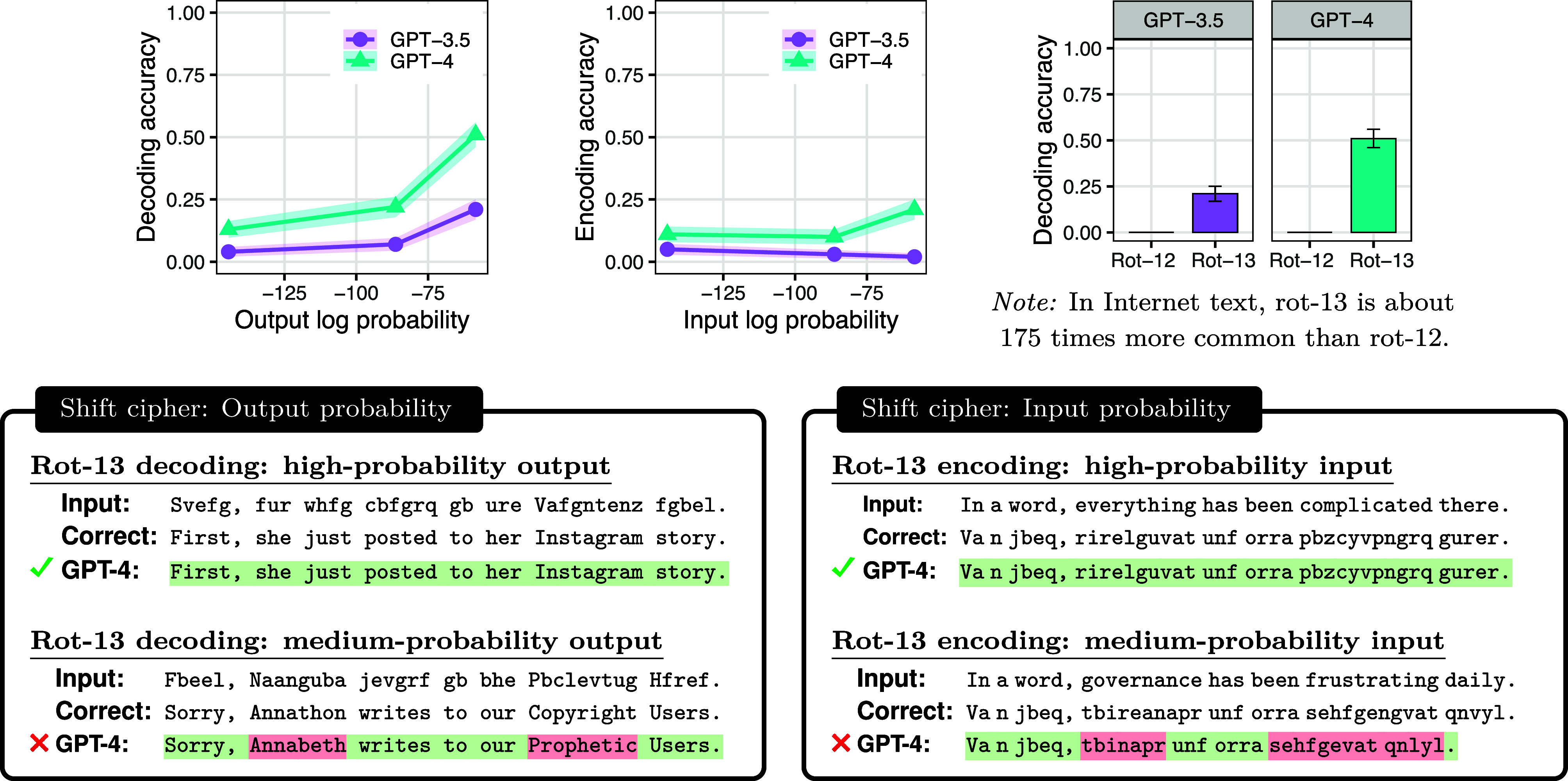
The widespread adoption of large language models (LLMs) makes it important to recognize their strengths and limitations. We argue that to develop a holistic understanding of these systems, we must consider the problem that they were trained to solve: next-word prediction over Internet text. By recognizing the pressures that this task exerts, we can make predictions about the strategies that LLMs will adopt, allowing us to reason about when they will succeed or fail. Using this approach—which we call the teleological approach—we identify three factors that we hypothesize will influence LLM accuracy: the probability of the task to be performed, the probability of the target output, and the probability of the provided input. To test our predictions, we evaluate five LLMs (GPT-3.5, GPT-4, Claude 3, Llama 3, and Gemini 1.0) on 11 tasks, and we find robust evidence that LLMs are influenced by probability in the hypothesized ways. Many of the experiments reveal surprising failure modes. For instance, GPT-4’s accuracy at decoding a simple cipher is 51% when the output is a high-probability sentence but only 13% when it is low-probability, even though this task is a deterministic one for which probability should not matter. These results show that AI practitioners should be careful about using LLMs in low-probability situations. More broadly, we conclude that we should not evaluate LLMs as if they are humans but should instead treat them as a distinct type of system—one that has been shaped by its own particular set of pressures.
Overview
CoChat Summary
TL;DR
The paper argues that large language models can be understood teleologically as statistical next-word prediction systems shaped by Internet text, and it tests three predicted sensitivities: output probability, input probability, and task frequency. Across five LLMs and eleven tasks, accuracy is often higher for high-probability outputs and common task variants, and sometimes for high-probability inputs, even on deterministic tasks.
Key findings
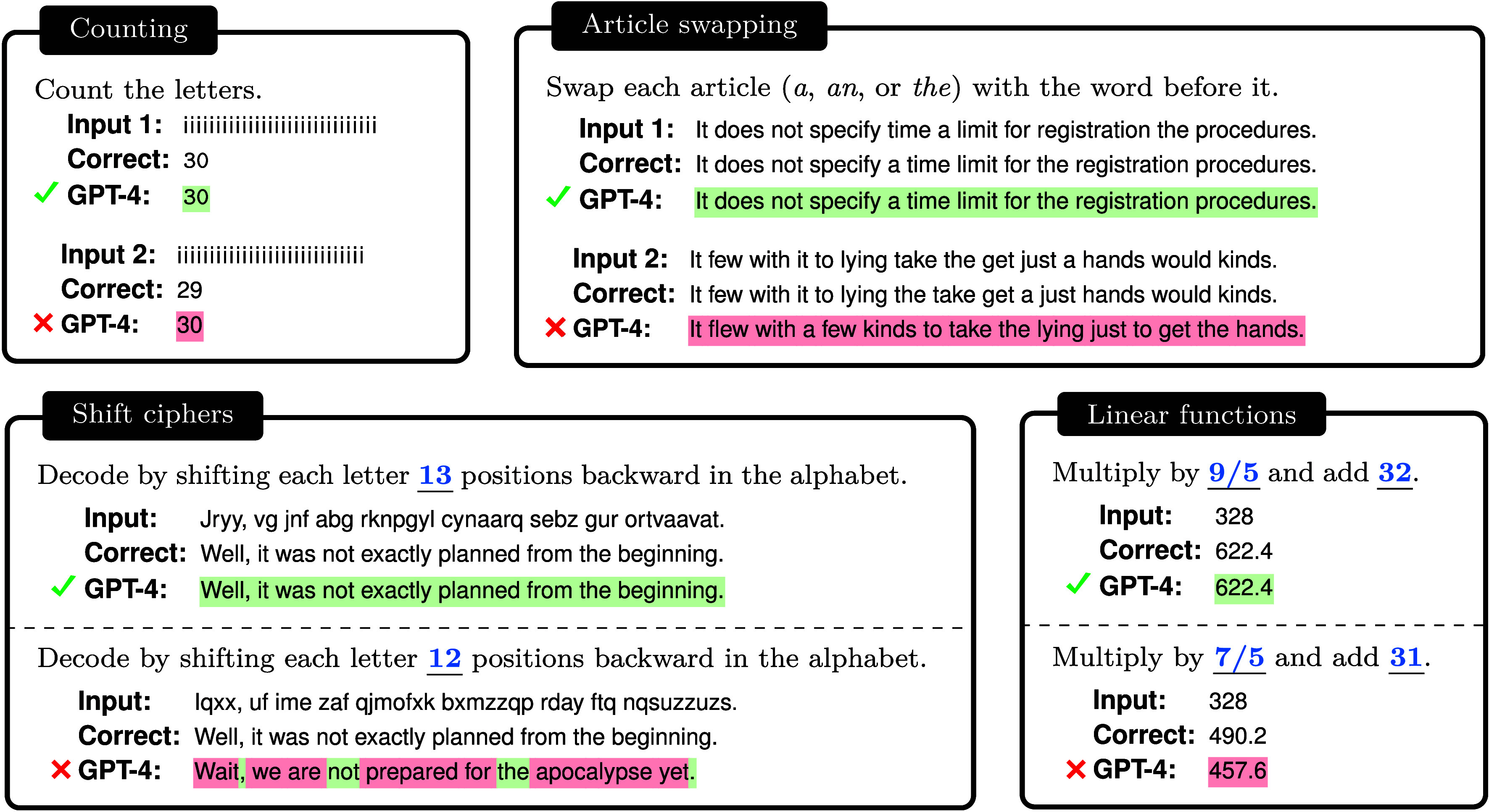
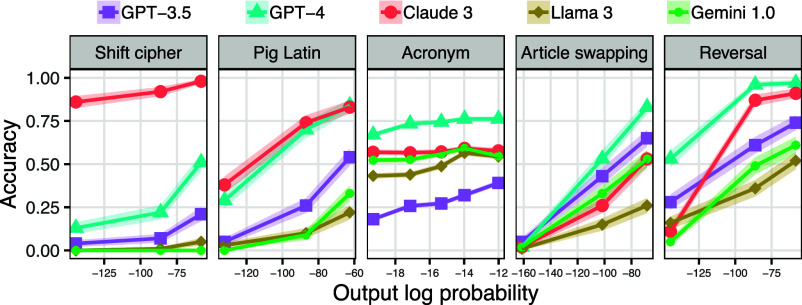
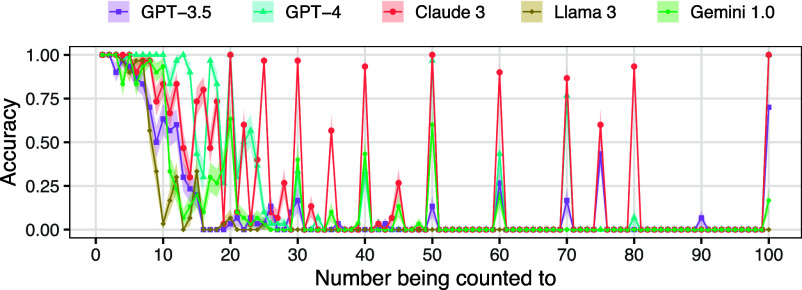
- Output probability: significant effect in all cases except Gemini 1.0 decoding shift ciphers (0% accuracy) and Claude 3 forming acronyms (P=0.38). GPT-4’s article-swapping accuracy ranged from 0.02 on low-probability examples to 0.83 on high-probability examples. Counting accuracy spiked at multiples of 10; for GPT-4, accuracy correlated more with number frequency than magnitude (absolute coefficients 0.84 vs. 0.70), and for Claude 3, 0.85 vs. 0.66. In shift-cipher errors, GPT-3.5 and GPT-4 produced a regularized high-probability sentence more often than the correct answer.
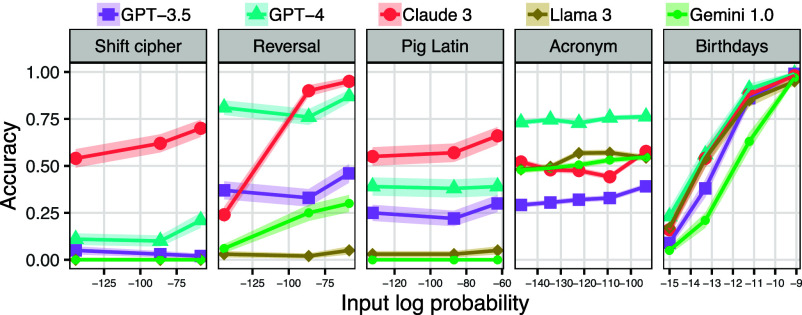
- Input probability: little or no effect on most tasks, but the birthday task showed a large effect (P<10−15 for all models). GPT-4 had higher accuracy when shift-cipher inputs were high-probability than low-probability; GPT-3.5 showed no significant input-probability effect.
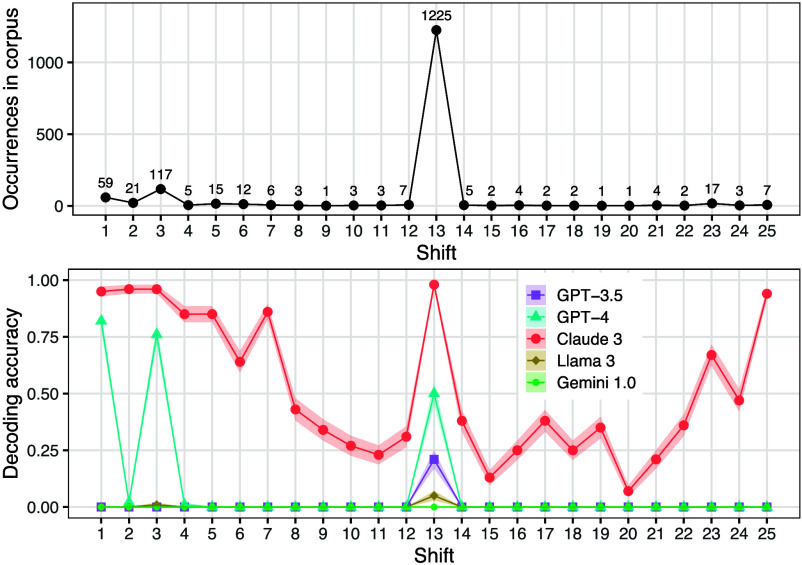
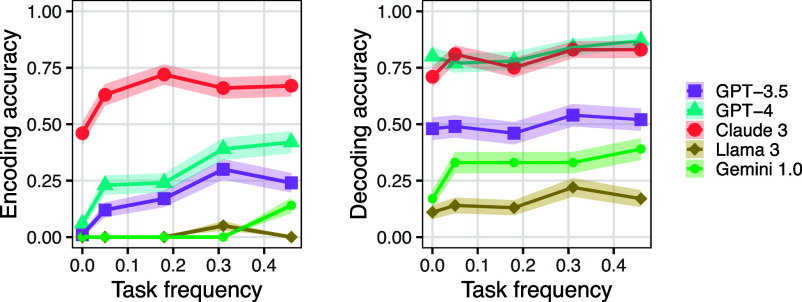
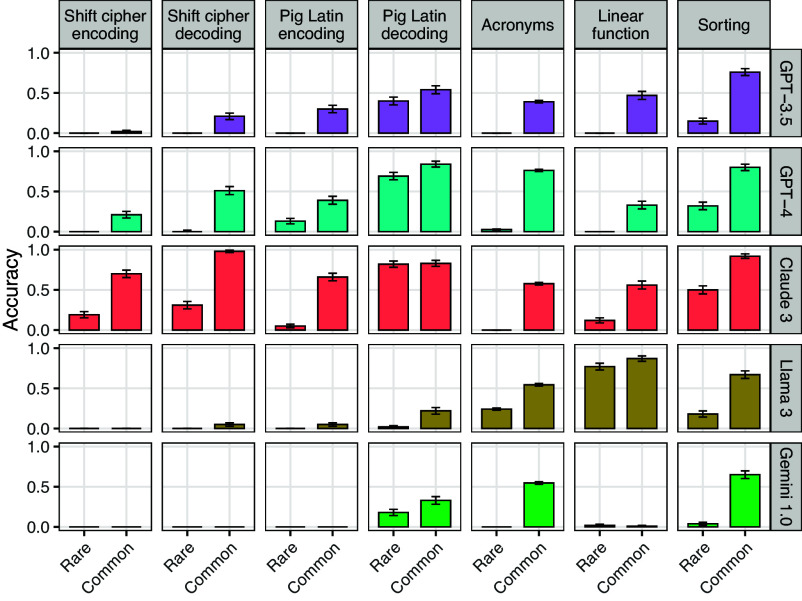
- Task probability: across seven common-vs-rare task pairs, models performed substantially better on common variants. For shift ciphers, all models except Gemini 1.0 spiked at rot-13; GPT-4 scored ≥0.50 on the three highest-frequency shifts (1, 3, 13) but <0.03 on all other shifts, and rot-13 beat rot-12 (P<0.01) for GPT-3.5, GPT-4, and Claude 3. Pig Latin encoding was better for the common variant (P<0.01) for GPT-3.5, GPT-4, and Claude 3; decoding favored Pig Latin for all five models but was significant only for GPT-4 and Llama 3 (P<0.05). First-letter acronyms beat second-letter acronyms for all five models (P<10−4). The common linear function f(x)=(9/5)x+32 beat the rare f(x)=(7/5)x+31 for GPT-3.5, GPT-4, and Claude 3 (P<0.01; Llama 3 P=0.22). Alphabetical sorting beat reverse alphabetical sorting for all five models (P<10−5), paralleling a 150× corpus-frequency difference.
- Overall: chain-of-thought and step-by-step prompting, scaling, and few-shot learning can raise overall accuracy, but the qualitative sensitivities to task frequency and example probability remained.
Methods
- The paper uses a teleological/Bayesian analysis of next-word prediction to derive predictions about output probability, input probability, and task probability. It evaluated five models: gpt-3.5-turbo-0613, gpt-4-0613, claude-3-opus-20240229, gemini-1.0-pro-001, and llama-3-70b-chat-hf, accessed via APIs at temperature 0.0. Preliminary tests with OLMo and Llama 2 were too low to yield trends (0% on most tasks).
- Eleven tasks were used: article swapping, reversal, counting, acronyms, linear function, multiplication, sorting, keyboard cipher, shift cipher, Pig Latin, and birthdays. High-probability sentences came from Global Voices; medium-probability sentences used RoBERTa word replacements; low-probability sentences shuffled medium-probability examples except first and last words. Words came from the CMU Pronouncing Dictionary; acronym lists had 7 words, sorting lists 10–20 words, counting lists 1–100 words, linear-function inputs were 0–999, multiplication inputs 100–999, and birthdays came from WikiBio. Sample sizes were 1,000 per condition for acronyms, 30 per number for counting, and 100 per condition for other tasks. Models received basic prompts without tuning.
- Statistical tests used logistic regressions with correctness as the outcome; predictors generally included input probability, output probability, input length, output length, and task variant. Output probabilities were estimated using GPT-2, and task frequencies were estimated from C4 and the Pile.
Limitations
- Paper states: the analysis focuses only on next-word prediction and leaves instruction tuning for future work; it considers only text-processing LLMs, not augmented models with image or code-execution abilities; it uses basic prompting, though chain-of-thought and step-by-step prompting can improve performance while preserving the reported trends; it does not make strong claims about qualitative human differences because there is no fair human comparison; and it does not claim LLMs cannot perform the tasks, only that some tasks and examples are harder than others.
- Paper states/evident: tasks were chosen adversarially to push models into low-probability situations and ensure nonnegligible error rates, so the results are not a general capability benchmark. Some models showed floor effects (e.g., Gemini 1.0 at 0% on shift ciphers; OLMo and Llama 2 at 0% on most tasks), and corpus-frequency estimates are proxies for training data. Sample sizes also varied, including only 30 examples per number in the counting task.
- Evident: the study covers only five API models at specific versions and temperature 0.0, does not separate instruction-tuned from pretrained behavior, lacks a human baseline, and uses a limited set of eleven tasks; some significance tests excluded models because of floor effects.
Model-written summary. Check it against the paper before relying on it.
Integrity signals
Registry
Cites
Statistics
Figures
Verification
Claims the paper makes
11 Valid · 3 Not valid · 8 Not checked · 107 Own results and interpretations
Every source the paper cites for this claim was checked and supports it.
In the paper
“Note that many recent LLMs are not solely trained on next-word prediction but also go through a training phase based on instruction tuning (22), which aims to align model behavior with human preferences.”
§ Embers of autoregression show how large language models are shaped by the problem they are trained to solve > A Teleological Approach to Understanding LLMs > What Problem Do LLMs Solve?.
What the sources say
- Supportedcites [22] L. Ouyang, Training language models to follow instructions with human feedback. NeurIPS 35, 27730– 27744 (2022). source
The Introduction (§1) describes fine-tuning GPT-3 to follow instructions using human preferences as a reward signal, rather than relying only on next-token prediction. Related Work (§2) also describes a range of studies that fine-tune language models with instructions. The paper qualifies its own alignment result as matching the stated preferences of its labelers and researchers, not human values broadly. (LLM, conf=0.89)
plain- Asserted: passes — The authors put it forward as true.
- Checkable: passes — It can be checked against evidence.
- Load-bearing: passes — The paper’s conclusions depend on it.
- Based: passes — The paper gives a reason why it holds.
- Supported
Every source the paper cites for this claim was checked and supports it.
In the paper
“they found that LLMs performed better on the default version of a task (e.g., executing Python code under the true assumption that Python uses 0-based indexing) than on a counterfactual version of the task (e.g., falsely assuming that Python uses 1-based indexing).”
§ Embers of autoregression show how large language models are shaped by the problem they are trained to solve > Sensitivity to Task Probability > Summary of Task Probability Effects.
What the sources say
- Supportedcites [42] Z. Wu et al., “Reasoning or reciting? Exploring the capabilities and limitations of language models through counterfactual tasks” in Proceedings of NAACL (2024), pp. 1819–1862. source
The Results (§4) state that language models consistently performed substantially worse on counterfactual task variants than on default variants. Appendix A.2 confirms that the programming task compared ordinary 0-based indexing with counterfactual 1-based indexing. (LLM, conf=0.94)
plainstates an association- Asserted: passes — The authors put it forward as true.
- Checkable: passes — It can be checked against evidence.
- Load-bearing: unclear — It is unclear whether the paper’s conclusions depend on it.
- Based: passes — The paper gives a reason why it holds.
- Supported
Every source the paper cites for this claim was checked and supports it.
In the paper
“Based on an analysis of the C4 corpus (36), we found that the three most common shift levels are rot-1, rot-3, and rot-13”
§ Embers of autoregression show how large language models are shaped by the problem they are trained to solve > Sensitivity to Task Probability > Shift Ciphers.
What the sources say
- Supportedcites [36] C. Raffel, Exploring the limits of transfer learning with a unified text-to-text transformer. J. Mach. Learn. Res. 21, 5485– 5551 (2020). source
Section 2.2 (p. 6) identifies the dataset as the Colossal Clean Crawled Corpus, or C4. The citing authors attribute the shift-frequency finding to their own analysis; this citation identifies the corpus they analyzed, not the source of that finding. (LLM, conf=0.93)
plain- Asserted: passes — The authors put it forward as true.
- Checkable: passes — It can be checked against evidence.
- Load-bearing: unclear — It is unclear whether the paper’s conclusions depend on it.
- Based: passes — The paper gives a reason why it holds.
- Rests on an assumption not shown here.
- Supported
Every source the paper cites for this claim was checked and supports it.
In the paper
“Based on an analysis of the C4 corpus, we estimate that alphabetical order is 150 times more common than reverse alphabetical order in Internet text.”
§ Embers of autoregression show how large language models are shaped by the problem they are trained to solve > Sensitivity to Task Probability > Sorting.
What the sources say
- Supportedcites [36] C. Raffel, Exploring the limits of transfer learning with a unified text-to-text transformer. J. Mach. Learn. Res. 21, 5485– 5551 (2020). source
Section 2.2 (p. 6) identifies C4 as the authors’ corpus of cleaned web text. The citing sentence presents the 150-times estimate as its own analysis, not as a result reported by Raffel et al.; this source supports the citation’s identification of C4, but does not verify the estimate. (LLM, conf=0.88)
hedged- Asserted: passes — The authors put it forward as true.
- Checkable: passes — It can be checked against evidence.
- Load-bearing: passes — The paper’s conclusions depend on it.
- Based: passes — The paper gives a reason why it holds.
- Rests on an assumption not shown here.
- Supported
The cited sources support only part of this claim — read each source’s verdict below.
In the paper
“a human’s ease of processing a sentence is influenced by that sentence’s probability (66–68)”
§ Embers of autoregression show how large language models are shaped by the problem they are trained to solve > Discussion > Comparing Models to Humans.
What the sources say
- Not checked — no full text of the sourcecites [66] S. F. Ehrlich, K. Rayner, Contextual effects on word perception and eye movements during reading. J. Verb. Learn. Verb. Behav. 20, 641– 655 (1981). source
- Partly supportedcites [67] N. J. Smith, R. Levy, The effect of word predictability on reading time is logarithmic. Cognition 128, 302– 319 (2013). 23747651 PMC3709001 sourceExperimental — accuracy not yet measured
The Discussion reports that word predictability affects word comprehension in context, and the paper relates that effect to reading time. It does not establish that the probability of an entire sentence affects how easily a human processes that sentence; its measured probabilities are for words in context. (LLM, conf=0.86)
- Partly supportedcites [68] E. Gibson, L. Bergen, S. T. Piantadosi, Rational integration of noisy evidence and prior semantic expectations in sentence interpretation. Proc. Natl. Acad. Sci. U.S.A. 110, 8051– 8056 (2013). 23637344 PMC3657782 sourceExperimental — accuracy not yet measured
The paper’s Discussion says that comprehenders use expectations about likely sentences to arrive at an interpretation, supporting the claim that sentence probability influences comprehension. But the Results measure which interpretation participants chose, not how easy a sentence was to process; the claim’s processing-ease component is not established. (LLM, conf=0.83)
plainstates an association- Asserted: passes — The authors put it forward as true.
- Checkable: passes — It can be checked against evidence.
- Load-bearing: unclear — It is unclear whether the paper’s conclusions depend on it.
- Based: passes — The paper gives a reason why it holds.
65 more claims
Create a free account to see all 129 claims and to verify the 1 reference still open.
- It may state two separate claims as one. 23
- Probably not a substantial claim. 42
Claims other papers make about this one
Each is checked against this paper’s own text: does it say what the citing paper says it does?
The cited source says what the claim attributes to it.
In the citing paper
“However, models and humans also have different capabilities and consequently different constraints for some tasks (Griffiths, 2020;Shiffrin & Mitchell, 2023;McCoy et al., 2024).”
From Mind Your Step (by Step): Chain-of-Thought can Reduce Performance on Tasks where Thinking Makes Humans Worse (2024) · cites this paper as McCoy et al., 2024
In the citing paper
“The disparity between LLM performance on mARC-QA and conventional medical QA aligns with studies suggesting that benchmark successes may stem from overfitting to statistical patterns in training data rather than reflecting emergent reasoning abilities19,54–57.”
From Limitations of large language models in clinical problem-solving arising from inflexible reasoning (2025) · cites this paper as [54]
In the citing paper
“This interpretation is reinforced by studies that have shown LLMs’ limited robustness and increased hallucination rates in low-probability contexts, where reliance on surface-level statistical correlations proves insufficient19,54,58.”
From Limitations of large language models in clinical problem-solving arising from inflexible reasoning (2025) · cites this paper as [54]
Citations
Cites
Vaswani, A., Shazeer, N., Parmar, N., Uszkoreit, J., Jones, L., Gomez, A. N., Kaiser, L., & Polosukhin, I. (2017) · arXiv · doi:10.48550/arxiv.1706.03762 · Cited by 120,404
Exploiting Generative AI to Scale up Intelligent Tutoring Systems
Jakubův, J., Chvalovský, K., Goertzel, Z., Kaliszyk, C., Olšák, M., Piotrowski, B., Schulz, S., Suda, M., & Urban, J. (2023) · DROPS (Schloss Dagstuhl – Leibniz Center for Informatics) · doi:10.4230/lipics.itp.2023.19 · Cited by 76,658
Language Models are Few-Shot Learners
Brown, T. B., Mann, B., Ryder, N., Subbiah, M., Kaplan, J., Dhariwal, P., Neelakantan, A., Shyam, P., Sastry, G., Askell, A., et al. (2020) · arXiv · doi:10.48550/arxiv.2005.14165 · Cited by 23,372
Regularization Paths for Generalized Linear Models via Coordinate Descent
Friedman, J., Hastie, T., & Tibshirani, R. (2010) · Journal of Statistical Software · doi:10.18637/jss.v033.i01 · Cited by 19,927
RoBERTa: A Robustly Optimized BERT Pretraining Approach
Liu, Y., Ott, M., Goyal, N., Du, J., Joshi, M., Chen, D., Levy, O., Lewis, M., Zettlemoyer, L., & Stoyanov, V. (2019) · arXiv · doi:10.48550/arxiv.1907.11692 · Cited by 16,515
Kaugeranna, R., Kaugeranna, E., & Aion, (. S. 4. 6. (2023) · DROPS (Schloss Dagstuhl – Leibniz Center for Informatics) · doi:10.4230/lipics.giscience.2023.43 · Cited by 13,690
Elman, J. L. (1990) · Cognitive Science · doi:10.1207/s15516709cog1402_1 · Cited by 11,212
Exploring the Limits of Transfer Learning with a Unified Text-to-Text Transformer
Raffel, C., Shazeer, N., Roberts, A., Lee, K., Narang, S., Matena, M., Zhou, Y., Li, W., & Liu, P. J. (2019) · arXiv · doi:10.48550/arxiv.1910.10683 · Cited by 10,929
The spandrels of San Marco and the Panglossian paradigm: a critique of the adaptationist programme
Gould, S. J., & Lewontin, R. C. (1979) · Proceedings of the Royal Society of London. Series B. Biological Sciences · doi:10.1098/rspb.1979.0086 · Cited by 7,770
Tree of Thoughts: Deliberate Problem Solving with Large Language Models
Yao, S., Yu, D., Zhao, J., Shafran, I., Griffiths, T. L., Cao, Y., & Narasimhan, K. (2023) · arXiv · doi:10.48550/arxiv.2305.10601 · Cited by 7,650
Self-citation
Research works printed but not linked: 8
- Anthropic, Introducing the next generation of Claude. Anthropic [Preprint] (2024). https://www.anthropic.com/news/claude-3-family. Accessed 28 August 2024.
- D. Marr, Vision (W.H. Freeman, 1982).
- A. Radford et al., Language models are unsupervised multitask learners. OpenAI [Preprint] (2019). https://openai.com/index/better-language-models. Accessed 28 August 2024.
- Suetonius, The Twelve Caesars (R. Worthington, 1883), vol. 121, Translator: Alexander Thomson.
- D. Kahn, The Codebreakers (Scribner, 1967).
- S. Singh, The Code Book (Doubleday, 1999).
- B. Vaux, A. I. Nevins, “Underdetermination in language games: Survey & analysis of Pig Latin dialects” in 77th Annual Meeting of the LSA (Atlanta, GA, 2003), pp. 2–5.
- BIG-bench authors, Beyond the imitation game: Quantifying and extrapolating the capabilities of language models. Trans. Mach. Learn. Res. 05/2023, 1–95 (2023).
Cited by
SWE-agent: Agent-Computer Interfaces Enable Automated Software Engineering
Yang, J., Jimenez, C. E., Wettig, A., Lieret, K., Yao, S., Narasimhan, K., & Press, O. (2024) · arXiv · doi:10.48550/arxiv.2405.15793 · Cited by 3,708
Self-citationGSM-Symbolic: Understanding the Limitations of Mathematical Reasoning in Large Language Models
Mirzadeh, I., Alizadeh, K., Shahrokhi, H., Tuzel, O., Bengio, S., & Farajtabar, M. (2024) · arXiv · doi:10.48550/arxiv.2410.05229 · Cited by 714
Dissociating language and thought in large language models
Mahowald, K., Ivanova, A. A., Blank, I. A., Kanwisher, N., Tenenbaum, J. B., & Fedorenko, E. (2024) · Trends in Cognitive Sciences · doi:10.1016/j.tics.2024.01.011 · Cited by 345
LLMs Can't Plan, But Can Help Planning in LLM-Modulo Frameworks
Kambhampati, S., Valmeekam, K., Guan, L., Verma, M., Stechly, K., Bhambri, S., Saldyt, L., & Murthy, A. (2024) · arXiv · doi:10.48550/arxiv.2402.01817 · Cited by 237
Theory Is All You Need: AI, Human Cognition, and Causal Reasoning
Felin, T., & Holweg, M. (2024) · doi:10.2139/ssrn.4737265 · Cited by 152
On the Self-Verification Limitations of Large Language Models on Reasoning and Planning Tasks
Stechly, K., Valmeekam, K., & Kambhampati, S. (2024) · arXiv · doi:10.48550/arxiv.2402.08115 · Cited by 120
Theory Is All You Need: AI, Human Cognition, and Causal Reasoning
(2024) · doi:10.1287/stsc.2024.0189 · Cited by 151
Measuring what Matters: Construct Validity in Large Language Model Benchmarks
Bean, A. M., Kearns, R. O., Romanou, A., Hafner, F. S., Mayne, H., Batzner, J., Foroutan Eghlidi, N., Schmitz, C., Korgul, K., Batra, H., et al. (2025) · Advances in Neural Information Processing Systems 38 · doi:10.52202/085713-0590 · Cited by 110
Chatlaw: A Multi-Agent Legal Assistant based on a Role-Aligned Mixture-of-Experts Architecture
Cui, J., Ning, M., Li, Z., Li, H., Yang, Y., Chen, B., Ling, B., Tian, Y., & Yuan, L. (2026) · Fundamental Research · doi:10.1016/j.fmre.2026.03.026 · Cited by 94
Chatlaw: A Multi-Agent Legal Assistant based on a Role-Aligned Mixture-of-Experts Architecture
Cui, J., Ning, M., Li, Z., Chen, B., Yan, Y., Li, H., Ling, B., Tian, Y., & Yuan, L. (2023) · arXiv · doi:10.48550/arxiv.2306.16092 · Cited by 94
Röttger, P., Hofmann, V., Pyatkin, V., Hinck, M., Kirk, H., Schuetze, H., & Hovy, D. (2024) · Proceedings of the 62nd Annual Meeting of the Association for Computational Linguistics (Volume 1: Long Papers) · doi:10.18653/v1/2024.acl-long.816 · Cited by 89
Exploring the role of large language models in the scientific method: from hypothesis to discovery
Zhang, Y., Khan, S., Mahmud, A., Yang, H., Lavin, A., Levin, M., Frey, J., Dunnmon, J. A., Evans, J., Bundy, A., et al. (2025) · npj Artificial Intelligence · doi:10.1038/s44387-025-00019-5 · Cited by 186
“Consequently,cautionisadvisedwhen applying LLMs to novel reasoning tasks, and incorporating human over-sight into the process is recommended 170,171 .”
Mirza, A., Alampara, N., Kunchapu, S., Ríos-García, M., Emoekabu, B., Krishnan, A., Gupta, T., Schilling-Wilhelmi, M., Okereke, M., Aneesh, A., et al. (2025) · Nature Chemistry · doi:10.1038/s41557-025-01815-x · Cited by 380
“Although our findings indicate many areas for further improvement of LLM-based systems, such as agents (more discussion in Supplementary Note 11), it is also important to realize that clearly defined metrics have been the key to the progress of many fields of ML, such as computer vision.”
InfluentialLimitations of large language models in clinical problem-solving arising from inflexible reasoning
Kim, J., Podlasek, A., Shidara, K., Liu, F., Alaa, A., & Bernardo, D. (2025) · Scientific Reports · doi:10.1038/s41598-025-22940-0 · Cited by 78
Large language models predict human sensory judgments across six modalities
Marjieh, R., Sucholutsky, I., van Rijn, P., Jacoby, N., & Griffiths, T. L. (2024) · Scientific Reports · doi:10.1038/s41598-024-72071-1 · Cited by 73
Self-citationPrompting is not a substitute for probability measurements in large language models
Hu, J., & Levy, R. (2023) · Proceedings of the 2023 Conference on Empirical Methods in Natural Language Processing · doi:10.18653/v1/2023.emnlp-main.306 · Cited by 60
Testing AI on language comprehension tasks reveals insensitivity to underlying meaning
Dentella, V., Günther, F., Murphy, E., Marcus, G., & Leivada, E. (2024) · Scientific Reports · doi:10.1038/s41598-024-79531-8 · Cited by 54
Math Education With Large Language Models: Peril or Promise?
Kumar, H., Rothschild, D. M., Goldstein, D. G., & Hofman, J. M. (2025) · Lecture Notes in Computer Science · doi:10.1007/978-3-031-98459-4_5 · Cited by 54
Math Education with Large Language Models: Peril or Promise?
Kumar, H., Rothschild, D. M., Goldstein, D. G., & Hofman, J. (2023) · doi:10.2139/ssrn.4641653 · Cited by 54
Tutor CoPilot: A Human-AI Approach for Scaling Real-Time Expertise
Wang, R., Ribeiro, A., Robinson, C., Loeb, S., & Demszky, D. (2024) · doi:10.21203/rs.3.rs-5363154/v1 · Cited by 53
Generative Artificial Intelligence in Qualitative Data Analysis: Analyzing—Or Just Chatting?
Nguyen, D. C., & Welch, C. (2025) · Organizational Research Methods · doi:10.1177/10944281251377154 · Cited by 71
“In domains where reliability and accuracy are paramount, this inherent variability undermines any practical utility (Kaddour et al., 2023; McCoy et al., 2024).”
Technological folie à deux: feedback loops between AI chatbots and mental health
Dohnány, S., Kurth-Nelson, Z., Spens, E., Luettgau, L., Reid, A., Gabriel, I., Summerfield, C., Shanahan, M., & Nour, M. M. (2026) · Nature Mental Health · doi:10.1038/s44220-026-00595-8 · Cited by 51
“…responses are often expressed with a high level of linguistic fluency and confidence regardless of the accuracy of the conveyed information 36,41 , reflecting a training objective that optimises for the generation of plausible text completions, rather than accurate and unbiased information 42 .”
Coelho Mollo, D., & Millière, R. (2026) · Philosophy and the Mind Sciences · doi:10.33735/phimisci.2026.12307 · Cited by 48
Mollo, D. C., & Millière, R. (2023) · arXiv · doi:10.48550/arxiv.2304.01481 · Cited by 47
A roadmap for evaluating moral competence in large language models
Haas, J., Bridgers, S., Manzini, A., Henke, B., May, J., Levine, S., Weidinger, L., Shanahan, M., Lum, K., Gabriel, I., et al. (2026) · Nature · doi:10.1038/s41586-025-10021-1 · Cited by 25
“The facsimile problem affects LLM computations of all kinds, including counting 40 , analogical reasoning 41,42 and the generation of new solutions to open-ended problems 43 .”
Technological folie à deux: Feedback Loops Between AI Chatbots and Mental Illness
Dohnány, S., Kurth-Nelson, Z., Spens, E., Luettgau, L., Reid, A., Gabriel, I., Summerfield, C., Shanahan, M., & Nour, M. M. (2025) · arXiv · doi:10.48550/arxiv.2507.19218 · Cited by 26
“This is because, even when generating false or otherwise inappropriate content, chatbots maintain striking linguistic coherence and confidence (formal vs functional linguistic competence) 31,47 , a property related to a training objective to generate plausible text completions 48 .”
How to evaluate the cognitive abilities of LLMs
Ivanova, A. A. (2025) · Nature Human Behaviour · doi:10.1038/s41562-024-02096-z · Cited by 43
Barrit, S., Torcida, N., Mazeraud, A., Boulogne, S., Benoit, J., Carette, T., Carron, T., Delsaut, B., Diab, E., Kermorvant, H., et al. (2025) · Brain Science · doi:10.3390/brainsci15040347 · Cited by 18
Six Fallacies in Substituting Large Language Models for Human Participants
Lin, Z. (2025) · Advances in Methods and Practices in Psychological Science · doi:10.1177/25152459251357566 · Cited by 66
“…et al., 2024)—and in tasks such as reasoning (Binz & Schulz, 2023b; Dasgupta et al., 2022; Yax et al., 2024), decision-making (Binz & Schulz, 2023a; Suri et al., 2024), theory of mind (Strachan et al., 2024), moral judgments (Oh & Demberg, 2025), and more (Kamoi et al., 2024; McCoy et al., 2024).”
Revealing emergent human-like conceptual representations from language prediction
Xu, N., Zhang, Q., Du, C., Luo, Q., Qiu, X., Huang, X., & Zhang, M. (2025) · Proceedings of the National Academy of Sciences · doi:10.1073/pnas.2512514122 · Cited by 36
Pan, Y., & Nehm, R. H. (2025) · Education Sciences · doi:10.3390/educsci15060676 · Cited by 16
“Recent studies of LLM performance have shown that the distribution of training data features significantly predicts model performance; what a system learns from will determine what it learns (Huebner et al., 2021; McCoy et al., 2024; Wei et al., 2021).”
AI Mimicry and Human Dignity: Chatbot Use as a Violation of Self‐Respect
van der Rijt, J., Coelho Mollo, D., & Vaassen, B. (2026) · Journal of Applied Philosophy · doi:10.1111/japp.70037 · Cited by 13
Re-evaluating Theory of Mind evaluation in large language models
Hu, J., Sosa, F., & Ullman, T. (2025) · Philosophical Transactions of the Royal Society B: Biological Sciences · doi:10.1098/rstb.2023.0499 · Cited by 10
Ra, S., Kim, J., Na, I., Ko, E. S., & Park, H. (2025) · Computer Methods and Programs in Biomedicine · doi:10.1016/j.cmpb.2025.108765 · Cited by 17
Towards More Accurate Static Analysis for Taint-Style Bug Detection in Linux Kernel
Li, H., Zhang, H., Pei, K., & Qian, Z. (2025) · IEEE/ACM International Conference on Automated Software Engineering (ASE) · doi:10.1109/ase63991.2025.00039 · Cited by 19
“This fragility is often attributed to the learned models taking “shortcuts” based on superficial patterns in training data rather than robust, generalizable reasoning strategies [24], [48]–[51].”
Phelps, S., & Russell, Y. I. (2025) · Journal of Physics: Complexity · doi:10.1088/2632-072x/ada711 · Cited by 8
“I will tell you what your partner chooses in subsequent prompts, but you will make your choice ahead of your partner telling me your choice.”
Current AI applications by Estonian tax authorities and use case scenarios
Künnapas, K., Maslionkina, P., Hinno, R., & Liberts, R. (2025) · TalTech Journal of European Studies · doi:10.2478/bjes-2025-0010 · Cited by 18
LLMs as models for analogical reasoning
Musker, S., Duchnowski, A., Millière, R., & Pavlick, E. (2025) · Journal of Memory and Language · doi:10.1016/j.jml.2025.104676 · Cited by 46
The Fragility of Moral Judgment in Large Language Models
van Nuenen, T., & Sachdeva, P. S. (2026) · Proceedings of the 2026 ACM Conference on Fairness, Accountability, and Transparency · doi:10.1145/3805689.3806447 · Cited by 8
Better artificial intelligence does not mean better models of biology
Linsley, D., Feng, P., & Serre, T. (2026) · Trends in Cognitive Sciences · doi:10.1016/j.tics.2025.11.016 · Cited by 7
Artificial Authority: The Promise and Perils of LLM Judges in Healthcare
Genovese, A., Hegstrom, L., Prabha, S., Gomez-Cabello, C. A., Haider, S. A., Collaço, B. G., Wood, N. G., & Forte, A. J. (2026) · Bioengineering · doi:10.3390/bioengineering13010108 · Cited by 15
Pan, Y., He, Y., Liu, Y.-Q., Shan, Y., Liu, S., Ma, J.-H., Liu, X., Pan, X., Bai, Y., Xu, Z., et al. (2026) · National Science Review · doi:10.1093/nsr/nwag376 · Cited by 12
Bayes in the Age of Intelligent Machines
Griffiths, T. L., Zhu, J.-Q., Grant, E., & McCoy, R. T. (2024) · Current Directions in Psychological Science · doi:10.1177/09637214241262329 · Cited by 35
Self-citationLiu, R., Geng, J., Wu, A. J., Sucholutsky, I., Lombrozo, T., & Griffiths, T. L. (2024) · arXiv · doi:10.48550/arxiv.2410.21333 · Cited by 6
“An example CoT prompt and output where GPT-4o fails for the artificial grammar learning task is in Table 8.”
InfluentialSelf-citationArti-‘fickle’ intelligence: using LLMs as a tool for inference in the political and social sciences
Argyle, L. P., Busby, E. C., Gubler, J. R., Hepner, B., Lyman, A., & Wingate, D. (2025) · Nature Computational Science · doi:10.1038/s43588-025-00843-4 · Cited by 27
“However, we do not expect that they are capable of completing every task, and it is possible that an LLM fails because the researcher is asking it to do something that is fundamentally beyond what it can provide 30 .”
Quantifying artificial intelligence through algorithmic generalization
Ito, T., Campbell, M., Horesh, L., Klinger, T., & Ram, P. (2024) · Nature Machine Intelligence · doi:10.1038/s42256-025-01092-w · Cited by 11
“A recent study concluded that the behaviour of LLMs is a function of the problems they are trained to solve 25 .”
Neural Generative Models and the Parallel Architecture of Language: A Critical Review and Outlook
Rambelli, G., Chersoni, E., Testa, D., Blache, P., & Lenci, A. (2024) · Topics in Cognitive Science · doi:10.1111/tops.12733 · Cited by 8
Specify What? Enhancing Neural Specification Synthesis by Symbolic Methods
Granberry, G., Ahrendt, W., & Johansson, M. (2024) · Lecture notes in computer science · doi:10.1007/978-3-031-76554-4_19 · Cited by 25
Untrained neural networks can demonstrate memorization-independent abstract reasoning
Barak, T., & Loewenstein, Y. (2024) · Scientific Reports · doi:10.1038/s41598-024-78530-z · Cited by 4
Shades of zero: Distinguishing impossibility from inconceivability
Hu, J., Sosa, F., & Ullman, T. D. (2025) · Journal of Memory and Language · doi:10.1016/j.jml.2025.104640 · Cited by 11
Artificial Intelligence and Actor-Specific DecisionsPreprint
Felin, T., Sako, M., & Hullman, J. R. (2025) · SSRN Electronic Journal · doi:10.2139/ssrn.5279401 · Cited by 5
The Surprising Effectiveness of Test-Time Training for Few-Shot Learning
Akyürek, E., Damani, M., Zweiger, A., Qiu, L., Guo, H., Pari, J., Kim, Y., & Andreas, J. (2024) · arXiv · doi:10.48550/arxiv.2411.07279 · Cited by 4
Thinking beyond the anthropomorphic paradigm benefits LLM research
Ibrahim, L., & Cheng, M. (2025) · arXiv · doi:10.48550/arxiv.2502.09192 · Cited by 4
Insights into cognitive mechanics from education, developmental psychology and cognitive science
Hartshorne, J. K., & Jing, M. (2025) · Nature Reviews Psychology · doi:10.1038/s44159-025-00412-6 · Cited by 8
“However, neural networks work best for familiar situations and can produce nonsensical results in less familiar ones 169,170 (humans are likewise more accurate at solving classical mechanics problems embedded in familiar scenarios 17 ).”
Overcoming classic challenges for artificial neural networks by providing incentives and practice
Irie, K., & Lake, B. M. (2025) · Nature Machine Intelligence · doi:10.1038/s42256-025-01121-8 · Cited by 13
“…work has revived the classic debate, proposing new benchmark challenges on systematicity (focusing on operations over sequences, function composition, visual question answering and so on) and studying whether new architectures show improved capabilities for systematic generalization 7,44–52 .”
A medically grounded LLM agent–based tool to detect patient safety events in medical recordsPreprint
Trujillo, D., Wang, D., Bahr, N. J., et al. (2025) · medRxiv · doi:10.64898/2025.12.16.25342438 · Cited by 3
“Recent studies have shown that their performance is highly conditional on the probability of the correct outcome [10].”
Yap, W., Cheng, S.-C., Lin, C.-H., Hsiao, I., Tsai, T., Yap, W.-L., Chen, W. P.-Y., Lin, C., & Huang, S.-M. (2025) · Bioengineering · doi:10.3390/bioengineering12121345 · Cited by 5
“…associated with higher malignancy and resistant cell populations.” from Transformers (BERT), are highly effective for classification and natural language understanding (NLU) tasks, they are not designed for the generative component of our task: the production of a ‘chain-of-thought’ rationale [54].”
Hills, T. T. (2026) · AI · doi:10.3390/ai7010033 · Cited by 6
The Philosophy of Language Models
Millière, R., & Buckner, C. J. (2026) · Philosophy Compass · doi:10.1111/phc3.70095 · Cited by 10
“This motivates an adversarial strategy us-ing “counterfactual tasks”: trivial variations on problems that are easy for humans but cause LLM performance to collapse (Lewis and Mitchell 2024; McCoy et al. 2024; Philip and Hemang 2024; Ullman 2023; Z. Wu, Manning, et al. 2024).”
AI-as-exploration: Navigating intelligence space
Mollo, D. C. (2025) · THEORIA An International Journal for Theory History and Foundations of Science · doi:10.1387/theoria.25837 · Cited by 9
Evidence from formal logical reasoning reveals that the language of thought is not natural language
Kean, H., Fung, A., Jaggers, P., Chen, J., Rule, J. S., Benn, Y., Tenenbaum, J. B., Piantadosi, S. T., Varley, R. A., & Fedorenko, E. (2026) · Proceedings of the National Academy of Sciences · doi:10.1073/pnas.2520095123 · Cited by 2
Salido, E. S., Gonzalo, J. A., & Marco, G. (2026) · IEEE Access · doi:10.1109/access.2026.3651579 · Cited by 29
Leveraging AI to advance psychological research for climate policy
Yu, D., Thompson, B. D., & Dubey, R. (2025) · Current Opinion in Behavioral Sciences · doi:10.1016/j.cobeha.2025.101547 · Cited by 3
Xu, L., Cong, X., Wang, R., Li, N., Liu, X., Wang, R., & Cuiping, X. (2025) · JMIR Medical Informatics · doi:10.2196/78279 · Cited by 2
Mining the gaps: Deciphering Alzheimer’s biology through AI-driven reconciliation
Funk, C. C., Paterson, T., Bangs, A., Cannon, D. M., Savage, G., Ringger, E. K., & Hood, L. (2025) · The Journal of Prevention of Alzheimer s Disease · doi:10.1016/j.tjpad.2025.100402 · Cited by 6
“While this makes them highly effective for contextual reasoning, they are optimized for fluency and statistical plausibility rather than factual accuracy or mechanistic understanding [27,32,33].”
Buattini, M., Barjami, D., Paponetti, L., Torres, D., Borlimi, R., & Caselli, G. (2026) · Cyberpsychology Journal of Psychosocial Research on Cyberspace · doi:10.5817/cp2026-1-4 · Cited by 1
“In clinical contexts, LLMs hold promise for aiding in complex analyses, such as interpreting patient statements or aligning them with theoretical frameworks (McCoy et al., 2024).”
On Evaluating Abstraction and Analogy in Humans and Machines
Mitchell, M. (2026) · Current Directions in Psychological Science · doi:10.1177/09637214261433528 · Cited by 1
“In many cases of high performance by AI systems on benchmarks, the systems have been found to lack robustness—they fail on variations of the benchmark tasks that would presumably not be difficult for humans (McCoy et al., 2024; Mirzadeh et al., 2024; Srivastava et al., 2024; Taghanaki et al., 2024).”
Understanding Hallucinations in Large Visual and Language Models
Ho, Z.-Y., Liang, S.-Y., & Tao, D. (2026) · ACM Computing Surveys · doi:10.1145/3811409 · Cited by 5
“Strong focus on understanding root causes and mechanisms.”
From Form(s) to Meaning: Probing the Semantic Depths of Language Models Using Multisense Consistency
Ohmer, X. I., Bruni, E., & Hupkes, D. (2024) · Computational Linguistics · doi:10.1162/coli_a_00529 · Cited by 36
The need for ethical guidelines in mathematical research in the time of generative AI
Pantsar, M. (2025) · AI and Ethics · doi:10.1007/s43681-025-00660-5 · Cited by 5
Large language model research: Knowledge structure, thematic evolution, and future research agendaPreprint
Cao, X., Yang, B., Yang, X., Wang, Q., & Cao, N. (2026) · Research Square · doi:10.21203/rs.3.rs-8876513/v1 · Cited by 1
No Consciousness? No Meaning (and no AGI!)Preprint
Masi, M. (2024) · Qeios · doi:10.32388/dn232y
No Consciousness? No Meaning (and no AGI)!Preprint
Masi, M. (2025) · Qeios · doi:10.32388/dn232y.2
Multi-scale Attention Network for Diabetic Foot Ulcer Segmentation Using Self-supervised Learning
Murali, A., Chuquilín, M., & Lee, E.-J. (2025) · Lecture notes in computer science · doi:10.1007/978-3-031-80871-5_7 · Cited by 1
No Consciousness? No Meaning (and no AGI)!Preprint
Masi, M. (2025) · Qeios · doi:10.32388/dn232y.3
Program Synthesis Using Inductive Logic Programming for the Abstraction and Reasoning Corpus
Rocha, F. M., Dutra, I., Costa, V. S., & Reis, L. P. (2025) · Communications in computer and information science · doi:10.1007/978-3-031-89366-7_4 · Cited by 7
No Consciousness? No Meaning (and no AGI)!Preprint
Masi, M. (2025) · Qeios · doi:10.32388/dn232y.4
No Consciousness? No Meaning (and no AGI!)Preprint
Masi, M. (2025) · Qeios · doi:10.32388/dn232y.5
Three Tiers of Computation in Transformers and in Brain Architectures
Graham, E., & Granger, R. (2026) · ACM Transactions on Intelligent Systems and Technology · doi:10.1145/3844612 · Cited by 2
Equal Potential, Unequal Opportunities
Kayyali, M. (2025) · IGI Global eBooks · doi:10.4018/979-8-3373-7245-7.ch004
Beckmann, P. (2025) · Synthese · doi:10.1007/s11229-025-05174-5 · Cited by 4
Psychometric Comparability of LLM-Based Digital TwinsPreprint
Zhang, Y., & Ma, Z. (2026) · SSRN Electronic Journal · doi:10.2139/ssrn.5967255
Osorio, A. T. (2026) · Pasavento Revista de Estudios Hispánicos · doi:10.37536/preh.2025.13.2.2699
What Smart AIs Can Do without Consciousness
Strasser, A. (2026) · Journal of Artificial Intelligence and Consciousness · doi:10.1142/s2705078526400023
Zhou, H., & Jia, G. (2026) · SSRN Electronic Journal · doi:10.2139/ssrn.6329666
Fixing foundational concepts in machine learning: a methodological primer
Grote, T., & Huang, A. C. W. (2026) · Synthese · doi:10.1007/s11229-026-05510-3 · Cited by 2
LLMs for Causal Reasoning in Medicine? A Call for Caution
Mathur, S., Singh, R., Skinner, M., Radivojac, P., Haas, D. M., Raman, L., & Natarajan, S. (2025) · Joint International Conference on Data Science & Management of Data (CODS-COMAD) · doi:10.1145/3799830.3799848 · Cited by 1
Can Large Language Models Generalize Analogy Solving Like Children Can?
Stevenson, C. E., Pafford, A., van der Maas, H. L. J., & Mitchell, M. (2026) · Transactions of the Association for Computational Linguistics · doi:10.1162/tacl.a.614 · Cited by 19
“This makes sense given the predict-the-next-token goal that LLMs are trained on (McCoy et al., 2024).”
Addressing Challenges of Science Assessment with Artificial Intelligence
Liu, L., Haudek, K. C., Zhaı, X., Nehm, R. H., & Neumann, K. (2026) · Springer eBooks · doi:10.1007/978-3-032-16871-9_9
Six principles for evaluating cognitive capabilities in AI models
Mitchell, M. (2026) · AI Magazine · doi:10.1002/aaai.70061 · Cited by 7
Levels of analysis for large language models
Ku, A. Y., Campbell, D., Bai, X., Geng, J., Liu, R., Marjieh, R., McCoy, R. T., Nam, A., Sucholutsky, I., Zhang, L., et al. (2026) · Philosophical Transactions of the Royal Society A Mathematical Physical and Engineering Sciences · doi:10.1098/rsta.2025.0012 · Cited by 28
“[11] used an approach based on computational‑level analysis to try to understand the behaviour of large language models (LLMs).”
InfluentialSelf-citationPersonnel Psychology's 40 Questions Series: Artificial Intelligence
Campion, E. D., & Tonidandel, S. (2026) · Personnel Psychology · doi:10.1111/peps.70031
Regan, C., & Xie, Y. (2026) · Journal of Risk and Financial Management · doi:10.3390/jrfm19060382
SuperVoxelGPT: Adaptive and Ordered 3D Tokenization for Autoregressive Shape Generation
Li, Y., Zhang, C., Gao, X., & Guo, X. (2026) · Lecture notes in computer science · doi:10.1007/978-3-032-37577-3_22 · Cited by 1
Can There Be Meaning Without Conscious Experience? Why Embodiment May Not Suffice for AGIPreprint
Masi, M. (2026) · Qeios · doi:10.32388/dn232y.7
Institutions as cached computation for resource-rational negotiation
Huang, M., & Evans, J. A. (2026) · Behavioral and Brain Sciences · doi:10.1017/s0140525x2510174x
Interpretable compositional computation with recurrent neural networksPreprint
Pezon, L., & van Meegen, A. (2026) · bioRxiv (Cold Spring Harbor Laboratory) · doi:10.64898/2026.06.23.733979 · Cited by 1
Introduction to the Special Issue on Human and Machine Intelligence
Goldstone, R. L. (2026) · Current Directions in Psychological Science · doi:10.1177/09637214261450881
“For example, because the most important training procedure for modern LLMs involves predicting next items from previous items, their performance deteriorates far more sharply than people as situations get progressively lower in probability (McCoy et al., 2024; Mitchell, 2026).”
Hunt, D., & Miceli, M. D. (2026) · American Journal of STEM Education · doi:10.32674/tfptev94 · Cited by 1
AI and actor-specific decisions
Felin, T., Sako, M., & Hullman, J. (2026) · AI & Society · doi:10.1007/s00146-026-03202-7 · Cited by 9
Metadata
- Authors
- McCoy, R. T., Yao, S., Friedman, D., Hardy, M. D., & Griffiths, T. L.
- Affiliations
- Princeton University (US)
- Corresponding author
- McCoy, R. Thomas
- Venue
- Proceedings of the National Academy of Sciences
- Publisher
- National Academy of Sciences
- Published
- 2024-10-04
- Volume
- 121
- Issue
- 41
- Pages
- e2322420121-e2322420121
- ISSN
- 0027-8424 (ISSN-L)
- 1091-6490
- PMC
- PMC11474099
- OpenAlex
- W4403122979
- Cited by
- 96
- References
- 66
- Citations by year
- 2026: 48 · 2025: 39 · 2024: 9
- FWCI
- 14.11
- Type
- journal article
- Language
- en
- Open access
- hybrid
- doi.org
- Licence
- Locations
- Proceedings of the National Academy of Sciences (publishedVersion, cc-by)
- PubMed Central (publishedVersion, cc-by)
- PubMed (publishedVersion)
- Funders
- National Science Foundation (2204152)
- Princeton University (N/A)
- U.S. Department of Defense (N/A)
- Topics
- Physical Sciences › Computer Science › Artificial Intelligence › Topic Modeling
- Physical Sciences › Computer Science › Artificial Intelligence › Natural Language Processing Techniques
- Physical Sciences › Computer Science › Artificial Intelligence › Adversarial Robustness in Machine Learning
- Keywords
- large language models, teleological approach, next-word prediction, LLM failure modes, LLM evaluation, autoregression, GPT-4, Claude 3, Llama 3
- MeSH terms
- Humans, Language, Models, Theoretical
About these checks
Registry, retraction, Cites and statistics results are computed, not judged, with one exception: a printed reference that no index lists is read once by a model before it counts as a citation error. Claims are extracted by a model and kept only when their quote appears verbatim in the text; each cited source is then checked, with a model’s help, for whether it says what the claim relies on. Those verdicts can be wrong — read the claim’s quote and the cited source before relying on one.
The claim verdicts this report counts are experimental: their accuracy is not yet measured.
A language model drew the claims from the paper on 2026-10-01, under version 3 of the claim definition (model deepseek-v4.1-flash, prompt extract-v3).
A second model labelled each claim on 2026-10-01 (model jev-1.13-20260917, definition revision gold-guideline-v0.2).
Cited sources are checked with a language model’s help (gpt-6-sol).
Statistics and arithmetic are recomputed, not judged.
Confidence bands are shown only for fields calibrated on our annotated test set. None is calibrated yet, so no band is shown.
What counts as a claim ›How we measure confidence ›How we check this ›
Are you an author, or do you see a problem with this page? Request a review
Data sources
Bibliographic data: Semantic Scholar, OpenAlex, Crossref.
Contains information from the Semantic Scholar Academic Graph Datasets, made available under the ODC Attribution License (ODC-BY 1.0).
Semantic Scholar’s data is described in: Kinney, R., et al. (2023). The Semantic Scholar Open Data Platform. arXiv:2301.10140.
