

The DOI matches its Crossref record; 70 of the 70 references it cites were found in a registry or an index.
Importance of Shank3 Protein in Regulating Metabotropic Glutamate Receptor 5 (mGluR5) Expression and Signaling at Synapses
Open accessAbstract
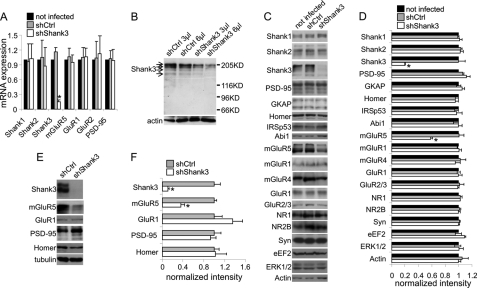
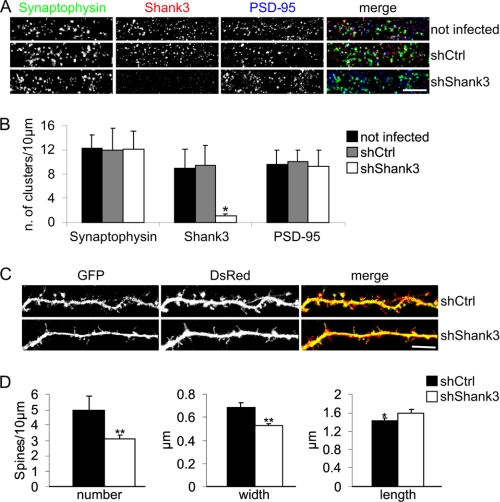
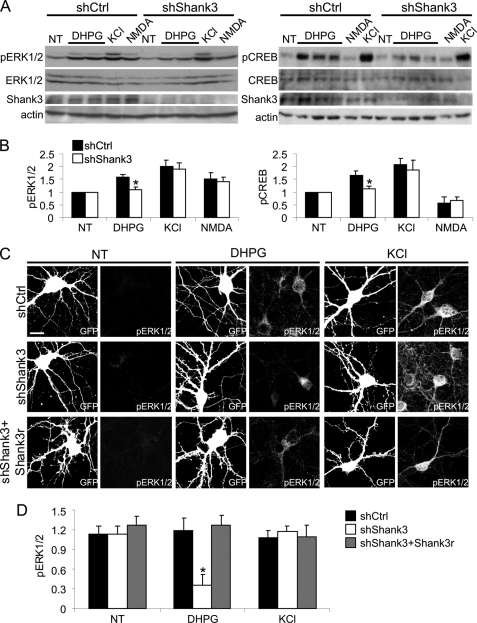
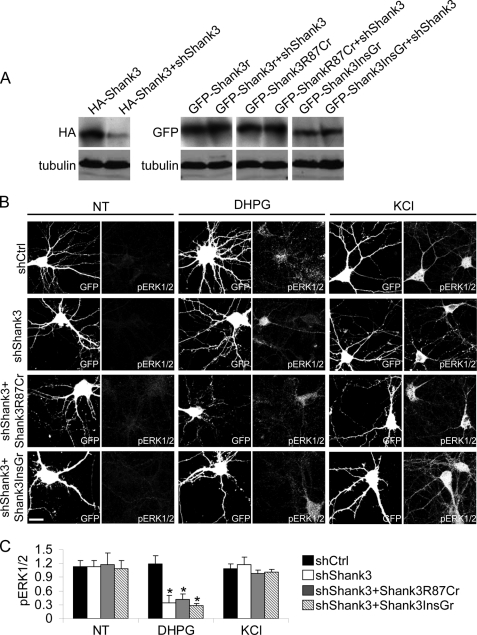
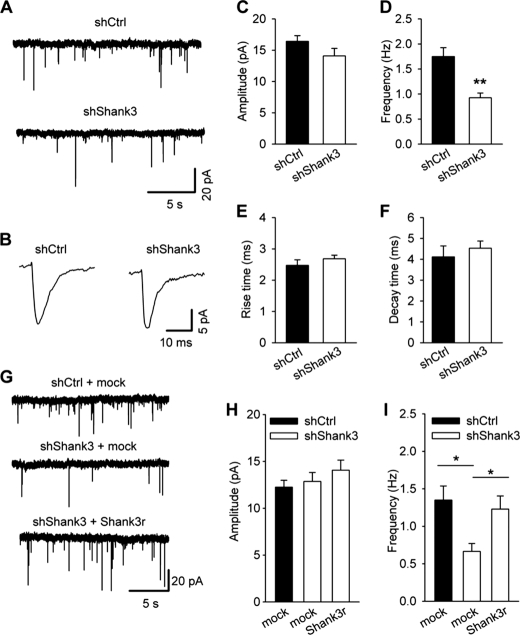
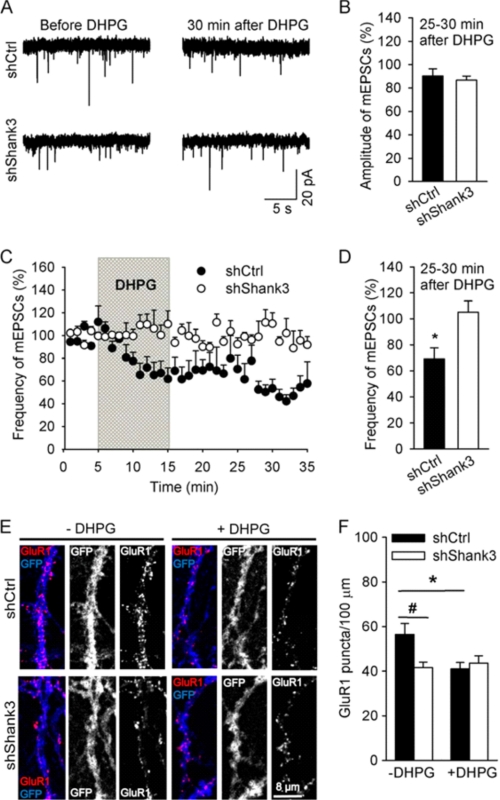
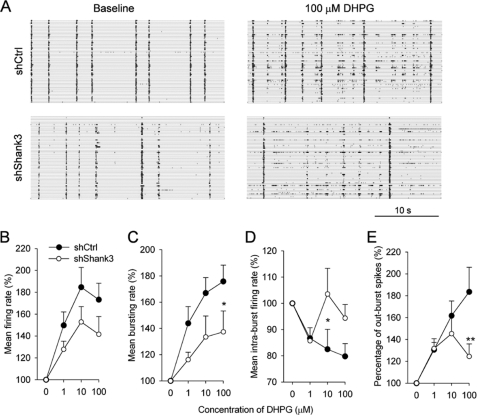
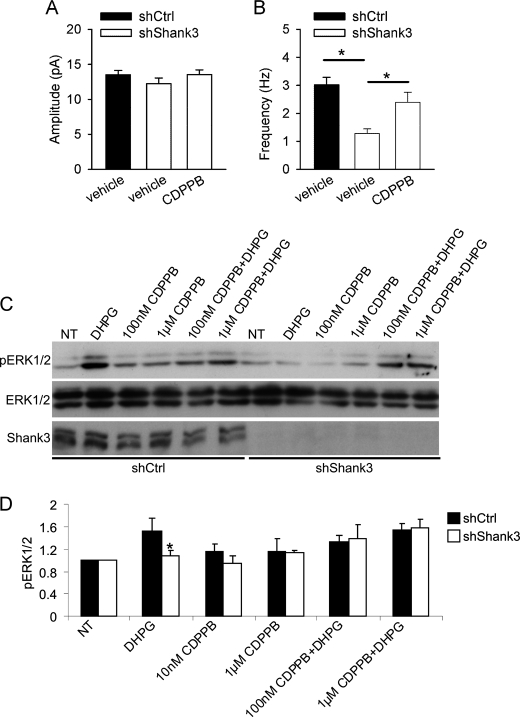
Shank3/PROSAP2 gene mutations are associated with cognitive impairment ranging from mental retardation to autism. Shank3 is a large scaffold postsynaptic density protein implicated in dendritic spines and synapse formation; however, its specific functions have not been clearly demonstrated. We have used RNAi to knockdown Shank3 expression in neuronal cultures and showed that this treatment specifically reduced the synaptic expression of the metabotropic glutamate receptor 5 (mGluR5), but did not affect the expression of other major synaptic proteins. The functional consequence of Shank3 RNAi knockdown was impaired signaling via mGluR5, as shown by reduction in ERK1/2 and CREB phosphorylation induced by stimulation with (S)-3,5-dihydroxyphenylglycine (DHPG) as the agonist of mGluR5 receptors, impaired mGluR5-dependent synaptic plasticity (DHPG-induced long-term depression), and impaired mGluR5-dependent modulation of neural network activity. We also found morphological abnormalities in the structure of synapses (spine number, width, and length) and impaired glutamatergic synaptic transmission, as shown by reduction in the frequency of miniature excitatory postsynaptic currents (mEPSC). Notably, pharmacological augmentation of mGluR5 activity using 3-cyano-N-(1,3-diphenyl-1H-pyrazol-5-yl)-benzamide as the positive allosteric modulator of these receptors restored mGluR5-dependent signaling (DHPG-induced phosphorylation of ERK1/2) and normalized the frequency of mEPSCs in Shank3-knocked down neurons. These data demonstrate that a deficit in mGluR5-mediated intracellular signaling in Shank3 knockdown neurons can be compensated by 3-cyano-N-(1,3-diphenyl-1H-pyrazol-5-yl)-benzamide; this raises the possibility that pharmacological augmentation of mGluR5 activity represents a possible new therapeutic approach for patients with Shank3 mutations.
Overview
The claims and statistics of this paper haven’t been checked yet.
Run the check — free, no account needed. It reads the open-access text and checks the sources it cites.
Integrity signals
Registry
Cites
Statistics
Figures
Verification
Claims the paper makes
The claims and statistics of this paper haven’t been checked yet.
Run the check — free, no account needed. It reads the open-access text and checks the sources it cites.
Claims other papers make about this one
Each is checked against this paper’s own text: does it say what the citing paper says it does?
In the citing paper
“In cultured rat neurons, knock-down of Shank3 selectively reduces synaptic mGluR5 receptor and impairs mGluR5-dependent signaling and plasticity (Verpelli et al., 2011).”
From Modeling Autism by SHANK Gene Mutations in Mice (2013) · cites this paper as Verpelli et al., 2011
In the citing paper
“Moreover, acute knockdown of Shank3 in cultured neurons decreases mGluR-dependent plasticity (Verpelli et al., 2011)”
From Modeling Autism by SHANK Gene Mutations in Mice (2013) · cites this paper as Verpelli et al., 2011
Self-check
Percentages, sums and reported differences re-computed from the paper’s own numbers.
The self-check needs the paper’s full text.
Citations
Cites
1 retracted
RETRACTED: Enhanced Polyubiquitination of Shank3 and NMDA Receptor in a Mouse Model of Autism
Bangash, M. A., Park, J. M., Melnikova, T., Wang, D., Jeon, S. K., Lee, D., Syeda, S. K., Kim, J., Kouser, M., Schwartz, J. L., et al. (2011) · Cell · doi:10.1016/j.cell.2011.03.052 · Cited by 116
RetractedConserved role of intragenic DNA methylation in regulating alternative promoters
Maunakea, A. K., Nagarajan, R. P., Bilenky, M., Ballinger, T. J., D’Souza, C., Fouse, S. D., Johnson, B. E., Hong, C., Nielsen, C., Zhao, Y., et al. (2010) · Nature · doi:10.1038/nature09165 · Cited by 1,743
Durand, C. M., Betancur, C., Boeckers, T. M., Bockmann, J., Chaste, P., Fauchereau, F., Nygren, G., Rastam, M., Gillberg, I. C., Anckarsäter, H., et al. (2007) · Nature Genetics · doi:10.1038/ng1933 · Cited by 1,602
Shank3 mutant mice display autistic-like behaviours and striatal dysfunction
Peça, J., Feliciano, C., Ting, J. T., Wang, W., Wells, M. F., Venkatraman, T. N., Lascola, C. D., Fu, Z., & Feng, G. (2011) · Nature · doi:10.1038/nature09965 · Cited by 1,570
Altered synaptic plasticity in a mouse model of fragile X mental retardation
Huber, K. M., Gallagher, S. M., Warren, S. T., & Bear, M. F. (2002) · Proceedings of the National Academy of Sciences · doi:10.1073/pnas.122205699 · Cited by 1,349
Coupling of mGluR/Homer and PSD-95 Complexes by the Shank Family of Postsynaptic Density Proteins
Tu, J. C., Xiao, B., Naisbitt, S. R., Yuan, J. P., Petralia, R. S., Brakeman, P., Doan, A., Aakalu, V. K., Lanahan, A. A., Sheng, M., et al. (1999) · Neuron · doi:10.1016/s0896-6273(00)80810-7 · Cited by 1,079
Fragile X Syndrome: Loss of Local mRNA Regulation Alters Synaptic Development and Function
Bassell, G. J., & Warren, S. T. (2008) · Neuron · doi:10.1016/j.neuron.2008.10.004 · Cited by 1,051
Naisbitt, S., Kim, E., Tu, J. C., Xiao, B., Sala, C., Valtschanoff, J., Weinberg, R. J., Worley, P. F., & Sheng, M. (1999) · Neuron · doi:10.1016/s0896-6273(00)80809-0 · Cited by 1,009
Self-citationLong-term depression in the CNS
Collingridge, G. L., Peineau, S., Howland, J. G., & Wang, Y. T. (2010) · Nature Reviews Neuroscience · doi:10.1038/nrn2867 · Cited by 926
Regulation of Dendritic Spine Morphology and Synaptic Function by Shank and Homer
Sala, C., Piëch, V., Wilson, N. R., Passafaro, M., Liu, G., & Sheng, M. (2001) · Neuron · doi:10.1016/s0896-6273(01)00339-7 · Cited by 716
Self-citation
Cited by
Sorted by citations
Autistic-like social behaviour in Shank2-mutant mice improved by restoring NMDA receptor function
Won, H., Lee, H.-R., Gee, H. Y., Mah, W., Kim, J.-I., Lee, J., Ha, S., Chung, C., Jung, E. S., Cho, Y. S., et al. (2012) · Nature · doi:10.1038/nature11208 · Cited by 695
Modeling Autism by SHANK Gene Mutations in Mice
Jiang, Y.-H., & Ehlers, M. D. (2013) · Neuron · doi:10.1016/j.neuron.2013.03.016 · Cited by 488
Dendritic Spines: The Locus of Structural and Functional Plasticity
Sala, C., & Segal, M. (2014) · Physiological Reviews · doi:10.1152/physrev.00012.2013 · Cited by 491
Self-citationYang, M., Bozdagi, O., Scattoni, M. L., Wöhr, M., Roullet, F. I., Katz, A. M., Abrams, D. N., Kalikhman, D., Simon, H., Woldeyohannes, L., et al. (2012) · The Journal of Neuroscience · doi:10.1523/jneurosci.6107-11.2012 · Cited by 369
Kouser, M., Speed, H. E., Dewey, C. M., Reimers, J. M., Widman, A. J., Gupta, N., Liu, S., Jaramillo, T. C., Bangash, M. A., Xiao, B., et al. (2013) · Journal of Neuroscience · doi:10.1523/jneurosci.3017-13.2013 · Cited by 297
Metadata
- Authors
- Verpelli, C., Dvoretskova, E., Vicidomini, C., Rossi, F., Chiappalone, M., Schoen, M., Di Stefano, B., Mantegazza, R., Broccoli, V., Böckers, T. M., Dityatev, A., & Sala, C.
- Affiliations
- University of Milan (IT)
- Italian Institute of Technology (IT)
- Universität Ulm (DE)
- Fondazione IRCCS Istituto Neurologico Carlo Besta (IT)
- IRCCS Ospedale San Raffaele (IT)
- Corresponding author
- Sala, Carlo
- ORCID
- Venue
- Journal of Biological Chemistry
- Publisher
- Elsevier BV
- Published
- 2011-10
- Volume
- 286
- Issue
- 40
- Pages
- 34839-34850
- ISSN
- 0021-9258 (ISSN-L)
- PMC
- PMC3186429
- OpenAlex
- W2073501423
- Cited by
- 197
- References
- 70
- Citations by year
- 2026: 4 · 2025: 9 · 2024: 5 · 2023: 15 · 2022: 15 · 2021: 12 · 2020: 13 · 2019: 12 · 2018: 13 · 2017: 9 · 2016: 20 · 2015: 14 · 2014: 15 · 2013: 23 · 2012: 14
- FWCI
- 7.28
- Type
- journal article
- Language
- en
- Open access
- hybrid
- doi.org
- Licence
- Locations
- Journal of Biological Chemistry (publishedVersion, cc-by)
- PubMed Central (publishedVersion, cc-by-nc)
- PubMed (publishedVersion)
- CINECA IRIS Institutial Research Information System (University of Genoa) (submittedVersion)
- Funders
- Fondazione Cariplo
- Istituto Italiano di Tecnologia
- Regione Lombardia
- Topics
- Life Sciences › Neuroscience › Cellular and Molecular Neuroscience › Neuroscience and Neuropharmacology Research
- Life Sciences › Biochemistry, Genetics and Molecular Biology › Genetics › Genetics and Neurodevelopmental Disorders
- Life Sciences › Neuroscience › Cognitive Neuroscience › Autism Spectrum Disorder Research
- Keywords
- SHANK3, metabotropic glutamate receptor 5, postsynaptic density, synaptogenesis, dendritic spines, synaptic plasticity, long-term depression, ERK1/2 phosphorylation, CREB phosphorylation, DHPG, miniature excitatory postsynaptic currents, glutamatergic neurotransmission, positive allosteric modulators, autism spectrum disorder, intellectual disability
- MeSH terms
- Animals, Hippocampus, Mice, Inbred C57BL, Models, Biological, Nerve Tissue Proteins, Neurons, Phosphorylation, Synapses, Signal Transduction, Receptors, N-Methyl-D-Aspartate, Receptors, AMPA, Receptors, Metabotropic Glutamate, Adaptor Proteins, Signal Transducing, Dendritic Spines, Mice, Rats, Receptor, Metabotropic Glutamate 5
About these checks
Registry, retraction, Cites and statistics results are computed, not judged, with one exception: a printed reference that no index lists is read once by a model before it counts as a citation error. Claims are extracted by a model and kept only when their quote appears verbatim in the text; each cited source is then checked, with a model’s help, for whether it says what the claim relies on. Those verdicts can be wrong — read the claim’s quote and the cited source before relying on one.
Statistics and arithmetic are recomputed, not judged.
Confidence bands are shown only for fields calibrated on our annotated test set. None is calibrated yet, so no band is shown.
What counts as a claim ›How we measure confidence ›How we check this ›
Are you an author, or do you see a problem with this page? Request a review
