

The DOI matches its Crossref record; 87 of the 87 references it cites were found in a registry or an index.
The 2-Oxoacid Dehydrogenase Complexes in Mitochondria Can Produce Superoxide/Hydrogen Peroxide at Much Higher Rates Than Complex I
Open accessAbstract
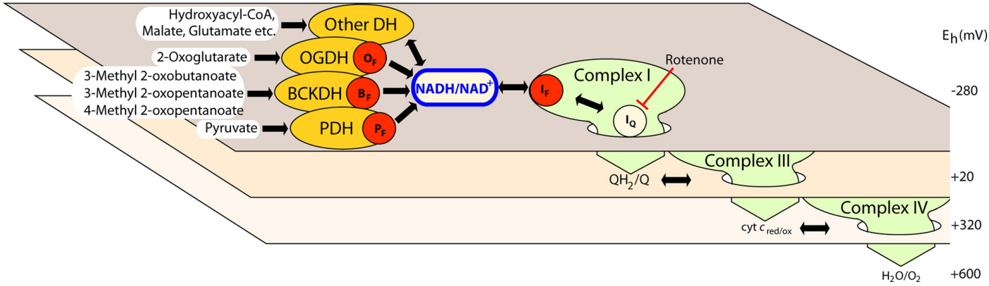
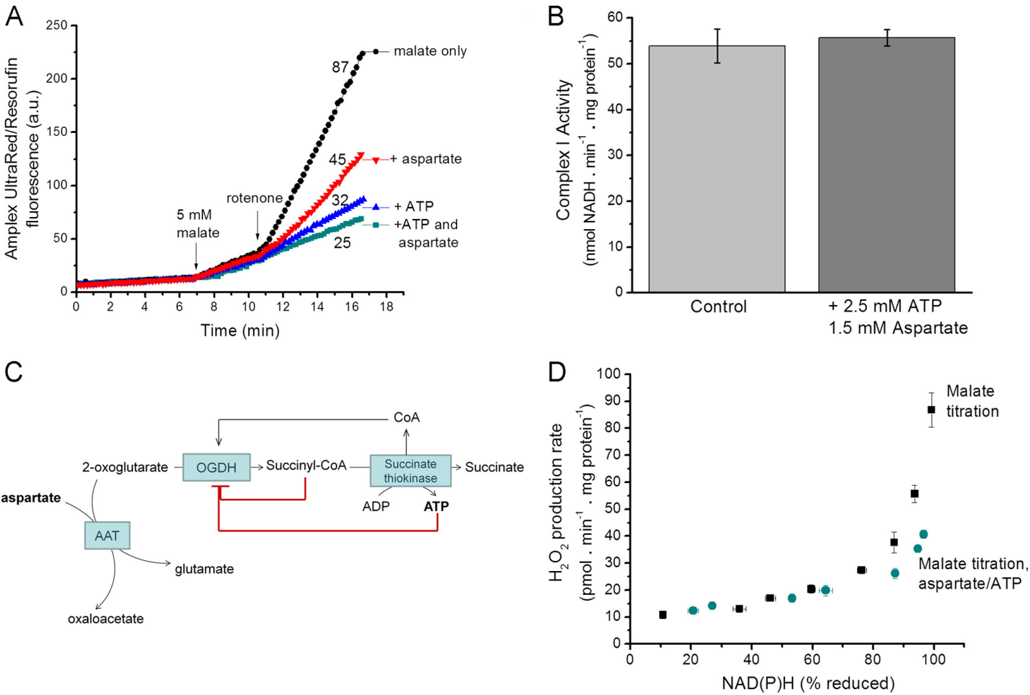
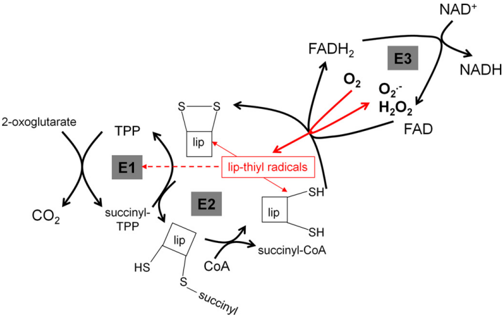
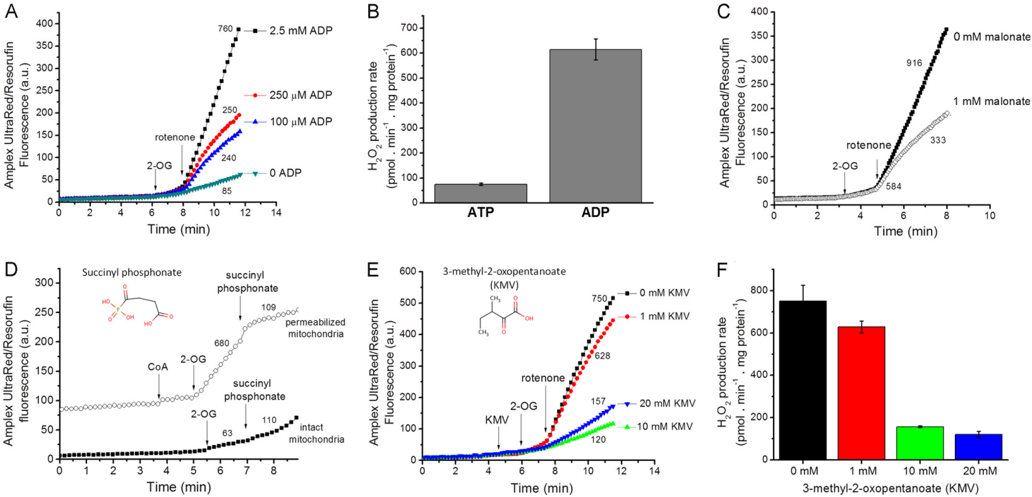
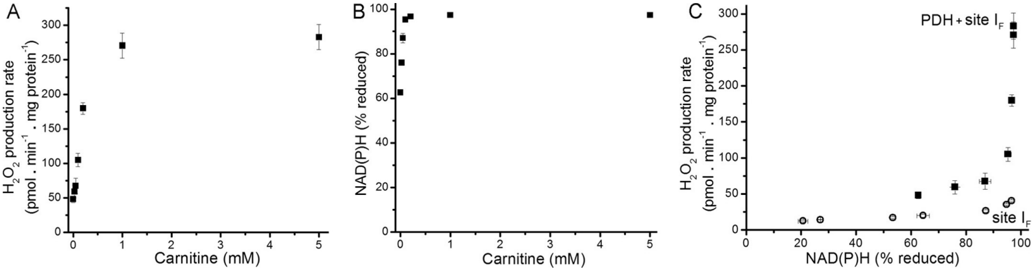
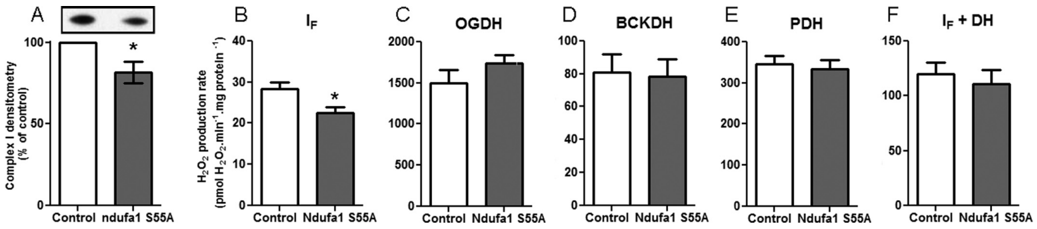
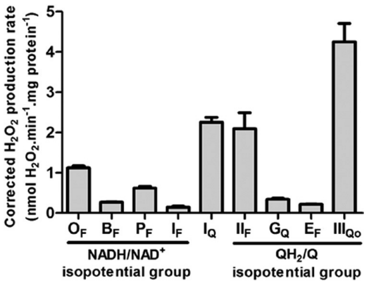
Several flavin-dependent enzymes of the mitochondrial matrix utilize NAD(+) or NADH at about the same operating redox potential as the NADH/NAD(+) pool and comprise the NADH/NAD(+) isopotential enzyme group. Complex I (specifically the flavin, site IF) is often regarded as the major source of matrix superoxide/H2O2 production at this redox potential. However, the 2-oxoglutarate dehydrogenase (OGDH), branched-chain 2-oxoacid dehydrogenase (BCKDH), and pyruvate dehydrogenase (PDH) complexes are also capable of considerable superoxide/H2O2 production. To differentiate the superoxide/H2O2-producing capacities of these different mitochondrial sites in situ, we compared the observed rates of H2O2 production over a range of different NAD(P)H reduction levels in isolated skeletal muscle mitochondria under conditions that favored superoxide/H2O2 production from complex I, the OGDH complex, the BCKDH complex, or the PDH complex. The rates from all four complexes increased at higher NAD(P)H/NAD(P)(+) ratios, although the 2-oxoacid dehydrogenase complexes produced superoxide/H2O2 at high rates only when oxidizing their specific 2-oxoacid substrates and not in the reverse reaction from NADH. At optimal conditions for each system, superoxide/H2O2 was produced by the OGDH complex at about twice the rate from the PDH complex, four times the rate from the BCKDH complex, and eight times the rate from site IF of complex I. Depending on the substrates present, the dominant sites of superoxide/H2O2 production at the level of NADH may be the OGDH and PDH complexes, but these activities may often be misattributed to complex I.
Overview
The claims and statistics of this paper haven’t been checked yet.
Run the check — free, no account needed. It reads the open-access text and checks the sources it cites.
Integrity signals
Registry
Cites
Statistics
Figures
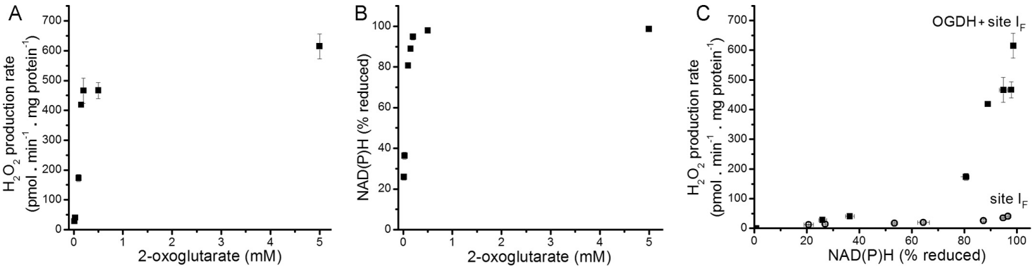
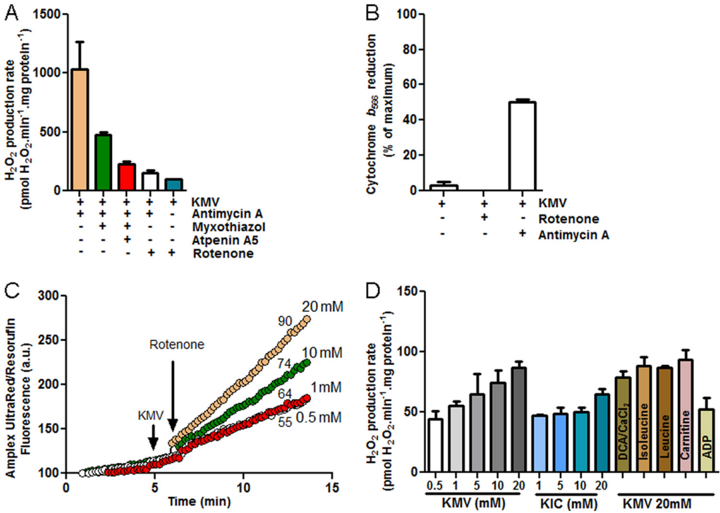
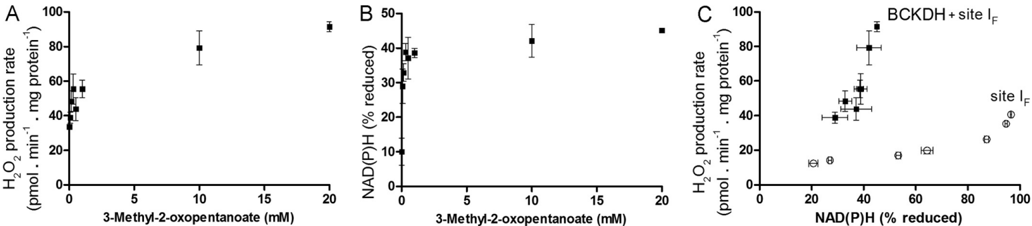
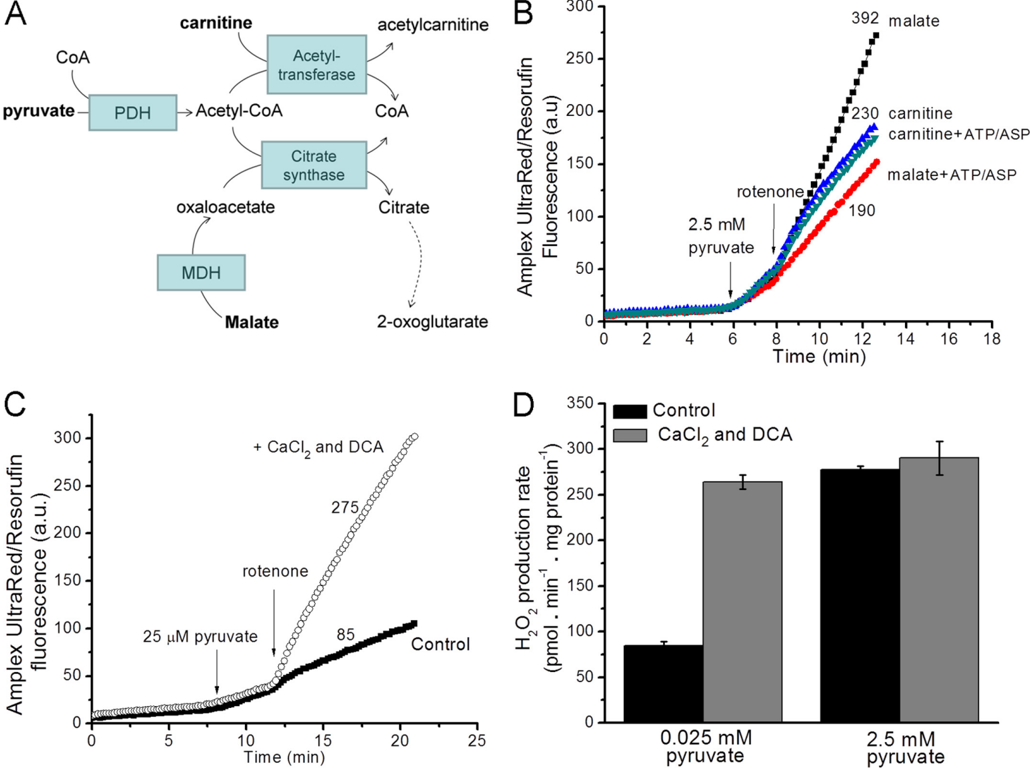
Verification
Claims the paper makes
The claims and statistics of this paper haven’t been checked yet.
Run the check — free, no account needed. It reads the open-access text and checks the sources it cites.
Claims other papers make about this one
Each is checked against this paper’s own text: does it say what the citing paper says it does?
In the citing paper
“SIRT3 also deacetylates key enzymes that produce ROS such as unique subunits of the electron transport chain ((Rahman et al. 2014)) and 2-oxoacid dehydrogenases ((Quinlan et al. 2014)).”
From The Mitochondrial Acylome Emerges: Proteomics, Regulation by Sirtuins, and Metabolic and Disease Implications (2018) · cites this paper as Quinlan et al. 2014
Self-check
Percentages, sums and reported differences re-computed from the paper’s own numbers.
The self-check needs the paper’s full text.
Citations
Cites
How mitochondria produce reactive oxygen species
Murphy, M. P. (2009) · Biochemical Journal · doi:10.1042/bj20081386 · Cited by 8,207
Topology of superoxide production from different sites in the mitochondrial electron transport chain
St-Pierre, J., Buckingham, J. A., Roebuck, S. J., & Brand, M. D. (2002) · Journal of Biological Chemistry · doi:10.1074/jbc.m207217200 · Cited by 1,545
Self-citationMitochondrial metabolism of reactive oxygen species
Andreyev, A. Y., Kushnareva, Y. E., & Starkov, A. A. (2005) · Biochemistry (Moscow) · doi:10.1007/s10541-005-0102-7 · Cited by 1,336
The sites and topology of mitochondrial superoxide production
Brand, M. D. (2010) · Experimental Gerontology · doi:10.1016/j.exger.2010.01.003 · Cited by 1,217
Self-citationActivation of molecular oxygen by flavins and flavoproteins.
Massey, V. (1994) · Journal of Biological Chemistry · doi:10.1016/s0021-9258(17)31664-2 · Cited by 823
Kußmaul, L., & Hirst, J. (2006) · Proceedings of the National Academy of Sciences · doi:10.1073/pnas.0510977103 · Cited by 745
Mitochondrial α-Ketoglutarate Dehydrogenase Complex Generates Reactive Oxygen Species
Starkov, A. A., Fiskum, G. M., Chinopoulos, C., Lorenzo, B. J., Browne, S. E., Patel, M. S., & Beal, M. F. (2004) · Journal of Neuroscience · doi:10.1523/jneurosci.1899-04.2004 · Cited by 711
Kushnareva, Y., Murphy, A. N., & Andreyev, A. Y. (2002) · Biochemical Journal · doi:10.1042/bj20021121 · Cited by 696
Linn, T. C., Pettit, F. H., & Reed, L. J. (1969) · Proceedings of the National Academy of Sciences · doi:10.1073/pnas.62.1.234 · Cited by 671
Quinlan, C. L., Orr, A. L., Perevoshchikova, I. V., Treberg, J. R., Ackrell, B. A., & Brand, M. D. (2012) · Journal of Biological Chemistry · doi:10.1074/jbc.m112.374629 · Cited by 670
Self-citation
Cited by
Sorted by citations
Items 301–310 of 310
Cysteine thiol modifications—Oxidative (eu)stress perspective
Kopacz, A., Józkowicz, A., & Grochot‐Przeczek, A. (2023) · Elsevier eBooks · doi:10.1016/b978-0-443-19247-0.00005-9
Fatty Acid Oxidation Drives Hydrogen Peroxide Production by Α-Ketoglutarate DehydrogenasePreprint
Grayson, C., Faerman, B., Koufos, O., & Mailloux, R. J. (2023) · bioRxiv (Cold Spring Harbor Laboratory) · doi:10.1101/2023.11.23.568449
Hypoxia Decreases Mitochondrial ROS Production in CellsPreprint
Sen, B., Benoit, B., & Brand, M. D. (2024) · SSRN Electronic Journal · doi:10.2139/ssrn.4876726
Self-citationRole of mitochondrial respiration in Listeria monocytogenes infection
Spier, A. (2021) · theses.fr (ABES) · doi:10.70675/cd44057azc986z44a5zbfd6zc91fa993e0bf
Sayehmiri, F., Parvenous, M., Vakili, K. G., Ebrahimi, R., Batool, Z., Bazgir, N., Kazemi, K., Moafi, M., Ebrahimi, M. J., & Hajiesmaeili, M. (2026) · Metabolic Brain Disease · doi:10.1007/s11011-026-01809-9
Kokas, M., Ambrus, A., Tretter, L., & Komlódi, T. (2026) · Biochemistry (Moscow) · doi:10.1134/s0006297926600663
Distinct sources and effects of mitochondrial reactive oxygen species
Barnett, D., Booraem, C., Orr, A. G., & Orr, A. L. (2026) · Molecular Cell · doi:10.1016/j.molcel.2026.07.009
Metals exposure dissociates mitochondrial NAD(P)H redox state from H₂O₂ emission
Tetteh, P. A., Kalvani, Z., Stevens, D., Sappal, R., & Kamunde, C. (2026) · Comparative Biochemistry and Physiology Part C Toxicology & Pharmacology · doi:10.1016/j.cbpc.2026.110639
Experimental workflows for the accurate identification of mitochondrial redox events
Hernansanz‐Agustín, P., Bolaños, J. P., Borrás, C., Cabiscol, E., Campuzano, V., de Cubas, L., Enrı́quez, J. A., Fabregat, I., Gonfaus-Ortiz, G., Hidalgo, E., et al. (2026) · Redox Biology · doi:10.1016/j.redox.2026.104387
Metadata
- Authors
- Quinlan, C. L., Goncalves, R. L. S., Hey-Mogensen, M., Yadava, N., Bunik, V. I., & Brand, M. D.
- Affiliations
- Buck Institute for Research on Aging (US)
- Lomonosov Moscow State University (RU)
- Corresponding author
- Brand, Martin D.
- Venue
- Journal of Biological Chemistry
- Publisher
- Elsevier BV
- Published
- 2014-03
- Volume
- 289
- Issue
- 12
- Pages
- 8312-8325
- ISSN
- 0021-9258 (ISSN-L)
- PMC
- PMC3961658
- OpenAlex
- W1986366581
- Cited by
- 310
- References
- 87
- Citations by year
- 2026: 11 · 2025: 18 · 2024: 14 · 2023: 26 · 2022: 21 · 2021: 41 · 2020: 18 · 2019: 27 · 2018: 21 · 2017: 31 · 2016: 30 · 2015: 33 · 2014: 19
- FWCI
- 15.45
- Type
- journal article
- Language
- en
- Open access
- hybrid
- doi.org
- Licence
- Locations
- Journal of Biological Chemistry (publishedVersion, cc-by)
- PubMed Central (publishedVersion)
- PubMed (publishedVersion)
- Funders
- National Institutes of Health (TL1 AG032116)
- Topics
- Life Sciences › Biochemistry, Genetics and Molecular Biology › Molecular Biology › Mitochondrial Function and Pathology
- Life Sciences › Biochemistry, Genetics and Molecular Biology › Biochemistry › Biochemical Acid Research Studies
- Life Sciences › Biochemistry, Genetics and Molecular Biology › Molecular Biology › Redox biology and oxidative stress
- Keywords
- superoxide production, hydrogen peroxide production, 2-oxoglutarate dehydrogenase, pyruvate dehydrogenase complex, complex I, mitochondrial matrix, flavoenzyme, skeletal muscle mitochondria, reactive oxygen species
- MeSH terms
- Animals, Female, Hydrogen Peroxide, Ketoglutarate Dehydrogenase Complex, Mitochondria, Muscle, NAD, Oxidation-Reduction, Pyruvate Dehydrogenase Complex, Superoxides, Rats, Wistar, Muscle, Skeletal, Rats
About these checks
Registry, retraction, Cites and statistics results are computed, not judged, with one exception: a printed reference that no index lists is read once by a model before it counts as a citation error. Claims are extracted by a model and kept only when their quote appears verbatim in the text; each cited source is then checked, with a model’s help, for whether it says what the claim relies on. Those verdicts can be wrong — read the claim’s quote and the cited source before relying on one.
Statistics and arithmetic are recomputed, not judged.
Confidence bands are shown only for fields calibrated on our annotated test set. None is calibrated yet, so no band is shown.
What counts as a claim ›How we measure confidence ›How we check this ›
Are you an author, or do you see a problem with this page? Request a review
