

The DOI matches its Crossref record; 46 of the 46 references it cites were found in a registry or an index.
S-Nitrosohemoglobin Is Unstable in the Reductive Erythrocyte Environment and Lacks O2/NO-linked Allosteric Function
Open accessAbstract
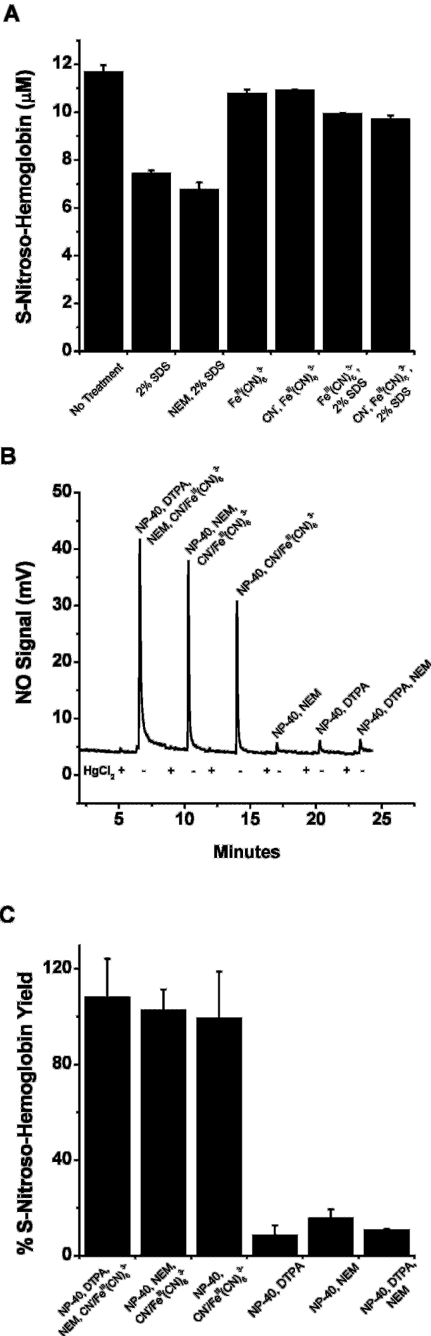
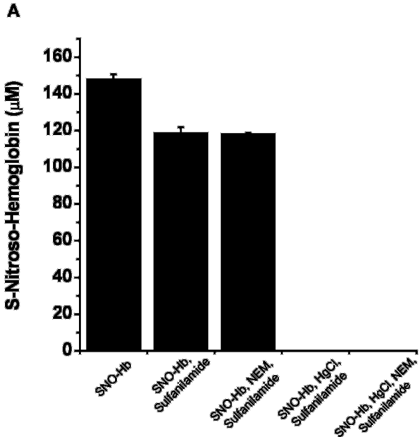
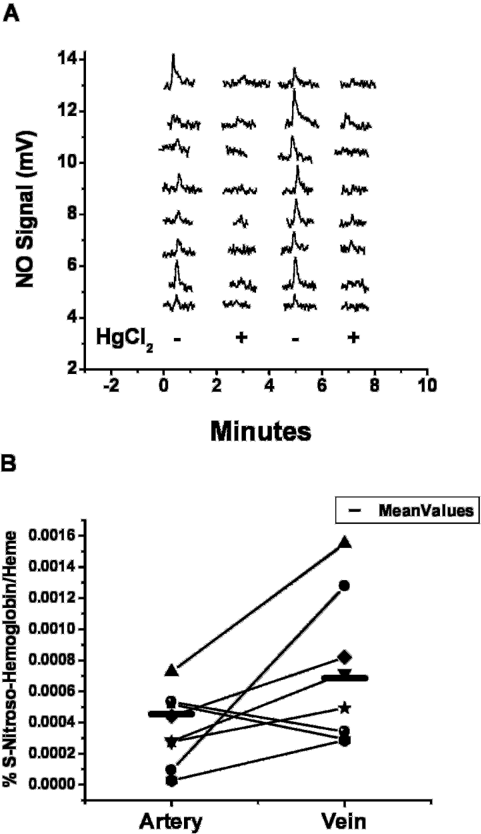
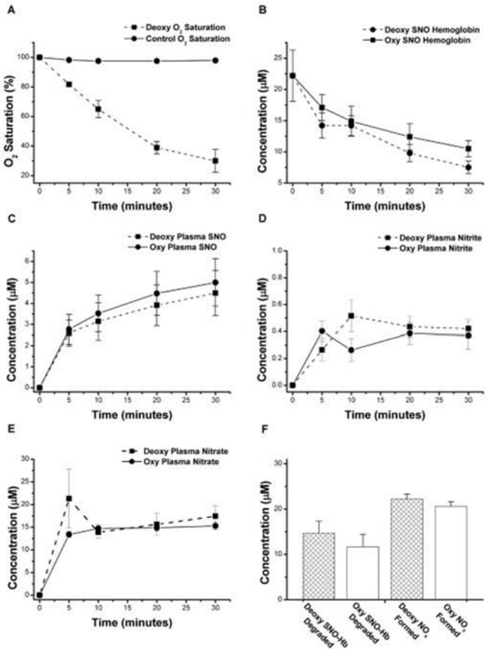
Our previous results run counter to the hypothesis that S-nitrosohemoglobin (SNO-Hb) serves as an in vivo reservoir for NO from which NO release is allosterically linked to oxygen release. We show here that SNO-Hb undergoes reductive decomposition in erythrocytes, whereas it is stable in purified solutions and in erythrocyte lysates treated with an oxidant such as ferricyanide. Using an extensively validated methodology that eliminates background nitrite and stabilizes erythrocyte S-nitrosothiols, we find the levels of SNO-Hb in the basal human circulation, including red cell membrane fractions, were 46 +/- 17 nm in human arterial erythrocytes and 69 +/- 11 nm in venous erythrocytes, incompatible with the postulated reservoir function of SNO-Hb. Moreover, we performed experiments on human red blood cells in which we elevated the levels of SNO-Hb to 10,000 times the normal in vivo levels. The elevated levels of intra-erythrocytic SNO-Hb fell rapidly, independent of oxygen tension and hemoglobin saturation. Most of the NO released during this process was oxidized to nitrate. A fraction (25%) was exported as S-nitrosothiol, but this fraction was not increased at low oxygen tensions that favor the deoxy (T-state) conformation of Hb. Results of these studies show that, within the redox-active erythrocyte environment, the beta-globin cysteine 93 is maintained in a reduced state, necessary for normal oxygen affinity, and incapable of oxygen-linked NO storage and delivery.
Overview
The claims and statistics of this paper haven’t been checked yet.
Run the check — free, no account needed. It reads the open-access text and checks the sources it cites.
Integrity signals
Registry
Cites
Statistics
Figures
Verification
Claims the paper makes
The claims and statistics of this paper haven’t been checked yet.
Run the check — free, no account needed. It reads the open-access text and checks the sources it cites.
Claims other papers make about this one
Each is checked against this paper’s own text: does it say what the citing paper says it does?
In the citing paper
“However studies conducted in this area over the last few years have unraveled mechanisms by which NO bioactivity in blood and in tissue have been preserved in the form of nitrite, nitrate, S-nitrosothiols (RSNO), N-nitrosamines (RNNO), nitrosylhemoglobin (NOHb), and S-nitrosohemoglobin (SNOHb) [16–21].”
From Inorganic nitrite therapy: historical perspective and future directions (2011) · cites this paper as [18]
Self-check
Percentages, sums and reported differences re-computed from the paper’s own numbers.
The self-check needs the paper’s full text.
Citations
Cites
Furchgott, R. F., & Zawadzki, J. V. (1980) · Nature · doi:10.1038/288373a0 · Cited by 12,064
Nitric oxide release accounts for the biological activity of endothelium-derived relaxing factor
Palmer, R. M. J., Ferrige, A. G., & Moncada, S. (1987) · Nature · doi:10.1038/327524a0 · Cited by 10,704
Endothelium-derived relaxing factor produced and released from artery and vein is nitric oxide.
Ignarro, L. J., Buga, G. M., Wood, K. S., Byrns, R. E., & Chaudhuri, G. (1987) · Proceedings of the National Academy of Sciences · doi:10.1073/pnas.84.24.9265 · Cited by 5,074
Oxidized Redox State of Glutathione in the Endoplasmic Reticulum
Hwang, C., Sinskey, A. J., & Lodish, H. F. (1992) · Science · doi:10.1126/science.1523409 · Cited by 1,968
S-nitrosohaemoglobin: a dynamic activity of blood involved in vascular control
Jia, L., Bonaventura, C., Bonaventura, J., & Stamler, J. S. (1996) · Nature · doi:10.1038/380221a0 · Cited by 1,592
Self-citationNitric oxide circulates in mammalian plasma primarily as an S-nitroso adduct of serum albumin.
Stamler, J. S., Jaraki, O., Osborne, J., Simon, D. I., Keaney, J., Vita, J., Singel, D., Valeri, C. R., & Loscalzo, J. (1992) · Proceedings of the National Academy of Sciences · doi:10.1073/pnas.89.16.7674 · Cited by 1,238
Activation of the OxyR Transcription Factor by Reversible Disulfide Bond Formation
Zheng, M., Åslund, F., & Storz, G. (1998) · Science · doi:10.1126/science.279.5357.1718 · Cited by 1,197
Blood Flow Regulation by S -Nitrosohemoglobin in the Physiological Oxygen Gradient
Stamler, J. S., Jia, L., Eu, J. P., McMahon, T. J., Demchenko, I. T., Bonaventura, J., Gernert, K., & Piantadosi, C. A. (1997) · Science · doi:10.1126/science.276.5321.2034 · Cited by 1,050
Endogenous nitrogen oxides and bronchodilator S-nitrosothiols in human airways.
Gaston, B. M., Reilly, J., Drazen, J. M., Fackler, J. C., Ramdev, P., Arnelle, D. R., Mullins, M. E., Sugarbaker, D. J., Chee, C., Singel, D. J., et al. (1993) · Proceedings of the National Academy of Sciences · doi:10.1073/pnas.90.23.10957 · Cited by 620
Export by red blood cells of nitric oxide bioactivity
Pawloski, J. R., Hess, D. T., & Stamler, J. S. (2001) · Nature · doi:10.1038/35054560 · Cited by 579
Research works printed but not linked: 1
- Garel, 1984, Mol. Pharmacol., 26, 559
Cited by
Sorted by citations
Nitrite reduction to nitric oxide by deoxyhemoglobin vasodilates the human circulation
Cosby, K., Partovi, K. S., Crawford, J. H., Patel, R. P., Reiter, C. D., Martyr, S., Yang, B. K., Waclawiw, M. A., Zalos, G., Xu, X., et al. (2003) · Nature Medicine · doi:10.1038/nm954 · Cited by 1,807
Self-citationCell-free hemoglobin limits nitric oxide bioavailability in sickle-cell disease
Reiter, C. D., Wang, X., Tanus-Santos, J. E., Hogg, N., Cannon, R. O., Schechter, A. N., & Gladwin, M. T. (2002) · Nature Medicine · doi:10.1038/nm1202-799 · Cited by 1,330
Self-citationMethods to detect nitric oxide and its metabolites in biological samples
Bryan, N. S., & Grisham, M. B. (2007) · Free Radical Biology and Medicine · doi:10.1016/j.freeradbiomed.2007.04.026 · Cited by 1,005
Cytoprotective effects of nitrite during in vivo ischemia-reperfusion of the heart and liver
Duranski, M. R., Greer, J. J. M., Dejam, A., Jaganmohan, S., Hogg, N., Langston, W., Patel, R. P., Yet, S.-F., Wang, X., Kevil, C. G., et al. (2005) · Journal of Clinical Investigation · doi:10.1172/jci22493 · Cited by 674
Self-citationInorganic nitrate is a possible source for systemic generation of nitric oxide
Lundberg, J. O., & Govoni, M. (2004) · Free Radical Biology and Medicine · doi:10.1016/j.freeradbiomed.2004.04.027 · Cited by 657
Metadata
- Authors
- Gladwin, M. T., Wang, X., Reiter, C. D., Yang, B. K., Vivas, E. X., Bonaventura, C., & Schechter, A. N.
- Affiliations
- National Institutes of Health (US)
- Duke University (US)
- Corresponding author
- Gladwin, Mark T.
- Venue
- Journal of Biological Chemistry
- Publisher
- Elsevier BV
- Published
- 2002-08
- Volume
- 277
- Issue
- 31
- Pages
- 27818-27828
- ISSN
- 0021-9258 (ISSN-L)
- OpenAlex
- W2061156310
- Cited by
- 160
- References
- 45
- Citations by year
- 2026: 1 · 2024: 2 · 2023: 3 · 2022: 3 · 2021: 1 · 2020: 1 · 2019: 1 · 2018: 4 · 2017: 4 · 2016: 3 · 2015: 1 · 2014: 3 · 2013: 4 · 2012: 5
- FWCI
- 7.92
- Type
- journal article
- Language
- en
- Open access
- hybrid
- doi.org
- Licence
- Locations
- Journal of Biological Chemistry (publishedVersion, cc-by)
- PubMed (publishedVersion)
- Topics
- Life Sciences › Biochemistry, Genetics and Molecular Biology › Biochemistry › Hemoglobin structure and function
- Health Sciences › Medicine › Physiology (medical) › Nitric Oxide and Endothelin Effects
- Life Sciences › Biochemistry, Genetics and Molecular Biology › Molecular Biology › Heme Oxygenase-1 and Carbon Monoxide
- Keywords
- S-nitrosohemoglobin, nitric oxide storage, erythrocytes, S-nitrosothiols, reductive decomposition, oxygen affinity, allosteric regulation, nitrate formation, redox conditions, nitric oxide delivery
- MeSH terms
- Allosteric Regulation, Animals, Cattle, Drug Stability, Erythrocytes, Hemoglobins, Humans, Kinetics, Nitric Oxide, Nitrites, Oxygen, Serum Albumin, Serum Albumin, Bovine
About these checks
Registry, retraction, Cites and statistics results are computed, not judged, with one exception: a printed reference that no index lists is read once by a model before it counts as a citation error. Claims are extracted by a model and kept only when their quote appears verbatim in the text; each cited source is then checked, with a model’s help, for whether it says what the claim relies on. Those verdicts can be wrong — read the claim’s quote and the cited source before relying on one.
Statistics and arithmetic are recomputed, not judged.
Confidence bands are shown only for fields calibrated on our annotated test set. None is calibrated yet, so no band is shown.
What counts as a claim ›How we measure confidence ›How we check this ›
Are you an author, or do you see a problem with this page? Request a review
