

Modulating Acetyl-CoA Binding in the GCN5 Family of Histone Acetyltransferases
Open accessThe DOI matches its Crossref record; 43 of the 43 references it cites were found in a registry or an index.
Abstract
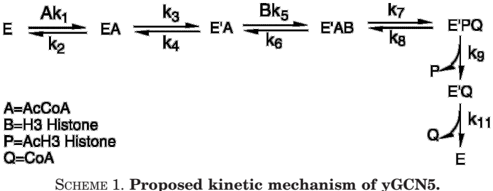
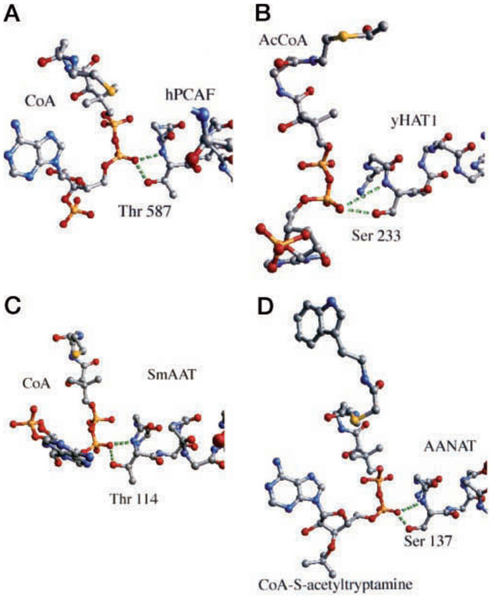
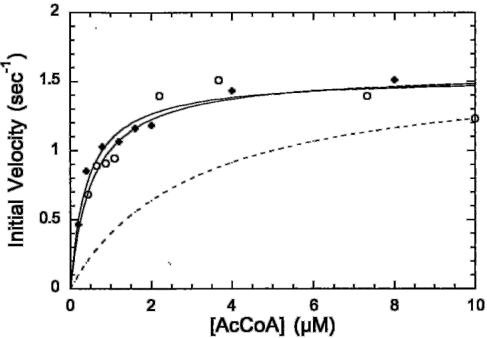
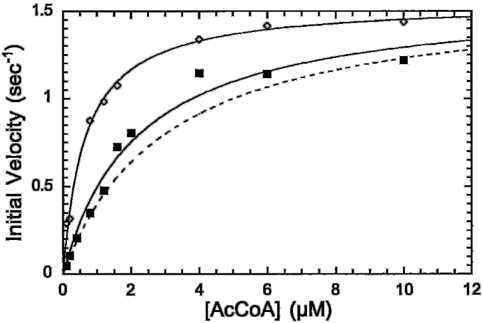
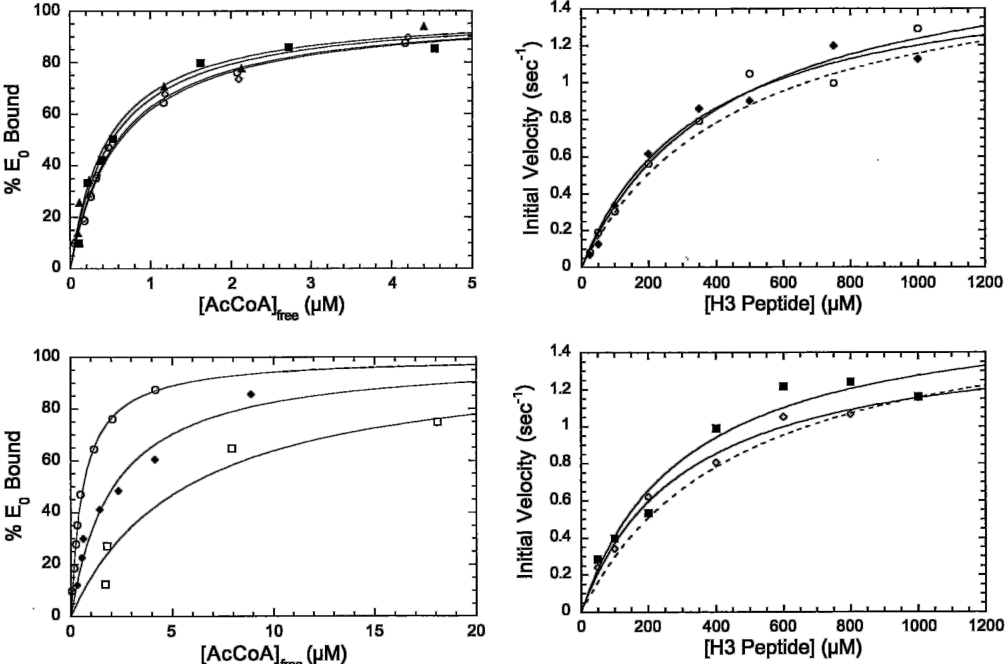
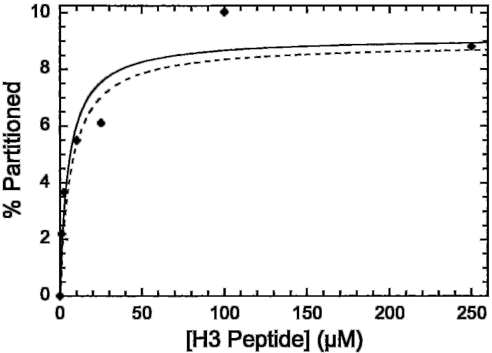
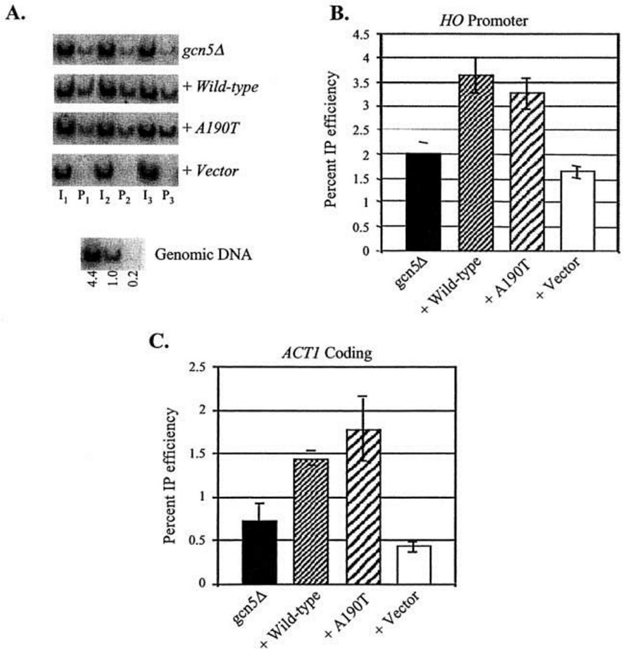
The histone acetyltransferase (HAT) GCN5 is the founding member for a family of chromatin remodeling enzymes. GCN5 is the catalytic subunit of a large multi-subunit complex that functions in the regulation of gene activation via acetylation of lysine residues within the N-terminal tails of core histone proteins. Using acetyl-CoA as a co-substrate, the high affinity binding of acetyl-CoA is a critical first step in the reaction. Here, we examine the biochemical and biological importance of a conserved hydroxyl-bearing residue in signature motif A. Interestingly, one major exception is the Saccharomyces cerevisiae GCN5, where an alanine (Ala(190)) is located in the corresponding position. In related GCN5 family structures, a hydroxyl-containing side chain residue is hydrogen-bonded to the alpha-phosphate oxygen of CoA. We demonstrate that this key hydrogen bond contributes approximately 10-fold to the binding affinity of GCN5 HATs for acetyl-CoA. Human p300/CBP-associating factor, human GCN5, and tetrahymena GCN5 displayed dissociation constants (K(d)) for acetyl-CoA of 0.64 +/- 0.12, 0.56 +/- 0.15, and 0.62 +/- 0.17 microm, respectively. In contrast, S. cerevisiae GCN5 displayed a K(d) of 8.5 microm. When Ala(190) was replaced with threonine, the A190T derivative yielded a K(d) value of 0.56 +/- 0.1 microm for acetyl-CoA, completely restoring the higher affinity binding seen with the GCN5 homologs that naturally harbor a threonine at this position. Detailed kinetic analyses revealed that the A190T derivative was otherwise catalytically indistinguishable from wild type GCN5. We also demonstrate that the A190T allele rescued the slow growth phenotype and the defect in HO transcription caused by a deletion of GCN5. Furthermore, the A190T allele supported wild type levels of transcriptionally targeted and global histone H3 acetylation. In each case, the A190T derivative behaved similarly to wild type GCN5, suggesting that the efficacy of HAT activity by GCN5 is not limited by the availability of nuclear acetyl-CoA pools.
Overview
The claims and statistics of this paper haven’t been checked yet.
Free: it reads the open-access text and checks the first 5 claims that cite a source we can check. Create a free account to check every claim.
Integrity signals
Registry
Cites
Statistics
Figures
Verification
Claims the paper makes
The claims and statistics of this paper haven’t been checked yet.
Free: it reads the open-access text and checks the first 5 claims that cite a source we can check. Create a free account to check every claim.
Claims other papers make about this one
Each is checked against this paper’s own text: does it say what the citing paper says it does?
The source backs part of the claim, not all of it — or backs it for a different population, condition or comparison.
In the citing paper
“the off-rate of acetyl-CoA binding to the yeast GCN5 enzyme is more than an order of magnitude more rapid than that of human p300/CBP HAT enzyme, human GCN5, or Tetrahymena GCN5”
From Influence of Metabolism on Epigenetics and Disease (2013) · cites this paper as Langer et al., 2002
Experimental — accuracy not yet measured
Self-check
Percentages, sums and reported differences re-computed from the paper’s own numbers.
The self-check needs the paper’s full text.
Citations
Cites
Bradford, M. M. (1976) · Analytical Biochemistry · doi:10.1016/0003-2697(76)90527-3 · Cited by 255,302
The Transcriptional Coactivators p300 and CBP Are Histone Acetyltransferases
Ogryzko, V. V., Schiltz, R. L., Russanova, V., Howard, B. H., & Nakatani, Y. (1996) · Cell · doi:10.1016/s0092-8674(00)82001-2 · Cited by 2,952
Histone acetylation in chromatin structure and transcription
Grunstein, M. (1997) · Nature · doi:10.1038/38664 · Cited by 2,884
Roth, S. Y., Denu, J. M., & Allis, C. D. (2001) · Annual Review of Biochemistry · doi:10.1146/annurev.biochem.70.1.81 · Cited by 1,845
Self-citationThe CBP co-activator is a histone acetyltransferase
Bannister, A. J., & Kouzarides, T. (1996) · Nature · doi:10.1038/384641a0 · Cited by 1,805
A p300/CBP-associated factor that competes with the adenoviral oncoprotein E1A
Yang, X.-J., Ogryzko, V. V., Nishikawa, J.-I., Howard, B. H., & Nakatani, Y. (1996) · Nature · doi:10.1038/382319a0 · Cited by 1,479
Grant, P. A., Duggan, L., Côté, J., Roberts, S. M., Brownell, J. E., Candau, R., Ohba, R., Owen-Hughes, T., Allis, C. D., Winston, F., et al. (1997) · Genes & Development · doi:10.1101/gad.11.13.1640 · Cited by 1,085
Histone acetylases and deacetylases in cell proliferation
Kouzarides, T. (1999) · Current Opinion in Genetics & Development · doi:10.1016/s0959-437x(99)80006-9 · Cited by 601
Brownell, J. E., & Allis, C. D. (1996) · Current Opinion in Genetics & Development · doi:10.1016/s0959-437x(96)80048-7 · Cited by 534
Histone acetylation: chromatin in action
Wade, P. A., Pruss, D., & Wolffe, A. P. (1997) · Trends in Biochemical Sciences · doi:10.1016/s0968-0004(97)01016-5 · Cited by 471
Cited by
Acetyl coenzyme A: a central metabolite and second messenger
Pietrocola, F., Galluzzi, L., Bravo-San Pedro, J. M., Madeo, F., & Kroemer, G. (2015) · Cell Metabolism · doi:10.1016/j.cmet.2015.05.014 · Cited by 1,378
“5 mM (Langer et al., 2002), both of which fall in the concentration range of acetyl-CoA found in human or yeast cells (Cai et al.”
BackgroundInfluentialModulation of cellular processes by histone and non-histone protein acetylation
Shvedunova, M., & Akhtar, A. (2022) · Nature Reviews Molecular Cell Biology · doi:10.1038/s41580-021-00441-y · Cited by 936
Influence of Metabolism on Epigenetics and Disease
Kaelin, W. G., & McKnight, S. L. (2013) · Cell · doi:10.1016/j.cell.2013.03.004 · Cited by 920
“In this regard it may be notable that the off-rate of acetyl-CoA binding to the yeast GCN5 enzyme is more than an order of magnitude more rapid than that of human p300/CBP HAT enzyme, human GCN5, or Tetrahymena GCN5 (Langer et al., 2002).”
Cai, L., Sutter, B. M., Li, B., & Tu, B. P. (2011) · Molecular Cell · doi:10.1016/j.molcel.2011.05.004 · Cited by 701
“Moreover, we observed that the A190T mutant, which increases its affinity for acetyl-CoA by 10-fold from 8.5 to 0.56 mM (Langer et al., 2002), exhibits a temperature-sensitive growth defect on acetate as the carbon source, suggesting that Gcn5p might be finely tuned to sense and respond to a higher…”
InfluentialAkt-dependent metabolic reprogramming regulates tumor cell histone acetylation
Lee, J. V., Carrer, A., Shah, S., Snyder, N. W., Wei, S., Venneti, S., Worth, A. J., Yuan, Z.-F., Lim, H.-W., Liu, S., et al. (2014) · Cell Metabolism · doi:10.1016/j.cmet.2014.06.004 · Cited by 563
“However, human GCN5 binds acetyl-CoA much more tightly (Kd of 0.56 μM) (Langer et al., 2002).”
BackgroundInfluentialSpatiotemporal Control of Acetyl-CoA Metabolism in Chromatin Regulation
Sivanand, S., Viney, I., & Wellen, K. E. (2018) · Trends in Biochemical Sciences · doi:10.1016/j.tibs.2017.11.004 · Cited by 357
“Many KATs have a Kd for acetyl-CoA in the low μM or high nM range [68,69].”
BackgroundMetabolic Regulation of Histone Post-Translational Modifications
Fan, J., Krautkramer, K. A., Feldman, J. L., & Denu, J. M. (2015) · ACS Chemical Biology · doi:10.1021/cb500846u · Cited by 330
“Acetyltransferase P/CAF can undergo autoacetylation and is also acetylated by p300.”
BackgroundInfluentialSelf-citationSink into the Epigenome: Histones as Repositories That Influence Cellular Metabolism
Ye, C., & Tu, B. P. (2018) · Trends in Endocrinology and Metabolism · doi:10.1016/j.tem.2018.06.002 · Cited by 146
“Histone acetyltransferase enzymes have a Km for acetyl-CoA in the low μM range [47, 48], which is close to estimated intracellular acetyl-CoA concentrations [49].”
BackgroundShi, L., & Tu, B. P. (2013) · Proceedings of the National Academy of Sciences · doi:10.1073/pnas.1302490110 · Cited by 129
“To further investigate the possibility that Gcn5p activity is modulated by levels of acetyl-CoA, we constructed a gcn5 A190Tmutant that was previously reported to have higher acetyl-CoA binding affinity in vitro (48).”
Albaugh, B. N., Arnold, K. M., & Denu, J. M. (2011) · ChemBioChem · doi:10.1002/cbic.201000438 · Cited by 117
Self-citationPerlova, O., Gerth, K., Kaiser, O., Hans, A., & Müller, R. (2005) · Journal of Biotechnology · doi:10.1016/j.jbiotec.2005.10.011 · Cited by 125
Metabolism and epigenetics: a link cancer cells exploit
Carrer, A., & Wellen, K. E. (2015) · Current Opinion in Biotechnology · doi:10.1016/j.copbio.2014.11.012 · Cited by 109
GCN5 acetyltransferase in cellular energetic and metabolic processes
Mutlu, B., & Puigserver, P. (2020) · Biochimica et Biophysica Acta (BBA) - Gene Regulatory Mechanisms · doi:10.1016/j.bbagrm.2020.194626 · Cited by 88
“Acetyl-CoA is thought to be a potent regulator of HAT activity.”
BackgroundInfluentialGao, F., Yan, X., Shakya, T., Baettig, O. M., Aı̈t-Mohand, S., Berghuis, A. M., Wright, G. D., & Auclair, K. (2006) · Journal of Medicinal Chemistry · doi:10.1021/jm060732n · Cited by 76
Metabolic Mechanisms of Epigenetic Regulation
Meier, J. L. (2013) · ACS Chemical Biology · doi:10.1021/cb400689r · Cited by 73
Sahar, S., Masubuchi, S., Eckel-Mahan, K., Vollmer, S., Galla, L., Ceglia, N., Masri, S., Barth, T. K., Grimaldi, B., Oluyemi, O., et al. (2014) · Journal of Biological Chemistry · doi:10.1074/jbc.m113.537191 · Cited by 73
“Because the Km of histone acetyltransferases for acetyl-coA is relatively low (31), it is likely that modest fluctuations in acetylCoA levels might not be sufficient to alter histone acetylation and thus affect gene expression.”
BackgroundSelf-citationWang, Y., Yang, H., Geerts, C., Fürtös, A., Waters, P. J., Cyr, D., Wang, S., & Mitchell, G. A. (2022) · Molecular Genetics and Metabolism · doi:10.1016/j.ymgme.2022.106966 · Cited by 83
Metabolic Regulation of Histone Acetyltransferases by Endogenous Acyl-CoA Cofactors
Montgomery, D. C., Sorum, A. W., Guasch, L., Nicklaus, M. C., & Meier, J. L. (2015) · Chemistry & Biology · doi:10.1016/j.chembiol.2015.06.015 · Cited by 75
Structural basis for acyl-group discrimination by human Gcn5L2
Ringel, A. E., & Wolberger, C. (2016) · Acta Crystallographica Section D Structural Biology · doi:10.1107/s2059798316007907 · Cited by 60
Structural basis for activation of SAGA histone acetyltransferase Gcn5 by partner subunit Ada2
Sun, J., Paduch, M., Kim, S.-A., Kramer, R. M., Barrios, A. F., Lu, V., Luke, J., Usatyuk, S., Kossiakoff, A. A., & Tan, S. (2018) · Proceedings of the National Academy of Sciences · doi:10.1073/pnas.1805343115 · Cited by 57
“Ada2(1-120) includes the SANT domain known to enhance Gcn5’s catalytic activity as well as the ZZ zinc-binding domain.”
BackgroundMethodInfluentialMetabolic interactions with cancer epigenetics
Gao, X., Reid, M. A., Kong, M., & Locasale, J. W. (2017) · Molecular Aspects of Medicine · doi:10.1016/j.mam.2016.09.001 · Cited by 56
“In fact, various HATs have Km values that fall within the range of estimated intracellular concentrations of acetyl-CoA (Cai et al., 2011; Langer et al., 2002).”
Ma, F., Liu, M., Wang, Z., & Zhang, C. (2015) · Chemical Communications · doi:10.1039/c5cc08797j · Cited by 54
Global Profiling of Acetyltransferase Feedback Regulation
Montgomery, D. C., Garlick, J. M., Kulkarni, R. A., Kennedy, S., Allali‐Hassani, A., Kuo, Y., Andrews, A. J., Wu, H., Vedadi, M., & Meier, J. L. (2016) · Journal of the American Chemical Society · doi:10.1021/jacs.6b03036 · Cited by 51
Enzyme kinetics and inhibition of histone acetyltransferase KAT8
Wapenaar, H., van der Wouden, P. E., Groves, M. R., Rotili, D., Mai, A., & Dekker, F. J. (2015) · European Journal of Medicinal Chemistry · doi:10.1016/j.ejmech.2015.10.016 · Cited by 38
“Taken together, the postulated ping-pong mechanism as observed in the enzyme kinetic experiments can be rationalized by structural data for KAT8 and closely related HATs thus further supporting the evidence for this mechanism.”
InfluentialIntegration of transcriptional and metabolic control in macrophage activation
Natoli, G., Pileri, F., Gualdrini, F., & Ghisletti, S. (2021) · EMBO Reports · doi:10.15252/embr.202153251 · Cited by 36
“…the concentration of acetyl-CoA has been reported to range between 2 and 20 l M (Lee et al , 2014) which is well above the Km of several HATs including Gcn5 and P/CAF (Tanner et al , 2000; Langer et al , 2002), whose activity would thus be unaffected by acetyl-CoA fluctuations within such range.”
Khare, G., Gupta, V., Gupta, R. K., Gupta, R., Bhat, R., & Tyagi, A. K. (2009) · PLoS ONE · doi:10.1371/journal.pone.0008387 · Cited by 32
“Residue Ser(404) present in the C-terminal domain of FadD13 was targeted, as serine residues from active site of several CoA utilizing enzymes are known to interact with 49-phopshopantetheinyl moiety of CoA through their hydroxyl groups [26,27,28].”
BackgroundObesity, cancer and acetyl-CoA metabolism
Lee, J. V., Shah, S. A., & Wellen, K. E. (2013) · Drug Discovery Today Disease Mechanisms · doi:10.1016/j.ddmec.2013.03.005 · Cited by 32
“56 μM) [42], it is noteworthy that many KATs, including Gcn5, are subject to product inhibition by free coenzyme A (CoASH), indicating that the acetyl-CoA/CoASH ratio might be the relevant regulator of KAT activity instead of absolute levels of acetyl-CoA [43].”
BackgroundStepp, M. W., Salazar‐González, R. A., Hong, K. U., Doll, M. A., & Hein, D. W. (2019) · Journal of Oncology · doi:10.1155/2019/3860426 · Cited by 24
Russo, M., Gualdrini, F., Vallelonga, V., Prosperini, E., Noberini, R., Pedretti, S., Borriero, C., Chiaro, P. D., Polletti, S., Imperato, G., et al. (2024) · Molecular Cell · doi:10.1016/j.molcel.2023.12.033 · Cited by 26
Huang, Z., Cai, L., & Tu, B. P. (2015) · Current Opinion in Cell Biology · doi:10.1016/j.ceb.2015.05.004 · Cited by 20
“For example, various acetyltransferase enzymes have Km values in the low mM range [15,16], within the range of estimated intracellular concentrations of acetylCoA [13].”
BackgroundAcetyl-CoA drives the transcriptional growth program in yeast
Cai, L., & Tu, B. P. (2011) · Cell Cycle · doi:10.4161/cc.10.18.17000 · Cited by 18
Bhattacharya, S., & Tu, B. P. (2024) · Journal of Cell Science · doi:10.1242/jcs.261250 · Cited by 20
Simple and universal function of acetic acid to overcome the drought crisis
Kudo, T., To, T. K., & Kim, J.-M. (2023) · Stress Biology · doi:10.1007/s44154-023-00094-1 · Cited by 14
Nucleoside diphosphate kinases 1 and 2 regulate a protective liver response to a high-fat diet
Iuso, D., Garcia-Saez, I., Couté, Y., Yamaryo-Botté, Y., Boeri Erba, E., Adrait, A., Zeaiter, N., Tokarska-Schlattner, M., Jilkova, Z. M., Boussouar, F., et al. (2023) · Science Advances · doi:10.1126/sciadv.adh0140 · Cited by 14
Cencioni, C., Atlante, S., Savoia, M., Martelli, F., Farsetti, A., Capogrossi, M. C., Zeiher, A. M., Gaetano, C., & Spallotta, F. (2016) · Pharmacology & Therapeutics · doi:10.1016/j.pharmthera.2016.10.005 · Cited by 12
Amato, I., Meurant, S., & Renard, P. (2023) · International Journal of Molecular Sciences · doi:10.3390/ijms241512181 · Cited by 14
High throughput screening identifies modulators of histone deacetylase inhibitors
Gaupel, A., Begley, T. J., & Tenniswood, M. (2014) · BMC Genomics · doi:10.1186/1471-2164-15-528 · Cited by 10
“Furthermore, histones and histone modifying enzymes show a high degree of sequence and functional conservation among eukaryotes [24-27].”
BackgroundInsights into Structure and Function of GCN5⧸PCAF and yEsa 1 Histone Acetyltransferase Domains:
Clements, A. M., & Marmorstein, R. (2003) · Methods in enzymology on CD-ROM/Methods in enzymology · doi:10.1016/s0076-6879(03)71041-6 · Cited by 12
Wang, C., Lee, T. C., Crowley, K. S., & Bell, E. (2013) · Protein Expression and Purification · doi:10.1016/j.pep.2013.05.011 · Cited by 7
Competitive Inhibition Can Linearize Dose-Response and Generate a Linear Rectifier
Savir, Y., Tu, B. P., & Springer, M. (2015) · Cell Systems · doi:10.1016/j.cels.2015.09.001 · Cited by 9
Metabolic Regulation of Lysine Acetylation: Implications in Cancer
Singh, S., Senapati, P., & Kundu, T. K. (2022) · Sub-cellular biochemistry/Subcellular biochemistry · doi:10.1007/978-3-031-07634-3_12 · Cited by 2
Rupture forces of split aptamers
Nguyen, T. (2013) · Gutenberg Open Science · doi:10.25358/openscience-2703 · Cited by 1
Mutagenesis of tGCN5 core region reveals two critical surface residues F90 and R140
Mehta, K. R., Chan, Y. M., Lee, M. X., Yang, C., Волощук, Н. І., & Montclare, J. K. (2010) · Biochemical and Biophysical Research Communications · doi:10.1016/j.bbrc.2010.08.069 · Cited by 1
“tGCN5 carries out a single step acetyl transfer with the help of hydrogen bond formation between the acetyl group of AcCoA and the lysine residue of the histone substrate [13].”
Background(2006) · Springer eBooks · doi:10.1007/3-540-37716-6_77
Wittenberg, C. (2013) · Faculty Opinions – Post-Publication Peer Review of the Biomedical Literature · doi:10.3410/f.718000650.793476804
BindingDB Entry 50006360: Enzyme kinetics and inhibition of histone acetyltransferase KAT8.
BindingDB (2020) · UC San Diego · doi:10.7270/q2tt4txw
Metadata
- Authors
- Langer, M. R., Fry, C. J., Peterson, C. L., & Denu, J. M.
- Affiliations
- Oregon Health & Science University (US)
- University of Massachusetts Chan Medical School (US)
- Corresponding author
- Denu, John M.
- Venue
- Journal of Biological Chemistry
- Publisher
- Elsevier BV
- Published
- 2002-07
- Volume
- 277
- Issue
- 30
- Pages
- 27337-27344
- ISSN
- 0021-9258 (ISSN-L)
- OpenAlex
- W2052489833
- Cited by
- 45
- References
- 43
- Citations by year
- 2024: 2 · 2023: 3 · 2022: 3 · 2021: 1 · 2020: 1 · 2019: 1 · 2018: 2 · 2017: 1 · 2016: 4 · 2015: 7 · 2014: 4 · 2013: 7
- FWCI
- 0.23
- Type
- journal article
- Language
- en
- Open access
- hybrid
- doi.org
- Licence
- cc-by
- www.elsevier.com/tdm/userlicense/1.0/ (tdm)
- creativecommons.org/licenses/by/4.0/ (vor, 6689 d)
- Locations
- Journal of Biological Chemistry (publishedVersion, cc-by)
- PubMed (publishedVersion)
- Funders
- National Institutes of Health (GM49650)
- National Institute of General Medical Sciences (GM-49650, GM59785, R37GM049650, R01GM049650)
- Topics
- Life Sciences › Biochemistry, Genetics and Molecular Biology › Molecular Biology › Genomics and Chromatin Dynamics
- Life Sciences › Biochemistry, Genetics and Molecular Biology › Molecular Biology › Histone Deacetylase Inhibitors Research
- Life Sciences › Biochemistry, Genetics and Molecular Biology › Molecular Biology › Chromatin Remodeling and Cancer
- Keywords
- histone acetyltransferase, acetyl-CoA binding, PCAF, histone H3 acetylation, gene activation, lysine acetylation, chromatin remodeling
- MeSH terms
- p300-CBP-Associated Factor, Acetyl Coenzyme A, Acetyltransferases, Alanine, Alleles, Amino Acid Sequence, Chromatin, DNA-Binding Proteins, Dose-Response Relationship, Drug, Kinetics, Lysine, Models, Molecular, Molecular Sequence Data, Plasmids, Precipitin Tests, Protein Binding, Protein Kinases, Saccharomyces cerevisiae, Transcription, Genetic, Gene Deletion, Saccharomyces cerevisiae Proteins, Histone Acetyltransferases
About these checks
Registry, retraction, Cites and statistics results are computed, not judged, with one exception: a printed reference that no index lists is read once by a model before it counts as a citation error. Claims are extracted by a model and kept only when their quote appears verbatim in the text; each cited source is then checked, with a model’s help, for whether it says what the claim relies on. Those verdicts can be wrong — read the claim’s quote and the cited source before relying on one.
Statistics and arithmetic are recomputed, not judged.
Confidence bands are shown only for fields calibrated on our annotated test set. None is calibrated yet, so no band is shown.
What counts as a claim ›How we measure confidence ›How we check this ›
Are you an author, or do you see a problem with this page? Request a review
Data sources
Bibliographic data: Semantic Scholar, OpenAlex, Crossref.
Contains information from the Semantic Scholar Academic Graph Datasets, made available under the ODC Attribution License (ODC-BY 1.0).
Semantic Scholar’s data is described in: Kinney, R., et al. (2023). The Semantic Scholar Open Data Platform. arXiv:2301.10140.
