

Protein Identification False Discovery Rates for Very Large Proteomics Data Sets Generated by Tandem Mass Spectrometry
Open accessThe DOI matches its Crossref record; 43 of the 44 references it cites were found in a registry or an index.
Abstract
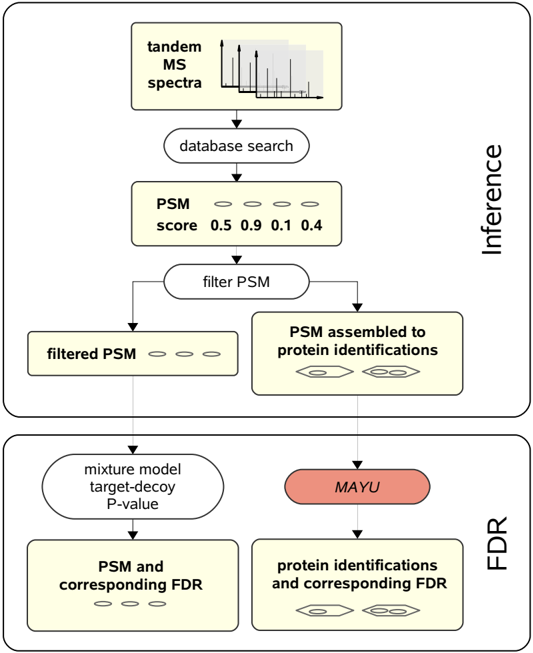
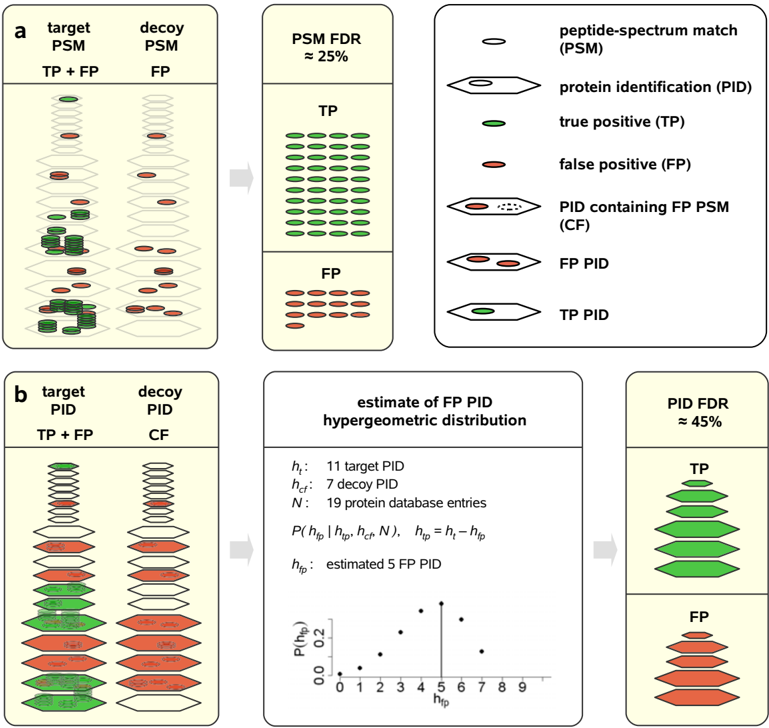
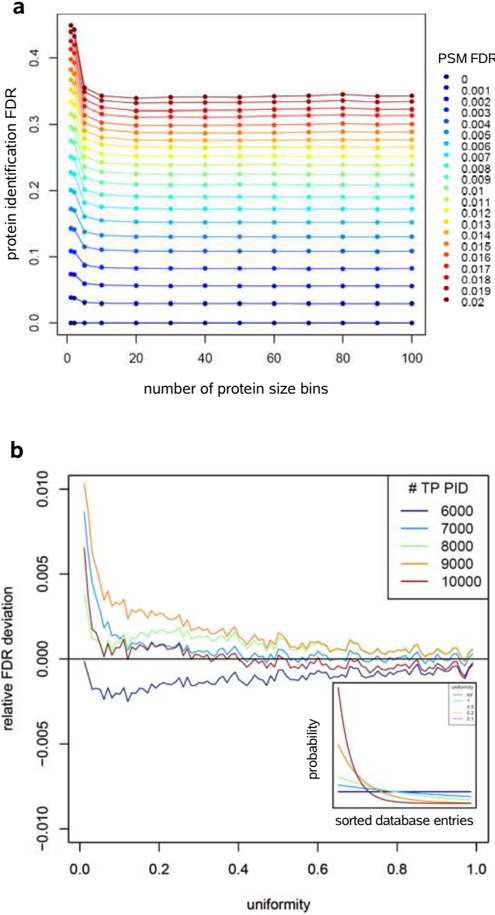
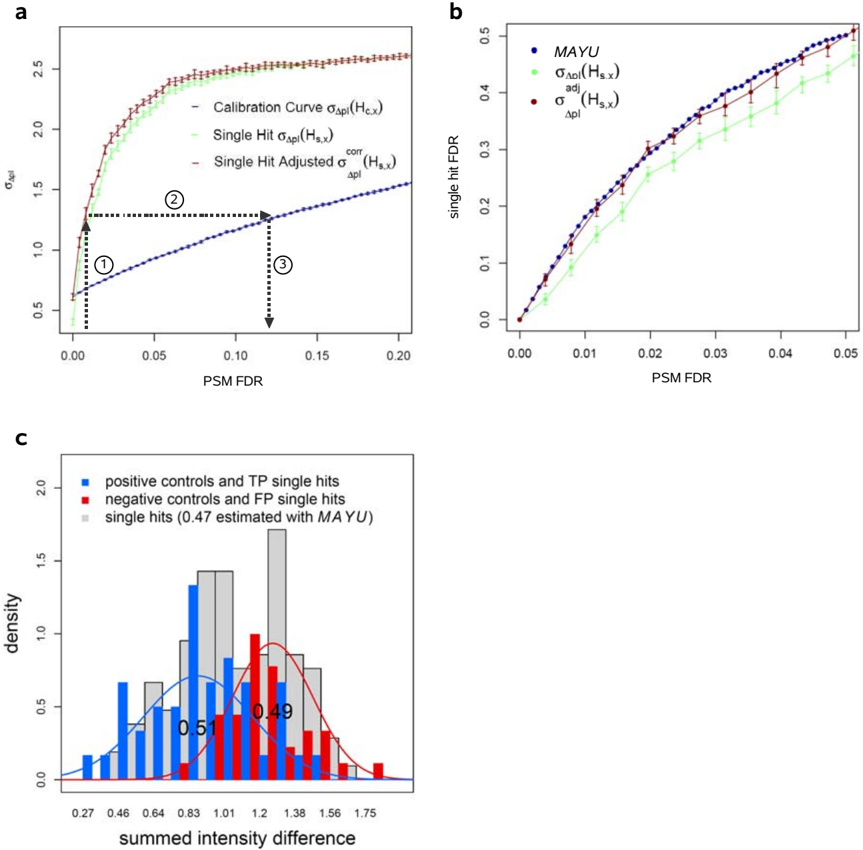
Comprehensive characterization of a proteome is a fundamental goal in proteomics. To achieve saturation coverage of a proteome or specific subproteome via tandem mass spectrometric identification of tryptic protein sample digests, proteomics data sets are growing dramatically in size and heterogeneity. The trend toward very large integrated data sets poses so far unsolved challenges to control the uncertainty of protein identifications going beyond well established confidence measures for peptide-spectrum matches. We present MAYU, a novel strategy that reliably estimates false discovery rates for protein identifications in large scale data sets. We validated and applied MAYU using various large proteomics data sets. The data show that the size of the data set has an important and previously underestimated impact on the reliability of protein identifications. We particularly found that protein false discovery rates are significantly elevated compared with those of peptide-spectrum matches. The function provided by MAYU is critical to control the quality of proteome data repositories and thereby to enhance any study relying on these data sources. The MAYU software is available as standalone software and also integrated into the Trans-Proteomic Pipeline.
Overview
The claims and statistics of this paper haven’t been checked yet.
Free: it reads the open-access text and checks the first 5 claims that cite a source we can check. Create a free account to check every claim.
Integrity signals
Registry
Cites
Statistics
Figures
Verification
Claims the paper makes
The claims and statistics of this paper haven’t been checked yet.
Free: it reads the open-access text and checks the first 5 claims that cite a source we can check. Create a free account to check every claim.
Claims other papers make about this one
Each is checked against this paper’s own text: does it say what the citing paper says it does?
In the citing paper
“To exclude the possibility of an inflated protein false discovery rate (FDR) due to error propagation from peptide to protein level inference, we used the Mayu software tool that determines the protein FDR in large data sets as a function of the peptide FDR (Reiter et al, 2009).”
From The quantitative proteome of a human cell line (2011) · cites this paper as Reiter et al, 2009
In the citing paper
“Protein FDRs have been estimated by the generalized target-decoy strategy Mayu (Reiter et al, 2009).”
From The quantitative proteome of a human cell line (2011) · cites this paper as Reiter et al, 2009
In the citing paper
“The accumulation of new peak groups steadily increased across the data set, indicating a likely accumulation of false positives and, highlighting the importance of appropriate global FDR control55, 56.”
From Multi-laboratory assessment of reproducibility, qualitative and quantitative performance of SWATH-mass spectrometry (2017) · cites this paper as [56]
Self-check
Percentages, sums and reported differences re-computed from the paper’s own numbers.
The self-check needs the paper’s full text.
Citations
Cites
Controlling the False Discovery Rate: A Practical and Powerful Approach to Multiple Testing
Benjamini, Y., & Hochberg, Y. (1995) · Journal of the Royal Statistical Society Series B: Statistical Methodology · doi:10.1111/j.2517-6161.1995.tb02031.x · Cited by 109,482
Mass spectrometry-based proteomics
Aebersold, R., & Mann, M. (2003) · Nature · doi:10.1038/nature01511 · Cited by 6,955 · cited 1×
“An explicit goal of proteomics is the complete description of a proteome and the measurement of its response to perturbations (Aebersold and Mann 2003).”
BackgroundSelf-citationEng, J. K., McCormack, A. L., & Yates, J. R. (1994) · Journal of the American Society for Mass Spectrometry · doi:10.1016/1044-0305(94)80016-2 · Cited by 6,484 · cited 2×
“We searched each data set against a composite target-decoy database using Turbo Sequest (Eng, McCormack et al. 1994) and Sequest on a Sorcerer machine (Sorcerer™-SEQUEST®, 3.10.4 release).”
MethodInfluentialKeller, A., Nesvizhskii, A. I., Kolker, E., & Aebersold, R. (2002) · Analytical Chemistry · doi:10.1021/ac025747h · Cited by 4,830
Self-citationA Statistical Model for Identifying Proteins by Tandem Mass Spectrometry
Nesvizhskii, A. I., Keller, A., Kolker, E., & Aebersold, R. (2003) · Analytical Chemistry · doi:10.1021/ac0341261 · Cited by 4,809 · cited 14×
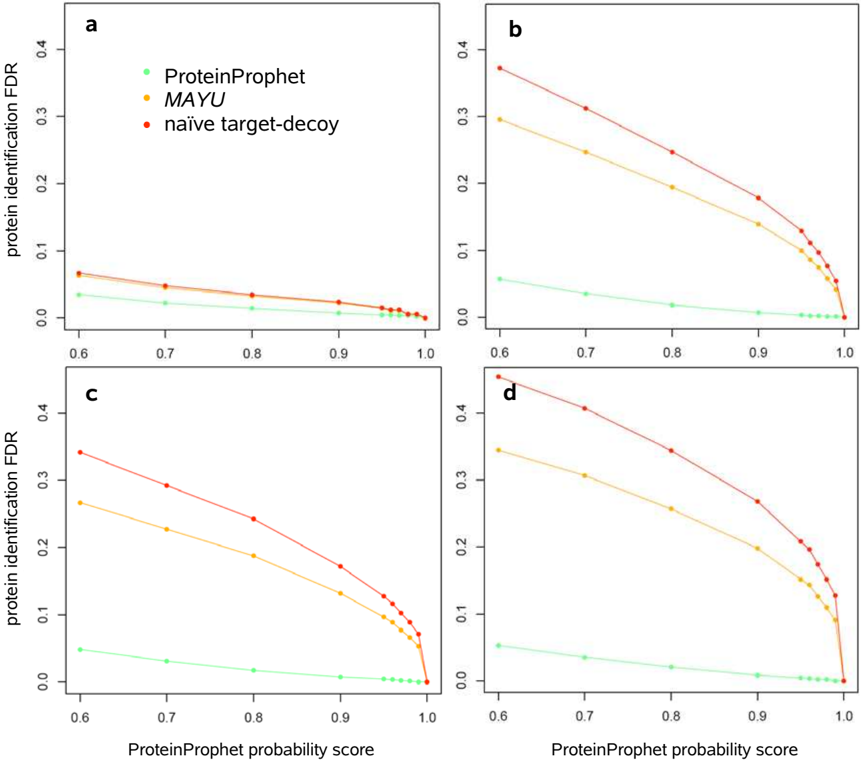
“Widely used protein inference tools like ProteinProphet (24) have proven to yield reliable error estimates on data sets at the experiment level (typically 10–50 LC-MS/MS runs) but fail to estimate an accurate protein identification FDR for large data sets (Fig.”
MethodInfluentialSelf-citationLarge-scale analysis of the yeast proteome by multidimensional protein identification technology
Washburn, M. P., Wolters, D., & Yates, J. R. (2001) · Nature Biotechnology · doi:10.1038/85686 · Cited by 4,752 · cited 1×
“at the protein identification level (2, 3, 7, 27, 28).”
BackgroundElias, J. E., & Gygi, S. P. (2007) · Nature Methods · doi:10.1038/nmeth1019 · Cited by 3,925 · cited 12×
“We performed all the database searches using a concatenated target-decoy database (Elias and Gygi 2007 Based on the well established assumption that false positive PSMs equally likely map to either target or decoy database, we used the number of PSMs mapping to the decoy database as an estimate for the number of false…”
BackgroundMethodInfluentialA Model for Random Sampling and Estimation of Relative Protein Abundance in Shotgun Proteomics
Liu, H., Sadygov, R. G., & Yates, J. R. (2004) · Analytical Chemistry · doi:10.1021/ac0498563 · Cited by 2,500 · cited 1×
“(41), and targeted proteomics approaches based on the”
BackgroundThe Bioperl Toolkit: Perl Modules for the Life Sciences
Stajich, J. E., Block, D., Boulez, K., Brenner, S. E., Chervitz, S. A., Dagdigian, C., Fuellen, G., Gilbert, J. G. R., Korf, I., Lapp, H., et al. (2002) · Genome Research · doi:10.1101/gr.361602 · Cited by 1,654 · cited 2×
“We used the standard deviatio n pI of isoelectric point deviations pI as a quality measure for a set H of PSMs, ( σ where pI pr (i) is the isoelectric point of a PSM i predicted by Bioperl (Stajich, Block et al. 2002). pI ex (i) corresponds to the experimentally measured isoelectric point of a PSM i, determined as the…”
BackgroundInfluentialPeng, J., Elias, J. E., Thoreen, C. C., Licklider, L. J., & Gygi, S. P. (2003) · Journal of Proteome Research · doi:10.1021/pr025556v · Cited by 1,647 · cited 2×
“Number, frequency and size and heterogeneity of proteomic data sets steadily increase (Washburn, Wolters et al. 2001; Peng, Elias et al. 2003; Omenn, States et al. 2005; Foster, de Hoog et al. 2006; King, Deutsch et al. 2006; Brunner, Ahrens et al. 2007; Baerenfaller, Grossmann et al. 2008; de…”
BackgroundInterpretation of Shotgun Proteomic Data
Nesvizhskii, A. I., & Aebersold, R. (2005) · Molecular & Cellular Proteomics · doi:10.1074/mcp.r500012-mcp200 · Cited by 1,025
Self-citationComprehensive mass-spectrometry-based proteome quantification of haploid versus diploid yeast
de Godoy, L. M. F., Olsen, J. V., Cox, J., Nielsen, M. L., Hubner, N. C., Fröhlich, F., Walther, T. C., & Mann, M. (2008) · Nature · doi:10.1038/nature07341 · Cited by 873 · cited 1×
“Protein Identification False Discovery Rates for”
Omenn, G. S., States, D. J., Adamski, M., Blackwell, T. W., Menon, R., Hermjakob, H., Apweiler, R., Haab, B. B., Simpson, R. J., Eddes, J. S., et al. (2005) · PROTEOMICS · doi:10.1002/pmic.200500358 · Cited by 787 · cited 2×
“Number, frequency and size and heterogeneity of proteomic data sets steadily increase (Washburn, Wolters et al. 2001; Peng, Elias et al. 2003; Omenn, States et al. 2005; Foster, de Hoog et al. 2006; King, Deutsch et al. 2006; Brunner, Ahrens et al. 2007; Baerenfaller, Grossmann et al. 2008; de…”
BackgroundSelf-citationComputational prediction of proteotypic peptides for quantitative proteomics
Mallick, P., Schirle, M., Chen, S. S., Flory, M. R., Lee, H., Martin, D., Ranish, J., Raught, B., Schmitt, R., Werner, T., et al. (2007) · Nature Biotechnology · doi:10.1038/nbt1275 · Cited by 695 · cited 1×
“those derived from low abundance proteins, are more difficult to detect, and a large number of fragment ion spectra have to be acquired to increase the likelihood of their detection (2, 13, 14).”
BackgroundSelf-citationOpen Source System for Analyzing, Validating, and Storing Protein Identification Data
Craig, R., Cortens, J. P., & Beavis, R. C. (2004) · Journal of Proteome Research · doi:10.1021/pr049882h · Cited by 694 · cited 1×
“Data repositories have been created to store the vast amount of mass spectrometric data (Craig, Cortens et al. 2004; Desiere, Deutsch et al. 2005; Martens, Hermjakob et al. 2005; King, Deutsch et al. 2006).”
BackgroundA uniform proteomics MS/MS analysis platform utilizing open XML file formats
Keller, A., Eng, J., Zhang, N., Li, X., & Aebersold, R. (2005) · Molecular Systems Biology · doi:10.1038/msb4100024 · Cited by 693
Self-citationA method for the comprehensive proteomic analysis of membrane proteins
Wu, C. C., MacCoss, M. J., Howell, K. E., & Yates, J. R. (2003) · Nature Biotechnology · doi:10.1038/nbt819 · Cited by 651 · cited 1×
“Protein Identification False Discovery Rates for”
Analysis and validation of proteomic data generated by tandem mass spectrometry
Nesvizhskii, A. I., Vitek, O., & Aebersold, R. (2007) · Nature Methods · doi:10.1038/nmeth1088 · Cited by 629 · cited 1×
“Tandem) (Nesvizhskii, Vitek et al. 2007).”
Self-citationAssigning Significance to Peptides Identified by Tandem Mass Spectrometry Using Decoy Databases
Käll, L., Storey, J. D., MacCoss, M. J., & Noble, W. S. (2008) · Journal of Proteome Research · doi:10.1021/pr700600n · Cited by 607 · cited 1×
“The approach extends the well established targetdecoy strategy designed to estimate FDR at the PSM level (17, 18) to the level of protein identifications, i.”
BackgroundPRIDE: The proteomics identifications database
Martens, L., Hermjakob, H., Jones, P., Adamski, M., Taylor, C., States, D., Gevaert, K., Vandekerckhove, J., & Apweiler, R. (2005) · PROTEOMICS · doi:10.1002/pmic.200401303 · Cited by 594 · cited 1×
“Data repositories have been created to store the vast amount of mass spectrometric data (Craig, Cortens et al. 2004; Desiere, Deutsch et al. 2005; Martens, Hermjakob et al. 2005; King, Deutsch et al. 2006).”
BackgroundA Mammalian Organelle Map by Protein Correlation Profiling
Foster, L. J., de Hoog, C. L., Zhang, Y., Zhang, Y., Xie, X., Mootha, V. K., & Mann, M. (2006) · Cell · doi:10.1016/j.cell.2006.03.022 · Cited by 576 · cited 1×
“at the protein identification level (2, 3, 7, 27, 28).”
BackgroundLam, H., Deutsch, E. W., Eddes, J. S., Eng, J. K., King, N., Stein, S. E., & Aebersold, R. (2007) · PROTEOMICS · doi:10.1002/pmic.200600625 · Cited by 517 · cited 1×
“…curated data repositories are a prerequisite of the success of applications like spectrum library searching (Stein 1995; Craig, Cortens et al. 2006; Lam, Deutsch et al. 2007), protein expression estimates by spectral counting (Liu, Sadygov et al. 2004) and targeted proteomics approaches based on…”
BackgroundSelf-citationGenome-Scale Proteomics Reveals Arabidopsis thaliana Gene Models and Proteome Dynamics
Baerenfaller, K., Grossmann, J., Grobei, M. A., Hull, R., Hirsch-Hoffmann, M., Yalovsky, S., Zimmermann, P., Grossniklaus, U., Gruissem, W., & Baginsky, S. (2008) · Science · doi:10.1126/science.1157956 · Cited by 484 · cited 3×
“…data sets steadily increase (Washburn, Wolters et al. 2001; Peng, Elias et al. 2003; Omenn, States et al. 2005; Foster, de Hoog et al. 2006; King, Deutsch et al. 2006; Brunner, Ahrens et al. 2007; Baerenfaller, Grossmann et al. 2008; de Godoy, Olsen et al. 2008; Schrimpf, Weiss et al. 2009).”
BackgroundQscore: An algorithm for evaluating SEQUEST database search results
Moore, R. E., Young, M. K., & Lee, T. D. (2002) · Journal of the American Society for Mass Spectrometry · doi:10.1016/s1044-0305(02)00352-5 · Cited by 390 · cited 1×
“Various approaches have been developed to estimate the reliability of PSMs (Keller, Nesvizhskii et al. 2002; Moore, Young et al. 2002; Elias and Gygi 2007; Kall, Storey et al. 2008).”
MethodProbability-Based Validation of Protein Identifications Using a Modified SEQUEST Algorithm
MacCoss, M. J., Wu, C. C., & Yates, J. R. (2002) · Analytical Chemistry · doi:10.1021/ac025826t · Cited by 377 · cited 1×
“…to good error estimates for individual experiments (typically 10-100 LC-MS/MS runs), the complexity level at which most proteomics studies operate (MacCoss, Wu et al. 2002; Nesvizhskii, Keller et al. 2003; Adamski, Blackwell et al. 2005; Weatherly, Astwood et al. 2005; Price, Lucitt et al. 2007).”
BackgroundScoring proteomes with proteotypic peptide probes
Kuster, B., Schirle, M., Mallick, P., & Aebersold, R. (2005) · Nature Reviews Molecular Cell Biology · doi:10.1038/nrm1683 · Cited by 364 · cited 1×
“selection of proteotypic peptides (42).”
Self-citationUsing Annotated Peptide Mass Spectrum Libraries for Protein Identification
Craig, R., Cortens, J. C., Fenyo, D., & Beavis, R. C. (2006) · Journal of Proteome Research · doi:10.1021/pr0602085 · Cited by 301 · cited 1×
“Well curated data repositories are a prerequisite of the success of applications like spectrum library searching (Stein 1995; Craig, Cortens et al. 2006; Lam, Deutsch et al. 2007), protein expression estimates by spectral counting (Liu, Sadygov et al. 2004) and targeted proteomics approaches based…”
BackgroundIntegration with the human genome of peptide sequences obtained by high-throughput mass spectrometry
Desiere, F., Deutsch, E. W., Nesvizhskii, A. I., Mallick, P., King, N. L., Eng, J. K., Aderem, A., Boyle, R., Brunner, E., Donohoe, S., et al. (2004) · Genome Biology · doi:10.1186/gb-2004-6-1-r9 · Cited by 291 · cited 2×
“The C. elegans project is part of the Center for Model Organism Proteomes (C-MOP) initiative (http://www.mop.unizh.ch/); the C. elegans proteome data are available on PeptideAtlas (http://www.peptideatlas.org/) (Desiere, Deutsch et al. 2005).”
BackgroundSelf-citationHilpert, K., Winkler, D. F., & Hancock, R. E. (2007) · Nature Protocols · doi:10.1038/nprot.2007.160 · Cited by 278 · cited 1×
“Validation of Single Hit FDR Using Synthetic Peptides—We generated three different sets of synthetic peptides synthesized on a microscale using the SPOT synthesis technology (33, 34).”
MethodA high-quality catalog of the Drosophila melanogaster proteome
Brunner, E., Ahrens, C. H., Mohanty, S., Baetschmann, H., Loevenich, S., Potthast, F., Deutsch, E. W., Panse, C., de Lichtenberg, U., Rinner, O., et al. (2007) · Nature Biotechnology · doi:10.1038/nbt1300 · Cited by 276 · cited 5×
“…been compiled according to heuristic criteria for which so far no quantitative confidence measures like FDR have been derived at the protein identification level (Washburn, Wolters et al. 2001; Wu, MacCoss et al. 2003; Chu, Liu et al. 2006; Foster, de Hoog et al. 2006; Brunner, Ahrens et al. 2007).”
BackgroundInfluentialSelf-citationComparative Functional Analysis of the Caenorhabditis elegans and Drosophila melanogaster Proteomes
Schrimpf, S. P., Weiss, M., Reiter, L., Ahrens, C. H., Jovanovic, M., Malmström, J., Brunner, E., Mohanty, S., Lercher, M. J., Hunziker, P. E., et al. (2009) · PLoS Biology · doi:10.1371/journal.pbio.1000048 · Cited by 229 · cited 3×
“All studies were based on multidimensional fractionation techniques and comprised samples from Caenorhabditis elegans (10), Leptospira interrogans, and Schizosaccharomyces pombe.”
BackgroundMethodInfluentialSelf-citationWeatherly, D. B., Atwood, J. A., Minning, T. A., Cavola, C., Tarleton, R. L., & Orlando, R. (2005) · Molecular & Cellular Proteomics · doi:10.1074/mcp.m400215-mcp200 · Cited by 210
Coherent membrane supports for parallel microsynthesis and screening of bioactive peptides
Wenschuh, H., Volkmer-Engert, R., Schmidt, M., Schulz, M., Schneider-Mergener, J., & Reineke, U. (2000) · Biopolymers · doi:10.1002/1097-0282(2000)55:3<188::aid-bip20>3.0.co;2-t · Cited by 203 · cited 1×
“Validation of Single Hit FDR Using Synthetic Peptides—We generated three different sets of synthetic peptides synthesized on a microscale using the SPOT synthesis technology (33, 34).”
MethodSperm chromatin proteomics identifies evolutionarily conserved fertility factors
Chu, D. S., Liu, H., Nix, P., Wu, T. F., Ralston, E. J., Yates III, J. R., & Meyer, B. J. (2006) · Nature · doi:10.1038/nature05050 · Cited by 193 · cited 1×
“at the protein identification level (2, 3, 7, 27, 28).”
BackgroundWhat does it mean to identify a protein in proteomics?
Rappsilber, J., & Mann, M. (2002) · Trends in Biochemical Sciences · doi:10.1016/s0968-0004(01)02021-7 · Cited by 183 · cited 1×
“Second, protein identifications are inferred from the PSMs by assembling the identified peptide sequences into proteins (Rappsilber and Mann 2002; Nesvizhskii and Aebersold 2005).”
BackgroundGrobei, M. A., Qeli, E., Brunner, E., Rehrauer, H., Zhang, R., Roschitzki, B., Basler, K., Ahrens, C. H., & Grossniklaus, U. (2009) · Genome Research · doi:10.1101/gr.089060.108 · Cited by 167 · cited 1×
“Other recent studies confirm this considerable error accumulation among single hits (11).”
ResultSchmidt, A., Gehlenborg, N., Bodenmiller, B., Mueller, L. N., Campbell, D., Mueller, M., Aebersold, R., & Domon, B. (2008) · Molecular & Cellular Proteomics · doi:10.1074/mcp.m700498-mcp200 · Cited by 140 · cited 1×
“For all 250 synthetic peptides an inclusion list was generated (35) and measured on an LTQ-FT instrument such that the precursors corresponding to the selected PSMs were targeted.”
MethodSelf-citationChemical substructure identification by mass spectral library searching
Stein, S. E. (1995) · Journal of the American Society for Mass Spectrometry · doi:10.1016/1044-0305(95)00291-k · Cited by 130 · cited 1×
“Well curated data repositories are a prerequisite of the success of applications like spectrum library searching (Stein 1995; Craig, Cortens et al. 2006; Lam, Deutsch et al. 2007), protein expression estimates by spectral counting (Liu, Sadygov et al. 2004) and targeted proteomics approaches based…”
BackgroundEriksson, J., & Fenyö, D. (2007) · Nature Biotechnology · doi:10.1038/nbt1315 · Cited by 74 · cited 2×
“…other subsets of peptides, e.g. those derived from low abundance proteins are more difficult to detect and a large number of fragment ion spectra have to be acquired to increase the likelihood of their detection (Brunner, Ahrens et al. 2007; Eriksson and Fenyo 2007; Mallick, Schirle et al. 2007).”
BackgroundAnalysis of the Saccharomyces cerevisiae proteome with PeptideAtlas
King, N. L., Deutsch, E. W., Ranish, J. A., Nesvizhskii, A. I., Eddes, J. S., Mallick, P., Eng, J., Desiere, F., Flory, M., Martin, D. B., et al. (2006) · Genome Biology · doi:10.1186/gb-2006-7-11-r106 · Cited by 65 · cited 3×
“…increase in proteome coverage (Washburn, Wolters et al. 2001; Peng, Elias et al. 2003; Omenn, States et al. 2005; Foster, de Hoog et al. 2006; King, Deutsch et al. 2006; Brunner, Ahrens et al. 2007; Baerenfaller, Grossmann et al. 2008; de Godoy, Olsen et al. 2008; Grobei, Qeli et al. 2009;…”
BackgroundSelf-citationEBP, a Program for Protein Identification Using Multiple Tandem Mass Spectrometry Datasets
Price, T. S., Lucitt, M. B., Wu, W., Austin, D. J., Pizarro, A., Yocum, A. K., Blair, I. A., FitzGerald, G. A., & Großer, T. (2006) · Molecular & Cellular Proteomics · doi:10.1074/mcp.t600049-mcp200 · Cited by 61 · cited 1×
“…to good error estimates for individual experiments (typically 10-100 LC-MS/MS runs), the complexity level at which most proteomics studies operate (MacCoss, Wu et al. 2002; Nesvizhskii, Keller et al. 2003; Adamski, Blackwell et al. 2005; Weatherly, Astwood et al. 2005; Price, Lucitt et al. 2007).”
BackgroundData management and preliminary data analysis in the pilot phase of the HUPO Plasma Proteome Project
Adamski, M., Blackwell, T. W., Menon, R., Martens, L., Hermjakob, H., Taylor, C. F., Omenn, G. S., & States, D. J. (2005) · PROTEOMICS · doi:10.1002/pmic.200500186 · Cited by 57 · cited 1×
“given the number of supporting PSMs (22).”
Computational prediction of proteotypic peptides
Blonder, J., & Veenstra, T. D. (2007) · Expert Review of Proteomics · doi:10.1586/14789450.4.3.351 · Cited by 12
Cited by
The MaxQuant computational platform for mass spectrometry-based shotgun proteomics
Tyanova, S., Temu, T., & Cox, J. (2016) · Nature Protocols · doi:10.1038/nprot.2016.136 · Cited by 4,797
“This is a very crucial step, because if search results for separate raw files are collected into one larger data set without any further higher-level FDR control, false-positive protein identifications will aggregate 42,43 .”
BackgroundMass-spectrometry-based draft of the human proteome
Wilhelm, M., Schlegl, J., Hahne, H., Gholami, A. M., Lieberenz, M., Savitski, M. M., Ziegler, E., Butzmann, L., Gessulat, S., Marx, H., et al. (2014) · Nature · doi:10.1038/nature13319 · Cited by 1,820
Protein Analysis by Shotgun/Bottom-up Proteomics
Zhang, Y., Fonslow, B. R., Shan, B., Baek, M.-C., & Yates, J. R. (2013) · Chemical Reviews · doi:10.1021/cr3003533 · Cited by 1,491
Bruderer, R., Bernhardt, O. M., Gandhi, T., Miladinović, S. M., Cheng, L.-Y., Messner, S., Ehrenberger, T., Zanotelli, V., Butscheid, Y., Escher, C., et al. (2015) · Molecular & Cellular Proteomics · doi:10.1074/mcp.m114.044305 · Cited by 1,238
“The FDR was controlled at protein level (37).”
BackgroundSelf-citationData‐independent acquisition‐based SWATH ‐ MS for quantitative proteomics: a tutorial
Ludwig, C., Gillet, L., Rosenberger, G., Amon, S., Collins, B. C., & Aebersold, R. (2018) · Molecular Systems Biology · doi:10.15252/msb.20178126 · Cited by 1,002
“If SWATH extraction results are summarized at the inferred protein level, the error rate can be further inflated by such false positives (Reiter et al , 2009; Rosen-berger et al , 2017a).”
Self-citation
Metadata
- Authors
- Reiter, L., Claassen, M., Schrimpf, S. P., Jovanovic, M., Schmidt, A., Buhmann, J. M., Hengartner, M. O., & Aebersold, R.
- Affiliations
- University of Zurich (CH)
- ETH Zurich (CH)
- Corresponding author
- Aebersold, Ruedi
- Venue
- Molecular & Cellular Proteomics
- Publisher
- Elsevier BV
- Published
- 2009-11
- Volume
- 8
- Issue
- 11
- Pages
- 2405-2417
- ISSN
- 1535-9476 (ISSN-L)
- PMC
- PMC2773710
- OpenAlex
- W2129897014
- Cited by
- 312
- References
- 44
- Citations by year
- 2026: 7 · 2025: 3 · 2024: 6 · 2023: 7 · 2022: 14 · 2021: 18 · 2020: 18 · 2019: 20 · 2018: 26 · 2017: 24 · 2016: 25 · 2015: 33 · 2014: 11 · 2013: 25 · 2012: 28
- FWCI
- 10.59
- Type
- journal article
- Language
- en
- Open access
- hybrid
- doi.org
- Licence
- cc-by
- www.elsevier.com/tdm/userlicense/1.0/ (tdm)
- www.elsevier.com/legal/tdmrep-license (tdm)
- creativecommons.org/licenses/by/4.0/ (vor, 3972 d)
- Locations
- Molecular & Cellular Proteomics (publishedVersion, cc-by)
- Europe PMC (PubMed Central) (publishedVersion)
- PubMed Central (publishedVersion)
- PubMed (publishedVersion)
- Zurich Open Repository and Archive (University of Zurich) (acceptedVersion, other-oa)
- Zurich Open Repository and Archive (University of Zurich) (submittedVersion, other-oa)
- Zurich Open Repository and Archive (University of Zurich)
- Funders
- National Science Foundation
- Schweizerischer Nationalfonds zur Förderung der Wissenschaftlichen Forschung (10767)
- Universität Zürich
- SystemsX.ch
- National Institutes of Health (n01hv028179-000)
- Functional Genomics Center Zurich
- National Heart, Lung, and Blood Institute (N01 HV028179, N01-HV-28179)
- Topics
- Physical Sciences › Chemistry › Spectroscopy › Advanced Proteomics Techniques and Applications
- Life Sciences › Biochemistry, Genetics and Molecular Biology › Molecular Biology › Bioinformatics and Genomic Networks
- Physical Sciences › Chemistry › Spectroscopy › Mass Spectrometry Techniques and Applications
- Keywords
- protein identification, false discovery rate, tandem mass spectrometry, peptide-spectrum matches, proteome coverage
- MeSH terms
- Algorithms, Animals, False Positive Reactions, Leptospira, Peptides, Schizosaccharomyces, Reproducibility of Results, Models, Statistical, Caenorhabditis elegans, Computational Biology, Proteome, Databases, Protein, Proteomics, Tandem Mass Spectrometry
About these checks
Registry, retraction, Cites and statistics results are computed, not judged, with one exception: a printed reference that no index lists is read once by a model before it counts as a citation error. Claims are extracted by a model and kept only when their quote appears verbatim in the text; each cited source is then checked, with a model’s help, for whether it says what the claim relies on. Those verdicts can be wrong — read the claim’s quote and the cited source before relying on one.
Statistics and arithmetic are recomputed, not judged.
Confidence bands are shown only for fields calibrated on our annotated test set. None is calibrated yet, so no band is shown.
What counts as a claim ›How we measure confidence ›How we check this ›
Are you an author, or do you see a problem with this page? Request a review
Data sources
Bibliographic data: Semantic Scholar, OpenAlex, Crossref.
Contains information from the Semantic Scholar Academic Graph Datasets, made available under the ODC Attribution License (ODC-BY 1.0).
Semantic Scholar’s data is described in: Kinney, R., et al. (2023). The Semantic Scholar Open Data Platform. arXiv:2301.10140.
