

The DOI matches its Crossref record; 50 of the 50 references it cites were found in a registry or an index.
Predicting Academic Misconduct Intentions and Behavior Using the Theory of Planned Behavior and Personality
Open accessAbstract
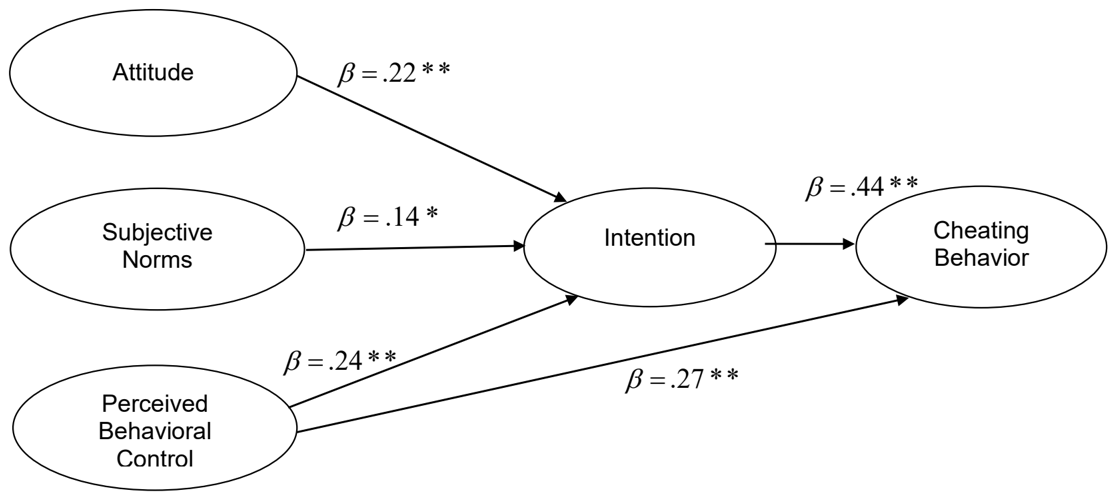
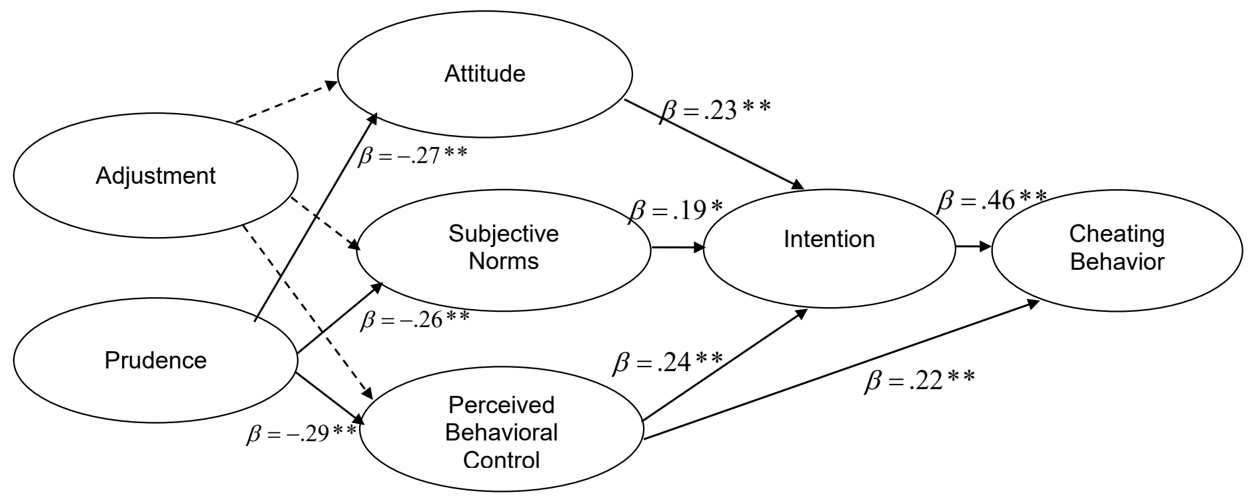
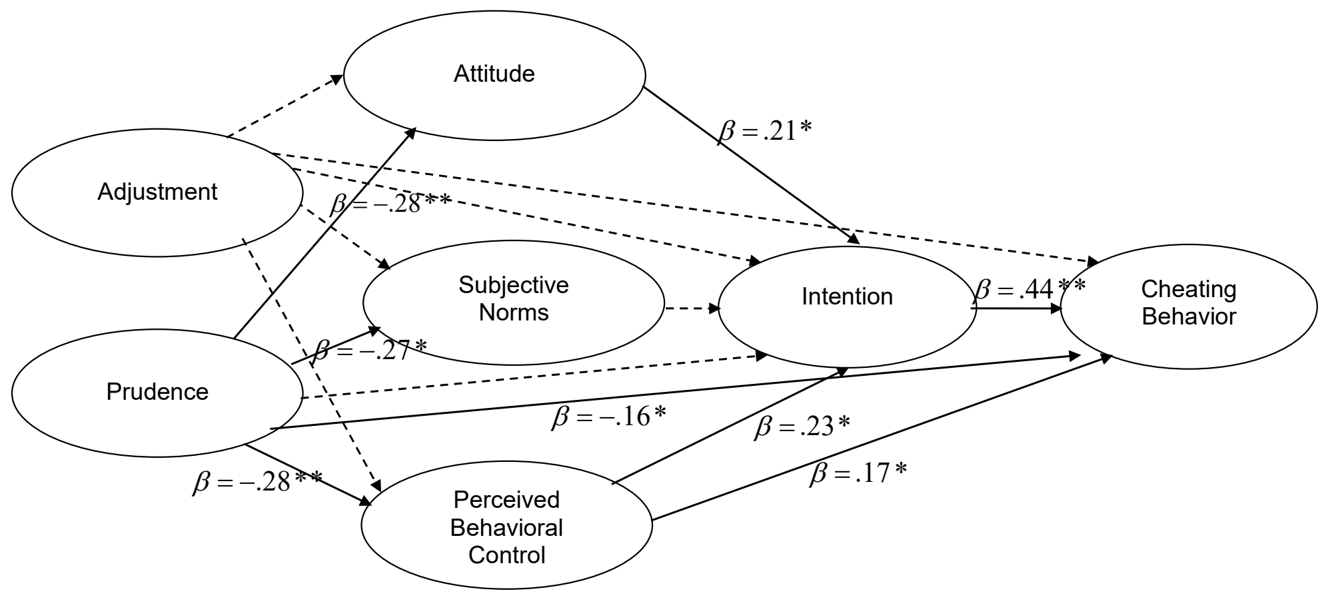
The efficacy of Azjen's (1985, 1991) Theory of Planned Behavior (TPB) for the prediction of cheating intentions and behaviors was examined in a sample of 241 business undergraduates. Mediated structural equation models of the TPB, with personality constructs, adjustment, and prudence, as antecedents were examined. The TPB model explained 21% of the variance in cheating intentions and 36% of cheating behavior. Results support both the TPB model and a partially mediated model in which prudence, but not adjustment, is significantly related to model components, attitudes, norms, control, and behavior but not intention to cheat. These results suggest that the TPB model may parsimoniously integrate and advance academic misconduct research. Further TPB research and practical implications are discussed.
Overview
The claims and statistics of this paper haven’t been checked yet.
Run the check — free, no account needed. It reads the open-access text and checks the sources it cites.
Integrity signals
Registry
Cites
Statistics
Figures
Verification
Claims the paper makes
The claims and statistics of this paper haven’t been checked yet.
Run the check — free, no account needed. It reads the open-access text and checks the sources it cites.
Claims other papers make about this one
Each is checked against this paper’s own text: does it say what the citing paper says it does?
In the citing paper
“Research indicates that attitudes significantly influence the intention to engage in or avoid academic misconduct.”
From Addressing student non-compliance in AI use declarations: implications for academic integrity and assessment in higher education (2025) · cites this paper as Stone, Jawahar, and Kisamore 2010
Self-check
Percentages, sums and reported differences re-computed from the paper’s own numbers.
The self-check needs the paper’s full text.
Citations
Cites
The theory of planned behavior
Ajzen, I. (1991) · Organizational Behavior and Human Decision Processes · doi:10.1016/0749-5978(91)90020-t · Cited by 90,587
Structural equation modeling in practice: A review and recommended two-step approach
Anderson, J. C., & Gerbing, D. W. (1988) · Psychological Bulletin · doi:10.1037/0033-2909.103.3.411 · Cited by 41,941
(1975) · PhilPapers (PhilPapers Foundation) · Cited by 36,737
(1980) · Medical Entomology and Zoology · Cited by 25,810
Generalized expectancies for internal versus external control of reinforcement.
Rotter, J. B. (1966) · Psychological Monographs: General and Applied · doi:10.1037/h0092976 · Cited by 21,937
From Intentions to Actions: A Theory of Planned Behavior
Ajzen, I. (1985) · Action Control · doi:10.1007/978-3-642-69746-3_2 · Cited by 19,057
Gottfredson, M. R., & Hirschi, T. (1990) · doi:10.1515/9781503621794 · Cited by 10,127
Efficacy of the Theory of Planned Behaviour: A meta‐analytic review
Armitage, C. J., & Conner, M. (2001) · British Journal of Social Psychology · doi:10.1348/014466601164939 · Cited by 9,970
(1993) · Medical Entomology and Zoology · Cited by 7,690
Perceived Behavioral Control, Self‐Efficacy, Locus of Control, and the Theory of Planned Behavior 1
Ajzen, I. (2002) · Journal of Applied Social Psychology · doi:10.1111/j.1559-1816.2002.tb00236.x · Cited by 7,629
Research works printed but not linked: 9
- Aizen I., 2009, TPB bibliography
- 10.1207/S15324834BASP2104_4 · DOI
- Barringer J. M., 2005, Hesperia, 74, 211, 10.2972/hesp.74.2.211 · DOI
- Hogan R., 1995, Hogan Personality Inventory Manual
- 10.1037/0022-0663.78.3.230 · DOI
- Joreskog K. G., 1982, Systems under indirect observation: Causality, structure, and prediction, 263
- 2006, The ethics of American youth
- McCabe D. L., 2005, Promoting academic integrity in business schools
- Stone T. H., 2007, Proceedings of the 2007 Management Education Division of the Administrative Sciences Association of Canada
Cited by
Sorted by citations
Items 101–197 of 197
Cultivating Academic Integrity in a Digital Learning Environment
Akin, I., & Johnson, E. (2018) · International Journal for Digital Society · doi:10.20533/ijds.2040.2570.2018.0167 · Cited by 6
TARGETS FOR HONESTY: HOW PERFORMANCE INDICATORS SHAPE INTEGRITY IN DUTCH HIGHER EDUCATION
Overman, S., Akkerman, A., & Torenvlied, R. (2016) · Public Administration · doi:10.1111/padm.12282 · Cited by 6
Assessing IT Students’ Intentions to Commit Unethical Actions
Aasheim, C. L., Kaleta, J. P., & Rutner, P. (2019) · Journal of Computer Information Systems · doi:10.1080/08874417.2019.1584544 · Cited by 6
Bissessar, C. S. (2025) · Equity in Education & Society · doi:10.1177/27526461251326919 · Cited by 5
Lehmann, C. S., & Gorsuch, R. L. (2016) · Psychology of Religion and Spirituality · doi:10.1037/rel0000110 · Cited by 5
Cheating, Pluralistic Ignorance, and the Theory of Normative Social Behavior
Henningsen, M. L. M., & Henningsen, D. D. (2019) · Southern Communication Journal · doi:10.1080/1041794x.2019.1678195 · Cited by 5
Firman, F., Anra, Y., Pratama, R., & Tersta, F. W. (2021) · Spektrum Jurnal Pendidikan Luar Sekolah (PLS) · doi:10.24036/spektrumpls.v9i4.114281 · Cited by 5
Salehi, L., & Ghasemzadeh, M. (2018) · Journal of Medical Education Development · doi:10.29252/edcj.11.31.52 · Cited by 5
It's Bad but It's Good: An Exploration of AI Cheating on Higher Educational Students Perspectives
Sholikhah, Z., Pramuka, B. A., Adawiyah, W. R., Yanuar, I., Respati, Y. A., & Pramuka, M. F. (2024) · 2024 IEEE Technology & Engineering Management Conference - Asia Pacific (TEMSCON-ASPAC) · doi:10.1109/temscon-aspac62480.2024.11024673 · Cited by 4
Testing a Psychological Model of Post-Pandemic Academic Cheating
Johnson-Clements, T. P., Curtis, G. J., & Clare, J. (2024) · Journal of Academic Ethics · doi:10.1007/s10805-024-09561-4 · Cited by 4
Deeb, H., Vrij, A., Leal, S., Verigin, B. L., & Kleinman, S. M. (2020) · Legal and Criminological Psychology · doi:10.1111/lcrp.12171 · Cited by 4
Integrity of nursing students in Israel: An exploratory study
Kay, A., Polin, B. A., & Sadeh, S. (2022) · Nurse Education in Practice · doi:10.1016/j.nepr.2022.103446 · Cited by 7
Capitalising on Emotions and Emotional Regulation: Five Strategies to Improve Academic Integrity
Tatum, H. E., & Curtis, G. J. (2023) · Ethics and integrity in educational contexts · doi:10.1007/978-3-031-43292-7_5 · Cited by 4
Dishonest Academic Conduct: From the Perspective of the Utility Function
Sun, Y., & Tian, R. (2015) · Accountability in Research · doi:10.1080/08989621.2015.1096206 · Cited by 4
Fichten, C. S., Amsel, R., Jorgensen, M., Nguyen, M. N., Budd, J., Havel, A., King, L. H., Jorgensen, S., & Asuncion, J. V. (2016) · eScholarship@McGill (McGill) · Cited by 4
Perilaku menabung rumah tangga di program pembinaan kesejahteraan keluarga berbasis minat
Nindya, B. U., & Supramono, S. (2018) · Jurnal Ekonomi dan Bisnis · doi:10.24914/jeb.v21i1.1580 · Cited by 4
The Challenge of Academic Integrity in the Age of Generative Artificial Intelligence
Huang, C., Alhur, A. A., Azam, M., & Naeem, S. B. (2025) · Libri · doi:10.1515/libri-2025-0024 · Cited by 11
THE STUDENT EVALUATION OF TEACHING: LET’S BE HONEST – WHO IS TELLING THE TRUTH?
Cox, S. R., Rickard, M. K., & Lowery, C. M. (2021) · Marketing Education Review · doi:10.1080/10528008.2021.1922924 · Cited by 3
Prince, M., & Wang, E. (2024) · Journal of Further and Higher Education · doi:10.1080/0309877x.2024.2375307 · Cited by 5
The theory of planned behavior and its applicability in research
Příhodová, T., & Preiss, M. (2020) · Psychologie a její kontexty (Psychology & Its Contexts) · doi:10.15452/psyx.2019.10.0003 · Cited by 3
Subjective Norms and Academic Dishonesty: A Decision Tree Algorithm Analysis
Dewanti, P. W., Purnama, I. A., SUKIRNO, S., & Parthasarathy, K. (2021) · JOIV International Journal on Informatics Visualization · doi:10.30630/joiv.5.1.423 · Cited by 4
Factors influencing intention to plagiarize among nursing students in the Philippines
Debuque, M. B. G., Dofitas, J. B. A., Espia, D. A. P. P., Ferrariz, T. C. R., Gargarita, F. J. P., & Oducado, R. M. (2023) · Belitung Nursing Journal · doi:10.33546/bnj.2555 · Cited by 3
Synopsis on Cyberethics Behaviour: A Literature Review
Aderibigbe, N. A. (2021) · Inkanyiso · doi:10.4102/ink.v13i2.8 · Cited by 4
The Experimental Effects of a Student Whistleblower Policy on Reporting Classmate Misconduct
DeZoort, F. T. (2023) · Issues in Accounting Education · doi:10.2308/issues-2021-062 · Cited by 5
Huang, C. L., Ling, C., & Yang, S. C. (2023) · European Journal of Psychology of Education · doi:10.1007/s10212-023-00776-4 · Cited by 3
Conflicts between academic misconduct and University honor codes: implications for ethical behavior
Okolo, E., Appiah, I., & Wingenbach, G. (2025) · International Journal for Educational Integrity · doi:10.1007/s40979-025-00198-3 · Cited by 3
STUDI PERILAKU KETIDAKJUJURAN AKADEMIK MAHASISWA AKUNTANSI ERA PANDEMI COVID19 DI BANDAR LAMPUNG
Sarumpaet, S. (2022) · Jurnal Akuntansi dan Keuangan · doi:10.23960/jak.v27i2.598 · Cited by 3
The Contemporary Plagiarist: The Roles of Technology and Moral Development
Roberts, J. A., & Wasieleski, D. M. (2011) · Journal of the Association for Information Systems · Cited by 3
The Effect of SNS Use on the Social Network: Moderating Effect of the Gender
Han, S., Choi, M.-H., Park, M., & Lee, H. (2013) · Journal of the Korean Society for information Management · doi:10.3743/kosim.2013.30.3.133 · Cited by 3
IS ACADEMIC DISHONESTY RELATED TO ACADEMIC PROCRASTINATION IN STUDENT COLLEGE?
dian, H., & Zamal, S. N. (2021) · Education Sustainability & Society · doi:10.26480/ess.02.2021.62.65 · Cited by 3
Why do Accounting Students at Higher Learning Institutions Conduct an Academic Dishonesty?
Mustikarini, A., Winardi, R. D., & Azalea, M. (2017) · SHS Web of Conferences · doi:10.1051/shsconf/20173406008 · Cited by 4
The Disparity of Racial Diversity in Counselor Education and Supervision
Webb, S. H. (2015) · ScholarWorks (Walden University) · Cited by 3
Taye, D., Semela, T., & Assefa, S. (2025) · F1000Research · doi:10.12688/f1000research.150357.3 · Cited by 4
Mungall, L. R., Fazaa, G. R., & Blais, J. (2025) · Psychological Reports · doi:10.1177/00332941251379435 · Cited by 3
Al-Thani, N. A., & Wright, S. (2026) · Journal of risk and financial management · doi:10.3390/jrfm19010033 · Cited by 3
Development and Measurement Validity of a Social Media Activity Instrument
Paul, J. A., & Cochran, J. D. (2020) · Communications of the Association for Information Systems · doi:10.17705/1cais.04703 · Cited by 2
Muqtadiroh, F. A., Prabowo, A. H., Tarigan, R. N., Purwitasari, D., Purnomo, M. H., & Subriadi, A. P. (2020) · IEEE International Conference on Engineering Technologies and Applied Sciences (ICETAS) · doi:10.1109/icetas51660.2020.9484264 · Cited by 2
Academic Integrity Scholarship: The Importance of Theory
Curtis, G. J., & Clare, J. (2023) · Springer eBooks · doi:10.1007/978-981-287-079-7_164-1 · Cited by 3
PENGARUH EFIKASI DIRI, TEMAN SEBAYA, DAN INTEGRITAS SISWA TERHADAP KECURANGAN AKADEMIK
Aurel, D. N., Fauzi, A., & Susanti, S. (2023) · Jurnal Riset Pendidikan dan Pengajaran · doi:10.55047/jrpp.v2i2.460 · Cited by 2
A structural equation model for cyber academic dishonesty in higher education: Evidence from Taiwan
Cheng, Y., Ho, W., Chang, S.-H., Yao, K., & Lo, C. (2023) · Accountability in Research · doi:10.1080/08989621.2023.2293955 · Cited by 2
Roy, B., Mazumdar, S., & Guha, B. (2024) · Global Business Review · doi:10.1177/09721509241263174 · Cited by 3
Academic Dishonesty Intentions in the Perspectives of Higher Education in Malaysia
Kassim, S. A., Nasir, N. F. M., Johari, N. R., & Razali, N. F. Y. (2019) · Springer eBooks · doi:10.1007/978-981-10-8730-1_20 · Cited by 2
Academic dishonesty based on religiosity among Muslim students in Indonesia
Herdian, H., & Mildaeni, I. N. (2022) · Cultura Educación y Sociedad · doi:10.17981/cultedusoc.13.1.2022.01 · Cited by 2
Kholid, M. N., Diptasary, F. A. A., & Tumewang, Y. K. (2021) · Jurnal Reviu Akuntansi dan Keuangan · doi:10.22219/jrak.v11i3.17689 · Cited by 2
Brophy, V. N. (2013) · Cornerstone (Minnesota State University, Mankato) · Cited by 2
Kam, C. C. S., Hue, M. T., Cheung, H. Y., & Risavy, S. D. (2018) · Current Psychology · doi:10.1007/s12144-018-9887-6 · Cited by 5
Matsebatlela, E. M., & Kuhudzai, A. G. (2018) · Alternation Interdisciplinary Journal for the Study of the Arts and Humanities in Southern Africa · doi:10.29086/2519-5476/2018/v25n2a8 · Cited by 2
EGO DEPLETION AND ACADEMIC DISHONESTY IN STUDENTS COLLEGE DURING PANDEMI COVID-19
Herdian, & Putri, N. D. S. N. (2022) · Education Innovation Diversity · doi:10.17770/eid2021.2.6715 · Cited by 2
Plagiarism Software is a Creator or Destroyer for Effective Writing
Subaveerapandiyan, A. (2022) · DESIDOC Journal of Library & Information Technology · doi:10.14429/djlit.42.2.17415 · Cited by 2
Do Students Follow the Wisdom or the Madness of Crowds?
Curtis, G. J. (2023) · Ethics and integrity in educational contexts · doi:10.1007/978-3-031-43292-7_1 · Cited by 2
Influence of Community Behaviour on Water Quality in Sekanak River, Palembang
Kospa, H. S. D., & Rahmadi (2019) · IOP Conference Series Earth and Environmental Science · doi:10.1088/1755-1315/306/1/012008 · Cited by 2
Delaying First Pregnancies: Canadian Women's Knowledge and Perception of the Consequences
Haynes, D. A. (2016) · ScholarWorks (Walden University) · Cited by 2
Nurlaela, N., Amiruddin, A., Irfan, A. M., & Setialaksana, W. (2024) · Information and Learning Sciences · doi:10.1108/ils-10-2023-0136 · Cited by 1
Taye, D., Semela, T., & Assefa, S. (2025) · F1000Research · doi:10.12688/f1000research.150357.4 · Cited by 1
Mirzaei-Alavijeh, M., Valadbeygi, S., Gharibnavaz, H., & Jalilian, F. (2025) · BMC Medical Ethics · doi:10.1186/s12910-025-01315-0 · Cited by 1
Liang, H., & Reiss, M. J. (2026) · BMC Psychology · doi:10.1186/s40359-026-04186-1 · Cited by 1
Baig, M., & Paparo, J. (2026) · Teaching in Higher Education · doi:10.1080/13562517.2026.2663440 · Cited by 2
Exploring Entrepreneurial Intention among University Students at Yarmouk University in Jordan
Melhem, Y. S., & Shaikh, F. N. A. (2018) · Jordan Journal of Business Administration · Cited by 1
Academic student fraud in longitudinal research design
Епанчинцева, Г. А., Zubova, L. V., Козловская, Т. Н., Volosova, N. Y., Lebedenko, A., & Bukaev, N. (2021) · Revista de la Universidad del Zulia · doi:10.46925//rdluz.35.19 · Cited by 1
Bantu, A. N., & Malik, N. S. (2022) · International Journal of Applied Business and Management Sciences · doi:10.47509/ijabms.2022.v03i01.04 · Cited by 1
The Effect of Internet-Based Psychoeducation on Decreasing Academic Cheating in High School Students
Muslimah, R. S., & Yudiarso, A. (2023) · Psikostudia Jurnal Psikologi · doi:10.30872/psikostudia.v12i2.9331 · Cited by 1
Academic Dishonesty on Students: What is the Role of Moral Integrity and Learning Climate?
Efendy, M., Kusumandari, R., Norhidayah, M. R., & Putri, E. N. A. (2023) · Journal of Educational Health and Community Psychology · doi:10.12928/jehcp.v12i4.27414 · Cited by 1
Cyberethical behaviour of high school students in selected schools in uMhlathuze Municipality
Buthelezi, N., Ocholla, D. N., & Luthuli, L. P. (2024) · Mousaion South African Journal of Information Studies · doi:10.25159/2663-659x/13249
Ahmed, I. S. Y., El-Kasim, M., & Mustapha, L. K. (2017) · Media Watch · doi:10.15655/mw/2017/v8i2/49010 · Cited by 1
Overt And Covert Retaliation Of Service Employees Against Customers Who Mistreat Them
Shepard, A. K. (2018) · Human Biology · Cited by 1
PENGARUH INSENTIF FINANSIAL, INSENTIF NONFINANSIAL, MOTIVASI KERJA TERHADAP KEPUASAN KERJA KARYAWAN
Gunawan, I., & Dewi, A. S. K. (2020) · E-Jurnal Manajemen Universitas Udayana · doi:10.24843/ejmunud.2020.v09.i11.p03 · Cited by 1
Parent and peer attachment to academic dishonesty in online learning during the COVID-19 pandemic
Herdian, Fatin, A. A., Grafiyana, G. A., & Wahidah, F. R. N. (2021) · DOAJ (DOAJ: Directory of Open Access Journals) · Cited by 1
Academic Integrity Scholarship: The Importance of Theory
Curtis, G. J., & Clare, J. (2023) · Springer eBooks · doi:10.1007/978-3-031-39989-3_164 · Cited by 1
Stakeholder-Centric Exploration of Health Insurance Subscription
Arkorful, V. E. (2021) · Springer eBooks · doi:10.1007/978-3-319-31816-5_4251-1 · Cited by 1
Expanding entrepreneurship education to boost students' innovation in South African universities.
Mtshali, T. W. (2024) · doi:10.29086/10413/22908 · Cited by 1
Behavioral Empowerment Determinants Artisanal Fishermen in East Kalimantan Indonesia
Rusmiyati, R. , Setyadi, D., & Mintarti, S. U. (2015) · European Journal of Business and Management
Parental Awareness and Attitudes toward Academic Dishonesty in a Suburban High School Setting
Sykes, M. (2010) · SUNY Digital Repository Support (State University of New York System)
Thaver, G. (2015) · Unisa Institutional Repository (University of South Africa)
Is WhItE-COllar CrImE a FOrm OF EntrEprEnEurshIp?
Técnica, F. (2013)
Unproctored Internet Testing in Personnel Selection: A Test of Cheating Deterrence Strategies
Eren, E. (2018) · Carleton University's Institutional Repository (MacOdrum Library, Carleton University) · doi:10.22215/etd/2018-12968
Plagiarism Intention Among Private University Students In Pahang
Rasli, M. A. M. (2020) · The European Proceedings of Social & Behavioural Sciences · doi:10.15405/epsbs.2020.12.05.40
Astuti, S. A., Lako, A., & Utami, M. S. S. (2021) · Journal of Southwest Jiaotong University · doi:10.35741/issn.0258-2724.56.5.18
زكی, ه. م., & سالم, ر. م. م. (2022) · مجلة کلية التربية · doi:10.21608/jfe.2022.249661
孙, 婷. (2022) · Advances in Psychology · doi:10.12677/ap.2022.128326
Stakeholder-Centric Exploration of Health Insurance Subscription
Arkorful, V. E. (2022) · Springer eBooks · doi:10.1007/978-3-030-66252-3_4251
Thabet, R. A., Masoed, E. S., Marzouk, S. A., & Saray, O. A. A. E.-F. A. (2019) · International Journal of Research in Paediatric Nursing · doi:10.33545/26641291.2019.v1.i2a.18
Impact of Dark Triad Personality Traits on Financial Misbehaviour
Boonroungrut, C., Muangkaew, K., Eiamnate, N., & Saroinsong, W. P. (2023) · Advances in psychology, mental health, and behavioral studies (APMHBS) book series · doi:10.4018/978-1-6684-7375-7.ch005
جعفر, أ. (2023) · مجلة کلية التربية جامعة طنطا · doi:10.21608/mkmgt.2024.251316.1672
Respati, Y. A., & Harsono, M. (2023) · EXCELLENT · doi:10.36587/exc.v10i2.1576
Anxiety and the Urge to Conform: Triggers of Academic Dishonesty in the Health Sciences
oktaviani, T. W., & Herdian, H. (2024) · International Journal of Social Science and Human Research · doi:10.47191/ijsshr/v7-i03-79
Личностные особенности студентов, прибегающих к академическому мошенничеству
Епанчинцева, Г. А., Козловская, Т. Н., & Тронь, О. С. (2024) · All-Russian Scientific and Practical Journal of Social and Humanitarian Research · doi:10.46741/sgjournal.2024.14.3.008
Phipps, D. J., Hannan, T. E., Vasandani, M., Keech, J. J., Green, H. J., & Hamilton, K. (2025) · Psychology Learning & Teaching · doi:10.1177/14757257251359742 · Cited by 1
Ávila-Toscano, J. H., & Veloza, J. J. F. G. (2025) · Revista Complutense de Educación · doi:10.5209/rced.96613
Student Perceptions of AI-Assisted Institutional Emails
Huynh, M. K., Tran-Pham, T. A., & Nguyễn, H. K. (2026) · Business and Professional Communication Quarterly · doi:10.1177/23294906261418213
Le, T. T. T., Ho, D., & Tran, H. (2026) · Research Square · doi:10.21203/rs.3.rs-8458923/v1
Trusted autonomy and academic integrity: a grounded theory of moral decision‑making in exams
Avci, O. (2026) · Ethics & Behavior · doi:10.1080/10508422.2026.2646859
Sardar, H., Azam, A., Azam, M., & Ramzan, M. (2026) · The Electronic Library · doi:10.1108/el-10-2025-0435
Sánchez‐García, J., Cebrián, J., del Río, E. F., & Ramos‐Villagrasa, P. J. (2026) · PLoS ONE · doi:10.1371/journal.pone.0346573
Sullivan, C. M., Mitchell, J., Boyd, J., & Cole, K. (2026) · Marketing Education Review · doi:10.1080/10528008.2026.2668672
Ojedeji, S. O. (2026) · Frontiers in Education · doi:10.3389/feduc.2026.1862601
Khlaif, Z. N., Hamamra, B. T., Farran, H. K., & Salama, N. (2026) · Journal of Academic Ethics · doi:10.1007/s10805-026-09768-7
Metadata
- Authors
- Stone, T. H., Jawahar, I. M., & Kisamore, J. L.
- Affiliations
- Oklahoma State University (US)
- Illinois State University (US)
- University of Oklahoma - Tulsa (US)
- Corresponding author
- Stone, Thomas H.
- Venue
- Basic and Applied Social Psychology
- Publisher
- Informa UK Limited
- Published
- 2010-02-23
- Volume
- 32
- Issue
- 1
- Pages
- 35-45
- ISSN
- 0197-3533 (ISSN-L)
- 1532-4834
- OpenAlex
- W1964988792
- Cited by
- 198
- References
- 50
- Citations by year
- 2026: 11 · 2025: 11 · 2024: 17 · 2023: 23 · 2022: 23 · 2021: 18 · 2020: 12 · 2019: 13 · 2018: 13 · 2017: 10 · 2016: 12 · 2015: 10 · 2014: 9 · 2013: 5 · 2012: 7
- FWCI
- 12.59
- Type
- journal article
- Language
- en
- Open access
- green
- hdl.handle.net
- Licence
- cc-by-nc
- Locations
- Basic and Applied Social Psychology (publishedVersion)
- SHAREOK (University of Oklahoma; Oklahoma State University; Central Oklahoma University) (submittedVersion, cc-by-nc)
- Topics
- Social Sciences › Education › Academic integrity and plagiarism
- Social Sciences › Psychology › Applied Psychology › Behavioral Health and Interventions
- Social Sciences › Business, Management and Accounting › Organizational Behavior and Human Resource Management › Ethics in Business and Education
- Keywords
- academic misconduct, cheating, theory of planned behavior, prudence, personality, adjustment, undergraduate business students, mediation, attitudes, social norms, perceived behavioral control
About these checks
Registry, retraction, Cites and statistics results are computed, not judged, with one exception: a printed reference that no index lists is read once by a model before it counts as a citation error. Claims are extracted by a model and kept only when their quote appears verbatim in the text; each cited source is then checked, with a model’s help, for whether it says what the claim relies on. Those verdicts can be wrong — read the claim’s quote and the cited source before relying on one.
Statistics and arithmetic are recomputed, not judged.
Confidence bands are shown only for fields calibrated on our annotated test set. None is calibrated yet, so no band is shown.
What counts as a claim ›How we measure confidence ›How we check this ›
Are you an author, or do you see a problem with this page? Request a review
