

The DOI matches its Crossref record; 50 of the 50 references it cites were found in a registry or an index.
Predicting Academic Misconduct Intentions and Behavior Using the Theory of Planned Behavior and Personality
Open accessAbstract
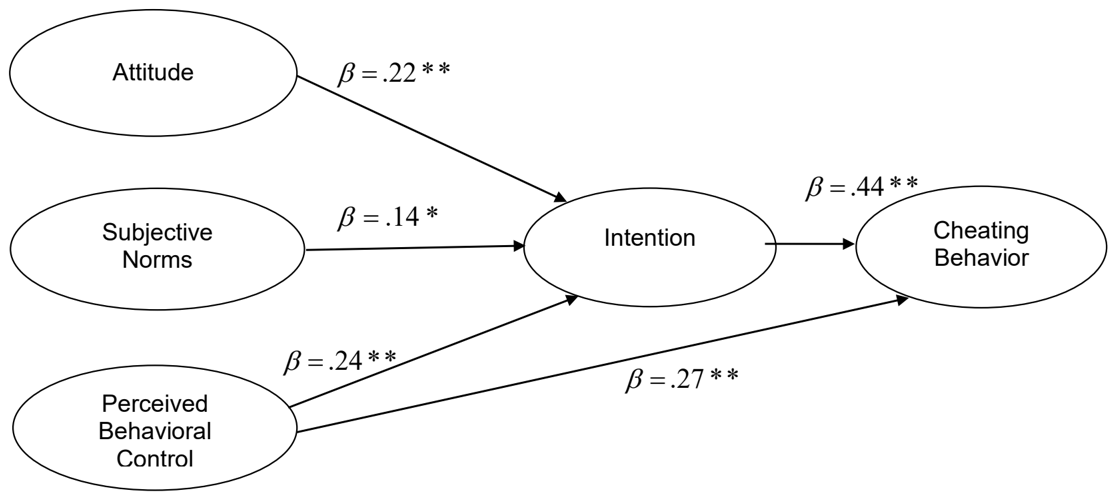
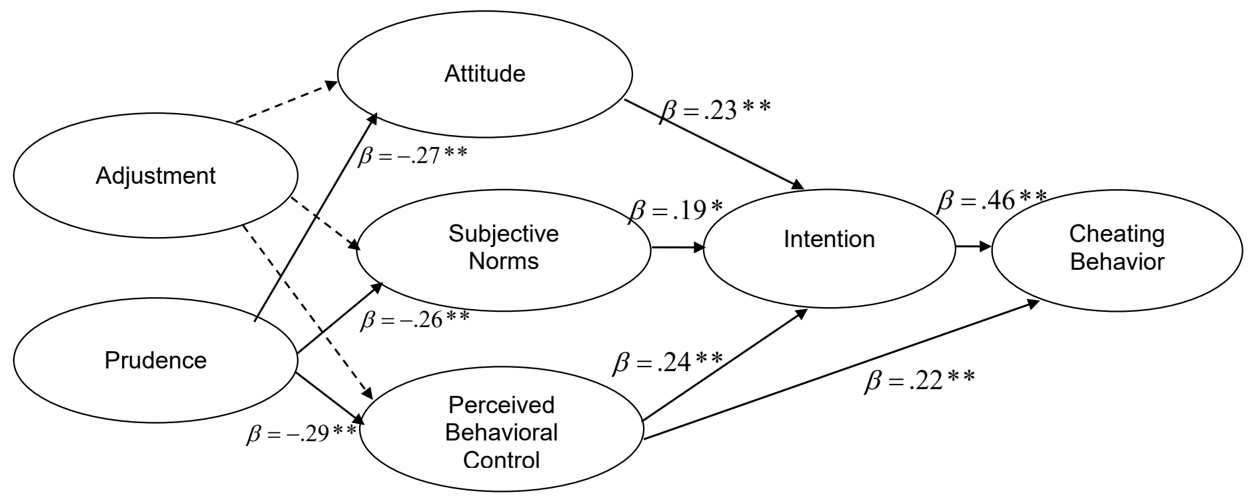
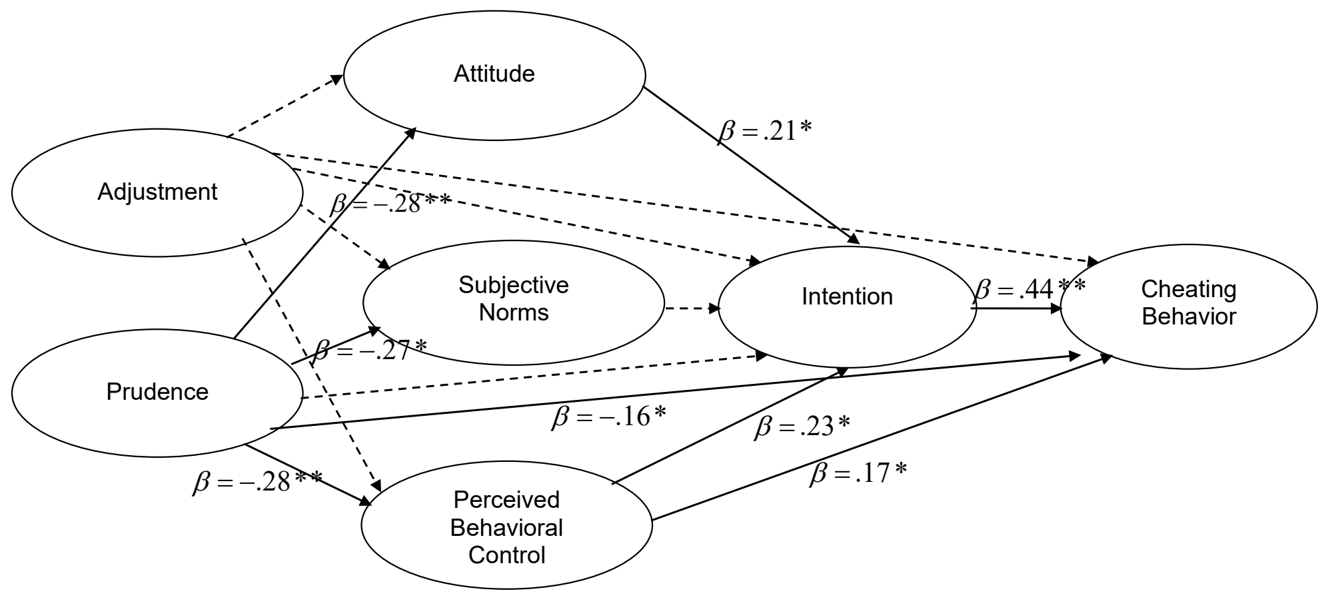
The efficacy of Azjen's (1985, 1991) Theory of Planned Behavior (TPB) for the prediction of cheating intentions and behaviors was examined in a sample of 241 business undergraduates. Mediated structural equation models of the TPB, with personality constructs, adjustment, and prudence, as antecedents were examined. The TPB model explained 21% of the variance in cheating intentions and 36% of cheating behavior. Results support both the TPB model and a partially mediated model in which prudence, but not adjustment, is significantly related to model components, attitudes, norms, control, and behavior but not intention to cheat. These results suggest that the TPB model may parsimoniously integrate and advance academic misconduct research. Further TPB research and practical implications are discussed.
Overview
The claims and statistics of this paper haven’t been checked yet.
Run the check — free, no account needed. It reads the open-access text and checks the sources it cites.
Integrity signals
Registry
Cites
Statistics
Figures
Verification
Claims the paper makes
The claims and statistics of this paper haven’t been checked yet.
Run the check — free, no account needed. It reads the open-access text and checks the sources it cites.
Claims other papers make about this one
Each is checked against this paper’s own text: does it say what the citing paper says it does?
In the citing paper
“Research indicates that attitudes significantly influence the intention to engage in or avoid academic misconduct.”
From Addressing student non-compliance in AI use declarations: implications for academic integrity and assessment in higher education (2025) · cites this paper as Stone, Jawahar, and Kisamore 2010
Self-check
Percentages, sums and reported differences re-computed from the paper’s own numbers.
The self-check needs the paper’s full text.
Citations
Cites
The theory of planned behavior
Ajzen, I. (1991) · Organizational Behavior and Human Decision Processes · doi:10.1016/0749-5978(91)90020-t · Cited by 90,587
Structural equation modeling in practice: A review and recommended two-step approach
Anderson, J. C., & Gerbing, D. W. (1988) · Psychological Bulletin · doi:10.1037/0033-2909.103.3.411 · Cited by 41,941
(1975) · PhilPapers (PhilPapers Foundation) · Cited by 36,737
(1980) · Medical Entomology and Zoology · Cited by 25,810
Generalized expectancies for internal versus external control of reinforcement.
Rotter, J. B. (1966) · Psychological Monographs: General and Applied · doi:10.1037/h0092976 · Cited by 21,937
From Intentions to Actions: A Theory of Planned Behavior
Ajzen, I. (1985) · Action Control · doi:10.1007/978-3-642-69746-3_2 · Cited by 19,057
Gottfredson, M. R., & Hirschi, T. (1990) · doi:10.1515/9781503621794 · Cited by 10,127
Efficacy of the Theory of Planned Behaviour: A meta‐analytic review
Armitage, C. J., & Conner, M. (2001) · British Journal of Social Psychology · doi:10.1348/014466601164939 · Cited by 9,970
(1993) · Medical Entomology and Zoology · Cited by 7,690
Perceived Behavioral Control, Self‐Efficacy, Locus of Control, and the Theory of Planned Behavior 1
Ajzen, I. (2002) · Journal of Applied Social Psychology · doi:10.1111/j.1559-1816.2002.tb00236.x · Cited by 7,629
Research works printed but not linked: 9
- Aizen I., 2009, TPB bibliography
- 10.1207/S15324834BASP2104_4 · DOI
- Barringer J. M., 2005, Hesperia, 74, 211, 10.2972/hesp.74.2.211 · DOI
- Hogan R., 1995, Hogan Personality Inventory Manual
- 10.1037/0022-0663.78.3.230 · DOI
- Joreskog K. G., 1982, Systems under indirect observation: Causality, structure, and prediction, 263
- 2006, The ethics of American youth
- McCabe D. L., 2005, Promoting academic integrity in business schools
- Stone T. H., 2007, Proceedings of the 2007 Management Education Division of the Administrative Sciences Association of Canada
Cited by
Sorted by citations
Big Five personality and academic dishonesty: A meta-analytic review
Giluk, T. L., & Postlethwaite, B. E. (2014) · Personality and Individual Differences · doi:10.1016/j.paid.2014.08.027 · Cited by 277
Cronan, T. P., Mullins, J. K., & Douglas, D. E. (2015) · Journal of Business Ethics · doi:10.1007/s10551-015-2988-3 · Cited by 177
Alam, M. Z., Kousar, S., & Rehman, C. A. (2019) · Journal of global entrepreneurship research · doi:10.1186/s40497-019-0175-1 · Cited by 160
Personality, attitude, and demographic correlates of academic dishonesty: A meta-analysis.
Lee, S. D., Kuncel, N. R., & Gau, J. (2020) · Psychological Bulletin · doi:10.1037/bul0000300 · Cited by 154
Gonsalves, C. (2025) · Assessment & Evaluation in Higher Education · doi:10.1080/02602938.2024.2415654 · Cited by 212
“For instance, Stone, Jawahar, and Kisamore (2010) show that attitudes towards academic dishonesty, such as cheating, directly impact students’ intentions to engage in such behaviours.”
Metadata
- Authors
- Stone, T. H., Jawahar, I. M., & Kisamore, J. L.
- Affiliations
- Oklahoma State University (US)
- Illinois State University (US)
- University of Oklahoma - Tulsa (US)
- Corresponding author
- Stone, Thomas H.
- Venue
- Basic and Applied Social Psychology
- Publisher
- Informa UK Limited
- Published
- 2010-02-23
- Volume
- 32
- Issue
- 1
- Pages
- 35-45
- ISSN
- 0197-3533 (ISSN-L)
- 1532-4834
- OpenAlex
- W1964988792
- Cited by
- 198
- References
- 50
- Citations by year
- 2026: 11 · 2025: 11 · 2024: 17 · 2023: 23 · 2022: 23 · 2021: 18 · 2020: 12 · 2019: 13 · 2018: 13 · 2017: 10 · 2016: 12 · 2015: 10 · 2014: 9 · 2013: 5 · 2012: 7
- FWCI
- 12.59
- Type
- journal article
- Language
- en
- Open access
- green
- hdl.handle.net
- Licence
- cc-by-nc
- Locations
- Basic and Applied Social Psychology (publishedVersion)
- SHAREOK (University of Oklahoma; Oklahoma State University; Central Oklahoma University) (submittedVersion, cc-by-nc)
- Topics
- Social Sciences › Education › Academic integrity and plagiarism
- Social Sciences › Psychology › Applied Psychology › Behavioral Health and Interventions
- Social Sciences › Business, Management and Accounting › Organizational Behavior and Human Resource Management › Ethics in Business and Education
- Keywords
- academic misconduct, cheating, theory of planned behavior, prudence, personality, adjustment, undergraduate business students, mediation, attitudes, social norms, perceived behavioral control
About these checks
Registry, retraction, Cites and statistics results are computed, not judged, with one exception: a printed reference that no index lists is read once by a model before it counts as a citation error. Claims are extracted by a model and kept only when their quote appears verbatim in the text; each cited source is then checked, with a model’s help, for whether it says what the claim relies on. Those verdicts can be wrong — read the claim’s quote and the cited source before relying on one.
Statistics and arithmetic are recomputed, not judged.
Confidence bands are shown only for fields calibrated on our annotated test set. None is calibrated yet, so no band is shown.
What counts as a claim ›How we measure confidence ›How we check this ›
Are you an author, or do you see a problem with this page? Request a review
